Blog

  • Thou Shall Not Confuse Franco Columbu with Thyself

    Thou Shall Not Confuse Franco Columbu with Thyself

    One sluggish afternoon at Canyon High, as Mrs. Hanson’s freshman English class shuffled into their desks and prepared to feign interest in Romeo and Juliet, I had something far more compelling on my desk: Pumping Iron. It was my sacred text, my adolescent scripture, filled with black-and-white photos of demi-gods flexing under the Californian sun. My favorite shot was of Mr. Universe Franco Columbu, hanging upside down from a chin-up bar like a bat carved from granite.

    Next to me sat Jill Swanson—tall, sleek, with the effortless grace of a swimmer and the smile of someone who had never sweated through a protein fart. I decided this was my moment. I turned the page toward her.
    “Hey,” I said, “check out this bodybuilder at the beach.”
    She leaned in. “Holy smokes, he’s huge.”
    I nodded solemnly. “That’s me.”
    She blinked. “What?”
    “That’s me. Can’t you tell?”
    Jill squinted at the photograph, studying the Herculean Italian upside down in all his vascular glory.
    “Oh my God,” she said slowly. “That’s you?”
    “Yep.”
    And just like that, I was Franco Columbu. I spun a whole mythology—how I’d been visiting my grandparents in L.A., hanging out with my “bodybuilding friends” in Venice, when a photographer captured me mid-workout.

    For five glorious minutes, I was a god among freshmen. Then, as Jill flipped back to her notes and I basked in the afterglow of deceit, the truth curdled in my gut. The lie that had inflated me like a balloon was already leaking air. By the time I got home, I felt hollow and cheap. I stared into the bathroom mirror, splashed cold water on my face, and summoned my inner monk.

    “Master Po,” I said, “why am I such a compulsive liar?”
    “Because, Grasshopper,” he replied, “you wish to appear strong because you are weak. True strength is not forged in muscle but in mastering your inner demons.”
    “I have only one?”
    “No,” he said, “but let’s start with the demon of inadequacy—the one that makes you trade truth for applause.”
    “How do I kill it?”
    “You don’t,” he said. “You chip away at it. Great acts are made of small deeds. Each honest act is a strike against the demon.”
    “But where do I start?”
    “Stop gazing at your reflection as though it’s a sculpture to be admired,” he said. “When you cease to worship yourself, you’ll stop fearing imperfection. The sage who puts himself last finds nourishment. You, Grasshopper, are still starving.”

    I looked at my reflection—small, soft, and decidedly un-Franco-like—and realized Master Po was right. The hardest muscle to build is the one that keeps you honest.

  • Thou Shalt Find Beauty in Freakishness—or Die Trying

    Thou Shalt Find Beauty in Freakishness—or Die Trying

    By high school, I had fully accepted that I was not designed for the mainstream assembly line. Master Po—the blind sage from Kung Fu—had become my imaginary spiritual adviser, reminding me that I was a misfit, “a brooding soul misaligned with this world.” I wore that label like a second skin. While the cool kids air-guitared to Aerosmith and Led Zeppelin, I was hypnotized by the twelve-minute prog-rock epics of Yes, King Crimson, The Strawbs, and Genesis—bands that required liner notes and a calculator to appreciate.

    Football was for the square-jawed; I preferred curling iron plates in the garage, sculpting myself into a protein-powered statue of misplaced purpose. Worse, I wasn’t just eccentric—I was evangelical. At parties, I arrived armed with Genesis LPs, a blender, and the self-righteous zeal of a macrobiotic missionary. While everyone else chugged beer, I lectured them on amino acid assimilation. “Beer tastes like horse piss!” I declared, mid-flex, clutching a protein shake like a chalice. Girls scattered like pigeons from a lawn sprinkler. “Come back!” I shouted after them. “I’m the only one here with abs!”

    Later, alone in my room, my biceps and I sulked together under the blue glow of my bedside lamp.
    “Master Po,” I sighed, “why am I such a freak?”
    “Because you throw banana peels in people’s path to keep them from getting close to you,” he said.
    “And why would I do that?”
    “To protect yourself.”
    “From what?”
    “Everyone is broken, Grasshopper—but you are cracked to the core. Yet remember: beauty can be found even in freakishness. If you don’t draw that beauty out, it will turn inward and destroy you.”
    “How so?”
    “Because if you keep throwing banana peels for others, you’ll eventually slip on them yourself.”
    I sighed. “I think it’s already happened.”

  • Breaking Up with the Protein Powder Industrial Complex

    Breaking Up with the Protein Powder Industrial Complex

    The deeper I dug into protein powders, the less convinced I became. What I’d been calling “nutrition” was really convenience dressed up in a plastic tub—processed, low in fiber, and shadowed by questions about heavy metals. So I scrapped the shortcuts. Instead, I built a rotation of four plant-based staples that quietly do the job: plain soy milk, pumpkin seeds, nutritional yeast, and hemp hearts.

    Now, my breakfast writes itself: oats or buckwheat groats folded with soy milk, pumpkin seeds, and hemp hearts—a meal that actually feels alive instead of engineered. For lunch and dinner, I toss the same mix with nutritional yeast into sautéed tofu, quinoa or millet, roasted sweet potatoes, and dark greens like broccoli or kale.

    Knowing exactly where my protein comes from—and how clean those sources are—has wiped out the low-grade anxiety that came with every scoop of powder. I’m no longer buying peace of mind from a supplement jar. I’ve reclaimed it in the kitchen, where real food and a decent spice rack make every meal something worth anticipating.

  • Your Tears Won’t Change the World

    Your Tears Won’t Change the World

    When I was thirteen, I decided the path to popularity ran straight through Soul Train. I spent months studying the dance troupe Captain Crunch and the Funky Bunch, who could pivot from the robotic precision of the Funky Robot to doing splits so fast you’d think they were animated. I practiced every night in front of my bedroom mirror until my limbs clicked like clockwork and my expression was as vacant as a mannequin’s. I was ready to unleash my Funky Robot at the Earl Warren Junior High dance.

    The playlist that night was pure chaos. Whoever the DJ was, he seemed to be drawing songs from a hat. “Free Bird” dragged like a eulogy, “Walk This Way” felt like cardiac arrest, and “Midnight at the Oasis” was exactly what it sounded like—a languid romp in the desert. But when Stevie Wonder’s “Living for the City” came on, I sprang into motion. My body jerked and popped with righteous purpose. I was a mechanical deity in Adidas, a human jukebox powered by insecurity.

    By some miracle of social physics, I ended up dancing all night with Cheryl Atkins—the prettiest girl there—because her boyfriend Rick hated to dance. While we funked and twirled under the mirrored ball, I noticed the misfits pressed against the gym walls like condemned prisoners. They’d ask for dances, get shot down, and limp back to their corner of despair. Watching them, I felt an unexpected pang—an ache sharper than any muscle burn.

    Meanwhile, the popular eighth-graders were perfecting a ritual called “getting wasted,” which apparently involved puking and maintaining high social standing at the same time. As a Junior Olympic weightlifter, I found this baffling. I could clean and jerk my body weight, but I couldn’t comprehend how vomiting could make you cool.

    By the end of the night, Cheryl and I won the dance contest. Vice Principal Gillis handed me a trophy, but instead of basking in my Funky Robot glory, I felt hollow. The faces of the wallflowers haunted me. That night, I dreamed of a beach where a giant elephant seal handed each lonely misfit a beautiful radio, and as they tuned it, they glowed and vanished into the horizon. I woke up certain of one thing: radios were holy.

    “Master Po,” I said, “the world is cruel. I can’t be happy knowing people like those misfits suffer.”
    “Spare me your tears, Grasshopper,” he said. “Sadness feels noble, but it’s an addiction. It comforts the ego while changing nothing.”
    “But what can I do?” I asked. “Darwin was right—the strong thrive, and the weak pay the price.”
    “Indeed,” he said. “And in case you haven’t noticed, you’re one of the weak. So tend your own garden, Grasshopper. The misfit must save himself before he can save the world.”

  • Care Less About Your Reflection–It’s Already Lying to You

    Care Less About Your Reflection–It’s Already Lying to You

    When I came back from Kenya and landed in the California hedonistic mecca of Earl Warren Junior High, I was less “student” and more “cultural oddity.” I joined the Olympic Weightlifting team and became pathologically devoted to squats—so much that I’d drop into deep-knee bends while the PE teacher took roll, earning myself the nickname “Squats,” which followed me like a bad tattoo. My ignorance of marijuana culture didn’t help. I thought a “doobie” was some industrial-sized cousin of a joint—like a weed burrito—and made the mistake of announcing this to the cool kids at lunch. The laughter was volcanic. Overnight, I went from “Squats” to “Narc,” a walking PSA in gym shorts.

    But my humiliation wasn’t complete until the day the snack bar opened and my friends bolted toward it for ice cream sandwiches. I stayed rooted in place, wallet empty, as a girl perched in a tree pointed at me and sang out, “Ha-ha, Jeff doesn’t have any money!” The shame hit me like the sting of the Portuguese Man o’ War that nearly killed me in Kenya.

    At home, sprawled on my bed, I consulted Master Po.
    “Grasshopper,” he said, “you must learn to accept disgrace with dignity. A self-image is a sword—sharpen it too much, and it snaps.”
    “Easy for you to say,” I muttered. “You never got laughed at for thinking a doobie was a family-size joint.”
    He continued, “If you care what others think, you become their prisoner.”
    “I just want respect,” I said.
    “When you stop chasing it,” he replied, “you’ll finally earn it.”

    That night, I resolved to rise above it all—to become a new man. Then I did fifty squats before bed.

  • Do Not Trust the Smile of the Sea

    Do Not Trust the Smile of the Sea

    When I was twelve, my family lived briefly in Nairobi, where my father worked for the Peace Corps. One school break, we headed to Mombasa, the coastal jewel of Kenya, where the Indian Ocean was as warm as bathwater and clear enough to read your reflection in. Leopard-spotted shells glimmered beneath the surface, and purple sea urchins decorated the shallows like jeweled land mines. I was a sunburned boy in blue terry-cloth trunks printed with white lilies—half Tarzan, half tourist—determined to conquer nature with curiosity alone.

    At low tide, I discovered sea cucumbers: bulbous, indecently soft things that looked like props from a B-movie. I picked one up and chased my younger brother along the beach, brandishing it like a medieval mace, laughing so hard I forgot to breathe. Then, mid-laughter, the ocean answered back. I fell into the shallow surf, and my back erupted in white-hot agony. My father sprinted toward me, wielding a stick like an exorcist, shouting that I’d been wrapped by a Portuguese Man o’ War. By the time he peeled the translucent tentacles off my skin, the jellyfish had already written its signature in fire across my spine.

    A local doctor, somber and leathery from the sun, told us a five-year-old boy had died from the same sting just a week earlier. He handed me pain medication and ordered a long, cold bath. As I soaked, trembling and pink, I asked Master Po why the most beautiful place I’d ever seen had tried to kill me.

    “Grasshopper,” he said, “Heaven and Earth show no mercy. You thought yourself Tarzan, but you are a fragile boy—a straw dog—easily crushed by nature’s indifference. Do not be deceived by beauty. It will destroy you.”

    “I’m not fooled,” I said, “but I still want to be close to it. Surfers in Santa Cruz watch their best friend get swallowed by a great white, and a year later they’re back in the same waves. Tomorrow my brother and I will be back in the Indian Ocean. Are we fools?”

    “Foolishness,” Master Po said, “is closing your eyes to the lesson and calling it courage. Tomorrow, you may return to the sea—but this time, you’ll keep your eyes open.”

  • The Wrap Is the Wet Handshake of Tortillas

    The Wrap Is the Wet Handshake of Tortillas

    The Wrap—the pretentious, joyless burrito alternative that slithered into American lunch culture during the 1990s—remains an enduring insult, both culinary and conceptual. It is not a burrito, a falafel, or even a respectable sandwich. Those are categories with histories, boundaries, and soul. The Wrap, by contrast, is the menu equivalent of a corporate mission statement—vague, overpromising, and spiritually empty.

    Marketed as healthy and progressive, it is in fact a sad slurry of “lite” mayonnaise, cold protein, and moral posturing, encased in a tortilla that resembles a damp résumé. The Wrap promises wellness but delivers wetness. Its cold, papery sheath—sometimes greenish with “spinach,” sometimes orangish with “tomato-basil”—cracks under the weight of its own self-importance.

    A burrito is proud, hot, and complete—a working-class symphony of beans, rice, and molten cheese, wrapped in a warm, elastic tortilla designed to survive both gravity and appetite. The Wrap is its sterile cousin, born not in the markets of Juárez but in a boardroom buffet in Palo Alto. One feeds the soul; the other lectures it.

    If the burrito is street poetry, the Wrap is PowerPoint. Burritos radiate grease-stained authenticity; wraps arrive pre-sliced at corporate retreats, accompanied by a motivational slogan.

    And yet, there is something eerily modern about the Wrap—its prefab perfection, its sanitized efficiency. It is the edible ancestor of AI: an algorithm of health and convenience, engineered to look human but taste like compromise. The Wrap, in short, is the uncanny valley of lunch—soulless, identical, and faintly threatening. I fear, as with AI, that it may someday evolve, learn to mimic pleasure, and finally take over the world, one sad office lunch at a time.

  • Honor Your Inner Light, But Don’t Forget to Open a Window

    Honor Your Inner Light, But Don’t Forget to Open a Window

    In the early seventies, when Kung Fu flickered across American televisions, my family and our Berkeley friends spent two weeks each summer at Berkeley Tuolumne Camp—a “rustic getaway” that was really just Yosemite-adjacent squalor with better lighting. We slept in glorified tents, shared public latrines, and dined communally on food that could have been mistaken for field rations. I liked to think of myself as a young Caine, the barefoot monk of Kung Fu, wandering the wilderness in contemplative solitude. Sadly, my Zen aspirations were constantly interrupted by counselors who mistook joy for a group activity.

    Every hour they corralled us for something: forced sing-alongs, talent shows, and “athletic contests” such as tug-of-war, which was neither athletic nor a contest so much as an exercise in rope burn. One counselor resembled Bernadette Peters in both hair and chaos. Another, a sun-bleached folk singer in patched jeans and a tunic, looked unsettlingly like a California Jesus. He roamed the camp with his guitar and a homemade theology he called the Divine Point System. Every act earned or lost “Jesus Points”: ten off for littering, fifteen on for picking up trash, thirty off for talking during the talent show. He doled out morality like a camp accountant for God.

    I privately dubbed him Berkeley Camp Jesus, and his system wormed its way into my psyche like a pious parasite. Soon I was mentally awarding and deducting points from myself all day long. Back home, I picked a plum from our tree, ate it, and flicked the pit into the neighbor’s yard. Immediately, I heard the voice: “Ten points deducted, you littered.” Then came my rebuttal: “No, you planted future nourishment for your neighbors—plus twenty.” Thus began my lifelong facility for creative moral bookkeeping—a skill that would serve me well in future ethical entanglements.

    That same summer, my real education came not from campfire sing-alongs but from a contraband paperback: Herman Raucher’s Summer of ’42. While my peers hiked and swam, I stayed inside my tent reading about Hermie’s torrid affair with a married woman. I’d already seen the movie with Jennifer O’Neill, so my imagination was well supplied. Nature, with all its pines and chirping insects, couldn’t compete with adolescent desire and literary scandal.

    When I finished the novel, I didn’t rejoin the living; I began my private religion: Dice Baseball. Armed with two dice, stat sheets, and a Panasonic tape recorder, I simulated entire baseball seasons—162 games of pure obsession. I played both teams, announced every pitch in my best Monte Moore voice, conducted post-game interviews as Reggie Jackson, Catfish Hunter, and myself, and recorded it all. My church was a canvas tent, my congregation a stack of baseball cards.

    One morning, my father—having eaten steak and eggs in the communal mess hall—entered the tent, surveyed my sanctuary, and decided I was going feral. “I didn’t bring you to the wilderness to sit inside all day,” he said. Then, in a gesture that still burns in my soul, he used my Bert ‘Campy’ Campaneris baseball card to floss steak gristle from his teeth. “Get out and play,” he ordered, leaving me spiritually shattered and morally cleansed.

    I trudged to the lake in silent protest and asked Master Po, my ever-patient inner guru, why I preferred solitude.

    “Solitude, Grasshopper,” he said, “is the forge of your Inner Light.”

    “So my father was wrong to kick me out?”

    “I did not say that. The Inner Light must be balanced by the Outer Radiance of the world. You cannot discover one without glimpsing the other. Your father was right to deliver what you call a ‘kick in the pants.’ Balance, Grasshopper. Always balance.”

    And so I learned the paradox of enlightenment: seek inner peace, but occasionally go outside before your father uses your baseball cards as dental tools.

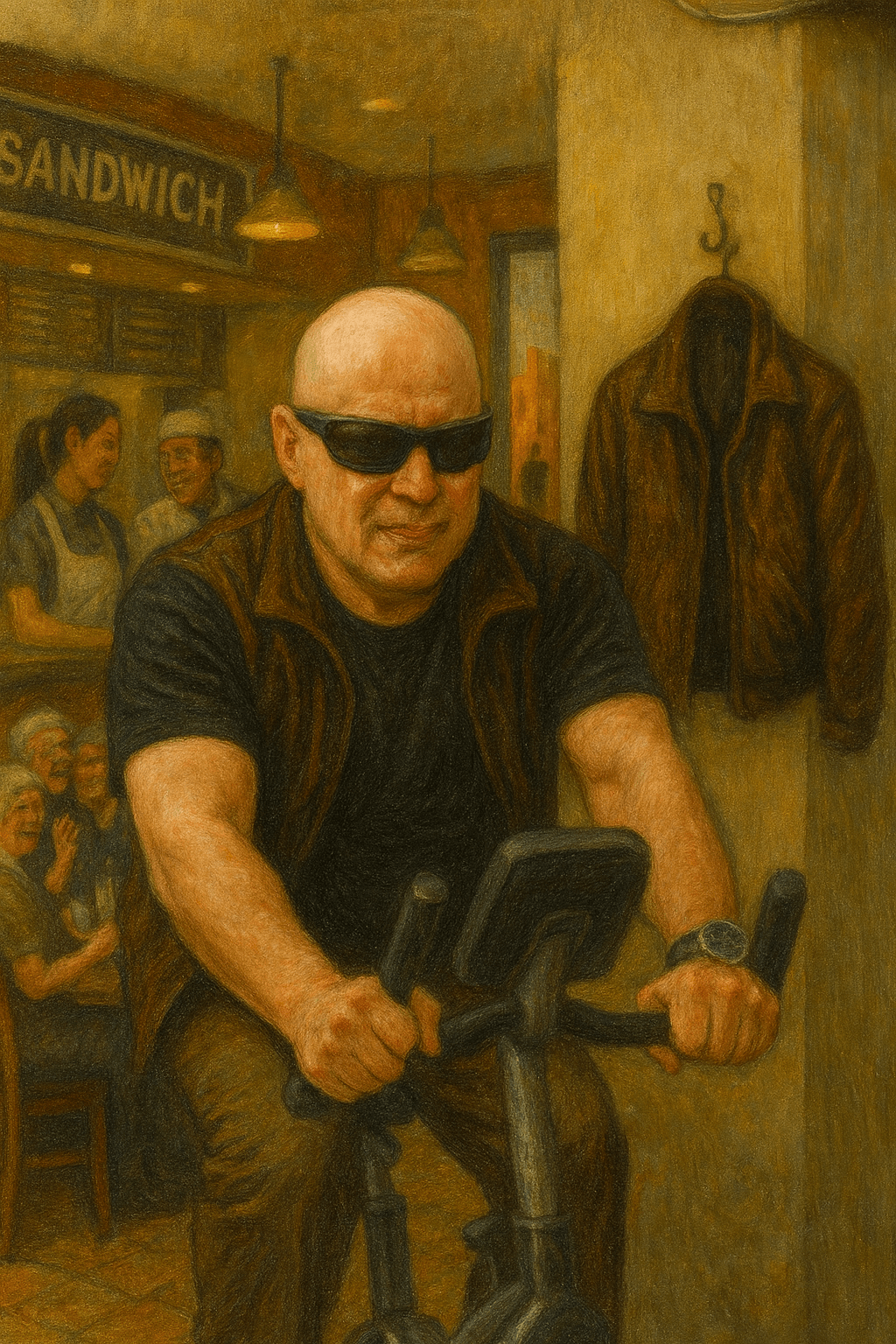
  • The Double-Minded Man on His Exercise Bike

    The Double-Minded Man on His Exercise Bike

    Thoughtful theists often find themselves backpedaling from the most odious doctrines of their faith until what remains is no longer recognizably orthodox. Some manage this theological detour while keeping their faith intact. Others slide further down the slope until their religion becomes something more universal, even Unitarian—a faith stripped of dogma and distilled to moral simplicity: love thy neighbor, serve the poor, practice charity, and call it good.

    Within Christianity, the spectrum is wide. On one end stand the infernalists of the Augustinian school, firm in their vision of eternal punishment. On the other are the universalists who, following Origen, imagine purgatory as a place of cleansing rather than damnation, with the possibility of post-mortem salvation. Some, like Martin Gardner and H. G. Wells, found orthodoxy itself to be a spiritual illness in William James’s sense—a sickness of the soul that required liberation. Others, like Dale Allison, hold to faith but jettison the Augustinian vision of perdition. And then there is philosopher Elizabeth Anderson, who takes orthodoxy at its word and concludes that if God authored it, He cannot be moral.

    As one nears death, it would be comforting to have these matters settled—to face eternity with the theological equivalent of a neatly tied bow. But such closure eludes those of us who remain agnostic, chastising ourselves as James’s “double-minded man, unstable in all his ways.”

    I do, however, possess a few fragments of certainty. I reject Rousseau’s sentimental fantasy that human nature is innately good and can serve as our moral compass. I’ve seen enough of humanity to know we are corrupt, self-deceiving creatures who must wrestle with our yetzer hara—our bad inclination, as Jewish tradition calls it. Yet I’m not entirely convinced, as Paul was, that we are hopelessly depraved. Perhaps Paul and I are lost causes, but that doesn’t make the condition universal. The Jewish notion of meeting God halfway—using the strength He gave us—differs sharply from Paul’s portrayal of helpless man collapsing before the mercy seat. One path is desperate; the other is disciplined.

    Whether I write these reflections out of genuine spiritual torment or simple procrastination before an hour on the exercise bike is unclear. Either way, I’ll mount the Schwinn Airdyne, pedal furiously, and try not to think too much about eternal damnation.

  • The Wizard of Kaiser

    The Wizard of Kaiser

    My daughter woke up with a monstrous eye stye that had slammed her eyelid shut like a faulty garage door. I called Kaiser and was immediately greeted by the robot lady—a voice engineered to sound calm while raising your blood pressure. She asked for my daughter’s birthdate and medical number, which I dutifully recited. Then, in her synthetic cheer, she said, “What else can I help you with?”

    I said, “You didn’t help me with anything, so don’t say ‘what else.’”

    We argued, man versus machine, until she promised to connect me to a human—but not before warning that the wait time could “exceed one hour.” One second later, a live representative picked up. Bureaucratic time, apparently, obeys no earthly laws.

    The human rep began a ritual of verification so thorough I expected her to ask for my high school GPA and the name of my childhood pet. She wanted my address, my medical number, my cell number, and—why not?—the phone numbers of everyone in my family.

    Dealing with bureaucracies always feels like Dorothy trying to get an audience with the Wizard. You ring the bell, and a cranky Gatekeeper appears, demanding proof that you even exist. He wants your bona fides, your credentials, your metaphorical ruby slippers—and unless you flash something that glitters, you’re condemned to wander in the waiting-room purgatory, forever on hold, listening to smooth jazz that mocks your mortality.

    Service, it turns out, isn’t granted. It’s earned—by endurance, patience, and whatever modern magic passes for ruby slippers these days: a good Wi-Fi connection and an unholy amount of persistence.