Last night I dreamed myself into a surreal mashup of The Great British Bake Off, Yellowstone, and a calorie-induced nervous breakdown.
It began at a retirement party for D, a former colleague who had apparently left academia behind to study gourmet pastry arts in Europe. Now reborn as a culinary goddess, she presided over a dining room that looked like it had been styled by a Michelin-starred fever dream: trays of deconstructed brownies arranged like abstract sculpture, sourdough donuts with the texture of warm clouds, cinnamon rolls coiled with existential menace, and a chocolate cake so dense it might have had its own gravitational field.
In the corner sat a magical grand piano, humming with faint luminescence. I was meant to play it—perhaps to provide ambiance for the pastry rapture—but I never made it past the donuts. They called to me. I answered with both hands and minimal dignity.
Mid-binge, I was struck with a bolt of dietary guilt. I remembered I had a dinner date with my wife at her best friend C’s house. Worse, it wasn’t just any dinner—it was a social obligation. I arrived in C’s oversized dining room to find the ghost of a party long gone. Tables were abandoned like an upscale Pompeii, the air buzzing with lazy flies circling over still-warm piles of food: chicken pot pies glowing under golden crusts, French dips bleeding delicious regret, carne asada tacos wafting guilt into the air, and blueberry pie with a lattice crust so precise it looked like it had been braided by angels.
I ate. With one hand I fed myself; with the other, I held my phone to my ear, explaining the situation to my wife. She responded with calm detachment: “When you’re done, meet us in Montana.”
Of course. Montana.
I was then transported—no explanation needed, dream logic intact—to a bustling Montana restaurant. I wandered from table to table in search of my wife, passing clusters of archetypes: the Trust Fund Cowboy, the Patagonia-clad Nutrition Mystic, the Ex-Brooklyn Homesteader. They were deep in conversation about the social fault lines of modern Montana. At one table, a blonde woman lectured an enraptured audience. “There are only two kinds of people in Montana,” she declared. “Old-comers and New-comers. And the old-comers don’t want anyone else coming.”
Enter my friend Mike—ex-Navy SEAL, tropical city-builder, and walking rebuttal to provincial snobbery. He appeared like the Deus ex Machina he is, still radiating heat from his last humanitarian war-zone operation.
I turned to the blonde know-it-all. “Mike’s a new-comer,” I said, “but he built an entire city in the tropics in under forty-eight hours. Not only could he settle in Montana—he could govern the state.”
Silence fell. Victory was mine.
But before I could savor the moment, I was ambushed by a different horror: the specter of calories consumed. The desserts at D’s party, the savory gluttony at C’s—how much damage had I done? Had I ruined months of progress? Was I now one sourdough donut away from emotional collapse?
And then I woke up. The sweat was real. The calories were not.
Relief washed over me like cold Montana spring water. My body was intact. My diet undisturbed. I had survived the sugar apocalypse, and all of it—Mike, Montana, the magical brownies—had happened in the safe, consequence-free realm of REM sleep.
As I consider Cicero’s call for self-restraint in Tusculan Disputations, my thoughts return to a story that’s haunted me for over twenty years—Anton Chekhov’s “Gooseberries.” It is, in essence, the tragic fable of a Maudlin Man, told with surgical clarity and Chekhovian cruelty.
His name is Nicholai Ivanich, and he’s not merely pathetic—he’s morally revolting. He marries an aging, unattractive woman for her wealth and waits with predator patience for her to die. Once she obliges, he buys himself a country farmhouse ringed with gooseberry bushes, retreats from the world, and crowns himself a minor deity among the local peasants by handing out cheap liquor like some portly, provincial Dionysus.
Chekhov doesn’t give us Nicholai’s voice. He gives us Ivan, the disgusted brother, who sees this man for what he is: a swollen, self-satisfied corpse in waiting. Ivan calls Nicholai’s farmhouse dream a “definite disorder”—not a goal, but a fixation, a fever dream dressed up as a life plan. For Ivan, his brother’s pastoral retreat is less Arcadia and more open-casket viewing. “He looked old, stout, flabby,” Ivan observes. “His cheeks, nose, and lips were pendulous. I half expected him to grunt like a pig.”
That image sticks: Nicholai, the human piglet, grinning over his plate of gooseberries, believing he’s achieved bliss when in truth he’s just decaying in comfort.
And then comes the moment that seals it—Nicholai’s nightly ritual: he’s brought a plate of gooseberries from his estate, and upon seeing them, he literally weeps with joy. “He looked at them in silence, laughed with joy, and could not speak for excitement.” He is consumed by the performance of happiness. It’s not the berries he loves—it’s what they symbolize. In his mind, they are proof that his life is complete.
But it’s all delusion. Nicholai isn’t fulfilled—he’s embalmed in maudlin sentimentality, drunk on nostalgia for something that never really existed. His joy is cosmetic. He’s not flourishing. He’s fermenting.
And this, I confess, reminds me of myself—and my fellow watch addicts.
We, too, have our gooseberries. Ours just happen to tick.
We post videos of our “grail watches” and glow with reverence as we hold them up to the camera like relics from a sacred shrine. We give breathless soliloquies about our “perfect” collections, our “ultimate” configurations. We praise bezels and dial textures the way Nicholai praises his berries—with trembling hands and watery eyes. And like Nicholai, we’re not convincing anyone but ourselves.
Because deep down, we know: the drama is maudlin. The joy is hollow. The entire pageantry is just a way to distract from the torment our hobby brings us. We spend hours obsessing, comparing, flipping, tweaking, always convinced that this next watch will bring balance and peace, only to find ourselves more anxious than before.
We are men who weep over gooseberries. And worse—we make YouTube thumbnails about them.
If we were honest, we’d admit that one decent, mid-priced watch would offer more peace than any “holy grail” ever could. But that would mean giving up the theater. The drama. The illusion that our fixations have meaning. And that, for the Maudlin Man, is the hardest loss of all.
The watch-obsessive’s quest for the so-called Holy Grail of watches is not heroic—it’s theatrical, maudlin, and embarrassingly earnest. He speaks of it with reverence, as if he’s Sir Galahad in a NATO strap. But what he’s chasing isn’t a singular object of desire—it’s a shapeshifting chimera, a delusion dressed in brushed stainless steel.
Today’s grail is a bronze diver with gilt indices. Tomorrow it’s a minimalist field watch with a sandwich dial. By the weekend it’ll be a 41mm titanium chronograph with a “stealth” finish. Each new acquisition is preceded by the familiar declarations: This is it. The one. The final piece. And yet, within weeks—days, even—that “final piece” becomes just another stepping stone in a never-ending wrist safari.
There is no grail. There is only motion sickness.
The watch obsessive, in his tortured enthusiasm, is less knight and more Tantalus. In Greek mythology, Tantalus is doomed to stand waist-deep in a pool of cool water beneath a tree dripping with ripe, fragrant fruit. But as he reaches out—just a bit more—the water recedes, the fruit retreats. His thirst is never quenched. His hunger never satisfied. Only the illusion of satisfaction persists.
And so it goes with the watch addict. His fingertips brush the bezel. His nostrils catch a whiff of Horween leather. His YouTube thumbnails promise “GRAIL ACHIEVED” in all caps. But it’s never real. The moment fades. The watch, once unboxed and adored, begins its quiet drift into mediocrity. It no longer sings. It just ticks.
And like a fool with a ring light, he’ll sit in front of his camera, describing the myth of Tantalus with tragic flair—his voice trembling as if he’s reciting Homeric verse—while wearing a watch he no longer loves, but can’t yet admit has failed him.
Because admitting that would mean facing the truth: the grail isn’t late—it’s a lie.
One of the bitter ironies of the watch addict is that he seeks a “manly watch” with “bold wrist presence,” yet much of his behavior as it pertains to his hobby is similar to that of a thirteen-year-old girl crying effusively as she leafs through her journals and scrapbooks in which she chronicles her “lost loves” and tries to mend her “broken heart” with the excessive self-regard one would expect from a thirteen-year-old. However, the watch addict, a man somewhere between his thirties and sixties, perhaps even older, is going down the same rabbit hole of melodrama as the thirteen-year-old. When he does a watch unboxing on his YouTube channel and trembles with tears running down his cheeks with anticipation, or does a YouTube rant about the regrets for all the prized watches that he “let get away” and left him with irreparable heartbreak, or stands before his YouTube watchers like a five-star-general as he announces with maniacal self-regard his “plans” to create his “ultimate collection,” or agonizes over the black and orange strap on his diver and goes back and forth over and over because he “loves both but can’t decide,” he probably doesn’t know that he is committing an act of colossal folly: He is embodying the Maudlin Man.
To understand the Maudlin Man and the folly he partakes in, we are well advised to consult Jeffrey Rosen’s book The Pursuit of Happiness. Rosen discovers that major American thinkers such as Benjamin Franklin draw their wisdom from Cicero’s Tusculan Disputations, which state that the soul must be “tranquilized by restraint and consistency.” In such a state, the soul “neither pines away in distress, nor is broken down by fear, nor consumed with a thirst of longing in pursuit of some ambition, nor maudlin in the exuberance of meaningless eagerness–he is the wise man of whom we are in quest, he is the happy man.”
There is much to unpack here. Perhaps the best way to do so is to divide man into two types: Restrained Man and Maudlin Man. Restrained Man is the type we should aspire to be. He is tranquilized by his own restraint, consistency, and self-agency and does not pine after things that cause him distress, anxiety, and FOMO.
Just reading the above words makes the addict inside me rebel. As a watch addict, I enjoy pining after watches and being caught in the melodrama of distress, FOMO, and desire for watches as shiny new objects my greedy little fingers can get a hold of. Wrap your head around that: I’m addicted to the very maudlin drama of my watch hobby. To be the Maudlin Man, therefore, is to be addicted to addiction.
But what Cicero is arguing is this: This melodramatic state that causes us to froth at the mouth for the things we desire is a form of “meaningless eagerness.”
Again, my inner addict rebels. It rages and counterargues, “Cicero, watches are my hobby. The very point of this hobby is that it is a benign and meaningless pastime that gives me enjoyment and relaxation.”
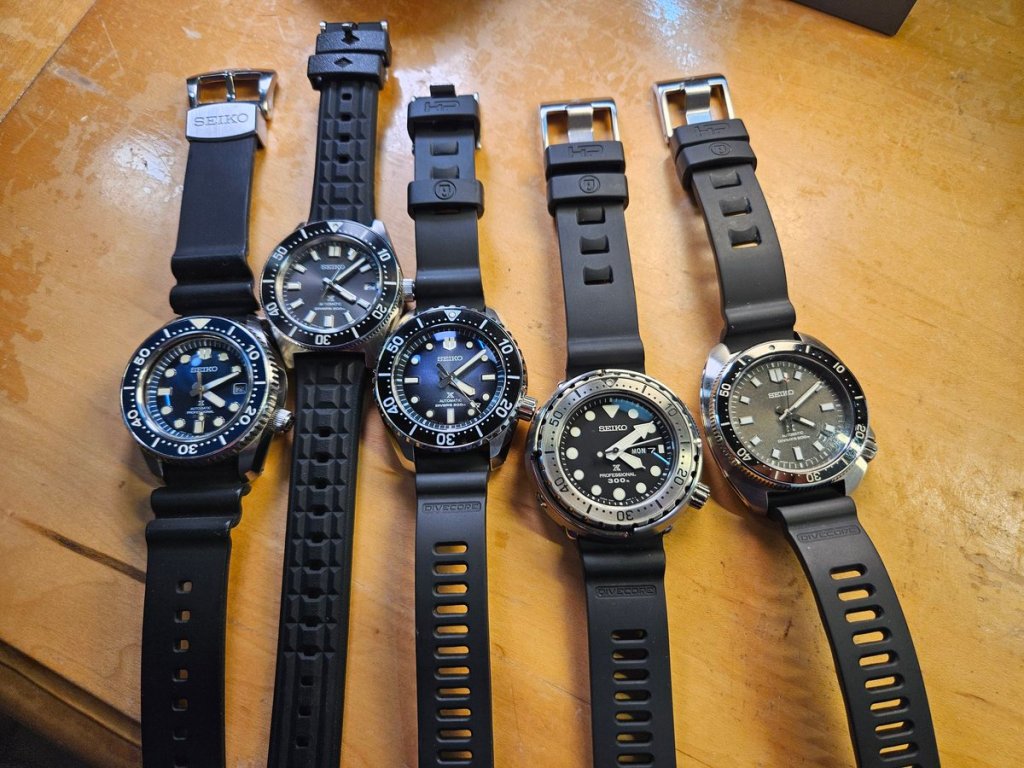
Of course, I am in denial. As I write this, I have a very beautiful diver watch with a wave-blue dial to be delivered from Singapore today from a DHL carrier. I’ve tracked the package six times since five this morning, and I couldn’t sleep last night because I agonized over whether I should keep it on the stock bracelet, put a sedate black Divecore on it, or put a loud orange Divecore on it. The stress is almost causing me to have a nervous breakdown.
I’m acting just like Maudlin Man. I’m experiencing effulgent emotions over something that is basically meaningless. As a result, I’m investing way too much energy and emotion toward my “watch situation,” and as a result, I am showing a lack of contact with reality.
Cicero’s point is that when we lack self-possession because we are in the maudlin state, we cannot be happy. Happiness is the byproduct of having self-agency and self-control.
I wince at Cicero’s words. Do I even want self-control? Do I not enjoy the drama of a watch strap “dilemma”? Do I not enjoy being an exuberant man-child?
Cicero would argue otherwise. He would argue that the “pleasures” I experience from my maudlin indulgences are at the root of my unhappiness. To understand Cicero’s argument better, let us look at the entire quotation:
Therefore the man, whoever he is, whose soul is tranquilized by restraint and consistency and who is at peace with himself, so that he neither pines away in distress, nor is broken down by fear, nor consumed with a thirst of longing in pursuit of some ambition, nor maudlin in the exuberance of meaningless eagerness–he is the wise man of whom we are in quest, he is the happy man.
My inner pessimist, which I call Glum, scoffs at Cicero’s words of wisdom and gives me a litany of my failures, which prove me unworthy of Cicero’s portrait of a happy man. Glum says to me the following:
“Regarding restraint, your appetites for tacos, spaghetti, garlic bread, homemade sourdough loaves stuffed with kalamata olives, semi-sweet chocolate chunk peanut butter cookies, chocolate cake, and pineapple cheesecake are so monstrous, you don’t have a chance in hell of exercising restraint when it comes to your appetites. Your very self is defined by your excesses, so good luck talking about restraint and moderation. You’re doomed.”
“Regarding ambition, it is only repeated failure of many decades, not humility, that abates your grandiose designs and fantasies of being famous and ubiquitous on television as a talking head whose opinions everyone greedily consumes as if your every word is a delicious morsel to be savored. So don’t go around bragging about your modesty and humble aspirations. Old age and an eye for the inevitability of your failure are your only salves, so you have no bragging rights.”
“Regarding maudlin exuberance and meaningless eagerness, you are the worst violator of these infractions, gushing with lame euphoria as you curate your watch collection to your YouTube viewers. Your entire enterprise of incorporating the wisdom of the Stoics and other classical thinkers is the biggest joke I’ve ever heard of and may qualify you for a life in comedy.”
My rebuttal to Glum is this. “With your keen insight into my wretched being, you have helped me see the very depth of my pathology. So thank you, Glum, you have helped me with an unflinching diagnosis of my spiritual dissolution, and thanks to you, this accurate diagnosis marks the beginning of my long road to recovery.”
I am grateful that I am both honest and smart enough to offer rebuttals to Glum, but having an intellectual grasp of what I should do and actually doing it are two vastly different things. For now, I have a clear grasp of Cicero’s notion of Maudlin Man. The seeds have been planted. I now hope that with those seeds, a counter self can grow that will put the Maudlin Man inside of me out of business.
The TV show Loudermilk is part sitcom, part group therapy, and part existential smackdown. Ron Livingston plays Sam Loudermilk, a grizzled music critic and recovering alcoholic with the face of a hungover basset hound and the social graces of a man allergic to kindness. He barrels through life offending everyone within a five-foot radius, insulting his fellow addicts with toxic flair. But beneath the wreckage lies a strange tenderness—a story not just about addiction, but about people trying to survive themselves.
Loudermilk lives in a halfway house with a cast of human tire fires, and the comedy burns hot: irreverent, profane, and deeply affectionate. The show loves its damaged characters even as it roasts them alive. Naturally, I love Loudermilk. Love it like a convert. I’ve become a low-key evangelist, promoting it to anyone within earshot—including the assistant at my local watch shop.
This isn’t just any watch shop. I’ve been going there for 25 years. The Owner and the Assistant know me well—well enough to have witnessed the slow, expensive progression of my watch addiction, including the day I came in twice because the first bracelet adjustment “didn’t feel quite right.” It’s my barbershop. My confessional. My dopamine dispensary.
So one afternoon, I’m there getting a link removed from my Seiko diver and I bring up Loudermilk. I describe the show’s gallery of screwups—addicts clawing toward redemption by way of insults, setbacks, and semi-functional group hugs. The Assistant looks up from his tools and tells me something personal. He watches Loudermilk too. And he gets it. He’s thirteen days sober and goes to five meetings every morning—not because he’s a morning person. He tells me that in his culture, drinking into one’s eighties is just called “living.” But for him, it was a slow-motion self-immolation. Now, he’s trying to claw his way back.
Before I can respond, a woman with a chihuahua tucked under her arm chimes in from across the shop. She too is a Loudermilk fan. “What a shame it got canceled after three seasons,” she laments. The Assistant counters—there’s still hope for a revival. They argue lightly, both fully engaged, two strangers momentarily bonded over their shared love of a comedy about pain.
I say goodbye and step out of the store. That’s when it hits me.
I love Loudermilk because I see myself in it. I am an addict. Not just of watches, but of distraction, validation, control—whatever lets me delay the moment when I must confront the snarling voice inside me.
Writers like Steven Pressfield and Phil Stutz describe this inner saboteur with chilling clarity. Pressfield calls it Resistance, the destructive force that undermines your better self. Stutz names it Part X, the anti-you that wants you to abandon meaning and pursue comfort. Both insist the enemy must be fought daily.
And I know that voice. It’s lived in my head for decades.
Once, at an English Department Christmas party, a colleague called me “Captain Comedown.” I don’t remember what I said to earn the nickname, but it tracks. I’ve got that bleak edge, the voice that sees futility everywhere and calls it wisdom. But a better name than Captain Comedown comes from my childhood: Glum, the joyless little pessimist from The Adventures of Gulliver, whose go-to phrase was: “It will never work. We’ll never make it. We’re doomed.”
That’s my inner monologue. That’s my Resistance. That’s my Glum.
Every day I wrestle him. He tells me not to bother, not to try, not to hope. That joy is a scam and effort is for suckers. And some days, I believe him. Other days, I don’t. But the battle is constant. It doesn’t end. As Pressfield says, the dragon regenerates. My job is to keep swinging the sword.
And maybe, just maybe, buying a new watch is my way of telling Glum to shut up. It’s a shiny, ticking middle finger to despair. A symbolic declaration: The world still contains wonder. And precision. And brushed stainless steel.
But there must be cheaper ways to silence Glum. A walk. A song. A friend. A laugh. Even a half-hour with Loudermilk.
Because, irony of ironies, what addicts like me really want isn’t the next hit. It’s relief from the craving.
The Portrait of the Artist as a Sweaty Young Man by Jeff McMahon
Jeff McMahon was supposed to be a titan—or so he believed. His father, a man so dominant he once stole McMahon’s future mother from none other than General John Shalikashvili with the cold-blooded finesse of a Komodo dragon, radiated command like a halogen lamp. In the long shadow of that military bearing, McMahon sought to carve out his own myth—one barbell at a time.
As a competitive Olympic weightlifter and golden-era bodybuilder in the 1970s, McMahon sculpted not just muscle, but identity. He was a Greek statue in motion, a walking promise of masculine potential. But while others were flexing in the mirror, he was gasping for air in a high school locker room, undone not by physical strain, but by panic attacks, a Nabokov fixation, and a Kafkaesque obsession with grammar. This was not ascension to Mount Olympus. This was implosion.
The Portrait of the Artist as a Sweaty Young Man is a semiautobiographical novel in two acts. The first unfolds in the sun-drenched, protein-soaked Bay Area of the 1970s, where McMahon trained alongside a tribe of emotionally stunted muscleheads. The second takes place decades later, when he emerges as a reluctant intellectual—still jacked, still haunted—teaching college writing in a desert town where ambition goes to die and office politics are played with knives.
Told in the second person, the novel is both an interrogation and a darkly comic trial of McMahon’s younger self—a character he observes with a mix of horror, sympathy, and disbelief. This is not a story of triumph, but the brutally funny autopsy of one. With merciless wit and an eye for the absurd, McMahon dismantles the treacherous myth of transformation and the masculine delusion that biceps can shield one from existential despair.
For Gen X and Boomer men raised on Schwarzenegger and Bukowski, now softening into middle age and Googling blood pressure medication, Sweaty Young Man punctures the performance-driven culture of the gym, the classroom, and the self-help aisle. What begins as a memoir of obsession and physicality ends as a meditation on identity, shame, nostalgia, and the slow, bewildering shift from symbol to person.
This is McMahon’s offering to the younger man he once was—the sweaty, striving, half-mad lifter who believed that heroism could be bench-pressed. He was wrong. But he was trying.
To understand the madness of the modern watch addict, you’d do well to consult Dopamine Nation by Stanford psychiatrist Anna Lembke, a book that should be shelved somewhere between philosophy, neuroscience, and quiet screaming. Her central thesis? In an age of relentless indulgence, the line between pleasure and pain is not only blurry—it’s the same neurological pathway. You’re not escaping pain with your latest acquisition. You’re feeding it.
“The smartphone,” she writes, “is the modern-day hypodermic needle.” And the drug? Dopamine—delivered in neat little parcels: TikToks, tweets, memes, and yes, wrist shots of watches you don’t own (yet). If you haven’t met your poison of choice, don’t worry. It’s just a click away.
Lembke makes the uncomfortable truth clear: The more dopamine hits we seek, the more our brain adapts by reducing our baseline pleasure response. What once thrilled you—your grail watch, your Rolex Explorer, your Seiko with the Wabi-Sabi patina—now barely registers. You’re not chasing pleasure anymore. You’re just trying to feel something.
Watch addicts, of course, understand this intimately. The pursuit of horological perfection starts out innocent enough: a G-Shock here, a vintage diver there. But soon you’re tumbling into the abyss of boutique limited editions and message board enablement, haunted by the need to stay relevant. Because here’s the twist: It’s not just about the watches. It’s about being seen. You post, you review, you flex because if you stop, you vanish. No new watches = no new content = digital extinction.
And extinction, in a social-media world, feels like death.
Lembke warns us that addiction thrives in secrecy, in the exhausting double life. The watch addict may present as a tasteful minimalist to family and friends, while secretly rotating 19 watches, five straps deep, waiting for the next “drop.” The addiction is fed by access, and we live in an access economy. New releases are no longer annual events—they’re hourly temptations. The vortex is bottomless. The supply creates the demand.
Even worse, modern society normalizes this behavior. Everyone is scrolling. Everyone is upgrading. Our addiction to novelty is passed off as taste. Our frenzied consumption masquerades as identity. Lembke borrows from Philip Rieff to explain the deeper shift: “Religious man was born to be saved; psychological man is born to be pleased.” The modern watch collector doesn’t believe in salvation. He believes in configuration.
But here’s the cruel irony: The more you seek to be pleased, the less capable you are of being pleased. In Lembke’s words: “Hedonism, the pursuit of pleasure for its own sake, leads to anhedonia—the inability to enjoy pleasure of any kind.”
What’s the solution? A dopamine fast. Lembke prescribes it like a bitter medicine: Remove the source. Reset the brain. Let it reestablish homeostasis. For the watch addict, this means one thing: a watch fast.
And yes—it’s brutal. I’ve been a watch obsessive for over twenty years. My longest fast? Six months. And I nearly went feral. New releases tempt. Friends enable. Algorithms whisper. Strap swaps and vintage reissues beckon like sirens. Even the FedEx truck starts to look like a personal tormentor.
So you get creative. You stash watches in the safe and “rediscover” them. You buy new straps instead of new watches. You try to redirect the compulsion toward something productive: fitness, music, sourdough, monkish austerity. Anything but another chronograph.
But the real cure, oddly enough, may be conversation—actual human connection. At watch meet-ups, we start out discussing bezels and spring bars, but within ten minutes we’re talking about life: real estate, parenting, knee surgeries, emotional burnout, dinner recipes. We talk for hours. But barely about watches.
The truth slips out in these moments: we want to be free. We crave community more than we crave sapphire crystals. What began as a shared obsession has become a trap, and these conversations, paradoxically, offer relief from the very addiction that brought us together.
Imagine a bunch of watch enthusiasts at a watch meet-up and we’re talking about everything but watches. Wrap your head around that.
In her darkly hilarious comedy special Father, Atsuko Okatsuka shares the origin story of her career in punchlines. Her schizophrenic mother once “kidnapped” her in Japan and whisked her away to the United States without warning, severing her ties to her father in the process. The trauma was so disorienting, so profound, that Atsuko now mines laughter for survival. She tells us, with a comedian’s grin and a survivor’s twitch, that she performs to fill an infinite hole in her soul with the validation of strangers.
That hole is not unique to her. It’s a universal pit—bottomless and demanding. Validation comes in many flavors. For some, it’s esteem and admiration. For others, it’s expertise, artistry, the warm glow of audience approval. For Atsuko, it’s laughter. For others, it’s the faint buzz of a “like” on a post about a wristwatch.
Let us now consider the watch obsessive, a different breed of relevance-seeker, but a kindred spirit nonetheless. He isn’t doing five-minute sets at the Laugh Factory, but he is performing—on Instagram, on forums, on YouTube, in the comment sections of strangers’ macro shots. He presents his taste, his “knowledge,” his ever-shifting collection. But underneath the sapphire crystals and brushed titanium is the same primal whisper: Do I still matter? Do they still see me?
Here’s the tragic twist: he may already have the perfect collection. It gives him joy. It’s balanced. It fits in a single watch box. By all logic, he should stop. Buying another watch would be like adding a fifth leg to a table—wobbly and unnecessary. But he doesn’t stop. He can’t stop.
Why? Because if he stops collecting, he stops posting. If he stops posting, he stops being seen. And in a world addicted to scrolling, disappearing feels like dying.
Relevance is the new oxygen. And social media is a machine that runs on novelty, not legacy. The digital hive forgets fast. “Gangnam Style” is now a fossil. “Call Me Maybe” is background noise at the grocery store. To stay visible, you must be new. You must be shiny. You must offer dopamine.
And what happens when the watch addict manages his demons, reaches peace, and stops feeding the machine?
He becomes boring. He becomes silent. He becomes irrelevant.
And the parasocial bonds he once had—those illusory friendships, those mutual obsessions—fade. The sense of exile is real. It doesn’t matter that the exile is self-imposed. The pain still lingers.
That fear—that primordial fear of irrelevance, of being cast out from the tribe—can be so powerful it masquerades as passion. It convinces the watch obsessive to keep flipping, keep chasing, keep posting. Not out of love, but out of fear.
So the question becomes: Are we collectors? Or are we hostages? Do we love horology? Or are we simply terrified of vanishing?
Last night I dreamed I was adrift in a farmer’s market purgatory, toggling between two dried fruit stalls like a man on a doomed pilgrimage. At one end stood my friend Adam, hawking dried apricots beside his immaculate new Honda Accord, polished to a showroom glint. At the other, Andre offered prunes with the calm assurance of a man backed by a brand-new Toyota Camry.
I paced between them, acting like a mildly deranged Consumer Reports correspondent. I asked about mileage, comfort, tire pressure, road feel. Adam, ever candid, confessed that his Accord’s 19-inch tires required constant babysitting—a weekly ritual of crouching beside his car like a penitent monk, pumping air into finicky rubber. Andre, on the other hand, practically preened. His Camry had no such neediness. His tires, he implied, were stoic and self-reliant, like Roman centurions.
As my dithering grew more manic, Adam and Andre began to notice. They called each other—yes, in the dream they phoned each other mid-market—and the temperature dropped. Andre, initially genial, grew terse. Adam smirked defensively over his dried apricots. The whole affair soured like old fruit.
Then, like a man possessed, I made my declaration. I would buy the Camry. Not for the horsepower. Not for the design. But because I refused—refused!—to spend my golden years crouching beside a car, inflating tires like a desperate cyclist.
No sooner had I made my proclamation than the dream world pivoted sharply, as dreams do. I was no longer in a farmer’s market—I was on a college campus. But not my college. Not the place where I once held a proud tenure-track post. No, I had been demoted. My prestigious job had evaporated. I was now an adjunct at some podunk backwater school with low ceilings and fluorescent lights that hummed with institutional malaise.
Why the fall from grace? Simple. My years spent obsessing over the Camry-vs-Accord dilemma had not gone unnoticed. While I was inhaling tire PSI data and fondling prune samples, my absence from the college became conspicuous. The administrators, ruthless as vultures in blazers, terminated me. I had toggled too long. My career had flatlined.
I woke at 5 a.m. in a wash of dread and despair—not from the dream’s end, but from the clatter of the real world: an Amazon delivery person, fumbling at the gate, dropping a box on the porch like a coffin lid.
I opened it. Inside was a stainless steel bathroom trash can, taller, sleeker, with built-in liners—my daughter’s request. Unlike our old can, which was a rust-streaked monument to hygienic defeat, this one gleamed with a kind of futuristic dignity. Its surface mirrored my face: puffy, sleepless, faintly haunted.
And yet, in its shimmering steel, I saw something unexpected: hope. Renewal. The modest redemption of functional design.
Watch obsessives have more in common with Howard Ratner than we care to admit. Yes, that Howard Ratner—the unhinged gem pusher played with twitchy brilliance by Adam Sandler in the Safdie brothers’ cinematic panic attack, Uncut Gems. Ratner operates in the Diamond District behind bulletproof glass, drowning in sparkle and debt. We operate behind the bulletproof delusions of horological obsession, buried in brushed steel and moonphase complications.
Like Ratner, we gamble—not at sportsbooks, but with FedEx tracking numbers. We tell ourselves, this is the one as we refresh the delivery status of the next “grail” watch. The package might as well be glowing, Pulp Fiction-style. And like Ratner chasing a cursed Ethiopian black opal mined from the bloodied crust of the Earth, we twist ourselves into financial and emotional pretzels to score that one special piece—the wrist-mounted miracle that will finally quiet the voices.
Spoiler: it never does.
Ratner is a man who thinks more is the cure. More bets. More jewels. More chaos. The watch obsessive runs the same play. We soothe our midlife despair not with therapy or silence, but with spring drives, meteorite dials, and limited edition bronze cases. Our collections don’t grow—they metastasize.
Like Ratner, our problem isn’t the world. Our problem is internal. The call is coming from inside the skull. He can’t stop because he doesn’t want to stop. The thrill is the point. Every acquisition, every wrist shot, every gushing forum post—just another hit of synthetic joy to distract from the gnawing void. We call it a hobby. Let’s not kid ourselves. It’s dopamine addiction disguised as design appreciation.
Uncut Gems is a cinematic espresso shot laced with panic. My wife and brother couldn’t sit through thirty minutes. Too stressful, they said. Too jittery. I’ve watched it three times.
But of course I have. I’m a watch addict.
I live in Ratner’s world. The caffeinated chaos? That’s not discomfort. That’s home.




 Cinemorphosis