Blog

  • The Gospel According to Arnold

    The Gospel According to Arnold

    At thirteen, you weren’t just growing—you were bulking. You launched yourself headfirst into the gladiatorial quest for muscle supremacy, wolfing down 200 grams of protein a day in four frenzied “feedings,” as if you were a ravenous prehistoric beast on a cutting-edge strength cycle. While other kids were figuring out how to talk to girls without combusting from nerves, you were busy calculating amino acid ratios and chasing the elusive state of protein-muscle synthesis like it was the Holy Grail.

    Your kitchen became a makeshift laboratory of gains. You blended protein shakes with powders hawked by the beefy prophets in Strength and Health magazine—chalky concoctions that tasted like regret mixed with drywall. You drank them anyway. Satiety was sacred.

    After a year of racking up Junior Olympic Weightlifting trophies—hoisting iron like a Cold War super-soldier on state-sponsored hormones—your well-meaning mother tried to support your calling. On your fourteenth birthday, she handed you what you assumed would be a Soviet-tier weightlifting manual. Instead, it was Pumping Iron—a glossy coffee-table tome filled with baby-oiled men in banana hammocks. Bodybuilders. Flexing. Posing. Pouting.

    You had to sit her down.

    “Mom,” you said, as diplomatically as a hormonal adolescent can, “weightlifters move heavy things. Bodybuilders pose in sequined underwear and shave their armpits.”

    To you, weightlifters were Spartans. Bodybuilders were Vegas lounge acts with glutes.

    Still, curiosity got the better of you. You flipped through Pumping Iron with a mixture of revulsion and wonder. The men on those pages didn’t look human. They looked like sculptures that got bored and decided to bench press.

    You imagined them living in their parents’ houses, drinking protein sludge while their heat-addled mothers babbled to parakeets and dabbed their foreheads with cold washcloths. They were carnival beasts. You, however, were a noble practitioner of Olympic Weightlifting—a sport so pure it belonged in the actual Olympics, unlike the oiled-up beauty pageants you now held in low regard.

    Your hero was Vasily Alekseyev, the 350-pound Russian colossus who looked like he ate livestock for brunch. You watched him waddle onto the platform, glare at a loaded barbell like it owed him money, and launch it overhead like a man tossing furniture in a domestic dispute. When that barbell hit the floor, it echoed through your ribcage. That, you told yourself, was true strength.

    But then… Arnold happened.

    You’d seen him before, sure. But when you saw Pumping Iron—saw him—something shifted. It wasn’t just admiration. It was conversion. Arnold wasn’t a man. He was a solar flare with biceps. A deity with an accent.

    Soon, you were hanging around Walt’s Gym, where the walls smelled like testosterone and chalk dust, and where the guys wore cutoffs like they were Roman togas. One afternoon, you spotted a bodybuilder straight out of central casting: a tall, tanned fireman who had just placed in the Mr. California competition. Blond hair, thick broom-handle mustache, horn-rimmed glasses that screamed “Clark Kent just deadlifted a Buick.”

    He bench-pressed over 300 pounds, stood up, and stared into the mirror like Narcissus on creatine. “The first time I saw Arnold,” he said with reverence, “I felt I was in the presence of the Lord. I said to myself, ‘There stands the Messiah. There stands God Almighty, come to bring good cheer to this world.’”

    And you believed him.

    Because Arnold wasn’t just jacked—he was divine. He was the Pied Piper of Pecs, leading you out of your ordinary life and into a new religion: Bodybuilding Fever. There was no vaccine. No mercy. Just the cure: protein shakes, gym mirrors, and relentless flexing.

    You no longer lifted just to be strong. You lifted to be seen. To be admired. To become an icon. You drank from the sacred chalice of the dumbbell and chased the gleam of your own reflection. You weren’t just lifting—you were becoming.

  • Curling Ashtrays and Other Signs You’re Destined for Muscle Madness

    Curling Ashtrays and Other Signs You’re Destined for Muscle Madness

    Long before you were twelve and dominating Olympic lifts, before you sculpted yourself into a fourteen-year-old bodybuilder, the signs were there—you were already bitten by the iron bug. Every fiber of your being was obsessed with getting huge. You found strange inspiration in the unlikeliest of places: television commercials for dog food. Yes, dog food. Those ads were less about pets and more about performance enhancement in your impressionable, muscle-hungry brain.

    Gaines-Burgers looked like prime cuts straight from Mount Olympus. Gravy Train’s magical transformation from dry nuggets to savory stew made your jaw drop. If this stuff could pump a German Shepherd into a jacked beast, what was stopping you from sampling the ambrosia yourself?

    So you did what any logic-defying, delusional muscle aspirant would do: you marched up to your dad and declared—with all the conviction of a beagle spotting a squirrel—that you wanted to become a dog. Not metaphorically. Literally. That way, you could indulge in the canine cuisine of champions. Your father’s face went on a journey: confusion, horror, resignation. He’d seen a lot, but this—this was a new low.

    In a desperate act of culinary intervention, he took you to a local bistro and ordered you a French Dip with au jus, hoping that real food might reroute your deranged protein fantasies. The sandwich arrived, dripping in savory decadence. Your dad leaned in, eyebrows raised, voice tense with hope: “So, how do you like your French Dip?”

    You took a bite. Heaven. Your taste buds erupted like fireworks. And then—of course—you growled, dropped to all fours, and scratched at an imaginary flea with your hind leg, fully committing to the bit. Patrons stared. Your dad’s face turned a shade of red that Sherwin-Williams has yet to name. He looked like a man reevaluating every life decision he’d ever made.

    But you didn’t stop there. No, your devotion to hypertrophy was a full-spectrum obsession. You judged cereals by their muscle-building mascots. Quisp and Quake tasted the same, but you knew who the real hero was: Quake, the barrel-chested, pickaxe-wielding coal miner with a neck like a bridge cable. Quisp? A pencil-neck Martian who probably couldn’t curl a paperclip.

    So when those two faced off in the ultimate cereal showdown, you pledged allegiance to Team Quake. Those gear-shaped nuggets were more than breakfast—they were barbell fuel. Quisp’s saucer-shaped flakes turned to mush in milk faster than your patience at a shopping mall. Quake stood firm, stoic in the milky battlefield of your bowl.

    But then, disaster. America chose the Martian. Quake vanished. It wasn’t just a marketing decision—it was a betrayal. When Quake was discontinued, a part of your soul died. The cereal aisle became a graveyard of broken promises. Eating Quisp felt like betrayal. Worse: it felt like surrender. You imagined Quake crying out from some cereal Valhalla, mourned like a fallen hero.

    Still, the signs of your bodybuilding destiny didn’t end with cereal or dog food. They were everywhere. In your living room sat a ceramic ashtray the size of a manhole cover—your parents’ nicotine shrine. During The Incredible Hulk cartoons, you’d curl that ashtray like you were training for the Strongest Kid on Earth competition. It was your first dumbbell, your sacred relic of strength.

    Family vacations? Gymless wastelands. But you adapted. You curled suitcases, hoisted skillets, deadlifted detergent bottles, and pressed soup cans with religious fervor. You squatted potato sacks and benched dictionaries. Hotel staff stared. Your family sighed. You called it training.

    Eventually, you found a real gym. Barbells. Plates. Chalk. Grunts. It was everything you dreamed of. Your transformation from kitchen utensil lifter to iron disciple was complete. You weren’t just a bodybuilder in the making—you were a walking comic book origin story, forged in dog food commercials, French Dip delusions, and cereal-fueled vengeance.

  • The Gospel of Squats

    The Gospel of Squats

    In seventh grade, while your father was off playing superhero in the Peace Corps—presumably saving the world one mosquito net at a time—you were marooned in Nairobi, Kenya. Your days were spent juggling soccer balls with local kids whose knees seemed invincible, bonding with mood-swinging chameleons, and trying to convince yourself that your Action Man dolls (the British knockoff of G.I. Joe) were more than just inert plastic with bad articulation. When the dolls failed to deliver, you escaped into glossy American sports magazines, fantasizing about transforming your spaghetti frame into the hulking majesty of Reggie Jackson or Greg Luzinski. You didn’t realize it yet, but you were becoming a social alien—an unintentional exile from your former Bay Area self, the human equivalent of a chameleon stuck on a disco strobe.

    Coming back to California in 1974 to attend Earl Warren Junior High felt like being dropped into a strange new planet where bad perms and bell-bottoms were considered high fashion. When kids talked about “doobies,” you imagined something slimy from the ocean depths, and “bong” sounded like an unfortunate percussion instrument. Naturally, you said all this out loud. Your classmates—high-functioning experts in pot, Zeppelin, and humiliation—saw you for what you were: a clueless alien with a warped pop culture radar. “This kid thinks a bong is a wind chime” became your unofficial welcome-back slogan.

    Enter Lou Kruk, your P.E. teacher: part demigod, part drill sergeant, part Baywatch extra. He stood over six feet tall with the torso of an ice cream cone, mahogany tan legs bursting out of gym shorts so tight they could’ve been airbrushed. His lion-like hair, aviator sunglasses, and windbreakers gave him the aura of a man who taught dodgeball by day and raced Porsches by night. He did, in fact, drive a Porsche. He also owned a sailboat. And his girlfriend looked like a magazine ad for champagne and yacht clubs.

    Kruk’s voice thundered like Wolfman Jack having a meltdown, and he blasted Herb Alpert & The Tijuana Brass while ordering you to deadlift your body weight. During one rope climb session in the cafeteria, he interrupted class to verbally annihilate a group of bullies with a monologue worthy of a Greek tragedy. “He’s already in the gutter! You want to put your boot on his head too?” The bullies melted. You, meanwhile, silently vowed to name your first child Lou.

    On day one of Olympic Weightlifting, Kruk preached the gospel of the front squat. Feet flat, butt to the floor—no exceptions, no mercy. You took this commandment personally. You practiced until your glutes sang hymns of soreness. Your squats got so deep they could’ve hit oil. And when Kruk pointed to you as the Platonic ideal of squat form, the gym practically knelt.

    Eventually, you were powering through front squats with 200 pounds like they were grocery bags. The day you nailed a dozen reps at 225, the entire gym went silent. You weren’t lifting; you were levitating. Your thighs bloomed into grotesque botanical wonders. 

    Soon, you were squatting everywhere. At your locker. In algebra. As goalie during PE soccer games (to your teammates’ horror, as balls flew by into the net). You became known as “Squats,” and also “Thunder Thighs,” titles you wore like medals pinned to your hypertrophic quads. You didn’t care about ridicule anymore. You were a squat apostle, a zealot for quad dominance in the 148-pound class, where you snatched and clean-and-jerked like an adolescent Hercules hopped up on whey and divine purpose.

    You basked in Kruk’s approval like a reptile soaking up solar validation. His nods, his booming laughter—they were your sacraments. You became an unsolicited preacher, spreading the word of the front squat like a sidewalk prophet. For you, the squat wasn’t just exercise. It was theology. It was identity. It was the key to everything: confidence, masculinity, self-worth. Every rep was a sermon. Every deep descent into the squat rack brought you closer to the divine.

  • Hulk Couture: The Fashion Crimes of a Musclebound Child

    Hulk Couture: The Fashion Crimes of a Musclebound Child

    Whether you admit it or not, a part of you still wants to Hulk out like a fever-dream escapee from a 1970s television set. Watching the gentle, tortured soul of Bill Bixby morph into Lou Ferrigno’s snarling green colossus wasn’t just entertainment—it was therapy without the deductible. You didn’t want to trudge through life as a tightly wound ball of quiet despair. No, you wanted to erupt, transcend, and become an unstoppable force against loud chewers, bullies, and the guy curling in the squat rack.

    As a budding bodybuilder, you didn’t need gamma rays—just iron. And lots of it. Your transformation wasn’t just about building muscle; it was a sartorial revolution. You hacked off your sweatshirt sleeves, butchered the legs of your sweatpants, and stomped through the gym like a deranged fashion anarchist. You weren’t lifting weights—you were channeling rage into reps, morphing into a DIY Hulk with every guttural breath and dripping bead of sweat.

    But your Hulk obsession started long before puberty. You were a pint-sized fanatic, glued to the 1960s cartoon version of the green juggernaut. What captivated you most was the metamorphosis: how Bruce Banner’s clothes tore away, leaving only ragged dignity and raw power. So one fateful Saturday morning, with a level of creative genius only a six-year-old could summon, you took a brand-new pair of slacks from Mayberry’s and turned them into Hulk couture—frayed, slashed, and ruined. Then you stomped into your parents’ bedroom flexing, growling, “HULK SMASH!” Lucky for you, your mother’s laughter outweighed her rage.

    This was your first known case of Ferrigno Fever: the compulsive need to emulate Lou Ferrigno’s Hulk physique and fashion sense, typically culminating in destroyed clothing and inflated delusions of grandeur.

    As a teenager, your obsession graduated to the live-action Incredible Hulk. After the chaos subsided and Ferrigno’s beast melted back into Bixby’s sorrowful wanderer, you were left with “The Lonely Man Theme”—Joe Harnell’s melancholic piano elegy—as your personal anthem. It became the soundtrack to your self-pity and your deeply misguided belief that the world had wronged you by not immediately recognizing your divine potential.

    You weren’t just lifting at the gym; you were sculpting a mythic figure, trapped in a fluorescent-lit purgatory of men who looked like overripe tomatoes with toothpick limbs. They didn’t understand. They didn’t see the epic. But you did. You were a tragic hero, a lone star bench-pressing against the gravity of a cruel, indifferent world.

    Eventually, you realized that self-pity is seductive—like opium, but cheaper and twice as cringe. It whispers lies, paints you the tragic lead in a play no one else is watching, and delays the actual work of growing up. It took years, maybe decades, to hush that voice. But for a long time, the Hulk was your muse, your fashion icon, and your excuse.

  • Captain America vs. the Aryan Poster Child

    Captain America vs. the Aryan Poster Child

    On dry land, you were Captain America incarnate—at least in your own mind. A five-year-old freedom fighter in light-up sneakers, flexing your spaghetti arms to vanquish Red Skull stand-ins wherever they lurked. And in 1973, Kindergarten was your battlefield. The enemy? A kid named Teddy Heinrich, your neighbor at the Royal Lanai Apartments in San Jose—a cherubic little stormtrooper-in-training who strutted around with the smugness of a pint-sized Aryan poster child.

    You had no idea you were Jewish, not consciously. But Teddy sure did. He made it his mission to educate you—mostly through Nazi memorabilia and unsolicited history lessons delivered between episodes of The Three Stooges and Superman, which you watched on his living room TV because your family didn’t have UHF. His parents were phantoms—always cloistered in the master bedroom, never cracking a smile, and dressed like they were auditioning for The Cabinet of Dr. Caligari.

    One day, Teddy gave you the grand tour of his family’s closet. Instead of a vacuum or winter coats, he pulled out his grandfather’s SS uniform—complete with a swastika armband, as if he were unveiling a treasured heirloom. “Check it out,” he said, beaming. “The greatest fighting machine the world has ever known.” His father peeked out from the shadows, nodded with ghostly approval, and slithered back into the bedroom.

    You didn’t know what to make of it. Your Nazi education came exclusively from The Sound of Music, and even then, the swastikas were mostly an inconvenience to the yodeling.

    Days later, under the hot California sun, you and Teddy were sprawled on the apartment lawn. He used his magnifying glass to torch a grotesque Jerusalem cricket, its alien limbs writhing in agony. You kicked it away, trying to save the poor thing, but Teddy doubled down—burning swastikas and “Nazi” into a wood block like a miniature war criminal with a hobby.

    You started mimicking him, doodling swastikas like a deranged architect. When your mother caught you mid-sketch, she froze. “Where did you learn that?” You dropped Teddy’s name like a hot grenade.

    She banned the symbols and told you they were evil. You nodded, swore to behave—and went right back to etching them at school, seduced by their sinister geometry.

    Then came the day Teddy called you a “dumb Jew.”

    You didn’t even know what the word meant. You just knew something flared in your chest like a lit fuse. In an instant, you were on top of him, pounding his freckled face into the grass. He didn’t fight back. He just took it—limp, passive, stunned. You clawed at his cheeks, turned them into raw hamburger. It was an out-of-body experience. You were rage. You were justice. You were five years old and seeing red.

    You walked home calm, maybe even proud. An hour later, Teddy and his mother showed up at your door. She was full of righteous German fury. “Your son did this?” she said, pushing her bruised child forward like Exhibit A. “I almost had to take him to the hospital.”

    Your mother, stunned, sent you to the kitchen. You listened from the other room as she said, “Did he really do all this?”

    “Yes!” the woman barked. “Your son should not be allowed to play with mine anymore.”

    Once they left, your mother turned to you. You explained the swastikas. The Nazi closet. The slur.

    She didn’t ground you. She didn’t raise her voice. Instead, she nodded with a quiet, ancestral gravity—as if somewhere in the back of her mind, ghosts had nodded with her.

    In her eyes, you weren’t a delinquent.

    You were Captain America.

  • Micky Dolenz, Dave Draper, and the Death of a Boy’s Dreams

    Micky Dolenz, Dave Draper, and the Death of a Boy’s Dreams

    By the time you hit kindergarten, you were already a zealous convert to the gospel of hard work, marinated in a diet of children’s books and those absurdly persuasive Charles Atlas bodybuilding ads found in comic books. Your tiny brain was hardwired to believe that with enough elbow grease and grit, you could bend the universe to your will. You marched through life armed with Captain Kangaroo’s treacly aphorisms and the motivational war cries of The Little Engine That Could. “I think I can” became your toddler mantra, your creed, your caffeinated Kool-Aid.

    Then came October 16, 1967. The day optimism died.

    You were just twelve days shy of your sixth birthday, nestled into your evening ritual of watching The Monkees, when the episode “I Was a 99-lb. Weakling” detonated your reality. There on the screen was your scrappy hero Micky Dolenz, getting demolished on the beach by a slab of muscle named Bulk—played by none other than Mr. Universe Dave Draper. Bulk, a bleach-blonde Hercules with pecs that looked weaponized, snatched away Brenda, the beach goddess, without breaking a sweat.

    Crushed but hopeful, Micky sought salvation through Weaklings Anonymous. His training montage was nothing short of existential punishment: lifting weights the size of Volkswagens, chugging fermented goat milk curd (which may as well have been bottled regret), and pawning off his drum set—essentially amputating his soul—to finance this fever dream of redemption.

    And then came the final betrayal.

    After all that sweat, sacrifice, and putrid curd, Brenda dumped Bulk and hooked up with some Proust-reading dandy who probably thought cardio was a character in Les Misérables. Your six-year-old heart imploded. You sat there slack-jawed, betrayed by TV, by Micky, by Brenda, and most of all, by the myth that hard work would win the day. Goat curd couldn’t save you. Pop-Tarts couldn’t save you. Even a twin-pack of Ding Dongs barely numbed the existential sting.

    You wandered the next few years like a ghost of your former self, disillusioned, cynical, nursing your wounds in sugary snacks and quiet rage. Not until Arnold Schwarzenegger stormed into your life via Sports Illustrated and Pumping Iron did your faith in the bodybuilding gospel return. But by then, the damage was done. You knew the truth: sometimes, life crowns the guy reading Proust—and leaves the guy drinking protein shakes in the dust.

  • Drunk on Barbara Eden

    Drunk on Barbara Eden

    You grew up in VA housing—repurposed army barracks known as Flavet Villages—in Gainesville, Florida. The buildings sagged with humidity and history, not far from an alligator swamp and a patch of forest that always smelled like something prehistoric had recently bathed. Perched on a branch at the edge of that forest was a Mynah bird, the same one, every evening. It became a ritual—your father and you, walking out at dusk to visit the bird and carry on what felt like real conversations with it. The swamp behind you would breathe out its musk, that potent stench of low tide and alligator dung. Most would gag. But for you, the smell was oddly soothing—earthy, primal, even sublime. It made you feel tethered to something vast and mysterious.

    One evening, while chatting with the Mynah bird under a bruised pink sky, you heard a distant radio drifting through the humid air. Juanita Hall was singing “Bali Ha’i” from South Pacific. Her voice wrapped itself around you like vapor. The song, with its haunting promise of a paradise just out of reach, was meant to stir longing—but you didn’t feel any. Your paradise was right there, next to your father, speaking to a magical bird on the lip of an enchanted forest. No ache. No yearning. Just presence.

    You didn’t understand longing—at least not yet.

    Longing came for you in 1965, when you discovered I Dream of Jeannie. Barbara Eden appeared on your screen in chiffon and sequins, smiling from inside her genie bottle—a velvet dream chamber lined with pink and purple satin brocade, the walls glowing with embedded glass jewels like shards of a pearl sky. You didn’t just want to meet Jeannie. You wanted to live with her. Inside that bottle. Forever. The ache you’d been spared during “Bali Ha’i” finally found you. You didn’t just want the bottle—you needed it. Later you learned it was actually a painted Jim Beam decanter. Appropriate. You were drunk on Barbara Eden, intoxicated by the fantasy of never having to grow up.

  • Captain Kangaroo Cookies and the Fall of the Sun-Maid Man

    Captain Kangaroo Cookies and the Fall of the Sun-Maid Man

    As a small child, you had a surprisingly clear notion of the Cold War, thanks in no small part to The Rocky and Bullwinkle Show. The Russian spies—Boris Badenov and Natasha Fatale—were your first exposure to international espionage. They weren’t subtle. They schemed and snuck around trying to steal jet fuel and military secrets, their motives cartoonish but unmistakable: Mother Russia wanted what America had. It was geopolitical skulduggery with punchlines. But beneath the gags was a message that stuck: America and Russia were locked in a death match for global supremacy.

    Television kept hammering the point. Every other cartoon, sitcom, or Saturday matinee made it clear who the winners were in this world: the ones in uniform. They flew jets, walked on the moon, and—most importantly—got the girl.

    Exhibit A: I Dream of Jeannie.

    Major Anthony Nelson was your blueprint for alpha success. He wore a crisp military uniform, cracked classified codes, and—oh yeah—discovered a genie. A blonde bombshell genie in a pink silk outfit, no less. Barbara Eden was your first crush, and rightly so. She was radiant, pliant, and always barefoot. She called him “Master” and granted his every wish. You never questioned the logic. Of course Major Nelson found Jeannie. He was an astronaut. A military genius. A winner. That’s what TV taught you: if you reached the top of the competence pyramid, beautiful women would appear from household objects to serve you breakfast and unconditional love.

    You internalized that myth early—long before puberty had its say.

    Your first real-world test of dominance happened when you were five, in Gainesville, Florida. You had a treehouse wedged into one of the mangled trees at the Flavet Villages Apartments, and you thought you were the man. You invited Tammy Whitmire—flaxen-haired, gap-toothed, and already a queen bee—to climb up the slats of your kingdom. Your bait? A box of Sun-Maid Raisins.

    You flashed the red box like it was contraband gold. The Sun-Maid girl beamed up from the label, holding her tray of grapes like a Eucharistic offering. Her red bonnet and angelic glow gave her the holy aura of snack-time supremacy.

    Tammy bit. She started climbing. You were about to win.

    And then, betrayal—sudden, brutal, Cold War-style betrayal.

    From a nearby tree emerged Zane Johnson, a rival operative whose swagger you hadn’t accounted for. He popped his head out from the foliage like a jungle sniper and shouted, “I’ve got Captain Kangaroo Cookies!”

    Tammy froze on your slats like a deer caught between two headlights of desire. Her eyes locked on Zane’s offering. Chocolate-drenched. Cream-centered. An unholy union of fudge and status. Compared to your meager raisins, they were basically nuclear warheads.

    Tammy snarled at your pathetic bait, climbed down without a word, and defected to Zane’s cookie republic. They ascended together and cozied up in his treehouse like Khrushchev and a new mistress. You watched them eat and gloat, their lips chocolate-slick and cruel with triumph.

    You reclined in your empty fortress and cried yourself into unconsciousness.

    Hours later, your agony turned literal. Red ants—attracted to the raisins, no doubt—had overrun your body, biting every inch of skin. You woke up in hell, bolted for home, and howled under a scalding bath as your mother drowned the ants clinging to your body.

    It hurt. It really, really hurt.

    But the worst part wasn’t the bites. It was the sting of humiliation. The alpha lost. You lost.

    In that moment, you understood something primal: in the great arms race of life, you’d better bring cookies.

  • The Road Trip That Made You Possible: An Origin Story

    The Road Trip That Made You Possible: An Origin Story

    Everyone has an origin story. You are no exception. Yours begins with your father. Without your father’s sheer audacity and competitive determination, you wouldn’t even be here today. Long before you were a glint in his eye, your father was locked in a battle of epic proportions—an all-out, no-holds-barred contest for the affections of your eighteen-year-old mother. And this wasn’t just any competition. His rival? None other than John Shalikashvili, future United States General and Chairman of the Joint Chiefs of Staff. Their battlefield? The smoky, beer-soaked bar scene of Anchorage, where the stakes were higher than a highball glass during happy hour.

    Their duel for your future mother’s heart took a brief Christmas ceasefire when Shalikashvili retreated to his tactical command center in Peoria, Illinois, while your father returned to Hollywood, Florida, to soak up some sunshine and plot his next move. But as he lounged by the pool, your father realized that victory in this romantic Cold War required swift and decisive action. So he cut his vacation short, crammed himself into a cream-colored 1959 Morris Minor—a vehicle that looked like it had been assembled from the Island of Misfit Toys, complete with a coat hanger for an antenna and door handles barely clinging on by the grace of duct tape—and embarked on the most high-stakes road trip of the 20th century.

    Halfway through this odyssey, the car’s fuel filter decided to go on strike, leaving your father stranded in the middle of nowhere. When the local auto parts store couldn’t supply a replacement, your father—who would later perform engineering miracles at IBM—pulled off a MacGyver-level feat of mechanical wizardry. Armed with nothing but a prophylactic and a paperclip, he fashioned a makeshift fuel filter that was equal parts creative desperation and mechanical blasphemy. This duct-taped miracle kept the fuel pump from either flooding the engine or abandoning ship entirely, depending on its mood.

    Driven by the urgency of love and the fear of losing ground to Shalikashvili’s brass-polished charm, your father powered through the journey, ignoring his growling stomach like a man possessed. Subsisting on loaves of bread devoured like a feral squirrel, he soldiered on, skipping meals because, who needs food when you’re racing against the clock to prevent a military coup over your future wife?

    After a ferry ride that probably felt like crossing the River Styx, your father finally arrived in Anchorage, a full forty-eight hours before Shalikashvili could swoop in with his military swagger and irresistible authority. Nine months later, you were born, the ultimate trophy in this love-struck arms race.

    Even before you took your first breath, your father’s victory over Shalikashvili imparted some crucial life lessons: The competition is fierce, and life is a zero-sum game where you’re either a winner or a nobody. To survive, you must find a competitive edge, and if you ever get complacent, rest assured, someone will move in on your turf faster than you can say “ranked second.”

    As a teenage bodybuilder obsessed with becoming Mr. Universe, opening a gym in the Bahamas, and silencing your critics, you often thought about bodybuilding great Ken Waller stealing Mike Katz’s shirt before a competition in the movie Pumping Iron. Something as trivial as a missing shirt could send your opponent into a tailspin, disrupt his focus, and rattle his confidence like a cheap shaker bottle. Like Mr. Universe Ken Waller, your father taught you that power is a road paved with relentless cunning, ruthless strategy, and a healthy dose of underhanded shenanigans. 

    But underneath the shenanigans and Machiavellian flair, your father taught you one core truth: sweat more than everyone else. Out-hustle, out-grind, outlast. In his gospel, sweat wasn’t just effort—it was currency. The person who left the biggest puddle won. 

  • Watch Island: Where Grown Men Click Bezels and Call It Meaning

    Watch Island: Where Grown Men Click Bezels and Call It Meaning

    After twenty years tumbling down the horological rabbit hole, I’ve come to one conclusion: the watch hobby is a paradoxical fever dream held together by delusion, desire, and just enough self-awareness to laugh before crying.

    If Alec Baldwin’s mantra in Glengarry Glen Ross was “Always be closing,” then the watch nerd’s version is: “Always be laughing at yourself.” Because let’s be clear—none of this is serious. And yet, it’s also deathly serious. That’s the contradiction we live in: a tension between cosplay and existential weight.

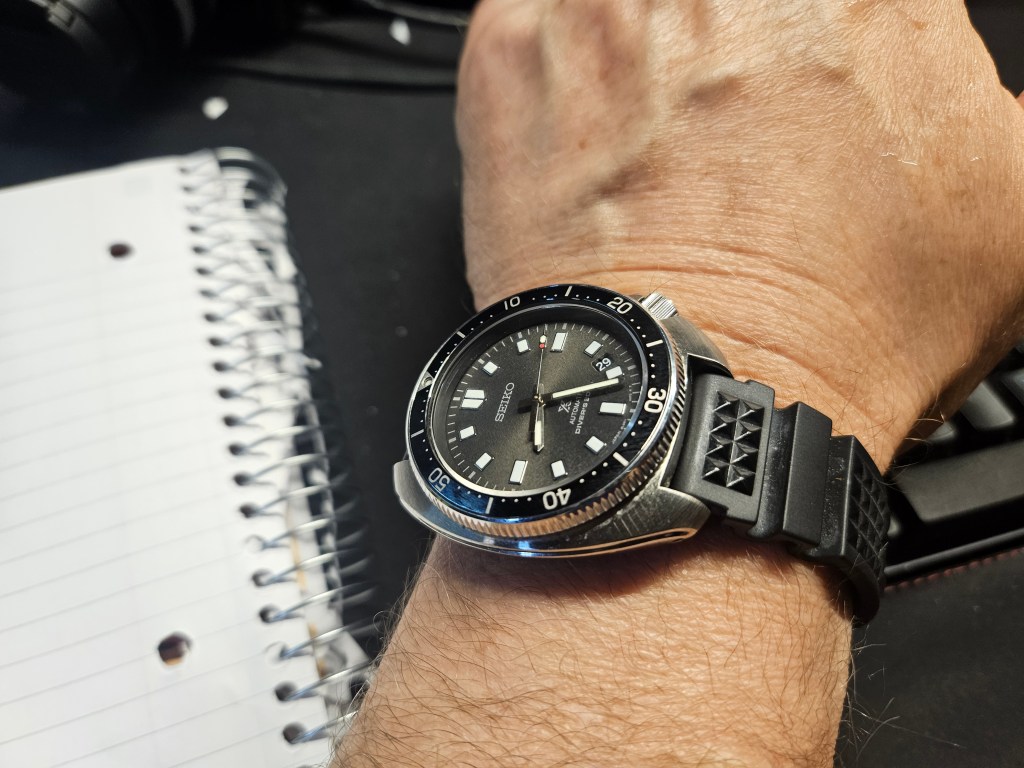
    At its core, watch collecting is elaborate roleplay. Grown men strapping on wrist-bound fantasies, each timepiece a character costume in a rotating lineup of imaginary lives. We cosplay as deep-sea divers, fighter pilots, Arctic explorers, NASA engineers, rugged survivalists, or minimalist monks of Japanese restraint. We don’t just wear watches. We become them. Just as fans dress as superheroes at Comicon, we show up to Bezel-Palooza with Seikos and Sinns, flexing our sapphire crystals and ceramic inserts like badges of forged identity.

    And don’t get me started on the straps. We favor models named after desserts: waffles, chocolate bars, and tropic vanilla-scented rubber. We’re just high-functioning children in the horological wing of Willy Wonka’s Chocolate Factory. But instead of licking the wallpaper, we post lume shots under moody lighting and argue about clasp tolerances.

    It’s cosplay for the emotionally overcommitted.

    But the strangest contradiction? For something so clearly un-serious, we treat our collections with a kind of medical gravity. The annual “State of the Collection” post feels like a cholesterol screening—an attempt to gauge whether we’re healthy, balanced, evolving, or simply delusional. We don’t just love watches. We debate the proper ways to love them. We agonize over whether we’re rebuying the Willard out of longing or self-sabotage. We assign spiritual weight to which dial shade of blue best reflects our soul.

    This isn’t just madness. It’s structured madness. With forums.

    We are a niche tribe of adult males—many of us husbands, some of us fathers—who transform into Man-Babies the moment we utter the words “bezel action” or “ghost patina.” Our wives, bless them, want no part in our obsessive monologues about case thickness and end-link articulation. To them, we are overgrown children clinging to our G.I. Joes and Tinker Toys, slowly sprouting donkey ears like Pinocchio and Lampwick on Watch Island, while they look on with bemused pity.

    We know we’re ridiculous. That’s the beautiful tragedy. And still, we dive deeper. Because in a world that often lacks identity, silence, and meaning, we find it in brushed stainless steel and micro-adjust clasps.

    And yes—we’re probably overdue for an intervention.