Tag: adventure

  • Paradise by the Hour

    Paradise by the Hour

    It is perfectly reasonable to think more about death as you get older. I am approaching sixty-five. Mortality has stopped being an abstraction involving unfortunate people in newspaper obituaries and begun appearing in the neighborhood. Thinking about it is not necessarily morbid. The question is what those thoughts do to you.

    Ideally, thinking more about dying should make you think harder about living.

    Call this the Mortality-Vitality Paradox: as the remaining quantity of life becomes more conspicuously finite, its individual moments can acquire greater intensity. The clock doesn’t merely frighten you. Sometimes it turns up the voltage.

    What gets you out of bed? What do you still long for? What produces that surge of anticipation that makes you think, Yes, I want more of this?

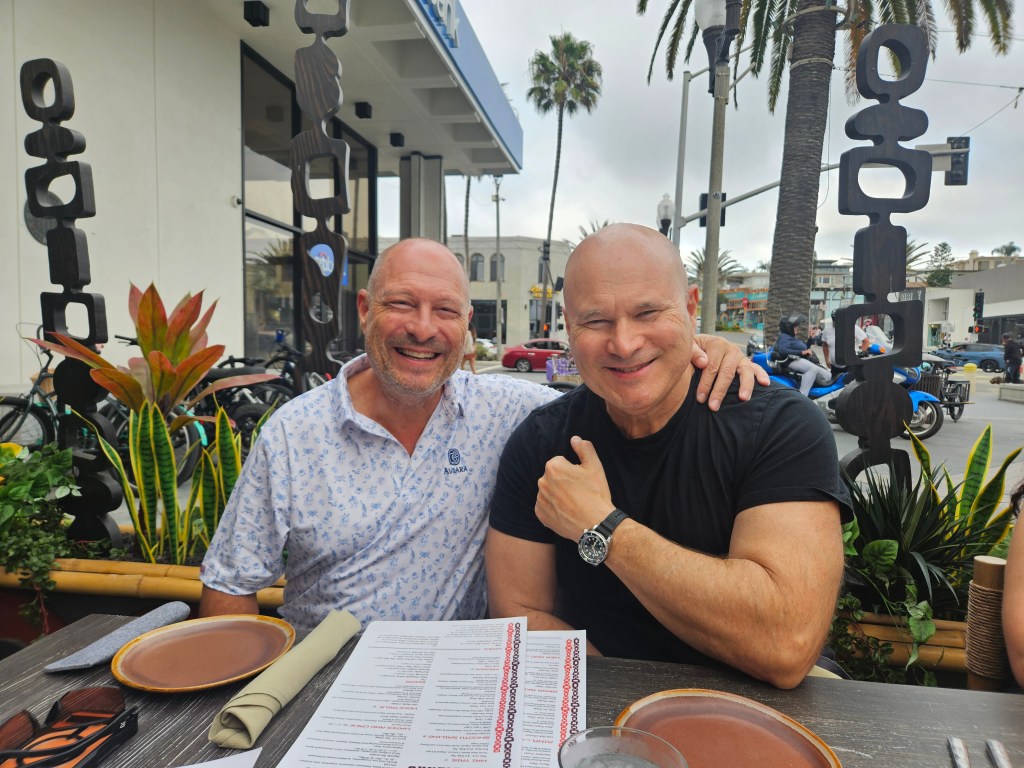
    I was thinking about these questions last night while having dinner with my family, my brother, and his girlfriend at Tiki Kai, an “island-inspired” restaurant at the mouth of Pier Plaza in Hermosa Beach.

    We barely made it there.

    Parking in Hermosa on a warm Saturday evening requires either divine intervention or the predatory instincts of a great white shark. Every parking space within half a mile had been claimed. Cars circled the neighborhood with the grim determination of bombers awaiting clearance to land.

    There was a reason.

    Everyone wanted to be there.

    By six o’clock, the temperature was still around eighty degrees, softened by an ocean breeze. We sat outside drinking mocktails and eating ceviche, mahi mahi, fire shrimp, Hawaiian salad, and other foods that become considerably more expensive when served within smelling distance of the Pacific Ocean.

    Across the plaza stood Patrick Molloy’s. Twenty years ago, my wife and I used to meet her coworkers there on Fridays for fish tacos. I looked at the building and experienced one of those increasingly common late-life distortions of time. Twenty years had passed, yet some part of me expected to walk across the plaza and find our younger selves still sitting there.

    Nearby, televisions in another bar were showing Ohio State against Texas. The game was close, and every few minutes the crowd erupted. Cheers spilled into the plaza. Pedestrians streamed toward the pier. Restaurants overflowed. People were laughing, drinking, eating, flirting, watching football, pushing strollers, meeting friends.

    The entire place seemed electrically charged.

    This is what I call the Paradise-Proximity Principle: certain places make us feel that paradise, while obviously unattainable, might at least be geographically nearby.

    Southern California has been selling this proposition for more than a century.

    The evidence was all around us. Warm September air. Pacific Ocean. Palm trees. Beautiful people. Outdoor restaurants. Sunset. Young couples walking toward the beach. Middle-aged couples pretending not to notice the young couples. Retirees demonstrating through aggressively casual linen clothing that Tuesday and Saturday have become essentially the same day.

    The California Dream was operating at full voltage.

    We constantly hear about Californians fleeing for Texas, Arizona, Nevada, and other places where a modest house does not require the financial resources of a minor European principality. The migration is real. So are California’s taxes, traffic, housing costs, bureaucracy, and innumerable other aggravations.

    Yet somehow nobody sent the memo to Hermosa Beach.

    The place was packed.

    People from around the world still cram themselves into Southern California’s coastal cities because the California Dream remains one of America’s most durable fantasies. The dream promises good weather, beauty, abundance, health, youth, reinvention, and proximity to the ocean.

    In this respect, the California Dream resembles the Hawaiian Dream. Both are modern expressions of something much older: the Paradise Instinct.

    Human beings have always imagined a place where suffering recedes and abundance takes its place. Eden. Arcadia. Shangri-La. The Land of Milk and Honey. Hawaii. Southern California.

    The scenery changes. The fantasy doesn’t.

    We want to believe there is some place where the weather is warm, the fruit is ripe, the body remains healthy, the family gathers around the table, and death has temporarily misplaced our address.

    Cynics will point out that much of this paradise is manufactured.

    Of course it is.

    Tiki Kai isn’t an untouched Polynesian village mysteriously deposited at the western end of Pier Avenue. Somebody held meetings. Somebody hired designers. Somebody selected the lighting. Somebody developed the cocktail menu. Somebody decided exactly how much tropical vegetation was required before a customer would willingly pay twenty dollars for something containing ube.

    This is the Vibe Economy.

    Restaurants such as Tiki Kai aren’t merely selling food. They’re selling admission to an emotional atmosphere. The mahi mahi is real, but so is the fantasy surrounding it. For two hours you purchase temporary citizenship in an imaginary country where everyone is relaxed, the ocean breeze is permanent, and nobody has an appointment with a urologist Monday morning.

    There is a temptation to dismiss all this as superficial consumerism.

    I resist that conclusion.

    Human beings have always constructed places designed to produce particular states of mind. We built cathedrals, gardens, theaters, plazas, resorts, stadiums, restaurants. We manipulate architecture, music, light, food, landscape, and ritual because consciousness responds to surroundings.

    The fact that an experience has been designed doesn’t necessarily make the experience fraudulent.

    The Beach Boys understood this long before anybody invented the term “vibes.” They didn’t call the song “Good Rational Assessment of Objective Conditions.”

    They called it “Good Vibrations.”

    Then the bill arrived.

    With tip, dinner cost more than five hundred dollars. I paid roughly two-thirds; my brother picked up the rest.

    For a moment, the Puritan accountant who apparently lives somewhere behind my frontal lobe emerged carrying a clipboard.

    Five hundred dollars?

    For dinner?

    I asked myself how often I did something like this. Once a year? Once every two years?

    The accountant returned to his cave.

    This was not Tuesday night takeout. My family was together. My brother was there. We were sitting outside on an eighty-degree September evening near the Pacific Ocean. Twenty years of memory were standing across the plaza. Football crowds were cheering. Everyone around us seemed delighted to have secured a small piece of this particular evening.

    I looked at the other diners. Some were clearly regulars. They greeted servers by name. They laughed across tables. They leaned back into the tropical breeze with the ease of people who had performed this ritual many times before.

    They weren’t merely buying dinner.

    They were buying access to the dream.

    And perhaps retirement intensifies the Paradise Instinct rather than extinguishing it. The career begins receding. The children grow older. Time becomes more visible. You become increasingly aware that the body has terms and conditions you apparently accepted without reading.

    Yet the desire for life remains.

    Perhaps it becomes stronger.

    You want to stay healthy. You want to remain vigorous. You want dinners with your family. You want warm evenings near the ocean. You want places that generate energy rather than drain it. You want experiences that make the remaining years feel expansive rather than diminished.

    That is the Mortality-Vitality Paradox again.

    Death enters the picture, and instead of making life smaller, its presence can make life glow.

    This doesn’t mean pretending that Southern California is paradise. Drive east on the 91 at five o’clock and the theological case collapses rapidly. Nor does it mean spending retirement in an endless procession of restaurants, resorts, cruises, and premium experiences in a desperate attempt to purchase immortality.

    It means recognizing the Paradise Instinct for what it is: an ancient human longing for abundance, health, fellowship, beauty, and peace.

    At sixty-five, I don’t feel embarrassed by that longing.

    I trust it more.

    Man does not live by bread alone. Apparently he also requires ocean breezes, family, football cheers, tropical lighting, memories of fish tacos from twenty years ago, and an occasional Ube Nada Colada costing considerably more than good judgment would recommend.

    The bill comes eventually.

    It always does.

    Until then, the dream lives.
  • Breakfast Eschatology

    Breakfast Eschatology

    I no longer want to resolve my eschatological crisis.

    I don’t want to determine the nature of substitutionary atonement, theodicy, and eternity. I don’t want to debate whether hell is eternal, corrective, metaphorical, mistranslated, or the unfortunate product of several centuries of theologians getting overexcited. I’m tired of sifting through my epistemic crisis as though somewhere beneath a pile of Greek nouns I will finally uncover the laminated instruction sheet for the universe.

    I’ve also given up on perfection, physical, spiritual, and otherwise.

    What I really want is a good breakfast.

    Not breakfast at home. Home breakfast has its virtues, but it is essentially maintenance. Oatmeal. Yogurt. Berries. Protein. The nutritional equivalent of changing the oil.

    I want to go to a café.

    A good one.

    I want banana-nut French toast, buttermilk pancakes, poblano eggs Benedict, crisp potatoes, and a waitress approaching with a coffee pot before I’ve even noticed that my cup is half empty.

    More importantly, I want people. Lots of them.

    A true breakfast is communal. Certain movies become better when watched in a packed theater, where laughter moves through the audience like electricity. Breakfast works the same way.

    The lonely café is hell on earth.

    Three customers scattered across twenty empty tables. Fluorescent lights humming overhead. A laminated menu curling at the corners. Somewhere in the kitchen, a microwave beeps with the melancholy finality of a hospital monitor.

    Technically, breakfast is being served.

    Spiritually, the place is already closed.

    The packed café is another universe.

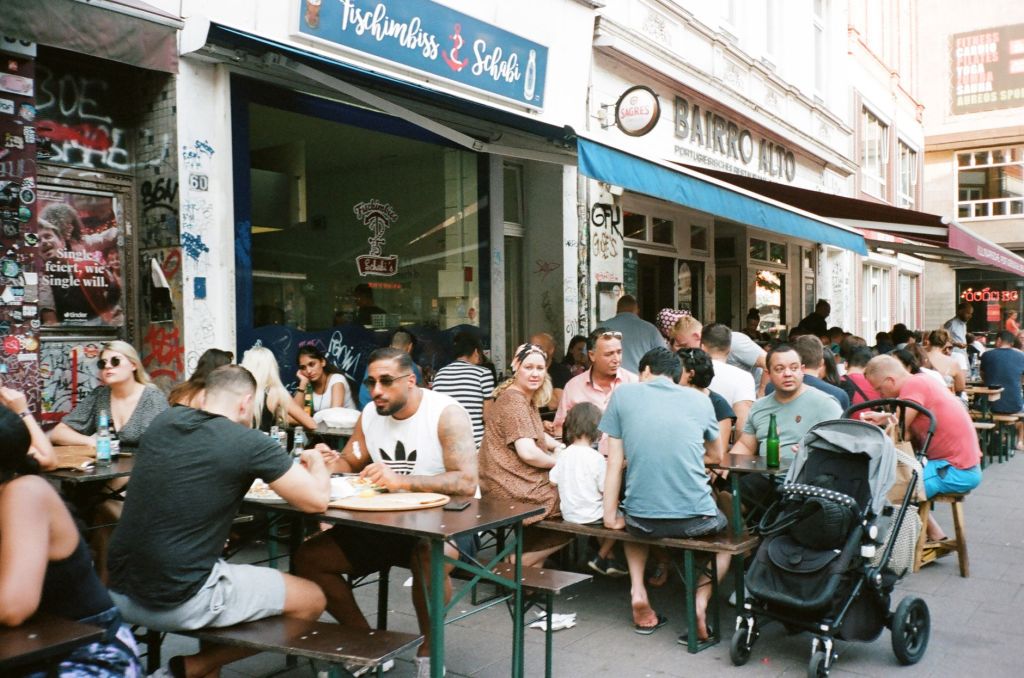
    You open the door and hear the glorious racket of human appetite. Forks strike plates. Coffee cups land on saucers. Children negotiate syrup distribution. Servers weave between tables carrying platters of eggs and potatoes. The room smells of coffee, butter, toasted bread, maple syrup, and potatoes surrendering magnificently to the griddle.

    Every table is occupied.

    A line waits outside.

    This is not merely a restaurant.

    This is evidence.

    I call it Breakfast Eschatology: the abandonment of speculation about ultimate salvation in favor of recognizing modest intimations of heaven in the communal celebration of a magnificent breakfast.

    For years, I have worried about the Last Things.

    What happens after death?

    What is the nature of original sin?

    What are the rigors of postmortem salvation? 

    What did the Greek word aiōnios mean before two thousand years of theology climbed onto its back?

    At some point, the soul develops theological indigestion.

    Enough.

    Bring me the poblano eggs Benedict.

  • Carlsbad’s Shadow, Oceanside’s Soul

    Carlsbad’s Shadow, Oceanside’s Soul

    We spent a few days in Carlsbad at the Hotel Solea. Aside from the sublime crepes at The French Corner and the infectious energy of surfers drifting through town with boards tucked under their arms, the place left me strangely cold. Carlsbad struck me as polished to the point of sterility, a resort town forever orbiting the gravitational pull of Legoland. Everywhere you looked, there were souvenir shops, family vacation logistics, and the unmistakable soundtrack of overtired toddlers conducting negotiations at full volume. The town seemed suspended in a permanent state of cheerful tourism.

    Then, on the drive home, we traveled fifteen minutes north on Interstate 5 and discovered Oceanside.

    The difference was immediate.

    Instead of curated resort charm, Oceanside possessed the rough confidence of a town that exists for the people who actually live there. We wandered into The Beach Break Cafe, tucked beside a residential neighborhood, where every table seemed occupied by people who looked genuinely happy to be exactly where they were. Nothing about the place felt manufactured. There was no Instagram choreography, no designer rusticity, no desperate attempt to convince diners they were enjoying an “authentic experience.” It simply was authentic.

    More importantly, they don’t phone in breakfast.

    They treat eggs, pancakes, and French toast with the seriousness of a Michelin chef preparing foie gras. The omelets were generously stuffed without collapsing into greasy excess. The French toast achieved that elusive balance of crisp edges and custardy center. The whole-grain banana pancakes possessed a nutty richness that made them taste less like indulgence than craftsmanship.

    The manager—a fit man in his thirties with a neatly trimmed beard and a weathered gray baseball cap—told me he had taken over the restaurant from his father. Born and raised in Oceanside, he spoke about the community with the quiet pride of someone who had no desire to escape it. He mentioned that elite fighters from Camp Pendleton regularly come in for breakfast. After one bite, I understood why. If your profession involves throwing another human being across a room, this is precisely where you’d replenish your glycogen stores.

    That conversation crystallized the difference between the two towns.

    Carlsbad feels like milquetoast chic: affluent, immaculate, and carefully curated for visitors. Oceanside has working-class muscle. It doesn’t seem interested in impressing you. It simply gets on with the business of living. There is an honesty to that kind of place, a confidence that doesn’t require branding consultants or lifestyle influencers to validate it.

    Fifteen minutes separate Carlsbad from Oceanside.

    Culturally, they feel like different countries.

    I’ll take Oceanside.

  • My Adventures in Threshold Tourism

    My Adventures in Threshold Tourism

    You insist on living near the ocean, but not because you have any romantic desire to surf, bodyboard, or frolic in the waves like a sunscreen commercial. The beach serves a higher purpose. It calms you simply by existing. You need to smell the salt air, hear the muffled percussion of the surf, and watch the horizon dissolve into infinity. What you do not need is to step into the Pacific’s suspicious broth of runoff, seaweed, sunscreen residue, and whatever else civilization has politely donated to the tides. Nor do you wish to experience the tactile indignity of sand infiltrating every crevice of your body, clothing, luggage, and soul. During vacations in Oahu or Miami, you dutifully reserve a room overlooking the beach, then spend the day luxuriating beside the resort pool, periodically glancing toward the ocean with profound gratitude that you are not actually in it.

    Deserts present a similar paradox. From a safe distance they possess a cinematic grandeur, a landscape sculpted by eternity itself. Up close they reveal themselves to be an elaborate rehearsal for the apocalypse. Every cactus appears armed, every rock radiates hostility, and every gust of wind feels like the opening chapter of Mad Max. Your lips chap. Your skin shrivels. Your eyeballs seem to lose moisture by the minute. After forty-eight hours you become convinced you are quietly mummifying while still alive.

    Snow fares no better. Others speak reverently of winter wonderlands. You see an aggressively inhospitable climate masquerading as a Christmas card. Snow closes roads, freezes lungs, transforms ordinary errands into survival expeditions, and renders every hillside one unfortunate sneeze away from an avalanche. Even aesthetically it disappoints. An endless field of white is less majestic than monotonous, as though nature had forgotten to finish painting the landscape. Icicles, meanwhile, look less like decorations than nature’s collection of sharpened stakes awaiting an unfortunate passerby. One of your life’s quiet triumphs has been constructing a life that requires almost no interaction with snow whatsoever.

    Instead, you are captivated by what you call Unicorn Cities—those mythical communities that seem to have discovered the cheat code to geography. They enjoy unusually pleasant weather, attract unusually decent people, and somehow escape the afflictions suffered by neighboring regions. Port Angeles occupies a privileged place in this private mythology. Nestled within Washington’s Banana Belt, it promises milder temperatures than logic suggests it deserves. You are endlessly fascinated by it. You consume photographs, weather reports, and travel videos with almost devotional enthusiasm. Yet you have no real desire to go. Visiting would replace imagination with reality, and reality almost never survives comparison with imagination.

    So congratulate yourself for remaining loyal to your quiet corner of Southern California, where you leave town only reluctantly, tan in your own backyard for fifteen minutes a few afternoons each week, and venture to Hawaii or Miami once or twice a year merely to sit beside an immaculate swimming pool while gazing at the ocean from a respectful distance.

    You are, after all, a Threshold Tourist.

    A Threshold Tourist prefers to remain at the edge of an experience rather than surrender to it, extracting its beauty, symbolism, and emotional nourishment while politely declining its inconveniences. The destination is not meant to be conquered or consumed. It is meant to be contemplated. Paradise, in your estimation, is best appreciated from the balcony.

  • The Great E-Bike Menace

    The Great E-Bike Menace

    I live in Torrance, where over the past few years I have watched an invasive species establish itself on our streets: the teenage e-bike rider. They dart through traffic at unpredictable speeds, weave between cars as though participating in an unauthorized video game, perform wheelies in busy intersections, blow through stop signs with religious devotion, and occasionally taunt motorists who have the misfortune of sharing the road with them. Most appear blissfully unaware of the danger they create. A smaller but more troubling minority seem fully aware and simply do not care.

    The problem has steadily worsened. A few months ago, during a night of heavy rain, I watched three teenage e-bike riders navigate the intersection of Torrance Boulevard and Anza Avenue. The roads were slick, visibility was poor, and the conditions were dangerous even for experienced drivers. Yet there they were, riding through the storm with the confidence of young people who have not yet learned that physics is undefeated.

    For that reason, I was not surprised to read Salvador Hernandez’s Los Angeles Times article, “California’s New Hell’s Angels: Teens on E-Bikes Cut a Path of Danger.” Hernandez describes much of what residents like me have witnessed firsthand. Among the incidents he recounts is the death of an elderly man who was struck by a fourteen-year-old riding recklessly on an e-bike. The problem has grown serious enough that law enforcement agencies are developing specialized responses. Police departments have begun cracking down on illegally modified e-bikes that exceed state regulations, and in Orange County authorities have created dedicated task forces to pursue dangerous riders.

    Many parents remain unaware that California recognizes three distinct classes of e-bikes.

    Class 1 bikes use pedal assist only and have a maximum speed of twenty miles per hour. They are permitted for riders of all ages and require helmets.

    Class 2 bikes combine pedal assist with a throttle and are also limited to twenty miles per hour. They too are available to riders of all ages and require helmets.

    Class 3 bikes use pedal assist and can reach twenty-eight miles per hour. Riders must be at least sixteen years old and wear helmets.

    All three classes are required to display a visible label identifying their classification, though one suspects that some of today’s young speed merchants regard regulatory labels with roughly the same respect they show stop signs.

    Like many public-safety problems, this one seems destined to become worse before it gets better. Driving in Los Angeles was already a test of patience before the arrival of the e-bike era. The city had long mastered the arts of congestion, stress, discourtesy, and occasional road rage. The addition of e-bikes has introduced a fresh layer of chaos. Every morning when I drive my daughters to school, I encounter a gauntlet of obstacles: teenagers weaving through traffic, ignoring traffic laws, and treating the safety of others as an optional consideration.

    The irony is that e-bikes themselves are not the problem. Used responsibly, they are efficient, economical, and environmentally friendly. The problem is the culture that has developed around them—a culture that often treats traffic laws as suggestions and regards reckless behavior as a form of entertainment.

    Where I live, pulling to the side of the road for emergency vehicles is a routine occurrence. We have both Little Company of Mary and Torrance Memorial nearby, and sirens are part of the local soundtrack. Perhaps the increase in emergency activity has nothing to do with e-bikes. Perhaps it is merely my imagination. But after watching teenagers launch themselves through intersections on machines capable of twenty-eight miles per hour while possessing the judgment of teenagers, I cannot help suspecting that at least some of those sirens are chasing the inevitable consequences of youthful overconfidence meeting the laws of motion.

  • The Man Who Collected Timepieces and Ignored Time

    The Man Who Collected Timepieces and Ignored Time

    For more than twenty years, I lived inside the watch hobby like a man living inside a museum—reverent, obsessive, and curiously uninterested in the exhibits’ stated purpose. I rotated Seiko divers, admired their dials like stained glass, felt their rotors hum like distant machinery—and barely cared what time it was. That’s the joke with teeth: the one function watches exist to perform was never the center of my fixation. I wasn’t tracking time. I was courting it. Romance, nostalgia, the giddy satisfaction of gears responding to my wrist’s movement—those were my currencies. Timekeeping was just the pretext.

    G-Shock, in that world, was vulgar. Too digital. Too close to the smartwatch species I distrust—the glowing, needy devices that feel less like tools and more like supervisors. A G-Shock belonged on a mannequin posed mid-adventure, not on a human being trying to convince himself he possessed taste.

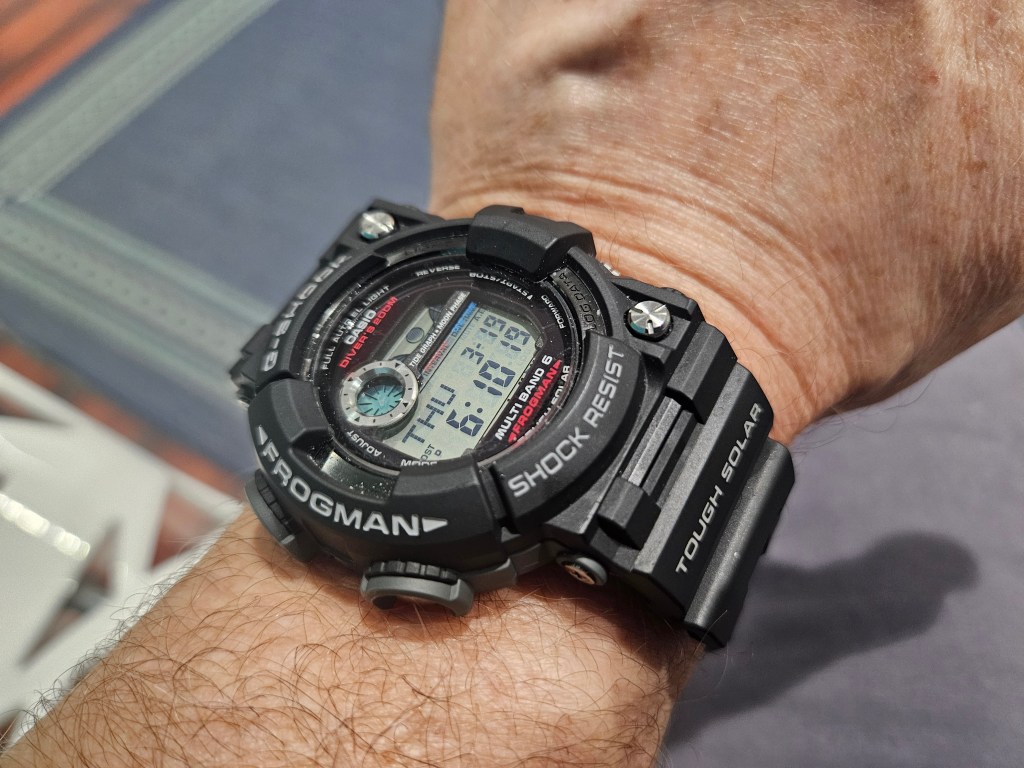
    And yet, sometime around 2010, the Frogman GWF-1000 slipped past my defenses. That asymmetrical case had a crooked charisma, like a boxer with a broken nose who still wins fights. I’d think about it, then shut it down with the usual litany: plastic, digital, not my tribe. I repeated those lines for years, the way a man repeats vows he secretly hopes to break.

    About a month ago, something in me stopped negotiating. The impulse didn’t arrive politely; it landed like a fever. I ordered the Frogman from Japan and watched it crawl through customs as if it were being interrogated for treason. Three weeks later, it showed up. I strapped it on.

    And there it was—presence. Not the polished, self-conscious presence of a luxury diver, but a blunt, physical authority. It didn’t ask for admiration. It assumed compliance.

    Then came the real disruption: Tough Solar and Multiband-6. Set it and forget it—except you don’t forget it, because it quietly corrects you. The watch syncs itself to atomic time, and suddenly you are no longer negotiating with approximation. You are pinned to reality. No drift, no romance, no mechanical shrug. Just accuracy, arriving nightly like a silent auditor.

    I didn’t expect the psychological effect. Being anchored to exact time produced a strange calm, the way a well-balanced diet makes you realize how erratic you’ve been eating. My mechanical divers—beautiful, expensive, lovingly chosen—never gave me that. They gave me narrative. The Frogman gave me certainty.

    The numbers didn’t help the old regime either. Five hundred dollars for the Frogman. A little over a hundred for the GW-7900 Rescue. Both delivered the same atomic truth. Meanwhile, my divers sat there—two, three times the price—offering charm, yes, but also drift, maintenance, and the faint suspicion that I’d been paying for the idea of precision rather than precision itself.

    Before I start sounding like a late-night infomercial for resin and radio signals, I need to detour—briefly, and deliberately—to a song that used to haunt my teenage gym sessions: “You Light Up My Life” by Debby Boone. It would float through the speakers while I benched and curled, all syrup and sentiment, and it filled me with such irritation that I lifted harder just to drown it out. The song wasn’t just bad; it was suffocating in its insistence on emotional purity.

    This matters because the watch hobby is full of that same conversion energy. The language of revelation. The before-and-after testimony. And men, in particular, are suckers for it.

    We don’t adopt hobbies; we convert to them. We don’t adjust our diets; we declare them. We don’t experiment; we renounce and rebuild. One week it’s mechanical purity, the next it’s quartz precision, then solar enlightenment. Each shift arrives with the force of a Damascus-road epiphany, complete with blind spots and overconfidence.

    I know this pattern because I’ve lived it—in watches, in fitness, in every arena where identity can be strapped on, laced up, or swallowed. Men love absolutes. We love the feeling of total overhaul. We love the idea of the metamorphosis so much we may have a figurine on our desk: Thing or Megatron–icons of brute conversion. We mistake intensity for clarity and call it transformation.

    So when I talk about G-Shock, I have to keep one hand on the brake. Because “being anchored to Real Time” has the flavor of conversion, and conversion is intoxicating. It makes you want to declare the past obsolete and the present definitive. It turns a purchase into a philosophy.

    And yet—facts remain stubborn. I’m typing this wearing the GW-7900 Rescue. Tomorrow will be the Frogman. The next day, back to the Rescue. The mechanicals sit in their box a few feet away, arranged with care, untouched—like last year’s tax documents: important, preserved, and no longer consulted.

    That doesn’t make G-Shock a religion. It makes it a correction. Whether I treat it as one or the other will determine whether this is clarity—or just another episode in a long history of well-dressed delusion.

  • Aura Farming in the Age of the Priority Pass

    Aura Farming in the Age of the Priority Pass

    Zach Helfand’s New Yorker piece “The Airport-Lounge Wars” reads like the natural sequel to John Seabrook’s “How the Sports Stadium Went Luxe.” Both writers chart America’s drift into a soft feudalism—an economy built on velvet ropes, curated vanity, and the tyranny of creature comforts. Exclusivity is our reigning civic religion. Helfand opens with a thesis as blunt as a boarding announcement: “Airport lounges are about who gets in and who does not.” In today’s America, you must cultivate an aura—what my teenage daughters call “aura farming,” the strategic cultivation of mystique, importance, and manufactured nonchalance. Airports have become the perfect stage for this theater of status. You either inhabit the drab terminal with its cracked vinyl seats and public coughing contests, or you ascend to the glowing Xanadu behind frosted glass. My own family acts out the class divide: my wife and daughters breeze through TSA with their PreCheck halos while I shuffle through the cattle chute, sacrificing my bottled water, removing my belt, and enduring laptop shaming before rejoining them, a humbler, poorer man.

    These airport Xanadus have grown so seductive that some travelers go full pilgrim. One Malaysian businessman, drunk on his Priority Pass privileges, missed his flight to Kuala Lumpur and drifted through lounges for eighteen days, forging boarding passes like a monk copying sacred texts—until he was arrested and relocated to the Prison Lounge, where the amenities are famously lacking.

    Wanting a taste of this strange devotion, Helfand spent a week touring New York’s airport lounges with his own Priority Pass. At the HelloSky Lounge at JFK, he marinated in what historian Kevin James calls “an enhanced experience of stasis.” Translation: high-thread-count boredom. Even this, Helfand notes, is aspirational—CBS travel editor Peter Greenberg says lounges aim for nothing more noble than inspiring customers to murmur, “Well, it’s better than nothing.” Indeed, the holy trinity of “better than nothing” turns out to be fruit-infused water, padded leather walls, and chandeliers in the bathroom. Civilization marches on.

    Airports are designed to grind the soul down to a nub, so perhaps this “slightly better than nothing” aesthetic is our cultural Valium. A tranquilizer bubble for people waiting to be herded onto aluminum tubes. Pay the fee, flash the pass, and anesthetize the existential dread of a three-hour layover. As Helfand puts it, “Waiting can make one feel needy, like a baby.” Maybe that’s why lounges feel like nurseries for adults: dim lighting, soft chairs, snacks within arm’s reach. The more infantile we become, the grander the titles on the door—V.I.P., Admiral, Ambassador. It’s a fantasy nobility designed to distract us from the truth: we are tired, displaced, sleep-deprived, and longing for our beds, our routines, and—let’s be honest—our blankies.

  • Kettlebells, Clorox, Waikiki Dread, and the Need to Reread Ariel Leve’s An Abbreviated Life

    Kettlebells, Clorox, Waikiki Dread, and the Need to Reread Ariel Leve’s An Abbreviated Life

    At nearly sixty-four, I still work out like a man who thinks death is watching from the corner of the garage, arms crossed, waiting to pounce the moment I skip a kettlebell swing. I train with the same primal urgency I felt at thirteen—when muscle equaled safety, and soreness meant I still mattered. I think about workouts. I talk about them. I bore people to death with unsolicited fitness manifestos. My obsessions are a carousel of age, mortality, exercise, oatmeal breakfasts, French-press coffee, and a pathological resistance to anything resembling leisure, especially vacations.

    Which brings me to now: it’s Sunday, and in a few hours my wife’s friend will drive us to LAX so we can board a United flight to Oahu. I should be thrilled. I’m not. I feel like a hostage in my own well-appointed life. I’m going only because family life requires the occasional sacrifice—and this is mine. A three-night stay at the Embassy Suites in Waikiki Beach. Palm trees. Breezes. Ocean sunsets. All of it unnerves me. I want to be helpful, gracious, even grateful—but I am a neurotic, OCD-addled man-child in a do-rag who agonizes every morning over which chunky diver watch to wear, like I’m prepping for surgery on the space-time continuum.

    I do not want to be the dead weight on this trip.

    Still, I try to prepare. My comfort rituals are in full swing. We’re packing two memory foam pillows because hotel pillows have the spinal integrity of a wet napkin. I created a “Travel Checklist” yesterday with over 30 items. My wife flagged two of them—Clorox gel and a scrub brush—and asked why I intended to pack janitorial supplies. “To disinfect the hotel shower,” I said. She told me I’m crazy. Scratch that from the list.

    We’ll land around eleven tonight, pick up the rental car, check in, visit ABC Store #38—because no Hawaii trip is complete without wandering into an ABC Store to buy bottled water, toothpaste, and the spiritual reassurance that you haven’t forgotten something vital. Then we’ll sync our devices to the hotel WiFi, maybe sit on the bed and stare blankly at the TV for twenty minutes before collapsing into our pancake pillows (if the foam ones failed to survive the suitcase crush). By the time I feel vaguely human, it will be midnight.

    And just like that, the countdown begins.

    We fly back Wednesday. Back to LAX. Back to my routine. By Thursday morning, I’ll be at Trader Joe’s shopping for groceries, then in the garage doing kettlebell swings to reassert my identity as a disciplined, slightly unhinged older man who treats a three-day vacation like a stint in exile.

    My wife’s friends raised their eyebrows when they heard how short the trip is. “That’s all my husband can take,” she told them. I felt seen and exposed all at once. It hit me while writing this: it really is a short trip. I feel guilty for being the reason we trimmed it down to a long weekend. And yet—I’m also relieved. Too much freedom, too much unstructured joy, and I begin to unravel. I need my routines. I need the Mothership. Without them, I drift.

    I’m reminded of a memoir I read nine years ago and plan to reread after this trip: An Abbreviated Life by Ariel Leve. It’s about surviving childhood under the tyranny of a narcissistic, chaotic mother. Leve writes with scalpel precision about how chronic trauma rewires the brain, how the child adapts with emotional detachment and hypervigilance, and how adulthood becomes a performance of normalcy built on damaged circuitry. Her memoir is unsentimental, razor-sharp, and achingly honest. I admire her. In some cracked mirror, I recognize myself.

    When I return from Oahu, I’ll dig up my old copy of her book. It’ll be the perfect homecoming gift—a reminder that healing is a long-haul flight, often with delays, turbulence, and very bad pillows.

  • Royal Palm Mirage: A Midlife Fantasy in Flip-Flops

    Royal Palm Mirage: A Midlife Fantasy in Flip-Flops

    I am in agony—real, soul-bruising agony—because for the past few months, I have been drunk on the seductive fumes of a dream: early retirement in Royal Palm Beach, Florida. Not Palm Beach proper—no, that would be too garish, too Gatsby. I mean the inland cousin, fifteen humid miles from the Atlantic, nestled inside a gated community with a neighborhood pool, a bubbling hot tub, and the promise of palms swaying while my family lounges like extras in a Jimmy Buffett fever dream.

    This fantasy has infected my sleep, crept into the margins of my Google Maps history, and left me hypnotized by listing photos of stucco homes with outdoor ceiling fans and screened-in lanais. I dared to believe I could trade my overworked California existence for a new life—a life of 5 a.m. swims, grocery runs in flip-flops, and the quiet joy of hearing my daughters say, “I’m bored,” while floating in chlorinated bliss.

    And then—smack. My wife crushed the dream with one phrase: “Florida’s a big no.”

    Just like that, the mirage dissolved. I am at the age—let’s not name it—where the idea of fleeing to a tropical holding cell with reliable AC and an HOA that enforces silence after 9 p.m. sounds not just reasonable but romantic. But maybe that’s the trick. Maybe Florida isn’t salvation. Maybe it’s a siren song crooned by real estate agents with perfect teeth and mosquito-resistant tans.

    Next week we fly to Oahu, and yes, I hope my family finds some version of the enchantment I’ve been chasing. But let’s be honest: deep in the humid corners of my heart, I’ll still be yearning for Royal Palm Beach—a gated Eden with pool rules and a hot tub that works.

  • The Jungle, the Bigfoot, and the Fan Man Cometh

    The Jungle, the Bigfoot, and the Fan Man Cometh

    Last night I dreamed I was deep in the jungle—not metaphorically, mind you, but the kind you’d find on a Nature Channel special narrated by a vaguely concerned Brit. I wasn’t alone. Beside me stood a woman zookeeper in full khaki safari cosplay, complete with binoculars and a steel gaze. We weren’t observing wildlife—we were at war. The prize? A sprawling jungle compound. The opponent? A hulking, glowering Bigfoot-like brute who looked like he’d crawled out of my Neanderthal ancestry with unresolved issues and a gym membership.

    It was a reality show, naturally. Cameras everywhere. High stakes. Death possible. Maybe probable.

    What shocked me wasn’t the premise—it was me. I watched myself morph from suburban dad into a primal tactician, a creature with cunning in his marrow and bloodlust behind his bifocals. The zookeeper and I didn’t stand a chance physically, but we were shrewd, dirty-fighting strategists. While the beast snorted and stomped like a sentient linebacker, we set a trap—an elegant, jungle-engineered booby trap. And it worked. Bigfoot fell. Cue commercial break. Cue confetti.

    Victory was ours.

    But I, ever the responsible homeowner, sold my half of the prize to the zookeeper in exchange for a wad of cash and a sense of capitalist purpose. I left the jungle compound behind and made my triumphant return not to glory—but to shopping.

    I hit the beachside bazaar with missionary zeal, eyes blazing, nostrils flaring with sea air and consumer ambition. My quarry: fans. Tower fans. Desk fans. Oscillating fans. Fans with remotes, timers, and multi-speed whisper motors. Each vendor pitched their product like they were auditioning for Shark Tank. I nodded sagely as an assistant loaded box after box into a truck like I was provisioning for the end times—but with superior airflow.

    I had ventured into the heart of darkness, found my inner beast, won the battle, and returned not with enlightenment or moral clarity—but with high-performance climate control.

    In the dream’s strange logic, it made perfect sense. I had confronted the savage within, and now, armed with cutting-edge ventilation, I would cool the tempers of suburban life.

    This, apparently, is my idea of spiritual integration.