Tag: blog

  • G-Shock Atomic Time Is Too Perfect to Talk About

    G-Shock Atomic Time Is Too Perfect to Talk About

    I’m reluctant to make a video about my G-Shock saga and how atomic time cured me of my restless quest for timekeeping.

    That’s not a boast. It’s a problem.

    In a hobby that runs on dissatisfaction—the faint itch that your mechanical watch is almost right but not quite—content thrives on unrest. There’s always another model to chase, another micro-adjustment to obsess over, another reason to believe the next acquisition will finally close the gap. Discontent is the engine. It powers the reviews, the comparisons, the late-night rationalizations dressed up as research.

    And then along comes atomic time, which does something unforgivable: it removes the gap.

    My G-Shocks are correct. Not “close enough,” not “within spec,” but correct in a way that leaves nothing to argue about. The second hand doesn’t drift. The numbers don’t wander. The watch does its job with a kind of quiet authority that makes further discussion feel like talking to fill the silence.

    That silence is the problem.

    Because what, exactly, am I supposed to say now? I can’t keep making variations of the same video—“I’m still happy,” “Still accurate,” “Nothing has changed except my continued satisfaction.” That’s not content. That’s a man reporting, week after week, that the sun rose on schedule.

    Making such a video would amount to a confession: the story has reached its logical conclusion. The quest for perfect timekeeping—the narrative arc that justified the channel—has ended, not with a triumphant crescendo, but with a polite, digital beep.

    And endings are bad for business.

    The only way forward would be to pivot—to talk about something other than watches. But let’s be honest: people didn’t subscribe for my thoughts on life, philosophy, or the alarming moral implications of oatmeal. They came for watches. Leave the watches behind, and you risk discovering that the audience was never there for you—only for the object you orbited.

    So yes, making such a video is terrifying.

    Not because it’s difficult to make, but because it points, with uncomfortable clarity, to my limitations. It suggests that I’ve solved the very problem that made me interesting to watch. It hints—quietly but persistently—that the channel may have been a story with a natural endpoint all along.

    And I’m not sure I’m ready to film that ending.

  • Two Hours in a Hotel Room: My Mechanical Watch Purgatory

    Two Hours in a Hotel Room: My Mechanical Watch Purgatory

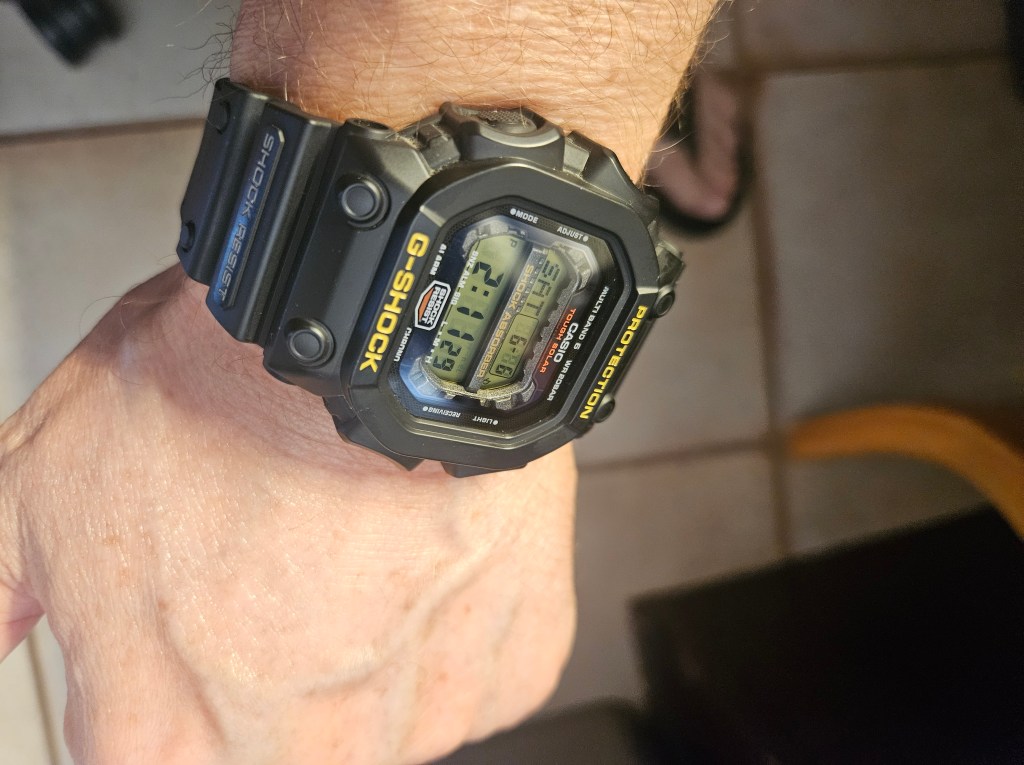
    At night, I go to bed wearing one of my Tough Solar, Multiband-6 G-Shocks. When I wake up, it’s still there—quietly correct, indifferent to my dreams. I make coffee. I eat porridge fortified with protein powder, as if I’m feeding a machine that happens to have a pulse. I write. I take my daughters to school. I return home, sit at the piano, and tap out something halfway between discipline and distraction before changing into workout clothes.

    Then the ritual begins.

    Before I train, I remove the G-Shock and place it—carefully, almost ceremonially—into an open ceramic butter dish. Inside are two watch pillows, like small upholstered altars. I set the dish by the living room window, perched on actual pillows, and let the watches drink sunlight. I don’t charge them. I feed them. They sit there absorbing photons like obedient livestock while I sweat through my penance.

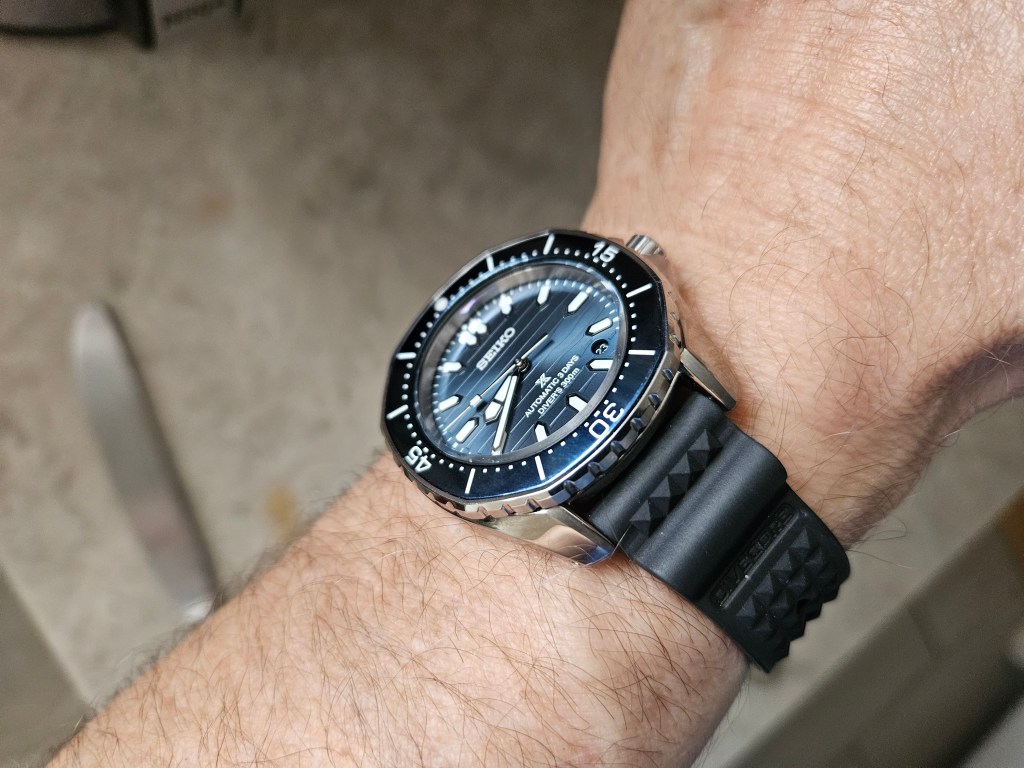
    After the workout, after the shower, after lunch, I leave the G-Shocks at the window, basking in their solar feast, and I reach for a mechanical Seiko diver. This is where things get strange.

    I wear the mechanical for my nap.

    Not because I prefer it. Not because I need it. But because I feel I owe it something.

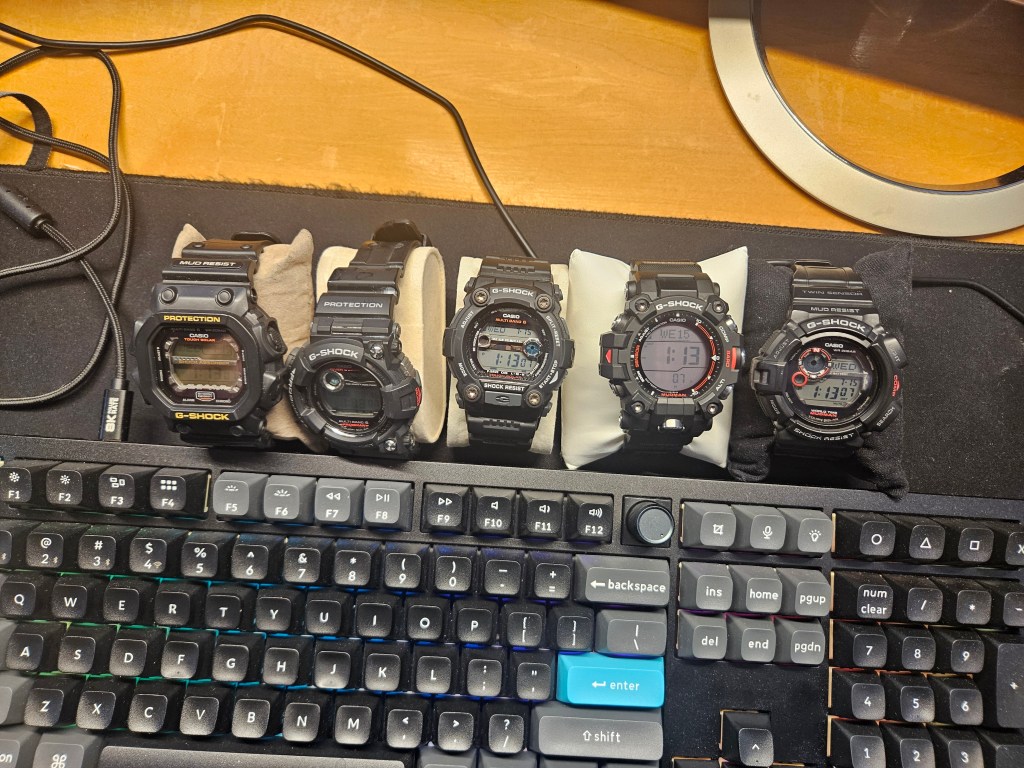
    For two hours, I strap on a relic of my former life—polished steel, automatic movement, the old romance of gears and springs. I rotate through four of them, day after day, as if fulfilling a contractual obligation. They sit on my wrist like ghosts with good machining.

    And then I take them off.

    I return to my G-Shock the way a traveler returns home after a brief, awkward stay in a hotel. The mechanical watch is the Holiday Inn—clean, respectable, vaguely unsettling in its impermanence. I check out after two hours, hand in the key to a staff member in the hotel lobby, and fly back to where I actually live: atomic time, solar power, numbers that tell the truth without flourish.

    Something happened to me. I can feel it, but I can’t fully explain it yet.

    For twenty years, I was immersed in mechanical dive watches. Not casually—devotionally. They were objects of study, desire, identity. And now, when I look at them, I don’t feel longing. I feel… residue. A faint aftertaste of something that once promised more than it could deliver.

    Pain might be too strong a word. But it’s in the neighborhood.

    I find myself wondering if addiction—because let’s stop pretending it wasn’t that—is less about pleasure and more about escape. About trying to solve something internal with something external. A watch becomes a talisman, a small, gleaming object that whispers: This will fix it. This will complete you.

    It never does, of course. It just resets the hunger.

    Maybe that’s what I’m processing now. Not just the watches, but what they stood in for. The idea that acquiring the right object could quiet something restless inside me. The belief that completion was one purchase away.

    Now I’m in a strange in-between state. Not fully attached to the old world, not entirely settled into the new one. The two-hour mechanical watch session feels like a concession—an obligation to a former self I haven’t fully buried. It’s polite. It’s controlled. It’s also faintly absurd.

    The G-Shocks, by contrast, feel like clarity. They don’t seduce. They don’t promise transcendence. They just tell the time—accurately, relentlessly, without commentary. And for now, that’s enough.

    But I don’t fully understand what’s happened to me yet.

    Give me a year.

    I suspect I’ll have a better answer—or at least a more honest question.

  • Take a Year Off Buying Watches—And See What’s Left

    Take a Year Off Buying Watches—And See What’s Left

    Daniel Samayoa and I met at several watch meet-ups in Long Beach, just outside Mimo’s Jewelry. We quickly discovered a shared fascination not only with watches themselves, but with the strange ways timepieces take hold of the mind. With that in mind, Daniel offers a guest post for my blog Cinemorphosis, examining the psychology of watch addiction and the habits that keep collectors in its grip:

    At a certain point, the habit stops being a hobby and starts looking like compulsion dressed up as enthusiasm.

    We all like new watches. We also all like taking a good shit. That doesn’t mean you should do it ten times a day and call it a hobby.

    The same principle applies to watch collecting. Just because you feel the urge doesn’t mean you need to act on it. That “great value” diver you just discovered—the one you’re convinced is different this time—will likely be worn twice before it disappears into the padded anonymity of your watch box.

    And that’s the problem.

    You tell yourself you’re building a collection, but what you’re really doing is chasing a small hit of excitement with every purchase. The watch isn’t the point. The transaction is. The anticipation is. The brief illusion of completion is.

    Then it fades, and you’re back where you started.

    It shows.

    Some of you don’t have collections. You have accumulation—watch boxes that resemble clearance racks, full of pieces that once felt essential and now feel optional at best.

    Here’s a simple experiment: stop buying watches for a year. Not a month. Not a “cooling-off period.” A full year.

    A one-year hiatus isn’t punishment; it’s diagnostic. When you remove the option to buy, you strip away the easiest form of self-distraction and force the habit into the open. The itch doesn’t disappear—it sharpens. You start to notice when it shows up: late at night, after a long day, in those idle gaps where boredom masquerades as curiosity. Without the relief of a purchase, you’re left to examine the mechanism itself—the rationalizations, the urgency, the quiet belief that the next watch will complete something that has never quite been defined. Over time, the noise subsides. What remains is clarity: which watches you actually reach for, what you value in them, and how much of your “collection” was built on impulse rather than need. The hiatus doesn’t take anything away. It reveals what was never there to begin with.

    More importantly, you’ll be forced to confront what you actually enjoy wearing. Not what impressed you in a YouTube review. Not what felt like a smart deal. The watches that earn wrist time—the ones that fit your life without effort.

    If you own nineteen watches and rotate through four, then you already have your answer. The rest are noise.

    The next time the urge hits, pause. Ask a direct question: does this watch have a clear role in my collection, or am I just bored and looking for stimulation?

    That question alone will eliminate most purchases.

    Then take it one step further: sell what you don’t wear. Not someday. Not when the market is better. Now.

    What remains won’t just be smaller—it will be coherent. Intentional. Yours.

    Because most people don’t need another watch.

    They need restraint.

    And a watch box that reflects decisions, not impulses.

  • Seven Watches Have Made Me Contemplate the Tyranny of Want

    Seven Watches Have Made Me Contemplate the Tyranny of Want

    I was raised to believe that wanting something was reason enough to have it.

    Not a suggestion. Not a temptation. A principle.

    In the 60s and 70s, appetite was rebranded as intelligence. If you knew how to indulge—food, gadgets, experiences—you weren’t weak. You were evolved. The man who said no looked like a malfunction: tight-lipped, joyless, possibly afraid of his own shadow.

    The rest of us were out there chasing pleasure like it was a civic duty.

    And I didn’t just participate—I specialized.

    I built a life around calibrated indulgence. Watches, food, stimulation. I didn’t impulse-buy; I strategized. I had rotations, hierarchies, justification frameworks. I could explain any purchase with the calm authority of a man who had already made the purchase.

    Which is why it’s unsettling—borderline alarming—that I now feel relief that my watch collection is down to seven.

    Seven.

    At one point, seven watches would have been the warm-up act. Now it feels like silence after a fire alarm. Manageable. Contained. Almost peaceful.

    Out of curiosity, I tried to imagine adding just one more watch.

    Not buying it—just imagining it.

    Within seconds, I felt the familiar anxiety spool up: Where does it fit? When do I wear it? What does it replace? What problem is it solving that doesn’t exist?

    That’s when the illusion cracked.

    What I used to call “expanding the collection” was actually expanding the burden.

    Which led to a thought I’ve spent most of my life avoiding:

    What if self-denial isn’t deprivation?
    What if it’s relief?

    This idea runs against decades of conditioning. My instincts are trained like a high-performance lab animal: stimulus, response, reward. See it. Want it. Acquire it. Repeat until the dopamine system starts filing complaints.

    And yet the results are undeniable.

    The next watch doesn’t calm me—it destabilizes me.
    The next meal doesn’t satisfy me—it expands me.
    The next YouTube video doesn’t enlighten me—it hooks me into a slot machine where the jackpot is always one more spin away.

    Different behaviors. Same engine.

    I’ve spent years obeying impulses that don’t know how to stop—and calling that freedom.

    Now I’m starting to see it for what it is: a feedback loop that promises satisfaction and delivers agitation.

    So I’m experimenting with a radical intervention.

    Not buying the watch.
    Not eating the extra food.
    Not clicking the next video.

    It sounds trivial. It feels trivial. But it isn’t.

    Because when you interrupt the impulse—even once—you discover something unexpected: nothing collapses. The urgency fades. The world keeps spinning. You’re still here.

    And in that small gap between wanting and doing, something rare appears.

    Control.

    Self-denial, it turns out, is not a punishment. It’s leverage.

    It’s the ability to step between impulse and action and say, “Not this time.” It’s the quiet refusal that breaks the loop. It doesn’t feel dramatic. It feels almost boring. But it works.

    Which raises a question I can’t quite shake:

    Why did no one make this case to me when I was younger?

    Or did they—and I dismissed it because it sounded like the philosophy of people who weren’t having any fun?

    Would I have listened? Or would I have reacted the way anyone reacts when you threaten their favorite addiction—with polite skepticism covering a deeper hostility?

    Tonight, the old circuitry is still humming.

    There’s hunger—not real hunger, but the kind that shows up after dinner with a marketing pitch.
    There’s restlessness—the urge to check something, watch something, consume something.
    There’s the gravitational pull toward the kitchen and the screen.

    I know how this ends.

    Stay up late, and discipline dissolves. You eat something unnecessary while watching something forgettable and go to bed slightly disappointed in both.

    So I try something different.

    Go to sleep.

    End the day before the impulses take over.

    It’s not heroic. It won’t trend. No one is going to applaud the man who defeated temptation by becoming unconscious.

    But it might be the smartest move I make all day.

    And still—because habits don’t die quietly—the voice is there, smooth as ever:

    I’ll deny myself.

    Just not yet.

  • Collector’s Paradox

    Collector’s Paradox

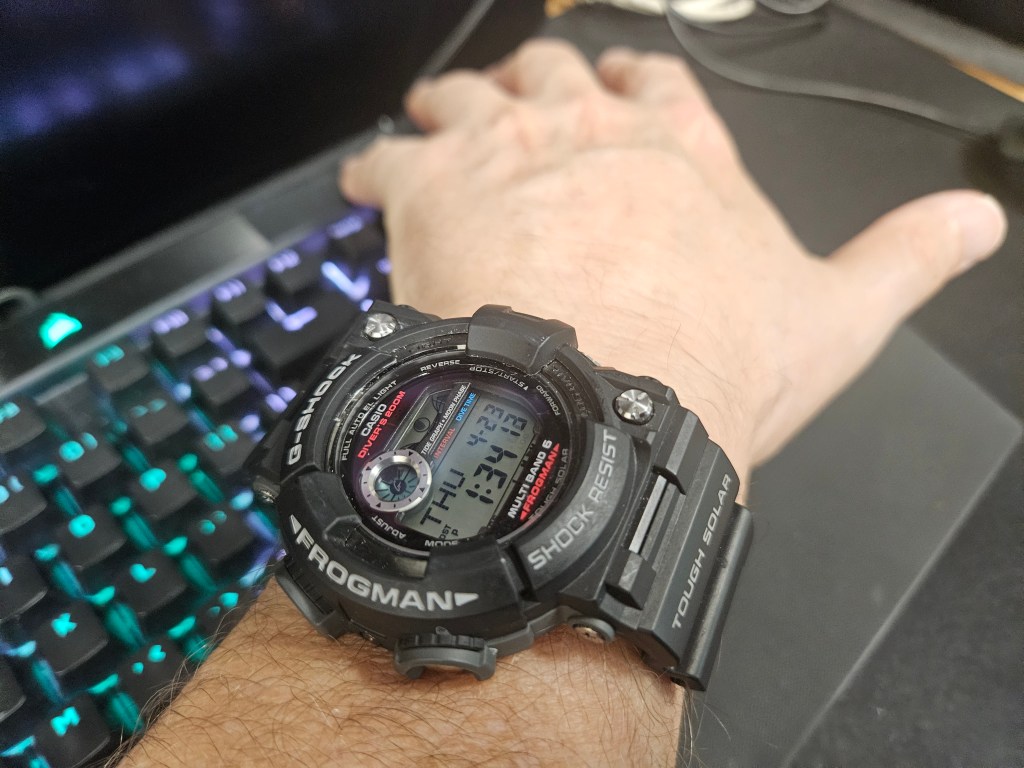
    I sometimes imagine the perfect end state of my G-Shock hobby: four watches rotating peacefully through my week like planets in a stable orbit. The lineup is already clear in my mind. The Frogman GWF-1000. The Rescue GW-7900. The Three-Eyed Triple Graph GW-6900. And the Frogman GWF-D1000B. Four machines, each with a distinct personality, each capable of carrying the entire hobby on its shoulders without needing help from a dozen cousins.

    In theory, that sounds like serenity.

    But there’s a catch.

    A modest four-watch rotation brings peace, but it also brings something else: the end of discovery. And discovery is half the fun. The moment the collection becomes complete, the hunt quietly packs its bags and leaves town.

    This is where the trouble begins.

    Inside my head two different personalities are negotiating, and neither one intends to surrender easily. One personality wants order. The other wants novelty. One wants a finished system; the other wants an endless frontier.

    The first personality is the Curator. The Curator wants a tidy garage with four perfectly chosen machines parked inside. He wants familiarity. He wants mastery. He wants watches whose buttons, modules, and quirks are so well known they stop feeling like gadgets and start feeling like companions. In the Curator’s world, the hobby becomes calm. Predictable. Comfortable.

    But the Curator’s paradise has a downside: once the system is finished, the hunt is over.

    And the hunt is intoxicating.

    That’s where the Explorer enters the picture. The Explorer lives for discovery. He watches reviews. He compares modules. He learns about obscure models produced in tiny Japanese batches fifteen years ago. He imagines how each watch might fit into his life like a missing puzzle piece. The excitement is not really about owning the watch—it’s about the possibility of it.

    Discovery delivers a small dopamine rush.

    But discovery has a hidden clause buried in the contract: every discovery whispers the same seductive suggestion—You should own this.

    When that suggestion is obeyed too often, the collection begins to swell. And when the collection swells, the hobby begins to generate friction. Watches compete for wrist time. Drawers fill up. Decisions multiply. The collection slowly transforms from a playground into an inventory system.

    The very activity that made the hobby thrilling begins to make it stressful.

    This is the Collector’s Paradox.

    Discovery is the fuel that powers the hobby. But discovery also leads to accumulation. Accumulation eventually produces clutter, decision fatigue, and the creeping sense that the watches are managing the collector instead of the other way around.

    To escape that stress, the collector dreams of a small, perfectly balanced collection—four watches rotating peacefully like a well-tuned engine.

    But here’s the paradox: the moment the collection feels complete, the discovery that made the hobby exciting begins to disappear.

    Discovery creates excitement but leads to accumulation.
    Restraint creates peace but risks boredom.

    And the collector finds himself standing between two competing instincts: the Curator, who wants a finished system, and the Explorer, who wants endless possibility.

    One way out of this trap may be to admit that I’m actually practicing two different hobbies at the same time.

    One hobby is ownership—the watches I actually live with. The small rotation that occupies my wrist and my watch box.

    The other hobby is exploration—the endless universe of watches I can study, admire, and analyze without needing to buy them.

    Separating those two activities may be the key to keeping the hobby alive without letting it metastasize.

    This is not easy in the world of G-Shock. G-Shock culture is a discovery machine. Hundreds of models. Endless colorways. Limited editions popping up like mushrooms after rain. The watches are affordable enough that buying one rarely feels catastrophic, and the community itself celebrates acquisition like a team sport.

    The Explorer inside a collector can run wild in that environment.

    But the fact that I’m even imagining a four-watch rotation suggests something interesting about where I am psychologically. The Curator inside me is gaining strength. Many collectors never reach that stage. They remain permanently trapped in the thrill of acquisition.

    The anxiety I’m feeling may actually be a sign that I’m trying to bring the hobby under control rather than letting it control me.

    And that leads to a possible next stage of the hobby: Observational Collecting.

    In Observational Collecting, curiosity and acquisition finally separate. Watches are still studied. Still admired. Still discussed. But they are no longer automatic candidates for purchase.

    The central question of the hobby quietly changes.

    Instead of asking, “Should I buy this watch?” I begin asking, “Isn’t that an interesting watch?”

    The curiosity remains alive, but the compulsion to acquire loosens its grip.

    Discovery doesn’t disappear. It simply stops demanding ownership as the price of admission.

    And if that shift finally takes hold, the hobby may achieve something collectors rarely experience.

    Peace.

  • Mechanical Atrophy Prevention

    Mechanical Atrophy Prevention

    I wear my G-Shock Frogman GWF-1000 almost every day. It has become the default setting of my wrist, the horological equivalent of gravity. Twice a week, however, I stage a small act of resistance. I slip on one of my Seiko divers. If I don’t, the Frogman will quietly suffocate the rest of the collection. It already has, to a degree. The moment I first strapped that Frogman on, it felt less like a purchase and more like a declaration: this watch had my name written across it in thick permanent ink. It fit my life with such ruthless competence that every other watch in the box began to look like an understudy waiting for a call that will never come.

    So twice a week I impose discipline. The Seikos get their turn. Think of it as horological cross-training. Most days I’m on the exercise bike or doing yoga, but I still force myself to swing the kettlebells twice a week so my muscles don’t dissolve into decorative noodles. The Seikos perform the same function. They are my defense against mechanical watch atrophy.

    This ritual belongs to what I call my Mechanical Atrophy Prevention program: the deliberate act of wearing a mechanical watch just often enough to preserve one’s emotional bond with gears, springs, and that hypnotic sweeping second hand. Without this intervention, the human brain quickly adapts to the ruthless efficiency of digital timekeeping. Soon you’re living in a world of solar charging, atomic synchronization, and clinical precision, and the charming little clockwork creatures in your watch box begin to feel quaint—like writing letters with a quill.

    Wearing the Seikos twice a week is my version of lifting weights so my body doesn’t evolve into an ergonomic office chair with legs. The practice keeps alive the fragile illusion that I am still a “mechanical watch person,” not a man who has quietly surrendered to the cold efficiency of quartz.

    Does this sound crazy to you?

    Welcome to my world.

  • Give Me Watch Sobriety—Only Not Yet

    Give Me Watch Sobriety—Only Not Yet

    If you think of yourself as a watch addict—someone whose hobby has drifted from interest into pathology—then you are probably also someone who longs for balance, for improvement, for a steadier inner life. You turn, as serious people do, to philosophy. Cicero’s Tusculan Disputations offers the promise: a tranquil soul, calmed by restraint and consistency. No distress. No fear. No desperate longing. No childish emotional swings. The happy man, Cicero suggests, is not the one who feels good, but the one who lives well.

    Then you look at your watch history and feel personally indicted.

    Restraint? You chased the perfect collection like a man hunting a mirage. Consistency? Your tastes pivoted with the emotional weather. Instead of tranquility, you endured the familiar cycle: anticipation, anxiety, justification, regret, and renewed desire. Twenty years of it. Even writing a book about the madness begins to look suspicious—less reflection than performance, a long-form version of hobby melodrama.

    You thought you had achieved peace. Seven mechanical divers. Stability. Closure.

    Then a G-Shock arrived.

    Then another.

    Like Augustine praying for chastity, the watch collector makes the classic promise:
    “Give me watch sobriety—only not yet.”

    The private bargain follows: One more watch, and the madness will be over.

    The promise is never kept.

    At this point, you have two options. You can keep prosecuting yourself for moral failure, or you can acknowledge a simpler truth: every hobby runs on enthusiasm, and enthusiasm always carries a trace of obsession. If you’re honest, part of this has been fun. But honesty requires the other admission as well: balance matters. An hour spent comparing G-Shock legibility is recreation. Losing an entire day to forums while your family heads to the beach without you is not enthusiasm. That’s displacement.

    So stop diagnosing yourself as diseased. You are not broken. You are wired this way. Some people chase golf swings. Some chase wine vintages. You chase watches.

    The real task is not suppression. It’s containment.

    This is where Guardrail Collecting begins.

    Guardrail Collecting allows your enthusiasm to run at full emotional voltage while installing firm limits that keep it from reorganizing your life around itself. It accepts a non-negotiable fact: the impulse isn’t going away. You will want to research, compare, optimize, and improve. The system doesn’t silence that impulse. It puts it inside a lane where curiosity remains pleasure instead of sliding into compulsion. The goal is not austerity. The goal is stability—so the hobby adds energy to your life instead of quietly draining it.

    The guardrails must be built before the surge hits, because no one makes rational decisions during Acquisition Afterglow. Establish three hard limits: a spending ceiling, a time boundary, and a capacity rule—maximum collection size or strict one-in/one-out. Then add a reality check: if watch activity begins to replace family time, sleep, health, or focused work, the rail has been hit. Activity stops. No bargaining. No heroic narratives.

    Maintenance requires periodic audits. Every few months, ask three questions: What am I wearing? What am I spending? How much time disappeared into comparison and speculation? If the hobby feels heavy, tighten the rails. If it feels light and contained, leave them alone.

    Because willpower is unreliable. Mood fluctuates. Enthusiasm surges and crashes.

    Structure does not.

    Guardrail Collecting works for one reason: it replaces self-control with architecture—and architecture holds steady long after motivation fades.

  • The Frogman Effect: When the Algorithm Beats the Essay

    The Frogman Effect: When the Algorithm Beats the Essay

    On a good day, my blog draws between 100 and 150 readers. Each post is labored over like a piece of furniture: sanded, polished, adjusted until the grain of my interior life shows through. I wordsmith. I revise. I try to put something honest on the page.

    My readers appreciate it.

    Then they tell me to make a video.

    To them, the blog is fine—earnest, thoughtful, respectable. But what they really want is the moving version of me: voice, wrist shots, confession, immediacy. When I wrote about my G-Shock Frogman and its disruptive takeover of my watch life, the post attracted the usual slow trickle—perhaps a hundred readers over the course of a month.

    Then I made a video: I Am the Frogman.

    I talked about the asymmetrical case, the atomic precision, the way the digital display had pushed my mechanical divers into temporary retirement. I admitted I would probably oscillate between the two worlds, letting digital utility and mechanical romance take turns running my wrist.

    Within twenty-four hours, the video crossed 2,000 views.

    The message was clear. If I want reach, connection, and conversation, the camera wins. The keyboard, by comparison, is a quiet room at the back of the building.

    And yet, the blog stays.

    Because the difference between video and writing mirrors the difference between my atomic Frogman and my mechanical divers. One is immediate, energetic, communal. The other is slower, quieter, and inward. Moving between them isn’t a compromise. It’s therapy.

    I’ve come to think of this rhythm as Complementary Universe Rotation.

    The high-stimulation world—YouTube, comments, rapid feedback—makes the hobby feel alive. People react. They argue. They confess their own obsessions. The tribe gathers. Energy multiplies. A private fascination becomes a shared event, and that shared energy feeds motivation. It reminds me that this strange fixation on timepieces is, at its core, a social language.

    But energy comes with a tax.

    Too much exposure to opinions, releases, hype cycles, and algorithmic excitement slowly shifts the center of gravity. Comparison creeps in. So does FOMO. Without noticing it, enthusiasm becomes performance. The hobby stops being felt and starts being acted.

    That’s when writing rescues me.

    The blog is the low-stimulation world. No algorithm urgency. No comment storms. Just a blank page and a stubborn question: Why do I actually care about this watch? Writing forces distance. Distance restores perspective. Editing turns noise into narrative. Instead of reacting to the hobby, I interpret it. The page brings me back to myself.

    Moving between these worlds creates a flywheel. Community energy fuels interest. Solitude converts that energy into clarity. That clarity, in turn, makes the next video more grounded, less reactive, less infected by hype. Over time, this rotation produces something rare among collectors: stability. Fewer impulse decisions. Fewer mood swings disguised as strategy. A deeper attachment to the watches that survive the noise.

    The rotation also protects pleasure itself.

    Constant exposure dulls the senses. Too many releases, too many opinions, too much content—it’s palate fatigue. Writing creates absence. Absence restores appetite. When I return to the high-energy world, the excitement feels earned again rather than manufactured. Each universe cleans up the excess of the other: community drains isolation; solitude drains hype.

    This isn’t just a content strategy.

    It’s a survival strategy.

    Video answers the question: What excites people?
    Writing answers the more dangerous question: What actually matters to me?

    If I lived only in the video world, I’d drown in noise. If I lived only on the blog, I’d dry out in isolation. But rotating between them keeps the system balanced. The energy flows without overheating. The interest deepens without drifting.

    In the end, my watch hobby doesn’t thrive in a single environment.

    Like my wrist moving between atomic digital and mechanical romance, it lives best in parallel universes—where the crowd keeps the fire burning, and the quiet keeps it from burning out.

  • The Don’t Forget Watch: A Monthly Appointment With Reality

    The Don’t Forget Watch: A Monthly Appointment With Reality

    Two weeks ago, you did something familiar and slightly suspicious: you re-bought a watch you had already owned. The return offender was a mint Citizen Fujitsubo gunmetal diver—DLC-coated, Super Titanium, sapphire crystal, and powered by a serious mechanical movement. At $325, the price was so low it felt less like a purchase and more like a rescue operation. It arrived quickly. It looked excellent. For a brief moment, you felt the warm glow of reunion.

    Then reality entered the room.

    Problem one: the G-Shock Frogman you’d already purchased was still in transit. The Fujitsubo pushed your collection to nine watches—a number that didn’t feel like ownership so much as property management. Nine watches suggested spreadsheets, rotation anxiety, and the faint sensation that you were running a boutique hotel for objects. Problem two: the Fujitsubo came on a titanium bracelet. This violated your recent identity shift into The Strap Man—a collector who rejects bracelets as unnecessary shine and embraces vintage straps as a manifesto of simplicity and restraint.

    So, despite the watch’s quality and absurd value, it became a psychological liability. You listed it on eBay for $389. Five days passed. Fifteen watchers. Zero bids. You relisted at $359. Three more days. Still nothing. And then, somewhere between refreshing the listing and checking the clock, the epiphany arrived: you weren’t trying to sell a watch—you were trying to sell your dignity at a discount. To sell this majestic timepiece at such a cheap price to a stranger would feel like being violated.

    So you took the Fujitsubo off of the eBay chopping block.

    This was no longer inventory to be sold. This was your Don’t Forget Watch.

    Its purpose is not rotation pleasure. Its purpose is memory. It exists to remind you that you are a watch addict, a flipper, a re-buyer, a man capable of buying the same object twice and then trying to unload it like contraband. It is not a source of shame. It is a quiet corrective. A cork in the bottle of your addiction. Once a month—on the first—you wear it. No debate, no analysis, no wrist-time optimization. It is a ritual of humility, a scheduled encounter with your own behavioral history.

    Yes, it’s on a bracelet. Yes, that complicates your Strap Man identity. But this is not stainless steel flash—it’s Super Titanium, light, matte, and appropriately subdued. More importantly, it is your only monochromatic gunmetal piece, which gives it a legitimate ecological niche inside the collection. This is not a fire-sale candidate. It is a fixed monument.

    Treat it accordingly.

    The Don’t Forget Watch is not there to impress you. It is there to steady you—to remind you that the real project is not building a collection, but reclaiming control, maintaining single-digit sanity, and moving forward without repeating the same expensive lesson.

  • The High Isn’t the Watch–It’s the Rabbit Hole

    The High Isn’t the Watch–It’s the Rabbit Hole

    One of my favorite pastimes is watching YouTube comparison videos of the Toyota Camry vs. the Honda Accord. I’m not shopping for a car. I don’t need a car. I may never buy another car. 

    But these videos? They soothe the savage beast inside of me. They go down like a smooth bourbon, with notes of ABS braking and a smoky finish of fuel economy.

    While others go to YouTube to meditate or do yoga, I fall into the hypnotic cadence of two grown men comparing rear-seat legroom and infotainment systems with the solemnity of Cold War negotiators. 

    I’m riveted. Parsing the pros and cons of these two sedans gives me a focus so intense it borders on religious ecstasy. I study engine specs like they’re verses from Leviticus. My concentration sharpens, my anxiety fades. I am, for a brief and blissful moment, free.

    And then it hits me: I don’t want the car. I want the focus. The Camry and Accord are just placeholders in the temple of obsession.

    This revelation sheds light on my watch obsession. It helps me realize that acquiring a watch in most cases is a bitter letdown. A $3,000 watch on the wrist is like a Tinder date at Denny’s: out of place and super embarrassing. 

    I’ve worn $5,000 watches while taking my daughters to YogurtLand and I’ve said to myself, “Dude, you’ve lost the plot.”

    How did I get here with expensive watches that I wear when I’m buying pretzels and diet soda at Target?

    And then I realize. The same drive to focus on Camry-Accord comparisons is the same drive that makes me do “timepiece research.”  Watching my fellow timepiece obsessives drool over bezels and lume shots is the real high. That’s what lights me up. That’s what gets the adrenaline surging through my veins. 

    So as watch obsessives, we need to understand that, even more than watches, we are addicted to focus. We are afflicted with Focus Addiction–the true dependency hiding beneath consumer desire: the craving for intense, narrowing concentration that drowns out modern life’s chaos, even if it must be chemically replicated through YouTube reviews and lume shots.

    I’ve spent years confusing consumer acquisition with personal transformation. Getting this thing or that thing will change me inside. I want to be courageous, dignified, courteous, disciplined, fit, and healthy. A watch can’t redeem me. It can’t make me whole. It can’t make me the person I wish I were. Not once have I ever put a new watch on my wrist, gave my wife a wrist shot, and said, “Look, honey, I’ve achieved a metamorphosis.”

    She’ll just look at me and say, “Dude, clean the leaves out of the rain gutters.”

    The material thing in my hands is a letdown because what I really want is the chase and the intense focus. The glorious plunge down a rabbit hole lined with brushed stainless steel and leather-wrapped dashboards. My consumerism isn’t about consumption—it’s about cultivating a state of intense obsession that drowns out the shrieking absurdity of modern life.

    So no more mistaking adrenaline for fulfillment. No more clicking “Buy Now” hoping for transcendence in a shipping box. 

    I’ll keep researching. That’s my Prozac. That’s my monastery. 

    But buying something has proven to be a fool’s errand. And if doing so-called research inflames my consumer appetites, then I should probably put my foot on the brakes when it comes to the research because it can be a prelude to making a purchase I don’t want to make.

    Let me give you an analogy. Let’s say you’re back in high school and you’re at the high school dance, but your girlfriend isn’t there because she’s on a ski trip. While bored at the dance, your ex shows up. She looks more beautiful than you remember her. She approaches you and asks you to dance. “Nothing will happen,” she says. “It will be completely innocent.” You dance with her and something happens. 

    That’s what watch research is like. You tell yourself the research is innocent. You’re just reading forums. Watching a video or two. Maybe checking inventory. 

    But then you wake up and you’re shopping at Target with a $5,000 watch on your wrist and you feel both embarrassed and ashamed.

    Doing research on watches is like having that dance with your ex-girlfriend: Something is going to happen. And it’s not going to be pretty. 

    Have a wonderful day, everyone. Don’t forget to smash that Like button of your soul.