Tag: books

  • The Bodybuilding Gollum of Shepherd College

    The Bodybuilding Gollum of Shepherd College

    In Jordan Castro’s Muscle Man, paranoia has a name: Harold, a disgruntled English professor who stalks the halls of Shepherd College convinced his masculinity is shriveling under fluorescent lights and academic jargon. The place is no sanctuary of learning but a mausoleum of joyless theory—an institution where semiotics and power structures reign supreme, while Harold dreams of biceps, protein macros, and shredded abs. To him, the Priests of the Intellect are laughable scarecrows, their bodies soft as tomatoes skewered on toothpicks, their credibility dissolving with every Oreo they dunk between papers on Derrida.

    Banished to a basement classroom without sunlight, Harold becomes a musclebound Gollum snarling at his colleagues above, who bask in daylight and collegial belonging. Faculty meetings are his personal hell: an ordeal as odious as wisdom-teeth extractions performed by a dentist with no anesthetic and no soul. While his peers pontificate about “backward design” and “cohorts,” Harold visualizes his metabolism torching fat, each fiber of muscle flexing like a Renaissance sculpture coming alive.

    What makes Harold truly unhinged is Shepherd College itself—a cult in mortar and brick, built on the deranged philosophy of the late R.K. Mort, who declared that architecture should “infect” and “haunt” its inhabitants. Mort’s disciples fawn over his absurdities as if he were an academic messiah, turning the college into a dehumanizing theme park of theory. It’s Severance with faculty ID cards.

    As a lifelong bodybuilder trapped in academia myself, I relate to Harold’s plight more than I’d like to admit. Yet I nearly hurled the book across the room when Harold showed up to his interminable meeting without food. A man obsessed with protein who forgets to pack a meal? Unforgivable. In my forty years of teaching, I never once forgot to bring my Tupperware of chicken breast or Greek yogurt to the institutional trenches. I wanted to shout at the page: “Get in the game, Harold! Respect the gains!” Still, his misfit rage and comic pathos hook me. Harold may be a wreck, but he’s my kind of wreck.

    I’m only two chapters in but eager to consume the entirety of this delicious satire.

  • The Man Who Always Waved

    The Man Who Always Waved

    When my twins were born in 2010, I spent years pacing the sidewalks of my Torrance neighborhood with them—first in a stroller, then a wagon, and eventually on their own unsteady feet. Along those same sidewalks shuffled old couples with dogs, walkers, and time to spare. Sometimes one half of a pair would vanish, leaving the other to walk alone, and soon enough that figure too disappeared from the neighborhood stage. I never knew most of their names, yet I felt tethered to them; they would smile at my daughters, wave with fragile hands, and in that exchange I saw the cycle of life laid bare: the beginning in my stroller, the ending in their absence.

    One man I did know by name—Frank. I don’t recall how we met, but I remember the details: his beige Volvo station wagon, the clever mirror nailed to the tree behind his house so he could back out with precision. Frank looked to be in his late sixties in 2010. He walked the neighborhood with brisk efficiency, always in uniform—olive shorts, white T-shirt, glasses perched on his nose, a beige bucket hat shading his face, and a small wristwatch on a leather band, which he consulted like a man keeping an appointment with life itself.

    He reminded me of a restrained Ned Ryerson from Groundhog Day: perhaps square at first glance, but steady, decent, reliable. No matter how intent he was on his route, he never failed to lift a hand in greeting. The wave was never exuberant, never perfunctory—it was graceful, automatic, the gesture of a man who seemed stitched together with quiet goodness. His wife matched him in cheer, and though I never learned her name, she radiated authenticity. They were a pair who seemed to exist outside of fashion, untouched by fads or pretensions.

    Over time, I realized they had become more than neighbors to me. They were a balm against my cynicism, proof that stability, kindness, and simple decency still existed in a world that seemed allergic to all three. Which is why, six months ago, while lifting weights in my garage, I felt a chill: What happened to Frank? I hadn’t seen him in ages. He would be in his eighties now. Surely he hadn’t slipped away unnoticed?

    Then, this morning, as I turned into my neighborhood after dropping my daughters at high school, I saw him. Frank, unchanged, same outfit, same bucket hat, same little watch. I raised my hand. He raised his. And before I knew it, a tear streaked my cheek.

  • Words of Wisdom in a World of Publishing Hallucinations

    Words of Wisdom in a World of Publishing Hallucinations

    Last night I dreamed I was at the Aspen Institute, where I took the stage as a guest speaker while snowflakes pirouetted past the classroom windows like bored ballerinas. Dozens of young writers—already published, already duped—sat before me, waiting to be enlightened. I told them the truth their publishers had concealed with a smile and a contract: the marketing promises were fairy dust, the royalty checks were jokes, and their “book deals” were little more than elaborate scams. They would earn a pittance, and the betrayal would sting worse than any bad review.

    Some of them glared at me like I’d just blasphemed against their gods, but others—emboldened by rage—shouted the names of their novels and memoirs into the snowy air. A nineteen-year-old tech billionaire from India cried out the title of his memoir: The Gunther Effect. I made him repeat it three times, as if conjuring a spell, so the words wouldn’t slip away. Against my better judgment, I was intrigued.

    By popular demand, I returned for a second sermon. This time, I was flanked by professors and “established” writers who knew the game as well as I did. Their lectures weren’t brilliant, but they didn’t have to be. For me, just focusing on one speaker, narrowing the scattered kaleidoscope of my mind into a single lens, felt like mental hygiene—a purging of the Internet’s endless distractions. I thought, This is what I miss: the monastic joy of being a student, concentrating on one voice instead of chasing dopamine scraps.

    And slowly, the room shifted. The students began to understand that my colleagues and I weren’t cynics but keepers of the ugly gospel. We had the keys to the vault, the passwords to real power. We were the Priests and Priestesses of Light and Success, consecrated by disillusion. Hands shot up like candles in a vigil, their questions burning against the snowfall outside, and we were exalted, gratified, almost holy in the glow of their hunger.

  • The Road to Studio City Is Paved with Lane Closures

    The Road to Studio City Is Paved with Lane Closures

    Yesterday I braved my cousin Pete’s 75th birthday blowout in Studio City, dragging my wife and one of my twin daughters along for the ordeal. Like a fool, I skipped the Google Maps pre-check. The punishment: three lane closures on the 405. What should have been a breezy forty-minute jaunt became a 95-minute death march in a metal box. I joked that Pete should’ve hired a therapist specifically for the traumatized survivors of Southern California traffic—“Welcome, let’s unpack your freeway PTSD before the cake is served.”

    The party itself was bigger than I bargained for—150 guests orbiting around a swimming pool, lubricated by a taco bar, hummus hills, pita plains, and charcuterie slabs that could feed a small country. A band of four septuagenarians hacked out Beatles and Stones covers with the enthusiasm of men reliving their garage-band glory years.

    I chatted with cousins and one of the guitarists, but inevitably the conversation veered into my professional life: “So, Jeff, what about AI in the classroom?” I gave them my stock answer: AI is a double-edged sword. It can turn us into lazy bots outsourcing our brains—or, on the bright side, it can make my grading life less of a grammar police beat. I explained that AI gives every student a free grammar tutor, a perk I never thought I’d live to see. And yes, I confessed my own guilty pleasure: I write a sprawling Nabokovian memo, feed it to the machine, and tell it, “Sharpen this. Add acid wit.” What comes back is so tight and sly that I want to light a candle in gratitude.

    Left unsupervised, AI churns out limp, hollow paragraphs—Shakespeare’s “sound and fury, signifying nothing.” But with a solid draft and precise marching orders, it can take my word-bloated gasbaggery and spin it into crisp, surgical prose. The tool is neither angel nor demon; the sin or virtue belongs to the user.

    Of course, I also sinned in the culinary department. My “moderation” consisted of three or four thick slabs of brie smothered with figs and crackers, plus a couple of carne asada tacos. I had a token bite of my daughter’s birthday cake, which was so sweet it could have stripped paint, but that was restraint by default, not discipline. I’m certain I left Pete’s bash two pounds heavier.

    The drive home was mercifully shorter—just an hour—though Google still had the gall to insist the 405 was the “fast” route, lane closures and all. Let’s just say the 405 and I are on a trial separation for at least a year.

  • Blast from the Past: Telefunken Banjo Automatic

    Blast from the Past: Telefunken Banjo Automatic

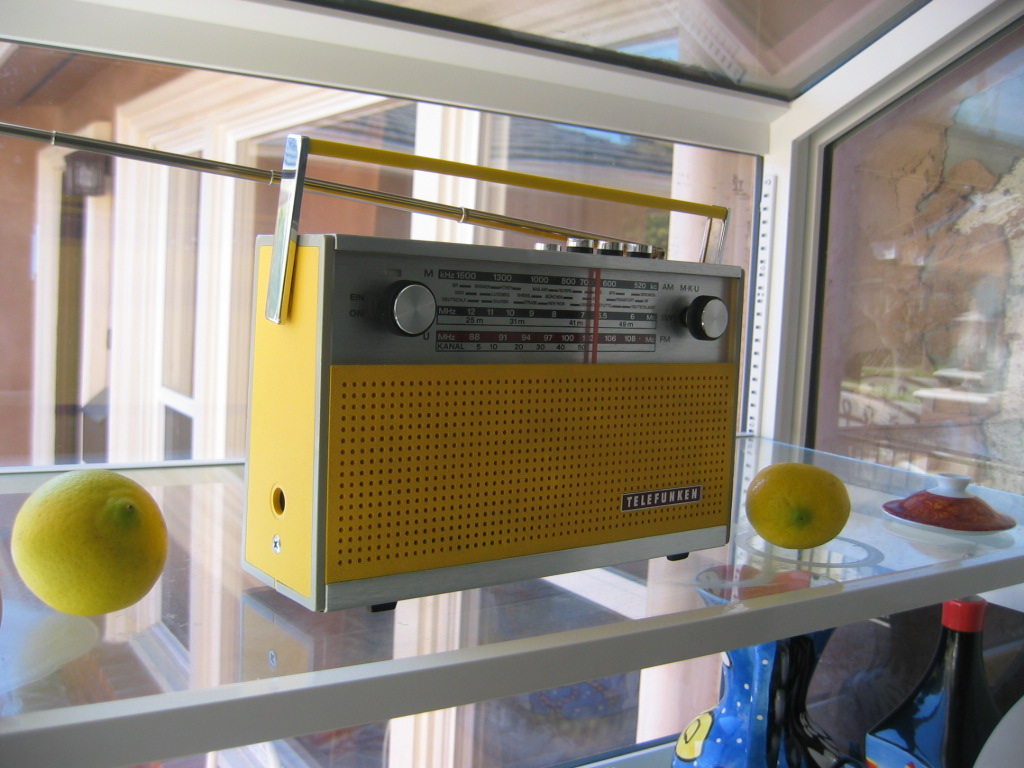
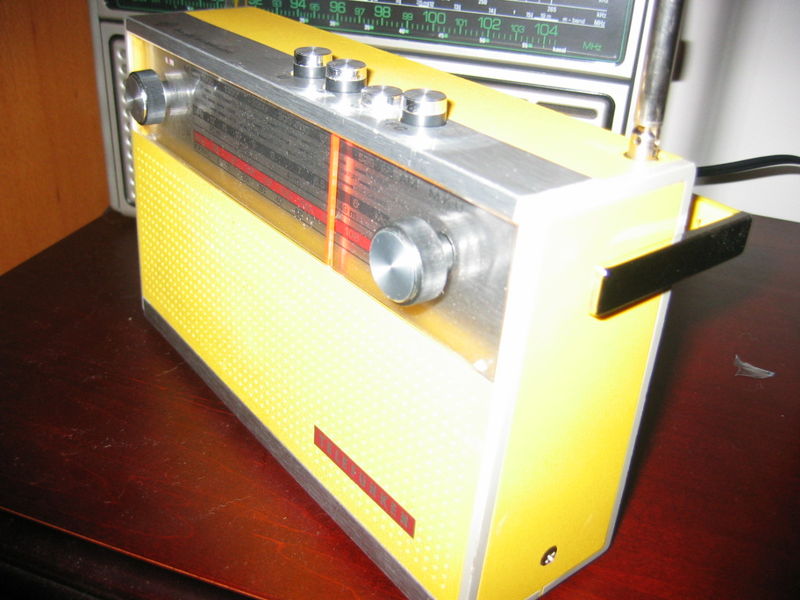
    Six inches tall and barely ten inches across, the Telefunken Banjo Automatic delivers a lot of effortless sound for a radio its size. This vintage came in good shape as the seller had cleaned it up, even took it apart and did a “deep clean” to all the knobs. So there’s no static to speak of. This arrived with no AC. It’s feeding of six C batteries.

    Don’t be fooled by the swanky yellow. This colorful radio has outstanding FM reception and while the AM is above average it cannot light a candle to my bigger, brawnier Telefunken Partner 700, which at $40, cost me about half of the Banjo price. 

    The Banjo’s controls are smooth, and this bright yellow Telefunken feels upscale through and through, but if you’re Telefunken hunting, I recommend the bigger Partner 700. As good as the spunky yellow Banjo is, its speaker sound and AM sound loses to its bigger, more serious cousin. 

    In some ways it’s not fair to compare the two Telefunkens. The Banjo is a smaller portable, the Partner a heavier table radio. If I compare the Banjo to the similar sized Sangean PR-D5, the Banjo wins in speaker sound. The PR-D5’s small stereo speakers are so tinny my ears have trouble picking up the sound. In contrast, the Banjo fills a room easily. The FM on the Banjo is better than the PR-D5 and AM sound is similar. Of course, the $80 PR-D5 is new and digital and has presets so the comparison doesn’t quite work either.

    One strange quirk about the Banjo that I’ve never encountered before is that AM numbers are inverse to the FM numbers so that 103.1 FM, for example, is close to 640 AM. Strange, but no big deal.

    If you’re looking for a small travel companion, the Banjo is high-end and will not disappoint. If you’re looking for the majesty of a Panasonic RF-3000 (one just sold for over $300) and want to save some dough, check out the Partner 700, which I stole for $40.

    IMG_3564
  • Blast from the Past: Panasonic RF-3000, The Tank

    I picked up the package of the Panasonic RF-3000 and could already feel the presence of greatness evidenced by the density of the box. Inside was a 25-pound radio. What do today’s radios weigh? Two pounds?

    The heft of this vintage reminds me of a beloved car my parents bought, a brand new 1967 Chrysler Newport. My parents loved that car and would still have it today except that a troubled neighbor boy attempted to steal the car in 1974 or 1975. The car rolled down the steep hill of a street we lived on and was totaled (as a side note that same troubled boy stole another car a few years later, crashed it, and suffered permanent brain damage, but I digress).

    My point is today’s products are cheap and often chintzy. This can not be said of the solid looking RF-3000. Its only flaws are that twice the previous owner, suffering from dotage presumably, felt compelled to inscribe his social security on the radio. Perhaps this is a testament to his proprietary love of the radio, well deserved. In any case, the person managing the deceased radio owner’s estate disclosed this flaw on eBay. Sorry, there’s something unwittingly macabre about this review. Please let me proceed. 

    Why does a man want a heavy radio? The same reason a man wants 300-500 horsepower in his sport sedan. One word: Confidence. The RF-3000 delivers and more.  

    I turned on the RF-3000 and was stunned by crystal clarity and a salient quality of sound that in my subjective mind may eclipse its legendary brother, the RF-2200. Stations came in with ease. The birdy on the dreaded 710 AM vanished with a slight rotation of the hulking 3000. 88.9 KXLU came in loud and clear. Same for 89.3 and 103.1, other touchy stations. Let’s get real. The 3000 puts today’s radios to utter shame (forgive me, but hyperbolic emotion lends itself to cliche).

    IMG_3362

    This radio is huge. My wife says it looks like a relic from The Hatch in ABC’s hit TV show Lost. As I said earlier, it evokes the grand heft of my parents’ 1967 Chrysler Newport. 

    What did I pay for this booming radio that is so solid I am reminded of the hull of a cruise ship? A paltry $87. You can buy some mediocre radios out there for twice that much. I’m glad I snatched this thing. What a treasure. File the vintage RF-3000 as more grist for middle-aged curmudgeonly men to rant and bicker about the loss of quality in the Modern Age. 

    IMG_3363
  • Comparing the Tecsun PL-660 and the PL-680: Why the 660 Is Better for Me

    Comparing the Tecsun PL-660 and the PL-680: Why the 660 Is Better for Me

    20250226_132117

    I picked up an open-box Tecsun PL-680 for a huge discount, a deal too good to resist. Did I need it? Absolutely not. I already own the Tecsun PL-660, its near-identical twin. But this wasn’t a rational purchase—this was a radio-fueled nostalgia binge, a return to my obsession from 15 years ago. I love these radios. I love their design, their buttons, their retro Cold War aesthetic. And let’s be honest—I just wanted to compare them.

    First Impressions:

    I expected to prefer the PL-660’s design, but the PL-680 surprised me. It has a slightly different look, and now that I have both, I can’t pick a favorite. They’re like fraternal twins with great reception and a questionable resale value.

    Performance Check:

    • AM/FM Reception? Identical—stellar sensitivity, fantastic clarity, and minimal RFI (unlike my finicky DSP radios).
    • Speaker Sound? Nearly indistinguishable, though the PL-680 might have a hair more output—but if you blindfolded me, I doubt I could tell the difference.
    • Compared to My Tecsun PL-880 & PL-990? Not even close—those two have the richer, fuller audio these models lack.

    The Unexpected Revelation:

    Now here’s where things get weird—the Qodosen DX-286, a smaller, less expensive radio, outshines them in speaker quality. It sounds richer, deeper, fuller, like it’s punching out a solid 3 watts of audio muscle compared to the 1-watt Tecsuns. Suddenly, I found myself fantasizing about a “Super Qodosen”—a 10-watt speaker beast, with a sturdy kickstand and a 7.5-inch chassis, like the Tecsun 660 and 680. If someone built that, I’d throw money at it immediately.

    Do I Prefer the Qodosen Overall?

    The short answer is no. Its short telescopic antenna can limit FM in some areas of the house and other owners tell me it really shines with an elongated FM antenna, which fits in the 3.5mm jack. This is inconvenient for some.

    Also, I’ve learned that I can enjoy the speaker sound on both the 660 and 680 by turning the Treble/Bass switch to Bass, a personal preference. 

    Buyer’s Remorse?

    Not a chance. These are legendary performers, and more importantly, they’re relics of my Radio Obsession 1.0 days. Nostalgia, curiosity, and a good deal—that’s all the justification I need.

    Update:

    After a month of comparing the two, I much prefer the 660 because the 680 fades in and out of LAist 89.3 causing huge volume fluctuations. I don’t have this problem with the 660. I’m using the 680 in my garage for my kettlebell workouts and close to the outside parkway, the clear reception helps the 680 so I don’t get those volume fluctuations. 

    680 Alone

  • Self-Interest with Sauce: Why Your Finger Isn’t Worth a Million Lives

    Self-Interest with Sauce: Why Your Finger Isn’t Worth a Million Lives

    In How Adam Smith Can Change Your Life, Russ Roberts quotes the Talmudic sage Hillel: “If I am not for myself, who will be for me? If I am only for myself, who am I?” Roberts riffs on this by pointing out Smith’s hard edge: if you would sacrifice millions of lives to save a single finger, you are “a monster of inhuman proportions.”

    Which, of course, made me think of chicken tenders. A few nights ago I had the Sweet Thai Glazed chicken at Starbird—fast food so transcendent it felt like a religious conversion, crispy shallots and herb aioli included. I wanted to go back the next day. And the next. My self-interest is crystal clear: eat more Starbird. The problem? My pursuit of gustatory bliss comes at the expense of chickens. Just as my hunt for bioavailable whey protein powders comes at the expense of cows.

    So—am I a monster? If I turned vegan, would that absolve me, or would I just uncover a longer list of moral failings still clinging to my name tag? Because the world isn’t eating less meat. It’s eating more, mostly factory-farmed, while pretending not to notice the conveyor-belt cruelty behind the menu. Ignore it long enough and moral numbness sets in, the kind that doesn’t just ruin animals but corrodes us too, spreading in ripples like bird flu, mad cow, or the next “mystery wet market disease.”

    And cruelty isn’t the only place where “self-interest” mutates into its evil twin. Consider America’s sacred cow: gun freedom. Other nations see mass shootings, change laws, and reduce tragedies. America, however, doubles down—choosing an idea of freedom that keeps killing us. Here, “self-interest” looks less like wisdom and more like suicide with better branding.

    That’s the trouble with self-interest. It’s a slippery little devil with at least two sharp horns. First: it lets us rationalize immoral behavior until we become monsters congratulating ourselves for our appetites. Second: it convinces us that policies which maim us—like endless guns, endless meat—are somehow in our “best interest.”

    In reality, self-interest is a hornet’s nest: buzzing passions, compulsive hungers, warped myths, and counterfeit happiness. To live in true self-interest means sorting out the destructive impulses from the behaviors that actually make us moral and happy. But most people never attempt the sorting, because the road to ruin is wide, comfortable, and paved with chicken tenders, while the road to virtue is narrow, steep, and has terrible Yelp reviews.

  • How Selfishness Accidentally Invented Kindness

    How Selfishness Accidentally Invented Kindness

    Morality is one of those words that makes people recoil. It has the stale odor of an HR training video, the medicinal burn of cod liver oil, the joyless bulk of broccoli shoveled onto your plate, or the dead-eyed banality of inspirational refrigerator magnets. Nothing about the word screams adventure—it screams paperwork.

    The topic itself feels penitential and airless, full of clichés, and as lively as a Soviet staff meeting in the Kremlin basement. Take Adam Smith’s The Theory of Moral Sentiments. The title alone could euthanize a graduate seminar.

    And yet economist Russ Roberts opened this dusty tome and found himself not nodding off, but utterly hooked. So hooked that he wrote How Adam Smith Can Change Your Life: An Unexpected Guide to Human Nature and Happiness. Roberts argues that Smith’s insight—that even our selfishness requires us to make others happy—isn’t boring at all. On the contrary, it’s deliciously counterintuitive: the truly selfish person learns that generosity is the best form of selfishness. The helper outpaces the sloth.

    This paradox gives Smith’s argument fizz. What looks like a grim penal code of moral duty turns out to be startlingly original and surprisingly human. For Roberts, the book became a companion, a talisman. He lugged it everywhere, scribbled notes in the margins, and evangelized to anyone who would listen. The book stopped being just a book and became, as Kafka once demanded, an axe for the frozen ocean of the soul.

    I admit, I almost left Roberts’ book untouched. The title had the whiff of self-help, and I vowed long ago to steer clear of the genre’s swamp of clichés. But Nabokov was right: it’s not the what but the how. A book brimming with insight and originality can transcend its category. Roberts’ take on Smith is philosophy dressed as self-help, but in the best sense: witty, sharp, and unafraid to wrestle with misery, selfishness, and the false idol of money.

    Good philosophers, like good teachers, are also salesmen. Roberts sells Smith not as piety in a powdered wig, but as a guide for how to live with honesty, courage, and—yes—even happiness. Against all odds, I’m sold.

  • The Warm Bath Illusion: Why Pleasure Culture Kills Relationships

    The Warm Bath Illusion: Why Pleasure Culture Kills Relationships

    When you’re married, you’ve closed the deal. You’ve made your public and private commitment to another person. Yet, as Phil Stutz points out in Lessons for Living, this loyalty oath collides with a culture that insists there’s always a better deal waiting. It’s our supposed “divine right” to find that deal, to “look outside ourselves for more.” In other words, FOMO infects the way we relate to our spouses. Stutz writes: “The result is a frenzy of activity, powered by the fear of missing something, which exhausts us emotionally and leaves us spiritually empty.”

    As a therapist to Hollywood’s wealthy actors and producers, Stutz sees people in perpetual pursuit of “bigger and better”—newer houses, flashier careers, younger spouses once they’ve “made it.” They want to “trade up,” convinced they deserve it. But what they crave isn’t a flesh-and-blood partner. It’s a “fantasy companion,” a frozen image of perfection that bears no resemblance to real life. As Stutz notes of one patient, a successful actor: “What he was really looking for was someone with the magical ability to change the nature of reality.”

    Why do so many of us want to change reality? Because reality is messy, uncertain, painful, and demands labor of mind and spirit. Consumer culture promises to scrub away that mess and deliver a “frictionless” existence. It sells us the Warm Bath: a world of perpetual pleasure and no conflict. But the Warm Bath is an adolescent fantasy—an illusion that reality will mold itself to our most immature notions of happiness.

    This fantasy always collapses. No “fantasy companion” exists, and even if one did, the Warm Bath curdles into hell. Experiences flatten, pleasures dull, the hedonic treadmill spins us into numbness, and from numbness we fall into rage—blaming the fantasy companion for failing to save us.

    Stutz argues we must abandon the fantasy of love—a stagnant “perfect” photograph—for the messier, real version: alive, unpredictable, and demanding effort. “To put it simply,” he writes, “love is a process. All processes require endless work because perfection is never achieved. Accepting this fact is not thrilling, but it is the first step to happiness. You can work on finding satisfaction in your relationship the same way you’d work on your piano playing or your garden.”

    So if you spend your days marinating in salacious fantasies and stoking your FOMO with consumer culture, you’re killing reality while feeding fantasy. And because you’re putting no work into your relationship, entropy sets in. Bonds fray, affection curdles, and instead of taking responsibility, you blame your partner and draft your exit strategy.

    To keep his patients from falling into this trap, Stutz prescribes three tools.

    The first is Fantasy Control. Fantasies, he warns, can grow “long and involved” until they compete with real relationships. Steely Dan’s “Deacon Blues” comes to mind. Its narrator is a suburban mediocrity who dreams himself into an edgy artist and seducer of women. Fans saw themselves in him, but the song is ironic: a portrait of a fallen man propping up a drab life with self-mythology. Such fantasies, Stutz says, “hold a tremendous amount of emotional energy.” The more energy you pour into a phantom partner, the less you have for your real one. When fantasies become sexual, the drain is worse. Stutz insists that when fantasies consume you, you must learn to interrupt them. “You’ll resent this at first,” he writes, “but each time you come down to earth you’re telling yourself that you are a committed adult who is strong enough to face reality. This will make you more satisfied with yourself, a precondition to becoming satisfied with any partner.”

    If you’re a boomer like me, this may sound like heresy. Raised in the 60s and 70s, we were taught to unleash the Id, to celebrate fantasies as expressions of the “true self.” The musical Hair didn’t just glorify wild locks but turned them into a metaphor of rebellion against authority. Hugh Hefner and Xaviera Hollander gave us ribald lifestyles to envy. Thomas Harris’s I’m Okay, You’re Okay blessed us with permission to indulge. And the cultural mantra was simple: “Let it all hang out!”

    But Stutz, a boomer himself, has watched fantasies devour his patients. His conclusion is blunt: curbing sexual fantasy is a crucial step toward adulthood and a stronger bond with one’s partner.

    The second tool is Judgment. Fixate on a fantasy partner and you suspend critical thought, surrendering to false perfection. You also sharpen your critique of your real partner until both fantasy and reality are grotesquely warped. To break free, Stutz says, you must recognize this distortion and choose a loving path over a fantasy path. “The process of loving requires that you catch yourself having these negative thoughts and dissolve them from your mind, replacing them with positive ones. You must actively construct thoughts about their good attributes, and let these thoughts renew feelings of attraction toward them.” This habit builds gratitude, restores attraction, and replaces helplessness with control.

    Reflecting on this, I recall Tim Parks’s essay “Adultery,” in which he describes a friend’s affair that destroyed his marriage. Parks likens sexual passion to a raging river that demolishes everything in its path, while domestic life is the quieter work of nest-building. The two impulses are locked in eternal conflict. Some people cannot resist hurling themselves into the river, even knowing it will consume them.

    To pull people out of that river, Stutz prescribes his third tool: Emotional Expression. Here self-expression works in reverse. Just as smiling can make you happier, acts of tenderness can make you feel tender. Stutz advises: when you’re alone with your partner, speak and touch them as if they are desirable. Do this consistently and not only will you find them more attractive, they’ll begin to find you more attractive too.

    It may sound counterintuitive. Who “works” for attraction? But that is Stutz’s point: love is work. Excessive fantasy, meanwhile, is infidelity—not only to your spouse, but to your adult self. Stay shackled to your adolescent hedonist, and like Lot’s wife, you’ll turn into a pillar of salt.