Tag: books

  • When Books Were Gods: Nostalgia for a Lost Era

    When Books Were Gods: Nostalgia for a Lost Era

    Alice Flaherty opens The Midnight Disease: The Drive to Write, Writer’s Block, and the Creative Brain with a quote from Roland Barthes: “A creative writer is one for whom writing is a problem.”

    Problem? That word hardly does justice to the affliction. A problem is misplacing your car keys or forgetting to pay the water bill. What I have is more like a life swallowed whole, a case study in obsession so severe it borders on the pathological. Writing isn’t just a habit; it’s an all-consuming parasite, a compulsion that, in a just world, would require a 12-step program and a sponsor who confiscates my pens at night.

    But since no one is shipping me off to a remote cabin with nothing but an axe and a survival manual, I’ll have to settle for less extreme interventions—like seeking solace in Flaherty’s musings on the so-called writing “problem.”

    As it turns out, my affliction has a clinical name. Flaherty informs me that neurologists call this compulsion hypergraphia—the unrelenting urge to write. In their view, I suffer from an overactive communication drive, a neurochemical malfunction that ensures my brain is forever churning out words, whether the world wants them or not.

    Yet Flaherty, a physician and a neuroscientist, doesn’t merely dissect the neurology; she also acknowledges the rapture, the ecstasy, the fever dream of writing. She describes the transformative power of literature, how great writers fall under its spell, ascending from the mundane to the sacred, riding some metaphorical magic carpet into the great beyond.

    For me, that moment of possession came courtesy of A Confederacy of Dunces. It wasn’t enough to read the book. I had to write one like it. The indignation, the hilarity, the grotesque majesty of Ignatius J. Reilly burrowed into my psyche like a virus, convincing me I had both a moral duty and the necessary delusions of grandeur to bestow a similarly deranged masterpiece upon humanity.

    And I wasn’t alone. Working at Jackson’s Wine & Spirits in Berkeley, my coworkers and I read Dunces aloud between customers, our laughter turning the store into a kind of literary revival tent. Curious shoppers asked what was so funny, we evangelized, they bought copies, and they’d return, eyes gleaming with gratitude. Ignatius, with his unhinged pontifications, made the world seem momentarily less grim. He proved that literature wasn’t just entertainment—it was an antidote to the slow suffocation of daily life.

    Before Dunces, I thought books were just stories. I didn’t realize they could act as battering rams against Plato’s cave, blasting apart the shadows and flooding the place with light.

    During my time at the wine store, we read voraciously: The Ginger Man, One Hundred Years of Solitude, Moravia’s Contempt, Camus’ Notebooks, Borges’ labyrinthine tales. We never said it out loud, but we all understood—life was a dense fog of absurdity and despair, and books were our MREs, the intellectual rations that kept us alive for another day in the trenches.

    Books were our lifeline. They lifted our spirits, fortified our identities, and sharpened our minds like whetstones against the dull blade of existence. They turned us into a ragtag band of literary zealots, clutching our dog-eared pages like relics, singing the praises of Great Literature with the fervor of the Whos in Whoville—except instead of roasting beast, we feasted on Borges and Camus.

    Which brings us to Flaherty’s lament: the Internet is muscling books out of existence, and when books go, so does a vital piece of our humanity.

    What would my memories of Jackson’s be without the shared reverence for literature? It wasn’t just a passion; it was the glue that bound us to each other and to our customers. The conversations, the discoveries, the camaraderie—none of it could be replicated by an algorithm or a meme.

    How can I not think of this in the context of a country still staggering through its post-pandemic hangover of rage, paranoia, and despair? Where the love of books has been trampled beneath an endless scroll of digital sludge, and where human connection has been reduced to strangers launching spiteful grenades at each other across social media—those lawless arenas ruled by soulless tech lords, their pockets fat with the profits of our collective decline?

    Flaherty confesses that her need to dissect the spark of writing—the thing that makes it so irrepressibly human—was an uncontrollable urge, one that made her question whether she suffered from hypergraphia, postpartum mania, or some deeper compulsion to explore what she calls the “Kingdom of Sorrow” after the devastating loss of her prematurely born twin boys. Her search for the root of her writing obsession reminded me of Rainer Maria Rilke’s advice in Letters to a Young Poet: the only writing worth doing is that which one cannot not do.

    Beyond hypergraphia—an affliction rare enough to keep it from becoming a trendy self-diagnosis—Flaherty also tackles the more mundane but far more common malady of writer’s block. She attributes it to mood disorders, procrastination, repressed anxieties, and perhaps a sprinkle of nihilism. I used to wrestle with writer’s block myself, particularly between short stories, back when I entertained the delusion that I might carve out a name for myself in literary fiction. But whenever I think of writer’s block, I think of the one person I’d most like to share a meal with: Fran Lebowitz.

    Lebowitz’s writer’s block has lasted for decades, so long, in fact, that she’s upgraded it to a “writer’s blockade.” If Blaise Pascal was an acid-tongued intellectual defending faith, Lebowitz is the sharp-tongued patron saint of the New York literati, delivering high-caliber cultural commentary with the precision of a diamond-tipped drill. That she doesn’t write is a cosmic joke. That people care she doesn’t write is part of her legend. That her off-the-cuff witticisms are more electrifying than most books in print makes her, without question, my literary idol.

    And yet, my devotion to Lebowitz only reveals the terminal nature of my writing affliction. If a genie granted me the chance to swap lives with her—to tour the world, bask in standing ovations, and deliver effortless, unfiltered cultural critique to sold-out crowds—but on the condition that I could never write another book, I would turn it down without hesitation. This refusal confirms the depths of my sickness. In this hypothetical scenario, books themselves are mere shadows compared to the brilliance of Lebowitz’s conversation. And yet, here I am, clinging to the shadows, convinced that somewhere in those pages, I will find the thing that makes existence bearable.

    Surely, no specialist can diagnose a disease like this, much less cure it.

    Reading Flaherty’s sharp and introspective book, I found myself circling a familiar question: is the urge to write both a pathology and a gift? This led me straight to The Savage God, A. Alvarez’s bleak yet compelling account of depression, suicide, and literature. Across history, writers afflicted by melancholy, madness, or sheer existential despair have been cast as tragic geniuses, indulgent sinners, or misunderstood romantics, depending on the prevailing religious and literary winds.

    Take Sylvia Plath, the confessional poet who sealed her fate at thirty, or John Kennedy Toole, the tortured author of A Confederacy of Dunces, who asphyxiated himself at thirty-one. Conventional wisdom holds that Toole’s despair stemmed from his inability to publish his novel, but Tom Bissell, in “The Uneasy Afterlife of A Confederacy of Dunces,” suggests a more tangled story—one of creeping paranoia and the pressures of academia, where Toole, at twenty-two, was the youngest professor in Hunter College’s history.

    Like his doomed creator, Ignatius J. Reilly is possessed by the need to write. His screeds, stitched together from the wisdom of Boethius, function less as arguments and more as the existential flailings of a man convinced that writing will bring him salvation. He writes because he must, the way a fish swims—to stay alive.

    Bissell’s most cutting insight isn’t about Toole’s life, but about his novel’s fundamental flaw: Dunces is riddled with indulgences—flabby with adverbs, allergic to narrative structure, and populated with characters so exaggerated they teeter on the edge of cartoonhood. He argues that Dunces is “a novel that might have been considerably more fun to write than it is to read.” This line stopped me cold.

    Why? Because Dunces was my Rosetta Stone, my gateway drug to the idea of becoming a comic novelist. And yet here was the brutal truth: the very book that set me on this path was a wreck of undisciplined excess. If Dunces ruined my life, it did so not because it failed, but because I absorbed its flaws as gospel. I inhaled its bloated exuberance, its unshackled absurdity, and made it my literary template.

    To undergo a religious experience from a flawed book is to risk a kind of artistic contamination—you don’t just inherit its brilliance, you inherit its sins. My writing compulsion is perhaps nothing more than Dunces’ worst tendencies metastasized in my brain.

    And so, as a recovering writing addict, I am forced to sit with this painful revelation and digest it like a bad meal—one that demands an industrial-strength antacid.


  • Johnny Carson Was Prozac Before Big Pharma Perfected the Formula

    Johnny Carson Was Prozac Before Big Pharma Perfected the Formula

    I’m listening to Carson the Magnificent on Audible, Bill Zehme’s lush tribute to the King of Late Night. Zehme is a skilled writer, no doubt—but he suffers from an affliction familiar to many stylists: chronic purple prose. His descriptions don’t sparkle; they sprawl. Reading him is like eating an entire wedding cake when a slice would have sufficed. He’s so enamored with his own flourishes that Johnny Carson occasionally vanishes behind the velvet curtain of Zehme’s adjectives.

    Still, what he lacks in restraint, he makes up for in ardor. Zehme clearly loves his subject, and his affection pulses through the pages. Carson emerges as a sort of secular priest of television, delivering nightly benedictions of laughter for thirty years. He wasn’t edgy or groundbreaking—he was dependable, a soothing presence at 11:30 PM, like a warm bath or a glass of room-temperature white wine. He was comfort food for the collective American psyche, Prozac before Big Pharma perfected the formula. A totem from a time when a single man in a suit could stand at the crossroads of politics, culture, and showbiz and crack wise to a nation that hadn’t yet shattered into a million niche audiences.

    I was never much of a Carson acolyte myself. Dick Cavett had the brain. Letterman had the bite. Carson? He had commercials. What I remember most is that the show seemed designed to lull you into a trance of polite chuckles and bland banter. It wasn’t bad, exactly—it was just relentlessly there. Watching The Tonight Show felt less like a choice and more like a ritual, a nightly genuflection before the glow of the TV set. People tuned in not out of excitement, but out of habit. He was the head caveman, murmuring jokes by firelight, while the rest of us nodded and laughed, grateful to not be alone in the dark.

    To skip Carson was to risk social exile. You didn’t want to be the one who missed what the country’s collective subconscious had passively absorbed.

    As I listen to Carson the Magnificent, I find myself pining—not for Carson, but for the era he ruled. A time when a singular voice could still cut through the noise and hold the country’s wandering attention. That cultural unity is gone now, and maybe for the best, but I can’t help mourning it a little.

    Zehme will, I’m sure, delve into the darker recesses of Carson’s psyche—and I’m ready for it. I’ve already mainlined The Larry Sanders Show three times, with a fourth round likely on the way. That show remains the gold standard for peeling back the sequined curtain to reveal the neurotic, solipsistic soul of late-night television. If Zehme gets even halfway there, I’ll consider the audiobook time well spent—even if I have to wade through another paragraph that reads like a thesaurus suffered a head injury.

  • The Ghost in Aisle Nine: Remembering Chris Grossman

    The Ghost in Aisle Nine: Remembering Chris Grossman

    Back in the Reagan era, when I was a college kid working part-time at Jackson’s Wine & Spirits in Berkeley, I shared long, dusty shifts with a man named Chris Grossman—a wine salesman whose last name, ironically, matched neither his physical presence nor his temperament. Chris was lanky, six foot four, and moved with the grace of a man perpetually on the verge of tripping over his own limbs. He had a face only a Freudian could love: aquiline nose, dark beard, black-framed glasses smudged with fingerprints, and a mop of dark curly hair that looked like it had lost a long battle with a pillow. A pencil was always tucked behind his ear, as if at any moment he might be called upon to draft blueprints for a submarine.

    To customers, Chris was a savant in work shirts with the sleeves rolled just so—half wine whisperer, half philosopher of Zinfandel. He had an uncanny ability to match a Pinot Noir to a personality type, like some sort of boozy Myers-Briggs. The regulars adored him. They trusted his palate, his calm authority, his encyclopedic knowledge of terroir. What they didn’t know—and what I only discovered gradually—was that once he stepped off the floor, he disappeared.

    Chris Grossman had no friends. Not one. He was social the way a vending machine is social—polite, efficient, devoid of emotional commitment. Once, during a lull in business, he confided that he’d had a girlfriend, briefly, years ago. He spoke of it as though he’d survived a hostage crisis. The constant negotiation, the emotional bookkeeping—it exhausted him. “I’m too selfish to pretend otherwise,” he said with an eerie clarity. “I’d only make her miserable.” There was something almost noble in his blunt self-awareness, as if he’d spared both himself and others the slow drip of mutual disappointment.

    His father, he once told me, had been a brilliant but frostbitten physician, a man incapable of affection. Chris, I think, carried his father’s circuitry—a brain tuned for analysis, not empathy. Still, he wasn’t bitter. He wasn’t even rude. If he hated humanity, he kept it on a low simmer, tucked behind a mild smile and a firm handshake.

    We both left Jackson’s in the late ’80s. I moved to the California desert to lecture on writing and lose my illusions in the faculty lounge. Chris stayed local, selling stereos on Shattuck Avenue for places like The Good Guys and Circuit City. He made good money and spent exactly none of it on companionship. No wife, no kids, no pets, not even a ficus. Once a year he drove his Triumph convertible down to Carmel for a vintage car rally, then disappeared back into his cocoon.

    I think about him more than I should. Forty years have passed, and still, his silhouette lingers. Why? Maybe because I recognize myself in him. The difference is, I got married—and in doing so, outsourced my social life to someone with actual initiative. My wife arranges our dinners, our vacations, our tenuous grasp on community. She reminds me to be human. And yet, even she knows I’m a recluse at heart. She gently suggests I see more of my friends—or at least have more friends—so she doesn’t have to absorb every neurotic spiral I produce. Fair enough.

    I’m 63 now. Chris, if he’s still around, must be pushing seventy. I sometimes wonder how he’s weathered the years, whether the silence that once comforted him has curdled into something more sinister. But I also suspect he made peace with his solitude. He looked at the world, with all its needy, buzzing, soul-sucking demands, and chose the quieter suffering. Not because he was brave or broken, but because he knew himself too well to fake it.

    I hope he’s okay. I really do. Solitude, like alcohol, is dose-dependent. For some, it’s a meditative stillness. For others, it’s a slow erosion. I don’t know which side of the line Chris landed on. But wherever he is, I raise a glass to him—alone, perhaps, but not forgotten.

  • Case Studies in Performatosis: Black Mirror’s “Joan Is Awful” and “Nosedive”

    Case Studies in Performatosis: Black Mirror’s “Joan Is Awful” and “Nosedive”

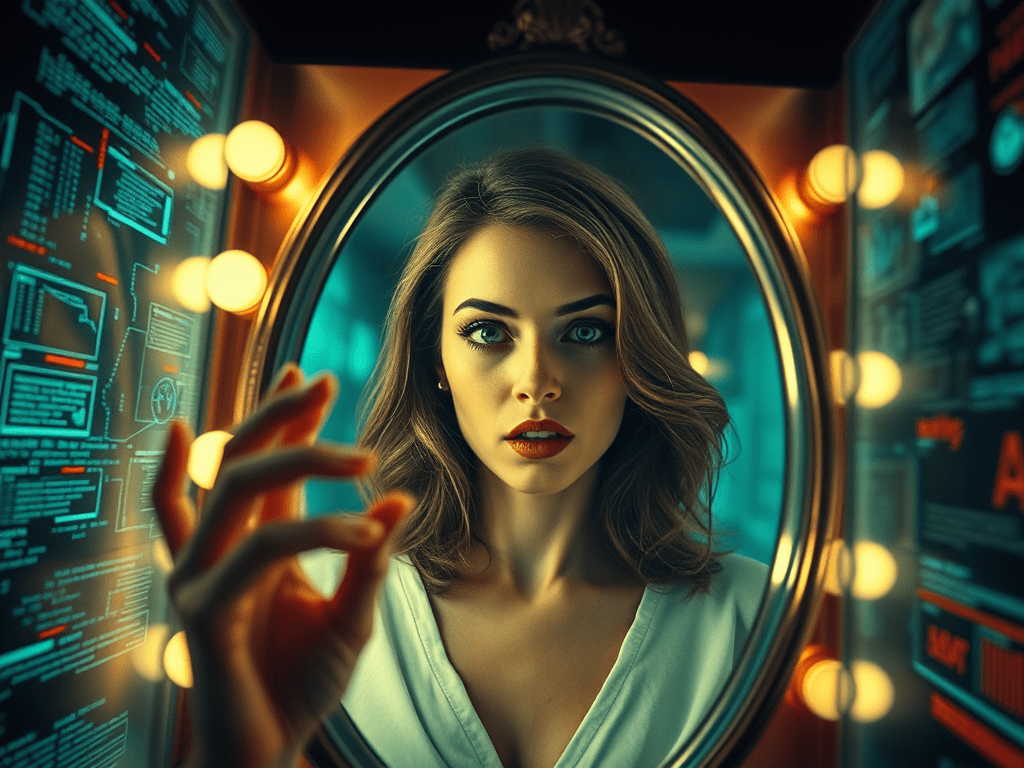
    In the grand medical theater of Black Mirror, few disorders are as virulent and tragically funny as Performatosis—the compulsive need to live life as if constantly auditioning for an invisible panel of social media judges. Two episodes in particular, “Joan Is Awful” and “Nosedive,” offer prime case studies in this terminal condition. Both protagonists—Joan and Lacie—aren’t just victims of technological dystopia; they’re emotionally exhausted performers collapsing under the weight of their own curated identities. And like all great tragicomedies, they bring it on themselves with a smile, a filter, and a legally binding Terms of Service they definitely didn’t read.

    “Joan Is Awful” is what happens when you outsource your entire identity to an algorithm and then act surprised when it turns on you. Joan, a blandly competent tech middle-manager with questionable morals and a perpetual expression of secondhand guilt, becomes a literal character in a TV show about her own life. But this isn’t just surveillance—it’s a forced performance, one she never auditioned for but can’t stop starring in. Her daily decisions are reinterpreted, exaggerated, and broadcast to a global audience craving content, not character. The real tragedy? Joan begins modifying her behavior to match the awful version of herself the algorithm is producing, proving that once Performatosis sets in, the line between self and spectacle evaporates faster than a TikTok trend.

    Meanwhile, in “Nosedive,” Lacie lives in a pastel-colored prison of positivity, where smiles are currency and emotional repression is a public service. Her entire life is a performance designed to earn ratings—every cup of overpriced coffee, every chirpy interaction, every dead-eyed compliment is another step up the social ladder. But like all performances, hers eventually cracks, and when it does, it’s not just a fall—it’s a nosedive into social exile. Her descent is more than a narrative arc; it’s a diagnosis. She’s suffering from terminal Performatosis, unable to stop performing even as her audience turns on her. The episode’s final, cathartic scream-off in jail is less an act of rebellion and more a final gasp of unscripted truth.

    What links Joan and Lacie is not just the technology that invades their lives, but the deep, internalized need to be seen—and more dangerously, to be liked. They are not characters living in dystopias; they are mirrors of us, the perfectly average user who has confused validation with identity. The systems they’re trapped in are just more honest versions of the ones we already use—systems that reward curated personas, punish messiness, and encourage self-policing with a faux-empowering smile. In both cases, the platforms don’t just reflect reality; they rewrite it, edit it, and package it for mass consumption—leaving the person behind feeling like a glitch in their own story.

    Performatosis, as diagnosed through these episodes, is not about ego. It’s about survival in a world where being real is risky, but being performative is profitable. Joan and Lacie suffer not just because they’re being watched, but because they’ve handed over their stories to people—and systems—that care more about ratings than reality. Their eventual breakdowns are not mental collapses; they’re acts of resistance. Unscripted, unbeautiful, and gloriously human. And if we’re smart, we’ll take the hint: stop performing before you forget the script was never yours to begin with.

  • Ozempification and DeBrandification in Black Mirror

    Ozempification and DeBrandification in Black Mirror

    In the dystopian funhouse mirror that is Black Mirror, two episodes—”Joan Is Awful” and “Rachel, Jack and Ashley Too”—serve as cautionary tales about the perils of Ozempification and the arduous journey toward DeBrandification. These narratives dissect how individuals relinquish their identities to external forces, only to embark on a tumultuous quest to reclaim them.

    Ozempification, much like the quick-fix weight loss drug it’s named after, represents the seductive allure of outsourcing personal agency for immediate gratification. In “Joan Is Awful,” Joan’s passive acceptance of Streamberry’s invasive terms leads to her life being broadcasted without consent, morphing her into a grotesque caricature for public consumption. Similarly, in “Rachel, Jack and Ashley Too,” Ashley O’s acquiescence to her aunt’s overbearing control transforms her into a commodified pop puppet, her authentic self suppressed beneath layers of marketable artifice.

    The consequences of Ozempification are stark. Joan becomes a prisoner of her own life, scrutinized and vilified by an audience oblivious to her reality. Ashley O’s existence is hijacked, her consciousness commodified into AI dolls like Ashley Too, symbolizing the extreme exploitation of her identity. Both women find themselves trapped in narratives dictated by others, their true selves obscured by the demands of an insatiable audience.

    Enter DeBrandification: the messy, rebellious process of dismantling the curated personas imposed upon them. Joan’s revolt against Streamberry’s AI-driven exploitation and Ashley O’s defiance against her aunt’s manipulative machinations epitomize this struggle. Their battles underscore the difficulty of reclaiming authenticity in a world that thrives on manufactured images.

    However, DeBrandification is not a seamless endeavor. Joan’s attempt to obliterate the quantum computer orchestrating her televised torment results in legal repercussions, highlighting the societal resistance to such acts of defiance. Ashley O’s liberation, while cathartic, leaves her navigating an industry that may still view her as a product rather than a person. Their stories illuminate the complexities and potential fallout of shedding a commodified identity.

    Black Mirror masterfully illustrates that while Ozempification offers the tantalizing ease of relinquishing control, it leads to an existence dictated by external forces. Conversely, DeBrandification, though fraught with challenges, paves the path toward genuine selfhood. Joan and Ashley O’s journeys serve as stark reminders that in the age of digital commodification, reclaiming one’s identity is not just an act of rebellion, but a necessary step toward true autonomy.

  • Performance Anxiety: The Liver King and Joan, Both Awful in Their Own Way

    Performance Anxiety: The Liver King and Joan, Both Awful in Their Own Way


    The Liver King and Joan from Black Mirror’s “Joan Is Awful” walk into the same existential trap, only one is greased in raw liver and the other in algorithmic despair. Both become victims of their own performance, trapped in personas crafted for mass consumption. One flexes in loincloths to sell ancestral supplements, the other finds her life commodified by a streaming service that turns her every ethical failure into entertainment. What they share is the slow, public realization that the self they’ve been performing isn’t just unsustainable—it’s a lie with consequences.

    The Liver King, with veins like tree roots and an ego to match, built his brand on being the living embodiment of primal masculinity. Turns out, his liver was natural, but his abs were not. When the steroid truth came out, so did the emptiness behind the brand: a man so addicted to being a character that he forgot how to be a person. Similarly, Joan discovers she is both the protagonist and product of a Netflix-style show that mirrors her life in real time. Her public image becomes so divorced from her private self that the two are no longer distinguishable. In both cases, performance replaces identity—and eventually consumes it.

    Both characters suffer a mental breakdown not because they’ve failed, but because they’ve succeeded—at becoming the thing they thought the world wanted. The Liver King was adored until he wasn’t, and Joan was forgettable until she became a meme of moral failure. The irony is brutal: success, for them, is the trapdoor. Their audiences don’t want authenticity—they want a spectacle, a scapegoat, someone to mock or idolize, preferably both at once. And when the curtain is pulled back, the applause turns to outrage.

    There’s also the matter of control—or rather, the delusion of it. The Liver King believed he could manipulate his public image through primal storytelling and ab workouts. Joan believed she had autonomy until she saw Salma Hayek’s CGI avatar doing unspeakable things in her name. Both lose control of their narratives, and the horror isn’t just public shame—it’s the recognition that their true selves have been outsourced, packaged, and sold. They become strangers to their own lives.

    In the end, the Liver King and Joan are case studies in performative collapse. They remind us that the pursuit of a curated, amplified self—whether through steroids or streaming—leads not to greatness but to existential whiplash. When you spend your life trying to be a brand, don’t be surprised when you’re treated like a product: disposable, replaceable, and, eventually, outdated. Joan may be awful, and the Liver King may be absurd, but their breakdowns are brutally, unmistakably human.


  • The Maudlin Man: On Watches, Social Media, and the Narcissism of Meaningless Eagerness

    The Maudlin Man: On Watches, Social Media, and the Narcissism of Meaningless Eagerness

    There is no sound more pathetic than the cry of the maudlin man—the self-appointed tragic hero of his own YouTube channel, sobbing between cuts of B-roll footage of his watch collection, mistaking emotional leakage for authenticity. He clutches his diver watches like talismans, convinced that the right lume or bezel action will finally make him whole. But his affliction is deeper than poor taste or consumer excess. He is in love with his own sorrow. And worse, he films it.

    Cicero had a word for this spectacle: maudlin. It was not meant kindly. The maudlin man is drunk on his own emotional silliness, addicted to contrived drama, and tragically proud of his displays of overstated sorrow and giddy exuberance. In his pursuit of happiness, he has mistaken cheap feeling for moral virtue, dopamine for character, sentiment for wisdom. He is not mature. He is a teenager with a $5,000 Tudor.

    The watch hobby, for all its mechanical beauty and aesthetic value, has become a theater of narcissistic self-performance. The YouTube wrist-roll has replaced the confessional. The thumbnail becomes the new sacred icon: face frozen mid-epiphany, a timepiece held up like a religious relic. Each upload, each gushing review, is a digital Rolex—plucked, examined, and consumed with trembling fingers and tears in the eyes. The tragedy is not that the watch community is ridiculous (though it often is), but that it has devolved into a factory of performative adolescence.

    It wasn’t always this way. There was a time when the pursuit of happiness, as Jeffrey Rosen in The Pursuit of Happiness reminds us, meant the cultivation of moral character. Rosen draws from Franklin, Jefferson, and ultimately Cicero, who taught that happiness came not from pleasure but from the tranquil soul: one unbothered by fear, ambition, or maudlin eagerness. The watch obsessive is none of these things. His soul is rattled, consumed by longing, shaken by regret. He mistakes every new acquisition for a cure, every unboxing for a rebirth. But he is not reborn. He is merely re-dramatizing the same pathology.

    Enter the maudlin man, the inner saboteur. He mocks, he sneers, and he tells the truth: that the maudlin man has no real restraint. That his self-recrimination is as performative as his self-praise. The maudlin man is cruel. He exaggerates the regret that comes from flipping watches like penny stocks; the hollow boast of self-control while our eBay watchlist grows longer by the hour; the dopamine crashes masked by overproduced videos and fake enthusiasm. We are not collectors. We are addicts with ring lights.

    To be addicted to the watch hobby is to be afflicted with a thousand tiny regrets. We regret what we bought, what we sold, what we didn’t buy fast enough. We suffer from wrist rotation anxiety, Holy Grail delusions, false panic, and the creeping horror that we are just men who talk too much about case diameter. Our collections become mausoleums of past mistakes. We are haunted, not healed.

    The only cure—if one exists—is a form of philosophical sobriety. Cicero called it temperance. Franklin called it moral perfection. Phil Stutz calls it staying out of the lower channel. It is the refusal to feed the drama. It is the decision not to narrate your regret as if it were wisdom. It is stepping back, stepping away, and recognizing that sometimes, the most radical act of self-possession is to stop filming.

    This maudlin sickness isn’t limited to the horological hellscape. Social media itself is a dopamine machine engineered to keep us emotionally drunk. We live in a world of curated personas, algorithmic affirmation, and the self-cannibalizing loop of outrage and euphoria. As Kara Swisher notes in Burn Book, the tech elite have weaponized this environment for profit, fueling sociopathy with likes and retweets. They are not gods. They are billionaires who behave like wounded teenagers in private jets.

    It is not a coincidence that the watch obsessive and the tech mogul share the same pathology: a hunger for affirmation masquerading as taste. They are the same creature, only one wears a G-Shock and the other a Richard Mille. Both are drunk on maudlin emotion. Both mistake attention for meaning.

    What, then, is the alternative? It is to shut off the camera. To read. To walk. To live a life not curated but inhabited. To pursue virtue, not validation. To wear one watch and be content. To see, finally, that maudlin self-display is not depth, but decadence.

    So here is the diagnosis, bitter but true: The maudlin man must die. Not literally, but spiritually. He must be silenced so the adult may speak. He must be buried so the man of character can rise. He must be mocked, dissected, exposed, and ultimately exorcised.

    Only then, perhaps, will we stop crying over something as silly as the regret of sold watches we can never get back.

    And maybe—just maybe—stop filming them.

  • The Algorithm Will See You Now: Joan’s Collapse in a Funhouse Mirror World: Sample Thesis and Outline for Analysis of Black Mirror’s “Joan Is Awful”

    The Algorithm Will See You Now: Joan’s Collapse in a Funhouse Mirror World: Sample Thesis and Outline for Analysis of Black Mirror’s “Joan Is Awful”

    Sample Thesis Statement:


    In Joan Is Awful,” the titular character stumbles into ruin not because she’s evil, but because she’s deluded—clinging to a flattering self-image while ignoring the yawning chasm between how she sees herself and how others do. Her desperate need for approval blinds her to the hollow spectacle of parasocial fame, where the Streamberry audience gorges on her curated misery with slack-jawed glee and not an ounce of empathy. Meanwhile, Joan’s passive embrace of digital convenience—those sleek platforms that promise connection, ease, and relevance—costs her everything: privacy, agency, even identity. As her most intimate moments are vacuumed into the cloud, diced into monetizable data, and reassembled into lurid entertainment, Joan learns the hard way that algorithms don’t care about narrative nuance—they just want content. In the end, she’s not the star of her own life. She’s tech industry chum, chewed up and streamed.


    Outline (9 Paragraphs):

    1. Introduction: The Mirror Cracks
    Set the tone by describing Joan’s glossy, curated digital life as a carefully lit Instagram photo—harmless on the surface, but riddled with cracks. Preview the idea that Joan Is Awful isn’t just a satire about tech—it’s a psychological horror story about self-delusion, digital exploitation, and the death of narrative control.

    2. The Selfie Delusion: Joan’s Inflated Self-Perception
    Explore Joan’s internal image of herself as a reasonable, competent, kind professional. Contrast this with the version that appears on Streamberry: vain, passive-aggressive, and spineless. Argue that the episode’s central irony lies in Joan’s shock—not at being watched, but at being seen too clearly.

    3. The Streamberry Effect: Fame Without Love
    Analyze the parasocial dimension: Joan’s life is turned into a binge-worthy drama, but there’s no affection in the audience’s gaze. They’re not fans; they’re voyeurs. The more humiliating the content, the more addicted they become. This is the dopamine economy, and Joan is its punchline.

    4. Compliance and Convenience: How She Handed Over the Keys
    Joan doesn’t get hacked—she clicks “Accept Terms and Conditions.” Show how the episode weaponizes our own tech complacency. Her ruin begins with a shrug. She wanted frictionless tech. What she got was soul extraction via user agreement.

    5. Raw Data, Real Damage: The Monetization of Intimacy
    Dig into the idea that Joan’s emotions, her breakups, her therapist visits, even her sex life—all become commodities. They’re no longer private moments, but digital product. The episode skewers the idea that tech is neutral. It’s a vampire, and your heart is just another bite-sized upload.

    6. Algorithmic Authoritarianism: The Tyranny of Predictive Systems
    Focus on the moment when Joan realizes she’s been living inside a nested simulation created by AI. Explain how this metaphor extends beyond science fiction—it mirrors the way our lives are shaped, nudged, and pre-written by recommendation engines, targeted ads, and invisible code.

    7. Narrative Collapse: When You’re No Longer the Main Character
    Explore the existential horror of losing narrative control. Joan’s identity dissolves not just because she’s surveilled, but because she can no longer steer the story. She’s overwritten by code, versioned into oblivion, rendered into a flattened character in someone else’s plot.

    8. Final Descent: From Star to Spectacle to Scrub
    Track Joan’s downward spiral as she tries to fight the system, only to discover that her rebellion has already been commodified. Even her attempts to resist are folded into more content. Her final fate isn’t tragic—it’s product placement.

    9. Conclusion: A Warning Disguised as Entertainment
    Tie everything back to the real world. We are all Joan to some degree—curating, consenting, surrendering. Streamberry may be fictional, but the forces it parodies are not. End with a sharp jab: the next time you agree to terms of service without reading, remember Joan. She clicked too.

  • Confessions of a Washed-Up Watchfluencer: Dreaming of Leaving YouTube and Instagram

    Confessions of a Washed-Up Watchfluencer: Dreaming of Leaving YouTube and Instagram

    For the better part of a decade, I’ve been a talking head on YouTube—waxing unpoetic about dive watches, flipping Seikos like pancakes, and freefalling into endless spirals of horological self-loathing. My channel was never slick. No fancy cuts, no drone shots over crashing waves, no ominous music swelling over macro shots of ceramic bezels. Just me: a man, a camera, and the slow erosion of his dignity.

    I didn’t edit. I didn’t storyboard. I didn’t build a brand. I just rambled into the void, a kind of wristwatch confessional booth where I shared my joy, my shame, and my madness with an audience of fellow obsessives. For a while, it was exhilarating. Like catching your own reflection in a funhouse mirror and mistaking it for truth.

    At my pathological peak, I owned sixty-three “TV-brand” watches—any brand that looked good on camera and bad for your soul. I knew I had a problem when I started hiding watches in drawers and pretending I hadn’t bought another diver. Getting the collection down to five felt like detox. Like crawling out of a swamp in ripped jeans, clutching a G-Shock and whispering, never again.

    And now? I haven’t filmed in a month. The idea of making another video fills me with dread. My subscriber count has flatlined around 10,000. I’m not growing. I’m not evolving. I’m the guy in the garage band who still thinks the right lighting will disguise the fact that he’s 63, wearing a wig, and flexing in a tank top with a fake tan and a borrowed swagger.

    More than stagnation, it’s the cost of content creation that’s choking me. Every video drags me deeper into the watch swamp. I obsess. I fantasize. I compare. I scroll forums at 2 a.m. and start building mental spreadsheets of specs I’ll forget by morning. The longer I film, the more I think about watches, and the more I think about watches, the less I think about anything else.

    Then there’s Instagram—my other digital vice. The cigarette break I take between grading student essays and questioning my life choices. One minute I’m watching a documentary; the next I’m styling a wrist shot, spreading digital envy like cologne. Watch porn. FOMO fuel. I’m not sharing insight. I’m spreading existential rot disguised as lifestyle content.

    The breaking point came last week when two Instagram friends—good guys, honest guys—messaged me with admiration-tinged despair. They loved my collection but felt ashamed of their own modest $300 watches. That’s when I saw it: I wasn’t inspiring anyone. I was curating a highlight reel of hollow indulgence, turning craftsmanship into competition. I don’t want to be that guy. The one whose joy costs others their peace.

    So yes—I’ve been dreaming of leaving. Leaving YouTube. Leaving Instagram. Leaving the digital masquerade where likes masquerade as affection and comments stand in for connection. But here’s the kicker: I don’t want to announce my departure. I don’t want to post some faux-epic “farewell” video where I stare off into the middle distance like a monk who’s just discovered minimalism. That’s not liberation—that’s branding.

    And yet, here I am. Writing this.

    The irony is suffocating.

    What’s my future on YouTube and Instagram? I honestly don’t know. But I’ve caught the scent of something better—something that smells like freedom, like sanity, like the first breath of fresh air after crawling out of a sealed vault.

    In the meantime, there’s the blog. Nine subscribers. Twenty hits a day. Basically the sound of a tree falling in the woods while everyone’s at brunch. But unlike video, writing helps me think. It gives shape to the noise in my head. Like kettlebell workouts or noodling on a keyboard, it’s therapy with fewer side effects and no recurring subscription fee.

    So no, I don’t care about metrics. Not anymore. I just want to be true to myself, however unmarketable that truth might be.

    And if you’re still reading this—thanks. I’m guessing you get it.

  • What Am I Even Teaching Anymore? Enduring Understandings, Fleeting Trends, and the Ever-Shifting Ground of Freshman Composition

    What Am I Even Teaching Anymore? Enduring Understandings, Fleeting Trends, and the Ever-Shifting Ground of Freshman Composition

    After four decades of teaching college writing, you’d think I’d have my units and essay prompts locked in, shrink-wrapped, and ready to microwave. Not quite. The world moves fast. Prompts that feel brilliant on Tuesday can feel dated by Friday. TikTok didn’t exist when I started teaching. Neither did smartphones, influencers, or GLP-1 agonists. So instead of clinging to yesterday’s prompts like a hoarder clutching expired coupons, I chase the deeper prize: Enduring Understandings—those sticky, soul-level questions that live beyond the classroom and follow students into the messiness of real life. (Hat tip to Grant Wiggins and Jay McTighe, who gave this idea a name and a purpose.)

    This fall, my freshman comp class includes the college football team, which means our opening unit now tackles (yes, pun intended) the sport that defines American spectacle and denial. But this isn’t your uncle’s barstool rant about “kids these days.” We’ll use football as a lens to examine risk, consent, identity, and systemic power—big stuff disguised in helmets and shoulder pads.

    Whether my students wear cleats or Converse, I want them grappling with questions that matter: Why do we chase short-term glory when the long-term cost might be our body, our brain, or our soul? What do we sacrifice on the altar of performance—on the field, online, or in life?

    Here’s how the year breaks down:


    Freshman Composition and Critical Thinking

    Freshman Composition Class

    Unit 1: Gladiators in Pads: Risk, Consent, and the Business of Football
    Is football a sacred rite of passage or a meat grinder in cleats? Students will write about acceptable risk, consent, glory, money, and whether football is a path to opportunity—or exploitation wrapped in pageantry.

    Unit 2: Heroism and Resistance to the Sunken Place
    From Frederick Douglass to Malcolm X, from Get Out to Black Panther, students will explore how marginalized figures resist dehumanization and transform themselves. We’ll examine what it means to climb out of the “Sunken Place”—and why it matters.

    Unit 3: The Loneliness of the Digitally Depressed
    With help from Black Mirror (“Nosedive” and “Fifteen Million Merits”), students will explore the connection between online performance and psychological breakdown. Are we curating ourselves into oblivion?


    Critical Thinking Class

    Unit 1: Willpower Is Not a Weight-Loss Strategy
    Ozempic is here, and the willpower gospel is wobbling. Students will unpack the moral panic surrounding weight-loss drugs and debate what happens when biotech and body image collide.

    Unit 2: The Mirage of Self-Reinvention
    From Fitzgerald’s doomed dreamers to Black Mirror’s algorithmic puppets, we’ll examine how the myth of personal reinvention can go horribly wrong—and why losing control of your narrative is the ultimate modern horror.

    Unit 3: Culinary Code-Switching or Cultural Betrayal?
    Food as survival, as art, as compromise. We’ll trace the tangled line between adaptation and erasure in the Americanization of Chinese and Mexican cuisines. When is fusion a celebration—and when is it a sellout?


    Teaching writing in this century means teaching students how to think clearly while the world gaslights them with dopamine and distraction. These units won’t solve that problem, but they’ll make sure we’re asking the right questions while we’re still allowed to.