Tag: education

  • Lecture Drift Syndrome and the Vanishing Classroom

    Lecture Drift Syndrome and the Vanishing Classroom

    My students have been reporting a peculiar academic phenomenon: the two-hour class that contains no discernible lesson. In its place stands a performer—a professor intoxicated by the belief that a self-indulgent monologue is effective teaching. Convinced they possess the sacred “gift of gab,” they proceed to use it like a leaf blower in a library.

    And gab they do.

    They narrate their dreams with the seriousness of a Jungian symposium, decoding every symbol as if the subconscious were filing quarterly reports. They recount contractor disputes with the dramatic tension of courtroom testimony. They offer serialized updates on family feuds, restaurant conquests, tropical vacations, and medical procedures so vivid they border on malpractice to describe. They even resurrect their collegiate glory days, in which they allegedly outwitted professors and classmates alike—a mythos delivered with the confidence of a man who has never been fact-checked.

    Meanwhile, the classroom undergoes a quiet evacuation.

    Not physically—students remain seated, dutiful, nodding at appropriate intervals—but cognitively, the room is abandoned. One student is deep into a novel. Another is solving calculus proofs. Several are toggling between sports highlights and sports betting apps, hedging their attention the way day traders hedge risk. Text messages fly. Homework from other classes gets completed. What was scheduled as instruction has been repurposed into a supervised study hall with a live podcast no one asked to attend.

    The professor, of course, notices none of this.

    This is the defining pathology: two monumental blind spots. First, the inability to recognize that the monologue is not merely irrelevant but actively draining—an intellectual sedative administered over two uninterrupted hours. Second, the delusion that presence equals engagement, that a room full of bodies must also be a room full of minds.

    It is neither.

    What we are witnessing is an academic epidemic: Lecture Drift Syndrome. A condition in which a class session slowly detaches from its stated purpose and floats into the open sea of anecdote, confession, and self-display. The syllabus becomes a relic. Time warps—two hours pass, yet nothing has been learned. Themes dissolve. Structure collapses. The lecture doesn’t end so much as it dissipates.

    In the end, the classroom is no longer a site of instruction.

    It is a stage occupied by one man talking—and thirty students elsewhere.

  • 4 Writing Prompts That Address Sports Betting

    4 Writing Prompts That Address Sports Betting

    Next semester I’ll be teaching a class of student-athletes. Based on the epidemic of sports gambling, I am certain many of them are sports gamblers, or at least know people who are in the throes of this addiction. I think it would be appropriate to offer a unit in which they can write a research paper on this topic. Here are four argumentative topics:

    1. The Normalization of Gambling in Sports Culture

    Professional sports leagues once treated gambling as a threat to the integrity of competition. Today those same leagues partner with sportsbooks, run betting segments during broadcasts, and place odds directly on screen. Write an argumentative essay that answers this question: Does the normalization of sports betting strengthen fan engagement or does it corrupt the spirit of sports by transforming competition into a financial spectacle? Use examples from professional sports broadcasts, advertising, and campus culture to support your position. Address the counterargument that betting simply adds entertainment value for fans.

    1. The Ethics of Sports Betting Among Student-Athletes

    Many college athletes gamble on sports despite NCAA rules prohibiting it. Some argue these rules are outdated and unrealistic in an era when gambling apps are ubiquitous and heavily advertised. Others argue that athletes betting on sports—even unrelated games—undermines the integrity of college athletics and creates conflicts of interest. Write an argumentative essay evaluating whether the NCAA’s restrictions on sports betting for student-athletes are justified. Consider issues of integrity, fairness, financial pressure, and personal freedom. Include a counterargument that challenges your position.

    1. Are Sportsbooks Designing Gambling Addiction?

    Modern betting apps use features such as push notifications, instant deposits, “risk-free bets,” and live betting during games. Critics argue these features are designed to keep users betting continuously and blur the line between entertainment and addiction. Supporters argue that gambling is simply a voluntary activity and individuals must take responsibility for their choices. Write an argumentative essay evaluating the claim that the sports betting industry intentionally engineers addictive behavior. Use evidence from journalism, psychology, or personal observation. Address the counterargument that adults should be free to gamble without government or institutional interference.

    1. The Illusion of Skill in Sports Betting

    Many bettors believe they can “beat the system” through research, statistics, and insider knowledge of teams. However, studies show that the vast majority of bettors lose money over time. Write an argumentative essay addressing the claim that sports betting is largely an illusion of skill rather than a true test of knowledge or strategy. Is sports betting closer to investing, where expertise matters, or to casino gambling, where the house always wins? Use evidence from reporting on the sports betting industry and address the counterargument that disciplined bettors can consistently profit.

  • The Semester When Students Got Tired of AI Slop

    The Semester When Students Got Tired of AI Slop

    My critical thinking class this spring has produced something I have not seen in several years: essays that sound like they were written by human beings.

    The first two mini-essays show almost no signs of AI cheating. Students wrote about the theme of optimization without integration in the Black Mirror episode “Joan Is Awful,” and about toxic positivity and infantilization in “Rachel, Jack, and Ashley Too.” These are not easy concepts. Yet the writing has been thoughtful, uneven in places, occasionally clumsy—in other words, unmistakably human.

    Part of the explanation lies in the design of the assignments. I structured them as hybrids. Students begin with a single analytical paragraph about the episode itself. Then they pivot and connect the theme to their own lives. The second step is the key. AI can summarize television episodes all day long, but it has a harder time fabricating the peculiar messiness of someone’s actual life.

    But the assignments alone do not explain the shift.

    Conversations with students suggest something more interesting is happening: they are tired of AI. Not ethically troubled, not philosophically conflicted—simply exhausted. They complain about what they call AI slop: bloated paragraphs that say everything and mean nothing, prose that sounds like a motivational speaker trapped inside a thesaurus.

    They are burned out on the smooth, inflated voice of the machine.

    What they seem to want instead is something refreshingly primitive—authentic expression. The Black Mirror episodes help. The themes are sharp, strange, and slightly disturbing, which gives students something real to react to. They also appreciate that the assignments are short—well under 1,000 words. These essays function as warm-ups before the larger research papers later in the semester.

    The result, at least so far, is encouraging.

    After four years of watching AI creep into every corner of student writing, I may be seeing the beginning of a recalibration. Students appear to be treating AI less like a magic genie that produces instant essays and more like what it actually works best as: a tool for editing and cleanup.

    I could be misreading the moment. Trends in education are famous for evaporating the second you start feeling optimistic.

    But for now, the classroom sounds different.

    The paragraphs have fingerprints on them again.

  • The Sweet Tooth Age: How We Traded Depth for Dopamine

    The Sweet Tooth Age: How We Traded Depth for Dopamine

    In “The Orality Theory of Everything,” Derek Thompson makes a striking observation about human progress. One of civilization’s great turning points was the shift from orality to literacy. In oral cultures, knowledge traveled through speech, storytelling, and shared memory. Communication was social, flexible, and immediate. Literacy changed everything. Once ideas could be recorded, people could think alone, think slowly, and think deeply. Writing made possible the abstract systems—calculus, physics, modern biology, quantum mechanics—that underpin the technological world. The move from orality to literacy didn’t just change communication. It changed the human mind.

    Now the concern is that we may be drifting in the opposite direction.

    As social media expands, sustained reading declines. Attention fragments. Communication becomes faster, louder, and more performative. Thompson explored this shift in a conversation with Joe Weisenthal of the Odd Lots podcast, who draws heavily on the work of Walter Ong, the Jesuit scholar who wrote Orality and Literacy. Ong’s insight was simple but profound: when ideas are not recorded and preserved, people think differently. They rely on improvisation, memory shortcuts, and conversational instinct. But when ideas live in texts—books, essays, archives—people develop interiority: the capacity for reflection, precision, and layered analysis.

    It would be too simple to say we now live in a post-literate society. We still read. We still write. But the cognitive environment has changed. Our brains increasingly gravitate toward information that is fast, simplified, and emotionally stimulating. The habits required for what Cal Newport calls “deep work” now feel unnatural, even burdensome.

    A useful analogy is food. Literacy is like preparing a slow, nutritious meal. It requires time, effort, and attention, but the nourishment is real and lasting. The current media environment offers something else entirely: intellectual candy. Quick hits. Bright packaging. Strong flavor. Minimal substance. We have entered what might be called the Sweet Tooth Age—a culture that prefers pre-digested, entertaining fragments of ideas over sustained, solitary engagement. The concepts may sound serious, but they arrive in baby-food form: softened, sweetened, and stripped of complexity.

    After forty years of teaching college writing, I’ve watched this shift unfold in real time. In the past six years especially, many instructors have adjusted their expectations. Reading loads have shrunk. Full books are assigned less often. In an effort to get authentic, non-AI responses, more teachers rely on in-class writing. Some have abandoned homework entirely and grade only what students produce under supervision.

    This strategy has practical advantages. It guarantees original work. It keeps students accountable. But it also reflects a quiet surrender to the Sweet Tooth Age. The modern workplace—the environment our students are entering—runs on the same quick-cycle attention economy. Their exposure to slow thinking may be brief and largely confined to the classroom. When they transition to their careers, they may find that on-demand writing is no longer required or relevant. 

    Not just education but politics and culture are being swept by this new age of dopamine cravings. The Sweet Tooth Age carries a cost, and the bill will come due.

    The content that wins in the attention economy is not the most accurate or thoughtful. It is the most stimulating. It is colorful, simplified, emotionally charged, and designed to produce a quick surge of interest—what the brain experiences as a dopamine reward. But reacting to stimulation is not the same as thinking. Performance is not analysis.

    Performance, in fact, is the preferred tool of the demagogue.

    When audiences lose the habit of slow reading and critical evaluation, they become vulnerable to what might be called Kayfabe personalities—figures who are larger than life, theatrical, and emotionally compelling, but who operate more like entertainers than honest brokers. The message matters less than the performance. Complexity disappears. Nuance becomes weakness. Certainty, outrage, and spectacle take center stage.

    In such an environment, critical thinking doesn’t merely decline. It becomes a competitive disadvantage.

    This is why the Sweet Tooth Age is more than an educational concern. It is a political and cultural risk. A public trained to consume stimulation rather than evaluate evidence becomes easy to mobilize and difficult to inform. Emotion outruns judgment. Identity replaces analysis. The center—built on patience, evidence, and compromise—struggles to hold.

    When literacy weakens, the consequences do not remain confined to the classroom.

    They spread outward—into public discourse, institutional trust, and civic stability. The shift back toward orality is not simply a change in media habits. It is a shift toward immediacy over reflection, reaction over reasoning, spectacle over substance.

    And when a culture begins to prefer performance to thought, chaos is not an accident.

    It is the logical outcome.

  • The Submarine That Got Me Punished

    The Submarine That Got Me Punished

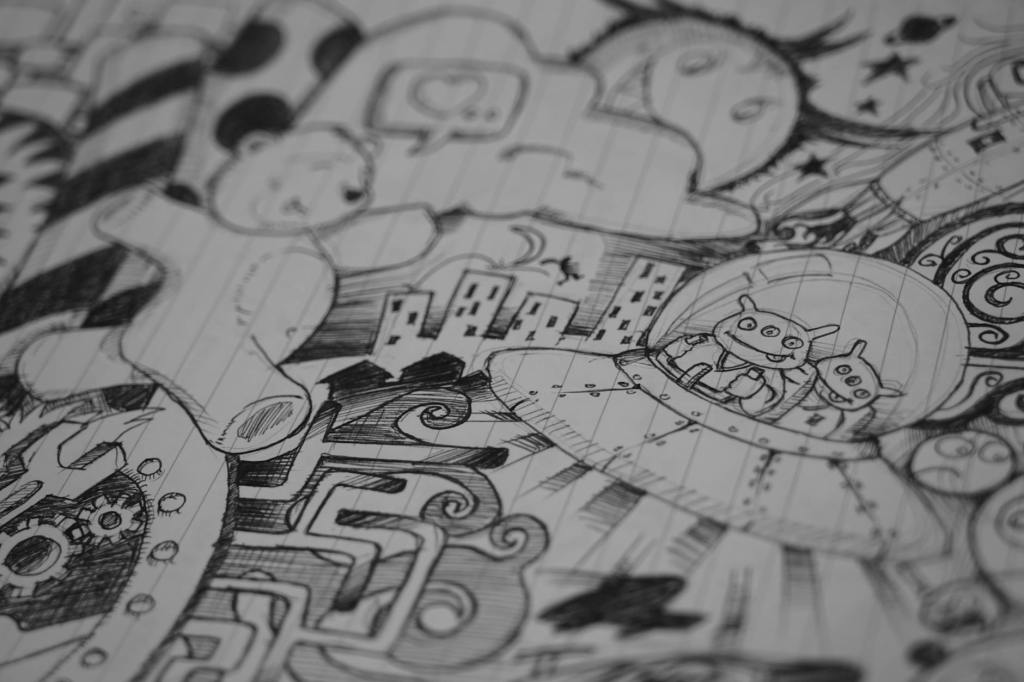
    One afternoon in Mrs. Eckhart’s fifth-grade class, I finished my reading questions early and found myself with a full hour to kill. So I did what any quietly restless child with access to art paper would do: I drew a gigantic submarine.

    It was glorious. The hull bristled with portal windows, and inside each window lived a tiny, talkative world. Every occupant had something urgent to say. One man was making pancakes and inviting others over. A woman, her hair set in curlers, announced she was in no condition to be seen. Another guy sulked over a bowl of cereal because the box promised a free toy and delivered nothing. Someone tried to nap in a hammock but complained about the noise. A girl had a strip of apple skin lodged between her teeth and was losing her mind over it. There were at least a dozen such figures—boasting, whining, confessing, performing.

    It was a floating anthology of minor human grievances.

    I was proud of it. I felt like I was getting valuable training for my future career writing for Mad Magazine. I was quiet. I was finished with my work. I was bothering no one.

    Then Mrs. Eckhart appeared.

    She moved down the aisle between desks, paused, and studied my drawing. I waited for praise—some acknowledgment of creativity, wit, talent. Instead, I got disdain. Her red hair was stacked into a bouffant, her eyebrows arched in judgment.

    “Is this how you spend your time in my class?”

    “But I finished the assignment,” I said. “I was working quietly.”

    She ignored that and began reading my dialogue bubbles aloud, dripping sarcasm into every line. The class erupted in laughter—not the good kind, the kind that comes from watching someone get filleted by authority.

    Then she delivered the verdict.

    “Your parents should know how you’re spending your time in my classroom.”

    She flipped the page over and wrote a note explaining my offense. I was to take it home, secure parental signatures, and return it like evidence.

    That evening, after dinner, I showed my father the drawing.

    He was livid.

    “You pissed off your teacher,” he said.

    “I don’t know why,” I said. “I finished my work. I was quiet.”

    “It doesn’t matter. You insulted her.”

    “I don’t get it.”

    “By finishing early and doodling, you implied her work was too easy. You disrespected her.”

    “But I didn’t say anything. I just drew.”

    “It doesn’t matter if you’re right,” he said. “What matters is you made her angry. In life, it’s better to be smart than to be right.”

    “I thought those were the same thing.”

    “Not always. Go to your room. Write her an apology.”

    I wrote the apology. But even then, I knew—deep down—I had done nothing wrong. In fact, to this day, that submarine remains the best use of time I ever managed in her class.

    The truth was simple: Mrs. Eckhart didn’t like me. I was brooding, inward, melancholic. She sensed something in me she found intolerable. Once, after she criticized a homework assignment, I tried to explain myself.

    “You have an excuse for everything, don’t you?” she snapped.

    If all my teachers had felt that way, I might accept the diagnosis. But they didn’t. Every other teacher thought I was polite, attentive, fine. There was something specific between us that never resolved.

    Sometimes hostility is not psychological; it’s biblical. It has no cause, no logic, no cure.

    I think of the excellent movie The Banshees of Inisherin. Colm abruptly ends his friendship with Padraic. No grievance. No inciting incident. “I just don’t like you anymore.” That’s it. Padraic hasn’t changed. Colm simply finds him unbearable.

    After nearly forty years of teaching, I know this pattern well. I’ve been popular, well-liked, even beloved by students—but that hasn’t spared me the occasional student who radiated pure contempt. Once, friendly students asked if I noticed a guy in the back who glowered at me all semester. I told them yes. Every so often, someone decides you are intolerable. There is no appeal process.

    In those cases, effort only makes things worse. Trying to win favor intensifies the repulsion. The Chinese phrase captures it perfectly: mei ban fa—nothing can be done.

    Do I resent Mrs. Eckhart? A little. She was an authority figure with a visceral dislike for a ten-year-old boy. But what endures most isn’t bitterness. It’s joy.

    That submarine was alive. It was funny. It was mine. No note home, no scolding, no pinch-faced teacher can take that away.

  • Colonel Lockjaw and the Cosplay Watches of the Soul

    Colonel Lockjaw and the Cosplay Watches of the Soul

    If I had to confess to one of my worst flaws, it would be this: I’m a virtuoso at diagnosing other people’s defects and a coward when it comes to inspecting my own. I can spot hypocrisy at fifty paces, write a character analysis of your blind spots, and deliver a withering critique of your moral laziness—while remaining blissfully obtuse about the same diseases raging in me. It’s not insight. It’s evasion. Instead of interrogating my own failures, I distract myself by putting others on trial.

    The hypocrisy deepens because I despise people who refuse self-interrogation. Over the years I’ve kept my distance from plenty of them—friends, colleagues, acquaintances—because their lack of self-awareness felt repellent. I judged them for their blindness without noticing I was practicing the same sin with better vocabulary. My watch hobby was an early case study in this delusion. I spent years buying grotesquely oversized timepieces—wrist-mounted monuments to masculine cosplay. In my private fantasy, I was Sean Penn starring as Colonel Lockjaw. In reality, I was a middle-aged man dodging a mirror. Why confront a crisis of purpose when you can drop five hundred dollars on a costume watch and call it identity?

    Eventually I sobered up—sold the ridiculous pieces, learned what real watches are, and cleared out my collection the way a dieter purges Doritos and Twinkies. But the damage was done: I’d wasted three years of a hobby because I refused to ask what my compensation phase said about me. I demanded self-interrogation from everyone else. I granted myself a permanent exemption. Do as I say, not as I do—the oldest creed of the unexamined life.

    That failure has been haunting me lately, triggered by a memory from thirty-five years ago: an English Department meeting that turned into a circus. I was a young instructor, terrified of tenure committees and power hierarchies, sitting quietly while the veterans argued about whether personal narratives belonged in college writing. One professor—let’s call him Foghorn Leghorn—was a legendary drunk who showed up to meetings in a black leather bomber jacket and a cloud of whiskey fumes. With disheveled silver hair and black horn-rimmed glasses, he declared that personal narratives were “sissy” assignments and that students needed “real-life” skills like argument and analysis. Susan, a colleague with more backbone than the rest of us combined, said that autobiographical writing gave students something called “personal enrichment.” Foghorn exploded. “What the hell does that mean?” he barked. “Personal enrichment? What the hell does that mean?” Susan backed down—not because she was wrong, but because there’s no winning an argument with a belligerent man auditioning for his own demolition.

    Back then, I kept my mouth shut. I was young. I was a lecturer on a non-tenure track. I was scared. But in the decades since, I’ve had time to think about Susan’s phrase. Personal enrichment. What does it mean—and should I, as a writing teacher, care? The answer is yes, and yes again. Personal enrichment is the cultivation of skills no standardized test can measure: moral clarity, self-honesty, the courage to look at yourself without flinching. In other words, self-interrogation.

    I learned that lesson early in my career without knowing what to call it. Around the same time Foghorn was grandstanding, I assigned a definition essay on passive-aggressive behavior. Students had to begin with a brutal thesis—passive aggression as cowardly hostility—then unpack its traits and finish with a personal narrative. I wanted them to stop admiring dysfunction as cleverness. The best essay came from a nineteen-year-old whose beauty could’ve launched a sitcom. She wrote about her boyfriend, a man who looked like life had given up on him. He was unemployed, proudly unwashed, and permanently horizontal—camped in her parents’ living room like a hostile occupier. He drank her father’s beer, ate his food, parked himself in his chair, and stank up the furniture with equal enthusiasm. Her parents hated him. Especially her father. And that was the point.

    She resented her father’s authority, so she punished him the only way she knew how—by sabotaging herself. Romantic self-destruction as revenge. When we discussed the essay, she told me something I’ve never forgotten: writing it forced her to see her behavior with unbearable clarity. She kicked the boyfriend out. Then, clumsily but honestly, she confronted her father. A personal narrative—mocked by my alcoholic colleague—did what no grading rubric ever could. It changed a life.

    Fifteen years later, I assigned another narrative, this one inspired by Viktor Frankl’s Man’s Search for Meaning. I asked students to write about a moment when tragedy forced them to choose between self-pity and courage. The finest essay came from a young mother who’d been abandoned by her own mother at two years old. She grew up with a hole in her heart, then gave birth to a daughter and decided she would be the mother she never had. In loving her child, she learned to love herself. I’ve taught for nearly forty years. Her story has moved me more than anyone’s.

    That’s why I assign personal narratives more than ever. Not just because they resist AI shortcuts, but because they demand moral inventory. And here’s the final irony: Foghorn Leghorn—the loudest critic of self-examination—was the man who needed it most. Last I heard, he’d burned down his kitchen while making dinner, lost his family, and was holed up in a cheap hotel drinking himself toward oblivion. The mansplainer who sneered at Susan ended up a tragic footnote in his own cautionary tale. I hope he found sobriety. If he did, it began where it always does—with honest self-interrogation.

    As for me, I’ll keep assigning personal narratives. I’ll keep asking students to look inward with courage. And I’ll keep reminding myself that the hardest essays to write are not on the syllabus. They’re the ones you compose silently, about your own life, when no one is grading you.

  • The Sleepwalking Student: Why Friction, Not Optimization, Reawakens Learning

    The Sleepwalking Student: Why Friction, Not Optimization, Reawakens Learning

    Academic Anhedonia is what it feels like to keep advancing through your education while feeling absolutely nothing about it. The assignments get done. The rubrics are satisfied. The credentials inch closer. And yet curiosity never sparks, pride never arrives, and learning registers as a faint neurological hum—like an appliance left on in another room. You move forward without momentum, effort without appetite. AI language machines make this easier, smoother, quieter. The result is not rebellion but compliance: efficient, bloodless, and hollow.

    When I started teaching college writing in the 1980s, this condition didn’t exist. Back then, I suffered from a different affliction: the conviction that I was destined to be the David Letterman of higher education—a twenty-five-year-old irony specialist armed with a chalkboard, a raised eyebrow, and impeccable timing. For a while, the bit landed. A well-placed joke could levitate a classroom. Students laughed. I mistook that laughter for learning. If I could entertain them, I told myself, I could teach them. For two decades, I confused engagement with applause and thought I was winning.

    That illusion began to crack around 2012. Phones lit up like votive candles. Attention splintered. Students weren’t bored; they were overclocked—curating identities, performing themselves, measuring worth in metrics. They ran hot: anxious, stimulated, desperate for recognition. Teaching became a cage match with the algorithm. Still, those students were alive. Distracted, yes—but capable of obsession, outrage, infatuation. Their pulses were fast. Their temperatures high.

    What we face now is colder. Around 2022, a different creature arrived. Not overstimulated, but under-responsive. Years of screen saturation, pandemic isolation, dopamine-dense apps, and frictionless AI assistance collapsed the internal reward system that once made discovery feel electric. This isn’t laziness. It’s learning-specific anhedonia. Students can assemble essays, follow scaffolds, and march through rubrics—but they do it like sleepwalkers. Curiosity is muted. Persistence is brittle. Critical thinking arrives pre-flattened, shrink-wrapped, and emotionally inert.

    The tragedy isn’t inefficiency; it’s emptiness. Today’s classrooms hum with quiet productivity and emotional frost—cognition without hunger, performance without investment, education stripped of its pulse.

    If there is a way forward, it won’t come from louder performances, cleverer prompts, or better optimization. Those are the same tools that bleached learning in the first place. Academic anhedonia cannot be cured with stimulation. It requires friction: slow reading that refuses to skim, sustained writing that will not autocomplete itself, intellectual solitude that feels mildly wrong, and work that denies the cheap dopamine hit of instant payoff. The cure is not novelty but depth; not entertainment but seriousness. Struggle isn’t a design flaw. It is the design.

    To interrupt academic anhedonia, I use an AI-resistant assignment that reintroduces cost, memory, and embodiment: The Transformative Moment. Students write 400–500 words about an experience that altered the trajectory of their lives. The assignment demands sensory precision—the one domain where AI reliably produces fluent oatmeal. It insists on transformation, which is what education is supposed to enact. And it drags students back into lived experience, away from the anesthetic glow of screens.

    I offer a model from my own life. When I was sixteen, visiting my recently divorced father, he asked what I planned to do after high school. I told him—without irony—that I intended to become a garbage man so I could finish work early and train at the gym all day. He laughed, then calmly informed me that I would go to college and join the professional class because I was far too vain to tell people at cocktail parties that I collected trash for a living. In that instant, I knew two things: my father knew me better than I knew myself, and my future had just been decided. I walked out of that conversation college-bound, whether I liked it or not.

    I tell them about a friend of mine, now a high school principal, who has been a vegetarian since his early twenties. While working at a deli during college, he watched a coworker carve into a bleeding slab of roast beef. In that moment—knife slicing, flesh yielding—something inside him snapped shut. He knew he would never eat meat again. He hasn’t. Transformation can be instantaneous. Conversion doesn’t always send a memo.

    My final example is a fireman I trained with at a gym in the 1970s. He was a recent finalist in the Mr. California bodybuilding contest: blond shag, broom-thick mustache, horn-rimmed glasses—Clark Kent with a bench press habit. One afternoon, after repping over three hundred pounds, he stood before the mirror, flexed his chest, and watched his muscles swell like they were auditioning for their own sitcom. “When I first saw Arnold,” he said, reverent, “I felt I was in the presence of the Lord. ‘There stands the Messiah,’ I said to myself. ‘There stands God Almighty come to bring good cheer to this world.’”

    He wasn’t speaking only for himself. He spoke for all of us. We wanted to be claimed by something larger than our small, awkward lives. Arnold was the messiah—the Pied Piper of Pecs—leading us toward the promised land of biceps, triceps, and quads capable of crushing produce.

    I assign The Transformative Moment because I want students to recreate an experience no machine can counterfeit. I want them to remember that education is not credential management but metamorphosis. And I want them to interrogate the conditions under which real change occurred in their lives—what they were paying attention to, what they risked, what it cost.

    Transformation—actual forward movement—is the antidote to anhedonia. And it cannot be outsourced.

  • How Real Writing Survives in the Age of ChatGPT

    How Real Writing Survives in the Age of ChatGPT

    AI-Resistant Pedagogy is an instructional approach that accepts the existence of generative AI without surrendering the core work of learning to it. Rather than relying on bans, surveillance, or moral panic, it redesigns courses so that thinking must occur in places machines cannot fully inhabit: live classrooms, oral exchanges, process-based writing, personal reflection, and sustained human presence. This pedagogy emphasizes how ideas are formed—not just what is submitted—by foregrounding drafting, revision, discussion, and decision-making as observable acts. It is not AI-proof, nor does it pretend to be; instead, it makes indiscriminate outsourcing cognitively unrewarding and pedagogically hollow. In doing so, AI-resistant pedagogy treats technology as a background condition rather than the organizing principle of education, restoring friction, accountability, and intellectual agency as non-negotiable features of learning.

    ***

    Carlo Rotella, an English writing instructor at Boston College, refuses to go the way of the dinosaurs in the Age of AI Machines. In his essay “I’m a Professor. A.I. Has Changed My Classroom, but Not for the Worse,” he explains that he doesn’t lecture much at all. Instead, he talks with his students—an endangered pedagogical practice—and discovers something that flatly contradicts the prevailing moral panic: his students are not freeloading intellectual mercenaries itching to outsource their brains to robot overlords. They are curious. They want to learn how to write. They want to understand how tools work and how thinking happens. This alone punctures the apocalyptic story line that today’s students will inevitably cheat their way through college with AI while instructors helplessly clutch their blue books like rosary beads.

    Rotella is not naïve. He admits that any instructor who continues teaching on autopilot is “sleepwalking in a minefield.” Faced with Big Tech’s frictionless temptations—and humanity’s reliable preference for shortcuts—he argues that teachers must adapt or become irrelevant. But adaptation doesn’t mean surrender. It means recommitting to purposeful reading and writing, dialing back technological dependence, and restoring face-to-face intellectual community. His key distinction is surgical and useful: good teaching isn’t AI-proof; it’s AI-resistant. Resistance comes from three old-school but surprisingly radical moves—pen-and-paper and oral exams, teaching the writing process rather than just collecting finished products, and placing real weight on what happens inside the classroom. In practice, that means in-class quizzes, short handwritten essays, scaffolded drafting, and collaborative discussion—students learning how to build arguments brick by brick instead of passively absorbing a two-hour lecture like academic soup.

    Personal narrative becomes another line of defense. As Mark Edmundson notes, even when students lean on AI, reflective writing forces them to feed the machine something dangerously human: their own experience. That act alone creates friction. In my own courses, students write a six-page research paper on whether online entertainment sharpens or corrodes critical thinking. The opening paragraph is a 300-word confession about a habitual screen indulgence—YouTube, TikTok, a favorite creator—and an honest reckoning with whether it educates or anesthetizes. The conclusion demands a final verdict about their own personal viewing habits: intellectual growth or cognitive decay? To further discourage lazy outsourcing, I show them AI-generated examples in all their hollow, bloodless glory—perfectly grammatical, utterly vacant. Call it AI-shaming if you like. I call it a public service. Nothing cures overreliance on machines faster than seeing what they produce when no human soul is involved.

  • Everyone in Education Wants Authenticity–Just Not for Themselves

    Everyone in Education Wants Authenticity–Just Not for Themselves

    Reciprocal Authenticity Deadlock names the breakdown of trust that occurs when students and instructors simultaneously demand human originality, effort, and intellectual presence from one another while privately relying on AI to perform that very labor for themselves. In this condition, authenticity becomes a weapon rather than a value: students resent instructors whose materials feel AI-polished and hollow, while instructors distrust students whose work appears frictionless and synthetic. Each side believes the other is cheating the educational contract, even as both quietly violate it. The result is not merely hypocrisy but a structural impasse in which sincerity is expected but not modeled, and education collapses into mutual surveillance—less a shared pursuit of understanding than a standoff over who is still doing the “real work.”

    ***

    If you are a college student today, you are standing in the middle of an undeclared war over AI, with no neutral ground and no clean rules of engagement. Your classmates are using AI in wildly different ways: some are gaming the system with surgical efficiency, some are quietly hollowing out their own education, and others are treating it like a boot camp for future CEOhood. From your desk, you can see every outcome at once. And then there’s the other surprise—your instructors. A growing number of them are now producing course materials that carry the unmistakable scent of machine polish: prose that is smooth but bloodless, competent but lifeless, stuffed with clichés and drained of voice. Students are taking to Rate My Professors to lodge the very same complaints teachers have hurled at student essays for years. The irony is exquisite. The tables haven’t just turned; they’ve flipped.

    What emerges is a slow-motion authenticity crisis. Teachers worry that AI will dilute student learning into something pre-chewed and nutrient-poor, while students worry that their education is being outsourced to the same machines. In the worst version of this standoff, each side wants authenticity only from the other. Students demand human presence, originality, and intellectual risk from their professors—while reserving the right to use AI for speed and convenience. Professors, meanwhile, embrace AI as a labor-saving miracle for themselves while insisting that students do the “real work” the hard way. Both camps believe they are acting reasonably. Both are convinced the other is cutting corners. The result is not collaboration but a deadlock: a classroom defined less by learning than by a mutual suspicion over who is still doing the work that education is supposed to require.

  • The Automated Pedagogy Loop Could Threaten the Very Existence of College

    The Automated Pedagogy Loop Could Threaten the Very Existence of College

    Automated Pedagogy Loop
    noun

    A closed educational system in which artificial intelligence generates student work and artificial intelligence evaluates it, leaving human authorship and judgment functionally absent. Within this loop, instructors act as system administrators rather than teachers, and students become prompt operators rather than thinkers. The process sustains the appearance of instruction—assignments are submitted, feedback is returned, grades are issued—without producing learning, insight, or intellectual growth. Because the loop rewards speed, compliance, and efficiency over struggle and understanding, it deepens academic nihilism rather than resolving it, normalizing a machine-to-machine exchange that quietly empties education of meaning.

    The darker implication is that the automated pedagogy loop aligns disturbingly well with the economic logic of higher education as a business. Colleges are under constant pressure to scale, reduce labor costs, standardize outcomes, and minimize friction for “customers.” A system in which machines generate coursework and machines evaluate it is not a bug in that model but a feature: it promises efficiency, throughput, and administrative neatness. Human judgment is expensive, slow, and legally risky; AI is fast, consistent, and endlessly patient. Once education is framed as a service to be delivered rather than a formation to be endured, the automated pedagogy loop becomes difficult to dislodge, not because it works educationally, but because it works financially. Breaking the loop would require institutions to reassert values—depth, difficulty, human presence—that resist optimization and cannot be neatly monetized. And that is a hard sell in a system that increasingly rewards anything that looks like learning as long as it can be scaled, automated, and invoiced.

    If colleges allow themselves to slide from places that cultivate intellect into credential factories issuing increasingly fraudulent degrees, their embrace of the automated pedagogy loop may ultimately hasten their collapse rather than secure their future. Degrees derive their value not from the efficiency of their production but from the difficulty and transformation they once signified. When employers, graduate programs, and the public begin to recognize that coursework is written by machines and evaluated by machines, the credential loses its signaling power. What remains is a costly piece of paper detached from demonstrated ability. In capitulating to automation, institutions risk hollowing out the very scarcity that justifies their existence. A university that no longer insists on human thought, struggle, and judgment offers nothing that cannot be replicated more cheaply elsewhere. In that scenario, AI does not merely disrupt higher education—it exposes its emptiness, and markets are ruthless with empty products.