Tag: education

  • The Price of Admission

    The Price of Admission

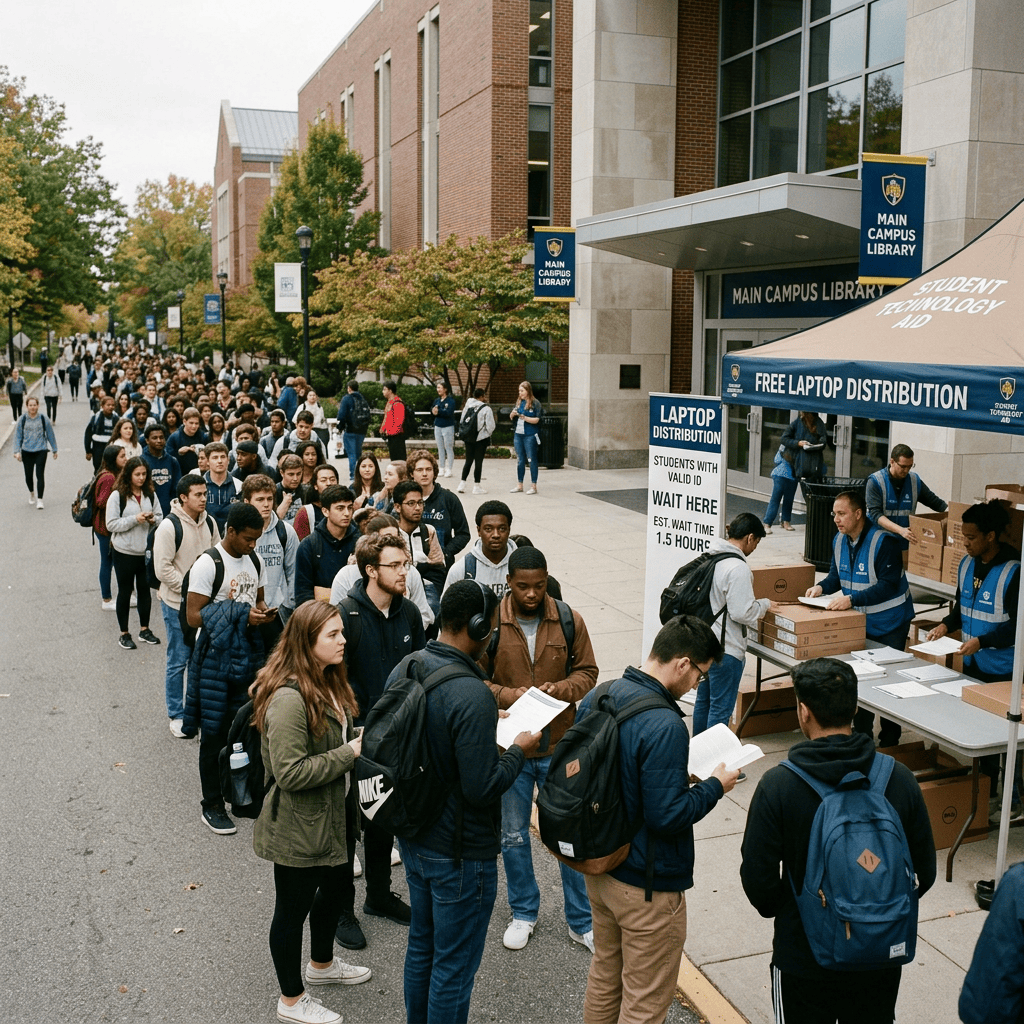
    Walking to my office this morning on the first day of the semester, I came upon a sight I had never seen before. A line of students curled around the library lawn, hundreds of them standing shoulder to shoulder in the morning sun. I estimated more than four hundred.

    I stopped and asked one of the students what everyone was waiting for.

    “Laptop loaners,” he said.

    The answer caught me off guard. These weren’t students lining up for concert tickets, free food, or some first-week campus giveaway. They were waiting to borrow the basic piece of equipment required to function as a college student in 2026.

    I looked at the line again, and it suddenly appeared different. I had to assume that many of these students simply couldn’t afford to spend even $300 on a Chromebook. They needed a computer to write papers, access Canvas, conduct research, communicate with professors, and complete the daily machinery of college life, yet purchasing one was beyond what their budgets could absorb.

    The sight humbled me because I spend an embarrassing amount of time thinking about computers. I research processors, RAM, displays, keyboards, battery life, and the microscopic differences between one generation of hardware and the next. I can become genuinely excited about a new chip or convince myself that some incremental specification represents a meaningful technological event. Meanwhile, four hundred students were wrapped around the library lawn waiting to borrow a machine that could run a browser and open a word processor.

    Standing there, I also confronted the enormous difference between the economic world in which I attended college and the one my students inhabit. My generation had its struggles, and nostalgia can easily airbrush them away. But college was cheaper. Housing consumed a smaller portion of ordinary incomes. The job market was more forgiving of young people trying to find their footing. The financial penalties for making a few wrong turns were not always so severe.

    My students have entered adulthood in a different economy. Tuition, rent, food, transportation, and nearly every other necessity compete for money many of them simply don’t have. Even the laptop that college now quietly assumes every student owns can become a luxury.

    I continued walking toward my office, carrying an uncomfortable awareness of the distance between my college experience and theirs. I had always known that distance existed. But abstract knowledge is bloodless. It is one thing to read about economic inequality and another to see it materialize in front of you as four hundred young people standing in a line, waiting for a computer.

  • What Steroids Can Teach Us About Generative AI

    What Steroids Can Teach Us About Generative AI

    I’ve been examining the effects of generative AI on my college writing students’ compositions over the last four years, and the best analogy I can come up with to get a handle on generative AI is to compare it to the way athletes use PEDs. 

    Athletes want an advantage, they want an edge, and they don’t want their opponents to have a better arsenal at their disposal, so they feel compelled to take PEDs. Same with college students who want the AI advantage. PEDs give athletes confidence that becomes a crutch. As AI does for students. 

    PEDs can give athletes a false sense of power, making them feel like superheroes. These PEDs give dope up their bodies until they don’t want to revert to the natural version of themselves. So does AI for busy students. Students with abysmal reading and writing skills can launder their writing through the AI machine and get a product that looks polished and articulate. This gives them a sense of cognitive doping. They become dependent on its sense of power. 

    Over time, PEDs make the body go flat because it acclimates to greater and greater doses. In this regard, AI makes the brain go flat after its users default to outsourcing their half-baked thoughts and letting AI generate full-blown, overwritten compositions. The disconnection between the writer and the output is soul-deadening. 

    Just as PEDs will never leave sports, AI will never leave writing or academia. Unless the data centers become too expensive to be sustained, the tool is here to stay. 

    The best thing I can do as a college writing instructor is craft assignments that defy AI use, such as field research, interviews, and personal reflections. I know full well that students will try to cheat the system and that I may have to have some blue book compositions to get a better handle on their writing, but we live in a high-performance world where often dangerous tools have to be harnessed. Otherwise, they will destroy us. 

  • When Reading Lost to the Dopamine Feed

    When Reading Lost to the Dopamine Feed

    Rose Horowitch’s essay The End of Reading Is Here,” published in The Atlantic, chronicles more than the decline of reading. It examines the kind of mind that flourishes after reading has surrendered. Citing data from the National Endowment for the Arts, she notes that fewer than half of American adults read any kind of book in 2022. Only 38 percent read a novel or short story. By 2023, a mere 16 percent reported reading for pleasure.

    What filled the vacuum? Gambling.

    Nearly 60 percent of Americans now gamble. We have traded one form of anticipation for another. Instead of turning pages in search of revelation, we pull slot-machine levers and refresh sports-betting apps in pursuit of dopamine.

    Even the books that survive have changed. Sentences are shorter. Syntax is simpler. Apparently, asking readers to navigate a few dependent clauses before arriving at the independent clause is now considered an unreasonable burden. The modern sentence has become a microwave dinner: engineered for speed, stripped of complexity, and consumed with minimal effort.

    The same contraction has reshaped our news diet. Long-form reporting that patiently excavates facts has given way to sixty-second video clips engineered for maximum stimulation. The reward is immediate. The understanding is shallow. It requires no political science degree to imagine what happens to a democracy when its citizens lose both the patience and the habit of sustained attention.

    Horowitch argues that this decline in reading parallels a decline in critical thinking itself. Increasing numbers of adults struggle to comprehend what they read, distinguish evidence from assertion, or draw reasonable conclusions. If adulthood once implied literacy, then America is drifting toward a peculiar form of cultural infantilization—a nation increasingly vulnerable to demagogues, conspiracy peddlers, and professional grifters eager to convert intellectual laziness into political capital.

    The greatest irony is that Americans have never consumed more words.

    We read texts, emails, Slack messages, Instagram captions, TikTok comments, headlines, notifications, and endless streams of digital debris. Never has so much language been processed to produce so little contemplation. We are drowning in words while starving for thought.

    That is why Horowitch describes America as becoming postliterate—not because language has disappeared, but because sustained reading has. Literacy once demanded immersion. Postliteracy rewards interruption.

    Nor has this transformation stabilized. It is accelerating. Each generation spends less time reading books and more time marinating its attention inside algorithmically curated feeds. Television, for all its faults, never possessed this power. During the television era, people still disappeared into novels on weekends and carried paperbacks to the beach. TV occupied a room. Smartphones occupy consciousness itself. They transformed distraction from an activity into a permanent habitat.

    I have watched this transformation from a privileged vantage point. For nearly forty years, I have taught college writing.

    The curriculum my colleagues and I teach today would have been almost unrecognizable when I began. We rarely assign long books. Many instructors assign none at all. My freshman composition course still requires one short classic, Frederick Douglass’ Narrative of the Life of Frederick Douglass, an American Slave. My critical thinking course assigns no books whatsoever. Instead, students read essays from The Atlantic, The New Yorker, and The New York Times. I upload the readings into Canvas, then spend class breaking them into digestible segments through Google Slides. Each slide contains roughly one hundred words followed by a discussion question that forces students to wrestle with the author’s reasoning one piece at a time.

    Some critics insist that professors should simply assign longer books and demand compliance. That fantasy evaporates the moment it encounters reality. Students vote with their enrollment. Assign too much reading, and many will either avoid the course altogether or quietly migrate to instructors who require less. Consumer demand has entered higher education whether professors approve or not. As students’ habits change, curriculum follows. The postliterate marketplace shapes the classroom long before faculty meetings do.

    Yet calling ours a “postliterate society” risks flattening important distinctions.

    My students are mostly between eighteen and twenty years old. Yes, they grew up on TikTok, YouTube, and Instagram. Yes, many arrive having read remarkably few books. But they are also intellectually curious. They enjoy argumentation. They respond viscerally to sharp prose, elegant rhetoric, and clever turns of phrase. They relish exposing logical fallacies and dismantling weak arguments. Once you capture their attention, they often surprise you with the sophistication of their thinking.

    They are not representative of America at large.

    A first-generation college student eager to transform his life occupies a different intellectual universe than an adult who never pursued higher education, works a dead-end job, and spends every evening numbing himself with algorithmic entertainment. Both may read fewer books than previous generations, but their relationship to knowledge is hardly the same. There is no single postliteracy. There are many varieties of it.

    Technology rewires us from the inside out. I can measure the changes in my own brain. At sixty-four, I find myself fighting distractions that barely existed thirty years ago. My attention requires more vigilance than it once did. The temptation to surrender to endless scrolling is no respecter of age, education, or profession. Digital gravity pulls on all of us.

    There is no reversing this transformation. The toothpaste is out of the tube. The smartphone is not going away. Artificial intelligence is not going away. Algorithmic media is not going away. We are not marching back to 1975 carrying hardcovers beneath our arms.

    That reality, however, should make us suspicious of sweeping declarations about postliteracy. Horowitch rightly identifies genuine losses: diminished attention spans, weaker reading comprehension, and shrinking tolerance for intellectual complexity. But we have also developed new literacies. We decode memes, navigate digital ecosystems, detect online irony, understand platform cultures, and learn new technologies with astonishing speed. Our cognitive landscape has not simply shrunk. It has been reorganized.

    Whether that reorganization represents progress remains an open question.

    I doubt we will someday revolt against TikTok and rediscover Tolstoy en masse. The fantasy of 90 percent of Americans reading one hundred books a year belongs somewhere between nostalgia and science fiction.

    Still, I hesitate to declare the reading life permanently dead.

    Human beings possess an appetite that algorithms cannot completely satisfy. Endless novelty eventually becomes monotonous. Constant stimulation eventually feels empty. Even the most dedicated scroller occasionally hungers for something with weight, texture, and permanence—an idea worth wrestling with rather than merely reacting to.

    Curiosity has survived every technological revolution humanity has endured. It survived radio. It survived television. It may yet survive TikTok.

    The reading brain has been wounded.

    I am not convinced it is beyond recovery.

  • Forty Years Later, I Finally Learned How to Teach Writing

    Forty Years Later, I Finally Learned How to Teach Writing

    This morning was bittersweet. Assuming I don’t substantially revise my curriculum for one final spring semester, I may have written my last syllabus after forty years of teaching college composition.

    My freshmen will spend the semester wrestling with subjects that would have been unimaginable when I began teaching in the 1980s. They will analyze the epidemic of sports betting in a culture of loneliness, examine how algorithmic platforms reshape identity and ambition, and challenge the mythology of the self-made man through the life and writings of Frederick Douglass.

    As I finished organizing my notes, an uncomfortable realization settled over me: I am retiring just as I feel I have finally learned how to do this job well.

    I have always been a slow learner. It took me four decades to discover how to design a writing course that feels intellectually coherent rather than merely competent. Only now do I feel that the readings, assignments, and classroom conversations reinforce one another with genuine purpose. Just as the picture has come into focus, I find myself stepping off the stage.

    I also have mixed feelings about OpenAI platforms. On one hand, they have created an endless stream of grading headaches. Every semester brings hundreds of essays that bear the unmistakable fingerprints of AI splatter—competent-looking prose that collapses under scrutiny because no real mind seems to inhabit it. I return many of these papers with one instruction: start over.

    Yet these same tools have also made teaching writing more intellectually exciting than it has been in years. I have used them to sharpen essay prompts, generate competing arguments, refine classroom activities, and demonstrate to students how AI can become an editorial collaborator rather than an intellectual substitute. I realize that sounds almost sacrilegious coming from a writing professor, but adapting to these technologies has rekindled my curiosity about cognition, literacy, learning, and composition. We do not yet know where this technological revolution is taking us, and I doubt anyone can fully control its direction. But the questions it raises are among the most fascinating of my career.

    My greatest concern is not artificial intelligence itself. It is the widening gap between students who possess deep literacy and those who do not. Students who have spent years reading demanding books can interrogate AI, challenge its assumptions, recognize its mistakes, and use it to strengthen their own thinking. Students raised primarily on TikTok and algorithmically curated snippets often lack that foundation. For them, AI becomes less a tool than a surrogate mind—a magical genie that produces respectable-looking mediocrity while quietly encouraging them to outsource their judgment, curiosity, and intellectual will. The danger is not that AI will make students less intelligent. The danger is that it will make them comfortable never developing the habits of mind that intelligence requires.

    Teaching students to acquire the literacy necessary to use these tools wisely may become the defining challenge of higher education over the next generation. That is one reason retirement feels bittersweet. Just as this frontier is opening, I am leaving the profession.

    Looking back over forty years, however, gratitude overwhelms regret. I was fortunate to spend my working life in a profession that demanded perpetual intellectual growth. Every semester required me to become a slightly better reader, writer, and thinker. I never tired of teaching argumentation, counterarguments, rebuttals, rhetorical strategy, or the mysterious alchemy that transforms an elephantine sentence into something lean, graceful, and memorable.

    Writing has always fascinated me because most of it disappears the moment it is read. Nearly everything we encounter is competent enough, clear enough, forgettable enough. Then, every so often, a sentence possesses that rare quality I call salience. It arrests your attention. It feels inevitable, as though no other arrangement of words could possibly exist. Discovering how writers achieve that effect—how they impose order, precision, and beauty upon the chaos of language—has remained one of the enduring pleasures of my life.

    Perhaps my final lecture should not be about grammar, thesis statements, or MLA format. Perhaps I should gather these reflections into a Google Slides presentation and offer my students a panoramic view of why writing classes matter more today than at any other moment in my career. Artificial intelligence has not diminished the value of literacy. It has elevated it. In an age when machines can imitate competent prose, the truly educated writer will not be the one who produces the most words. It will be the one who possesses enough judgment, imagination, and intellectual character to know which words are worth writing in the first place.

  • The Performance Trap: Online Identity, Narcissism, and the Collapse of the Real Self (college essay prompt)

    The Performance Trap: Online Identity, Narcissism, and the Collapse of the Real Self (college essay prompt)

    In the Netflix documentary The Crash and the Black Mirror episode “Joan Is Awful,” audiences witness characters whose lives become consumed by spectacle, performance, surveillance, and the relentless pressure of online visibility. While the two works differ in genre—one a real-life tragedy and the other a satirical dystopian drama—both raise disturbing questions about how modern digital culture reshapes identity, distorts reality, and erodes the boundary between authentic selfhood and online performance.

    In The Crash, the documentary suggests that Mackenzie Shirilla’s compulsive online self-curation reflected a deeper psychological unraveling in which image management, attention-seeking, and social media validation became inseparable from her sense of identity. Meanwhile, in “Joan Is Awful,” Joan discovers that her life has been transformed into a grotesque entertainment product streamed to millions of viewers, forcing her to confront the horrifying possibility that her real self has become secondary to a digitally manufactured persona designed for mass consumption. In both works, online visibility functions less as a tool for communication and more as a vortex that pulls individuals toward narcissism, performative behavior, emotional instability, and estrangement from reality itself.

    Write a 1,200-word argumentative essay in which you compare The Crash and “Joan Is Awful” to examine the claim that maintaining a constant online presence can suck people into a vortex of unhinged narcissism and madness that makes them unrecognizable from their authentic selves.

    Your essay should analyze how both works depict:

    ● the transformation of identity into performance;

    ● the addictive pursuit of attention, relevance, and validation;

    ● the psychological consequences of constant self-curation and surveillance;

    ● the collapse of the boundary between private life and public spectacle;

    ● and the dangers of confusing online visibility with genuine human worth.

    You should also address the broader cultural implications of these works. What do these texts suggest about the modern relationship between technology and identity? Do social media platforms merely reveal narcissism already present in human nature, or do they actively manufacture and intensify it? At what point does self-expression become self-erasure?

    A strong essay will move beyond summary and develop a clear argumentative thesis that makes an original claim about the psychological and cultural dangers presented in both works. Your thesis should be supported by detailed analysis of scenes, dialogue, imagery, characterization, and thematic parallels between the documentary and the episode.

    You must include:

    ● a clear and debatable thesis;

    ● detailed comparison of both works;

    ● at least one counterargument and rebuttal;

    ● analysis of specific scenes and examples;

    ● and thoughtful commentary about the relationship between technology, identity, and modern culture.

    Possible directions for argument include:

    ● Social media transforms ordinary narcissism into pathological self-obsession.

    ● Constant online performance erodes authentic identity and emotional stability.

    ● Digital culture rewards outrage, exhibitionism, and emotional extremity.

    ● Online validation creates a dopamine-driven cycle that destabilizes mental health.

    ● Surveillance culture turns human beings into entertainment products.

    ● The internet encourages people to construct marketable personas rather than genuine selves.

    You may agree, disagree, or complicate the prompt’s central argument, but your essay must directly engage the idea that online self-curation can psychologically deform individuals and distance them from reality.

    Requirements:

    ● Approximately 1,200 words

    ● MLA format

    ● Clear introduction, body paragraphs, counterargument-rebuttal section, and conclusion

    ● Use evidence from both The Crash and “Joan Is Awful”

    ● Include a Works Cited page

    The strongest essays will avoid simplistic “technology bad” arguments and instead explore the more unsettling possibility that modern digital culture rewards the most performative, narcissistic, and emotionally unstable versions of ourselves until the performance eventually consumes the person behind it.

    Personal Building Block 2

    For your first body paragraph, write a vivid profile of someone you know—or a friend of a friend—whose constant online presence has placed significant strain on their mental and emotional well-being. Describe how this person became absorbed in documenting, sharing, and curating nearly every aspect of their life for an online audience. How much time do they spend on social media? What kinds of content do they post, and what motivates them to seek attention, approval, or validation online?

    Analyze how this behavior has affected other areas of their life, including school, work, family relationships, friendships, or romantic relationships. Have they experienced anxiety, insecurity, loneliness, or an unhealthy dependence on likes, comments, and online engagement? Did they eventually recognize the negative effects of their behavior and take steps to change, or do they remain trapped in the cycle of constant self-presentation and digital validation?

    Your profile should include vivid details that capture the person’s personality, habits, and social environment. More importantly, it should illustrate how algorithm-driven platforms can influence behavior by rewarding attention-seeking, emotional intensity, and perpetual self-disclosure. Use the individual’s experience to show how a life increasingly organized around online performance can distort identity, damage relationships, and contribute to feelings of unhappiness, alienation, or loss of self. Your paragraph should be between 200 and 300 words.

    Argumentative Building Block 2

    You will turn in two paragraphs, your thesis and conclusion. 

    Your thesis paragraph should present a clear, arguable, and defensible claim that answers the central question of your essay. The paragraph should not merely announce a topic but establish a position that reasonable people could debate. After stating your thesis, include mapping components that identify the major points your body paragraphs will use to support your argument. These mapping components should provide readers with a clear roadmap of your essay’s structure and reasoning. Your thesis paragraph should be approximately 200 words.

    Your conclusion paragraph should move beyond the specific events of The Crash and “Joan Is Awful” to explore the broader cultural significance of your comparison. What do these texts reveal about the relationship between technology, identity, and human behavior in the digital age? Do social media platforms merely expose narcissistic tendencies that have always existed, or do they actively encourage and amplify them? At what point does self-expression cease to be authentic and become a performance shaped by algorithms, audiences, and the pursuit of attention? Consider whether modern technology has blurred the distinction between reality and representation to such an extent that people increasingly struggle to distinguish genuine experiences from curated personas. A strong conclusion should not simply summarize your argument but explain why it matters. Ultimately, your paragraph should demonstrate how The Crash and “Joan Is Awful” illuminate larger concerns about identity, authenticity, technology, and the future of human relationships in a world increasingly shaped by digital platforms. Your conclusion should be approximately 150 words.

  • The Addictive Power of Sports Betting (college essay prompt)

    The Addictive Power of Sports Betting (college essay prompt)

    Length

    1,200 words minimum

    Sources

    At least 4 credible sources

    Assignment

    Sports betting has become one of the fastest-growing industries in American culture. Once confined largely to casinos and illegal bookmakers, gambling is now integrated into professional sports broadcasts, podcasts, social media feeds, smartphone apps, and influencer culture. Millions of young men can place bets within seconds while receiving a constant stream of betting advice, predictions, and promotional offers.

    Many defenders argue that sports betting is simply another form of entertainment. Most participants gamble casually without developing serious problems. However, critics argue that the current sports-betting ecosystem possesses an unprecedented ability to exploit psychological vulnerabilities, especially among young men struggling with loneliness, identity, status anxiety, and the search for belonging.

    For this essay, analyze the causes of sports betting’s addictive power. Your goal is not merely to describe gambling addiction but to explain why sports betting has become so psychologically compelling in contemporary culture.

    In your analysis, consider some of the following questions:

    • How do sports-betting apps use psychological rewards, dopamine stimulation, and intermittent reinforcement to encourage repeated gambling?
    • Why might young men be particularly susceptible to sports-betting culture?
    • How does sports betting appeal to desires for competition, mastery, expertise, status, and recognition?
    • What role do loneliness and declining social connection play in the appeal of betting communities, podcasts, influencers, and online group chats?
    • How do social media algorithms amplify gambling content and normalize sports betting?
    • In what ways has sports betting become intertwined with broader forms of masculine performance and identity?
    • How do sports leagues, media companies, influencers, and betting companies contribute to the normalization of gambling?
    • To what extent does sports betting function as a substitute for older sources of meaning, community, achievement, and belonging?

    Your paper should move beyond the simplistic claim that gambling is addictive because people want money. Instead, investigate the deeper psychological, social, technological, and cultural forces that make sports betting attractive to millions of people.

    Counterargument Requirement

    Address the argument that sports betting is merely a harmless form of entertainment and that most participants gamble responsibly without developing addictive behaviors.

    After presenting this counterargument, explain why critics remain concerned about the current sports-betting ecosystem. Consider whether the scale, accessibility, sophistication, and constant availability of modern betting platforms create risks that differ from traditional forms of gambling.

    Suggested Organizational Structure

    Introduction

    • Introduce the rise of sports betting.
    • Present your thesis explaining why sports betting has become so addictive.

    Body Section 1: Psychological Factors

    • Dopamine, reward systems, risk-taking, intermittent reinforcement, and behavioral psychology.

    Body Section 2: Social and Cultural Factors

    • Loneliness, declining community, online identity, status-seeking, and belonging.

    Body Section 3: Technology and Media

    • Smartphones, social media algorithms, influencer culture, betting apps, and sports broadcasting.

    Body Section 4: Counterargument and Rebuttal

    • Address the claim that sports betting is harmless entertainment.
    • Explain why critics believe modern sports betting presents unique dangers.

    Conclusion

    • Evaluate whether the addictive power of sports betting is primarily financial, psychological, cultural, technological, or some combination of these factors.

    Sample Thesis Statements

    Thesis 1
    Sports betting has become highly addictive because it combines powerful psychological reward mechanisms with social media algorithms, digital convenience, and young men’s desire for status, belonging, and identity.

    Thesis 2
    While sports betting appears to be a harmless form of entertainment, its addictive power stems from its ability to transform loneliness, masculine insecurity, and risk-taking impulses into a profitable digital marketplace.

    Thesis 3
    The rapid growth of sports betting reflects more than a desire for money; it reveals how technology, social isolation, and modern identity formation have created ideal conditions for gambling addiction among young men.

    ***

    Personal Engagement Building Block 1

    For your first body paragraph, present a personal account that explores the psychological appeal of sports betting, including its attractions, risks, and financial consequences. Interview someone who regularly engages in sports betting and use the interview as the foundation of your paragraph. How did this person first become interested in sports betting? How much time and attention does it consume? How has it affected their finances, productivity, relationships, or emotional well-being? Do they have regrets about their gambling habits, or do they view sports betting as harmless entertainment? Have they ever worried that it was becoming addictive or taking control of their behavior? Do they hope to continue betting indefinitely, cut back, or quit altogether?

    Your paragraph should move beyond simple description and provide insight into the person’s motivations, habits, and mindset. Include vivid details that help readers understand the individual’s personality, social environment, and relationship with sports betting. The goal is to humanize the issue by showing how sports betting functions in the life of a real person. Your paragraph should be between 200 and 300 words.

    Argumentative Engagement Building Block 1

    Write two paragraphs: a thesis paragraph and a counterargument-rebuttal paragraph.

    Your thesis paragraph should present a clear, arguable, and defensible claim that answers the central question of your essay. The paragraph should not merely announce a topic but establish a position that reasonable people could debate. After stating your thesis, include mapping components that identify the major points your body paragraphs will use to support your argument. These mapping components should provide readers with a clear roadmap of your essay’s structure and reasoning. Your thesis paragraph should be approximately 200 words.

    Your counterargument-rebuttal paragraph should address a legitimate objection to your thesis. Begin by clearly and fairly explaining a viewpoint that challenges your argument. Demonstrate why thoughtful readers might disagree with your position and how their concerns complicate your claim. After presenting the counterargument, write a rebuttal that responds to those objections. A strong rebuttal may concede valid points made by the opposing side while demonstrating that, on balance, your argument remains more persuasive. It may also alleviate concerns by clarifying misconceptions, introducing additional evidence, or identifying important information that the opposing side overlooks. The goal is not to dismiss opposing viewpoints but to engage them thoughtfully and strengthen your overall argument. Your counterargument-rebuttal paragraph should be between 200 and 250 words.

  • From Family Table to Food Lab: Competing Visions of Eating: Example of an AI-Resistant Writing Prompt

    From Family Table to Food Lab: Competing Visions of Eating: Example of an AI-Resistant Writing Prompt

    As more students turn to AI to generate research papers, I have begun requiring what I call a Personal Engagement Building Block at the beginning of every major assignment. This opening section consists of one or two paragraphs in which students draw upon a personal experience—or the experience of someone they know—to frame the issue they will later investigate. The purpose is not merely autobiographical. It is to create a sample of the student’s authentic voice and thinking before they begin working with outside sources.

    These assignments are designed to be resistant to AI-generated responses because they require specific observations, concrete details, and personal knowledge that cannot easily be outsourced. At the same time, they must remain intellectually rigorous and directly connected to the larger argument of the essay. The challenge is to create prompts that move beyond simple storytelling and instead use personal experience as a lens through which students can examine complex social, cultural, or ethical questions.

    For example, in a research paper exploring how ultra-processed foods, food technology, and GLP-1 drugs may transform our relationship with eating, students begin by writing two contrasting personal-experience paragraphs. These paragraphs are intended to illuminate competing ways of thinking about food, pleasure, convenience, family, technology, and consumption before students engage with the broader research and debate surrounding the topic. The assignment begins with the following AI-resistant prompt:

    For the opening of your essay, write two contrasting personal-experience paragraphs that explore different relationships to food.

    In the first paragraph, describe yourself—or someone you know—sharing a memorable meal in a family setting. Focus on food as an expression of love, tradition, connection, and celebration. Use vivid details to capture the atmosphere, the people gathered around the table, the preparation of the food, and the emotions associated with the experience. Show how the meal becomes more than nourishment; it serves as a vehicle for family identity, cultural heritage, memory, and human connection. The food should be savored not only for its taste but also for what it represents.

    In the second paragraph, create a sharp contrast by describing an experience centered on hyperpalatable processed foods. You may focus on the compulsive nature of eating foods engineered to maximize cravings, appetite, and consumption. Describe the anxiety of never quite feeling satisfied, the urge to keep eating despite fullness, and the sense of helplessness that can accompany such behavior. Alternatively, if that experience does not apply to you, describe eating as an act of convenience and optimization rather than pleasure. Perhaps meals consist of protein bars, shakes, or packaged snacks consumed not because they are enjoyable but because they help you “hit your macros” or meet a nutritional goal.

    The purpose of these two paragraphs is to explore how modern technology is transforming both food and our relationship to food. Together, they should frame your essay’s argument about the cultural, psychological, and social consequences of ultra-processed foods.

  • Who Controls the Story Controls the People (college essay prompt)

    Who Controls the Story Controls the People (college essay prompt)

    Using Narrative of the Life of Frederick Douglass by Frederick Douglass, bell hooks’ essay “Learning in the Shadow of Race and Class,” Ahmir ‘Questlove’ Thompson’s documentary Summer of Soul, and Elvis Mitchell’s documentary Is That Black Enough for You?!? as your central texts, write a 1,200-word argumentative essay analyzing the claim that art, music, film, education, and literacy function as weapons against cultural erasure and oppression.

    As you develop your argument, examine how dominant cultures maintain power not only through physical oppression and economic inequality but also through controlling memory, representation, literacy, visibility, and storytelling itself. Consider how marginalized groups are often denied the power to narrate their own existence and how reclaiming narrative ownership becomes an act of resistance, survival, and humanization.

    In Narrative of the Life of Frederick Douglass, analyze how slavery denied enslaved people literacy, birthdates, ancestry, and historical identity in order to reduce them to property rather than persons. Consider how Douglass presents reading and writing as revolutionary acts that allow him to reclaim his humanity and resist a system designed to silence him. How does his memoir itself function as an act of historical recovery and resistance against cultural erasure?

    In “Learning in the Shadow of Race and Class,” analyze how bell hooks describes education as both a pathway toward empowerment and a site of alienation, performance, and cultural conflict. How does hooks show that race and class shape access to power, belonging, and self-definition? Why do marginalized students often feel pressure to erase or reinvent parts of themselves in elite educational spaces? To what extent does education demand assimilation into dominant cultural codes?

    In Summer of Soul, analyze how the Harlem Cultural Festival celebrated Black artistry, spirituality, joy, and political consciousness during a period of racial upheaval. Why was this massive cultural event largely erased from mainstream historical memory while Woodstock became mythologized as the defining music festival of the era? How does Questlove use archival footage, music, interviews, and storytelling to recover a forgotten history and challenge the marginalization of Black cultural memory?

    In Is That Black Enough for You?!?, analyze how Elvis Mitchell critiques Hollywood’s long history of reducing Black identity to stereotypes while marginalizing Black filmmakers, actors, and stories. How did Black cinema in the 1960s and 1970s challenge Hollywood’s control over representation? How does Mitchell argue that recovering overlooked Black films and artists becomes an act of cultural restoration and resistance against historical erasure?

    As part of your argument, analyze not only the ideas presented in these works but also the rhetorical and artistic methods used by the creators themselves. Consider how autobiography, music, archival footage, imagery, storytelling, editing, voice, and film structure shape audience perception and resist cultural invisibility.

    You must also address at least one counterargument. For example, some critics may argue that art, music, and representation alone are insufficient forms of resistance because symbolic visibility does not necessarily produce economic equality, political power, or institutional change. Others may argue that mainstream culture eventually commodifies resistance movements and transforms them into profitable entertainment. Respond to these objections by evaluating the actual power and limitations of cultural expression.

    As you conclude your essay, consider the larger implications of narrative control. Why do oppressive systems repeatedly attempt to regulate literacy, storytelling, education, historical memory, and representation? What happens to individuals and societies when marginalized groups lose the power to preserve and narrate their own histories? Finally, consider how modern digital culture, social media, AI, and algorithm-driven entertainment continue to shape which voices are amplified, marginalized, archived, or forgotten.

    For your introductory paragraph, explain how the struggle for the dominant narrative is presented in the documentary We Beat the Dream Team and how the film shows that battles over narrative power extend far beyond race into many areas of culture. Analyze how individuals and groups compete to control public memory, define legitimacy, shape historical perception, and claim symbolic victory. Show how the documentary demonstrates that the fight for the dominant narrative is ultimately a struggle over identity, status, recognition, and cultural power.

    Requirements:

    • 1,200 words minimum
    • MLA format
    • MLA Works Cited page with 5 sources
    • Use evidence from all five texts
    • Include a clear thesis with mapping components
    • Include at least one counterargument and rebuttal
    • Analyze specific scenes, passages, quotations, or examples rather than merely summarizing
    • Develop a focused argument about the relationship between narrative ownership, cultural memory, identity, and power

  • Why Online Education Deserves Defending

    Why Online Education Deserves Defending

    Since the COVID lockdown, most of my teaching has migrated online. Even now, roughly three-fourths of my courses remain in the digital realm, where students encounter me less as a flesh-and-blood professor pacing beneath fluorescent lights and more as a disembodied presence living inside Canvas announcements, discussion boards, and video lectures recorded in my home office.

    To my surprise, retention rates remain strong. That fact alone suggests online learning serves a real need for many students whose lives resemble logistical hostage situations involving jobs, childcare, commutes, aging parents, unstable work schedules, and economic exhaustion. For these students, online education is not a luxury. It is the only doorway left open.

    Still, online learning clearly is not for everyone.

    Today’s Los Angeles Times article, “‘I felt like I wasn’t learning’: Community college students struggle with online education” by Adam Echelman, highlights several genuine problems now reshaping higher education.

    First, nearly 40 percent of community college classes are online, leaving many campuses eerily underpopulated. I see this myself every time I walk across campus beneath giant stretches of empty concrete where student traffic once resembled an airport terminal. Some days the college feels less like a thriving institution of learning and more like the abandoned set of a post-apocalyptic indie film where only the squirrels still believe enrollment is healthy.

    Second, online education is highly vulnerable to AI-assisted academic dishonesty. Entire assignments can now be outsourced to machines with frightening ease. Students who once copied homework from friends can now summon instant essays, summaries, reflections, and discussion-board responses generated in seconds by software that never sleeps and never complains about deadlines. Academic rigor has unquestionably been destabilized.

    Third, many students experience profound disorientation in online courses. They sit alone at glowing screens trying to decode unfamiliar interfaces, navigate modules, interpret assignment instructions, and manage deadlines without the immediate human structure of a physical classroom. Some students thrive in this environment. Others feel psychologically untethered, as though they have been dropped into an educational escape room with no map and unreliable Wi-Fi.

    All of these criticisms contain truth.

    But I still feel compelled to defend online education because face-to-face instruction creates its own formidable barriers that critics often romanticize away.

    Many students simply do not possess the time, transportation, money, childcare, emotional bandwidth, or scheduling flexibility necessary to attend traditional classes several times a week. Others suffer from social anxiety so severe that walking into a crowded classroom feels less like entering a learning environment and more like arriving for public execution. Some students experience the same confusion staring at a printed syllabus that others experience navigating Canvas. Confusion is not unique to online learning; it is part of learning itself.

    And AI has disrupted all education, not merely online education.

    The fantasy that we can restore some pristine pre-pandemic classroom paradise by dragging everyone back into physical seats ignores reality entirely. Face-to-face classes are also saturated with AI. Students use it in dorm rooms, libraries, cafeterias, parking lots, and sometimes while sitting directly in front of us pretending to take notes. The disruption is universal.

    We are living through a historical transition in which educators are desperately trying to preserve critical thinking, reading, writing, and job preparation while technological conditions mutate faster than institutional bureaucracy can respond. No one possesses perfect answers. Anyone claiming otherwise is selling nostalgia disguised as certainty.

    But I remain optimistic.

    Online teaching continues improving. Faculty are becoming more sophisticated in course design, communication, engagement strategies, video instruction, accessibility, and platform navigation. We are learning how to create clearer modules, more interactive coursework, better communication systems, and stronger student support structures. In many cases, students now receive the best aspects of both worlds: the flexibility of online access combined with increasingly refined teaching methods.

    And flexibility matters enormously.

    For many community college students, education is squeezed into the margins of adult survival. They complete assignments after ten-hour shifts, during lunch breaks, inside parked cars, while supervising children, or late at night after the household finally quiets down. Critics who romanticize the traditional campus experience often imagine eighteen-year-olds strolling across ivy-covered quads discussing philosophy beneath oak trees. Community college reality is far less cinematic. It involves exhaustion, economic pressure, and scheduling warfare.

    All of higher education is undergoing massive disruption simultaneously:

    • AI is transforming intellectual labor.
    • Student attention spans are changing.
    • Economic pressures are intensifying.
    • Online teaching technologies are improving.
    • Work and family demands are growing more brutal.

    Under these conditions, demanding a wholesale return to “the old ways” feels less like wisdom and more like denial.

    The old world is not coming back.

    That does not mean standards should collapse or that online learning is automatically superior. It means education must evolve alongside the lives students actually live rather than the lives institutions nostalgically wish they still lived.

    Online education will continue improving because necessity drives innovation with ruthless efficiency. Likewise, our understanding of how to create meaningful, rigorous, and humane education in the AI Age will continue evolving. We are not witnessing the death of learning. We are witnessing the painful reconstruction of it.

    The task now is not retreat. It is adaptation.

    It is time to move forward rather than cling romantically to a vanished academic world that technology, economics, and history have already left behind.

  • Learning to Speak Rich

    Learning to Speak Rich

    Known publicly as bell hooks in honor of her grandmother, hooks explores in her essay “Learning in the Shadow of Race and Class” a deeply conflicted relationship with education, class mobility, race, and selfhood. Her story is not a simple celebration of academic success. It is the story of a woman who discovers that entering elite educational spaces often demands a painful reshaping—even partial erasure—of the self.

    hooks describes growing up in a deeply religious working-class black family defined by economic scarcity and moral restraint. Her parents taught her not to expect luxury, comfort, or indulgence. Desire itself carried a faint odor of danger and shame. Material appetites were viewed not as healthy ambitions but as temptations capable of corrupting the soul. As a result, hooks explains that she learned “the art of sublimation and repression,” training herself to suppress wants, ambitions, and emotional needs in the name of survival and moral discipline.

    When she entered college close to home, she found herself stranded in an overwhelmingly white social environment populated by affluent young women whose values seemed completely foreign to her own. Many of these students treated her with ridicule, cruelty, and casual contempt. hooks describes them almost as alien life forms—young women so economically secure and psychologically entitled that they moved through the world with complete confidence in their own importance. They expressed their desires openly and unapologetically, behaving as though comfort, pleasure, beauty, and success were their birthrights.

    To the young hooks, raised in a culture of modesty and self-denial, this behavior was shocking. She associated upper-class aspiration with vanity, ostentation, envy, and cruelty. Yet she also recognized that these women possessed a kind of social confidence unavailable to her own world of repression and apology. Their existence revealed how class shapes not only material conditions but body language, speech, appetite, ambition, and assumptions about one’s place in the world.

    Not all of the white students fit this mold. hooks found friendship with several women from modest economic backgrounds who shared her skepticism toward vanity and excess. These relationships gave her temporary relief from the alienation surrounding her.

    Still miserable at the college, hooks encountered an English professor educated at Stanford University who encouraged her to leave and attend Stanford instead. Her parents reacted with terror. To them, California represented a modern Babylon where humility dissolved into narcissism, vanity, materialism, and sinful desire. Yet hooks could not imagine remaining at the all-white college. Stanford at least offered the possibility of intellectual and racial community, so she persuaded her parents to let her go west.

    Stanford overwhelmed her senses immediately. The campus radiated wealth, ambition, appetite, and institutional power. The architecture itself seemed to proclaim that greatness—especially economic greatness—was the natural destiny of those who studied there. hooks realized quickly that elite universities do not merely educate students academically; they train them socially and psychologically for membership within elite classes. Networking, status management, and the performance of confidence were woven into the institution’s culture as thoroughly as lectures and exams.

    The message Stanford communicated was unmistakable: if you were already wealthy, your job was to become even wealthier and more powerful. If you were poor, your task was to abandon the habits, assumptions, insecurities, and cultural signals associated with poverty and remake yourself in the image of the elite.

    Although hooks found less overt racism at Stanford, she encountered something she found equally disturbing: unapologetic class contempt. Wealthy students and professors openly mocked and dismissed working-class people. She recalls hearing students speak about poorer Americans with startling derision, as though poverty itself reflected stupidity, vulgarity, or moral failure.

    Most shocking to hooks was discovering that this elitism extended into segments of the black intellectual community as well. She describes encountering members of the “black diaspora” who displayed the same contempt toward the poor and working class that she had seen among affluent whites. Poverty was treated not merely as an economic condition but as a psychological defect requiring correction and purification. hooks realized that race alone did not guarantee solidarity; class divisions fractured black communities from within.

    Over time, hooks came to believe that academic success for poor students often requires a painful form of self-renunciation. To become educated within elite institutions meant learning new codes of speech, dress, posture, behavior, and intellectual performance. One had to absorb the language and cultural signals of the privileged classes while distancing oneself from working-class origins. In effect, students from poorer backgrounds often succeed only by engaging in a kind of controlled self-erasure.

    Education, then, becomes morally complicated. It is not simply enlightenment or liberation. It is also performance. Mimicry. Adaptation. Sycophancy. Reinvention.

    By the time hooks earned her doctorate and became a professor herself, she felt not uncomplicated pride but deep ambivalence. She had entered the world of privilege while remaining emotionally loyal to the working-class culture that shaped her identity. She occupied elite academic spaces while refusing to sever her connection to the people and values from which she came.

    I have had the privilege of teaching hooks’ essays to college students since the 1980s—across five different decades of teaching. Of all her works, “Learning in the Shadow of Race and Class” remains my favorite because it exposes the emotional and psychological costs hidden beneath the mythology of higher education.

    Next semester, I plan to assign an essay asking students to evaluate the claim that hooks ultimately portrays higher education as a process requiring painful self-transformation. According to this interpretation, success in college often demands that students distance themselves from their past, imitate the language and cultural behaviors of professors and elites, and absorb the social signals associated with wealth and status. Education therefore becomes not merely intellectual growth, but a complicated mixture of genuine learning, shame, performance, ambition, self-betrayal, and social reinvention.

    Here is the 1,000-word argumentative essay prompt:

    In her essay “Learning in the Shadow of Race and Class,” bell hooks presents higher education not simply as a path toward knowledge and liberation, but as a psychologically painful process of social transformation. As a working-class black woman moving through predominantly white and elite educational spaces, hooks experiences education as both empowering and alienating. She discovers that academic success often requires students from poorer or marginalized backgrounds to adopt new forms of speech, dress, behavior, ambition, and self-presentation associated with wealth and class privilege. At times, this transformation feels less like intellectual growth and more like self-erasure.

    hooks argues that elite colleges and universities do more than teach information. They also train students to perform class identity. Students learn not only what to think, but how to speak, dress, network, express ambition, suppress insecurity, and project confidence in ways that signal belonging within elite professional culture. For hooks, the process becomes morally complicated because upward mobility often demands distance from one’s family, working-class roots, cultural identity, or former self. Success may require what hooks describes as forms of repression, performance, mimicry, and reinvention.

    Write a 1,000-word argumentative essay in which you evaluate the following claim:

    To become successful and “educated” within elite academic culture, students from working-class or marginalized backgrounds often feel pressure to reinvent themselves by adopting the language, behaviors, attitudes, and social codes of the privileged classes, even when doing so creates feelings of shame, alienation, self-betrayal, or disconnection from their past.

    In your essay, analyze how hooks portrays education as both liberating and psychologically costly. To what extent do you agree with her argument? Does higher education genuinely expand human freedom and opportunity, or does it pressure students into performing a new identity in order to gain acceptance and success? Is adapting to elite academic culture a necessary form of growth and professional development, or does it require students to abandon important parts of themselves?

    As you develop your argument, you may consider some of the following questions:

    • How do class, race, and economic background shape a student’s experience in college?
    • What social “codes” do elite universities teach beyond academics?
    • Is there a difference between education and social performance?
    • Does professional success require conformity?
    • Can students remain loyal to their working-class roots while entering elite institutions?
    • Does higher education reward authenticity or performance?
    • Is self-reinvention a healthy form of growth or a form of self-betrayal?
    • How do speech, clothing, confidence, networking, and cultural tastes function as markers of class?
    • Are elite universities spaces of liberation, assimilation, or both?

    You may use personal observations, contemporary examples, films, books, interviews, or other sources to support your argument. Possible connections could include social media culture, networking culture, corporate professionalism, influencer culture, first-generation college experiences, code-switching, or the pressure to cultivate a “successful” personal brand.

    Requirements:

    • Clear argumentative thesis
    • At least three mapping components in the thesis
    • Counterargument and rebuttal
    • Specific references to hooks’ essay
    • MLA format
    • Approximately 1,000 words

    Your goal is not merely to summarize hooks’ experiences, but to evaluate the larger argument her essay makes about education, class mobility, identity, and the hidden emotional costs of social advancement.