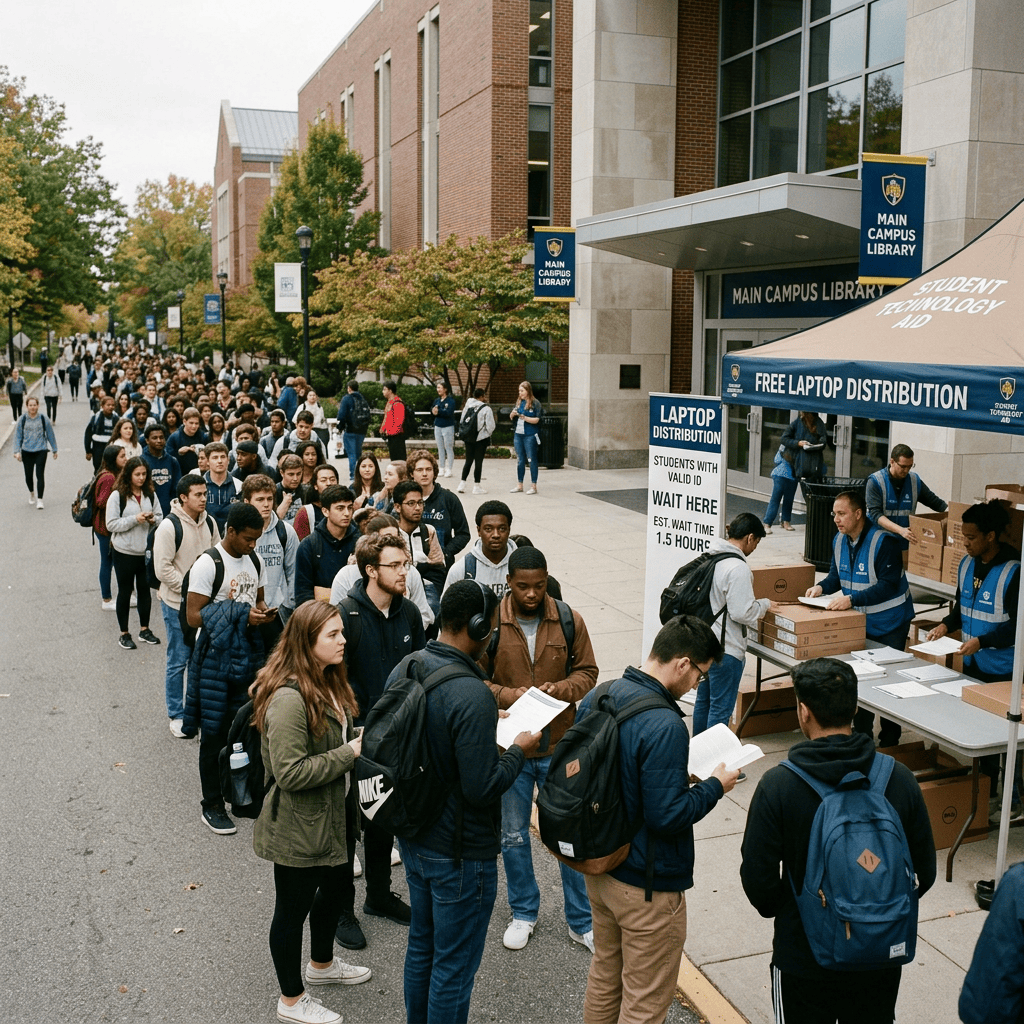
Walking to my office this morning on the first day of the semester, I came upon a sight I had never seen before. A line of students curled around the library lawn, hundreds of them standing shoulder to shoulder in the morning sun. I estimated more than four hundred.
I stopped and asked one of the students what everyone was waiting for.
“Laptop loaners,” he said.
The answer caught me off guard. These weren’t students lining up for concert tickets, free food, or some first-week campus giveaway. They were waiting to borrow the basic piece of equipment required to function as a college student in 2026.
I looked at the line again, and it suddenly appeared different. I had to assume that many of these students simply couldn’t afford to spend even $300 on a Chromebook. They needed a computer to write papers, access Canvas, conduct research, communicate with professors, and complete the daily machinery of college life, yet purchasing one was beyond what their budgets could absorb.
The sight humbled me because I spend an embarrassing amount of time thinking about computers. I research processors, RAM, displays, keyboards, battery life, and the microscopic differences between one generation of hardware and the next. I can become genuinely excited about a new chip or convince myself that some incremental specification represents a meaningful technological event. Meanwhile, four hundred students were wrapped around the library lawn waiting to borrow a machine that could run a browser and open a word processor.
Standing there, I also confronted the enormous difference between the economic world in which I attended college and the one my students inhabit. My generation had its struggles, and nostalgia can easily airbrush them away. But college was cheaper. Housing consumed a smaller portion of ordinary incomes. The job market was more forgiving of young people trying to find their footing. The financial penalties for making a few wrong turns were not always so severe.
My students have entered adulthood in a different economy. Tuition, rent, food, transportation, and nearly every other necessity compete for money many of them simply don’t have. Even the laptop that college now quietly assumes every student owns can become a luxury.
I continued walking toward my office, carrying an uncomfortable awareness of the distance between my college experience and theirs. I had always known that distance existed. But abstract knowledge is bloodless. It is one thing to read about economic inequality and another to see it materialize in front of you as four hundred young people standing in a line, waiting for a computer.


Leave a Reply