Tag: family

  • The Road Trip That Made You Possible: An Origin Story

    The Road Trip That Made You Possible: An Origin Story

    Everyone has an origin story. You are no exception. Yours begins with your father. Without your father’s sheer audacity and competitive determination, you wouldn’t even be here today. Long before you were a glint in his eye, your father was locked in a battle of epic proportions—an all-out, no-holds-barred contest for the affections of your eighteen-year-old mother. And this wasn’t just any competition. His rival? None other than John Shalikashvili, future United States General and Chairman of the Joint Chiefs of Staff. Their battlefield? The smoky, beer-soaked bar scene of Anchorage, where the stakes were higher than a highball glass during happy hour.

    Their duel for your future mother’s heart took a brief Christmas ceasefire when Shalikashvili retreated to his tactical command center in Peoria, Illinois, while your father returned to Hollywood, Florida, to soak up some sunshine and plot his next move. But as he lounged by the pool, your father realized that victory in this romantic Cold War required swift and decisive action. So he cut his vacation short, crammed himself into a cream-colored 1959 Morris Minor—a vehicle that looked like it had been assembled from the Island of Misfit Toys, complete with a coat hanger for an antenna and door handles barely clinging on by the grace of duct tape—and embarked on the most high-stakes road trip of the 20th century.

    Halfway through this odyssey, the car’s fuel filter decided to go on strike, leaving your father stranded in the middle of nowhere. When the local auto parts store couldn’t supply a replacement, your father—who would later perform engineering miracles at IBM—pulled off a MacGyver-level feat of mechanical wizardry. Armed with nothing but a prophylactic and a paperclip, he fashioned a makeshift fuel filter that was equal parts creative desperation and mechanical blasphemy. This duct-taped miracle kept the fuel pump from either flooding the engine or abandoning ship entirely, depending on its mood.

    Driven by the urgency of love and the fear of losing ground to Shalikashvili’s brass-polished charm, your father powered through the journey, ignoring his growling stomach like a man possessed. Subsisting on loaves of bread devoured like a feral squirrel, he soldiered on, skipping meals because, who needs food when you’re racing against the clock to prevent a military coup over your future wife?

    After a ferry ride that probably felt like crossing the River Styx, your father finally arrived in Anchorage, a full forty-eight hours before Shalikashvili could swoop in with his military swagger and irresistible authority. Nine months later, you were born, the ultimate trophy in this love-struck arms race.

    Even before you took your first breath, your father’s victory over Shalikashvili imparted some crucial life lessons: The competition is fierce, and life is a zero-sum game where you’re either a winner or a nobody. To survive, you must find a competitive edge, and if you ever get complacent, rest assured, someone will move in on your turf faster than you can say “ranked second.”

    As a teenage bodybuilder obsessed with becoming Mr. Universe, opening a gym in the Bahamas, and silencing your critics, you often thought about bodybuilding great Ken Waller stealing Mike Katz’s shirt before a competition in the movie Pumping Iron. Something as trivial as a missing shirt could send your opponent into a tailspin, disrupt his focus, and rattle his confidence like a cheap shaker bottle. Like Mr. Universe Ken Waller, your father taught you that power is a road paved with relentless cunning, ruthless strategy, and a healthy dose of underhanded shenanigans. 

    But underneath the shenanigans and Machiavellian flair, your father taught you one core truth: sweat more than everyone else. Out-hustle, out-grind, outlast. In his gospel, sweat wasn’t just effort—it was currency. The person who left the biggest puddle won. 

  • Watch Island: Where Grown Men Click Bezels and Call It Meaning

    Watch Island: Where Grown Men Click Bezels and Call It Meaning

    After twenty years tumbling down the horological rabbit hole, I’ve come to one conclusion: the watch hobby is a paradoxical fever dream held together by delusion, desire, and just enough self-awareness to laugh before crying.

    If Alec Baldwin’s mantra in Glengarry Glen Ross was “Always be closing,” then the watch nerd’s version is: “Always be laughing at yourself.” Because let’s be clear—none of this is serious. And yet, it’s also deathly serious. That’s the contradiction we live in: a tension between cosplay and existential weight.

    At its core, watch collecting is elaborate roleplay. Grown men strapping on wrist-bound fantasies, each timepiece a character costume in a rotating lineup of imaginary lives. We cosplay as deep-sea divers, fighter pilots, Arctic explorers, NASA engineers, rugged survivalists, or minimalist monks of Japanese restraint. We don’t just wear watches. We become them. Just as fans dress as superheroes at Comicon, we show up to Bezel-Palooza with Seikos and Sinns, flexing our sapphire crystals and ceramic inserts like badges of forged identity.

    And don’t get me started on the straps. We favor models named after desserts: waffles, chocolate bars, and tropic vanilla-scented rubber. We’re just high-functioning children in the horological wing of Willy Wonka’s Chocolate Factory. But instead of licking the wallpaper, we post lume shots under moody lighting and argue about clasp tolerances.

    It’s cosplay for the emotionally overcommitted.

    But the strangest contradiction? For something so clearly un-serious, we treat our collections with a kind of medical gravity. The annual “State of the Collection” post feels like a cholesterol screening—an attempt to gauge whether we’re healthy, balanced, evolving, or simply delusional. We don’t just love watches. We debate the proper ways to love them. We agonize over whether we’re rebuying the Willard out of longing or self-sabotage. We assign spiritual weight to which dial shade of blue best reflects our soul.

    This isn’t just madness. It’s structured madness. With forums.

    We are a niche tribe of adult males—many of us husbands, some of us fathers—who transform into Man-Babies the moment we utter the words “bezel action” or “ghost patina.” Our wives, bless them, want no part in our obsessive monologues about case thickness and end-link articulation. To them, we are overgrown children clinging to our G.I. Joes and Tinker Toys, slowly sprouting donkey ears like Pinocchio and Lampwick on Watch Island, while they look on with bemused pity.

    We know we’re ridiculous. That’s the beautiful tragedy. And still, we dive deeper. Because in a world that often lacks identity, silence, and meaning, we find it in brushed stainless steel and micro-adjust clasps.

    And yes—we’re probably overdue for an intervention.

  • “This Is the Other Place”: Twilight Zone Parenting and the Parking App of Doom

    “This Is the Other Place”: Twilight Zone Parenting and the Parking App of Doom

    Of all the Twilight Zone episodes that have taken up residence in my psyche, none clings more tenaciously than “A Nice Place to Visit.” A petty crook named Rocky Valentine gets gunned down during a botched robbery and wakes up in what appears to be paradise. He’s greeted by Pip, a genial, rotund guide played by Sebastian Cabot, who grants him everything his larcenous heart ever wanted: money, women, luck, luxury. No struggle, no stress. Every desire fulfilled on command.

    At first, Rocky revels in this frictionless dreamscape. It’s Vegas without losing streaks, heaven without requirements. But gradually, pleasure without purpose curdles into a thick, syrupy dread. He realizes that gratification without resistance is just another form of punishment. Bored out of his mind and desperate for meaning, Rocky pleads with Pip to send him “to the other place.”

    Pip laughs and delivers the gut punch: “Heaven? Whatever gave you the idea that you were in Heaven, Mr. Valentine? This is the other place!” And then, with glee, Pip cackles like the well-fed devil he is.

    Which brings me to paid parking.

    There is a hell, and it lives in the infrastructure of modern urban parking. It’s a realm of QR codes, license plate entries, and apps that want your soul—or at least your email and billing zip code. Some kiosks accept coins, others demand smartphone apps, two-step verification, and an MFA code just to stand still without being ticketed. My wife, tech-literate and cool-headed, usually handles this logistical hellscape while I loiter nearby, pretending to study the map of downtown like it’s a sacred text.

    But this week she’s out of town at a teaching convention, and I’m taking our twin daughters to Laguna Beach. This means I have to drive, find a parking structure, and—here’s the true horror—navigate the digital rigmarole of paid parking without her guidance. The thought of it has me sweating harder than Rocky in his silk suit.

    The absurd part? It’s not the traffic, the tides, or the teenagers that unnerve me. It’s the parking meter. The existential shame of standing in front of a digital payment kiosk, poking at it like a confused ape while my daughters wait patiently (or impatiently) beside me. I don’t fear the unknown. I fear looking like an idiot in front of my kids.

    But here’s the deeper, darker realization: this is just a symptom. My wife, through years of effort and mental load, has become the de facto logistics commander of our household. She knows which airport lines move faster. She’s the one strangers approach at terminals, sensing her Jedi-level calm. Meanwhile, I shuffle behind her like an NPC in a bad video game—directionless, frictionless, practically translucent.

    Frictionless living has a cost. It breeds detachment. It robs you of engagement, resilience, and presence. And like Rocky Valentine, I’ve grown too used to being served instead of showing up.

    Ironically, I’m obsessed with watches—those exquisite tools designed to remind you where you are in time. And yet, I’ve spent years drifting, distracted, floating outside the dial. It takes a solo day trip with my daughters—an hour drive, some shopping, a good lunch, and possibly a tantrum or two—to pull me back into the present.

    When my wife heard about my plan, she said, “You don’t know how happy this makes me.” And I believed her. She wasn’t just relieved that I was giving her a break. She was glad to see me step into the friction. To stop spectating and start parenting in real time.

    No, I don’t want to be Rocky. I don’t want a life where every parking spot is perfect, every line is short, and every meal arrives on time. I want the chaos. I want the curveballs. I want the real thing.

    Even if it means downloading the stupid parking app.

  • Demoted Dad: A Suburban Fall from Instructional Grace

    Demoted Dad: A Suburban Fall from Instructional Grace

    This morning, mid-swing in a blissful kettlebell session in my garage—a sacred temple of sweat, steel, and solitude—I glanced out to see a domestic drama playing out on the asphalt stage of my street.

    There he was: a dad in safari shorts and a floppy bucket hat, walking ten feet behind his five-year-old son, who was waging war with a two-wheeled bike. The boy had the wild energy of someone determined to conquer balance through sheer will. He fell. Got up. Fell again. But on the third tumble, he’d had enough. He plopped down in the middle of the road like a pint-sized union striker, arms crossed, lips pursed, radiating silent defiance. He wasn’t hurt. He was done.

    The dad—poor man—begged him to rise. Pleaded. Offered bribes, probably. But the child had entered the iron-willed resistance phase that all seasoned parents recognize: the Sit-In of Doom.

    I considered emerging from my kettlebell cave to offer peace offerings. Coffee for the dad. Lemonade for the boy. Something to cut the tension. But reason—and David French’s podcast on the masculinity crisis—pulled me back into my dungeon. I resumed my Turkish Get-Ups as the father stood in the street, trying to lead someone who refused to be led.

    Thirty minutes passed.

    When I looked again, the scene had shifted.

    Now the father was on his own bike, trailing behind his son and wife. The boy, steadier now, was pedaling confidently while the mother jogged beside him, holding the handlebars like a Secret Service agent shielding the President. The boy beamed, triumphant. The mother wore a face that said, without saying a word, “This is how it’s done.”

    And the father?

    He wore the same sullen expression his son had half an hour earlier. He looked demoted. Not from fatherhood, but from a very specific rank: Lead Bike Instructor.

    He was now an observing sidekick. A support staffer. An unpaid intern in his own household. Whether he’ll regain his instructor’s license remains to be seen, but one suspects the road back will involve bureaucratic hoops, penance, and perhaps a formal review board chaired by his wife.

    Such is the quiet theater of suburbia—played out between fallen bikes, bruised egos, and the eternal struggle for parental credibility.

  • Solitude Is My Boyfriend (And He Doesn’t Snore)

    Solitude Is My Boyfriend (And He Doesn’t Snore)

    In her essay “Same Life, Higher Rent,” Meghan Daum compares her life in 1997 to her life in 2017 and reaches a deflating, oddly liberating conclusion: nothing has changed. At 47 and freshly divorced, she’s more or less the same person she was at 27. Still single. Still chasing deadlines. Still drinking coffee, poking at takeout sushi, and trying to keep multiple Word docs open on her MacBook while ignoring the siren song of Twitter and low-stakes Amazon purchases.

    There is one glaring difference: her rent has skyrocketed and her cognitive bandwidth has shriveled. She estimates she’s lost 70% of her brainpower to the Digital Distraction Era. So yes—same life, dumber brain, higher rent. It’s a Nabokovian joke with a Billy Collins twist: Picnic, Lightning, but with Seamless orders and browser tabs.

    Like her earlier essay “The Broken-In World,” Daum doesn’t frame divorce as failure but as an act of radical return. Not regression—recognition. The performance is over. She’s stopped cosplaying as someone else’s version of a wife. The single life isn’t a punishment or a holding pattern—it’s her set point. The gravitational center she was orbiting all along.

    Coordinating a calendar with another adult, she admits, feels like a hostage negotiation. She loves living alone. She loves eating whatever she wants, whenever she wants, without anyone asking if they should defrost chicken. She can travel at the drop of a hat without shoving someone else’s life off balance. She’s not anti-love. She just refuses to bulldoze her rhythms for the sake of joint Costco runs.

    Post-divorce, she’s dated—kind, smart, well-meaning men—but none of them stood a chance against the one lover she can’t quit: solitude. She rarely goes on second dates. She doesn’t need romantic sabotage. She’s got peace and a dog. Who needs more?

    And let’s be clear: this position wasn’t won in a raffle. She fought for it. Marriage, divorce, reinvention. She earned this life through blood, paperwork, and self-inventory. She’s not about to crawl back into the foxhole of emotional compromise.

    Reading Daum, I’m reminded of a perfectly-cut line from Rodney Dangerfield: “You’re born a certain way and that’s it. You don’t change.” I think about that more than I should. At 63, I’m not all that different than I was at six. Moody, brooding one day. Goofy and loud the next. There’s a streak of isolato in me too. My family tolerates it. They let me take naps and skip amusement park trips that sound like air-conditioned nightmares.

    I’m probably not a perfect husband. But we make it work—me and this life. Me and my Daum-ian disposition. The marriage lasts, not because I’ve changed, but because we’ve all made our peace with who I am. And who I’ve always been.

  • The Pilgrim, the Mansion, and the Flying Death Rig

    The Pilgrim, the Mansion, and the Flying Death Rig

    Last night, I dreamed I worked at a surreal hybrid of a college campus and an amusement park—the kind of place where tenured professors could file paperwork in one building and ride a log flume in another. Picture syllabus deadlines and cotton candy coexisting. Naturally, I was late for both.

    Meanwhile, several miles away in my old neighborhood, Marcus, a childhood friend, decided he’d had enough of modern civilization. His exit wasn’t dramatic—no manifesto, no angry blog post—just a quiet pilgrimage beginning in front of my house. The weather was unreasonably perfect. Sunlight filtered through air that smelled like rose petals and eternal spring. Think Garden of Eden meets Orange County real estate brochure.

    So why would Marcus leave paradise? We didn’t know. But my neighbors and I were offended by the sheer moral audacity of it. His journey felt like a judgment—like he’d stared into the hollow eyes of our HOA and whispered, “You people are dead inside.” Naturally, we chased him. Not to stop him, but to prove we were decent people too. We jogged after him, waving metaphysical CVs and shouting, “We recycle! We make our own salad dressing!”

    But Marcus was too far ahead. By the time I arrived at the college-amusement park, he was gone. I retreated to my professor’s office to catch up on what dreams insist professors do: paperwork. That’s when Mike arrived—a former student, Navy SEAL, and time-traveling spirit guide from the 1990s. He led me to a house in Buena Park, once his father’s, now transfigured by dream logic into a mansion of staggering beauty, where I apparently lived a life of joy and ease in another dimension. It was, quite simply, the life I never knew I had but now mourned like a phantom limb. I was flooded with regret. Why did I leave that parallel mansion where I was whole, radiant, and probably never had to grade a single freshman essay?

    Then the sun set, and—as dreams do—I stopped being a professor and morphed into some kind of blue-collar rig worker, one of four men hauling cargo across the freeways of this theme park universe. At breakneck speed, we clung to the roof of a truck, flying over the 5 freeway like a band of deluded daredevils. I alone had the courage (or sanity) to question this arrangement. “You know,” I said, wind slapping my face, “we don’t have to die tonight. There’s an interior cabin. With seats.”

    At first, they mocked me—because apparently, dreamland logic still includes workplace hazing—but eventually, they gave in. We climbed down into the safety of the rig, like cowards, or people who enjoy not being flung across asphalt.

    As I relaxed, I thought once more about that mansion in Buena Park, that shadow life where I wasn’t trying to prove my worth or cling to cargo. A life of belonging, not striving. Then I woke up, ate a bowl of buckwheat groats, drank my Sumatra coffee, and wondered what it all meant.

  • The Forgotten Fleet: Memoirs of a Honda Hoarder

    The Forgotten Fleet: Memoirs of a Honda Hoarder

    Last night, my subconscious staged an intervention.

    In the dream, my family and I had relocated to a sprawling house perched at the edge of a forest—idyllic at first glance, but the driveway told another story. It had become a graveyard of Honda Accords. Not just one or two, but an entire archaeological dig of them: gleaming new models barely broken in, others half-eaten by moss and mulch, some peeking out from decaying leaf piles like forgotten Easter eggs, and one—yes, really—buried in the earth like a pharaoh’s chariot. Another Accord had somehow washed up near the beach, sun-faded and abandoned like a bloated sea lion.

    A kindly messenger—part real estate agent, part archangel—told my daughter and me about the beach-stranded Accord. So we climbed into an older model, the color of a liver spot, and headed to the coast. Upon arrival, we ditched that old heap to rescue another Accord of the exact same jaundiced hue. Predictably, the beach Accord was dead on arrival. My daughter and I, summoning the brute strength of Greek demigods, pushed it across the sand, up a mountain, and across California at warp speed—from Orange County to Simi Valley—as if towing the sins of my consumer past behind us.

    We paused at a cousin’s house, where iced tea and human needs awaited. My cousin, ever the concerned parent, confided that his son was wilting from loneliness. Without missing a beat, my daughter rang up a stunning actress—someone so luminous she made Instagram filters seem redundant. She showed up. So did half the neighborhood, offering baked goods in exchange for a glimpse at the sun goddess. One woman brought a cherry pie, trembling with reverence.

    As we continued northward, my joy curdled into anxiety. How many Accords had I bought over the years? Were there more hidden somewhere—collector’s editions with leather interiors and forgotten potential—lost to my Swiss cheese memory? Had I turned into the automotive equivalent of a hoarder monk, stacking sacred relics of midlife crises in the forest of my own forgetfulness? I awoke not with peace, but with regret, soothed only slightly by a tall, steaming mug of Sumatra roast, which I drank like a sacrament to sanity.

  • The Driveway Diaries: A Confession from the Curb

    The Driveway Diaries: A Confession from the Curb

    I live in Southern California’s golden triangle of suburban prestige: safe streets, sky-high property values, and public schools so highly rated they practically demand tuition. But on weekends and holidays, my block transforms into a theme park of inflatable bounce castles, fold-out chairs, and off-brand DJ booths—all courtesy of neighboring homeowners hosting backyard fiestas for their tiny heirs.

    With festivity comes the scourge: street congestion. Cars squeeze themselves into curbside crevices like sardines in a midlife crisis. They stack and cram and sidle up so tight to my house you’d think we were giving away parking validation and carne asada.

    Every so often, a guest parks with their bumper edging an inch—an inch—into the edge of my newly repaved driveway. A driveway I paid for myself because city bureaucracy shrugged and pointed to tree roots like they were an Act of God. That innocent slab of concrete cost me $5,500. Every time a Honda Pilot sniffs it without permission, I feel like I’m watching someone use my toothbrush.

    Still, I try to be Zen. I tell myself: “People want to be here. This isn’t intrusion. It’s affirmation. I am so blessed to live in a place so desirable, others will risk a petty homeowner’s wrath just to brush against my apron.”

    Then there’s the nightly ritual across the street. My neighbors, bless them, have adopted my driveway as part of their sacred reverse-entry protocol. They swing into my drive like a fighter pilot locking onto a carrier, headlights blazing through my living room window while I’m watching a true crime doc with my wife. Then they shift into reverse and back into their own driveway like they’re starring in a Ford commercial for backing-in bravado.

    Again, I resist the pettiness. I whisper: “What an honor to share my $5,500 slab of artisanal pavement. The city may have abandoned me, but I haven’t abandoned my commitment to grace.”

    But some nights, I spiral. I see my empty driveway (because my Honda is parked dutifully inside the garage like a respectable introvert) and I grow suspicious. “They’re circling,” I think. “Someone’s going to claim this space. They’re going to park smack in the middle of my private driveway, right under the basketball hoop I haven’t used since 2008.”

    In my darkest moments, I fantasize about war. “Let them try it,” I growl internally. “I’ll tow them. I’ll call the police. I’ll lawyer up. I’ll blog about it to my three dozen loyal followers and publicly shame their license plate into eternity.”

    And just when I think I’ve shaken off my paranoia, the sirens come. Always the sirens. I live wedged between two hospitals, so I’m serenaded hourly by ambulance howls and the Doppler wail of emergency response. It’s like being reminded every ten minutes that death is always trending.

    The crowded streets don’t help. It’s not just congestion—it’s existential compression. The world is full. There’s no more room. Civilization is a Jenga tower one move away from collapse.

    And still, I try to be kind. I try to be sane. “I’m not petty,” I tell myself. “I’m not paranoid. I’m just emotionally literate.”

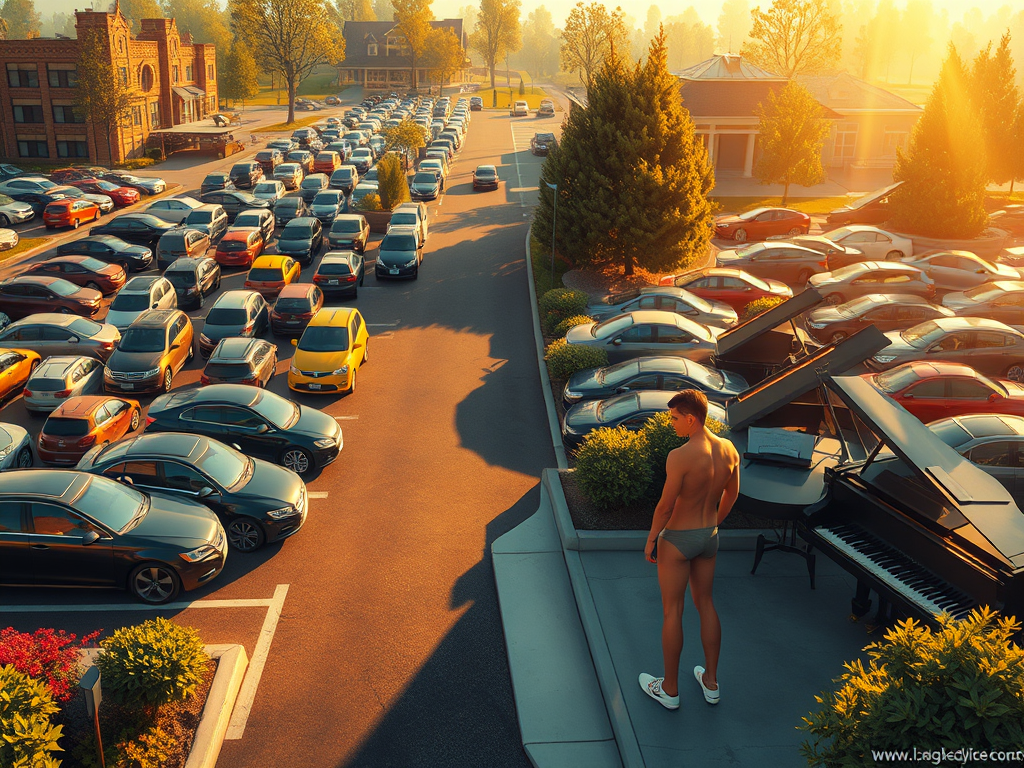
    So I do what I’ve always done: I go to the piano. I sit and play one of the hundreds of songs I’ve written since I was sixteen. The music softens the beast. It wraps my dread in a velvet ribbon of minor chords. Unfortunately, all my songs sound vaguely identical—like clones from the same melancholy womb. But I take what I can get.

    If twenty minutes of recycled piano sadness gives me peace in the suburbs, then I’ll sit at that bench and bleed quietly into the keys. No apologies.

  • The future, we’re told, is full of freedom—unless you’re the one still cleaning the mess.

    The future, we’re told, is full of freedom—unless you’re the one still cleaning the mess.

    Last semester, in my college critical thinking class—a room full of bright minds and burnt-out spirits—we were dissecting what feels like a nationwide breakdown in mental health. Students tossed around possible suspects like a crime scene lineup: the psychological hangover of the pandemic, TikTok influencers glamorizing nervous breakdowns with pastel filters and soft piano music, the psychic toll of watching America split like a wishbone down party lines. All plausible. All depressing.

    Then a re-entry student—a nurse with twenty years in the trenches—raised her hand and calmly dropped a depth charge into the conversation. She said she sees more patients than ever staggering into hospitals not just sick, but shattered. Demoralized. Enraged. When I asked her what she thought was behind the surge in mental illness, she didn’t hesitate. “Money,” she said. “No one has any. They’re working themselves into the ground and still can’t cover rent, groceries, and medical bills. They’re burning out and breaking down.”

    And just like that, all our theories—algorithms, influencers, red-vs-blue blood feuds—melted under the furnace heat of economic despair. She was right. She sees the raw pain daily, the kind of pain tech billionaires will never upload into a TED Talk. While they spin futuristic fables about AI liberating humanity for leisure and creativity, my nurse watches the working class crawl into urgent care with nothing left but rage and debt. The promise of Universal Basic Income sounds charming if you’re already lounging in a beanbag chair at Singularity HQ, but out here in the world of late rent and grocery inflation, it’s a pipe dream sold by people who wouldn’t recognize a shift worker if one collapsed on their marble floors. The future, we’re told, is full of freedom—unless you’re the one still cleaning the mess.

  • Lessons Learned from the Ring Light Apocalypse

    Lessons Learned from the Ring Light Apocalypse

    During lockdown, I never saw my wife more wrung out, more spiritually flattened, than the months her middle school forced her into the digital gladiator pit of live Zoom instruction. Every weekday morning, she stood before a pair of glaring monitors like a soldier manning twin turrets. At her feet, the giant ring light—a luminous, tripod-legged parasite—waited patiently to stub toes and sabotage serenity. It wasn’t just a lighting fixture; it was a metaphor for the pandemic’s unwanted intrusion into every square inch of our domestic life.

    My wife’s battle didn’t end with her students. She also took it upon herself to launch our twin daughters, then fifth-graders, into their own virtual classrooms—equally chaotic, equally doomed. I remember walking past their screens, peering at those sad little Brady Bunch tiles of glitchy faces and frozen smiles and thinking, This isn’t going to work. It didn’t feel like school. It felt like a pathetic simulation of order run by people trying to pilot a burning zeppelin from their kitchen tables.

    I, by contrast, got off scandalously easy. I teach college. My courses were asynchronous, quietly nestled in Canvas like pre-packed emergency rations. No live sessions. No tech panics. Just optional Zoom office hours, which no one attended. I sat in my garage doing kettlebell swings like a suburban monk, then retreated inside to play piano in the filtered afternoon light. The pandemic, for me, was a preview of early retirement: low-contact, low-stakes, and high in self-righteous tranquility.

    My wife envied me. She joked that teaching Zoom classes was like having your teeth drilled by a sadist who lectures you on standardized testing while fumbling with the pliers. And I laughed—too hard, because it wasn’t really a joke.

    The pandemic cracked open a truth I still wince at: the great domestic imbalance. I do chores, yes. I wipe counters, haul laundry, load the dishwasher. But my wife does the emotional heavy lifting—the million invisible tasks of motherhood, schooling, comforting, coordinating. During lockdown, that imbalance stopped being abstract. It stared me in the face.

    For me, quarantine was a hermit’s holiday. For her, it was a battlefield with bad Wi-Fi. And while I’m back to teaching and she’s back to something closer to normal, I haven’t forgotten the ring light, the glazed stare, or the guilt that hums quietly like a broken refrigerator in the back of my mind.