Tag: family

  • The Day the German Chocolate Cake Lost Its Throne

    The Day the German Chocolate Cake Lost Its Throne


    The plan for my birthday was simple: a German Chocolate Cake from Torrance Bakery—rich, decadent, predictable, the sugary punctuation mark to another year survived. My wife, Carrie, placed the order, and I considered the matter settled. But on Sunday, three days before the big event, she blindsided me with an unsolicited miracle: a homemade hummingbird cake. It’s carrot cake’s tropical cousin—bananas and pineapple mingling like exiled fruits at a Southern potluck.

    She confessed she wanted to get me a “real” present, not something outsourced, so she compensated with butter, flour, and a whole lot of love. I ate three thick slices that Sunday afternoon, each forkful blurring the line between nourishment and seduction. “This is so wholesome,” I told her, “it doesn’t even count as cheating on my diet. It’s morally superior to carrot cake—and so dangerously good it might ruin Tuesday’s German Chocolate encore.”

    Carrie laughed, apologized for my impending existential crisis, and on Tuesday returned with the official cake: the grand Torrance Bakery specimen. We performed the ritual—candles, singing, obligatory family cheer—and I consumed an 800-calorie slice with the reverence of a man honoring tradition.

    It was moist. It was glossy. It was… fine. The caramel layer, usually the German Chocolate’s battleground of decadence, seemed to have surrendered before the fight began. I chewed, waiting for transcendence that never came. It struck me then: German Chocolate Cake is unreliable—half the time glorious, half the time cafeteria bland.

    The verdict arrived between bites. My lifelong allegiance had shifted. My mother’s German Chocolate Cake once ruled the birthday throne, but the crown has passed. The hummingbird cake reigns supreme—a moist, fragrant coup d’état led by pineapple and banana insurgents. The old guard has fallen. Long live the new confectionary monarch.

  • Thou Shalt Not Confuse Self-Knowledge with Self-Flattery

    Thou Shalt Not Confuse Self-Knowledge with Self-Flattery

    When I was sixteen, my parents divorced—an event I took in stride only because I was too busy staring at my biceps in the mirror. My father moved into an apartment about thirty minutes away, and once a month he’d pick me up, grill a couple of ribeyes, and try to civilize me. It was his way of maintaining paternal authority through meat.

    One evening on his patio, with the smell of charcoal and masculinity wafting in the air, he asked me what I wanted to do with my life after high school. At the time, I was an aspiring bodybuilder with zero interest in college. I wanted a job that paid decently, had steady hours, and left me free to chase the holy trinity of youth: muscle, mirrors, and admiration.

    I told him I was thinking about becoming a sanitation engineer. A few guys at my gym drove garbage trucks and claimed it was honest work with great benefits.

    My father nearly choked on his steak.
    “You can’t be a garbage man,” he said, wiping his mouth with the precision of a surgeon preparing to deliver bad news.

    “Why not?”

    “Because you’re too vain.”

    That line hit like a barbell to the skull.
    “What’s that supposed to mean?” I asked.

    He leaned back and launched into his Socratic cross-examination. “Picture this: You’re at a cocktail party. Everyone’s introducing themselves—doctor, lawyer, software engineer, business executive. Then they get to you. What do you say? ‘Hi, I’m Jeff, and I pick up your trash’? I should think not.”

    “Oh my God, Dad, you’re right.”

    “Of course I’m right,” he said, stabbing the last piece of steak like a punctuation mark. “I’m your father. Now finish your meat and start planning for college.”

    That night I turned to Master Po, my invisible philosopher-therapist, for guidance.

    “Master Po,” I asked, “why did my father insult me by calling me vain?”

    “Grasshopper,” he said, “your father did not insult you. He simply named your disease. Truthful words are not beautiful; they bruise. Flattering words are lovely but poisonous. Your father loves you enough to deliver the ugly truth—that you are a creature driven by vanity and status.”

    “But this means I have to go to college,” I said. “I’ve spent all my high school years pumping iron and admiring my reflection. I’m too dumb for college.”

    “Fear not, Grasshopper,” said Master Po. “The journey of a thousand miles begins with a single step.”

    “My steps are small,” I said.

    “That is fine,” said Master Po. “An ant on the move does more than a sleeping ox.”

    And so it was: my path to higher learning began not in inspiration but in insult—proof that sometimes enlightenment arrives medium-rare, served with a side of humility.

  • The Wise Man Must Polish His Soul Before Critiquing Someone Else’s Plumbing

    The Wise Man Must Polish His Soul Before Critiquing Someone Else’s Plumbing

    It was a Saturday afternoon, and I was trapped in my bedroom, waiting for the plumber to leave so I could sneak into the kitchen and make a protein shake. I could still hear him grunting and groaning under the sink like a walrus in a crawlspace. Through my bedroom window—across the little atrium separating me from the scene of domestic violation—I could see his open toolbox: a chrome battlefield of wrenches, pipes, and filthy rags sprawled across the linoleum like the aftermath of a plumbing apocalypse.

    My mother tiptoed into my room and whispered, “It’s so nice of him to do this.”
    I frowned. “What’s that supposed to mean?”
    “He’s not charging me,” she said with the glee of someone who’d just gamed capitalism.
    “Of course he’s charging you.”
    She shook her head. “He’s a friend.”
    “You just met him.”
    “His name is Paul Bergdorf. One of my girlfriends introduced me.”
    “Mom,” I said, “this isn’t going to end well.”
    “Keep your voice down,” she hissed, which is parental shorthand for I know you’re right but don’t ruin it.

    Bergdorf shouted from the kitchen that he was finished. My mother floated toward the sound of her rescuer while I picked up my barbell and started doing reverse curls—the exercise of choice for sons on the verge of moral intervention.

    From my vantage point through the sliding glass door, I saw the man emerge from under the sink. Paul Bergdorf was a specimen of middle-aged decay: a big gut pressing against his jeans like bread dough rising from its pan, grease-slick hair combed over his scalp in defiance of reality, and a face red and puffy as if carved from boiled ham. His eyes were glazed, his nose bulbous, his stubble crawling toward his ears. The man radiated cologne, sweat, and failure.

    He wiped his hands on a rag, tested the faucet, and said proudly, “All fixed. Now before I go, I may not be the best-looking man in town, but I can make a hell of a steak. I’m talking big, thick, juicy steaks—barbecue the way it’s meant to be done.”
    “That’s nice,” my mother said, “but no thanks.”

    I continued curling, the barbell becoming heavier with every syllable of his pitch. My forearms burned, but my fury was burning hotter.

    “I’ll get the best cuts,” he said, grinning. “You’ve never had steak like mine.”
    “That’s very kind, but I’m busy.”
    “Just pick a weekend. I’ll do the rest.”

    That did it. I charged down the hallway, forearms pumped, veins bulging, looking like an interventionist deity of adolescent righteousness.

    “How many times,” I asked, “does she have to say no?”

    Bergdorf stepped back, rag in hand, suddenly less swaggering. “Hey, let’s cool it, kid. I just wanted to ask your mom out. I’ve been working on this sink all day—it’s the least you could let me do.”

    “If you want to fix sinks for free, that’s your business,” I said, “but you’re entitled to nothing—not steak, not gratitude, not my mother.”

    “I just wanted to barbecue,” he mumbled.
    “Congratulations,” I said. “You’ve told everyone within a five-mile radius that you’re a steak virtuoso. Now leave.”

    Bergdorf, perspiring and wounded, gathered his tools, slammed the toolbox shut, and stomped out to his truck. The engine roared, the tires squealed, and the house filled with the lingering scent of sweat, smoke, and Stetson cologne.

    My mother stood in the kitchen, arms crossed. “You scared him away.”
    “Damn right.”
    “The neighbors say you’re getting too big and too scary. Maybe you should cool it for a while.”
    “I’m not cooling anything.”
    “Sal Tedesco says his son sees you working out with some crazy football player.”
    “His name is John Matuszak,” I said. “And he’s not crazy.”

    I could still smell Bergdorf’s presence hanging in the air like a curse. “God, he stinks,” I said. “That smell’s never leaving this house. Just hire a plumber next time, okay?”

    I retreated to my room, slammed the door, and sat on the bed. My forearms throbbed. My conscience twitched. I turned to Master Po, my invisible therapist and ancient Chinese philosopher in exile.

    “Was I wrong to drive that man away?” I asked.
    “Your mother was managing the situation,” said Po, his voice calm as incense smoke. “You intervened because you lack patience—and because control soothes your fear.”
    “But he wouldn’t leave.”
    “Everything leaves in time,” said Po. “You must learn the difference between protecting and meddling. The sage does not seize control of others’ lives; he tidies his own.”

    He glanced around my room: dirty gym clothes strewn across the floor, cracked tiles, a broken window patched with a Cap’n Crunch cereal box.

    “Grasshopper,” he said, “before you become your mother’s moral custodian, try cleaning your own temple. It is written: the wise man polishes his soul before critiquing someone else’s plumbing.”

  • If You Spend Your Life Wanting Things, You Will be in a Constant Fever

    If You Spend Your Life Wanting Things, You Will be in a Constant Fever

    One evening, I was holed up in my room, devouring a muscle magazine like it was scripture. I’d just finished an article on “progressive resistance training,” a phrase that made my adolescent heart thump with moral clarity. The world, I decided, was divided into two kinds of people: those who were progressing—pushing, grinding, improving—and those who were stuck, rotting in the swamps of inertia. Naturally, I placed myself in the first camp, the self-anointed pilgrim of progress.

    When the article ended, I drifted into the ads—the sacred appendix of every muscle mag. Protein powders, chrome dumbbells, pulleys, powders, potions—alchemy for the ambitious. But one ad stopped me cold: the Bullworker. A gleaming, three-foot rod of plastic and steel with cables sprouting from its sides like mechanical tendons. When you pulled the cables, the thing bowed like a crossbow for Hercules. A shirtless bodybuilder—pecs like carved mahogany—was using it to crush air itself. Price tag: forty-five bucks. Steep, but wasn’t self-transformation always costly?

    I marched into the living room, magazine in hand. My father sat in his recliner, beer in one hand, football roaring from the TV like an angry god.
    “Dad, what do you think?” I said, pointing to the Bullworker.

    He barely glanced at it. Still had the infantryman haircut, the square jaw, the tattoo—MICHAEL, bold and blue—across his right bicep like a relic from some forgotten war.
    “You want big muscles?” he said. “Pull weeds. Mow the lawn. Clean the gutters. Chop some kindling. That should do it.”

    “Dad, come on, I’m serious. This would be great for my workouts.”

    He sighed, studied the ad, then set the magazine down.
    “Son, this is marketing dressed up as science. But if you want to waste your allowance, go ahead.”

    “I’m short on cash.”

    “Then save. But make sure you want it. Do your research. My guess? The more you learn, the less you’ll want it.”

    “Why do you say that?”

    He smirked. “You ever heard of Sturgeon’s Law?”

    “No.”

    “Ninety-nine percent of everything is bullshit. Including that. Remember that martial arts course you bought? The one that promised black-belt skills in six weeks? What did you get? Stick figures in a pamphlet. Bullshit. Perform your due diligence, son. It’ll save you money.”

    “What’s ‘due diligence’?”

    “It means don’t be a sucker. Look closely before you buy anything. Most things collapse under scrutiny. Always be eager to save your money and reluctant to spend it. You hear me?”

    “Yes, Dad.”

    I retreated to my room, unimpressed by football and existentially wounded by paternal pragmatism. I opened another magazine and, in a desperate act of spiritual outsourcing, asked Master Po—my imaginary monk mentor—what he thought.

    “Your father is right, Grasshopper,” he said, somewhere between my conscience and my guilt. “If you spend your life wanting things, you will stay forever busy saving for them—and it will not be a noble busyness. It will be the feverish pacing of a man hypnotized by catalogs. Simplify your life, Grasshopper, and do the work that needs to be done.”

    “And what work is that?” I asked.

    “To stop pretending the world owes you the front of the line,” he said. “Stand at the back. Wait your turn. While you wait, develop yourself. Earn your place.”

    “How long will that take?”

    “A lifetime, Grasshopper,” he said. “And when you think you’ve arrived, the journey will have only begun.”

  • Thou Shalt Find Beauty in Freakishness—or Die Trying

    Thou Shalt Find Beauty in Freakishness—or Die Trying

    By high school, I had fully accepted that I was not designed for the mainstream assembly line. Master Po—the blind sage from Kung Fu—had become my imaginary spiritual adviser, reminding me that I was a misfit, “a brooding soul misaligned with this world.” I wore that label like a second skin. While the cool kids air-guitared to Aerosmith and Led Zeppelin, I was hypnotized by the twelve-minute prog-rock epics of Yes, King Crimson, The Strawbs, and Genesis—bands that required liner notes and a calculator to appreciate.

    Football was for the square-jawed; I preferred curling iron plates in the garage, sculpting myself into a protein-powered statue of misplaced purpose. Worse, I wasn’t just eccentric—I was evangelical. At parties, I arrived armed with Genesis LPs, a blender, and the self-righteous zeal of a macrobiotic missionary. While everyone else chugged beer, I lectured them on amino acid assimilation. “Beer tastes like horse piss!” I declared, mid-flex, clutching a protein shake like a chalice. Girls scattered like pigeons from a lawn sprinkler. “Come back!” I shouted after them. “I’m the only one here with abs!”

    Later, alone in my room, my biceps and I sulked together under the blue glow of my bedside lamp.
    “Master Po,” I sighed, “why am I such a freak?”
    “Because you throw banana peels in people’s path to keep them from getting close to you,” he said.
    “And why would I do that?”
    “To protect yourself.”
    “From what?”
    “Everyone is broken, Grasshopper—but you are cracked to the core. Yet remember: beauty can be found even in freakishness. If you don’t draw that beauty out, it will turn inward and destroy you.”
    “How so?”
    “Because if you keep throwing banana peels for others, you’ll eventually slip on them yourself.”
    I sighed. “I think it’s already happened.”

  • My Doppelganger in Dark Sweats

    My Doppelganger in Dark Sweats

    Last night I dreamed that a baby had been abandoned in the flower garden outside my San Francisco apartment. His thin wail rose above the city hum, but no one seemed to hear it but me. The world went on—cars passing, neighbors coming and going—while I alone stood transfixed by that cry. I lifted the baby from the dirt, his skin warm and impossibly soft, and held him against my chest. Standing at the threshold of the apartment I rented with my wife and our stray orange cat, I prayed for holiness and wept, as though the infant had been dropped from heaven for me alone to fail or redeem.

    Inside, the apartment felt like an expensive tomb—luxurious, dim, deliberately shadowed, as if light itself were rationed. I fed the child and watched him feed, marveled at the smallness of his breaths. When his parents arrived, both scientists, I confronted them. They were calm, rational, and convinced me of their legitimacy with clinical precision. Their excuse was airtight, their affect detached, and in the end, I surrendered the baby, though my faith in their explanation felt paper-thin.

    Then the parents and the baby were gone. At this point, my role inside the apartment was clear: My wife and I were educators using the apartment to host seminars on DNA and algorithms for college students. The air smelled faintly of coffee and ozone. During one of these sessions, the true apartment owner appeared: my thirty-year-old doppelgänger, tall, lean, dressed in the sleek anonymity of wealth—dark designer sweats, minimalist sneakers. He admired the apartment I had borrowed as though validating his own taste: the kitchen gadgets gleamed like relics, the food neatly arranged, the DVDs alphabetized. His presence was eerie—a reflection of my own mind rendered in a sharper resolution. We talked about the future buyer of the apartment, another iteration of us—older, familiar, running on the same mysterious algorithm encoded in our shared DNA.

    When the lecture ended, my wife and I returned the keys to my younger self and walked hand in hand along the apartment’s tennis courts. The sky had the bruised hue of evening. I told her that everything—the baby, the double, the science lectures—had overwhelmed me. I broke down, crying again for the purity I had felt when I prayed over the abandoned child. That moment at the doorstep remained the still point of the dream: holiness in the act of holding something utterly helpless, something untouched by algorithm or ownership.

  • Latte Palace at the End of the Earth

    Latte Palace at the End of the Earth

    Last night I dreamed that my mother and her family—gone twenty years and counting—came back to life as if they’d only stepped outside for air. No trumpet blast, no spectral fog. Just my aunt’s kitchen in Los Angeles: sunlight on the vinyl, the smell of coffee and waffles, forks tapping plates like tiny hammers. My mother kissed my cheek the way she used to, a quick press and a pat—quality control for the living.

    Between bites of waffles and scrambled eggs my grandfather announced, in the same voice he used for weekend errands, that we were driving to a mansion in Alaska. He said “mansion” as if it were around the corner, not at the end of the continent and a climate shift away. Heads nodded. Coats appeared. Dream logistics are ruthless: one cut and we were already rolling, my grandfather at the wheel of a weary sedan, a caravan of relatives stacking up behind us like punctuation.

    The city dissolved. Los Angeles flattened into a silver slab, then a bright white riddle. Snow stitched itself across the windshield; the tires made that soft, murderous hush you hear on ice. My grandfather drove with cheerful indifference to physics, tapping the wheel to music only he could hear. I watched the road bloom and vanish and thought: so this is how resurrection handles transportation—no chariot of fire, just black ice and a bench seat.

    We crested a hill and there it was: a palace poured in espresso and cream, a latte-colored sprawl with too many windows and the kind of confidence money wears when it doesn’t expect to be told no. Someone in the back called it “Politburo chic,” and the phrase snapped into place—midcentury power with an indoor fur policy. The façade implied heated floors and quiet compromises. The roofline looked like it had read every memo and approved half of them.

    What struck me wasn’t that my family had returned; it was how casual I felt about it. My mother was alive. My grandfather was alive. Aunts and uncles murmured behind me, inventorying snacks, debating rooms. And I sat there with the calm of a man who receives an impossible package on his porch and signs without reading the label. Maybe grief is software and last night the update finally took.

    We idled at the circular drive while the house regarded us with its many eyes. I tried to imagine the foyer: the smell of wax and cold marble, a staircase that curves with the arrogance of a purebred. My brain kept blurring the picture like a censor’s bar. I could sense chandeliers, a staff of refined butlers. 

    But I woke up before entering the mansion. Now more than anything, I feel tantalized by what was inside that mansion. Now I’ll never know. 

  • Eternal Embarrassment

    Eternal Embarrassment

    Nietzsche imagined hell as reliving your life on loop—eternal recurrence. A demon forces you to endure every joy and misery again. Let’s revise the experiment: not your whole life, just the embarrassing parts on repeat. Eternal embarrassment. If that isn’t the full biography, it’s certainly old age. You no longer fit the world. Your butt shrinks; belts stop doing their job. Cheeks sag. Your neck goes a little fleshy. Your interior vocal editor—never stellar—finally quits, so you talk more than anyone asked for, mostly about how cold you are and how the TV volume is too low. You’ve slowed down, and the world—amped on Red Bull—won’t wait.

    In two weeks, I broke two Samsung TVs, failed to sync my phone with the new garage-door opener, threw an infantile tantrum, and my wife had to bail me out. She could have gone full prosecution; instead, her annoyance was tempered by pity. She saw me trying—earnest home-improvement flailing—and, when I stumbled, she picked up the pieces. I was left embarrassed and nursing a small crisis of confidence.

    So I went hunting for redemption. My family had been grumbling about dinners. Thursday’s Caesar-with-chicken-skewers had overstayed its welcome; they wanted better lunch ingredients—better bread, meats, cheese, and more interesting condiments. As the designated Saturday Trader Joe’s runner, I sat at my computer, family gathered around, actually listened, and updated the list like I was drafting a treaty.

    Next morning—Saturday—I launched my ritual at Hawthorne and Del Amo, a tradition I’ve upheld with the zeal of a cultist for twenty-two years. Grocery shopping isn’t a chore; it’s a military operation. My $350 haul is executed with Navy SEAL precision. Delays, obstacles, small talk? Enemies of efficiency. Armed with the evolving list, I dart through aisles like I’m on Supermarket Sweep, a stopwatch ticking in my skull. 

    That morning, I stepped out of my gunmetal gray Honda, I caught a reflection in the store window—an angle so unforgiving it announced, We’ve had one too many second helpings. I looked away. Denial is cheaper than therapy. In my mind I’m a sleek, youthful me—190 pounds of toned potential, not the spectacle of a 225-pound man auditioning for the Dad-Bod Calendar.

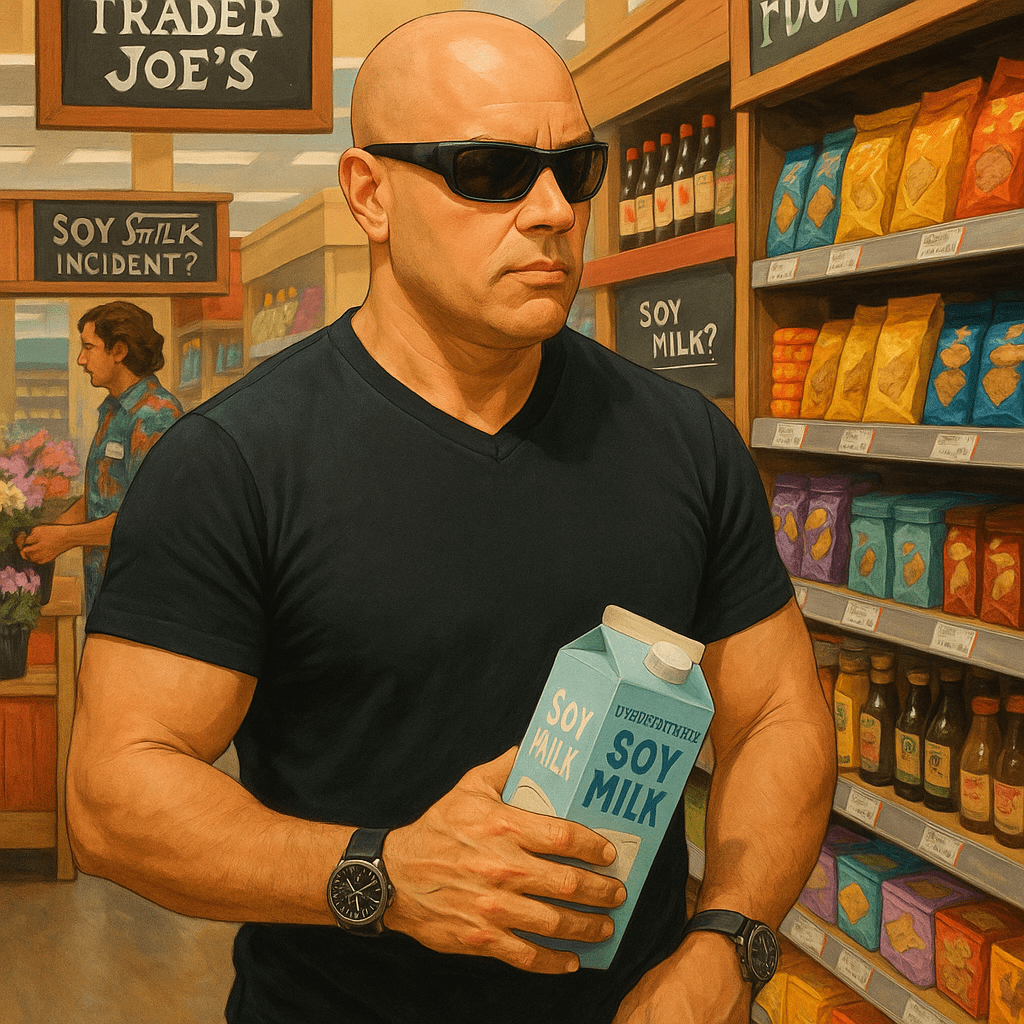
    Inside, my confidence was restored. The staff knows me; they greet me with the friendly heckling reserved for clockwork regulars. If I show up off-schedule, they act like I’ve survived a plane crash. One cheeky clerk calls me the “Larry Csonka of Trader Joe’s.” I play along: “There’s been a Larry Csonka sighting in aisle five.” The rapport was golden—until The Incident. The shelf was barren of unsweetened soy milk—the only plant milk with actual protein. I spotted Mary, the assistant manager, stocking canned goods. I asked, politely, if there was soy milk in the back. She said she’d check, then resumed stacking cans like bullion. Assuming she’d forgotten, I quietly asked another employee to check. Fatal misstep.

    By the time I looped back with bread and pastries, Mary had stocked the soy milk—and wore a look that said I’d insulted her canned-goods ethics. In that instant, I crossed the border from beloved regular to pushy customer. Two decades of goodwill, spilled across the linoleum for a stupid carton of soy. If I could time-travel, I’d go home and order a case of Edensoy on Amazon. Once, I entered like Larry Csonka at a Super Bowl parade; now I skulked, head low, list clutched like a last shred of dignity.

    Trader Joe’s was supposed to be my safe space, but I botched it—just like the “simple” garage-door purchase. Simple things kept flowering into fiascos. I was busy processing shame and embarrassment when Nietzsche drifted back in: eternal recurrence. Except my condition was worse. Who needs to replay old humiliations when fresh ones keep arriving on the conveyor belt?

  • The Garage Door Incident and the Fight with Balrog

    The Garage Door Incident and the Fight with Balrog

    Most people paddle along. We don’t have all the answers, but we keep the canoe upright. If you’re like me—diagnosed with low-grade depression, dysthymia—you brave forward and maintain emotional homeostasis by doing your duty to yourself, your friends, and your family. You exercise. You eat right. You post milestones on social media and affirm the tribe’s values, harvesting likes like daylight vitamins. You save for a rainy day.

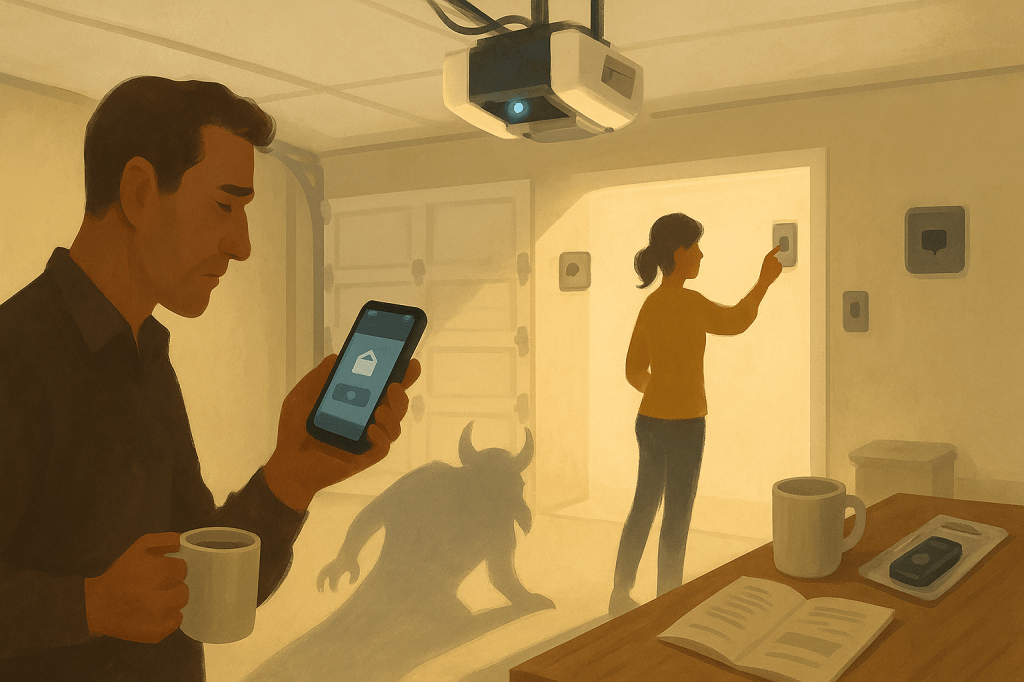
    That’s what I did. So when the garage door opener finally died after twenty-five years, I called the repair company that had been nursing it for a decade and paid a thousand dollars for a replacement. The tech arrived—mid-thirties, dark blue baseball cap, beard, sunglasses—affable and chatty. We covered carne asada tacos, the garage door racket, and daily protein quotas. In under an hour he had the new Genie humming. And yet: the in-house wall button turned into a ghost button (opens nothing, closes nothing); he issued only one new remote, leaving my wife remote-less; and he didn’t sync the unit to the Genie app. “Easy,” he said, packing up. “Just follow the directions.” Then he vaporized.

    For the next two hours, I tried to enter the unit ID and sync via Bluetooth. Problem: the buttons weren’t labeled, the manual’s diagrams didn’t match my unit, and the app’s pictures didn’t match either. I called my neighbor Joe. He said the same company had given him two remotes—minimum. “Did you already pay?” he asked. “Yes.” “You blew it. He should’ve synced your phone before he left. You’ll never see him again.” I protested that he seemed nice. “He’s gone, dude.” Then, after a long pause: “Call and demand they come back—and threaten a bad Yelp review.” I phoned the tech; he said he’d try to fit me in “tomorrow,” which I translated as never. The company promptly sent me a link to post a Google review. I wrote a calm, three-star warning: skilled install, but details ignored; don’t pay until the phone is synced and both remotes are in hand. I pasted the same on Yelp. Not spiteful—just a PSA. And then the shame arrived like a stomach punch. I felt as if I’d betrayed him—though he’d arguably betrayed me. Why was I ashamed? Because I felt stupid for failing at the sync.

    ChatGPT didn’t rescue me, and the failed DIY made me feel worse—ashamed and anxious. Getting the garage fully functional had become a talisman for my emotional homeostasis. Without it, I began to tilt into the abyss. My wife came home from her middle school job; I explained the mess. She said she’d help later—first, a mountain of paperwork. I tried to stay quiet but kept circling back to the tech’s “betrayal.” My posture turned desperate and wounded; the tension thickened. She retreated to the bedroom to grade and watch TV. She wanted nothing to do with me. I don’t blame her. I’d become an emotional siren labeled The Garage Door Incident.

    The next day the tech never called. My wife, apparently an engineer in a former life, pulled off the white plastic cover on the unit, found the Bluetooth button, and synced our phones. She also programmed the second remote I’d bought on Amazon. She fixed everything the tech didn’t. I thanked her. She answered—kindly, but surgical—that I’m like her sixth-graders: no patience; I want the world to stop until my problem is solved. When I spin out like that, she needs distance. I nodded. Fair.

    That was three days ago. Since then, something has shifted. I’ll call it a Balrog Moment: Gandalf and the demon in Moria, the bridge cracking, both plunging into darkness. My shame—for incompetence, impatience, and those two negative reviews—shook my homeostasis. I dropped into a shaft of depression, self-doubt, and nihilism. My paddling rituals—coffee, workouts, piano, posting pungent morsels on social media, even drafting my biting book Speedos at Sunset: How Not to Age Gracefully in Public—suddenly felt flimsy, even ridiculous.

    This morning, staring into that abyss, I decided not to look away. The loss of homeostasis—the Balrog Moment—is the marrow of the book. The pain is vast; it drowns, it devours, it cross-examines everything I am. I’ve been sucked into a vortex of nihilism and self-doubt, and yet here I am, hunting for tools to claw back dignity, rebuild self-confidence, and find alignment in a world that keeps knocking me off center.

  • Out of Alignment

    Out of Alignment

    The following is an expansion from yesterday’s short post about old age into a full-blown chapter:

    No one warned me, but I should have seen it coming: creeping toward your mid-sixties is less a rite of passage than a crisis of competence. Or, to be precise, it’s a progressive misalignment with the modern world. You drop references to Danish Go-Rounds, Screaming Yellow Zonkers, Tooter Turtle, Super Chicken, and All in the Family and watch blank faces stare back at you. You still assume that appliances are built with the sturdiness of yesteryear, only to find that today’s models disintegrate if you breathe on them sideways. This misalignment breeds a special kind of incompetence—egregious, preventable, humiliating.

    You can swallow vats of triglyceride omega-3 fish oil, but the short-term memory still slips away without mercy. You forget where you parked your socks (on the couch), that you meant to watch the final episode of that crime docuseries on Netflix, that a Costco-sized case of 12-gallon trash bags lurks in the garage, or that you already ground tomorrow’s coffee beans. The indignities pile up like unopened mail.

    These lapses, coupled with your fossilized references to extinct foods and beloved TV shows, render you a creature out of phase with the universe—an alien with wrinkles, blinking in confusion, flashing your unearned senior discount at the box office like it’s a badge of relevance.

    You can flex all you want against this verdict. Wolf down 200 grams of protein daily, clang kettlebells in the garage, and polish yourself into the semblance of a beaming bodybuilder who could pass for forty-four instead of sixty-four. But that delusion ends the second you get behind the wheel at night. Your depth perception is a cruel joke. The glare of headlights and streetlamps slices into your worn irises like laser beams, reminding you that biology—not discipline—is running the show.

    Like it or not, you’re aging in real time, a public spectacle of decline, the unwelcome prophet of mortality who shatters the younger generation’s illusion that time is indefinite. To them, you are as pleasant a presence as a neighbor’s dog barking at a squirrel at six a.m.—loud, unnecessary, and impossible to ignore.

    Congratulations–you’ve become the world’s unwanted alarm clock.

    My sense of misalignment with the world—along with the creeping incompetence that tags along with it—hit me square in the jaw in late September 2025, one month shy of my sixty-fourth birthday.

    It happened on a Saturday evening. My wife, a spring chicken at fifty, had night-driving duty, which now includes chauffeuring our teen daughters to and from Knott’s Berry Farm at closing time. She can handle glare and depth perception; my irises, however, are shot, so I stay home.

    Before leaving, she reminded me she’d be back in ninety minutes with not only our daughters but two of their friends, who would pile into the living room for a horror movie called Weapons. My task was humble: BLTs for the horde. She had assembled the sourdough, bibb lettuce, mayonnaise, and beefsteak tomatoes. All I had to do was bake two packages of turkey bacon. I asked when to start. She told me: cook it at five, eat my dinner alone, and she’d prep sandwiches for herself and the kids when they returned. And, since the girls had dibs on the living room, she and I would retreat to the bedroom to watch TV.

    So I dutifully cooked the bacon (in one tray, but we’ll get to that), made myself a sandwich, and felt ridiculously proud. I had suggested adding BLTs to our dinner rotation and here was proof that my idea, embraced by my family, tethered me—however briefly—into alignment with them.

    I capped off the meal with apple slices and mission figs, then decided to test the three-year-old Samsung QLED in our bedroom, which hadn’t been turned on since I’d moved it from the living room. That spot had been usurped by our new LG OLED. The LG was fine, except its remote summoned a ghastly leaf cursor on-screen, forcing you to point and shoot instead of just pressing buttons. A tremor in the hand and you’d select the wrong thing. Still, we had it tuned to Cinema Mode to dodge the dreaded “soap opera effect,” and the LG performed well enough.

    Around six p.m., I plopped on the bed and powered up the Samsung. To my horror, half the screen was draped in black vertical lines, like a digital funeral shroud. The likely culprit? My solo clean-and-jerk onto the dresser—an Olympic lift without chalk, belt, or applause. The impact probably fractured internal circuits invisible to the eye. Or perhaps a ribbon cable had shaken loose from the T-Con board, the kind of thing you might fix if you were comfortable performing micro-surgery with tweezers. I am not. That Samsung was marched to my office and exiled to the growing eWaste Waiting Area, a mausoleum for electronics that had lost their duel with me.

    But I was not done failing. I headed to my daughter’s room for Samsung Number Two—a two-year-old set I’d given her after last week’s reshuffling. The plan: reclaim the Samsung, and saddle her with the eleven-year-old 43-inch LG, which weighs twice as much as the supposedly bigger Samsungs.

    Hubris, however, is a loyal companion. Samsung Number Two sat high on her dresser. I approached like a gorilla in a hurry, arms eagle-spread. My right thumb betrayed me: it pressed into the panel with a sickening crackle, leaving a dent in the digital flesh. In a fit of magical thinking, I told myself, “It probably bounced back.” Reality arrived the moment I powered it on: fresh black lines glared from the wound, precisely where my Hulk thumb had struck.

    Two lessons seared themselves into my brain in those five minutes. First: modern TVs are absurdly fragile, delicate to the point of parody compared to their beefy ancestors. Second: I am unspeakably stupid.

    When my wife came home, the girls claimed the living room. She inspected the bacon and recoiled. “You didn’t spread it out,” she scolded. “You piled it on one tray. You should have used two.”

    “But two trays don’t fit in the toaster oven,” I countered.

    “Use the big oven.”

    “The bacon was fine,” I insisted, noting how transcendent my sandwich had been. She remained unmoved, cooked another batch herself, and then I broke the news about the TVs. She immediately texted her friends, who replied with the rolling-eye emoji. She rarely shares the emojis her friends lob back at my antics, but even she couldn’t suppress this one.

    The next morning, I texted my engineering friend Pedro, who invited me to lug the broken Samsungs to his place. He loaded them into his car and promised to take them to his jobsite’s eWaste disposal. That act of disappearance soothed my wife. For closure, I bought a $300 Roku TV for the bedroom. This time, no clean-and-jerks—just white velvet gloves.

    And no grunting.

    But the adjustments keep coming. I’ve learned not to talk too loudly in the morning while the twins sleep. I remember to rest my thumb on the bathroom lock so the door doesn’t fire off a pistol-crack at 2 a.m. during a bladder run.

    Still, no matter how many tweaks I make, I feel perpetually out of alignment. I am an old car with bald tires: once-grippy treads worn down to slick rubber, skidding across every patch of life. Just as a car with crooked alignment wobbles down the road, tugging against the driver’s will, so too does an old soul with fading memory and fossilized references lurch out of sync with the modern world. Both make unsettling noises, both grind themselves into uneven wear, and both provoke the same grim thought in bystanders: maybe it’s time for a realignment—or at least a new set of wheels.