Tag: fantasy

  • The G-Shock Multiband 6 Salvation Fantasy

    The G-Shock Multiband 6 Salvation Fantasy

    Pascal once observed that man cannot sit quietly in his room. Leave him alone with his thoughts and he begins to itch. Mortality looms. Meaning feels slippery. Silence becomes unbearable. So he reaches for distraction—baubles, upgrades, shiny mechanical companions that promise significance if only he can tighten one more screw or polish one more bezel.

    Call this Pascalian Gadget Panic: the modern expression of Pascal’s insight that when faced with the vague terror of existence, a man will anesthetize himself with objects. Radios. Cameras. Knives. Mechanical divers. G-Shocks. The object rotates through the years like a carousel horse, but the agitation underneath remains faithfully employed.

    Consider a suburban man in reasonably good health who nonetheless struggles with discipline, boundaries, and the mild chaos of his inner life. Spiritual philosophy eludes him. Self-knowledge feels slippery. Relationships are uneven terrain. Faced with this fog, he does what many modern men do.

    He buys toys.

    In his case, the toys are watches.

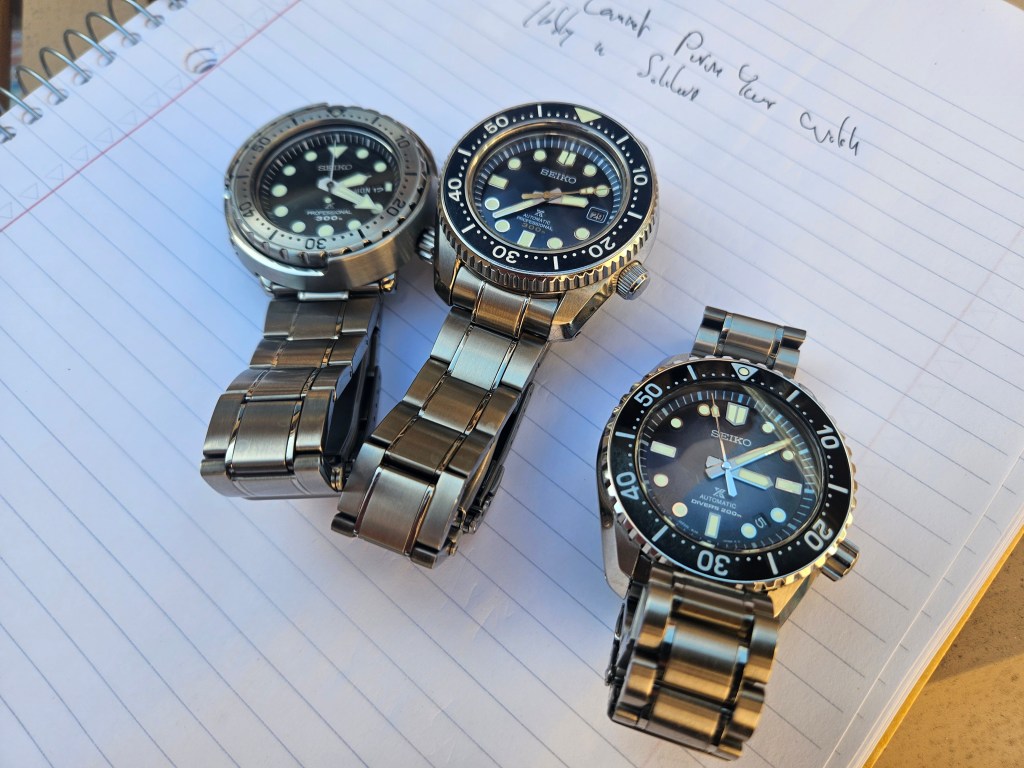
    For twenty years he labors happily in the vineyards of mechanical divers—Seikos mostly—fine steel contraptions that tick like tiny diesel engines beneath sapphire glass. The collection eventually reaches a comfortable plateau: curated, restrained, almost dignified.

    And then, inexplicably, he loses interest.

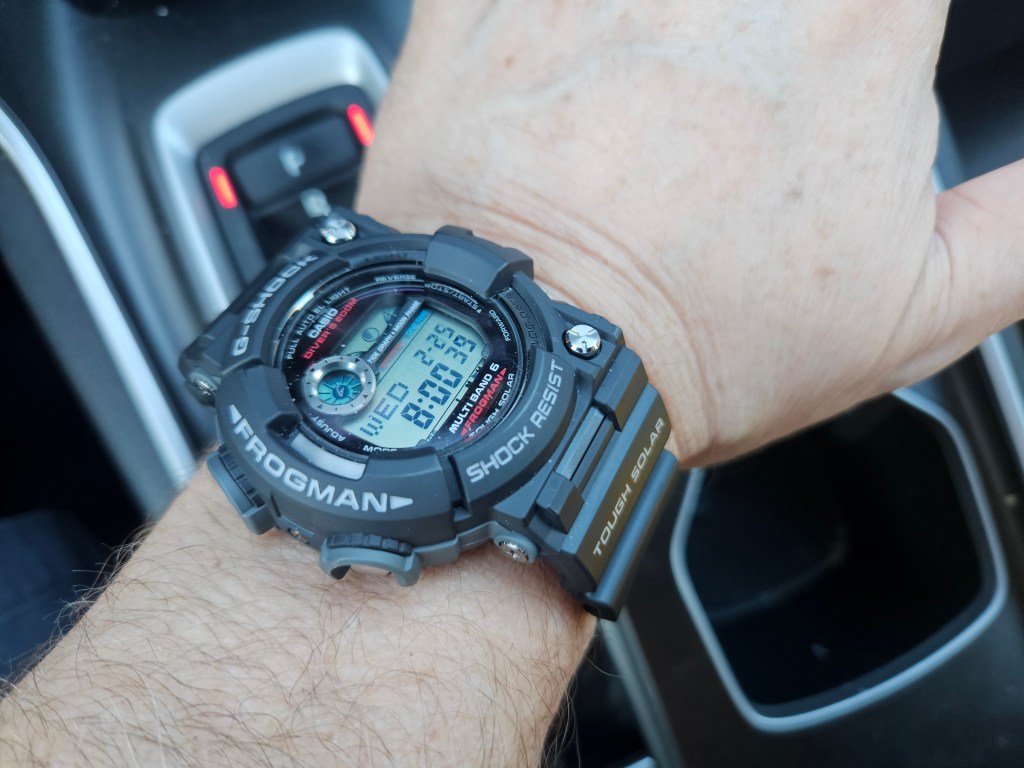
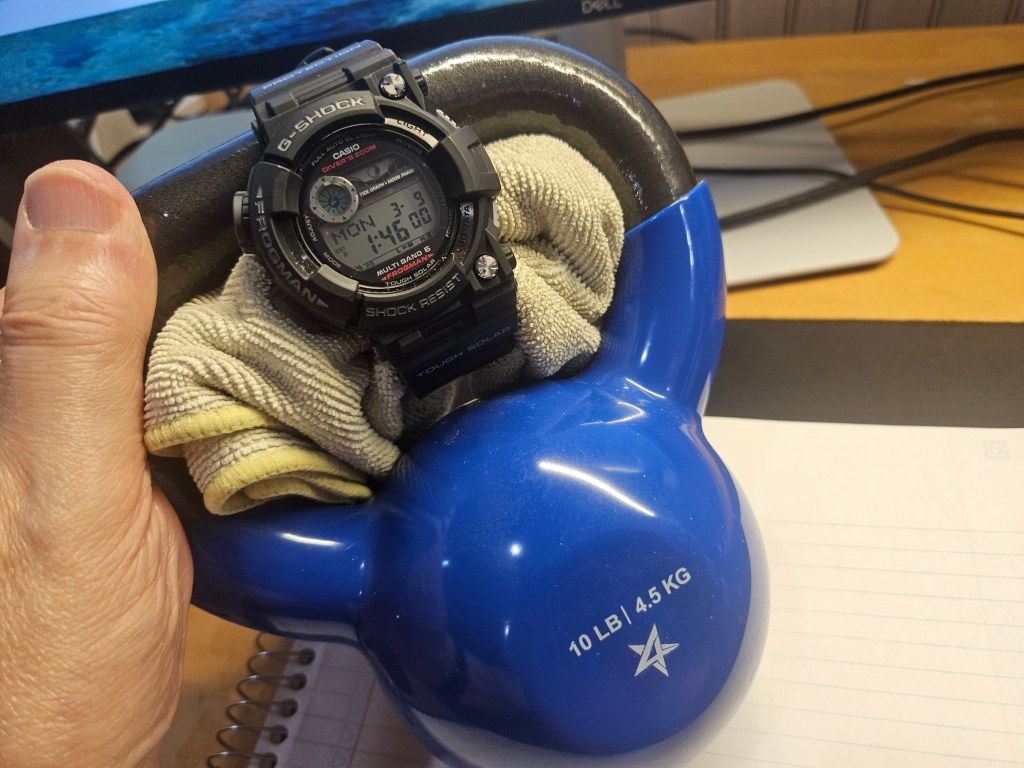
    The mechanical divers are quietly retired to their watch box like aging prizefighters. In their place emerges a new obsession: G-Shocks, but only of a very specific species—digital, solar-powered, atomic-synchronized, strapped in rubber armor like tiny tanks.

    Four commandments define the new religion:
    Tough Solar.
    Multiband 6 Atomic.
    Digital-only display.
    Rubber straps.

    One madness has been replaced with another, though the patient insists this is progress.

    To maintain psychological order, he compartmentalizes. The mechanical divers remain sealed in their box like museum artifacts. The G-Shocks, however, require their own ecosystem.

    Enter the Industrial Pipe Shrine.

    This object began life as a two-tier industrial pipe jewelry stand, the sort of thing normally used to hang headphones or necklaces. But in this household it has been promoted to sacred architecture. It sits reverently on a windowsill each night so the watches may commune with the atomic time signal emanating from Fort Collins, Colorado.

    To the uninitiated, it looks like plumbing hardware assembled by a bored welder.

    To the devotee, it is a receiving station of cosmic precision.

    Each night the G-Shocks dangle from the steel arms like metallic fruit awaiting revelation. Somewhere in Colorado a radio transmitter hums. Somewhere in the suburban night a man sleeps. And somewhere between them invisible time signals pass through drywall and glass until they arrive inside the tiny ferrite antenna hidden in a digital watch.

    When the signal locks in, the man experiences what can only be called the Multiband-6 Salvation Fantasy.

    For a brief moment the universe feels orderly. Accurate. Aligned. The watch has synchronized itself with atomic time. Solar cells sip daylight. Precision has been achieved.

    The feeling of control is intoxicating.

    Unfortunately, it lasts about as long as the next YouTube review.

    When members of the G-Shock community encounter this newly converted soul, they greet him with cheerful recognition.

    “Congratulations,” they say. “You’ve been G-Shocked.”

    The phrase functions like a baptism. The initiate is welcomed into a brotherhood of people who understand the deep satisfaction of armored watches, radio synchronization, and the quiet glow of solar charging indicators.

    At this moment the man realizes something unsettling: his geekdom has intensified

    Part of him embraces the absurdity. The watches are inexpensive. The hobby is harmless. Why not laugh at himself and enjoy the ride?

    But another part of him wonders whether something darker is unfolding.

    Is this, perhaps, the arrival of the Jungian Shadow—the neglected, obsessive part of the psyche now expressing itself through tactical wristwear?

    Will the Shadow politely stop at three G-Shocks?

    Or will it grow ambitious—multiplying into a monstrous collection that colonizes dresser drawers, nightstands, gym bags, glove compartments, and every horizontal surface in the home?

    Disturbed by these questions, the man attempts a strategic retreat. He throws himself into his other pursuits: bodybuilding, physical culture, literature, television, film.

    These distractions provide temporary relief.

    But the G-Shock Shadow is patient.

    Soon he is back on YouTube watching reviews of obscure Japanese models. He is compiling wish lists. He is studying signal reception strategies.

    Late at night he imagines the watches hanging from the steel arms of his T-bone pipe stand.

    And in darker moments he sees them differently.

    Not as tools.

    But as vampire bats—black, armored creatures dangling upside down, waiting for him to drift into sleep so they can descend silently and drink his blood.

    When he wakes in the morning, they will still be there on the windowsill.

    Perfectly synchronized.

    And waiting.
  • The Cure for Function Abandonment Syndrome

    The Cure for Function Abandonment Syndrome

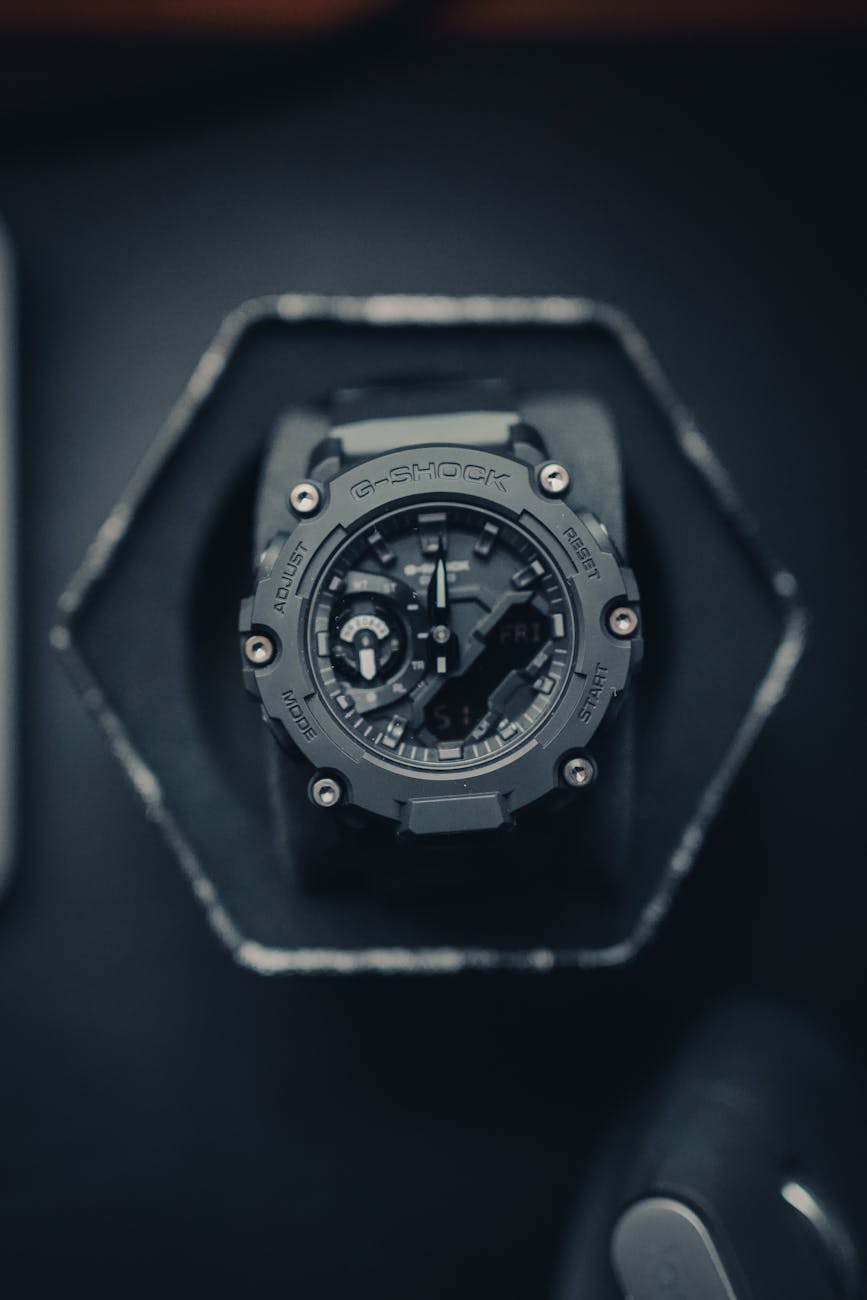
    You encounter a Rangeman owner who worships the stealth blacked-out model with a devotion bordering on performance art. He will tell you, calmly and without irony, that he can’t actually read the time on the negative display. It doesn’t matter. The watch stays on the wrist because it looks lethal—pure shadow, pure attitude, pure presence. Time, apparently, is now a secondary feature.

    Think about the pivot this represents. The man did not buy a timepiece; he bought an image. The geometry, the matte darkness, the tactical aura—these are the real functions. The digits exist somewhere inside the case, like a ceremonial appendix. If the light is right and the wrist is angled just so, the hour may reveal itself. But that’s incidental. The watch is no longer consulted. It is displayed.

    He resembles the fellow who once insisted he read glossy magazines for the articles, only to admit later that the articles had become irrelevant long ago. Content is gone. Only the visuals remain. In the same way, this enthusiast has crossed the line from horology to aesthetic intoxication. The watch no longer tells time. It tells a story about the man wearing it.

    Such a man is suffering from Function Abandonment Syndrome—the condition that sets in when a watch enthusiast quietly releases the expectation that the watch perform its basic task and begins wearing it purely for appearance, mood, or identity. Legibility becomes optional. Accuracy becomes theoretical. The time is technically available somewhere—under ideal lighting, at a cooperative angle—but that’s no longer the point. The owner has crossed the invisible threshold where tool becomes sculpture and utility becomes a nostalgic rumor. He doesn’t check the watch anymore; he acknowledges it. Function Abandonment Syndrome is what happens when style overwhelms purpose and the job description is politely retired without ceremony.

    Is there a cure for his condition? Yes. Imagine this: He lives happily in the glow of his blacked-out Rangeman until the day function suddenly matters again. Picture this: he’s driving a lonely stretch of highway at dusk when the fuel light comes on and the next gas station is closing in five minutes. His phone is dead. The dashboard clock is gone. All he has is the watch he chose for its “presence.” He lifts his wrist. Tilts. Squints. Rolls it toward the fading light like a man trying to read smoke signals from the wrist. The digits hover there, shy and evasive, revealing nothing but his own poor life choices. The station lights flicker off in the distance. In that moment—heart rate climbing, range dropping, darkness settling—he experiences the cold, clarifying terror that ends Function Abandonment Syndrome forever. Because style is thrilling in the showroom. But when the world gets real, the most beautiful watch on earth is the one that will tell you the time the first time you ask.

  • The Horological Crime Scene and the Watch That Cleans It Up

    The Horological Crime Scene and the Watch That Cleans It Up

    Watch addiction is not a hobby. It’s a war zone.

    Sleep is collateral damage. Bank accounts bleed out quietly. Marriages endure the slow drip of “just one more package.” Therapy bills rise. PayPal notifications arrive like ambulance sirens. Somewhere along the way, the language of joy gets replaced by the language of damage control.

    What you’re left with is an Horological Crime Scene—a condition in which the collection no longer looks curated but looks processed. Boxes stacked like evidence. Straps multiplying without explanation. Tracking numbers memorized. A strong smell of financial regret in the air. The collector stands in the middle of it all, insisting everything is fine while whispering the classic defense: “I just need one consolidation piece.”

    To understand the mythical cure for this condition, we need to talk about a man who specializes in cleaning up messes.

    In Pulp Fiction, Winston Wolf doesn’t arrive with empathy. He arrives with order. Vincent and Jules have turned a routine morning into a biological disaster. The Wolf doesn’t discuss feelings. He doesn’t analyze root causes. He doesn’t ask what went wrong. He walks in wearing a tuxedo, drinks their coffee, and converts panic into logistics.

    Towels. Bags. Timeline. Move.

    In a movie full of loud personalities and terrible judgment, The Wolf is something rare: competence without drama. The adult in a room full of armed adolescents.

    Every watch obsessive eventually needs a Wolf.

    That’s where the G-Shock Frogman comes in.

    The Frogman doesn’t seduce. It doesn’t charm. It doesn’t whisper heritage stories about Swiss craftsmen and moon missions. It shows up like a tool that expects you to get back to work.

    Where the watch box is chaos, the Frogman imposes a checklist.

    Accurate.
    Indestructible.
    Always running.
    Nothing to think about.

    The endless internal courtroom—Should I rotate? Should I sell? Should I upgrade? Is this the one?—suddenly feels absurd. The argument collapses under the weight of blunt competence.

    Like The Wolf, the Frogman doesn’t fix your personality. It fixes your situation.

  • Mortality Attenuation: When the Hobby Survives but the Hunger Fades

    Mortality Attenuation: When the Hobby Survives but the Hunger Fades

    I’ve made more real friendships online over watches than I ever expected—full-grown adults bonding over bezel action, dial texture, and the shared conviction that the perfect collection is exactly one purchase away. It’s a peculiar fraternity: half hobby, half recovery meeting. We compare scars from impulse buys and premature flips. We confess, we relapse, we congratulate one another on restraint that lasts roughly twelve days. Then someone posts a new release, and the room goes quiet. We nod, knowingly. Maybe this time we’re cured, we say—the way a gambler says he’s just there for the buffet.

    My own delirium began in 2005, when I was forty-three and certain that mechanical watches were not merely instruments but therapeutic devices—tiny machines capable of repairing the larger, less cooperative machinery inside me. Twenty years disappeared in a blur of rotating bezels, “exit watches,” and divers purchased for hypothetical adventures that never rose above grading papers. The obsession didn’t feel excessive. It felt like maintenance.

    Then, at sixty-three, something shifted. Mortality didn’t shout; it tapped me lightly on the shoulder, like a polite but persistent waiter. The hobby didn’t vanish. The flame still burns. But the heat changed. The urgency drained away. After two decades of acquisition, a quiet truth settled in: no matter how precise the watch, it was still losing the only race that mattered.

    The sensation reminds me of a scene from Battlestar Galactica: a traitor is sealed behind glass, pleading as the airlock hisses and the crew looks on, solemn and unmovable. A ritual exile. That’s what aging feels like–not tragedy, not humiliation. Just the slow recognition that you’ve crossed into a different atmosphere. Those still inside the warm illusion of endless tomorrows don’t push you away. They simply drift forward without you.

    The pane lowers gently. You tap it, wave, even smile, but the cockpit of youthful urgency is sealed. No reentry. What remains is quieter work: dignity over display, usefulness over accumulation, meaning over inventory. You stop building collections and start building perspective. You become less of a buyer and more of a witness.

    This is the Mortality Attenuation Phase: the gradual reduction of acquisition fever as the finite horizon comes into view. The obsession doesn’t die. It simply loses its panic. The watches remain. The urgency does not. Objects can mark time. They cannot bargain with it.

  • The Three-Watch Fantasy: Why Collectors Dream of Starting Over

    The Three-Watch Fantasy: Why Collectors Dream of Starting Over

    One of the most unsettling truths about my watch collection is how replaceable it really is. You would think that the hours of research, the hunting, the unboxings, the strap experiments, and the late-night lume checks would have forged something permanent—an extension of identity, a museum of the self. But that story doesn’t survive contact with honesty. Beneath the sentiment lies a colder fact: I could take a wrecking ball to the entire collection and feel a surge of relief.

    In fact, the demolition fantasy is strangely appealing. Clear the box. Sell the nine. Start over with three. If forced to rebuild today, I know exactly what would rise from the rubble: a Grand Seiko GMT SBGM221 for quiet elegance, the Seiko 62MAS SLA043 for historical gravity, and the G-Shock Frogman GWF-D1000B-1JF for operational indifference to reality. Three watches. Three roles. Order restored. Anxiety reduced. Narrative purified.

    Somewhere out there, I’m certain, a mischievous benefactor is reading this as a challenge. He wants to test the theory. He wants to see whether I—and collectors like me—are governed by what can only be called the Reset Fantasy: the recurring belief that happiness lives on the other side of total liquidation and a smaller, more perfect lineup. The purge promises clarity, discipline, renewal. It also quietly assumes that desire itself will behave once the environment is simplified. History suggests otherwise.

    The outcome would be predictable. I would miss pieces like the SLA055 and SLA023 for a week or two. Then I would adapt. The new trio would feel inevitable, even destined. And the community would be left with a sobering lesson: what we call “bonding” is often just attachment to a role in the narrative. Watches feel permanent. The feelings are not.

    This is why collectors regularly flirt with consolidation. When the box grows heavy, the mind reaches for the cure: the Three-Watch Salvation Myth—the conviction that the right trio will end the churn, quiet the wanting, and deliver lasting contentment. It is minimalism as therapy, discipline as redemption, and wisdom as a purchasing strategy. In truth, it’s simply the Exit Watch fantasy wearing a smaller suit.

  • The Watch Obsessive’s Imaginary Audience

    The Watch Obsessive’s Imaginary Audience

    Every watch obsessive has asked himself the question.

    If I were on television tonight, what would I wear?

    Not what would he say. Not whether he would be interesting, articulate, or memorable.

    No—the real question is the watch.

    Would it be bold or understated? Steel or titanium? Something iconic enough to signal taste, but restrained enough to suggest confidence? Would the case slip cleanly beneath the cuff? Would the host notice? Would the camera catch the glint at just the right angle?

    And most important: would the watch help create the impression—the myth—that this was a man worth watching?

    There is, of course, a problem with this line of thinking.

    He is not going on television.

    No producer is outside his house. No late-night booker is reviewing his résumé. There is no green room. No makeup artist. No segment titled Author and Cultural Commentator Discusses Bezel Alignment.

    And yet the fantasy persists.

    After decades of watching politicians, actors, and financial pundits subtly brandishing their wrists on camera, the association is burned in: television is the natural habitat of the watch. The wrist, after all, was built for close-ups.

    Soon a strange dissatisfaction sets in. Wearing a watch in ordinary life begins to feel incomplete. The object has no audience. No lighting. No narrative context. A diver at the grocery store. A GMT at the dentist. A chronograph while buying paper towels.

    The stage is missing.

    And still, he plans.

    This is Broadcast Readiness Syndrome—the quiet, persistent conviction that one must remain camera-ready at all times, because a moment of sudden visibility might arrive without warning. Today a faculty meeting. Tomorrow: a viral clip. Tonight, obscurity. Tomorrow, perhaps, Colbert.

    He knows this is irrational. He reminds himself daily.

    You are not on television.
    No one is looking.
    Relax.

    The logic changes nothing.

    The watches are still chosen with an imaginary audience in mind. The cuff is still adjusted. The wrist is still rotated, ever so slightly, as if a camera might be hiding near the coffee machine.

    Then comes the dream.

    He is backstage. The suit is perfect. The lights are warm. The host smiles and gestures him toward the chair. The band plays a tasteful sting.

    He sits.

    The conversation begins.

    Halfway through the first answer, he glances down.

    His wrist is bare.

    No watch.

    This is the true nightmare of the watch obsessive—not public embarrassment, not a failed joke, not an awkward interview.

    Exposure without branding.

    And he wakes up, heart racing, already thinking about what he’ll wear tomorrow.

    Just in case.

  • The Watch Miserabilist

    The Watch Miserabilist

    The Watch Miserabilist is a man determined—by temperament, guilt, vanity, and a punishing inner prosecutor—to turn a pleasurable hobby into a moral catastrophe. He stares at his collection as if it were evidence in a trial against him and sighs, “These watches mock me. I am unworthy. I have nowhere to wear them.” He glances down at his Omega Planet Ocean while seated in a windowless man cave and concludes, with theatrical despair, that the watch has exposed him as a fraud. Luxury, in his hands, becomes an accusation.

    He shuffles around his lair like a contemporary Gollum: threadbare robe, bloodshot eyes, four-day beard, posture of defeat. He looks vaguely unhoused. The contrast is brutal—this exhausted homunculus lugging around a six-thousand-dollar slab of Swiss engineering on his wrist. The watch gleams with purpose; the man does not. You can practically hear the object wondering how it ended up here. Whatever redemption the Miserabilist hoped the purchase would bring has failed spectacularly. The watch did not save him. It only sharpened the irony.

    Despite owning a dozen coveted Swiss watches, his YouTube channel limps along with fewer than fifty subscribers. His voice is saturated with despair—thick, damp, unventilated. Viewers last about five seconds before clicking away, not because the watch isn’t beautiful, but because the misery is suffocating. The sadness radiates through the screen. You can almost smell the robe. No lume shot can redeem a tone that sounds like it’s been steeped overnight in self-loathing.

    The uncomfortable truth is that every watch obsessive carries a trace of the Watch Miserabilist within. It’s the voice of guilt and nihilism that wants to poison enjoyment, to insist that pleasure is illegitimate, that beauty must be justified, that desire is suspect. This voice must be acknowledged—but never indulged. You laugh at it. You recognize it. You keep it at arm’s length. Because once coddled, it metastasizes. The Watch Miserabilist is not wisdom. It is a disease, and left unchecked, it will devour every ounce of joy in its path.

  • Living in the Bottle: A Life Spent Building Cozy Universes

    Living in the Bottle: A Life Spent Building Cozy Universes

    My parents like to remind me that I grew up poor in a cockroach-infested assisted-living situation in Gainesville, Florida. The place was called Flavet Villages—Flavet, if you lived there, which everyone did because there was nowhere else to go. These were not “villages” in any meaningful sense. They were World War II–era Camp Blanding army barracks, uprooted from Jacksonville and dropped into North Florida like surplus history.

    What I love, even now, is the audacity of the name. Flavet Villages. It’s a master class in rebranding: take a barracks crawling with roaches and give it a pastoral plural noun. It’s the real-estate equivalent of dabbing Vicks VapoRub on your neck and calling it Menthol d’Après-Minuit.

    Flavet sat near an alligator swamp and a stretch of forest that felt mythic to me, even then. A Mynah bird lived there—always on the same branch, like a sentry or an oracle—and before bedtime my father and I would walk to the edge of the woods and talk to it. At dusk, the tide dropped, and the swamp revealed itself. Alligator dung, fully expressed. The smell was feral and unmistakable. While most people would recoil, I found it oddly soothing—bracing, even. As if the universe were saying, You’re here. This is real.

    As a native Floridian, I sometimes wonder—with a perverse sense of pride—whether my early exposure to fecal alligator swamps permanently rewired my sensory thresholds in ways outsiders could never understand.

    One evening, as my father and I stood at the forest’s edge, we heard a distant radio playing Juanita Hall’s rendition of “Bali Ha’i” from South Pacific. The song is about an island paradise that seems achingly close yet forever unreachable, and it’s meant to induce longing and melancholy. But I felt none of that. Paradise was already present. I was standing in an enchanted forest with my storytelling father, a talking bird, mythical alligators nearby, and music drifting in like a siren call. This was not longing; this was habitation. I lived in a fairy tale and had no interest in leaving it.

    That same ache—for a magical enclosure—returned when I was five and living in the Royal Lanai Apartments in San Jose. The grounds were landscaped with sunflowers and volcanic rock, and as I walked to the playground I would stare at the flower beds and wish I could shrink myself down to Lilliputian size and live inside them forever. That was my first lesson in coziness: the idea that a small, bounded world could feel safer, richer, and more alive than the vast one surrounding it.

    Then came I Dream of Jeannie. Barbara Eden’s blonde goddess lived inside a genie bottle—a jewel-lined cocoon with a purple circular sofa and pink satin pillows glowing like some erotic reliquary. More than anything, I wanted to live in that bottle with her. The impossibility of that wish crushed me with the same quiet sadness as “Bali Ha’i.” That the bottle was, in reality, a painted Jim Beam decanter only deepened the metaphor. I was intoxicated by fantasy long before I understood the word.

    Flavet Village, the swamp forest, the Royal Lanai flower beds, Jeannie’s bottle—these were all variations on the same theme: cozy ecosystems that stood apart from the real world while quietly shaping how I understood it. Without those parallel universes, reality would have been flatter, harsher, less survivable.

    Now, in my sixties, I’ve built a new ecosystem: my watch world. A watch box holding seven watches that I tend like a mother hen, fretting over straps and bracelets, endlessly optimizing the rotation to extract maximum pleasure from time itself. It’s a controlled universe, one I can enter when the outside world becomes too loud or incoherent. I always come back—but I’m aware of the danger. The pull can be strong. Swapping a Tropic strap for a Waffle may calm me in the moment, but eventually I have to step out of the bottle, leave the forest, and reenter a world that demands attention, judgment, and responsibility.

    The fantasy sustains me. It just can’t replace the world.

  • The Man Who Broke Time: A Watch Obsession Goes Viral

    The Man Who Broke Time: A Watch Obsession Goes Viral

    Because I am known around The New Yorker offices as someone whose interest in watches occasionally elicits polite concern and the kind of side-eye usually reserved for men who won’t stop explaining cable management, it was perhaps inevitable that I would be assigned the Jeff McMahon story. When word spread that a 64-year-old writing instructor at Prospect College in Redondo Beach had triggered a watch-related disturbance of almost mythic proportions—drawing hundreds, then thousands of people into a crusade to “fix” his collection—I was dispatched to investigate how a private obsession metastasized into a civic emergency.

    I visited McMahon during winter break. His wife, a middle-school teacher, and his twin daughters, high-school sophomores, were safely elsewhere, leaving him alone with his thoughts, his watches, and whatever demons had learned to tell time. He answered the door wearing black travel pants with zippered pockets and a black T-shirt. Nearly six feet tall, close to 230 pounds, bald, square-jawed, with the squint of a man perpetually assessing lug-to-lug ratios, McMahon resembled a retired linebacker who had traded blitz packages for forum debates.

    Naturally, I clocked the watch immediately: a third-generation Seiko MM300 with a blue dial on a waffle strap.

    “It looks right on you,” I said, gesturing toward his forearm. “Especially given your build.”

    He shrugged. “It’s too late for me. I’m past swag. And honestly, the watch makes me miserable. I can’t decide if it belongs on a strap or a bracelet. I’ve switched so many times I no longer trust my own judgment. The only thing consistent about me is my inconsistency.”

    He led me into a bright, tile-heavy kitchen flooded with Southern California light. On the windowsill sat several shortwave radios, arranged among scattered lemons like some improvised altar.

    “Not just watches,” I observed. “Radios too.”

    He nodded, as if admitting to a second addiction was no longer worth defending.

    We sat at the kitchen table eating garlic hummus and rye crackers, drinking dark-roast coffee with soy milk and molasses.

    “Welcome,” he said with a tired smile, “to the House of Seiko. My man cave of madness.”

    I asked him why an entire community had mobilized to help solve his watch problem.

    “I have no idea,” he said. “It’s ridiculous. There are causes that matter. This doesn’t. I’m useless, over the hill, and fully Gollumified.”

    The saga began, he explained, at monthly meetups at Mimo’s Jewelry and Watches in Long Beach—friendly gatherings that escalated when he confessed the hobby no longer brought him joy. He wasn’t short on money; he was paralyzed by decision. Every choice felt wrong. The cognitive load became unbearable. He went to bed thinking about watches. He woke up thinking about watches.

    “Why not walk away?” I asked.

    “Because obsession doesn’t issue exit visas,” he said. “Once you’re in, the riddle feels existential. Solving it felt as urgent as founding a religion. I wanted to crack the code and then preach the gospel of happiness.”

    The intervention only made things worse. Camps formed. Seiko purists. Swiss loyalists. Minimalists. Maximalists. Arguments erupted. Then fights. A friend named Manny filmed the altercations. The videos went viral. Suddenly McMahon was a cause célèbre.

    “That’s when the watches started arriving in the mail,” he said.

    Luxury pieces worth more than his cars. None of them helped. He sold them and donated the money to charity. This, too, became content. More watches arrived. Then robberies. Burglaries. A P.O. box. A manager to process donations and deflect thieves.

    Millions eventually went to good causes. The silver lining, as they say.

    McMahon stared into his coffee. “I wish I felt redeemed. Mostly I feel disturbed—not just by my obsession, but by how easily the internet turned it into a farce. Sometimes I wonder if it had been anything else—stamps, guitars, fountain pens—would it have played out the same? Or is there something uniquely deranged about watches? Time itself? Father Time? Somehow my fixation feels disrespectful to him.”

    He paused, then added, “I have a friend who sold all his luxury watches. He wears a twenty-dollar Casio. Every day he thanks it for keeping him humble. He’s sane. That makes him my hero.”

    “You could follow his example,” I suggested. “Salvation is just a Casio away.”

    “And sell my divers?” he said flatly. “Not happening.”

    “You’d rather be miserable with expensive watches than happy with a cheap one.”

    “Exactly. Happiness is irrelevant now.”

    I studied him. “I don’t buy it,” I said. “This misery feels performative. A kind of cosplay.”

    He nodded slowly. “You’re right. But if I stop playing the miserable man, I have no idea who I’m supposed to be next. And that scares me more than any watch ever could.”

  • Why Men Can’t Stop Writing Manifestos

    Why Men Can’t Stop Writing Manifestos

    My wife has never been one to traffic in lazy generalizations about men and women, but a few years ago she offered one observation so sharp it lodged itself in my brain. Men, she said, have a peculiar itch that women conspicuously lack: the need to write a manifesto. Not a gentle essay about waking up early to tend tomatoes and eggplant while discovering the joys of fiber and self-care. No. A manifesto is something else entirely—a doctrinal collision, an absolutist thunderclap so brimming with rectitude, so certain of its own world-historical importance, that its author feels morally obligated to broadcast it to the four corners of the earth. Silence would be selfish. Restraint would be unethical.

    A manifesto, of course, cannot emerge from a vacuum. It requires a conversion story—preferably violent. The man was once lost, deformed, wandering in a fog of ignorance. Then something happened. The cosmos intervened. He was singled out. Enlightened. Charged with a mission. His truth, having been hard-won and privately revealed, must now be universalized. To keep it to himself would be a crime against humanity. Thus the manifesto is born: part gospel, part grievance, part personal branding exercise.

    My wife was not complimenting men. She was diagnosing a particular strain of virulent egotism—one that disguises itself as sincerity and moral urgency while quietly pursuing something else: control. To impose a worldview is to dominate. To dominate is to feel powerful. Strip away the rhetoric and you find that many manifestos are not about helping others live better lives but about arranging the world so it finally stops resisting the author’s will.

    Because many men will inevitably produce many manifestos, conflict follows. Doctrines metastasize. Defenses harden. Footnotes sprout like fortifications. Converts gather. Commentaries appear. Some commentaries become so influential they eclipse the original manifesto and establish themselves as superior, corrected versions. The ecosystem expands, competitive and self-referential, like an intellectual CrossFit gym where everyone is chasing the same leaderboard.

    What my wife was really saying, I think, is that men don’t create philosophies primarily to serve others. They create them the way athletes build muscle: to compete. A manifesto is intellectual athletics—grandstanding, bluster, and chest-thumping in paragraph form. It’s less a tool for understanding the world than a way to announce dominance within it.

    Here is my confession, one I may or may not share when my wife gets home tonight: I, too, feel the pull of the manifesto. The fantasy of a grand conversion, followed by the construction of a flawless, infallible system that explains everything, is intoxicating. But if I’m honest, what draws me to that fantasy isn’t egotism so much as fear. The world is a roiling swamp of ambiguity and uncertainty. A manifesto promises certainty on a silver platter, a pacifier for the anxious adult who wants the noise to stop.

    Perhaps my wife is right. Egotism may just be fear in a tuxedo. Men, for whatever reason—biology, culture, testosterone, self-loathing—seem especially adept at projecting their inner chaos onto the world and then mistrusting it for the mess they recognize in themselves. The manifesto becomes a coping mechanism, a way to simulate control in a reality that stubbornly refuses to cooperate.

    Women don’t write manifestos because a manifesto lectures. It talks down. It closes the case. Women talk instead. Life, as they seem to understand it, is an open court—conversation, improvisation, shared meaning, surprise, trust. Men, by contrast, barricade themselves inside doctrine, shout it through a megaphone, and grow indignant when no one salutes.

    When my wife gets home, I think I’ll abandon the manifesto project. I’ll try something riskier. I’ll start a conversation. I’ll listen.