Tag: fantasy

  • The Man Who Broke Time: A Watch Obsession Goes Viral

    The Man Who Broke Time: A Watch Obsession Goes Viral

    Because I am known around The New Yorker offices as someone whose interest in watches occasionally elicits polite concern and the kind of side-eye usually reserved for men who won’t stop explaining cable management, it was perhaps inevitable that I would be assigned the Jeff McMahon story. When word spread that a 64-year-old writing instructor at Prospect College in Redondo Beach had triggered a watch-related disturbance of almost mythic proportions—drawing hundreds, then thousands of people into a crusade to “fix” his collection—I was dispatched to investigate how a private obsession metastasized into a civic emergency.

    I visited McMahon during winter break. His wife, a middle-school teacher, and his twin daughters, high-school sophomores, were safely elsewhere, leaving him alone with his thoughts, his watches, and whatever demons had learned to tell time. He answered the door wearing black travel pants with zippered pockets and a black T-shirt. Nearly six feet tall, close to 230 pounds, bald, square-jawed, with the squint of a man perpetually assessing lug-to-lug ratios, McMahon resembled a retired linebacker who had traded blitz packages for forum debates.

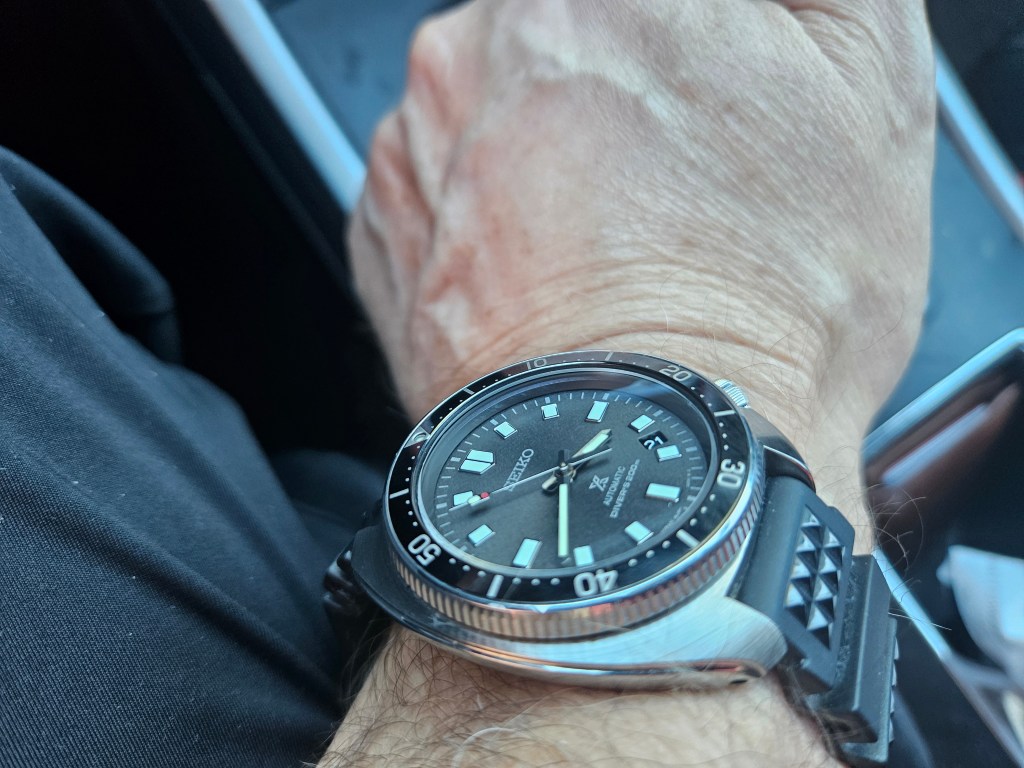
    Naturally, I clocked the watch immediately: a third-generation Seiko MM300 with a blue dial on a waffle strap.

    “It looks right on you,” I said, gesturing toward his forearm. “Especially given your build.”

    He shrugged. “It’s too late for me. I’m past swag. And honestly, the watch makes me miserable. I can’t decide if it belongs on a strap or a bracelet. I’ve switched so many times I no longer trust my own judgment. The only thing consistent about me is my inconsistency.”

    He led me into a bright, tile-heavy kitchen flooded with Southern California light. On the windowsill sat several shortwave radios, arranged among scattered lemons like some improvised altar.

    “Not just watches,” I observed. “Radios too.”

    He nodded, as if admitting to a second addiction was no longer worth defending.

    We sat at the kitchen table eating garlic hummus and rye crackers, drinking dark-roast coffee with soy milk and molasses.

    “Welcome,” he said with a tired smile, “to the House of Seiko. My man cave of madness.”

    I asked him why an entire community had mobilized to help solve his watch problem.

    “I have no idea,” he said. “It’s ridiculous. There are causes that matter. This doesn’t. I’m useless, over the hill, and fully Gollumified.”

    The saga began, he explained, at monthly meetups at Mimo’s Jewelry and Watches in Long Beach—friendly gatherings that escalated when he confessed the hobby no longer brought him joy. He wasn’t short on money; he was paralyzed by decision. Every choice felt wrong. The cognitive load became unbearable. He went to bed thinking about watches. He woke up thinking about watches.

    “Why not walk away?” I asked.

    “Because obsession doesn’t issue exit visas,” he said. “Once you’re in, the riddle feels existential. Solving it felt as urgent as founding a religion. I wanted to crack the code and then preach the gospel of happiness.”

    The intervention only made things worse. Camps formed. Seiko purists. Swiss loyalists. Minimalists. Maximalists. Arguments erupted. Then fights. A friend named Manny filmed the altercations. The videos went viral. Suddenly McMahon was a cause célèbre.

    “That’s when the watches started arriving in the mail,” he said.

    Luxury pieces worth more than his cars. None of them helped. He sold them and donated the money to charity. This, too, became content. More watches arrived. Then robberies. Burglaries. A P.O. box. A manager to process donations and deflect thieves.

    Millions eventually went to good causes. The silver lining, as they say.

    McMahon stared into his coffee. “I wish I felt redeemed. Mostly I feel disturbed—not just by my obsession, but by how easily the internet turned it into a farce. Sometimes I wonder if it had been anything else—stamps, guitars, fountain pens—would it have played out the same? Or is there something uniquely deranged about watches? Time itself? Father Time? Somehow my fixation feels disrespectful to him.”

    He paused, then added, “I have a friend who sold all his luxury watches. He wears a twenty-dollar Casio. Every day he thanks it for keeping him humble. He’s sane. That makes him my hero.”

    “You could follow his example,” I suggested. “Salvation is just a Casio away.”

    “And sell my divers?” he said flatly. “Not happening.”

    “You’d rather be miserable with expensive watches than happy with a cheap one.”

    “Exactly. Happiness is irrelevant now.”

    I studied him. “I don’t buy it,” I said. “This misery feels performative. A kind of cosplay.”

    He nodded slowly. “You’re right. But if I stop playing the miserable man, I have no idea who I’m supposed to be next. And that scares me more than any watch ever could.”

  • Why Men Can’t Stop Writing Manifestos

    Why Men Can’t Stop Writing Manifestos

    My wife has never been one to traffic in lazy generalizations about men and women, but a few years ago she offered one observation so sharp it lodged itself in my brain. Men, she said, have a peculiar itch that women conspicuously lack: the need to write a manifesto. Not a gentle essay about waking up early to tend tomatoes and eggplant while discovering the joys of fiber and self-care. No. A manifesto is something else entirely—a doctrinal collision, an absolutist thunderclap so brimming with rectitude, so certain of its own world-historical importance, that its author feels morally obligated to broadcast it to the four corners of the earth. Silence would be selfish. Restraint would be unethical.

    A manifesto, of course, cannot emerge from a vacuum. It requires a conversion story—preferably violent. The man was once lost, deformed, wandering in a fog of ignorance. Then something happened. The cosmos intervened. He was singled out. Enlightened. Charged with a mission. His truth, having been hard-won and privately revealed, must now be universalized. To keep it to himself would be a crime against humanity. Thus the manifesto is born: part gospel, part grievance, part personal branding exercise.

    My wife was not complimenting men. She was diagnosing a particular strain of virulent egotism—one that disguises itself as sincerity and moral urgency while quietly pursuing something else: control. To impose a worldview is to dominate. To dominate is to feel powerful. Strip away the rhetoric and you find that many manifestos are not about helping others live better lives but about arranging the world so it finally stops resisting the author’s will.

    Because many men will inevitably produce many manifestos, conflict follows. Doctrines metastasize. Defenses harden. Footnotes sprout like fortifications. Converts gather. Commentaries appear. Some commentaries become so influential they eclipse the original manifesto and establish themselves as superior, corrected versions. The ecosystem expands, competitive and self-referential, like an intellectual CrossFit gym where everyone is chasing the same leaderboard.

    What my wife was really saying, I think, is that men don’t create philosophies primarily to serve others. They create them the way athletes build muscle: to compete. A manifesto is intellectual athletics—grandstanding, bluster, and chest-thumping in paragraph form. It’s less a tool for understanding the world than a way to announce dominance within it.

    Here is my confession, one I may or may not share when my wife gets home tonight: I, too, feel the pull of the manifesto. The fantasy of a grand conversion, followed by the construction of a flawless, infallible system that explains everything, is intoxicating. But if I’m honest, what draws me to that fantasy isn’t egotism so much as fear. The world is a roiling swamp of ambiguity and uncertainty. A manifesto promises certainty on a silver platter, a pacifier for the anxious adult who wants the noise to stop.

    Perhaps my wife is right. Egotism may just be fear in a tuxedo. Men, for whatever reason—biology, culture, testosterone, self-loathing—seem especially adept at projecting their inner chaos onto the world and then mistrusting it for the mess they recognize in themselves. The manifesto becomes a coping mechanism, a way to simulate control in a reality that stubbornly refuses to cooperate.

    Women don’t write manifestos because a manifesto lectures. It talks down. It closes the case. Women talk instead. Life, as they seem to understand it, is an open court—conversation, improvisation, shared meaning, surprise, trust. Men, by contrast, barricade themselves inside doctrine, shout it through a megaphone, and grow indignant when no one salutes.

    When my wife gets home, I think I’ll abandon the manifesto project. I’ll try something riskier. I’ll start a conversation. I’ll listen.

  • The Watch I Want vs. the Life I Actually Live

    The Watch I Want vs. the Life I Actually Live

    For the past month I’ve been circling the black titanium Citizen Attesa CC4055-65E the way a moth circles a very handsome, very unnecessary flame. It’s not even obscenely priced—roughly the cost of a Lenovo mini business PC with an Ultra 7—so my brain keeps pitching it as “reasonable.” I picture it on my wrist: sleek, dark, stealthy, broadcasting a silent message of confidence, competence, and maybe a little controlled menace. The fantasy version of me wears it everywhere. The honest version of me pauses and asks a less flattering question: where, exactly, am I going that requires this level of cinematic wrist presence?

    That’s when the self-audit begins. Would I really wear it, or would I merely own it—like one of those tasteful paintings people hang in their living rooms to prove they have a soul, then never look at again? But that analogy collapses on contact. A painting is for the wall. A watch is for the wrist. One is meant to be admired from across the room; the other is meant to live on your body, accumulating scuffs and stories. When I buy watches, what I’m really buying is a version of myself in motion—someone who leaves the house, enters public life, and performs a coherent aesthetic identity in the wild. The problem is that most days, I don’t need a public uniform. I need something comfortable while I work, run errands, and live in my own cave like a reasonably civilized hermit.

    That’s why my divers live on straps and not bracelets. Straps belong to real life—coffee runs, grocery aisles, desk time. Bracelets belong to fantasy life—the version of me who is being interviewed on late-night TV or starring in a tasteful indie film about male regret. Since those scenarios remain stubbornly fictional, the idea of strapping on a glossy black titanium showpiece starts to feel like costume drama. And here’s the punchline I can’t dodge: even if I became that public figure tomorrow, it wouldn’t make me happier or more whole. That life is a mirage. Which means the Citizen Attesa, for all its beauty, risks becoming one too—a chimera in black titanium, promising a transformation I no longer believe in.

  • Too Much RAM, Not Enough Transcendence

    Too Much RAM, Not Enough Transcendence

    At sixty-four, time no longer strolls; it sprints, and I feel myself shrinking as it passes. Not dramatically—no tragic collapse—just a steady narrowing. Fewer friends than before. A smaller social orbit. My internal clock drifting farther out of sync with my wife’s and daughter’s, who are younger, livelier, and still tuned to daylight. They love me and make heroic efforts to lure me out of my cave, but by eight o’clock I’m asleep in the back seat, hibernating like a cartoon grizzly bear who misunderstood the invitation.

    Part of the shock is how badly my expectations were mis-set. I grew up marinated in television commercials that catechized me into a childish theology of consumerism: play by the rules, buy the right things, and you’ll be lifted onto a magic carpet of perpetual happiness and glowing health. The American Dream, as advertised, looked frictionless and eternal. Paradise was a purchase away. Then generative AI arrived and supercharged the fantasy. I didn’t just get a magic carpet—I became the magic carpet. Like Superman, I could optimize myself endlessly. If immortality wasn’t on the table, surely a close approximation was.

    And yet here I am. The house is nearly paid off in a premium Southern California neighborhood. My computer has more SSD, RAM, and CPU than I could have imagined as a kid. AI tools respond instantly, obedient and tireless. And still—no glory. No transcendence. Even my healthcare provider got in on the myth, emailing me something grandly titled “Your Personal Action Plan.” I arrived at the doctor’s office expecting revelation. He handed me a cup and asked for a urine sample.

    The gap between the life I was promised by the digital age and the life I’m actually living is soul-crushing in its banality. So I retreat to a bowl of steel-cut oats, drowned in prunes, molasses, and soy milk. It’s not heroic. It’s not optimized. But it’s warm, predictable, and faintly medicinal. “At least I’m eating clean,” I tell myself—clinging to this small, beige consolation as proof that even if the magic carpet never showed up, I can still manage a decent breakfast.

    Like millions before me, I have allowed myself to fall into Optimization Afterlife Fantasy–the belief that continuous self-improvement, technological upgrades, and algorithmic assistance can indefinitely postpone decline and approximate transcendence in a secular age. It replaces older visions of salvation with dashboards, action plans, and personalized systems, promising that with enough data, discipline, and tools, one can out-optimize aging, finitude, and disappointment. The fantasy thrives on the language of efficiency and control, encouraging the illusion that mortality is a solvable design flaw rather than a human condition. When reality intrudes—through fatigue, misalignment, or the body’s quiet refusals—the fantasy collapses, leaving behind not enlightenment but a sharper awareness of limits and the hollow ache of promises made by machines that cannot carry us past time.

  • How We Declawed a Generation in the Name of Comfort

    How We Declawed a Generation in the Name of Comfort

    Declawing Effect

    noun
    The gradual and often well-intentioned removal of students’ essential capacities for self-defense, adaptation, and independence through frictionless educational practices. Like a declawed cat rendered safe for furniture but vulnerable to the world, students subjected to shortened readings, over-accommodation, constant mediation, and AI-assisted outsourcing lose the intellectual and emotional “claws” they need to navigate uncertainty, conflict, and failure. Within protected academic environments they appear functional, even successful, yet outside those systems they are ill-equipped for unscripted work, sustained effort, and genuine human connection. The Declawing Effect names not laziness or deficiency, but a structural form of educational harm in which comfort and convenience quietly replace resilience and agency.

    ***

    In the early ’90s, a young neighbor told me that the widow behind his condo was distraught. Her cat had gone missing, and she didn’t expect it to come back alive. When I asked why, he explained—almost casually—that the cat had been declawed. He then described the procedure: not trimming, not blunting, but amputating the claws down to the bone. I remember feeling a cold, visceral recoil. People do this, he said, to protect their furniture—because cats will shred upholstery to sharpen the very tools evolution gave them to survive. The logic is neat, domestic, and monstrously shortsighted. A declawed cat may be well behaved indoors, but the moment it slips outside, it becomes defenseless. The price of comfort is vulnerability.

    Teaching in the age of AI, I can’t stop thinking about that cat. My students, too, are being declawed—educationally. They grow up inside a frictionless system: everything mediated by screens, readings trimmed to a few pages, tests softened or bypassed through an ever-expanding regime of accommodations, and thinking itself outsourced to AI machines that research, write, revise, and even flirt on their behalf. Inside education’s Frictionless Dome, they function smoothly. They submit polished work. They comply. But like declawed cats, they are maladapted for life outside the enclosure: a volatile job market, a world without prompts, a long hike navigated by a compass instead of GPS, a messy, unscripted conversation with another human being where nothing is optimized and no script is provided. They have been made safe for institutional furniture, not for reality. And here’s the part that unsettles me most: I work inside the Dome. I enforce its rules. I worry that in trying to keep students comfortable, I’ve become an enabler—a quiet accomplice in reinforcing the Declawing Effect.

  • The Monster in the Ravine and the Moon Over the Suburbs

    The Monster in the Ravine and the Moon Over the Suburbs

    Last night I dreamed I was wandering through a house I didn’t recognize. The world outside was pitch black. A small family dog pressed its nose to the sliding glass door and barked toward the backyard, desperate to escape. I opened the door and watched the little creature trot behind the bushes to relieve itself. That’s when a monster rose out of the ravine—some hulking mastiff with the skull of a bull, as if a guard dog from the underworld had crawled up to inspect the living. It ignored the pet and fixed its gaze on me. Without hesitation, it entered the house and began to contort into different shapes of malice. At first, I trembled. Then anger boiled in me like a furnace. This thing wasn’t just ugly; it was the source of suffering and rot in the world. I begged God to purify me so I could destroy it, but heaven stayed silent. What I received instead was a strange consolation: a feeling that at least my rage was righteous, and that I still knew where my moral compass pointed.

    Eventually the creature disappeared and daylight arrived. I made a long trek back toward what I understood to be “home.” Across the street, my neighbors were ecstatic, pointing skyward. Hovering above their house was a massive white dome—like a camper shell the size of a Costco, a fallen moon with decorative crenellations. Soon crowds formed. It was a city attraction, a spectacle engineered to “bring excitement.” Snowflakes—artificial, slow-motion confetti—drifted through the air. People gasped, laughed, and posed for photos, thrilled by the distraction.

    The beast was gone, but the problem of evil remained unsolved. In its place, my city embraced pageantry, gimmicks, and civic cheerleading. I touched my aching left shoulder, the one crippled by a three-month rotator cuff tear, and wondered what I would become—a broken man, a burden, a questionable member of society. Fake snow drifted onto the jubilant crowd, and their rosy smiles suggested that change, or at least the illusion of it, was already underway.

  • Self-Pity Is Its Own Sunken Place

    Self-Pity Is Its Own Sunken Place

    I’d been teaching Jordan Peele’s Get Out to my college students for six years—long enough to map every dark corner of the Sunken Place, that abyss where shame, paralysis, and despair fuse into one mute scream. It’s the emotional equivalent of being duct-taped to a chair while your soul tries—and fails—to clear its throat.

    The film, of course, locates the Sunken Place in a specific American ecosystem: those well-meaning liberals who talk like allies but behave like landlords of Black pain. They distribute microaggressions with the confidence of people handing out hors d’oeuvres at a garden party, all while enjoying the fruits of a system engineered to elevate them and drain everyone else. But Peele has insisted, in interviews and on stages, that the Sunken Place isn’t confined to racial oppression. For him, the first Sunken Place arrived in childhood, sitting slack-jawed in front of the TV. He felt like an NPC long before that acronym took over the internet—passive, programmed, invisible—while the creators on the screen radiated life, wit, and agency. He wanted to join them, and he did: stand-up, sketch comedy, screenwriting, filmmaking, cultural canonization. The man refused to stay sunken.

    After half a decade of teaching Peele’s masterpiece, a disquieting thought dawned on me: I wasn’t immune to the Sunken Place either. I had my own trapdoors. Too much internet bickering left me feeling hollow. My appetite—always several sizes larger than my actual caloric needs—dragged me downward. My talent for being obnoxious, selfish, and occasionally unbearable didn’t help. Neither did the small carousel of addictions and compulsions I’ve wrestled like a part-time zookeeper tending unruly beasts. Some days the labor of managing myself left me feeling like a broken machine, grinding out self-pity by the pound.

    Then I noticed something worse: self-pity is its own Sunken Place. It feeds on the original misery and creates a second pit under the first. And if you’re not careful, a third pit opens beneath that one. Before long, you’re living like a subterranean nesting doll of despair—each layer a reaction to the last—buried so deep you need spelunking gear just to find your own pulse.

    One morning, while playing piano, I drifted into one of my indulgent daydreams. I imagined myself back in the early 1980s, performing a private recital at the Berkeley wine shop where I used to work. In my fantasy, the customers lounged around me, gently swirling their glasses as my music washed over them. When I finished, they begged for encores—one, then another—until their brains were so marinated in endorphins that they thanked me for resurrecting their spirits from the doldrums. It was a pleasing vision, a warm hand pulling me briefly out of the Sunken Place.

    But after the fantasy evaporated, something clearer emerged: the way out—my way out, and maybe everyone’s—has nothing to do with grand performances or imaginary applause. The escape hatch begins with rejecting the velvet-lined coffin of self-pity and recognizing that everyone else is fighting their own Sunken Place too. And if I could help lift someone else out of their emotional quicksand, I might just rescue myself in the process.

    The final irony? I realized it wouldn’t be the piano that helped me do this. It would be humor. I could expose my flaws like specimens under bright light—my misfires, my vanities, my slapstick disasters—and let people laugh at them. Not cruelly, but with the relief that comes from recognizing themselves in another person’s foolishness. If my folly made someone else ease up on their own self-condemnation and offer themselves a small measure of grace, then maybe that, at long last, would be my encore.

  • Thou Shalt Not Mistake Thy Biceps for Enlightenment

    Thou Shalt Not Mistake Thy Biceps for Enlightenment

    It was June, the last day of my sophomore year at Canyon High, and the temperature had staged a coup. The campus was no longer a school but a human sauna—heat shimmering off asphalt, the smell of suntan lotion and hormones hanging thick in the air. Education had fled.

    Students drifted across the courtyard in various stages of undress: shorts, bikini tops, cutoffs, tank tops. The place looked less like an academic institution and more like a rehearsal for a Beach Boys video. Even the teachers had surrendered. Lesson plans were tossed aside like molting skin; the day was given over to signing yearbooks, gossip, and the open display of what could only be called collective infatuation disorder.

    Love had broken out like a rash. Everywhere I looked, couples were holding hands, whispering into each other’s ears, stroking hair, rubbing shoulders, and gazing into each other’s eyes with the same expression of caffeinated bliss. Even the nerds—the pale, calculator-clutching tribe of outcasts—had been swept into the delirium. It was an egalitarian apocalypse of affection. Everyone was paired off, melting together in the heat.

    Everyone except me.

    Apparently, I hadn’t received the memo that June 12 was Love Day at Canyon High. While the rest of the student body was basking in hormonal radiance, I sat alone on a bench near the cafeteria, marinating in my solitude and trying to figure out how romance had managed to skip my ZIP code.

    I sighed, stared at the ground, and summoned Master Po—the inner voice of my sarcastic conscience.

    “Grasshopper,” he began, “your lonely condition should be obvious to you.”

    “To you, maybe,” I said, “but to me, it’s as mysterious as algebra.”

    “Let’s begin,” said Po. “First, you spend too much time staring into your own navel. You are self-centered.”

    “Guilty,” I said. “Next?”

    “You talk too much. You deliver speeches when you should be listening.”

    “Double guilty.”

    “If you wish to see the humanity in others, you must first see the humanity in yourself. True transformation begins within.”

    “Master Po,” I said, “I’m already transforming. Six days a week in the gym, three hundred grams of protein a day. I’m practically evolving into another species.”

    “I meant transformation of the soul,” he said.

    “Oh. Right. The invisible muscle group.”

    “Your self-deprecation is merely cowardice dressed as humility. You fear your own potential.”

    “Maybe. But I’m warning you—every time I meditate, Raquel Welch rides through my mind on horseback in slow motion. I can’t stop her.”

    “Your distractions,” said Po, “are the result of an undisciplined mind. Seek silence.”

    “You mean meditate.”

    “Yes, Grasshopper.”

    “Then prepare yourself,” I said. “Because after Raquel Welch, the whole cast of Charlie’s Angels usually shows up.”

    Po sighed, the eternal sound of a teacher realizing his student is hopeless.

    And there I sat, the only unloved, unseduced, untransformed soul on the Canyon High campus—a bench-bound philosopher surrounded by teenage Aphrodites, sweating through his solitude while Raquel Welch galloped through his brain.

  • Thou Shalt Honor the Monster Who Shows Mercy

    Thou Shalt Honor the Monster Who Shows Mercy

    At sixteen, I thought I knew what a monster was. Then I met one—an authentic, breathing specimen of mythic proportions: John Matuszak, defensive lineman for the Oakland Raiders, the kind of man who made other men rethink their species.

    I’d seen him on TV—hulking, bearded, snarling—but television flattened him into two dimensions. In person, at The Weight Room in Hayward, California, Matuszak looked like evolution had taken a brief detour toward the gods. Nearly seven feet tall, close to 300 pounds, he was a paradox of mass and grace—slender by geometry, enormous by gravity. His hair was a feral snarl, his beard an ecosystem, and his eyes had the predatory focus of a hawk scanning for something foolish enough to move.

    One afternoon, the gym speakers played England Dan and John Ford Coley’s “Love Is the Answer”—a ballad so syrupy it could give insulin shock to a diabetic. Matuszak’s lips curled. “Bullshit,” he muttered, then grabbed the barbell loaded with 400 pounds and began to press, growling his blasphemy with each rep as if the song itself had personally insulted his testosterone.

    Between sets, he asked if I played football.
    “No,” I said, “I’m a bodybuilder—sort of.”
    He raised an eyebrow. “How old are you?”
    “Sixteen.”
    “Good for you,” he said, clapping a hand on my shoulder that felt like a catcher’s mitt made of stone. “Keep training, my brother.”

    Then he disappeared into the locker room, leaving me with the distinct impression that Zeus himself had just offered career advice.

    The kindness startled me. I’d heard the legends—Matuszak the maniac, Matuszak the ungovernable animal who devoured offensive linemen and bar fights with equal ferocity. Yet here he was, treating me, a lost, self-conscious teenager, with decency and warmth. The other pros at the gym wouldn’t even glance at me, but Matuszak talked to me like I mattered. He looked me in the eye. He saw me.

    When he emerged from the locker room later, showered and reborn as a gentleman—a sports coat, slacks, mirrored sunglasses—he’d point at me and say, “See you later, kid.” Then he’d vanish, as if returning to Mount Olympus by way of Interstate 880.

    I couldn’t reconcile it: this colossal madman known as The Tooz, destroyer of quarterbacks, showing kindness to a scrawny sixteen-year-old who barely knew what he was doing in life, much less the gym. That night, puzzled, I asked Master Po what it meant.

    “Grasshopper,” he said, “the Tooz is drawn to you for two reasons. First, your innocence. You want nothing from him. Everyone else approaches him with hidden motives—flattery, exploitation, self-interest. You are too young to be calculating, and he finds that purity refreshing. Second, you remind him of himself before he was devoured by fame and its demons. When he looks into your eyes, he sees the ghost of his younger self, a version unspoiled by appetite. The innocent, Grasshopper, give the fallen hope. They are proof that a life before corruption still exists.”

    “But Master Po,” I said, “I’m not innocent. I’m corrupt. I feel it.”

    He smiled that maddening, merciful smile. “Perhaps. But corruption is relative, Grasshopper. What feels like depravity to you may seem like mere dust on the soul to others. Never forget: even the fallen recognize light, and sometimes, they bow before it.”

  • Thou Shalt Not Measure Thy Goodness Against Fools

    Thou Shalt Not Measure Thy Goodness Against Fools

    In eighth grade, Erika Jenkins was every boy’s favorite target—a tall, freckled volleyball player with legs that seemed to go on for miles and a face that couldn’t hide her fear. The boys called her Horse, Giraffe, Hyena, Zebra—an entire menagerie of cruelty. Every morning she had to walk the gauntlet from her locker to the corridor, clutching her books to her chest like a shield, her eyes darting from side to side as if she were trying to survive a nature documentary. She looked like someone bracing for an attack, because she was.

    Then summer arrived—and performed a miracle. Her grandmother took her on a Caribbean cruise, and somewhere between the turquoise waves and the buffet line, Erika Jenkins molted. When she returned that fall, she was unrecognizable. The boys at Canyon High buzzed with talk of “The Caribbean Transformation.”

    At lunch on the first day, she made her debut. Gone was the awkward, lanky girl. In her place stood someone who could have walked off a shampoo commercial. She wore a sleeveless white linen dress that caught the light, her tan skin glowing like toasted sugar. Her once-flat hair now tumbled over her shoulders in glossy brown waves. Her limbs, once all elbows and knees, now belonged to a young woman who had grown into herself.

    The same boys who had brayed at her like hyenas now worshiped her like pilgrims before a shrine. They tripped over themselves to compliment her, their awe soon sliding into the same loutish cruelty—just with a new vocabulary. The tone changed from mockery to hunger, but the malice was the same. By October, Erika Jenkins vanished—transferred, rumor had it, to a small private school where maybe she could breathe.

    I was furious—but not for noble reasons. I had finally worked up the nerve to ask her out. And now she was gone, like a dream that evaporates the moment you wake.

    That night, I asked Master Po why her story hadn’t followed the script of The Ugly Duckling. “Why wasn’t there a happy ending?” I asked.

    “Because, Grasshopper,” he said, “not all fairytales are true. The boys mocked her when she was an ‘ugly duckling,’ and they mocked her again when she became a ‘beautiful swan.’ Only their weapons changed—from insult to lust. They remained prisoners of their malice. It was they, not she, who failed to evolve.”

    He said this with a sharpness I wasn’t used to. “But I never teased her,” I protested. “Not once.”

    “Do not congratulate yourself for being less vile than the wicked,” he said. “You still measured your worth by their ugliness. You did not defend her. You simply waited for your turn to possess her beauty. Her radiance blinded them—and you as well.”

    “Are you saying I’m no better than they are?”

    “I am saying,” Master Po said, “that even a moth believes itself noble until it burns in the flame. I can already see you falling from the sky.”

    He was right, of course. My heartbreak wasn’t about Erika’s suffering—it was about my own loss. I didn’t mourn her pain. I mourned my missed opportunity to bask in her glow. Even in my sympathy, I was self-absorbed. Master Po saw the rot beneath my pity.

    He always did.