Tag: fantasy

  • The G-Shock Boys

    The G-Shock Boys

    For decades he devoted himself to mechanical dive watches.

    His collection consumed tens of thousands of dollars, countless evenings on watch forums, and enough YouTube viewing to qualify as graduate work in horology. Every purchase promised permanence. Every new bezel, movement, and dial texture whispered that contentment was only one more acquisition away.

    Then, almost by accident, he bought a humble resin Casio G-Shock with Multiband 6 and Tough Solar.

    Everything changed.

    For the first time in his adult life, he glanced at his wrist and saw not merely the time, but the correct time. Alongside it sat the date and the day of the week, all delivered with effortless certainty. No winding. No resetting. No wondering whether the movement had drifted six or seven seconds since breakfast.

    He had quietly crossed a border.

    He had left the Kingdom of Approximate Time and entered the Republic of Accurate Time.

    The conversion brought unexpected peace.

    It also brought guilt.

    He felt as though he had betrayed lifelong companions—the mechanical-watch enthusiasts with whom he had shared triumphs, disappointments, and endless debates about lume, bezel action, and the superiority of one Swiss caliber over another. His social-media tribe suddenly felt like an abandoned religion. He experienced disorientation, grief, and the peculiar emotional wreckage that accompanies every genuine conversion.

    Confused, he confided in a trusted colleague.

    The man listened patiently and nodded.

    “I think you’re ready,” he finally said.

    “Ready for what?”

    “The House of Resin.”

    Perched atop one of the hills in Palos Verdes stood a sprawling Mediterranean mansion known only among initiates as The House of Resin.

    It existed for one purpose: helping newly converted souls orient themselves to life inside Accurate Time.

    Desperate, our hero made the pilgrimage.

    The front door swung open to reveal a portly, smiling gentleman who bore an uncanny resemblance to Sebastian Cabot. His cheerful eyes suggested that nothing in the universe surprised him anymore.

    “Welcome,” he said warmly. “I’m Jaunty.”

    The living room resembled an English country house designed by Casio. Bach cello suites floated through magnificent loudspeakers. Delicate porcelain cups brimmed with tea. Crackers of suspiciously exceptional quality circulated on silver trays.

    Around the room sat a dozen men.

    Every one of them wore a G-Shock.

    Every one of them looked profoundly uncomfortable, like survivors of a shipwreck who had somehow washed ashore in paradise but still missed the sinking vessel.

    After the tea had been poured and the crackers consumed, Jaunty’s smile disappeared.

    His posture stiffened.

    His eyes narrowed.

    “The time for pleasantries has ended.”

    Silence swallowed the room.

    “You are here because you have awakened. You have escaped Approximate Time, but you are not yet free. Freedom demands sacrifice.”

    He paused.

    “The first step is simple.”

    Another pause.

    “You will sell every mechanical watch you own.”

    A collective gasp swept through the room.

    “You will donate the proceeds to organizations that feed the hungry. Research them carefully. Find those worthy of your trust.”

    His voice softened.

    “You cannot carry two kingdoms on one wrist.”

    No one argued.

    The command possessed the quiet authority of Scripture.

    Within days the watches were gone.

    The strange thing was not the loss.

    It was what followed.

    Every man felt lighter.

    Younger.

    More awake.

    Many developed an overwhelming urge to walk for hours. During those solitary journeys, decades of buying, selling, flipping, chasing limited editions, and refreshing dealer websites replayed in vivid detail.

    They watched themselves as though observing strangers.

    Marionettes dancing on strings they had never noticed.

    As realization deepened, their pace quickened.

    Many found themselves crying.

    Not polite tears.

    Not cinematic tears.

    The deep, involuntary tears that arrive when an illusion finally surrenders.

    They no longer cared who saw them.

    The tears required no apology.

    The following week they returned.

    Each told essentially the same story.

    Jaunty nodded.

    “Excellent.”

    Then his expression darkened.

    “Do not mistake liberation for completion.”

    He explained that exhilaration would eventually give way to doubt, loneliness, and nostalgia. Recovery always progressed that way.

    Then he introduced Step Two.

    “You will train.”

    The men looked puzzled.

    “You will exercise four days each week. Lift weights. Swing kettlebells. Practice yoga. Climb ropes. Do calisthenics. I do not care what discipline you choose. Your body has spent years transporting your obsession. It is now time for your obsession to transport your body.”

    One participant timidly raised his hand.

    “Ever since selling my watches I’ve been walking two hours every day.”

    The others nodded enthusiastically.

    “So have we.”

    Jaunty smiled kindly.

    “Those are not workouts.”

    “What are they?”

    “Exorcisms.”

    The room fell silent.

    “They are necessary.”

    “But they do not count.”

    Within days the men discovered the irresistible simplicity of a twenty-five-pound kettlebell and an online instructor promising complete physical transformation through twelve exercises performed in a continuous one-hour circuit.

    Every garage became a monastery.

    Every kettlebell became a sacrament.

    By the third week something extraordinary began happening.

    Crows appeared.

    One landed on a fence and clearly announced,

    “Casio.”

    Another cried,

    “G-Shock.”

    A third declared,

    “Solar.”

    When the men nervously described these encounters, Jaunty beamed.

    “Entirely normal,” he assured them.

    “The crows always come.”

    “What should we do?”

    “Feed them breadcrumbs.”

    By the fourth week, no one arrived wearing ordinary clothes.

    Their bodies had changed.

    Their old wardrobes no longer fit—not physically or psychologically.

    Athletic clothing had become their natural attire.

    Their wrists displayed beloved G-Shocks with the quiet confidence formerly reserved for Swiss luxury.

    Jaunty surveyed them with unmistakable satisfaction.

    “You have completed your initiation.”

    He dimmed the lights.

    “For your graduation…”

    “…I have prepared a film.”

    The title appeared.

    THE G-SHOCK BOYS

    Part documentary.

    Part infomercial.

    Part religious testimony.

    It chronicled every stage of their transformation—from obsessive collectors imprisoned by luxury to cheerful disciples liberated by resin, solar charging, and atomic time.

    Against every expectation, the film became a worldwide sensation.

    Clips flooded social media.

    Millions watched.

    Soon the men found themselves traveling the globe, not to discuss watches, but to explain the strange freedom that arrived only after they stopped believing that another purchase could save them.

    They still wore watches.

    They had simply stopped asking them to tell them who they were.

  • The First Forty-Eight Shows When the Fantasy Ends

    The First Forty-Eight Shows When the Fantasy Ends

    Twenty-six years ago, while I was teaching at Cal State Dominguez Hills, one of my students was a man in his late thirties who worked as a probation officer. Before that, he had been a prison guard. Our conversations often drifted from freshman composition to crime, punishment, and the psychology of offenders. One observation has stayed with me ever since. The older gang members, he explained, were rarely the ones who frightened him most. The “Old Gs” had lived long enough to understand consequences. They could negotiate, calculate, and occasionally be reasoned with. The truly terrifying offenders were the teenagers. They were impulsive, reckless, and detached from reality. They committed acts so irrational that even hardened career criminals regarded them with apprehension. “The Old Gs are scared of them,” he told me. At the time, the comment struck me as paradoxical. Today it feels almost self-evident.

    I have found myself thinking about that conversation while watching nearly a hundred episodes of The First 48, the remarkable series that follows homicide detectives as they race to solve murders before the trail grows cold. Again and again, the interrogation room fills with teenage boys. Many slump defiantly in their chairs, radiating annoyance rather than remorse, as though the detectives have interrupted an otherwise pleasant afternoon. They insist they know nothing. They deny what surveillance footage plainly shows. They contradict eyewitnesses with astonishing confidence, even when the evidence leaves virtually no room for doubt. Much of the violence appears heartbreakingly trivial—a slight, an insult, a perceived challenge to someone’s reputation. Masculinity has been reduced to performance: proving toughness, defending street credibility, and refusing to appear weak, no matter how catastrophic the consequences.

    The most revealing moments arrive when the performance finally begins to crack. Even after hours of deception, many of these teenagers continue demanding to be released. “I just want to go home,” they protest, genuinely bewildered that anyone would keep them in custody. Then comes the moment detectives often recognize before the suspect does. Watching through a one-way mirror, an investigator quietly observes, “It’s starting to dawn on him. He’s realizing this isn’t a game anymore.” You can almost see reality entering the room. Sometimes the teenager collapses into uncontrollable sobbing. Sometimes he erupts in rage, screaming at officers, pounding walls, or thrashing against restraints. The emotional explosion is not simply fear of prison. It is the violent collision between fantasy and consequence. The imaginary world in which bravado guaranteed invincibility suddenly gives way to one governed by handcuffs, courtrooms, grieving families, and prison sentences measured in decades.

    That, to me, is the deepest tragedy. These young offenders often seem to inhabit a fever dream in which they are the untouchable protagonists of their own stories, convinced that swagger, intimidation, or reputation can somehow suspend the ordinary laws of cause and effect. Reality arrives only after irreversible damage has been done—to victims, to families, and ultimately to themselves. One cannot help wondering how many parents, teachers, pastors, coaches, or counselors warned them where this road would lead. Perhaps they all did. But adolescence possesses a peculiar arrogance: the conviction that every caution applies to someone else. The young man who believes he is the smartest person in the room often discovers otherwise only after the interrogation begins. Every time I watch that realization settle across a suspect’s face, I hear my former student’s voice from twenty-six years ago. The Old Gs, he said, feared the teenagers—not because the teenagers were stronger or smarter, but because they had not yet learned that reality is undefeated.

  • The Gospel of the Golden Kiwi

    The Gospel of the Golden Kiwi

    Around seven this evening, I found myself in Target performing the small rituals of domestic survival. I drifted first to produce, where I stood contemplating six-packs of kiwis—those fuzzy, unglamorous orbs that look like they were designed by a committee that feared both beauty and commitment.

    To my left stood a blonde woman in black athletic tights, late thirties, hair cinched back by a black headband. Her eyes were ringed with the faint bruising of fatigue or life—or both. When she saw me reach for the kiwis, her face brightened with the sudden, evangelical urgency of someone who has found a truth and is no longer capable of keeping it to herself.

    “Have you ever bought the golden ones?”

    I nodded, already sensing the sermon.

    “I love those because you can eat the skin.”

    “I can do without the skin,” I said, hoping to signal that my relationship with fruit had boundaries.

    She leaned in, undeterred. “Don’t skip that part. That’s where you’re getting all your antioxidants, folate, vitamin E, and fiber.”

    She delivered this litany with the confidence of someone who had recently completed a deep dive into the internet’s temple of wellness influencers and emerged fluent in their catechism.

    “I’m a true believer in the kiwi,” I said, offering a diplomatic half-truth in the hopes of ending the exchange.

    It did not end the exchange.

    She urged me to seek out the golden kiwis and to consume them whole, skin and all, as though salvation itself depended on my willingness to chew through fuzz. I smiled, nodded, and executed a tactical retreat.

    She struck me as a fundamentally decent person, but I recognized the type. I’ve met her before in various incarnations: the recently converted, the self-reinvented, the earnest disciple of a new regimen. Somewhere in her recent past, there had likely been a fracture—addiction, heartbreak, loneliness—and now she clung to nutrition and fitness as both shield and scripture. Her enthusiasm, admirable in theory, had outrun her social calibration.

    Five minutes later, we encountered each other again in the granola aisle, approaching from opposite directions like two diplomats from uneasy nations. Our carts collided in that narrow space, and she immediately yielded.

    “You can go first.”

    The earlier fervor had drained from her. In its place was a kind of tentative humility, as though she had replayed the kiwi lecture in her mind and found it excessive. She seemed smaller now, slightly folded into herself, her previous confidence replaced by a quiet, almost visible self-consciousness.

    I sensed embarrassment, perhaps even shame—not because she had said anything offensive, but because she had revealed too much of herself too quickly. Now she was attempting restraint, but the adjustment hadn’t taken. The performance read not as composed but as deflated.

    The poor woman was unraveling in real time, her emotional weather shifting faster than she could dress for it.

    “No worries,” I said, and moved past her.

    Later, at home, I found myself thinking about her with sympathy. I know that impulse—the sudden surge of enthusiasm that spills over onto strangers, the desire to connect that arrives without a proper governor. I’ve been that person, pressing too hard, talking too much, revealing too quickly, only to retreat later into a private audit of one’s own excess.

    If I ever find myself eating golden kiwis, skin and all, I suspect I’ll pause for a moment and offer a small, private prayer for her—for whatever she’s trying to fix, and for the courage it takes to try fixing it in public.

  • Waiting for Moments That Never Come

    Waiting for Moments That Never Come

    I shouldn’t indulge in self-pity or perform the aging writer’s ritual of staring mournfully into the middle distance while pretending the universe failed to recognize his genius. I have much to be grateful for. Still, as retirement approaches, I feel obligated to conduct a private audit of my creative life, and the results are complicated.

    At this stage, I imagined I would feel artistically established, as though decades of writing would eventually crystallize into some stable literary identity. Instead, every morning I wake up and begin again from scratch like a man rebuilding a sandcastle the tide erased overnight. I sit before the keyboard hoping language will once again perform its small daily miracle.

    To my credit, I recently completed a collection of eleven stories. That matters. The stories revolve around men whose obsessions slowly consume them: bodybuilders, hedonists, nihilists, dandies, counterfeit aristocrats, and assorted spiritual casualties wandering through the desert of modern American masculinity. I titled the collection What Does It Profit a Man to Gain the World and Lose His Soul?—which sounds either appropriately biblical or like the warning label on an energy drink marketed to divorced men in sports cars.

    The stories took years to finish because they were rewritten endlessly. Rewrites of rewrites of rewrites of rewrites. Entire paragraphs were dismantled and reconstructed so many times they resembled neighborhoods destroyed by artillery fire and rebuilt brick by brick. Yet I am grateful for the struggle because the stories finally feel as though they exist in the form they were always trying to reach. The characters and scenarios have haunted me for decades, lingering in my imagination like unresolved ghosts demanding literary exorcism. Finishing the book feels less like triumph than relief.

    I harbor no fantasy that these stories will suddenly launch me into literary celebrity. To keep myself psychologically grounded, I think about Rick Bass and his story collection The Watch from the 1990s. Those stories struck me as wild, profound, and emotionally unhinged in the best possible way—worthy of Gogol or Chekhov—yet Bass never ascended into the literary superstardom our culture reserves for a tiny handful of writers. He flourished artistically while remaining, to the broader public, relatively obscure.

    But obscurity is crowded with greatness.

    I think too of one of my favorite bands, The Trash Can Sinatras. I still remember standing inside a grimy T-shirt store on Hollywood Boulevard flipping through posters of The Smiths and Morrissey when “Obscurity Knocks” came over the speakers. The song hit me with such strange emotional precision that I immediately bought their album Cake and became a devotee for life.

    And yet did The Trash Can Sinatras become massively famous? Hardly.

    They nearly disappeared altogether before a small but stubborn online following revived them in the early 2000s. They continue making music today with almost monastic devotion despite occupying only a microscopic corner of the attention economy. As I write this, their official YouTube channel has roughly 3,500 subscribers—a number that feels morally absurd when one considers the beauty and intelligence of their music. In the metrics of the modern algorithmic carnival, they reside near the basement. In my mind, they stand near the summit.

    But perhaps my indignation itself reveals the problem.

    I keep imposing upon artists an American mythology that has been drilled into my brain since childhood: the myth of the self-made man. In this story, success arrives as visible conquest. The hero works relentlessly, overcomes humiliation and doubt, climbs the mountain, and finally receives public veneration, wealth, applause, and symbolic immortality. The crowd cheers. The parade begins. The nectar is consumed.

    Except reality rarely behaves this way.

    Many artists labor for decades, sharpen their craft, discover their authentic voice, and produce extraordinary work only to become beloved by small circles of devoted admirers rather than the masses. They are not failures. The dice simply landed where they landed. They flourished artistically without the bestseller list, Netflix adaptation, sold-out stadium, or blue-check coronation from the gods of cultural relevance.

    Even Dante Alighieri died in relative hardship. History later built the cathedral.

    As an American raised on success mythology—from Horatio Alger fantasies to that smug little children’s story about the train repeating “I think I can”—I find it difficult to fully abandon the fantasy that hard work eventually produces not merely accomplishment but wholeness. Somewhere deep inside me remains the childish belief that if I simply grind long enough, write hard enough, revise carefully enough, and suffer nobly enough, some grand validation ceremony awaits at the end.

    But one of the greatest scenes in The Wire dismantles that illusion with brutal clarity. Detective Lester Freamon warns Jimmy McNulty that police work will not save him. There is no grand parade waiting. No expensive watch. No final moment where the universe declares the suffering worthwhile. Lester tells him plainly: “This job will not save you, Jimmy. It won’t make you whole.”

    That line haunts me because it applies to almost everything Americans worship.

    Career.
    Status.
    Achievement.
    Recognition.
    Fame.
    Productivity.

    We imagine these things will rescue us from our unfinished selves. But Lester understands the deeper truth: life is happening elsewhere while we wait for the grand moment of validation that never fully arrives. As he says, life is “the shit that happens while you’re waiting for moments that never come.”

    What does it mean, then, to “get a life”?

    Perhaps it means accepting that there is no final coronation waiting beyond the horizon. No guaranteed fanfare. No cosmic scoreboard fairly distributing glory according to merit. Perhaps maturity means seeing clearly that art is not a vending machine where years of labor reliably produce fame and transcendence. Sometimes the reward is simply the work itself, the strange companionship of characters who haunted you into existence, and the small circle of people who genuinely understand what you made.

    Perhaps that has to be enough.

  • The Sacred Thud and the Beachside Alibi

    The Sacred Thud and the Beachside Alibi

    Last night I dreamed I visited a man who lived in an apartment not with furniture, but with his fleet of Lexus sedans, each one folded into suitcase-sized cardboard boxes like obscene luxury origami. When he carried them outside, they bloomed into full-sized cars—sleek, silent, and faintly smug. One in particular arrested me. It was labeled “brown,” a word that should have condemned it to mediocrity, but this was no pedestrian brown. It shimmered with a platinum undertone, a molten, aristocratic hue that made every other color feel like a clerical error.

    But the color was only the prelude. The real seduction was auditory. The man insisted I open and close the door. I obliged. The door shut with a dense, ceremonial thud—the kind of sound that suggests not merely engineering, but finality. It was the closing argument of a life well lived. I felt it in my chest, in my bones. At that moment, I understood with humiliating clarity that I would never feel complete until I owned this exact car in this exact shade and could summon that sacred thud on command. This, apparently, was my apotheosis.

    Once the demonstration concluded, he ushered me into his living room, where a large television glowed like an altar. It was tuned to CNN. On the screen: live coverage of his wife undergoing surgery for a rare and aggressive cancer. The procedure was experimental, a medical moonshot that, if successful, would not only save her life but advance the entire field. Her body lay open to the future; her survival would be a headline.

    The man watched with a peculiar intensity, not the anxious devotion of a husband, but the focused anticipation of someone waiting for a green light. He explained, almost casually, that once she was cured, he intended to meet his mistress at the beach. A public affair, he admitted, would be considered “unethical,” but surely—he reasoned—if his wife survived, the moral calculus would soften. One good outcome would offset the other. Balance restored.

    I stood there, staring at the screen. The broadcast cut between the operating table and a glowing chart tracking her biomarkers in real time—green lines twitching, rising, negotiating with fate. He leaned forward, eager, almost buoyant, rooting for her survival so he could proceed, unburdened, to his afternoon of betrayal.

    The room was quiet except for the hum of the television and, somewhere in the distance of my mind, the echo of that perfect car door closing—clean, decisive, final.

  • The G-Shock Multiband 6 Salvation Fantasy

    The G-Shock Multiband 6 Salvation Fantasy

    Pascal once observed that man cannot sit quietly in his room. Leave him alone with his thoughts and he begins to itch. Mortality looms. Meaning feels slippery. Silence becomes unbearable. So he reaches for distraction—baubles, upgrades, shiny mechanical companions that promise significance if only he can tighten one more screw or polish one more bezel.

    Call this Pascalian Gadget Panic: the modern expression of Pascal’s insight that when faced with the vague terror of existence, a man will anesthetize himself with objects. Radios. Cameras. Knives. Mechanical divers. G-Shocks. The object rotates through the years like a carousel horse, but the agitation underneath remains faithfully employed.

    Consider a suburban man in reasonably good health who nonetheless struggles with discipline, boundaries, and the mild chaos of his inner life. Spiritual philosophy eludes him. Self-knowledge feels slippery. Relationships are uneven terrain. Faced with this fog, he does what many modern men do.

    He buys toys.

    In his case, the toys are watches.

    For twenty years he labors happily in the vineyards of mechanical divers—Seikos mostly—fine steel contraptions that tick like tiny diesel engines beneath sapphire glass. The collection eventually reaches a comfortable plateau: curated, restrained, almost dignified.

    And then, inexplicably, he loses interest.

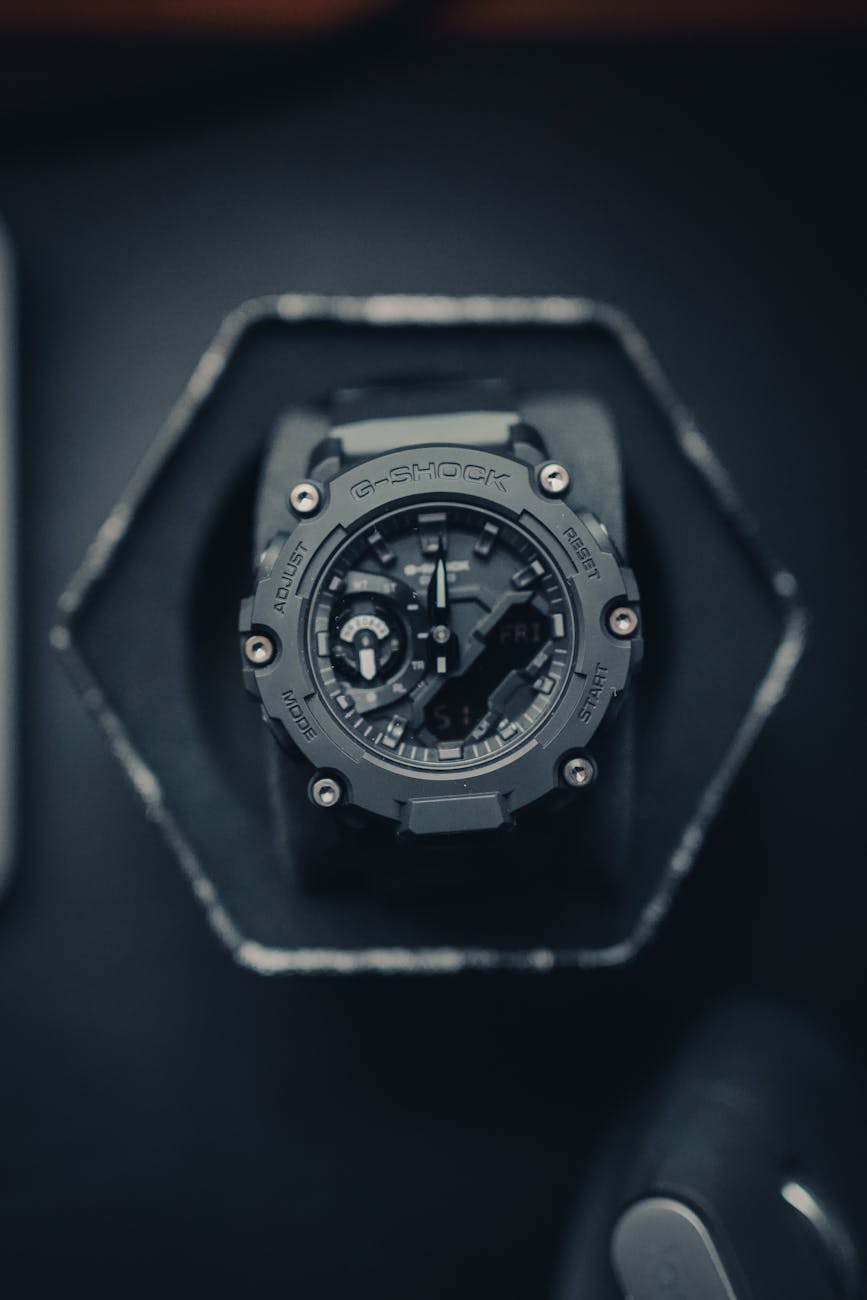
    The mechanical divers are quietly retired to their watch box like aging prizefighters. In their place emerges a new obsession: G-Shocks, but only of a very specific species—digital, solar-powered, atomic-synchronized, strapped in rubber armor like tiny tanks.

    Four commandments define the new religion:
    Tough Solar.
    Multiband 6 Atomic.
    Digital-only display.
    Rubber straps.

    One madness has been replaced with another, though the patient insists this is progress.

    To maintain psychological order, he compartmentalizes. The mechanical divers remain sealed in their box like museum artifacts. The G-Shocks, however, require their own ecosystem.

    Enter the Industrial Pipe Shrine.

    This object began life as a two-tier industrial pipe jewelry stand, the sort of thing normally used to hang headphones or necklaces. But in this household it has been promoted to sacred architecture. It sits reverently on a windowsill each night so the watches may commune with the atomic time signal emanating from Fort Collins, Colorado.

    To the uninitiated, it looks like plumbing hardware assembled by a bored welder.

    To the devotee, it is a receiving station of cosmic precision.

    Each night the G-Shocks dangle from the steel arms like metallic fruit awaiting revelation. Somewhere in Colorado a radio transmitter hums. Somewhere in the suburban night a man sleeps. And somewhere between them invisible time signals pass through drywall and glass until they arrive inside the tiny ferrite antenna hidden in a digital watch.

    When the signal locks in, the man experiences what can only be called the Multiband-6 Salvation Fantasy.

    For a brief moment the universe feels orderly. Accurate. Aligned. The watch has synchronized itself with atomic time. Solar cells sip daylight. Precision has been achieved.

    The feeling of control is intoxicating.

    Unfortunately, it lasts about as long as the next YouTube review.

    When members of the G-Shock community encounter this newly converted soul, they greet him with cheerful recognition.

    “Congratulations,” they say. “You’ve been G-Shocked.”

    The phrase functions like a baptism. The initiate is welcomed into a brotherhood of people who understand the deep satisfaction of armored watches, radio synchronization, and the quiet glow of solar charging indicators.

    At this moment the man realizes something unsettling: his geekdom has intensified

    Part of him embraces the absurdity. The watches are inexpensive. The hobby is harmless. Why not laugh at himself and enjoy the ride?

    But another part of him wonders whether something darker is unfolding.

    Is this, perhaps, the arrival of the Jungian Shadow—the neglected, obsessive part of the psyche now expressing itself through tactical wristwear?

    Will the Shadow politely stop at three G-Shocks?

    Or will it grow ambitious—multiplying into a monstrous collection that colonizes dresser drawers, nightstands, gym bags, glove compartments, and every horizontal surface in the home?

    Disturbed by these questions, the man attempts a strategic retreat. He throws himself into his other pursuits: bodybuilding, physical culture, literature, television, film.

    These distractions provide temporary relief.

    But the G-Shock Shadow is patient.

    Soon he is back on YouTube watching reviews of obscure Japanese models. He is compiling wish lists. He is studying signal reception strategies.

    Late at night he imagines the watches hanging from the steel arms of his T-bone pipe stand.

    And in darker moments he sees them differently.

    Not as tools.

    But as vampire bats—black, armored creatures dangling upside down, waiting for him to drift into sleep so they can descend silently and drink his blood.

    When he wakes in the morning, they will still be there on the windowsill.

    Perfectly synchronized.

    And waiting.

  • The Cure for Function Abandonment Syndrome

    The Cure for Function Abandonment Syndrome

    You encounter a Rangeman owner who worships the stealth blacked-out model with a devotion bordering on performance art. He will tell you, calmly and without irony, that he can’t actually read the time on the negative display. It doesn’t matter. The watch stays on the wrist because it looks lethal—pure shadow, pure attitude, pure presence. Time, apparently, is now a secondary feature.

    Think about the pivot this represents. The man did not buy a timepiece; he bought an image. The geometry, the matte darkness, the tactical aura—these are the real functions. The digits exist somewhere inside the case, like a ceremonial appendix. If the light is right and the wrist is angled just so, the hour may reveal itself. But that’s incidental. The watch is no longer consulted. It is displayed.

    He resembles the fellow who once insisted he read glossy magazines for the articles, only to admit later that the articles had become irrelevant long ago. Content is gone. Only the visuals remain. In the same way, this enthusiast has crossed the line from horology to aesthetic intoxication. The watch no longer tells time. It tells a story about the man wearing it.

    Such a man is suffering from Function Abandonment Syndrome—the condition that sets in when a watch enthusiast quietly releases the expectation that the watch perform its basic task and begins wearing it purely for appearance, mood, or identity. Legibility becomes optional. Accuracy becomes theoretical. The time is technically available somewhere—under ideal lighting, at a cooperative angle—but that’s no longer the point. The owner has crossed the invisible threshold where tool becomes sculpture and utility becomes a nostalgic rumor. He doesn’t check the watch anymore; he acknowledges it. Function Abandonment Syndrome is what happens when style overwhelms purpose and the job description is politely retired without ceremony.

    Is there a cure for his condition? Yes. Imagine this: He lives happily in the glow of his blacked-out Rangeman until the day function suddenly matters again. Picture this: he’s driving a lonely stretch of highway at dusk when the fuel light comes on and the next gas station is closing in five minutes. His phone is dead. The dashboard clock is gone. All he has is the watch he chose for its “presence.” He lifts his wrist. Tilts. Squints. Rolls it toward the fading light like a man trying to read smoke signals from the wrist. The digits hover there, shy and evasive, revealing nothing but his own poor life choices. The station lights flicker off in the distance. In that moment—heart rate climbing, range dropping, darkness settling—he experiences the cold, clarifying terror that ends Function Abandonment Syndrome forever. Because style is thrilling in the showroom. But when the world gets real, the most beautiful watch on earth is the one that will tell you the time the first time you ask.

  • The Horological Crime Scene and the Watch That Cleans It Up

    The Horological Crime Scene and the Watch That Cleans It Up

    Watch addiction is not a hobby. It’s a war zone.

    Sleep is collateral damage. Bank accounts bleed out quietly. Marriages endure the slow drip of “just one more package.” Therapy bills rise. PayPal notifications arrive like ambulance sirens. Somewhere along the way, the language of joy gets replaced by the language of damage control.

    What you’re left with is an Horological Crime Scene—a condition in which the collection no longer looks curated but looks processed. Boxes stacked like evidence. Straps multiplying without explanation. Tracking numbers memorized. A strong smell of financial regret in the air. The collector stands in the middle of it all, insisting everything is fine while whispering the classic defense: “I just need one consolidation piece.”

    To understand the mythical cure for this condition, we need to talk about a man who specializes in cleaning up messes.

    In Pulp Fiction, Winston Wolf doesn’t arrive with empathy. He arrives with order. Vincent and Jules have turned a routine morning into a biological disaster. The Wolf doesn’t discuss feelings. He doesn’t analyze root causes. He doesn’t ask what went wrong. He walks in wearing a tuxedo, drinks their coffee, and converts panic into logistics.

    Towels. Bags. Timeline. Move.

    In a movie full of loud personalities and terrible judgment, The Wolf is something rare: competence without drama. The adult in a room full of armed adolescents.

    Every watch obsessive eventually needs a Wolf.

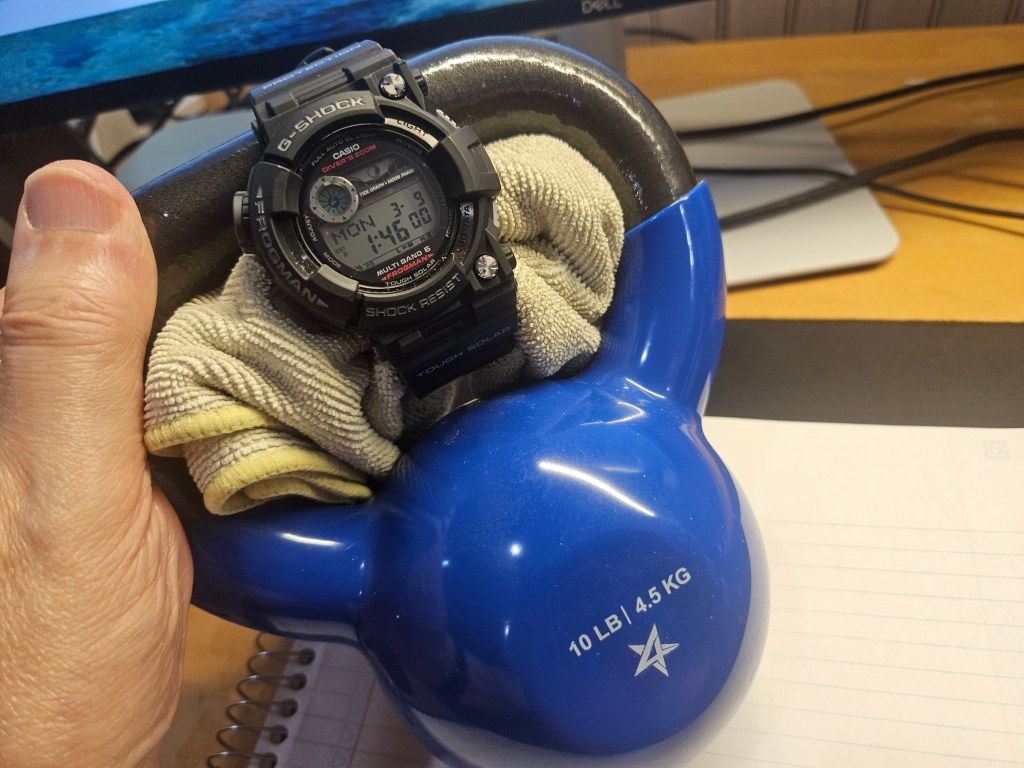
    That’s where the G-Shock Frogman comes in.

    The Frogman doesn’t seduce. It doesn’t charm. It doesn’t whisper heritage stories about Swiss craftsmen and moon missions. It shows up like a tool that expects you to get back to work.

    Where the watch box is chaos, the Frogman imposes a checklist.

    Accurate.
    Indestructible.
    Always running.
    Nothing to think about.

    The endless internal courtroom—Should I rotate? Should I sell? Should I upgrade? Is this the one?—suddenly feels absurd. The argument collapses under the weight of blunt competence.

    Like The Wolf, the Frogman doesn’t fix your personality. It fixes your situation.

  • Mortality Attenuation: When the Hobby Survives but the Hunger Fades

    Mortality Attenuation: When the Hobby Survives but the Hunger Fades

    I’ve made more real friendships online over watches than I ever expected—full-grown adults bonding over bezel action, dial texture, and the shared conviction that the perfect collection is exactly one purchase away. It’s a peculiar fraternity: half hobby, half recovery meeting. We compare scars from impulse buys and premature flips. We confess, we relapse, we congratulate one another on restraint that lasts roughly twelve days. Then someone posts a new release, and the room goes quiet. We nod, knowingly. Maybe this time we’re cured, we say—the way a gambler says he’s just there for the buffet.

    My own delirium began in 2005, when I was forty-three and certain that mechanical watches were not merely instruments but therapeutic devices—tiny machines capable of repairing the larger, less cooperative machinery inside me. Twenty years disappeared in a blur of rotating bezels, “exit watches,” and divers purchased for hypothetical adventures that never rose above grading papers. The obsession didn’t feel excessive. It felt like maintenance.

    Then, at sixty-three, something shifted. Mortality didn’t shout; it tapped me lightly on the shoulder, like a polite but persistent waiter. The hobby didn’t vanish. The flame still burns. But the heat changed. The urgency drained away. After two decades of acquisition, a quiet truth settled in: no matter how precise the watch, it was still losing the only race that mattered.

    The sensation reminds me of a scene from Battlestar Galactica: a traitor is sealed behind glass, pleading as the airlock hisses and the crew looks on, solemn and unmovable. A ritual exile. That’s what aging feels like–not tragedy, not humiliation. Just the slow recognition that you’ve crossed into a different atmosphere. Those still inside the warm illusion of endless tomorrows don’t push you away. They simply drift forward without you.

    The pane lowers gently. You tap it, wave, even smile, but the cockpit of youthful urgency is sealed. No reentry. What remains is quieter work: dignity over display, usefulness over accumulation, meaning over inventory. You stop building collections and start building perspective. You become less of a buyer and more of a witness.

    This is the Mortality Attenuation Phase: the gradual reduction of acquisition fever as the finite horizon comes into view. The obsession doesn’t die. It simply loses its panic. The watches remain. The urgency does not. Objects can mark time. They cannot bargain with it.

  • The Three-Watch Fantasy: Why Collectors Dream of Starting Over

    The Three-Watch Fantasy: Why Collectors Dream of Starting Over

    One of the most unsettling truths about my watch collection is how replaceable it really is. You would think that the hours of research, the hunting, the unboxings, the strap experiments, and the late-night lume checks would have forged something permanent—an extension of identity, a museum of the self. But that story doesn’t survive contact with honesty. Beneath the sentiment lies a colder fact: I could take a wrecking ball to the entire collection and feel a surge of relief.

    In fact, the demolition fantasy is strangely appealing. Clear the box. Sell the nine. Start over with three. If forced to rebuild today, I know exactly what would rise from the rubble: a Grand Seiko GMT SBGM221 for quiet elegance, the Seiko 62MAS SLA043 for historical gravity, and the G-Shock Frogman GWF-D1000B-1JF for operational indifference to reality. Three watches. Three roles. Order restored. Anxiety reduced. Narrative purified.

    Somewhere out there, I’m certain, a mischievous benefactor is reading this as a challenge. He wants to test the theory. He wants to see whether I—and collectors like me—are governed by what can only be called the Reset Fantasy: the recurring belief that happiness lives on the other side of total liquidation and a smaller, more perfect lineup. The purge promises clarity, discipline, renewal. It also quietly assumes that desire itself will behave once the environment is simplified. History suggests otherwise.

    The outcome would be predictable. I would miss pieces like the SLA055 and SLA023 for a week or two. Then I would adapt. The new trio would feel inevitable, even destined. And the community would be left with a sobering lesson: what we call “bonding” is often just attachment to a role in the narrative. Watches feel permanent. The feelings are not.

    This is why collectors regularly flirt with consolidation. When the box grows heavy, the mind reaches for the cure: the Three-Watch Salvation Myth—the conviction that the right trio will end the churn, quiet the wanting, and deliver lasting contentment. It is minimalism as therapy, discipline as redemption, and wisdom as a purchasing strategy. In truth, it’s simply the Exit Watch fantasy wearing a smaller suit.