Tag: fantasy

  • A College Professor in Search of Flexecutivewear

    A College Professor in Search of Flexecutivewear

    I, for one, am eternally grateful for the fashion revolution that finally told tight loafers and itchy tweed to take a long walk off a short runway. Gone are the days when professionalism meant strangling your thighs in wool trousers and embalming your torso in starched cotton. Now, thanks to society’s blessed surrender to performancewear, I can be a fully functioning member of the information economy without developing trench foot or sweating through my pancreas. At long last, it’s possible to look like I’m closing deals while feeling like I’m on my way to foam roll my glutes. So yes, it’s time for a wardrobe overhaul—one built not on thread count but on strategic stretch and moisture management. We’ll call this divine aesthetic what it truly is: Flexecutivewear—because nothing says power move like a blazer with hidden ventilation panels and joggers that whisper synergy.

    A definition is in order:

    Flexecutivewear (n.): A genre of athleisure engineered for men who want to appear as though they’ve just wrapped a high-stakes boardroom negotiation and a punishing HIIT session—without actually doing either. It’s business-casual for the delusional alpha male: moisture-wicking fabrics, tailored joggers, and compression hoodies that whisper “venture-backed” while screaming “please validate me.” Flexecutivewear exists at the tragic intersection of performance and performance art, where every outfit is a pitch deck and every stretch is a soft launch.

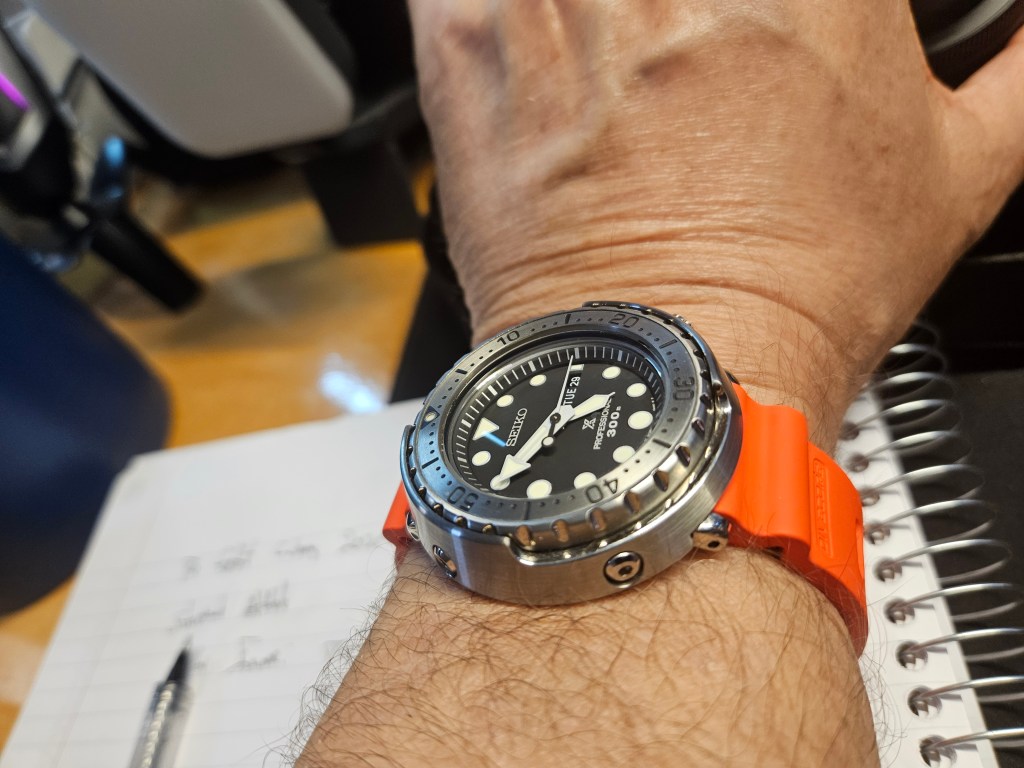
    No Flexecutivewear ensemble is complete without the obligatory diver watch on an orange strap—a bold timepiece that screams “I could be 200 meters underwater right now, but I’m actually just waiting for my cold brew.” The orange strap is crucial: it’s the high-visibility beacon of masculine daring, suggesting a rugged, adventurous spirit who might rappel down a cliff between Zoom calls. Never mind that the watch has never tasted saltwater and its nearest brush with danger was a CrossFit box opening. In the Flexecutive ecosystem, the diver watch is less tool and more talisman—a waterproof monument to imagined peril and aspirational virility.
  • The Shop Foreman of My Own Dysfunction and Other Life Chapters

    The Shop Foreman of My Own Dysfunction and Other Life Chapters

    At 63, I now divide my life into chapters—not by achievements or milestones, but by bone density, hormone decay, and the gradual hardening of the frontal cortex. Think of it as an anatomical calendar, where each page curls with protein shakes, pretension, and the occasional existential crisis.

    Chapter One: The Barbara Eden Years.
    Childhood wasn’t about innocence—it was about Cap’n Crunch. Bowls of it. Oceans of sweetened corn rubble. I dreamed not of firetrucks or baseball cards but of living inside Barbara Eden’s genie bottle—a plush, velvet-lined fever dream of satin pillows and cleavage. If Barbara Eden wasn’t beaming into my imagination, there was always Raquel Welch in fur bikinis or Barbara Hershey smoldering her way across a screen. This was hormonal awakening served with a side of sugar coma.

    Chapter Two: The Strength Delusion.
    By twelve, I was slamming Bob Hoffman’s bulk-up protein like it was communion wine. At Earl Warren Junior High, I became a Junior Olympic Weightlifter—a gladiator-in-training who wanted pecs like dinner plates and the gravitas of a Marvel origin story. This was the age of iron worship and adolescent mythology: I wasn’t building muscle—I was forging armor.

    Chapter Three: The Intellectual Flex.
    In my late teens, I realized I had all the social charm of a wet gym sock. So I went cerebral. I buried myself in Kafka, Nabokov, and classical piano, amassing a CD library of Beethoven and Chopin that could rival the Library of Congress. I worked in a wine shop where I learned to pronounce “Bordeaux” with a nasal twang and described Chablis as “crisp with notes of existential regret.” I didn’t just want to be smart—I wanted to be the human embodiment of a New Yorker cartoon.

    Chapter Four: The Shop Foreman of My Own Dysfunction.
    Marriage and employment hit like a cold bucket of reality. Suddenly, I had to function around other human beings. My inner demons—once delightfully antisocial—were now liabilities. I had to manage them like a foreman supervising a warehouse of unruly toddlers armed with crowbars. Turns out, no one wants to be married to a psychological landfill. I had to self-regulate. I had to evolve. This wasn’t personal growth; it was preventative maintenance, or what other people simply call adulthood.

    Chapter Five: Diver Cosplay.
    In my forties, I had just enough disposable income and suburban ennui to start collecting dive watches. Not just one or two. A flotilla. I wanted to be the hero of my own fantasy—a rugged diver-explorer-adventurer who braved Costco parking lots with a Seiko strapped to his wrist. This was less about telling time and more about clinging to the idea that I was still dangerous, or at least interesting. Spoiler: I was neither.

    Chapter Six: The Age of Denial and Delusion.
    These days, the watches still gleam, but now I’m staring down the barrel of cholesterol, visceral fat, and the slow betrayal of my joints. I swing kettlebells five days a week like a garage-dwelling warlock trying to ward off decay. I track my protein like a Wall Street analyst and greet each new biomarker like a hostile corporate audit. Am I aging gracefully? Hardly. I’m white-knuckling my way through geriatric resistance and calling it “wellness.” If I’m Adonis, then somewhere in the attic there’s a Dorian Gray portrait of my pancreas in open revolt.

    I know what’s coming: Chapter Seven. The reckoning. The spiritual compost heap where I either make peace with my body’s betrayal or turn into a bitter relic that grunts through foam-rolling sessions like it’s trench warfare. It’ll be the chapter where I either ascend or unravel—or both.

    And while our chapters differ in flavor, I suspect we’re all reading from the same book. Different fonts, same plot twist: we start with fantasies, build identities, fight the entropy, and eventually, we all kneel before the mirror and ask, “Was that it?

  • From Sunbathing to Suffering: Surviving Roland Beavers

    From Sunbathing to Suffering: Surviving Roland Beavers

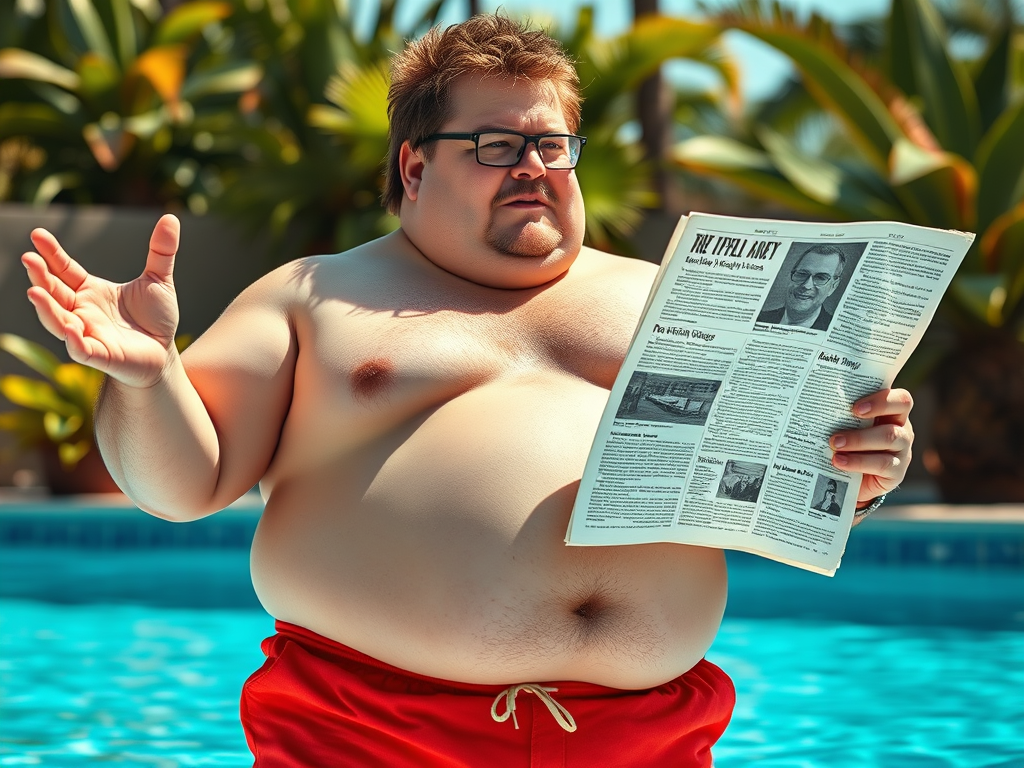
    A poolside pestilence was Roland Beavers. He was the type of poolside companion that nightmares are made of. Imagine, if you will, a pudgy man in his early thirties with dishwasher-blond hair clinging lifelessly to a scalp that seemed perpetually annoyed at its presence. His physique was more doughy than daring, his chin seemingly having taken an early retirement. And yet, this fine specimen insisted on strutting around the pool in a pair of lava-red terry cloth trunks so undersized that they clung to his hips for dear life, revealing a set of stretchmarks that looked like they’d been painted on by a vengeful graffiti artist. Roland, of course, had an explanation ready for anyone who dared make eye contact long enough to hear it. Those stretch marks? Oh, they weren’t the result of his love affair with powdered donuts. They were the battle scars from his days as a world-class daredevil, hurling himself off the cliffs of Acapulco. You could practically hear the collective eye-roll from the pool regulars every time he regaled them with his tales of high-flying heroics. But Roland’s true calling wasn’t acrobatics; it was unsolicited public broadcasting. Armed with a crumpled newspaper, he’d park himself by the pool and provide live commentary on every “news bit” that caught his eye, apparently under the delusion that everyone within a 20-foot radius was breathlessly awaiting his next headline. His audience, meanwhile, mumbled curses under their breath, desperately wishing he’d take up a hobby that didn’t involve public speaking. Maybe knitting—somewhere indoors. Roland’s social cluelessness reached its peak when playful couples would toss a football or frisbee in the water. For Roland, this wasn’t a game he could just watch; it was an invitation. He’d leap into the pool with all the grace of a boulder, wading into their game like an uninvited ghost at a family reunion. The couples, now robbed of their carefree fun, would give him the kind of look reserved for people who talk during movies before stomping off in search of a Roland-free zone. 

    And heaven help the women trying to sunbathe in peace. Roland, ever the gentleman, took it upon himself to offer his “services” to any woman within spraying distance. Whether it was spritzing their backs with a pump bottle of water or offering to rub sunscreen on their shoulders, Roland never missed an opportunity to “help,” oblivious to the fact that his mere presence was enough to ruin their entire tanning experience.

    Of course, these endless days at the pool weren’t just for Roland’s entertainment; they were an extension of his bizarre domestic life. His mother, Nadine, a woman who looked like she could bench-press a Buick, frequently leaned over the balcony of their apartment—muu-muu billowing in the desert wind—barking orders at Roland to “slather on more sunscreen.” With her hair twisted into tight curls that looked like they might pop loose at any moment and neck veins throbbing like they were signaling an SOS, Nadine’s concern for her son was a constant, vocal presence. “Get inside and eat something, Roland! You’re wasting away!” she’d holler, seemingly unaware that Roland had about 40 extra pounds he could “waste away” without anyone noticing.

    You’d think with all this doting and nagging, Roland might be motivated to get a job, maybe contribute something to society—anything to give the rest of us a break. But alas, Roland and Nadine were comfortably cushioned by the settlement from a lawsuit stemming from Roland’s failed attempt at flight school in San Diego. Apparently, the other students in the dorm took one look at Roland’s face and decided it needed to be rearranged, leaving him with a fractured skull and a big fat check to sit around and bother the rest of us for the rest of his natural life.

    And so there he was—our unwanted poolside companion—who, thanks to his mother’s coddling and that lawsuit cash, was free to spend his days lounging in his ridiculous red trunks, delivering headlines no one asked for, and making our lives just a little more unbearable, one stretch mark at a time.

  • Bachelor of Denial: The Speedo Messiah of Bakersfield

    Bachelor of Denial: The Speedo Messiah of Bakersfield

    Chief among my apartment acquaintances was Leonard Skeazy, an attorney from Santa Monica who was lured to the Bakersfield desert by a fat signing bonus and a monogrammed office, yet couldn’t shake the resentment of having been exiled to this cultural wasteland. He was the sort of guy who treated “style” like a religion. He sported custom-made Speedos that were purchased at a specialty boutique in Santa Monica—yes, he would actually drive back to the city to replace them whenever the chlorinated pool water faded the jewel tones of his spandex. His long, curly hair and eerie blue eyes made him look like a lounge singer who never quite made it out of the Holiday Inn circuit.

    Leonard was a man of eccentric habits and questionable hygiene. Despite being well into his 30s, he clung to the bachelor dream of finding “the right girl,” although his standards seemed laughably out of place in a town where having a high school diploma was considered highbrow. This was a guy who’d lounge poolside for hours, skin glistening like a buttered croissant, all while blasting Kenny G from his boombox as if smooth jazz were somehow his secret weapon. His breath, tinged with the distinct aroma of last night’s Chardonnay, matched his penchant for sneaking sips from boxes of white wine he kept stashed in his fridge.

    Curiosity (and a lack of better options) led me to visit Leonard at his apartment one day. It was a bachelor pad in the most tragic sense. Despite the fact that he was swimming in cash, his apartment was as bare as a prison cell. The living room housed only a lone couch, a TV balanced on cinder blocks, and—wait for it—an ironing board. Apparently, ironing his endless supply of gaudy silk ties was the only domestic task he took seriously. The walls were completely devoid of art or decor, just barren expanses of beige that made the flickering TV light cast ghostly shadows over the snake-like drape of his ties.

    His bedroom was even more pitiful: no dresser, no closet system—just three open suitcases serving as makeshift storage. It was as if he refused to fully unpack, a subconscious protest against ever settling into this armpit of a town. The fridge, naturally, was a barren tundra except for—what else—more boxes of white wine. Here was a man who had chased the scent of money into the middle of nowhere, only to refuse to acknowledge he’d actually arrived. Leonard was a ghost of himself, haunting his own life, clinging to the notion that he was just “visiting” until he could escape back to the big city. 

    What kind of man, I wondered, gets seduced by a fat paycheck only to spend his days living in a self-imposed purgatory, where the only things thriving are his excuses and his growing collection of faded Speedos? I suppose it was easier for Leonard to pretend he was just passing through than to face the fact that he’d become a permanent fixture in this desolate corner of nowhere, a relic clinging to the fading glamour of a life he never truly had.

  • The Postcard Life: Why Perfection Always Rings Hollow

    The Postcard Life: Why Perfection Always Rings Hollow

    I can’t shake an interview I heard thirty years ago—an offhand confession that stuck to me like burrs on a wool coat.
    Terry Gilliam, the Monty Python animator turned fever-dream film director, was talking with Charlie Rose. Gilliam described a moment straight from a high school dream: he was walking the Santa Monica Pier on a twilight evening, a beautiful woman on his arm, the beach shimmering under a dying sun. It was the kind of moment that screams You’ve Made It! if you’ve ever been a teenage boy with a tragic imagination.

    And yet, Gilliam said, he felt nothing. Not euphoria. Not awe. Just… flatness. Like he wasn’t even in his own life but rather trapped inside one of his own cartoons—a two-dimensional fantasy drawn by someone who had seen too many movies and lived too little.
    That was his grim epiphany: we don’t chase life—we chase the idea of it.

    Gilliam’s teenage dream had come true, but it rang hollow because it wasn’t connection he had caught. It was a postcard of connection, a lifeless image polished smooth by years of expectation.

    I’ve thought about that moment a lot, especially in the slow burns of my own life, in all the arenas where the blueprint of perfection crashed hard against the walls of reality.
    Take teaching: I’ve taught college writing for forty years. More times than I care to admit, I walked into class with what I believed was a masterstroke of a lesson plan—polished, structured, airtight. And then I delivered it like a robot with tenure. The students, bless them, tried not to visibly expire.
    Only when I threw away the script and talked to them like a breathing, flawed human being did I finally see heads lift and eyes focus.

    It’s the same poison at work: that blueprint, that false idol of how it’s supposed to be.
    Therapist Phil Stutz calls it the Magical Moment Frozen in Time—a mental snapshot of ideal beauty, love, success, whatever, that we spend our lives trying to recreate. And like the cruelest mirage, it recedes the closer we get.
    Because it’s not life.
    It’s a knockoff. A counterfeit so slick, it fools even the person living it.

    It’s sobering, humiliating even, to realize how often my life has been a performance for an audience that doesn’t exist—measuring real experiences against some fantasy standard cooked up in the caves of my mind.
    Maybe Plato had it right all along: we’re prisoners staring at shadows, mistaking flickers on the wall for the blazing, complicated, imperfect mess that is actual life.
    And every time we chase the shadow instead of the fire, we walk the Santa Monica Pier at sunset, hand in hand with a beautiful illusion, and feel… nothing.

  • Remembering the 90s when Seinfeld made existential apathy a form of cultural resistance

    Remembering the 90s when Seinfeld made existential apathy a form of cultural resistance

    I’ve always been a lousy sleeper—a lifelong insomniac, night-thinker, ceiling-staring obsessive. So when my brain, usually a humming engine of late-night anxieties, surprises me by downshifting into a silky semi-sleep, I take notice. I don’t just enjoy those moments—I archive them in some velvet-lined folder in my mind, filed between “Miracles” and “Rare Weather Patterns.”

    One such miracle happened in the summer of 1991 in the gloriously tacky suburb of Buena Park, California. I had recently relocated from the Bay Area to Bakersfield, that Central Valley of hot wind and dust, to teach composition at the university. It was a job that paid me in respect and barely enough money to keep me in burritos and gas.

    Weekends were spent visiting Nicole, the girlfriend of my ex-student Mike, a real-deal Navy SEAL with shoulders like boulders and a heart that thumped exclusively for her. We’d drive south, Mike and I, and wind up at Nicole’s parents’ place not far from Knott’s Berry Farm—California’s budget Disneyland, where roller coasters and churros come with a faint scent of desperation.

    Dinner with Nicole’s folks was always home-cooked, polite, and meatloaf-heavy. But the real magic happened later in the den, where the three of us would settle in for prime-time America’s Funniest Home Videos, back when Bob Saget’s voiceovers made even mild concussions look charming.

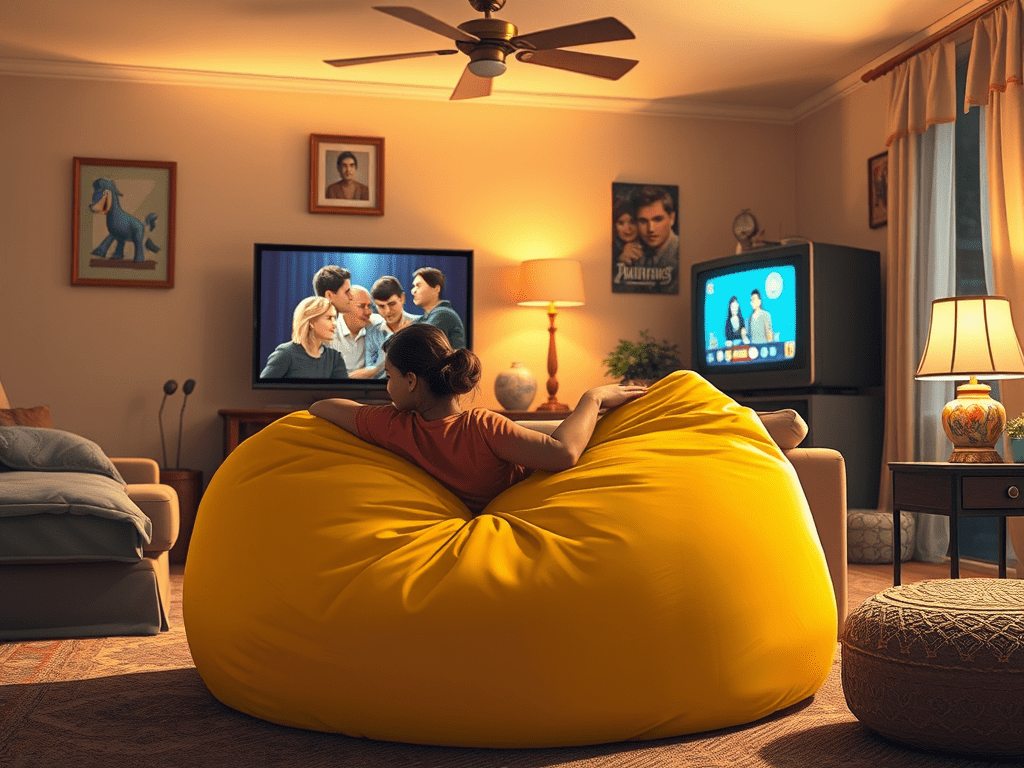
    Mike and Nicole snuggled on the sofa, whispering sweet nothings or planning some SEAL Team Six domestic mission. I would sink into a bloated yellow bean bag chair like a man slipping into a warm pond of polyester and forgotten dreams.

    As I floated somewhere between reruns and REM, Nicole’s mom would be doing laundry in the adjacent room, and the floral scent of freshly tumbled linens—fabric softener with notes of lilac and vague suburban joy—would drift in and intoxicate me. The TV flickered. The lovers whispered. I, utterly ignored, entered a state of transcendence usually reserved for monks or the chemically enhanced.

    In that half-dream, I’d rocket through constellations, revisit my childhood neighborhood where everyone still had knees that worked, and rendezvous with a mysterious dream woman who always met me at sunset on a Hawaiian beach. I was twenty-nine, single, unburdened, and lazy in a way only the early ‘90s allowed—when Seinfeld made existential apathy a form of cultural resistance.

    Looking back now, from the sagging perch of sixty-three, it’s easy to sigh at the sheer, stupid comfort of it all. I no longer live in that bubble-wrapped world where being a third wheel was a blissful kind of freedom, where responsibility was just a concept in other people’s lives.

    Still, on a quiet afternoon, stretched out on my modern couch, if the narrator of a nature documentary starts detailing the mating habits of sea otters in a sonorous British whisper, something in me softens. The air thickens. I begin to drift. And for a flickering moment, I’m back in that bean bag—yellow, ridiculous, sublime—floating on the fabric-softened breeze of a world that no longer exists.

  • Streamberry, Self-Loathing, and the Algorithmic Abyss: How “Joan Is Awful” Skewers the Curated Life

    Streamberry, Self-Loathing, and the Algorithmic Abyss: How “Joan Is Awful” Skewers the Curated Life

    In Black Mirror’s “Joan Is Awful,” Charlie Brooker offers more than a dystopian farce—he serves up a wickedly accurate satire of the curated lives we present online. It’s not just Joan who’s awful. It’s us. All of us who’ve filtered our flaws, outsourced our personalities to engagement metrics, and whittled ourselves down to algorithm-friendly avatars. The episode doesn’t critique Joan alone—it roasts the whole rotten architecture of social media curation and shows, with brutal clarity, how the pursuit of digital perfection transforms us into insufferable parodies of our former selves.

    First, let’s talk about performance. Joan, like any good social media user, lives her life as if auditioning for a role she already occupies—one shaped not by authenticity but by optics. She performs “relatable misery,” complete with awkward office banter, fake smiles, and passive-aggressive salad orders. Social media rewards this pantomime, demanding we be palatable, aspirational, and vaguely miserable all at once. The result? A version of ourselves designed to please an audience we secretly resent. Joan is what happens when your curated self becomes the dominant narrative—when branding overtakes being. Her AI-generated counterpart doesn’t misrepresent her; it distills her curated contradictions into a grotesque caricature that somehow feels… accurate.

    Second, there’s the fact that Joan—like all of us—is under constant surveillance. In Joan Is Awful, it’s not just the NSA snooping in the background—it’s the entire viewing public, binge-watching her daily descent into algorithm-approved degradation. This is what we’ve signed up for with every “I accept” click: to become content, voluntarily and irrevocably. Our data, behaviors, and digital crumbs are fed into the algorithmic sausage grinder, and what comes out is a grotesque mirror held to our worst instincts. The AI Joan is not a stranger; she’s the monster we’ve been molding through every performative tweet, selfie, and humblebrag. In a world where perception is currency, she’s our highest-valued coin.

    Then comes the psychological shrapnel: identity fragmentation. Joan can no longer tell where she ends and Streamberry’s Joan begins, just as many of us can’t quite remember who we were before the algorithm gave us feedback loops in the form of likes, retweets, and dopamine pings. This curated self isn’t just a mask—it becomes the default setting. The dissonance between public persona and private truth breeds an existential malaise. Joan’s real tragedy isn’t that her life is on TV—it’s that she’s lost the plot. She’s a passenger in her own narrative, outsourced to a system that rewards spectacle over substance.

    Let’s not forget the moral rot. Watching your AI double destroy your reputation while millions tune in might seem horrifying—until you remember we do this willingly. We doomscroll, rubberneck scandals, and serve our digital idols on platters made of hashtags. Joan, sitting slack-jawed in front of her TV, is no different from us—addicted to her own collapse. It’s not the horror of exposure that eats her alive; it’s the realization that her own worst self is exactly what the algorithm wanted. And that’s what it rewarded.

    Ultimately, Joan Is Awful is a break-up letter with social media—if your ex were a manipulative narcissist with access to all your personal data and a flair for psychological torture. Escaping the curated self, as Joan tries to do, is like fleeing an abusive relationship. You know it’s toxic, you know it’s killing you—but part of you still misses the attention. The episode doesn’t end with a triumphant reinvention; it ends with Joan in fast food purgatory, finally unplugged but still wrecked. Because once you’ve sold your soul to the algorithm, the buyback price is steep.

    So yes, Joan is awful. But only because she reflects what happens when we let the curated life take the wheel. In the Streamberry age, we aren’t living—we’re streaming ourselves into oblivion. And the worst part? We’re giving it five stars.

  • Floating on FOMO: My Personal Waterbed Fiasco

    Floating on FOMO: My Personal Waterbed Fiasco

    I spent my early childhood in VA housing—decommissioned army barracks optimistically rebadged “Flavet Villages”—in Gainesville, Florida. These were no-frills dwellings nestled near an alligator swamp and a patch of forest where a Mynah bird with the patience of a Zen master perched on the same branch every evening like it was punching a time clock. It became a ritual: before bed, my father and I would wander out to talk with the bird, who responded with eerie, robotic mimicry, as if channeling some extraterrestrial intelligence trapped in a tropical feather suit.

    At dusk, the low tide would pull back just enough to let the aroma of fermented alligator dung waft through the air—a stench so strong it could thin paint. Most people would gag. I inhaled deeply. Something about that swampy, putrid tang made me feel alive, elemental, cosmically tethered. It wasn’t beautiful, but it was real. And standing beside my father, breathing in swamp funk and chatting with a talking bird, I felt no lack. No longing. No itch. I was in paradise, the kind not found in brochures or Instagram feeds—though we didn’t yet have the latter to weaponize our dissatisfaction.

    Then came I Dream of Jeannie in 1965, and with it, the slow-burn tragedy of FOMO. Barbara Eden lived inside a jewel-toned genie bottle—a plush, circular sanctum upholstered in royal purples and pinks, encrusted with glass baubles and satin pillows. It was luxury wrapped in fantasy, and I wanted in. Badly. Suddenly, my swamp lost its sparkle. I began to ache—not for something real, but for something better. Something else.

    The cruelest part? Jeannie’s bottle was a repainted Jim Beam whiskey decanter. A piece of throwaway Americana converted into a portal of impossible longing. That detail says everything: desire is often just repackaged delusion. And once I tasted that kind of fantasy, the swamp and the Mynah bird—once holy—became mere prelude.

    By 1974, I was barely thirteen and neck-deep in my search for substitutes. The object of obsession that year? Waterbeds. Several friends and neighbors had them, and after a few demo flops onto their undulating surfaces, I became convinced that waterbeds were the gateway to pleasure, sophistication, and sensual repose. Surely, I reasoned, the waterbed was Jeannie’s bottle in disguise—fluid, decadent, vaguely erotic.

    I lobbied my parents hard. They relented. Victory tasted like vinyl and faint mildew.

    What followed was not paradise but an ongoing science experiment in disappointment. The temperature was always wrong—Sahara one night, Arctic the next. It leaked with the consistency of a bad marriage. The smell? Somewhere between wet dog and pond scum. And then there was the sensation: if I moved, the bed retaliated. A slow-motion punch of resistance, as if Poseidon himself were shoving back. I wasn’t cradled—I was stalked by unseen waves. One night it leaked so catastrophically that my bedroom floor bowed like a sinking schooner. I woke up in what felt like Act II of Hurricane Katrina: The Bedroom Years.

    This, I realized, was the fool’s errand of FOMO: chasing after glossy substitutes for longing we barely understand. Jeannie’s bottle wasn’t just a dream—it became the prototype for every ill-fated quest for magic in mundane form. Every waterbed, every gadget, every trend promising comfort, coolness, or connection is just another glittering bottle with no genie inside.

    The Mynah bird never promised me anything. It never asked me to chase or wish or want. It just sat, unbothered, mimicking the world as it was. And perhaps that’s what I miss most: the pre-FOMO clarity of being content beside a swamp, before marketing told me I was supposed to want more.

  • The Stucco Incident: A Tale of Paranoia, Kettlebells, and Redemption

    The Stucco Incident: A Tale of Paranoia, Kettlebells, and Redemption

    My neighbor Joe, a man with a penchant for awkward introductions and cargo shorts, once foisted upon me his friend Raymond—a wiry handyman with a cigarette rasp and a toolbelt that looked like it had seen battle. Raymond had installed our front and bedroom doors with the calm authority of someone who’s spent more time with a level than with his own family. More importantly, Raymond had a black book of contractor contacts so thick it could’ve doubled as a Catholic missal: painters, plumbers, concrete guys, stucco guys, electricians—everyone short of a Vatican-approved exorcist.

    Back in 2007, we’d had our house painted and cloaked in smooth stucco, the kind of finish that whispers suburban respectability. Fast forward to last week: three days of relentless rain and suddenly the back wall looked like it had taken a punch. A large section of the stucco buckled like cheap linoleum. Raymond, unbothered by the decay of manmade things, casually recommended a guy named Jose. Said he’d fix the wall for $650.

    Six-fifty? I was expecting two grand. I nearly kissed my phone. I told Jose yes before he could change his mind, and we agreed he’d start on Wednesday morning.

    That was the plan.

    On Wednesday, I forgot. Utterly. Blissfully. Didn’t check my phone. Didn’t check the time. Just wandered into the garage around 10 a.m. for a kettlebell session, ready to punish myself with Russian swings for no real reason. That’s when I saw it: two missed calls and a text from Jose at 9 a.m. “I’m at your front door.”

    Panic set in. I called him at 10, breathless with guilt. “Jose, I’m so sorry! Where are you?”

    “I’m on the job,” he said, calmly, like I should know what that means.

    “Wait… so, you’re still coming later?”

    Silence.

    After my workout, I crept through the house, peering out the windows like a man who suspects he’s just been ghosted by a contractor. Nothing. No truck. No ladder. Just the usual backyard gloom.

    Convinced I’d blown it—that I was now on Jose’s official “flakes and time-wasters” blacklist—I called him again, borderline pleading. “I’m so sorry for not answering earlier. Please forgive me. I hope we can reschedule…”

    He paused. Then said, almost tenderly, “Jeff. I’m here. I’ve been working in the back of your house the whole time.”

    I turned and looked through the sliding glass door—and there he was, crouched like a monk, phone to ear, smoothing cement with the devotion of a man sculpting a headstone.

    “I’m hanging up,” I said. “I will greet you in person.”

    He laughed, as if to say, You absolute wreck. I ran outside and thanked him more times than was strictly necessary. He just smiled and kept working.

    And the result? Perfect. Seamless. The repaired wall matched the rest of the house so precisely it looked like time had reversed itself. I’m fairly certain Jose undercharged me out of pity.

    Later, when I told my wife about the mix-up and my brief descent into full-blown paranoia, she laughed like it wasn’t the first time. “You’re a mess,” she said. “You get so worked up, you leave reality behind.”

    She’s not wrong. But at least the stucco’s smooth.

  • The Ghost in Aisle Nine: Remembering Chris Grossman

    The Ghost in Aisle Nine: Remembering Chris Grossman

    Back in the Reagan era, when I was a college kid working part-time at Jackson’s Wine & Spirits in Berkeley, I shared long, dusty shifts with a man named Chris Grossman—a wine salesman whose last name, ironically, matched neither his physical presence nor his temperament. Chris was lanky, six foot four, and moved with the grace of a man perpetually on the verge of tripping over his own limbs. He had a face only a Freudian could love: aquiline nose, dark beard, black-framed glasses smudged with fingerprints, and a mop of dark curly hair that looked like it had lost a long battle with a pillow. A pencil was always tucked behind his ear, as if at any moment he might be called upon to draft blueprints for a submarine.

    To customers, Chris was a savant in work shirts with the sleeves rolled just so—half wine whisperer, half philosopher of Zinfandel. He had an uncanny ability to match a Pinot Noir to a personality type, like some sort of boozy Myers-Briggs. The regulars adored him. They trusted his palate, his calm authority, his encyclopedic knowledge of terroir. What they didn’t know—and what I only discovered gradually—was that once he stepped off the floor, he disappeared.

    Chris Grossman had no friends. Not one. He was social the way a vending machine is social—polite, efficient, devoid of emotional commitment. Once, during a lull in business, he confided that he’d had a girlfriend, briefly, years ago. He spoke of it as though he’d survived a hostage crisis. The constant negotiation, the emotional bookkeeping—it exhausted him. “I’m too selfish to pretend otherwise,” he said with an eerie clarity. “I’d only make her miserable.” There was something almost noble in his blunt self-awareness, as if he’d spared both himself and others the slow drip of mutual disappointment.

    His father, he once told me, had been a brilliant but frostbitten physician, a man incapable of affection. Chris, I think, carried his father’s circuitry—a brain tuned for analysis, not empathy. Still, he wasn’t bitter. He wasn’t even rude. If he hated humanity, he kept it on a low simmer, tucked behind a mild smile and a firm handshake.

    We both left Jackson’s in the late ’80s. I moved to the California desert to lecture on writing and lose my illusions in the faculty lounge. Chris stayed local, selling stereos on Shattuck Avenue for places like The Good Guys and Circuit City. He made good money and spent exactly none of it on companionship. No wife, no kids, no pets, not even a ficus. Once a year he drove his Triumph convertible down to Carmel for a vintage car rally, then disappeared back into his cocoon.

    I think about him more than I should. Forty years have passed, and still, his silhouette lingers. Why? Maybe because I recognize myself in him. The difference is, I got married—and in doing so, outsourced my social life to someone with actual initiative. My wife arranges our dinners, our vacations, our tenuous grasp on community. She reminds me to be human. And yet, even she knows I’m a recluse at heart. She gently suggests I see more of my friends—or at least have more friends—so she doesn’t have to absorb every neurotic spiral I produce. Fair enough.

    I’m 63 now. Chris, if he’s still around, must be pushing seventy. I sometimes wonder how he’s weathered the years, whether the silence that once comforted him has curdled into something more sinister. But I also suspect he made peace with his solitude. He looked at the world, with all its needy, buzzing, soul-sucking demands, and chose the quieter suffering. Not because he was brave or broken, but because he knew himself too well to fake it.

    I hope he’s okay. I really do. Solitude, like alcohol, is dose-dependent. For some, it’s a meditative stillness. For others, it’s a slow erosion. I don’t know which side of the line Chris landed on. But wherever he is, I raise a glass to him—alone, perhaps, but not forgotten.