Tag: fantasy

  • The Comedians of Cell Block B

    The Comedians of Cell Block B

    Last night I dreamed I was in a bustling, overlit restaurant packed with the usual suspects—people chewing too loudly, waitstaff dodging elbows, silverware clinking like wind chimes in a windstorm. I was halfway through what I assumed was risotto when I realized two of my teeth had come loose, flapping in my gums like faulty hinges.

    Panicked, I waved down a waiter. He listened gravely, nodded with theatrical sympathy, then pointed toward a man in a white coat weaving through the crowd like a prophet leaving a revival. “That’s Dr. Beltrán,” he said. “Fixes teeth. Fixes lives. If you move now, you might catch him before he ascends to the exit sign.”

    So I followed. Fast forward to the next day: I’m in a waiting room that looked more like a casting call for eccentric sitcom roles. Among the crowd sat a married couple, both comedians. Raffi, a Canadian import with the weary charisma of someone who’s done too many festivals, and Tina, his statuesque, golden-haired wife, radiantly pregnant and visibly amused by the absurdity of her own life.

    Turns out Raffi and I had gone to college together, which gave our small talk the sheen of nostalgia. Tina, meanwhile, was the sort of woman you describe as a “former beauty queen” only because it sounds more manageable than “mythical being with a driver’s license.”

    Then the tone shifted. They told me they were serving life sentences. Yes—life sentences—for misreading pesticide instructions. About five years ago, they’d tried to fumigate their house for fleas and spiders but sprayed an industrial outdoor poison all over their bedroom carpet. Their organs liquefied. They almost died. When they recovered, they were arrested. The terms of their punishment? Eternal residence in a dungeon—an actual pitch-black basement beneath a towering apartment block. They were allowed out only for comedy gigs. Art, apparently, still mattered to the state.

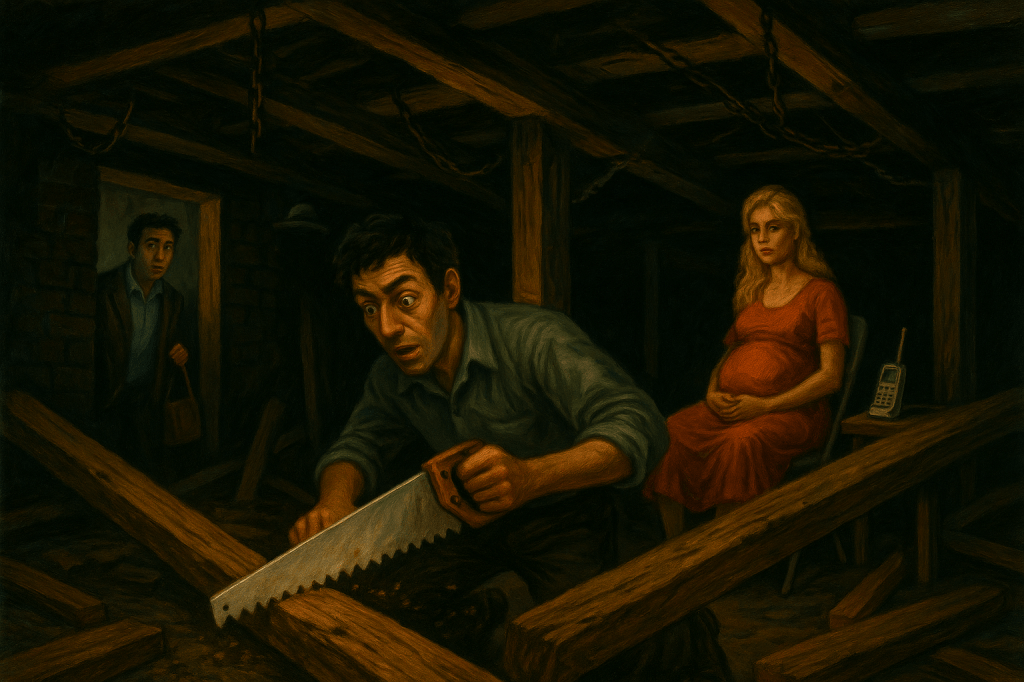
    Dental work complete, Raffi left for Canada to perform at a club. Tina, contractions ticking in her belly like a countdown timer, insisted on showing me the dungeon. The space was a horror. Not just black-as-night oppressive, but physically punishing—an absurdly low ceiling crisscrossed by thick beams of lumbar that made it feel like you were crawling through a collapsed IKEA warehouse.

    So I did what any good houseguest-slash-dream hero would do: I went to the nearest hardware store, returned with a comically oversized saw, and spent the afternoon hacking through beams like a man possessed. Tina cheered me on from a folding chair, one hand on her belly, the other clutching her flip phone, waiting for Raffi’s call.

    When I finished, the dungeon felt ever so slightly less apocalyptic. She looked at me and said, “I think the baby’s coming.” I nodded like I’d just finished installing a light fixture. My work here was done.

  • Meet the Timepiece Whisperer

    Meet the Timepiece Whisperer

    Chapter 6 of The Timepiece Whisperer

    At 6 a.m., I rose like a guilty priest on purge day and loaded my Honda Accord with a museum of failure. Each item whispered its own shame: busted radios that once sang, fans that blew nothing but despair, fossilized laptops gasping through Windows XP, iPads ghosted by iOS updates, a humidifier that wheezed its final death rattle in 2018, and a landmine of corroded batteries that could’ve earned me a write-up from the EPA.

    By 8:00, I was cruising down the 110 South, my car bloated with the technological detritus of a man who once believed that stuff—stuff!—might soothe an inner void. I exited Pacific Avenue and found myself crawling through a wasteland of rebar, chain-link fences, and brush thick enough to hide a body or two. It was less Los Angeles and more post-apocalyptic novella. A landscape haunted by discarded dreams and the occasional tented soul whose only offense was being born poor.

    After a slow-motion bounce over some railroad tracks, I veered down a bleak gravel path until I arrived at 8:50 to find a tarp flapping over what I assume someone dared to call a facility. It looked like a wedding tent designed by Satan’s party planner, squatting in front of a cinder-block warehouse that smelled like ozone and bureaucratic indifference.

    Ahead of me, a small line of sedans idled like supplicants outside a radiation baptism. Signs warned against bringing poisons, rotting food, firearms, explosives, and—oddly—crop waste. Another sign warned me not to exit my vehicle, eat, or drink, presumably because the combination of trail mix and lithium-ion residue could create a chemical lovechild that incinerated San Pedro.

    A silver SUV from Washington State attempted to cut the line, realized it had wandered into the wrong apocalypse, and peeled out in a plume of toxic dust that settled on our windshields like the aftermath of a low-budget nuke.

    By 9:00, the caravan had doubled. My rearview mirror showed a parade of shame stretching down the gravel like a funeral procession for the Age of Gadgets. Then she arrived—a smiling woman in an orange vest and clip-on radio. Clipboard in hand, she went car-to-car like a cheerful customs agent at the border of human depravity. When she got to me, I rattled off my cargo. Her nod was practiced. I suspect her real job was twofold: assess whether I was harboring illegal pesticides, and determine if I looked like the kind of man who’d stuff a body under an old humidifier.

    Eventually, I popped my trunk. Men in uniforms descended with the solemnity of pallbearers. They removed the items with clinical grace, not a single eyebrow raised at my hoarder shame. I thanked them. They nodded like undertakers who’d buried a thousand dreams before mine.

    Lighter by fifty pounds and several psychic burdens, I pulled away, my soul humming with moral superiority and the faint possibility of radiation poisoning. For a brief moment, I felt whole.

    Then came the craving.

    The Seiko Astron.

    The Watch Master had warned me. Had pleaded for restraint. But there it was again, the whisper in my mind, the itch in my wrist. By the time I got home, I was already spiraling. So I returned to the Watch Master’s house for counsel, but his front door was answered by a red-bearded mountain of a man who looked like he’d just wandered out of a Nordic crime novel.

    “Josh,” he said, extending a paw. “I’m the Timepiece Whisperer.”

    “What happened to the Watch Master?”

    “Dead. Stomachache. Went to bed and never woke up.”

    “And you’re… what, the sequel?”

    “That’s for you to decide.”

    Josh made me an iced coffee, honey and cinnamon. It tasted like guilt sweetened with denial.

    We sat at the kitchen table, a graveyard of coffee rings and philosophical despair.

    “So what’s troubling you, my friend?”

    “I’m almost sixty-four. I own seven watches. I want an eighth. Am I doomed?”

    He slurped his drink, crunched an ice cube, and nodded solemnly.

    “That depends. Are we talking about eight timepieces? Or eight identities, eight moods, eight regrets?”

    I blinked.

    He leaned forward. “If you’re still hunting, still haunted, then yes—eight is too many. You don’t have a collection. You have a symptom. But if you’ve made peace—if each watch has its rightful place in your little opera of masculinity—then eight is a symphony. A curated exhibit. A spiritual wardrobe.”

    Then he tilted his head. “The real question is: Are you wearing the watches, or are they wearing you?

    I wilted. I wanted to shrink into the upholstery.

    “I want the Astron to be the closer. I want to stop at eight. But history tells me I won’t. I go through the honeymoon, get bored, scratch the itch with another watch, and end up miserable. My collection isn’t a triumph. It’s a cry for help.”

    Josh chuckled, then howled, then nearly fell off his chair.

    “Now we’re getting somewhere. You think this is about timepieces? No, my friend. This is about you.”

    Then he called for backup.

    First came John, a zombie in slippers with bags under his eyes deep enough to hold grief. “Sell everything,” he said, “and get a Tudor Pelagos. End of story.” Then he stared at his slipper hole like it owed him money and shuffled off.

    Then came Gary, a cheerful human protein shake in a Lycra tracksuit.

    “Let the man buy the Astron,” he chirped. “Make it eight. Just get him a sponsor, a support group, maybe a hotline. The poor bastard needs this.”

    Then John stormed back, furious. “I said one watch!”

    Words escalated. Soon they were locked in a full-blown wrestling match, crashing into the walls like toddlers in a padded room. Josh laughed like a man watching Fight Club on loop and eventually threw both of them into the basement.

    He stood at the door, listening to the thumps and groans like it was jazz.

    “That,” he said, his eyes shining, “is the debate. One watch or many. Order or chaos. Simplicity or delirium.”

    I got up to leave.

    “What’s the rush?” he asked.

    “I’ve seen enough.”

    “You’ll be back.”

    “What makes you so sure?”

    Josh smiled. “Because you’re desperate.”

  • The Watch Potency Principle and the Man Who Couldn’t Count to Eight

    The Watch Potency Principle and the Man Who Couldn’t Count to Eight

    Chapter 2 from The Timepiece Whisperer of Redondo Beach

    The Watch Master accepted my Venmo transfer—five grand, no questions asked. He nodded like a monk receiving an offering, commending me for “putting my money where my mouth is,” as if throwing cash at the problem proved I was spiritually ready to shed my horological demons. Then he sent me home with a single directive: return the next night with all seven of my watches arranged in one box for evaluation.

    At precisely 10 p.m., under a bloated moon that cast an eerie glow across the red roof tiles of his dilapidated Redondo Beach bungalow, I stood in his living room. The Master’s pale, angular face looked freshly excavated from a tomb. He gestured for the box.

    He opened it. Seven divers—six Seikos and a lonely Citizen—gleamed under the yellowed light of a hanging stained-glass lamp.

    “Good,” he said, scanning the collection with the intensity of a mortician identifying a corpse. “All divers. That shows thematic restraint. You’re not a complete degenerate.”

    He picked up each Seiko, held it to his eye like a jeweler, then scoffed. “You baby these. When’s the last time you actually swam? Clinton administration?”

    He chuckled at his own joke, which I pretended not to hear.

    His bony fingers closed around the Citizen. “Hmm. Titanium case and bracelet. The others are all on straps. This inconsistency must be clawing at your OCD like a raccoon under drywall.”

    I nodded.

    “Sell it,” he said flatly. “It’s feeding your misery.”

    “But what about the Seiko Astron I’ve been eyeing? That one has a titanium bracelet too.”

    “Yes. And that’s not the least of your problems.” He sipped his black coffee—no cream, no joy. “You’re teetering on the edge of a collecting abyss. The Citizen’s already rotting your center. Add one more watch, and your soul will be lost to cluttered mediocrity.”

    “But the Astron—it’s beautiful,” I protested.

    “Of course it is,” he said, shrugging. “So is opium. Doesn’t mean you should buy a kilo.”

    I tried to recover. “It’s the Watch Potency Principle, right? The more watches you own, the more you dilute the power of each one.”

    He looked up sharply. “So you have read my work. Then why can’t you live by it? You recite the commandments, but break them before sunrise. Your brain and behavior are locked in bitter divorce.”

    “I just need a plan,” I said. “What do I do?”

    “Purge,” he said, as if uttering a sacred mantra.

    “Purge?”

    “Start with the titanium Citizen. Shed that one, then we’ll talk next steps.”

    “Our next move?”

    He sighed, pinched the bridge of his nose. “You’re exhausting. Come back tomorrow at ten sharp. And for God’s sake, don’t buy anything in the meantime.”

  • His Royal Hairdresser: A Dream in Kettlebells and Class Anxiety

    His Royal Hairdresser: A Dream in Kettlebells and Class Anxiety

    Last night, my subconscious staged an outdoor fitness class without my consent.

    I found myself in a park in Redondo Beach, the sun blinding, the grass impossibly green—an Instagram-filtered fantasy of Southern California wellness. I was mid-kettlebell swing, drenched in purpose and a light sheen of dream-sweat, when I realized I was surrounded. Dozens of adult learners had appeared from nowhere, kettlebells in hand, eager and expectant. Apparently, I was their instructor. No one had hired me. No one had asked. But the dream had spoken, and I complied.

    Midway through a set of Turkish get-ups, a British emissary arrived. She looked like a character from a post-Brexit spy novel: stern, sun-dried, calves like cannonballs, dressed in a starched khaki uniform that screamed military cosplay and mid-level bureaucrat. She informed me—in clipped tones—that she worked for Prince Charles and that, regrettably, I lacked the proper haircut to instruct kettlebell technique. Apparently, the heir to the throne had strong feelings about grooming standards in recreational fitness.

    I explained, gently but firmly, that I was bald. Smooth as an egg. No haircut necessary. She did not care. My objections were irrelevant. Orders were orders.

    We marched off to a nearby luxury hotel, the kind with carpeting so plush it slows your gait. Prince Charles was there, sitting cross-legged on a massive hotel bed surrounded by two open laptops, deep in what I can only assume was royal doom-scrolling. When he saw me, he snapped both laptops shut with the speed of a man hiding state secrets or Wordle stats.

    He gestured toward a massive, throne-adjacent salon chair, upholstered in padded leather and colonial guilt. “You need your hair parted down the middle,” he declared.

    Again, I protested—I was bald. But His Royal Highness was undeterred. He placed a comb on my scalp, and as if conjured by the Crown itself, hair appeared. Thick, black, center-parted. The haircut was bestowed.

    Feeling both knighted and absurd, I reached into my wallet and tipped him two twenties. He accepted the bills with the contempt of a man too wealthy for paper currency. It was as though I had handed him used Kleenex. He nodded, purely out of ritual, and turned back to his laptops, already erasing the memory of me from his mind.

    I returned to the park, my hair neatly parted, my purpose restored. I resumed leading my eager students in kettlebell swings, disappearing into the warm fog of belonging, convinced—for at least this dream—that I was a vital member of my sun-drenched community.

  • Late Night Linguine: What The Big Night Taught Us About Conan and Leno

    Late Night Linguine: What The Big Night Taught Us About Conan and Leno

    In Stanley Tucci’s criminally under-watched gem The Big Night (1996), two Italian brothers run a brilliant but nearly empty restaurant on the Jersey shore. Primo, the chef, is an artist of uncompromising culinary vision; he serves risotto that would make a grown man weep. But across the street, the tables are packed—at a red-sauce theme park run by Pascal, a bombastic hack whose food is as bland as it is crowd-pleasing. Pascal serves chicken parmesan to the masses. Primo serves culture, discipline, and slow-cooked soul. One sells out nightly. The other nearly starves. Sound familiar?

    This, friends, is the Conan O’Brien vs. Jay Leno saga, plated beautifully in pasta.

    Jay Leno is Pascal: Safe, Satisfying, and Instantly Forgettable

    Pascal’s restaurant thrives not because the food is good, but because it’s predictable. You know what you’re getting. He panders to his audience, flatters their expectations, and sends them home full but not transformed. He is, in short, Jay Leno with a meat tenderizer.

    Leno’s version of The Tonight Show was the late-night equivalent of chicken alfredo with a side of inoffensive jokes about airport security. He killed in the ratings. He never offended. He never challenged. He played it down the middle, night after night, in denim.

    Conan is Primo: Brilliant, Awkward, and Often Underappreciated

    Primo is the brother who won’t compromise. He won’t dumb down his food, won’t swap risotto for spaghetti and meatballs just to please a palate that doesn’t know what it’s missing. He’s the chef who would rather close the restaurant than sully the integrity of a dish. Conan O’Brien, likewise, built his comedy around absurdity, self-sabotage, and exquisite oddness. He gave us Masturbating Bears, Triumph the Insult Comic Dog, and the fever dream that was Walker, Texas Ranger lever pulls. Ratings? Meh. Relevance? Immeasurable.

    Conan didn’t want to “serve” the audience. He wanted to surprise them, confuse them, maybe even challenge them. He made comedy with the same attitude Primo brought to the kitchen: They may not get it now. But it matters.

    NBC as the Landlord: Just Pay the Rent, Please

    In The Big Night, the brothers face foreclosure. Their landlord doesn’t care about risotto. He cares about checks clearing. NBC was no different. When The Tonight Show with Conan O’Brien struggled in the ratings, the network didn’t see a delicate soufflé in progress. They saw empty tables and a full plate of Jay Leno standing by. So they evicted Primo and reinstalled Pascal, with all the subtlety of a bulldozer.

    The Feast We Deserved, the Chicken We Got

    The emotional climax of The Big Night is a final, silent meal—a simple omelet, cooked and shared after the titular “big night” fails to save the restaurant. There are no words, no triumph, no redemption—just brothers, food, and fatigue. It’s one of the great, quiet scenes in cinema, the kind that stays with you.

    And so it is with Conan. He didn’t get the kingdom. He didn’t win the war. But he got the last word. And his work—the strange, defiant, beautiful risotto of late-night—endures. Meanwhile, Leno’s legacy, like Pascal’s veal scaloppine, is likely to congeal into a nostalgic footnote: “He made people happy. I think?”

    Final Bill

    Pascal may have owned the block. But Primo owned the soul.
    Leno owned the ratings. But Conan owns the legacy.

    Late night, like food, is about more than filling time.
    It’s about what stays with you.

    And forty years from now, nobody’s quoting Jay Leno.

    But someone, somewhere, will be pulling the Walker, Texas Ranger lever. And laughing like hell.

  • A College Professor in Search of Flexecutivewear

    A College Professor in Search of Flexecutivewear

    I, for one, am eternally grateful for the fashion revolution that finally told tight loafers and itchy tweed to take a long walk off a short runway. Gone are the days when professionalism meant strangling your thighs in wool trousers and embalming your torso in starched cotton. Now, thanks to society’s blessed surrender to performancewear, I can be a fully functioning member of the information economy without developing trench foot or sweating through my pancreas. At long last, it’s possible to look like I’m closing deals while feeling like I’m on my way to foam roll my glutes. So yes, it’s time for a wardrobe overhaul—one built not on thread count but on strategic stretch and moisture management. We’ll call this divine aesthetic what it truly is: Flexecutivewear—because nothing says power move like a blazer with hidden ventilation panels and joggers that whisper synergy.

    A definition is in order:

    Flexecutivewear (n.): A genre of athleisure engineered for men who want to appear as though they’ve just wrapped a high-stakes boardroom negotiation and a punishing HIIT session—without actually doing either. It’s business-casual for the delusional alpha male: moisture-wicking fabrics, tailored joggers, and compression hoodies that whisper “venture-backed” while screaming “please validate me.” Flexecutivewear exists at the tragic intersection of performance and performance art, where every outfit is a pitch deck and every stretch is a soft launch.

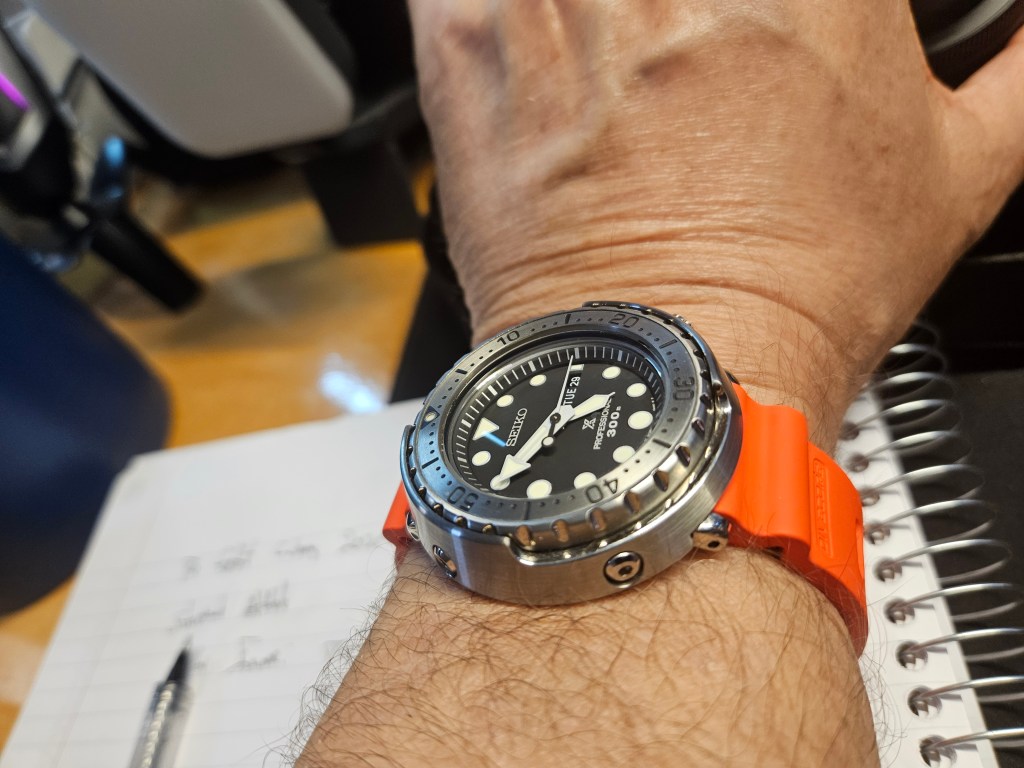
    No Flexecutivewear ensemble is complete without the obligatory diver watch on an orange strap—a bold timepiece that screams “I could be 200 meters underwater right now, but I’m actually just waiting for my cold brew.” The orange strap is crucial: it’s the high-visibility beacon of masculine daring, suggesting a rugged, adventurous spirit who might rappel down a cliff between Zoom calls. Never mind that the watch has never tasted saltwater and its nearest brush with danger was a CrossFit box opening. In the Flexecutive ecosystem, the diver watch is less tool and more talisman—a waterproof monument to imagined peril and aspirational virility.

  • The Shop Foreman of My Own Dysfunction and Other Life Chapters

    The Shop Foreman of My Own Dysfunction and Other Life Chapters

    At 63, I now divide my life into chapters—not by achievements or milestones, but by bone density, hormone decay, and the gradual hardening of the frontal cortex. Think of it as an anatomical calendar, where each page curls with protein shakes, pretension, and the occasional existential crisis.

    Chapter One: The Barbara Eden Years.
    Childhood wasn’t about innocence—it was about Cap’n Crunch. Bowls of it. Oceans of sweetened corn rubble. I dreamed not of firetrucks or baseball cards but of living inside Barbara Eden’s genie bottle—a plush, velvet-lined fever dream of satin pillows and cleavage. If Barbara Eden wasn’t beaming into my imagination, there was always Raquel Welch in fur bikinis or Barbara Hershey smoldering her way across a screen. This was hormonal awakening served with a side of sugar coma.

    Chapter Two: The Strength Delusion.
    By twelve, I was slamming Bob Hoffman’s bulk-up protein like it was communion wine. At Earl Warren Junior High, I became a Junior Olympic Weightlifter—a gladiator-in-training who wanted pecs like dinner plates and the gravitas of a Marvel origin story. This was the age of iron worship and adolescent mythology: I wasn’t building muscle—I was forging armor.

    Chapter Three: The Intellectual Flex.
    In my late teens, I realized I had all the social charm of a wet gym sock. So I went cerebral. I buried myself in Kafka, Nabokov, and classical piano, amassing a CD library of Beethoven and Chopin that could rival the Library of Congress. I worked in a wine shop where I learned to pronounce “Bordeaux” with a nasal twang and described Chablis as “crisp with notes of existential regret.” I didn’t just want to be smart—I wanted to be the human embodiment of a New Yorker cartoon.

    Chapter Four: The Shop Foreman of My Own Dysfunction.
    Marriage and employment hit like a cold bucket of reality. Suddenly, I had to function around other human beings. My inner demons—once delightfully antisocial—were now liabilities. I had to manage them like a foreman supervising a warehouse of unruly toddlers armed with crowbars. Turns out, no one wants to be married to a psychological landfill. I had to self-regulate. I had to evolve. This wasn’t personal growth; it was preventative maintenance, or what other people simply call adulthood.

    Chapter Five: Diver Cosplay.
    In my forties, I had just enough disposable income and suburban ennui to start collecting dive watches. Not just one or two. A flotilla. I wanted to be the hero of my own fantasy—a rugged diver-explorer-adventurer who braved Costco parking lots with a Seiko strapped to his wrist. This was less about telling time and more about clinging to the idea that I was still dangerous, or at least interesting. Spoiler: I was neither.

    Chapter Six: The Age of Denial and Delusion.
    These days, the watches still gleam, but now I’m staring down the barrel of cholesterol, visceral fat, and the slow betrayal of my joints. I swing kettlebells five days a week like a garage-dwelling warlock trying to ward off decay. I track my protein like a Wall Street analyst and greet each new biomarker like a hostile corporate audit. Am I aging gracefully? Hardly. I’m white-knuckling my way through geriatric resistance and calling it “wellness.” If I’m Adonis, then somewhere in the attic there’s a Dorian Gray portrait of my pancreas in open revolt.

    I know what’s coming: Chapter Seven. The reckoning. The spiritual compost heap where I either make peace with my body’s betrayal or turn into a bitter relic that grunts through foam-rolling sessions like it’s trench warfare. It’ll be the chapter where I either ascend or unravel—or both.

    And while our chapters differ in flavor, I suspect we’re all reading from the same book. Different fonts, same plot twist: we start with fantasies, build identities, fight the entropy, and eventually, we all kneel before the mirror and ask, “Was that it?

  • From Sunbathing to Suffering: Surviving Roland Beavers

    From Sunbathing to Suffering: Surviving Roland Beavers

    A poolside pestilence was Roland Beavers. He was the type of poolside companion that nightmares are made of. Imagine, if you will, a pudgy man in his early thirties with dishwasher-blond hair clinging lifelessly to a scalp that seemed perpetually annoyed at its presence. His physique was more doughy than daring, his chin seemingly having taken an early retirement. And yet, this fine specimen insisted on strutting around the pool in a pair of lava-red terry cloth trunks so undersized that they clung to his hips for dear life, revealing a set of stretchmarks that looked like they’d been painted on by a vengeful graffiti artist. Roland, of course, had an explanation ready for anyone who dared make eye contact long enough to hear it. Those stretch marks? Oh, they weren’t the result of his love affair with powdered donuts. They were the battle scars from his days as a world-class daredevil, hurling himself off the cliffs of Acapulco. You could practically hear the collective eye-roll from the pool regulars every time he regaled them with his tales of high-flying heroics. But Roland’s true calling wasn’t acrobatics; it was unsolicited public broadcasting. Armed with a crumpled newspaper, he’d park himself by the pool and provide live commentary on every “news bit” that caught his eye, apparently under the delusion that everyone within a 20-foot radius was breathlessly awaiting his next headline. His audience, meanwhile, mumbled curses under their breath, desperately wishing he’d take up a hobby that didn’t involve public speaking. Maybe knitting—somewhere indoors. Roland’s social cluelessness reached its peak when playful couples would toss a football or frisbee in the water. For Roland, this wasn’t a game he could just watch; it was an invitation. He’d leap into the pool with all the grace of a boulder, wading into their game like an uninvited ghost at a family reunion. The couples, now robbed of their carefree fun, would give him the kind of look reserved for people who talk during movies before stomping off in search of a Roland-free zone. 

    And heaven help the women trying to sunbathe in peace. Roland, ever the gentleman, took it upon himself to offer his “services” to any woman within spraying distance. Whether it was spritzing their backs with a pump bottle of water or offering to rub sunscreen on their shoulders, Roland never missed an opportunity to “help,” oblivious to the fact that his mere presence was enough to ruin their entire tanning experience.

    Of course, these endless days at the pool weren’t just for Roland’s entertainment; they were an extension of his bizarre domestic life. His mother, Nadine, a woman who looked like she could bench-press a Buick, frequently leaned over the balcony of their apartment—muu-muu billowing in the desert wind—barking orders at Roland to “slather on more sunscreen.” With her hair twisted into tight curls that looked like they might pop loose at any moment and neck veins throbbing like they were signaling an SOS, Nadine’s concern for her son was a constant, vocal presence. “Get inside and eat something, Roland! You’re wasting away!” she’d holler, seemingly unaware that Roland had about 40 extra pounds he could “waste away” without anyone noticing.

    You’d think with all this doting and nagging, Roland might be motivated to get a job, maybe contribute something to society—anything to give the rest of us a break. But alas, Roland and Nadine were comfortably cushioned by the settlement from a lawsuit stemming from Roland’s failed attempt at flight school in San Diego. Apparently, the other students in the dorm took one look at Roland’s face and decided it needed to be rearranged, leaving him with a fractured skull and a big fat check to sit around and bother the rest of us for the rest of his natural life.

    And so there he was—our unwanted poolside companion—who, thanks to his mother’s coddling and that lawsuit cash, was free to spend his days lounging in his ridiculous red trunks, delivering headlines no one asked for, and making our lives just a little more unbearable, one stretch mark at a time.

  • Bachelor of Denial: The Speedo Messiah of Bakersfield

    Bachelor of Denial: The Speedo Messiah of Bakersfield

    Chief among my apartment acquaintances was Leonard Skeazy, an attorney from Santa Monica who was lured to the Bakersfield desert by a fat signing bonus and a monogrammed office, yet couldn’t shake the resentment of having been exiled to this cultural wasteland. He was the sort of guy who treated “style” like a religion. He sported custom-made Speedos that were purchased at a specialty boutique in Santa Monica—yes, he would actually drive back to the city to replace them whenever the chlorinated pool water faded the jewel tones of his spandex. His long, curly hair and eerie blue eyes made him look like a lounge singer who never quite made it out of the Holiday Inn circuit.

    Leonard was a man of eccentric habits and questionable hygiene. Despite being well into his 30s, he clung to the bachelor dream of finding “the right girl,” although his standards seemed laughably out of place in a town where having a high school diploma was considered highbrow. This was a guy who’d lounge poolside for hours, skin glistening like a buttered croissant, all while blasting Kenny G from his boombox as if smooth jazz were somehow his secret weapon. His breath, tinged with the distinct aroma of last night’s Chardonnay, matched his penchant for sneaking sips from boxes of white wine he kept stashed in his fridge.

    Curiosity (and a lack of better options) led me to visit Leonard at his apartment one day. It was a bachelor pad in the most tragic sense. Despite the fact that he was swimming in cash, his apartment was as bare as a prison cell. The living room housed only a lone couch, a TV balanced on cinder blocks, and—wait for it—an ironing board. Apparently, ironing his endless supply of gaudy silk ties was the only domestic task he took seriously. The walls were completely devoid of art or decor, just barren expanses of beige that made the flickering TV light cast ghostly shadows over the snake-like drape of his ties.

    His bedroom was even more pitiful: no dresser, no closet system—just three open suitcases serving as makeshift storage. It was as if he refused to fully unpack, a subconscious protest against ever settling into this armpit of a town. The fridge, naturally, was a barren tundra except for—what else—more boxes of white wine. Here was a man who had chased the scent of money into the middle of nowhere, only to refuse to acknowledge he’d actually arrived. Leonard was a ghost of himself, haunting his own life, clinging to the notion that he was just “visiting” until he could escape back to the big city. 

    What kind of man, I wondered, gets seduced by a fat paycheck only to spend his days living in a self-imposed purgatory, where the only things thriving are his excuses and his growing collection of faded Speedos? I suppose it was easier for Leonard to pretend he was just passing through than to face the fact that he’d become a permanent fixture in this desolate corner of nowhere, a relic clinging to the fading glamour of a life he never truly had.

  • The Postcard Life: Why Perfection Always Rings Hollow

    The Postcard Life: Why Perfection Always Rings Hollow

    I can’t shake an interview I heard thirty years ago—an offhand confession that stuck to me like burrs on a wool coat.
    Terry Gilliam, the Monty Python animator turned fever-dream film director, was talking with Charlie Rose. Gilliam described a moment straight from a high school dream: he was walking the Santa Monica Pier on a twilight evening, a beautiful woman on his arm, the beach shimmering under a dying sun. It was the kind of moment that screams You’ve Made It! if you’ve ever been a teenage boy with a tragic imagination.

    And yet, Gilliam said, he felt nothing. Not euphoria. Not awe. Just… flatness. Like he wasn’t even in his own life but rather trapped inside one of his own cartoons—a two-dimensional fantasy drawn by someone who had seen too many movies and lived too little.
    That was his grim epiphany: we don’t chase life—we chase the idea of it.

    Gilliam’s teenage dream had come true, but it rang hollow because it wasn’t connection he had caught. It was a postcard of connection, a lifeless image polished smooth by years of expectation.

    I’ve thought about that moment a lot, especially in the slow burns of my own life, in all the arenas where the blueprint of perfection crashed hard against the walls of reality.
    Take teaching: I’ve taught college writing for forty years. More times than I care to admit, I walked into class with what I believed was a masterstroke of a lesson plan—polished, structured, airtight. And then I delivered it like a robot with tenure. The students, bless them, tried not to visibly expire.
    Only when I threw away the script and talked to them like a breathing, flawed human being did I finally see heads lift and eyes focus.

    It’s the same poison at work: that blueprint, that false idol of how it’s supposed to be.
    Therapist Phil Stutz calls it the Magical Moment Frozen in Time—a mental snapshot of ideal beauty, love, success, whatever, that we spend our lives trying to recreate. And like the cruelest mirage, it recedes the closer we get.
    Because it’s not life.
    It’s a knockoff. A counterfeit so slick, it fools even the person living it.

    It’s sobering, humiliating even, to realize how often my life has been a performance for an audience that doesn’t exist—measuring real experiences against some fantasy standard cooked up in the caves of my mind.
    Maybe Plato had it right all along: we’re prisoners staring at shadows, mistaking flickers on the wall for the blazing, complicated, imperfect mess that is actual life.
    And every time we chase the shadow instead of the fire, we walk the Santa Monica Pier at sunset, hand in hand with a beautiful illusion, and feel… nothing.