Tag: fiction

  • The Travails of Horological Identity Drift

    The Travails of Horological Identity Drift

    To have a hobby is to cultivate an identity. The longer you grow in the hobby, the more you learn about yourself, your likes, dislikes, and inclinations. If you’re a watch collector, as I am, you gravitate to certain types of watches and retreat from others. You cannot explain your inclinations. When fellow watch collectors notice you share a proclivity for a type of watch, there is both a bond and a fellowship. When the fellow watch collectors notice your tastes clash with theirs, disappointment and even hurt feelings can ensue. Within the larger watch hobby, there are subcategories, where collectors branch off and form tight alliances, tribes, and deeply-forged bonds. A sense of loyalty ensues. We call this Taste Tribalism: the formation of tight-knit subgroups within a hobby, bound not by logic but by shared aesthetic instincts. These tribes generate loyalty, belonging, and, when challenged, a surprising capacity for disappointment.

    Woe, however, to the watch collector who, for reasons he can’t explain, departs from what was once his favorite watch type and ventures into fresh waters. Such a transition can bring disorientation and confusion. To abandon one watch category and embrace another creates what is called Horological Identity Drift: the slow, almost imperceptible shift in a collector’s taste in which objects once central to identity begin to feel like artifacts from a previous self. The watches haven’t changed; the wearer has. What once signaled meaning now feels like a costume left over from a role no longer being played.

    While this new adventure from “watch drift” gives fresh blood to his hobby, it leaves his fellow collectors feeling betrayed and abandoned. What offends them is their sense of Aesthetic Apostasy: the moment a collector abandons a once-defining preference—crossing from one horological faith to another—provoking confusion, quiet resentment, and the sense that something sacred has been violated.

    In my case, the “drift” occurred two months ago when I started wearing G-Shocks at the exclusion of my Seiko divers. I did all I could do to return to my mechanicals, including the act of putting steel bracelets on them, in the hope that giving them a luxury look would make them more appealing, but this measure failed. The Seiko divers remain in the box, largely unworn. As a result, I am a watch drifter. 

    What does this “drifting” collector do? Retreat to his old watch type and return to his fellow collectors? What folly. He would simply be betraying himself to please others. Such an act would be a violation of a hobby that brought him joy and authenticity. He must therefore let his true tastes govern his watch journey and the desire to please others take a back seat. Otherwise, his hobby will be a superficial affair, a desperate act to belong while his authentic self withers on the vine. 

  • The Perpetual Convalescence of a Stolen Childhood in Ariel Levy’s Memoir “An Abbreviated Life”

    The Perpetual Convalescence of a Stolen Childhood in Ariel Levy’s Memoir “An Abbreviated Life”

    At the age of six, Ariel Leve’s mother said, “When I’m dead, you will be all alone because your father doesn’t want you. You know that, right?” This was a warning her mother gave her to ensure that her daughter would treat her nicely. That same year Ariel was so traumatized from the death of her caretaker that she could not speak for six months. This was the effect of Existential Hostage Conditioning: a form of psychological manipulation in which a parent binds a child’s survival and identity to their own approval, issuing threats of abandonment (“you will be all alone”) to manufacture obedience. The child is not merely disciplined but conscripted into an emotional hostage role, where love is contingent, fear is instructional, and autonomy feels like a life-threatening gamble.

    Writing about the effects her mother had on her in her memoir An Abbreviated Life, Leve chronicles the desperation to free herself from the shadow of her mother. A manipulative narcissist with no boundaries and treating her daughter’s life with reckless disregard, the mother inflicted the urge in daughter to commit her life to seeking escape from the psychological demons her mother implanted inside of her. 

    Being raised by a narcissist with dramatic mood swings was so chaotic and disorienting that Ariel describes childhood as a scary carnival ride, one of those cages that whirls in circles at a super speed, spins mercilessly, and spits you out so that you’re so dizzy you can’t stand on your feet. The world is still spinning. Up is down. Down is up. You don’t know what reality is anymore. Leve is describing the Narcissistic Gravity Field: the invisible but inescapable force exerted by a boundaryless, self-absorbed parent, pulling the child into a distorted orbit where the parent’s needs eclipse reality. In this field, the child’s inner life is bent, stretched, and often erased, replaced by a constant vigilance to anticipate moods, avoid eruptions, and survive the next shift in emotional weather.

    Leve wasn’t just affected mentally but physically. Her brain actually was warped by her mother’s constant abuse, which she compares to the way the constant winds will disfigure a tree trunk. We could call this the Trauma Topiary Effect: the slow, invisible reshaping of a child’s psyche under relentless stress, much like wind warps a tree over decades. What emerges is not natural growth but survival-shaped architecture—twisted, adaptive, and permanently marked by forces it could not resist.

    As she writes about the trajectory of her life, she realizes her entire existence is a convalescence from her mother. Being in a prolonged convalescence makes it hard to live life as an adventure, to be spontaneous, to embrace change, and to invite new challenges. The inclination in her case is to turn inward, reduce variables, and seek predictability. This turning inward makes intimacy, self-discovery, and living life fully nearly impossible. In many ways, Leve’s memoir is one that captures the misery of Perpetual Convalescence Syndrome: A life condition in which a person is never fully “well” but always recovering—structuring their existence around healing rather than living. Risk is avoided, spontaneity feels reckless, and the future is approached not as opportunity but as something to be managed carefully to prevent relapse.

  • The House at the Edge of the Woods

    The House at the Edge of the Woods

    I dreamed last night that I was lost along the California–Oregon border, swallowed by those lush, overconfident woods that seem to grow not just trees but disorientation itself. Out of that green excess, I stumbled onto a large house. It was too warm, too lit, too certain of its place in the world. Inside were people I hadn’t seen in decades: my old high school acquaintances. They had aged on paper–engineers, doctors, the usual résumé parade–but at the dinner table they wore their adolescent selves like a second skin. The same faces, the same postures, as if time had added credentials but declined to age them physically.

    They kept arriving from side rooms, as if the house were a memory with too many doors. Soon there were a dozen of them seated at a long table, the surface crowded with platters, tureens, and bowls exhaling fragrant steam like a benevolent fog. They welcomed me with an ease that felt rehearsed by kindness itself. Dishes appeared, were passed, insisted upon. They asked what had become of me. The question was polite on its face, but they implicitly felt sorry for me. 

    For a while I occupied the heady seat of attention. Then, as naturally as a tide recedes, their focus shifted back to one another–the practical side of their lives: projects, patients, schedules, mortgages. I felt the small withdrawal and, in that petty reflex one hates to recognize, tried to reclaim the floor. I blurted out a macabre fact about how some ordinary food, under the right conditions, could turn lethal. I pitched it as a funny tidbit, but it landed like a dropped utensil. They didn’t rebuke me; they simply continued, the conversation closing over my interruption as water splashes over a stone.

    Ignored but not injured, I watched them. What struck me wasn’t their success; it was their wholesomeness and innocence. No guile, no ambient spite, none of the low-grade cynicism that passes for sophistication. Their intelligence didn’t sour into cleverness; it steadied into clarity. They had chosen this life—steady, decent, bounded—not because they were naive, but because they had measured the alternatives and declined them. That was the unsettling part: their goodness was not accidental. It was willed.

    I felt a quiet melancholy then, a recognition as clean as it was unwelcome. Between us stood an invisible partition—no hostility, just difference. They were the children of light. I was the man who had wandered out of the woods and discovered, too late, that I was still lost.

  • The Rise of Podcast Proxy Consumption

    The Rise of Podcast Proxy Consumption

    A few years ago, best-selling author Sam Harris delivered a blunt verdict on his own profession: writing books no longer makes sense. Not for lack of ability, but for lack of return. He can spend years drafting, revising, and shepherding a manuscript through the publishing machinery, only to reach tens of thousands of readers, many of whom will abandon the book somewhere between page 37 and a vague sense of obligation. Then comes the ritual humiliation of the book tour: airports, polite applause, the same answers to the same questions. The yield is modest; the labor is not.

    Meanwhile, his podcast–assembled in a fraction of the time–pulls in audiences that dwarf his readership. Hundreds of thousands. Sometimes millions. No printing press. No tour. No illusion that anyone needs to finish anything. Just attention, delivered efficiently.

    This wasn’t an isolated complaint. On a recent podcast, Andrew Sullivan and Derek Thompson circled the same conclusion: the book has lost its central function. The old model–write, publish, promote, be read–has been quietly replaced. Today, you don’t tour bookstores; you make podcast appearances. The book itself becomes a kind of ceremonial object, a credential you wave before entering the real arena: conversation.

    In this new arrangement, reading is optional. Talking is essential.

    Helen Lewis echoed the same skepticism in conversation with Katie Herzog. She doubts, with refreshing candor, that many people actually buy her books. What they do instead is spend time with her–listening, nodding along, absorbing the arguments in podcast form. The discussion becomes the experience. The book recedes into the background, a ghost text haunting the conversation that replaced it.

    What these writers are describing is not a decline but a substitution. We have entered an era in which books are no longer endpoints; they are pretexts. The real product is the dialogue orbiting them.

    Call it Podcast Proxy Consumption: a cultural sleight of hand in which audiences outsource the labor of reading to the author’s own commentary, then mistake that secondhand familiarity for mastery. The conversation becomes the consumption, and the book–once the main course–now sits on the table, largely untouched, like an expensive meal photographed but never eaten.

  • Your Electric Tea Kettle Isn’t Broken–Your Circuit Is Maxed Out

    Your Electric Tea Kettle Isn’t Broken–Your Circuit Is Maxed Out

    For three years, my kitchen and I lived in quiet harmony. The outlets behaved. The appliances coexisted. The breaker, that silent arbiter of domestic peace, stayed in its lane.

    Then the electric tea kettle staged a coup.

    It began innocently enough. I’d flip the switch to boil water—an act so mundane it barely registers as effort—and suddenly half the kitchen would go dark. The microwave surrendered. The toaster went mute. The refrigerator went dark. The breaker, like a bouncer tired of excuses, shut everything down with a single decisive click.

    At first, I suspected treachery in the wiring. Then I wondered if the breaker had grown old and irritable. But the evidence pointed, with increasing clarity, to the most polite appliance on the counter: the electric kettle.

    When I removed the kettle from the equation, the kitchen returned to its former civility. No trips. No outages. No drama. The tyrant had been identified.

    Here’s what I learned, and what most people don’t realize:

    An electric kettle is one of the most power-hungry appliances in your kitchen.

    As your electric kettle ages, its heating element becomes less efficient and it draws more amperage than it did originally. 

    I live in an old house that probably has a 15-amp circuit. My house needs an upgrade that includes dedicated 20-amp kitchen lines. 

    Most electric kettles draw around 1500 watts. On a standard 120-volt circuit, that’s roughly 12 to 13 amps—nearly the entire capacity of a typical 15-amp circuit.

    In other words, when you turn on an electric kettle, you’re not adding a polite guest to the party. You’re inviting a heavyweight who immediately eats most of the food and demands the stereo.

    For years, my kitchen tolerated the kettle. Then, seemingly overnight, it didn’t. Nothing dramatic changed. No sparks, no smoke, no cinematic failure.

    What changed was margin.

    Circuits don’t fail like lightbulbs. They drift. A little more load here. A little more resistance there. Maybe the kettle’s heating element aged and became less efficient, drawing slightly more current. Maybe I added a device or two without noticing. Maybe the breaker itself became more sensitive after years of heat cycles.

    Individually, these are minor shifts. Together, they push the system past its limit.

    Before:

    The circuit was operating just under capacity.

    Now:

    The kettle pushed it just over.

    And breakers don’t negotiate. They enforce.

    At this point, a reasonable person might reach for a surge protector. That would be a mistake.

    Surge protectors guard against voltage spikes—lightning, grid fluctuations, the occasional electrical tantrum. They do not increase how much power a circuit can handle.

    Plugging a kettle into a surge protector is like giving a sumo wrestler a nicer chair. It doesn’t make him lighter.

    My solution, for now, is a stovetop kettle.

    It feels like a step backward, but it’s actually a step sideways. The load shifts away from a single electrical circuit and spreads out through the stove. No breaker trips. No negotiations with the grid. Just water, heat, and a whistle that doesn’t require a reset button.

    There’s even a strange side benefit: boiling water now takes a minute of attention. You wait. You listen. The process regains a small measure of dignity.

    This summer when my electrician friend visits from Dallas, I’ll upgrade the kitchen circuits. Modern kitchens are built for modern demands—multiple 20-amp lines, distributed loads, appliances that can coexist without staging a power struggle.

    In other words:

    I’m not fixing the kettle. I’m upgrading the system that failed to contain it.

    If your breaker trips when you use an electric kettle, the problem is probably not mysterious, and it’s probably not dangerous—assuming the breaker is doing its job.

    It’s arithmetic.

    • Electric kettle: ~1500 watts
    • Circuit capacity: limited
    • Other appliances: already drawing power

    Add them together, and something has to give.

    We like to think our homes are stable, predictable systems. But they’re more like negotiations—between demand and capacity, convenience and constraint.

    My kettle didn’t break my kitchen. It revealed it.

  • Purple Toothbrushes and Other Acts of Quiet Genius

    Purple Toothbrushes and Other Acts of Quiet Genius

    I have a student who makes the rest of the room recalibrate. Her essays arrive fully formed—sharp, unshowy, and quietly devastating—and in discussion she does what most people only pretend to do: she thinks out loud with precision. If airtime were currency, she’d hold a majority stake. And the remarkable part is that no one resents it. The other students lean in. They listen. At eighteen, she carries herself with a kind of early-onset professorial clarity, but without the usual symptoms—no grandstanding, no ornamental jargon, no whiff of performance. Just a mind doing its work in public.

    Yesterday she told the class she’s neurodivergent. It landed without ceremony. No one froze, no one fumbled for a response. She simply kept going, threading her way back into our discussion of cruelty as entertainment in The Biggest Loser, dissecting it with the same steady intelligence she brings to everything. The label didn’t explain her; it just named the angle of her vision.

    Later that day, I watched Sheng Wang: Purple on Netflix and had a familiar thought within five minutes: here is another mind that refuses to see the world the way the rest of us have agreed to see it. Sheng Wang doesn’t manufacture jokes so much as he exposes the wiring. He takes the banal—the humble toothbrush aisle—and turns it into a referendum on identity. Faced with a rainbow of options, he chooses purple, not because it cleans better, but because it confers a temporary aura of purpose, as if pigment could rescue a life drifting toward mediocrity. It’s ridiculous, which is why it’s true.

    Wang, born in Taiwan and raised in Houston, delivers all this with a soft Southern cadence that suggests a Baptist sermon delivered by a man who wandered in from a parallel universe. He glides across the stage in flowing purple clothes and white sneakers, looking like a kindly prophet of low-stakes revelation. The dissonance works. His demeanor—gentle, unhurried, almost disarmingly sincere—feels less like an act and more like a refusal to harden into one. You don’t watch him perform; you eavesdrop on how he thinks.

    That’s the throughline between my student and Wang. The best comedians aren’t joke machines; they’re cartographers of attention. They map the ordinary at strange angles and invite you to follow. Sometimes they surface thoughts you didn’t know you had—your private negotiations with a toothbrush color, your quiet horror as a friend’s child demolishes a bowl of expensive berries with the appetite of a small animal. Sometimes the thoughts are entirely their own, but the vantage point is so exact you recognize yourself anyway.

    A good comedian, like a good student, doesn’t just entertain or impress. He builds a small porch between minds. You sit there for a while, listening, and realize you’re not being dazzled—you’re being let in. That’s rarer, and far more valuable, than a punchline.

  • Why My G-Shock Saga Refuses to Become a YouTube Video

    Why My G-Shock Saga Refuses to Become a YouTube Video

    What follows is the essay that will serve as the basis for my YouTube video explaining why no such video can, in fact, be made from it.

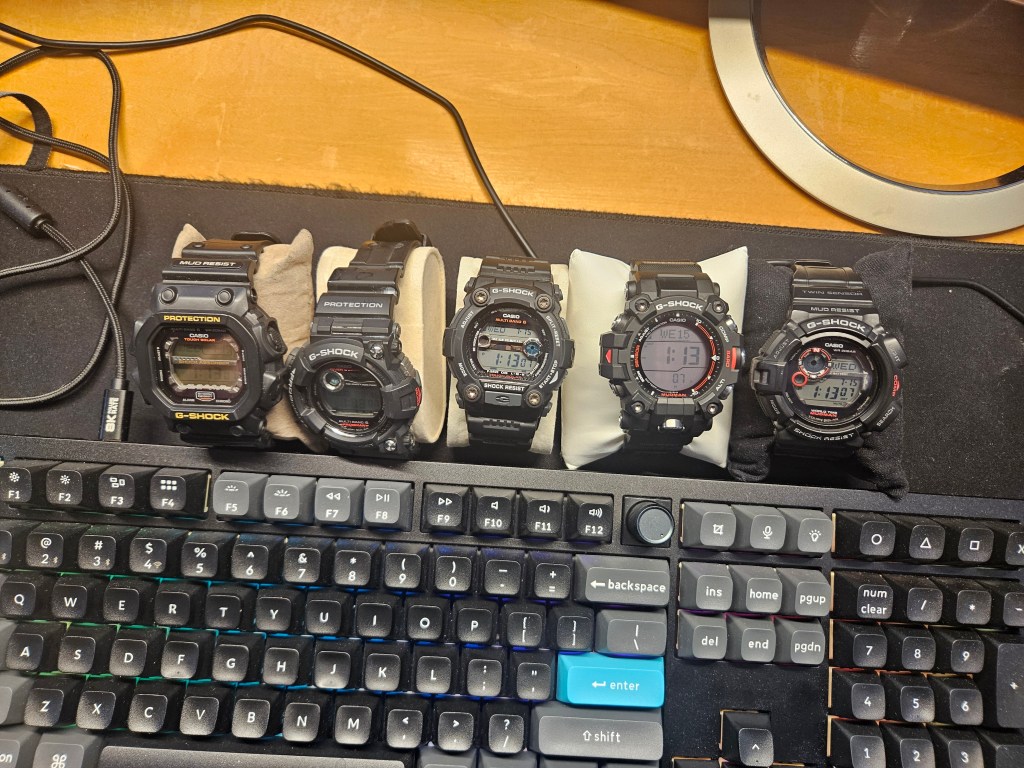
    Six weeks ago, I received my G-Shock Frogman and promptly lost my mind. Not gradually. Not with dignified hesitation. I went down hard. The more I studied its lopsided, industrial architecture, the more I found myself staring at it the way one stares at brutalist buildings—confused at first, then strangely moved. Black resin, thick as a tire wall, sat on my wrist with the quiet confidence of a machine that does not care if you approve of it. No one told me industrial black resin could look so beautiful. 

    This startled me. I had long filed resin under “gym timer” and “Office Space despair”—the sort of material worn by men who have stopped expecting things from life. What kind of man sidelines a stable of expensive mechanical divers—curated, polished, lovingly rationalized—for a slab of molded polymer that costs a fraction of the least expensive piece in the box? The answer, apparently, is me. Something shifted. I can’t explain it. It may take years, or therapy, or both.

    Naturally, I doubled down.

    Intoxicated by the Frogman, I added the GW-7900 Rescue, a watch that costs about one-fifth as much and delivers five times the daily utility. It is padded, legible, and indifferent to my previous standards. Its numerals are large enough to read without squinting, which, at this stage of life, qualifies as a luxury feature. It became my daily wearer within a week, displacing watches that once required white gloves and a sense of occasion.

    Still unsatisfied, I escalated. The Mudman GW-9500 arrived next, with numerals that resemble municipal signage. If the Rescue was readable, the Mudman is unavoidable. Together, the three form what I have come to call—without irony—the Hero Triad.

    All three are Multiband-6 with Tough Solar, which means they spend their nights quietly consulting the atomic clock in Fort Collins and correcting themselves with a level of discipline I have never achieved in any area of my life. The Frogman and Mudman prefer to be placed carefully—on a desk, or hanging from my T-bar like well-behaved instruments. The Rescue, by contrast, syncs wherever it pleases. It has the personality of a straight-A student who does not need supervision.

    These three watches now consume over ninety percent of my wrist time. My mechanical divers sit in their box like retired generals, decorated but irrelevant. When I told my wife this, she paused and asked, “Wrist time? Who uses that term?”

    I do. We do. We count wrist time the way bodybuilders count macros—with vigilance, denial, and occasional self-deception. And lately, my wrist time has been taken over by G-Shock.

    I’ve written about this infatuation on my blog, but my YouTube audience has made something clear: words are no longer enough. We live in an age where ideas must be performed, not merely stated. If I want to be understood, I must produce a video.

    And yet, I cannot make this video.

    First, the landscape is saturated. There are already hundreds of G-Shock videos—reviews, tutorials, warnings about imminent discontinuations delivered with the urgency of a public safety alert. To add my voice would be to echo the chorus, and I have no desire to hear myself harmonizing with better singers.

    Second, I refuse to become an evangelist. I am not here to declare a holy war against Seiko, Tudor, or Omega. This is not a zero-sum game. I have not betrayed mechanical watches with a Judas Iscariot kiss and fled into the desert with a resin accomplice. I still believe in their beauty. I simply no longer rely on them for giving me accurate time. That distinction is subtle, and subtlety does not perform well on YouTube.

    Third, I lack a coherent explanation for my conversion. I cannot tell you whether this shift is driven by age, by proximity to retirement, or by a growing intolerance for approximation in a world already saturated with it. Perhaps I simply escaped Seikotraz—the self-imposed prison of mechanical devotion—and ran toward the first open door. Whatever the cause, I am not yet qualified to narrate it.

    Fourth, my story is not unique. Millions discovered G-Shock long before I arrived, breathless and late, to report that it works. To stand before an audience and announce this would reduce me to a background character—another man discovering electricity and insisting on a press conference.

    Fifth—and most damning—this narrative reads like a watch downgrade. The story people want is ascent: the climb, the conquest, the triumphant pose at the summit. I have done the opposite. I have descended, calmly, into black resin. I have traded filet mignon for a protein bar and now stand before you insisting it is not only sufficient, but superior. This is not a heroic arc. It is a dietary confession. And possibly a sign of a pathology. 

    So no, I cannot make this video. 

    My escape from Seikotraz may or may not be complete. What I can promise is this: when the next chapter reveals itself—and it will—I’ll report back, possibly with less confusion, but no guarantees. Aren’t you glad I didn’t make this video? 

  • Santa by Accident, Employee by Design

    Santa by Accident, Employee by Design

    Last night I dreamed that some friends and I staged an ad hoc production so slick it deserved syndication. I was invited to a holiday party—one of those corporate affairs where irony does the heavy lifting—and, on a whim, I put on the Santa suit for a toy company that merchandised its own cartoon characters. It was meant to be a joke–something to be forgotten along with the eggnog.

    Instead, someone filmed it.

    The footage went viral. What began as a throwaway bit turned into an annual television event with ratings that could humble prime time. Every December, there I was—jovial, booming, absurd—beamed into living rooms as if I had been engineered for it. Checks arrived with the regularity of a season: generous, unearned, almost accusatory. 

    To capitalize on the accident, the company staged yearly reunions—cast gatherings dressed up as nostalgia, broadcast to a nation that now insisted we mattered. More ratings. More money. More of me, whether I intended it or not.

    At first, I drifted into these reunions like a tourist in my own life—late, amused, faintly embarrassed. Then the terms clarified. I wasn’t a guest. I was talent. I wasn’t attending; I was reporting for duty. Somewhere in the fine print of success, I had become an employee of an entity I never remembered joining. The arrangement produced a tidy moral shrug: the checks fed my family, so what right did I have to object? Freedom had quietly converted itself into obligation, and the conversion rate was excellent.

    There was, however, a fracture line running through the whole enterprise. By sheer accident, I had chosen Santa—the apex role, the gravitational center. My friends had chosen elves: diligent, decorative, forgettable. Hierarchy, once introduced, does its work without permission. One friend stopped speaking to me altogether. When he finally did, it was not to reconcile but to issue a verdict. I was too thick to see what had happened to him, he said. Years of playing the lesser figure had hollowed him out. The easy talker was gone; in his place stood a sullen, rationed version of a man. We were no longer friends. I was no longer welcome to pretend otherwise.

    Others were kinder, even grateful. They insisted my Santa had ignited the whole spectacle—that without it, there would have been no show, no checks, no ritual of reunion. They thanked me as if I had designed the machine rather than stumbled into its engine.

    But gratitude doesn’t cancel damage; it merely coexists with it. The money was real. The applause was real. So was the loss. Watching a friend calcify into bitterness has a way of stripping glamour down to its wiring. Fame, even the accidental kind, doesn’t just elevate. It arranges people. It assigns altitude. And someone, inevitably, is left breathing thinner air.

  • The Price of Your Work Exit

    The Price of Your Work Exit

    Retirement was supposed to feel like a gentle descent. Instead, it arrives with an invoice. For years, your college played the role of benevolent patron: five hundred dollars a month to insure a family of four at Kaiser Permanente, with a co-pay so small it felt almost ceremonial. Now the curtain lifts. Your wife’s middle school, thrifty to the point of cruelty, hands you the real number—nearly triple. At the same time, your paycheck shrinks to about eighty-five percent of its former self. The vise tightens from both ends: less coming in, far more going out. Retirement, it turns out, is not an exit but a recalibration of anxiety.

    On a Saturday morning, under the fluorescent calm of Trader Joe’s, you confess this arithmetic of dread to the cashier who has watched you age in weekly installments for two decades. He listens, nods, and then offers a solution with the confidence of a man suggesting a new brand of hummus: get a part-time job here. Be a cashier. Let the paycheck subsidize your health insurance. You have the build, the stamina, the conversational ease. In his telling, the transition is almost heroic—a late-life pivot, sleeves rolled, dignity intact.

    But you can already see the other version. You, sixty-five, standing in a Hawaiian shirt that once signaled leisure and now reads as camouflage, being told in a quarterly review that your tone lacks “warmth.” That you cleared the line too efficiently, failed to linger, failed to affirm. That your sarcasm—once a badge of intellect—needs to be diluted into something safer, sweeter, more compliant. You imagine the language of correction: more honey, less acid. You imagine nodding while someone half your age explains emotional calibration. The phrase writes itself in your head: a Late-Life Vocational Humility Crisis—the moment when accumulated status collides with the small, bright humiliations of starting over at the bottom, where friendliness is a metric and personality is a deliverable.

    You float the idea at home. Your wife laughs—not cruelly, but decisively. The verdict is clear: you are not built for this theater. The fantasy collapses on contact with reality. It was never a plan, only a flattering daydream in which you played the rugged provider, stacking pinto beans beside water-packed albacore, funding your family’s security with cheerful competence.

    So you stand in front of the mirror and deliver the final ruling: Trader Joe’s is a no-go. The new discipline will be quieter, less cinematic. No convertibles. No Swiss watch indulgences. No Cabo timeshare fantasies dressed up as investments. Just a narrower life, lived within its means, spared the indignity of proving—too late—that you can still take orders and smile about it.

  • The Man Who Refused to Retire and Learned to Fly at Costco

    The Man Who Refused to Retire and Learned to Fly at Costco

    You will be sixty-five in less than a year—fifteen months from your last day of work—and you would be wise to bury the word “retirement” before it buries you. It is a feeble, anemic term, a linguistic sedative that disguises the collapse of identity as leisure. Nothing about what lies ahead deserves that kind of small thinking.

    What you are approaching requires a name with altitude, velocity, and a touch of myth.

    You are entering the Sovereign Phase.

    In the Sovereign Phase, you do not keep a schedule—you issue one. You do not await approval—you render decisions. This is not an ending ceremonially dressed in khakis and early dinners; it is a coronation. You are not stepping away. You are stepping above.

    Your final act has begun, and it demands a certain boldness. The first order of business is symbolic but essential: you will upgrade your Costco membership to Executive. No committees. No approvals. No memos. You will simply decide—and it will be done.

    And then, one morning, before the doors officially open to the masses, you will enter.

    The aisles are empty. The pallets stand fresh and untouched. The air itself feels newly issued. You move through this cathedral of abundance with first access, first choice, first claim. Something happens to you here—something disproportionate to the act itself. A quiet but unmistakable inflation of the self. A sense that you have not merely arrived early, but ascended.

    You feel it in your chest first, then in your stride. The strange conviction that you are no longer bound by ordinary constraints. That you have, somehow, earned this.

    You have entered Executive Aisle Rapture.

    It is a near-mystical condition in which logistical privilege is mistaken for existential elevation, where empty aisles and shrink-wrapped towers of goods produce a sensation that borders on the divine. You begin to suspect that wings—actual wings—may be forming beneath your shirt, preparing you for a short, ill-advised flight toward the sun.

    This is not a side effect of the Sovereign Phase. It is a requirement.

    So when your last day of work arrives, do not mark it with melancholy or relief. Mark it with a transaction. Upgrade the membership. Secure your access. Step into the early light of the warehouse.

    And when the doors part and the aisles open before you, walk forward without hesitation.

    You are no longer a worker.

    You are sovereign.