Tag: fiction

  • Escape from Seikotraz: Starring Jeff McMahon

    Escape from Seikotraz: Starring Jeff McMahon

    This morning I woke up with a small, undeserved victory. My second shingles shot had not flattened me into a feverish heap of aches and regret. No vaccine hangover. No sack-of-muscle soreness. Just a functioning body and a clear head. I glanced down at my Casio G-Shock GW-7900 before swinging my legs out of bed, and as I reached for the coffee ritual, a thought crept in—quiet at first, then strangely intoxicating:

    What if I owned only G-Shocks?

    What if I were free of my Seiko divers?

    Free from what, exactly? That part remains stubbornly undefined.

    Three years ago, the fracture began. I developed an aversion to bracelets—not a mild preference, but a full-blown irritation, as if every metal link were conspiring against my wrist. I moved my Seiko divers onto straps, experimenting like a man searching for ergonomic salvation, until I discovered Divecore FKM. Suddenly, everything clicked. The watches felt right—balanced, secure, almost inevitable. For a brief moment, I thought I had solved the problem.

    Then came the contamination.

    August 2025. A message. A study. PFAS—“forever chemicals”—lurking in FKM. The phrase alone sounded like a villain in a low-budget sci-fi film. Dutifully, almost piously, I removed the straps. The watches went back onto inferior substitutes, and with that small act, something essential drained out of them. They were no longer “just right.” They were tolerable.

    Divecore, to their credit, pivoted—hydrogenated rubber, safer materials, a new Waffle strap on the way. I’m waiting for it now, like a man waiting for a repaired marriage.

    But in that interim, I did something careless. Or revealing.

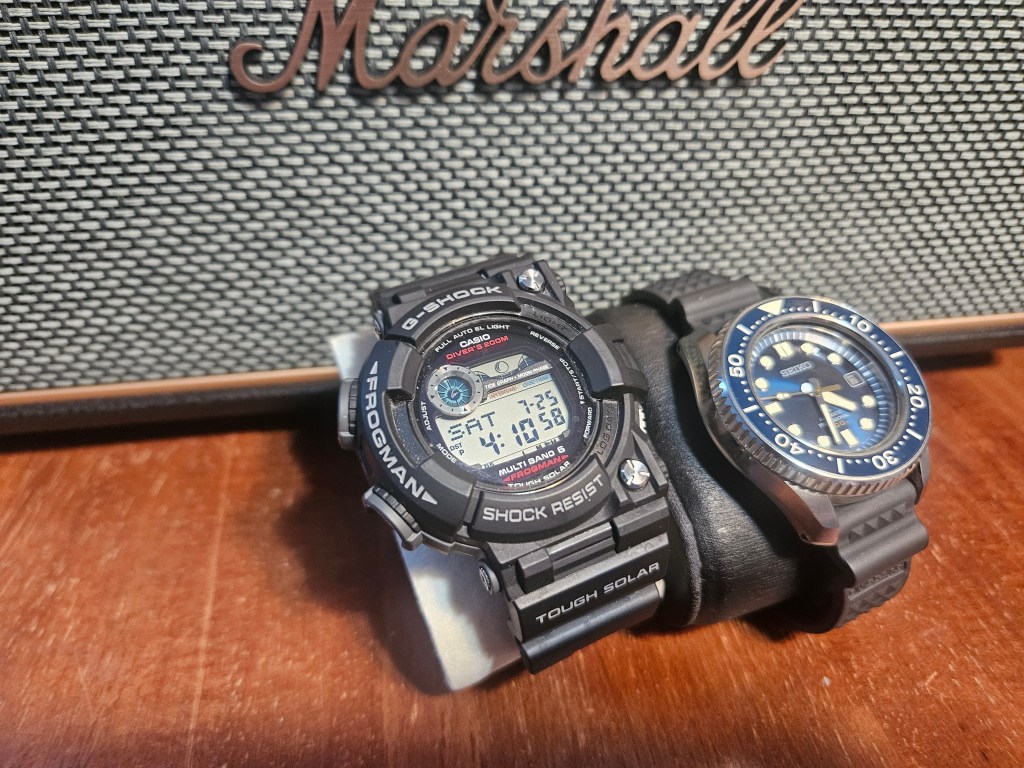
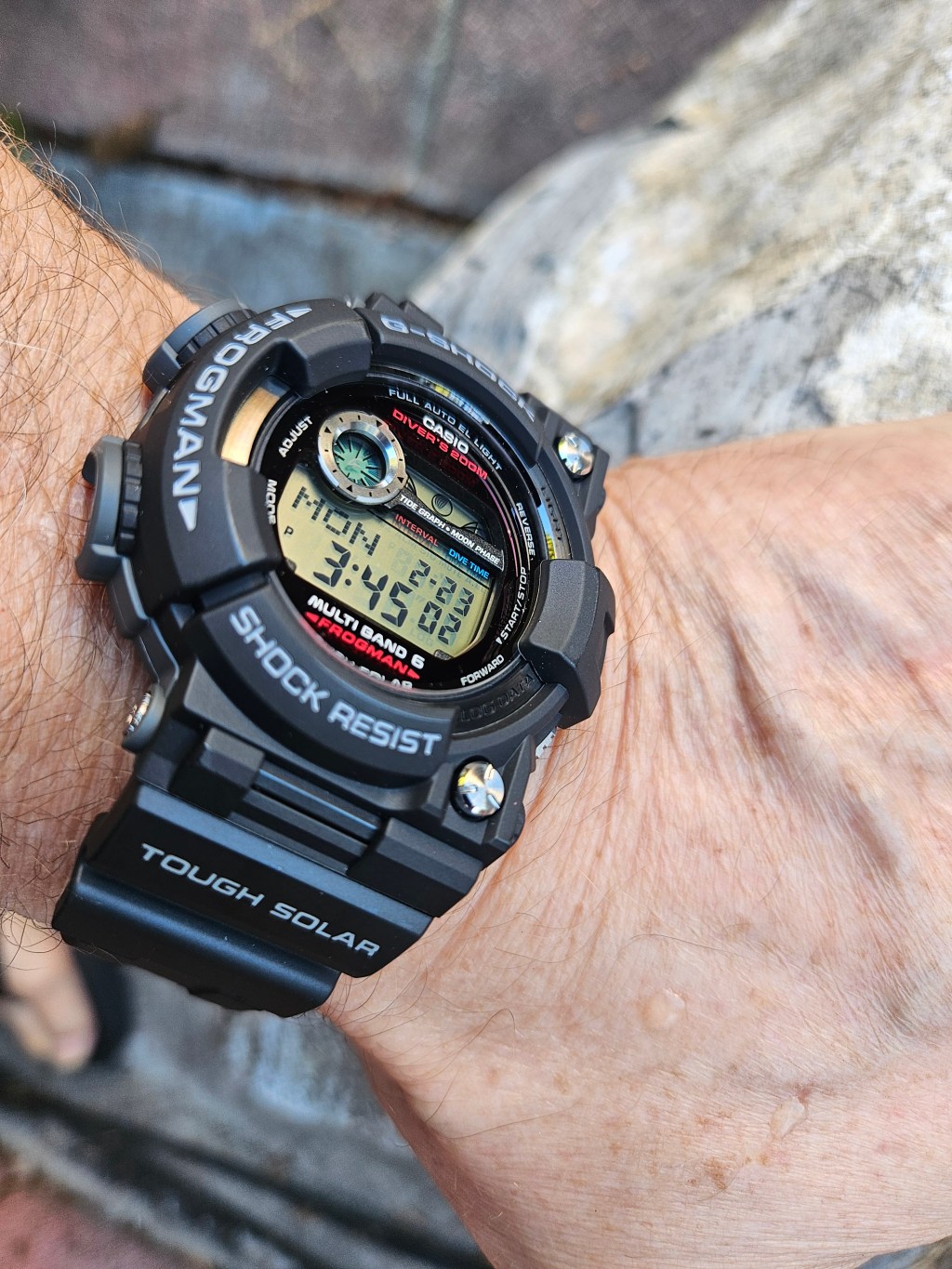
    On a lark, I bought a Casio G-Shock Frogman GWF-1000.

    And I didn’t just like it. I fell for it immediately.

    Its design wasn’t elegant—it was aggressively industrial, almost defiant. Its timekeeping wasn’t approximate—it was absolute. Atomic. Unquestionable. It didn’t ask for attention; it delivered certainty. One watch became three. The Rescue. The incoming Casio G-Shock GW-9500 Mudman. A quiet shift became a migration.

    This morning, still basking in my vaccine survival, I entertained a more radical thought: eliminate the Seikos entirely. Replace them with two final pieces—the sapphire Frogman D1000 and the GW-5000U Square, my so-called “dress watch,” a term that feels almost satirical in this context.

    At what point does a preference become a slide?

    Was it the PFAS scare that loosened the foundation? Or something deeper? Do the Seiko divers now carry the residue of an older obsession—one tied to acquisition, to the promise that the next watch would finally complete the picture? And if so, what exactly is this new G-Shock phase? Liberation? Or simply addiction in a more utilitarian costume?

    There are a few things I can say with certainty. I prefer atomic time to mechanical approximation. I prefer digital clarity to analog interpretation. Yes, the digital display demands a slight tilt of the wrist, a negotiation with the light, but I’ve made peace with that. It’s a small concession in exchange for precision.

    Maybe there is no grand psychological drama here. Maybe I’ve grown lazy in the most practical sense. I like convenience. I like certainty. I like not having to set the time like a monk tending to a ceremonial clock. Perhaps this is not a crisis of identity but a simple shift toward ease.

    But then I hear from others.

    Men who made this transition years ago. Men who, after watching my videos, bought a G-Shock out of curiosity and quietly abandoned their mechanical collections. No fanfare. No farewell. Just a gradual, almost polite disappearance.

    It suggests something larger. A quiet exodus.

    You could make a documentary about it: aging watch obsessives laying down their expensive mechanical relics and walking into the sunset wearing Squares and Mudmans, relieved, unburdened, and slightly confused about how it happened.

    Meanwhile, my own collection sits in a kind of purgatory. The Seiko divers wait, their fate undecided. Two have already been sold—the Captain Willard Ice Diver and the 62MAS—and their absence has not registered as loss. That’s the unsettling part. Watches that once felt essential have vanished without leaving a dent.

    And here I was, thinking of myself as a careful curator, a man assembling a coherent, meaningful collection.

    The truth is less flattering.

    My hobby is governed not by principle, but by impulse. By shifting preferences, passing anxieties, and the occasional well-timed scare about “forever chemicals.” I would prefer to believe in a deeper logic, a narrative of refinement and evolution.

    But honesty requires a different conclusion.

    I am not curating.

    I am drifting.

    I look into the mirror. “Oh my God,” I scream. “I am a capricious watch collector.”

    Meanwhile, my YouTube subscribers are making cogent remarks in the comment section. A gentleman who goes by the name of MDchaz recently wrote: “Coming to a theater near you “Escape from Seikotraz” starring Jeff McMahon.” I wrote back, “I’ll have to steal your idea for my next YouTube video.”

    And this blog post. 

  • Watch Straps, Paradise, and the Return of Mother

    Watch Straps, Paradise, and the Return of Mother

    Last night I found myself standing on a hill in Hawaii, the kind of place real estate agents describe as “transcendent” and charge accordingly. Below me, the ocean moved with rehearsed elegance—waves rolling in like they had been coached for the occasion. A tech billionaire, naturally, had invited my family and me to his New Year’s Eve party. In dreams, invitations arrive without explanation and are accepted without skepticism.

    Inside his mansion was a room devoted entirely to appetizers—a cathedral of small bites. I approached it with the zeal of a man who believes abundance is a moral right. Everything was sampled, nothing spared. Then I came upon a glass bowl filled with what appeared to be black licorice. I took a bite and immediately discovered I had made a categorical error. It wasn’t licorice. It was a bowl of rubber watch straps. I had, with full dental commitment, chewed into one of them like a lab animal testing the limits of its environment.

    The billionaire did not react. He stood in the next room, calmly painting a model holding yoga poses—his attention fixed, his world undisturbed. Either he hadn’t noticed, or he lived in a realm where a man biting into a watch strap barely registers as an event.

    Then my mother appeared.

    She has been gone for six years, but in the dream she returned without ceremony, as if death were a clerical error that had been quietly corrected. I greeted her with genuine joy and surprising composure, as though we had simply missed a few phone calls. She told me she was going for a swim. I said I’d join her later, the way one postpones something assumed to be indefinitely available.

    Time, as it does in dreams, rearranged itself. Someone came running to say she had cut her finger on coral. A doctor—there is always a doctor at these gatherings—offered to come with me, iodine and bandages in hand. But as we descended toward the water, word arrived that she had already been treated and had left for California.

    Meanwhile, I had waded into the ocean. The water was warm, enveloping, almost indulgent in its softness. It reached my chest and held me there, like something that preferred I not leave. Faced with the choice between urgency and comfort, I chose comfort. I stayed in the water. My mother, once again, slipped out of reach.

    What kind of dream arranges such a sequence? A billionaire’s excess, a son’s carelessness, a mother’s brief return and second departure. If I had to impose meaning, I’d say the ocean felt less like scenery and more like origin—a return to something pre-verbal, pre-ambition, pre-everything. Call it the womb, call it nature, call it a memory the body keeps when the mind forgets.

    But I hesitate to turn it into a sermon about mortality. Not every dream in one’s sixties needs to carry a funeral program in its back pocket. Perhaps it was about regeneration. Or the persistent illusion that what we lose might reappear long enough to test how we respond.

    I hope my dream was not some portent of mortality. But whatever the case, I’m glad the tech billionaire didn’t send security after me for leaving bite marks in one of his rubber watch straps. 

  • The Acrobats I Misjudged

    The Acrobats I Misjudged

    Sometime around 2018, I’d make the daily trek from the tennis courts to my office and pass the library lawn—a patch of campus that should have offered a quiet, pastoral glide into the workday. Instead, it hosted a recurring spectacle: half a dozen young men staging what can only be described as a low-budget Cirque du Campus. Shirtless or half-shirted, draped in genie pants or frayed denim cut-offs, they performed for an audience that did not exist. Their language was pure motion—flips that flirted with kung fu, kicks that negotiated with gravity, juggling routines that collapsed into chaos, and the occasional hacky sack circle, that ancient ritual of collegiate aimlessness.

    They were hungry—visibly, almost heroically so—for attention. Unfortunately, they possessed more appetite than assets. The enthusiasm was volcanic; the talent, less so. Their charm came in bursts, like a faulty engine. I found them unbearable. My morning walk, once a minor pastoral pleasure, was now hijacked by these blustering soltimbancos—performers without a stage, noise without necessity. I dismissed them with the easy confidence of a man certain he had outgrown foolishness.

    Today, I walked past that same lawn. Empty. Sunlit. Silent. The performance had ended without ceremony, as all such performances do. And I caught myself wondering—not with irritation, but with a strange, reluctant tenderness—what became of those boys.

    Because here is the inconvenient truth: youth is not a time for dignity. It is a sanctioned season of excess—of overreach, bad judgment, inflated self-regard, and public experiments in identity that collapse under their own absurdity. We try on personas the way they tried on those ridiculous pants: boldly, badly, and without permission. We embarrass ourselves in broad daylight and only later, with the benefit of distance, call it “growth.”

    So what changed? Not them. Me.

    Time performs a quiet surgery on the ego. It dulls the impulse to sneer and replaces it with something more complicated—recognition, perhaps, or even a flicker of respect. Those young men were not interrupting my peace; they were spending a currency I no longer possessed: the freedom to look ridiculous without apology.

    And so, to those lawn acrobats—wherever you’ve landed, whatever respectable disguises you now wear—I offer this: I hope life has been kind to you. I hope you found your footing, literal and otherwise.

    But for the sake of civilization, I must insist on one thing.

    Put a shirt on.

  • Unless You’re Certain Your G-Shockification Is Permanent, Keep Your Mechanical Divers

    Unless You’re Certain Your G-Shockification Is Permanent, Keep Your Mechanical Divers

    My mechanical watches sit in their box like retired athletes—well-kept, occasionally exercised, no longer in the game. Every so often I take one out, give it a few dutiful shakes, wind it like a ritual I don’t quite believe in, and return it to its padded cell. The magic has evaporated. In its place: the afterimage of a fever swamp—a mind that mistook obsession for discernment, a man who let proportion slip while calling it passion.

    Did I quit watches? No. I still strap one on every day. I rotate between two Tough Solar, Multiband-6 G-Shocks—the Frogman and the Rescue—and they do the one thing I apparently wanted all along: tell the correct time without drama. Precision, delivered nightly from a radio tower, not coaxed from springs and sentiment.

    The question nags: are these G-Shocks the nicotine patch—same habit, fewer toxins? A maintenance dose that keeps the shakes at bay while I detox from romance? Or have I simply traded one dependency for another, swapping lacquered nostalgia for resin certainty? I can imagine a small, sane G-Shock lineup—four, maybe five—but I recoil at the thought of a sprawling collection that demands wardrobe changes, spreadsheets, and a personality built around rotation schedules.

    I’m not selling the mechanicals. Not yet. A month is not a verdict; it’s a mood with good PR. I’ve undergone what I’m tempted to call a conversion—G-Shockification—but I don’t trust conversions. They arrive like thunder and leave like weather. If this holds, time will tell me so—accurately, for once.

    There’s also the quieter force at work: the sunk-cost instinct dressed up as dignity. When you’ve poured money, hours, and a piece of your identity into something, you don’t walk away—you renegotiate with yourself. You call it loyalty. You call it patience. You call it anything but regret.

    Let’s keep perspective. I own four mechanical divers and one quartz. This isn’t a warehouse liquidation. I’m not torching a museum. I’m a man with a small box and a slightly embarrassed past.

    So the divers stay—for now—on the shelf to my upper left as I type. They used to summon me: strap changes, wrist rotations, the ceremonial wipe-down. Now they sit in a quiet that feels less like neglect and more like clarity. The box hasn’t moved. I have.

  • The Boxes She Carried

    The Boxes She Carried

    This afternoon I dozed off after an hour of cardio, the body spent, the mind drifting, when a memory surfaced from the early nineties with unnerving clarity. I was around thirty then, teaching composition in a university town carved out of the California desert—a place where the light felt harsh and permanent, as if it refused to let anything hide. A loose circle of us—lecturers, adjuncts, hopefuls—would gather for dinners now and then, clinging to one another for a sense of community. Among us was an art professor, a woman in her mid-fifties. She wore her age without apology: short gray hair, angular features, and eyes the color of oxidized copper—blue-green, arresting, a little distant.

    I hadn’t seen her in months, and then one afternoon, in a neighborhood a few miles from my apartment—I was walking to my car after dropping off a date—I saw her again. A couple of houses over, I saw her unloading boxes from her SUV. The image is fixed in my mind with painful precision. Her head was wrapped in a scarf. Her frame had narrowed to something almost architectural, all angles and shadows. She was moving the boxes to her rental house, each trip measured, as if gravity had grown heavier for her alone.

    I remember I had a choice. I could walk to my car and drive away or walk toward the art instructor. I felt she needed me. So I walked over and stopped her—almost abruptly—and insisted I take over. She didn’t resist. There was no polite demurral, no social choreography. She simply yielded, nodded once, and lowered herself onto a nearby bench. Then she sat there, hands folded loosely, staring straight ahead—not at me, not at the house, but somewhere beyond both, as if the horizon held something she alone could see.

    I carried the boxes inside, one after another, trying to fill the silence with small talk that dissolved the moment it left my mouth. She didn’t answer. Not out of rudeness, but because the effort seemed beyond her. The air around her felt thinned out, as if speech itself required too much oxygen.

    Only now, decades later, does the obvious land with force: those boxes were likely the contents of her office. She wasn’t just moving houses. She was being removed—from her work, her routines, the life she had constructed. And she was doing it alone.

    Had I understood that, I would have done more than carry boxes from curb to doorway. I would have met her at the beginning of the task, at the office, at the place where the real loss was happening. I would have recognized the moment for what it was: not an errand, but an ending.

    When the last box was inside, I don’t remember much of what I said. A brief hug, probably. A few inadequate words. Then I left, as people often do when they sense something too large for them to face directly.

    I believe she died not long after. What remains with me is not just her frailty, though that alone was striking, but the expression she wore as she sat on that bench—an expression that seemed to belong not only to her but to all of us. It carried a quiet indictment: of time, of indifference, of the way we move past one another without truly seeing.

    I take a small measure of comfort in the fact that I stopped, that I helped in the only way I knew how in that moment. But that comfort is thin. What lingers is the recognition of how little I understood, how quickly I settled for the minimum, how unprepared I was to meet her where she actually was.

    She sat there, silent, looking past everything in front of her. And that look—plaintive, unguarded, already halfway gone—is something I have never been able to set down.

  • The Cruel Question Every Writer Must Answer

    The Cruel Question Every Writer Must Answer

    When you pitch a book, the publisher asks a question that feels less like business and more like interrogation: Why must this exist? Why this book, now, and not another? What justifies its presence in a world already swollen with print? The question has teeth. It strips away the soft fog of aspiration and leaves you standing with nothing but purpose—or the absence of it.

    A book is not a monument to your desire to “be published.” It is not your name in lights, your moment on the marquee. That impulse—vanity dressed as vocation—is the surest path to creative mediocrity. Purpose is the only defense. Without it, the work collapses under its own self-importance.

    The same cross-examination applies to everything else we produce. A blog post, a video, a channel—why does it exist? To collect attention? To be applauded by a tribe? To monetize a persona? To assemble the vague scaffolding of a “brand”? These are not answers; they are evasions.

    What, then, is my brand? Nothing coherent. I wander. I collect. I react. I move through the culture like a flâneur with a notebook, jotting down whatever strikes the nerves—ideas, trends, obsessions—and trying to distill some fragment of meaning from the debris. This is not a brand. It is a habit of attention. It resists consolidation. It refuses to become a product.

    I did write a book recently—a real one, nearly seventy thousand words. But even that resisted form. It wasn’t a narrative or an argument so much as a catalog of compulsions about watch enthusiasts: short, sharp definitions of obsessive behavior. A lexicon of affliction. Did it need to exist? I can argue that it did. The market delivered a quieter verdict. A few dozen copies moved. Meanwhile, a fifteen-minute video built from the same material drew thousands. The idea survived in video form. The book format did not.

    This is the final insult: even if you can construct an airtight case for a book’s existence, the audience may still decline to care. You can formulate the perfect product—nutrient-rich, elegantly packaged—but if no one consumes it, it sits on the shelf like expensive dog food no dog will eat. And its silence asks the only question that matters, the one you thought you had already answered:

    Why does this exist?

  • Life Inside the Chronophage

    Life Inside the Chronophage

    You can still read, technically. The eyes move. The words register. But something essential has thinned out. Years inside the chronophage—the great time-eating machine—have rewired the circuitry. You no longer take in ideas; you absorb fragments. You skim life the way you skim a feed. You prefer voices at 1.25 speed, ideas pre-chewed, narratives delivered in twelve-minute installments with thumbnails that promise revelation and deliver stimulation.

    You know what it is. The Internet is not a library—it’s a galactic food court, a neon sprawl of drive-through kiosks serving intellectual fast food. Ninety-nine percent of it is forgettable at best, corrosive at worst. You try to manage your intake. You play the piano. You lift weights. You show up for your family. You perform the rituals of a grounded life. But the residue remains. The machine has had its way with you.

    And then comes the quieter poison: self-pity. No one reads anymore, you tell yourself. Everyone is grazing from the same algorithmic trough. You feel stranded, a refugee from a literate past. You invoke the phrase “post-literate society” not as analysis but as lament. And yet, the only reason you can even diagnose the condition is because you remember something else—an earlier version of attention, slower, deeper, less contaminated. You carry that memory like a fading photograph and call it protection.

    You came across a word last week: chronophage—a system that feeds on your time while convincing you it is nourishing you. It fits too well. The system is not broken; it is functioning perfectly. Its purpose is to consume time, and it does so with industrial efficiency. In the attention economy, attention is not honored—it is harvested. Your mind is not engaged; it is extracted from. There is no mercy in this design. The only consolation is a thin, uneasy solidarity: your mind is not uniquely damaged. It is simply part of a mass casualty you are lucid enough to witness.

  • Chosen by the Frogman

    Chosen by the Frogman

    More than a decade ago, a seasoned watch obsessive told me something I dismissed at the time: you don’t hunt a Holy Grail—you stumble into it. It doesn’t arrive with fireworks or a four-figure invoice. It slips onto your wrist quietly, and then, without asking permission, it takes over. Everything else starts to feel like a costume. You try to rotate, you try to be fair, you give the others their appointed wrist time—but you feel a faint resentment, like you’re cheating on something that actually fits. Eventually the charade collapses. You stop negotiating. You wear the same watch because it works, and because you no longer have the patience for anything that doesn’t.

    When that happens, the chronophage loses its grip. The endless scroll of “must-haves,” the dopamine carnival of releases and reviews, the debates over marginal gains—all of it begins to look like noise generated by people who haven’t found their watch yet. You close the tabs. You ignore the hype. You retire from the rotation economy. Let the others keep spinning the wheel. You’re done. You’ve chosen, or more accurately, you’ve been chosen.

    If you had told me a year ago that a black resin digital watch would be the one to do this, I would have laughed you out of the room. My tastes, I thought, were too refined, too anchored in steel and mechanical romance to be hijacked by a plastic instrument. And yet, a month ago, the G-Shock Frogman GWF-1000 landed on my wrist and quietly began rewriting my habits. It doesn’t leave. The only thing that occasionally displaces it is another G-Shock—the GW-7900—which, if I didn’t have the Frogman, would be my undisputed daily driver. 

    Of course, I know the trap. The honeymoon phase has seduced better men than me. Give it six months, I tell myself. Let time do its work. If the Frogman is still there—if the others still feel like substitutes—then this isn’t infatuation. It’s alignment.

    The grail, it turns out, is not the watch you chase. It’s the one that makes you stop.

  • My 57-Minute Relationship with the G-Shock GW-6900

    My 57-Minute Relationship with the G-Shock GW-6900

    I got home at 5:00 p.m. to find my Amazon package waiting for me like a promise I didn’t remember making. Inside: the G-Shock GW-6900, the much-celebrated Three-Eyed Monster. I unboxed it, performed the usual initiation rituals—set it to LAX, marched through the modes, customized everything like a man preparing a command center—and then attempted the simplest task imaginable: return to Timekeeping.

    Impossible.

    No matter what I pressed, held, or pleaded with, the watch snapped back to UTC like a bureaucrat rejecting incomplete paperwork. I consulted the manual. I consulted YouTube. I even consulted AI, that modern oracle of last resort. Nothing. The watch refused to cooperate, as if it had been programmed with a small but firm sense of contempt.

    Meanwhile, the physical object itself began to lose its charm under scrutiny. Next to the Frogman and the 7900, the 6900 felt… cheap and underfed. Lighter, cheaper, less resolved. The strap clung to my wrist like it had second thoughts about the relationship—barely long enough, noticeably less comfortable. This wasn’t a heroic tool watch. This was a compromise wearing a reputation.

    The decision arrived with unusual clarity: return it.

    By 5:57 p.m., I had already processed its return on Amazon, dropped it off at the nearby UPS, and said good riddance. It is now on its way back to wherever failed expectations are processed. I had made the round trip—anticipation, confusion, disappointment, rejection—in under an hour. A full consumer arc compressed into a sitcom episode.

    Now the house is quiet again. Seven watches remain. The cognitive clutter has thinned. No more scrolling through modes like a man trapped in a digital maze. No more negotiating with a watch that refuses to tell time on command.

    The 6900 is gone.

    And for the first time today, everything is exactly where it should be, and I can now move forward with my life. 

    Update:

    Two friends messaged me to explain that with the 6900 you don’t press the upper left button to exit UTC and get into Timekeeping. You press the upper right button, so the watch was probably not defective. But it was so inferior to the 7900 in terms of build quality and strap length that I’m glad I returned it.

  • The Seiko Tuna Epiphany: A Late-Night Strategy for Escaping Watch Madness

    The Seiko Tuna Epiphany: A Late-Night Strategy for Escaping Watch Madness

    Last night, while watching television with my wife in a room lit about as brightly as a submarine corridor, I made a small but unsettling discovery: I am not always in the mood to press the G-Shock light button just to see the time. Not because the button is difficult—it isn’t—but because every tap reminds me that I’m siphoning a little solar life from the battery. For a normal person, this would register as trivia. For someone like me, it becomes a moral drama about energy management.

    Earlier that day both my G-Shocks—the Frogman and the GW-7900—were sitting at the dreaded Medium charge level. Medium is technically acceptable, but emotionally intolerable. So I placed them on the windowsill for four hours like two reptiles basking on a warm rock. By evening they had risen to the only status that calms my nervous system: High.

    Wanting to give their solar batteries a night of rest—and perhaps to give my brain a rest as well—I hung the GW-7900 on the industrial T-bar stand so it could quietly chase atomic signals overnight. In its place I strapped on my quartz Seiko Tuna SBBN049. The room was dark, but the Tuna’s lume glowed like a tiny lighthouse. No button pressing. No anxiety about draining solar reserves. Just the quiet satisfaction of luminous markers doing their job without negotiation.

    And something interesting happened: I rediscovered the Tuna.

    While I’ve been cooling off from my mechanical divers, this quartz brute suddenly felt…perfect. Reliable. Legible. Calm. A watch that does not demand emotional supervision.

    Then a second realization arrived.

    The Tuna—already equipped with sapphire—might quietly occupy the exact niche I’ve been trying to justify filling with the sapphire Frogman, the thousand-dollar titanium idol currently whispering to me from the internet.

    If the Tuna fills that lane, several pleasant consequences follow.

    First, I stop the collection at eight watches, a number that still resembles discipline rather than pathology.

    Second, I avoid introducing a sapphire Frogman that would inevitably start competing with my beloved Frogman GWF-1000, turning the watch box into a small arena of amphibious rivalry.

    Third, the Tuna—currently receiving about as much wrist time as a museum artifact—gets to live again.

    Fourth, I avoid spending nine hundred dollars on what is essentially a prestige upgrade: a watch whose improvements amount to slightly clearer digits and bragging rights for social media spectators.

    Fifth, I avoid paying nearly a thousand dollars for a watch that, if I squint hard enough and tilt my head toward the light like a suspicious jeweler, looks almost identical to the one I already own.

    What I’m really saying, ladies and gentlemen, is that I’m searching for an exit ramp.

    Not an exit from watches entirely, but an exit from the compulsion to keep expanding the collection as if the next acquisition might finally calm the storm.

    Because the truth is obvious. My eight watches already do everything a watch can possibly do. Another one at this point isn’t a tool—it’s an additional weight tied to the ankle of enjoyment.

    Another watch becomes an anchor.

    Another watch becomes kryptonite.

    Another watch dilutes the potency of the ones I already love.

    Of course, this is the speech I’m giving myself this morning. Whether I remain faithful to it is another matter entirely. A watch obsessive, after all, is simply a man locked in a polite but relentless argument with himself.

    And perhaps that is the broader human condition. The very pursuits that bring us joy—hobbies, ambitions, passions—also contain the seeds of excess. Mishandled, they curdle. What began as pleasure turns into agitation.

    These are the thoughts rushing through my brain today, pouring forward like a swollen river after heavy rain.

    If it weren’t watches, it would be something else.

    That much, I know for certain.