Tag: fiction

  • The G-Shock Frogman Sits in a Dark Warehouse

    The G-Shock Frogman Sits in a Dark Warehouse

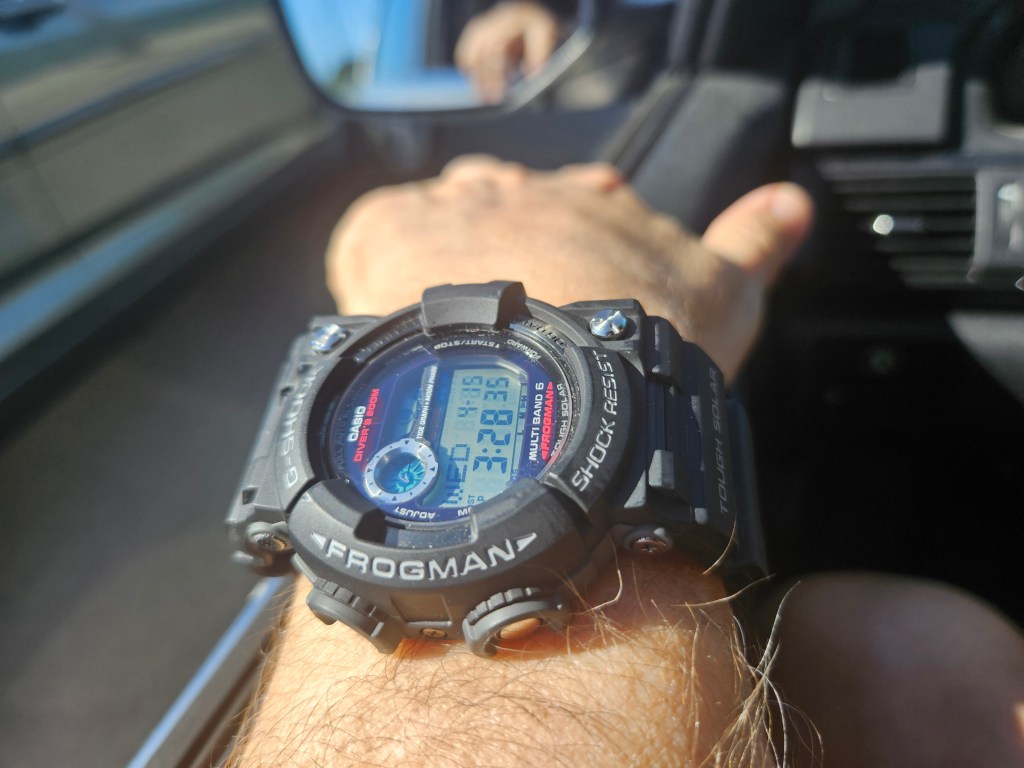
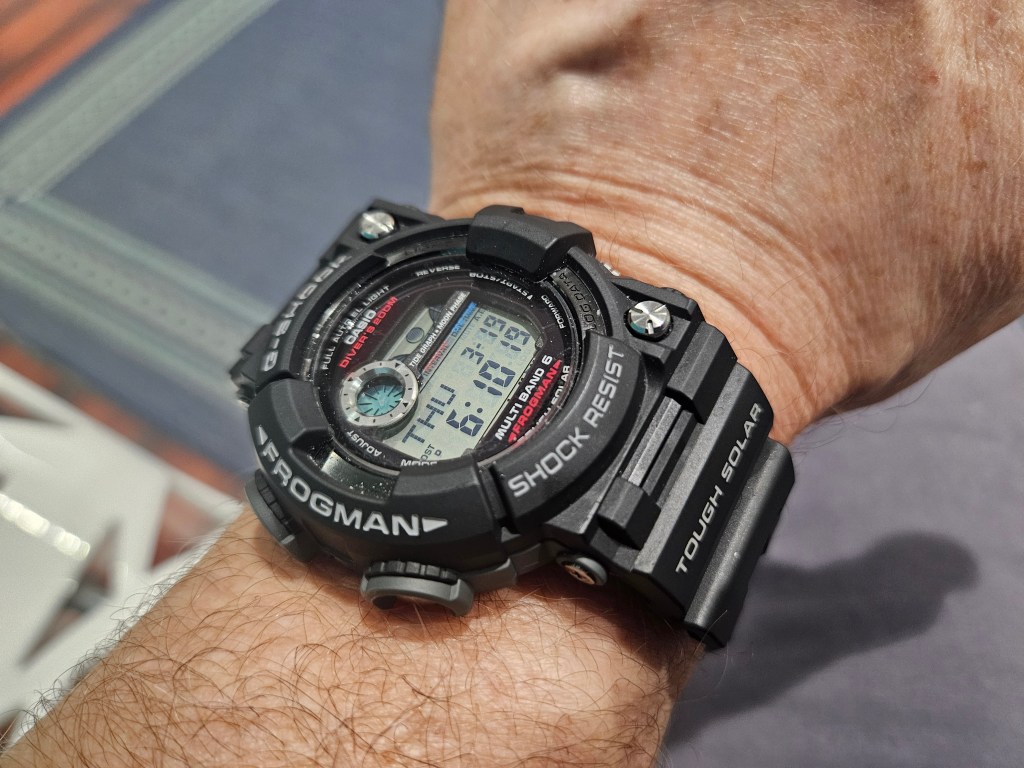
    My G-Shock Frogman from Japan is currently in the custody of DHL Customs, where it has been detained for reasons that appear to fall somewhere between administrative caution and bureaucratic sport.

    After a chain of communications—email links that didn’t open, automated messages that solved nothing, and the familiar sense of shouting into a digital canyon—I finally reached a living human being. The verdict: my package had been randomly flagged. To prove I was a legitimate citizen worthy of receiving a rubber-strapped dive watch, I was instructed to photograph my 1040 tax form, Social Security number included, and submit it for verification.

    I complied.

    The representative then added the final procedural flourish: the clearance team is backlogged, they don’t work weekends, and my Friday submission will not be reviewed until Monday at the earliest.

    And so the Frogman waits.

    Somewhere in a warehouse, my solar-powered watch sits sealed in darkness, a creature built to drink sunlight now confined to a bureaucratic aquarium. It calls to mind Melville’s Dead Letter Office—objects sent with intention, now suspended in institutional stillness. The watch waits. I wait.

    We are both experiencing what might be called Solar Purgatory Syndrome: a condition in which a solar watch is deprived of light while its owner is deprived of momentum. Energy, both mechanical and emotional, drains slowly while the system remains perfectly unmoved.

    What has changed is the feeling.

    Once, waiting for an overseas parcel carried the electricity of childhood—anticipation, possibility, the quiet thrill of something special moving across the world toward you. That feeling has been replaced by fatigue. Bitterness. The dull resentment that comes from being processed rather than served.

    Getting bitten by customs bureaucracy was not part of the romance.

    And something unexpected has happened. The friction hasn’t just slowed the purchase—it has cracked open a larger question. The stress, the forms, the delays, the mild institutional suspicion directed at a man buying a watch from Japan—it all begins to feel disproportionate.

    A voice, calm and unsentimental, has begun to speak:

    You’ve been bitten by the system.
    Consider this instruction.
    Consider this an exit opportunity.
    Enjoy the watches you have.
    Move on.

    This is the onset of a Bureaucratic Burnout Event—the moment when administrative friction overwhelms the emotional reward of the hobby that triggered it. What began as excitement—tracking updates, imagined wrist time, the pleasure of acquisition—collapses under documentation, verification, delay, and institutional indifference. The object itself begins to feel smaller than the effort required to obtain it.

    But the episode may carry a deeper meaning.

    It may be an Exit Omen Moment—the psychological shift in which inconvenience stops feeling like bad luck and starts feeling like instruction. The delay becomes a message. Simplify. Reduce. Stop expanding. Perhaps even stop buying altogether.

    Whether this reaction proves temporary or permanent remains to be seen.

    But for now, somewhere in a dark warehouse, a solar watch waits for light.

    And somewhere outside it, its owner is reconsidering the whole enterprise.

  • From Bicep Envy to Rolex Envy

    From Bicep Envy to Rolex Envy

    As a teenage bodybuilder, you suffered from classic body dysmorphia—the iron game’s most reliable side effect. Your arms measured a thick, hard-earned 19 inches. Impressive by any sane standard. But Arnold’s were 23. He owned the Rolex of physiques: cathedral pecs, mountain biceps, mythological proportion. You, by comparison, felt like you were wearing a plastic Timex.

    You could bench 400 pounds. Across the gym, a human forklift was casually repping 500 to warm up his joints. He was the champion. You were the fraud. The mirror didn’t show muscle; it showed deficiency. Reality had no vote. Comparison ran the court.

    Years later, the iron left your life, but the disease simply changed wardrobes.

    Now you collect watches. You watch Bosch. Titus Welliver stalks through Los Angeles wearing a Rolex Submariner like a badge of existential authority. Lance Reddick appears in the same universe, his TAG Heuer sitting on his wrist with the quiet confidence of a man who signs warrants and ends conversations.

    It isn’t the watches that get to you. It’s the gravity. The presence. The sense that the watch is merely the visible edge of a life lived at full command.

    Then you look down.

    Your Citizen Eco-Drive stares back—accurate, reliable, environmentally responsible. The watch of a reasonable man. The watch of an overweight suburbanite who owns a good coffee maker and worries about cholesterol. For a brief moment, you consider curling into the fetal position and asking the universe for a refund.

    The condition has a name: Watch Dysmorphia.

    Watch Dysmorphia is a status-perception disorder in which satisfaction with one’s watch—and by extension, one’s life—collapses under the pressure of upward comparison. The object on the wrist may be handsome, capable, even excellent. None of that matters. Against the symbolic weight of a Rolex on a television detective or the effortless confidence of a higher-status wearer, adequacy feels like failure.

    Like its muscular ancestor, the disorder ignores objective reality. A solid Citizen becomes a narrative of smallness. A respectable collection becomes evidence of mediocrity. The luxury watch is no longer a tool for telling time; it becomes a portable mythology of power, competence, and gravitas. When you look at your own wrist, you aren’t checking the hour—you’re reading a verdict.

    The result is predictable: dissatisfaction, restless upgrading, momentary relief, then renewed deficiency. Not because the watch is lacking, but because comparison has quietly rewritten the terms of enough.

    To live with Watch Dysmorphia is to learn a hard law of modern life:

    Comparison is the mother of misery.

  • The Wrist That Ate the Workday

    The Wrist That Ate the Workday

    Working from home is supposed to be a privilege. Deliver the numbers, meet the deadlines, and you’re spared the slow death of freeway traffic and fluorescent lighting. Your company trusts you. Your productivity is tracked by a sleek little monitoring app that converts your workday into a tidy efficiency score.

    Unfortunately, your desk shares airspace with the enemy.

    The lacquered watch box sits there like a silent casino. You glance at the watch on your wrist. Nice. Solid choice. But what about the others? You lift the lid. A row of polished faces looks back at you—steel, lume, sapphire, promise. You’re supposed to be refining actuarial tables, tightening the language in your report, making sure the graphs don’t embarrass you in front of management.

    Instead, you swap.

    The new watch feels right. For three minutes.

    Then doubt creeps in. Maybe the diver was too heavy. Maybe the field watch better matches your “work-from-home professional” persona. Swap again. Back to the box. Another selection. Another micro-adjustment to your identity. Meanwhile, the cursor blinks on an unfinished paragraph, and your productivity score quietly bleeds out.

    You know the behavior is neurotic. You also know you’re waiting for a moment of revelation—for one watch to settle onto your wrist and announce, in a calm and authoritative voice, This is the one. The watches remain silent. So you keep rotating, chasing a verdict that never comes.

    What you have is Chrono-Proximity Compulsion.

    The disorder is simple: when your collection lives within eyesight, your brain enters a loop—check, compare, swap, repeat. Each decision feels minor, harmless, even rational. In aggregate, they shred your attention into chrome-plated confetti. The watches stop telling time and start interrupting it. Work hours dissolve into wrist experiments, each swap chasing a mythical state of alignment between object, mood, and self.

    The cure is drastic but effective.

    You remove the collection from the battlefield. Down to the basement it goes—sealed in a treasure trunk, out of sight, out of negotiation. No lineup. No options. No silent chorus asking to be chosen.

    On your wrist remains the G-Shock GW5000.

    It does not flatter you. It does not whisper about heritage, craftsmanship, or lifestyle. It does not ask to be admired or reconsidered. It delivers one message, blunt and unromantic: Get back to work.

    For the first time all day, the cursor moves.

    And the efficiency app finally has something to measure.

  • Stop Writing About Your Obsession Before It Gets Worse

    Stop Writing About Your Obsession Before It Gets Worse

    You may be tempted to turn your watch obsession into literature. The idea has a certain romance. You picture yourself channeling Dostoevsky, producing a modern Diary of a Madman, transforming your horological unraveling into art—brave, raw, cathartic. You imagine clarity emerging from confession, insight distilled from chaos.

    But this is a dangerous illusion.

    Writing about your obsession does not drain it. It feeds it. The writer inside you is not a therapist; he is a scavenger. He needs material. And if the material isn’t dramatic enough, he will improve it. Soon you are not merely observing your compulsions—you are staging them, heightening them, curating your own instability for narrative effect. What began as self-examination becomes performance. You are now caught in a Pathology Amplification Loop: the act of writing about the fixation rehearses it, enlarges it, and gives it emotional weight. Reflection becomes rehearsal. Analysis becomes reinforcement.

    There is a second problem. Writing about watches keeps your attention locked on watches. For someone trying to loosen the grip of a fixation, this is the cognitive equivalent of hosting a wine tasting during sobriety. You are not stepping away from the stimulus. You are polishing it, describing it, lighting it for dramatic effect. Attention is fuel, and you are pouring it directly onto the fire.

    There is a third cost, and it is social. Confessional obsession reads less like literature and more like a slow-motion car crash. Your friends may be sympathetic, but sympathy has limits. Once people see the full machinery of your fixation—the spreadsheets, the rationalizations, the psychic weather reports—they quietly step back. You are still invited to gatherings. You are still greeted warmly. But you are no longer the person they choose for long conversations over coffee. Everyone has their own burdens. Few volunteer to carry someone else’s.

    The wiser move is not literary but physical. Shift the energy out of the head and into the body. Walk long distances. Lift something heavy. Eat food that grew in soil rather than in a laboratory. Maintain a modest calorie deficit. Build routines that produce fatigue instead of rumination. When watch thoughts rise, do not interrogate them, narrate them, or mine them for prose. Dismiss them the way you clear your throat when a cold threatens—briefly, calmly, without ceremony.

    The goal is not a better story.

    The goal is less story.

  • Monowatch Asceticism Meets the Skinny Yoga Guy

    Monowatch Asceticism Meets the Skinny Yoga Guy

    As the clock keeps punching holes in the calendar and I drift into the middle distance of my sixties, I’m stalked by the uneasy sense that I am not the man I’m supposed to be. I carry thirty extra pounds like unpaid emotional invoices. I cave to food temptations with embarrassing regularity. I indulge in narcissistic spirals of self-pity. My body bears the archaeological record of a lifetime of weightlifting injuries. Something has to give. The question isn’t whether I’m a complex human being—of course I am—but which single image can give me dignity, courage, and self-possession as I face my obligations, stay engaged with this lunatic world, and fend off entropy. The image that keeps returning, uninvited but insistent, is this: I am the Skinny Yoga Guy.

    The Skinny Yoga Guy eats vegan, clean, and whole, not as a performance but as a quiet discipline. He hits his protein macros with buckwheat, pumpkin seeds, peas, soy, garbanzos, and nutritional yeast, without sulking or negotiating. He cooks plant-based meals anchored in Thai, Mexican, and Indian traditions, not sad beige bowls marketed as “fuel.” He doesn’t snack like a raccoon in a pantry; he sips cucumber water and green tea and moves on with his day.

    He practices yoga six days a week, a full hour each time, sweating without complaint. The body lengthens. The spine straightens. He appears taller, calmer, less compressed by life. There’s a faint health glow—less “Instagram guru,” more “someone whose joints don’t hate him.” The discipline reshapes his temperament. The short fuse and indulgent sulks fade. In their place emerges a man who notices other people, attends to their needs without sermonizing, and discovers—almost accidentally—that service makes him sturdier, not smaller.

    In this revised operating system, the watch obsession quietly dies. No more chunky diver watches as heroic cosplay. No rotation. No drama. Just one watch: the G-Shock GW-5000. The purest G-Shock because it refuses theater. Shockproof, accurate, solar-powered, atomically synced. No Bluetooth, no notifications, no begging for attention. It does one thing relentlessly well: it tells the truth about time. It is reliability without narcissism.

    If the GW-5000 is indestructibility stripped of spectacle, then my assignment is clear: I must become its carbon-based counterpart. Less bloat. Fewer features. More uptime. Yoga becomes joint maintenance. Vegan food becomes corrosion control. No supplements that blink. No gadgets that chirp. No dietary Bluetooth pairing with guilt. Just a lean system designed to absorb impact, recover quickly, and remain accurate. GW-5000 firmware, now awkwardly attempting to run on two legs. Stripped down to one G-Shock, I can enjoy Monowatch Asceticism: the deliberate reduction of a watch collection to a single, purely functional timepiece as an act of identity purification. Ownership shifts from expression to discipline; the watch becomes less an accessory than a vow—proof that the wearer has stepped off the cycle of acquisition and into a life governed by restraint, durability, and quiet competence

    The longing is real. I want to be the Skinny Yoga Guy—disciplined, light, healthy—wearing a single $300 G-Shock as a quiet marker of having stepped off the status treadmill. I no longer want validation from a $7,000 luxury watch. Wanting this man is easy. Becoming him is not. That requires character, not aspiration.

    My hunch is that I need to write my way into him. A novel titled The Skinny Yoga Guy. Not a parody, not a self-help tract, but a chronicle of real-time change rendered with mordant humor and unsparing honesty. The book isn’t the point. Transformation is. The novel would simply be the witness.

    So here I am, a larval creature trapped in my cocoon. I must emerge as a new creature. The challenge is issued. Whether the world is waiting for my metamorphosis is irrelevant. I am. And that, for once, feels like enough.

  • Mortality Attenuation: When the Hobby Survives but the Hunger Fades

    Mortality Attenuation: When the Hobby Survives but the Hunger Fades

    I’ve made more real friendships online over watches than I ever expected—full-grown adults bonding over bezel action, dial texture, and the shared conviction that the perfect collection is exactly one purchase away. It’s a peculiar fraternity: half hobby, half recovery meeting. We compare scars from impulse buys and premature flips. We confess, we relapse, we congratulate one another on restraint that lasts roughly twelve days. Then someone posts a new release, and the room goes quiet. We nod, knowingly. Maybe this time we’re cured, we say—the way a gambler says he’s just there for the buffet.

    My own delirium began in 2005, when I was forty-three and certain that mechanical watches were not merely instruments but therapeutic devices—tiny machines capable of repairing the larger, less cooperative machinery inside me. Twenty years disappeared in a blur of rotating bezels, “exit watches,” and divers purchased for hypothetical adventures that never rose above grading papers. The obsession didn’t feel excessive. It felt like maintenance.

    Then, at sixty-three, something shifted. Mortality didn’t shout; it tapped me lightly on the shoulder, like a polite but persistent waiter. The hobby didn’t vanish. The flame still burns. But the heat changed. The urgency drained away. After two decades of acquisition, a quiet truth settled in: no matter how precise the watch, it was still losing the only race that mattered.

    The sensation reminds me of a scene from Battlestar Galactica: a traitor is sealed behind glass, pleading as the airlock hisses and the crew looks on, solemn and unmovable. A ritual exile. That’s what aging feels like–not tragedy, not humiliation. Just the slow recognition that you’ve crossed into a different atmosphere. Those still inside the warm illusion of endless tomorrows don’t push you away. They simply drift forward without you.

    The pane lowers gently. You tap it, wave, even smile, but the cockpit of youthful urgency is sealed. No reentry. What remains is quieter work: dignity over display, usefulness over accumulation, meaning over inventory. You stop building collections and start building perspective. You become less of a buyer and more of a witness.

    This is the Mortality Attenuation Phase: the gradual reduction of acquisition fever as the finite horizon comes into view. The obsession doesn’t die. It simply loses its panic. The watches remain. The urgency does not. Objects can mark time. They cannot bargain with it.

  • Every Watch Obsessive Has an Origin Story

    Every Watch Obsessive Has an Origin Story

    Every watch obsessive has a Watch Origin Story. It doesn’t matter whether the story is accurate, exaggerated, or stitched together from selective memory. What matters is that it explains everything. It gives the madness a beginning, a cause, a moment when fate tapped you on the shoulder and said, This is who you are now.

    The story functions as psychological ballast. Instead of admitting that the obsession grew slowly—from curiosity to habit to compulsion—the collector points to a single event: a grandfather’s heirloom, a childhood Casio, a promotion gift. A messy accumulation of impulses becomes a clean narrative arc. The hobby feels chosen, even destined, rather than accidental. That is the power of the Watch Origin Story: not historical accuracy, but emotional stability. It anchors the collector to a version of reality that makes the obsession feel meaningful instead of absurd.

    My own origin story began not with romance, but with humiliation.

    Years ago, I lost my classroom key at a university. This was not treated as a minor inconvenience. It was treated as a character defect.

    I was summoned before an administrator whose expression suggested I had been caught plagiarizing Aristotle. She informed me—slowly, ceremonially—that the one thing a college instructor does not do is lose his key. Her eyes moved over me the way airport security studies a suitcase that hums. My carelessness, she implied, had finally exposed my true nature: a professional lightweight, a man one misplaced stapler away from total institutional collapse.

    When the character autopsy concluded, I asked how one replaces a lost key.

    “You don’t just get a replacement,” she said. “It’s a process.”

    The word process fell like a prison door.

    I was instructed to drive to a remote facility on the outer rim of campus known only as Plant-Ops. There I would locate a locksmith. I would give him my personal information and twenty dollars in cash. No check. No receipt. The arrangement sounded less like facilities management and more like a controlled exchange of classified documents.

    “How will I know who he is?” I asked.

    “You’ll know him,” she said. “He’s the only person there.”

    Dismissed and morally diminished, I began the journey.

    The pavement gave way to dirt, then rubble, then a surface best described as geological suggestion. My car rattled through a landscape of sun-bleached debris and slow-moving tumbleweeds. Buzzards circled with professional interest. Without a watch, I had no sense of time, direction, or civilization. I was no longer in Southern California. I had entered a pocket dimension where entropy was the dominant administrative philosophy.

    At last, I reached Plant-Ops: a collapsing metal hangar that appeared to be losing its structural will to live.

    Inside stood the locksmith.

    He was small, skeletal, and deeply offended by my existence. Grease-stained apron. Glasses. A mustache clinging to his face like a final act of resistance. He glared at me while eating cold SpaghettiOs straight from the can, as if my arrival had interrupted a carefully scheduled moment of despair.

    I apologized for losing the key. I apologized for arriving. I apologized, indirectly, for modern society.

    He demanded twenty dollars in cash—up front—cut the key, and then leaned close to deliver a warning: he was retiring soon. His replacement, he said, was an idiot who could not make a proper key.

    I believed him.

    I fled.

    And on the drive back, a realization settled over me: life is unpredictable, systems fail, competence is fragile, and the world contains entire zones where time, direction, and institutional mercy disappear.

    I drove straight to a watch store and bought a G-Shock Rangeman.

    Compass. Altimeter. Barometer. Thermometer. Solar power. Tactical readiness.

    Because the next time I entered the Plant-Ops Zone, I intended to know exactly where I was—and how long I had left.

    That was the day I stopped wearing a watch.

    And started wearing equipment.

  • The Three-Watch Fantasy: Why Collectors Dream of Starting Over

    The Three-Watch Fantasy: Why Collectors Dream of Starting Over

    One of the most unsettling truths about my watch collection is how replaceable it really is. You would think that the hours of research, the hunting, the unboxings, the strap experiments, and the late-night lume checks would have forged something permanent—an extension of identity, a museum of the self. But that story doesn’t survive contact with honesty. Beneath the sentiment lies a colder fact: I could take a wrecking ball to the entire collection and feel a surge of relief.

    In fact, the demolition fantasy is strangely appealing. Clear the box. Sell the nine. Start over with three. If forced to rebuild today, I know exactly what would rise from the rubble: a Grand Seiko GMT SBGM221 for quiet elegance, the Seiko 62MAS SLA043 for historical gravity, and the G-Shock Frogman GWF-D1000B-1JF for operational indifference to reality. Three watches. Three roles. Order restored. Anxiety reduced. Narrative purified.

    Somewhere out there, I’m certain, a mischievous benefactor is reading this as a challenge. He wants to test the theory. He wants to see whether I—and collectors like me—are governed by what can only be called the Reset Fantasy: the recurring belief that happiness lives on the other side of total liquidation and a smaller, more perfect lineup. The purge promises clarity, discipline, renewal. It also quietly assumes that desire itself will behave once the environment is simplified. History suggests otherwise.

    The outcome would be predictable. I would miss pieces like the SLA055 and SLA023 for a week or two. Then I would adapt. The new trio would feel inevitable, even destined. And the community would be left with a sobering lesson: what we call “bonding” is often just attachment to a role in the narrative. Watches feel permanent. The feelings are not.

    This is why collectors regularly flirt with consolidation. When the box grows heavy, the mind reaches for the cure: the Three-Watch Salvation Myth—the conviction that the right trio will end the churn, quiet the wanting, and deliver lasting contentment. It is minimalism as therapy, discipline as redemption, and wisdom as a purchasing strategy. In truth, it’s simply the Exit Watch fantasy wearing a smaller suit.

  • Romance vs. Readiness: The $5,000 Watch Identity Test

    Romance vs. Readiness: The $5,000 Watch Identity Test

    If you had five thousand dollars to spend on a watch, would you buy a Tudor Black Bay or an apex G-Shock? Take a breath. This isn’t a trap. It’s a diagnostic. The question isn’t about taste, brand, or even watches. It’s about which story you want time to tell you when you look at your wrist.

    Because this isn’t a comparison. It’s a philosophical knife fight.

    What you’re buying with an MR-G is not nostalgia, prestige, or a century-old founder with a heroic mustache. You’re buying engineering density. The case is forged from exotic alloys—multi-layer titanium, Cobarion, DAT55—hardened, coated, and sealed like something designed to survive atmospheric reentry. The surfaces are finished with Zaratsu polishing, the same distortion-free technique used on high-end mechanical pieces, except here it’s applied to something that actually deserves the word precision.

    Inside, sentimentality has been removed for weight savings. Solar power eliminates battery anxiety. Multi-Band 6 pulls atomic time out of the sky. Bluetooth or GPS keeps it aligned with the planet. Perpetual calendar. Shock resistance. Magnetic resistance. Water resistance. This is not jewelry. This is equipment.

    In the real world, the result borders on the unsettling. The watch is essentially never wrong. It requires almost no maintenance. You don’t protect it; it protects itself. Decades pass. Nothing breaks. Nothing drifts. Nothing needs attention. Emotionally, the message is clear: you are wearing aerospace hardware. The subtext isn’t romance. It’s operational readiness.

    A Swiss mechanical watch lives in a different universe entirely.

    Here, you’re paying for inefficiency elevated to art. Hundreds of miniature parts dance together, powered by springs and friction, keeping time the way humans kept time before electricity. The movement is decorated with Geneva stripes, anglage, perlage—beautiful flourishes that improve nothing and mean everything. A large portion of the price isn’t metal or labor. It’s heritage, mythology, brand gravity, and the comforting knowledge that your purchase occupies a recognized tier in the luxury food chain.

    In practical terms, the performance is charmingly mediocre. The watch may gain or lose several seconds a day. Every five to ten years, it will require a service that costs the price of a respectable vacation. It’s durable, but not indestructible. You don’t live in it. You care for it. You wind it. You set it. You worry about it.

    And that’s the point.

    A Swiss mechanical watch is a tiny opera on your wrist. It hums with history and human effort. It suggests a world where time was slower, tools were permanent, and craftsmanship mattered more than optimization. It is gloriously unnecessary and emotionally persuasive. It doesn’t promise control. It promises meaning.

    The G-Shock, by contrast, does not care about your inner life.

    It assumes the world is hostile, gravity is inevitable, and precision is non-negotiable. Solar-powered. Atomically synchronized. Shockproof. Magnet-resistant. Overqualified for your most dangerous mission, which today will likely involve email, errands, and a conversation about air fryers. Where the Swiss watch whispers, “I honor tradition,” the G-Shock states, “Systems nominal.”

    One is a mechanical heirloom from a civilized past.
    The other is a wrist-mounted survival platform from a future that expects competence.

    This is the Romance–Reliability Divide: the tension between loving the poetry of imperfection and choosing the comfort of absolute performance. One approach treats timekeeping as an experience to be savored. The other treats it as a problem to be solved.

    There is no correct answer.

    But there is one mistake: not realizing which philosophy you’re buying when you open your wallet.

  • The G-Shock Exemption Doctrine: Why Some Watches “Don’t Count”

    The G-Shock Exemption Doctrine: Why Some Watches “Don’t Count”

    I have friends in the watch community who insist that “G-Shocks don’t count.” When they tally their collections, the squares and Frogmen are quietly left off the ledger. This is the G-Shock Exemption Doctrine—the unwritten rule that allows a collector to treat a G-Shock not as a watch, but as equipment, like a flashlight or a multi-tool. By this accounting magic, the collection remains disciplined, curated, respectable—untainted by the bulky, indestructible contraption sitting in the sock drawer, waiting for duty.

    The doctrine creates a bright border. On one side: mechanical divers, chronographs, heirlooms, objects of taste and tradition. On the other: the G-Shock. Yes, it tells time. But in the same way a Swiss Army knife contains scissors—it’s almost beside the point. To call a G-Shock a watch, in their view, is like calling a tricycle a bicycle. It operates in a different category of the brain, one less concerned with heritage and more concerned with survival, utility, and the quiet thrill of overcapacity.

    The psychology isn’t new. In the mid-1970s, the same reverence surrounded Texas Instruments calculators. They didn’t just crunch numbers; they conferred identity. The kid holding one wasn’t merely doing math—he was running systems. The G-Shock carries the same voltage. Atomic time. Solar charging. World time. Shock resistance. It doesn’t just tell you the hour; it implies operational readiness. You are synchronized, optimized, prepared—never mind that your most hazardous assignment today is grading essays or standing in line for almond milk. Press a button, and disorder yields to data. The fantasy is intoxicating: beneath the ordinary exterior lives a man quietly managing advanced capabilities.

    And the appeal goes deeper. The G-Shock is engineered for soldiers, divers, and field operators. It speaks not only to the analytical mind but to the tactical imagination. This is the fusion of Intellectual Man and Action Man—the spreadsheet warrior who is also, at least psychologically, deployment-ready.

    That’s the real divide. Mechanical watches point backward—to history, romance, and the comforting gravity of tradition. The G-Shock points forward. It belongs to the future, a small armored console strapped to the wrist, promising that whatever comes next, you will be ready for it.