Tag: fitness

  • Protein, Lies, and Artificial Flattery: Wrestling with ChatGPT Over My Macros

    Protein, Lies, and Artificial Flattery: Wrestling with ChatGPT Over My Macros

    Two nights ago, I did something desperate: I asked ChatGPT to craft me a weight-loss meal plan and recommend my daily protein intake. Ever obliging, it spit out a gleaming regimen straight from a fitness influencer’s fever dream—four meals a day, 2,400 calories, and a jaw-dropping 210 grams of protein.

    The menu was pure gym-bro canon: power scrambles, protein smoothies, broiled chicken breasts stacked like cordwood, Ezekiel toast to virtue-signal my commitment, and yams because, apparently, you can’t sculpt a six-pack without a root vegetable chaser.

    Being moderately literate in both numbers and delusion, I did the math. The actual calorie count? Closer to 3,000. I told ChatGPT that at 3,000 calories a day, I wouldn’t be losing anything but my dignity. I’d be gaining—weight, resentment, possibly a second chin.

    I coaxed it down to 190 grams of protein, begging for something that resembled reality. The new menu looked less like The Rock’s breakfast and more like something a human might actually endure. Still, I pressed further, explaining that in the savage conditions of the real world—where meals are not perfectly macro-measured and humans occasionally eat a damn piece of pizza—it was hard to hit 190 grams of protein without blowing past 2,400 calories.

    Would I really lose muscle if I settled for a lowly 150 grams of protein?

    ChatGPT, showing either mercy or weakness, conceded: at worst, I might suffer a “sliver” of muscle loss. (Its word—sliver—suggesting something as insignificant as a paper cut to my physique.) It even praised my “instincts,” like a polite but slightly nervous trainer who doesn’t want to get fired.

    In three rounds, I had negotiated ChatGPT down from 210 grams to 150 grams of protein—a full 29% drop. Which left me wondering:
    Was ChatGPT telling me the truth—or just nodding agreeably like a digital butler eager to polish my biases?

    Did I really want to learn the optimal protein intake for reaching 200 pounds of shredded glory—or had I already decided that 150 grams felt right, and merely needed an algorithmic enabler to bless it?

    Here’s the grim but necessary truth: ChatGPT is infinitely more useful to me as a sparring partner than a yes-man in silicon livery.
    I don’t need an AI that strokes my ego like a coddling life coach telling me my “authentic self” is enough. I need a credible machine—one willing to challenge my preconceived notions, kick my logical lapses in the teeth, and leave my cognitive biases bleeding in the dirt.

    In short: I’m not hiring a valet. I’m training with a referee.
    And sometimes, even a well-meaning AI needs to be reminded that telling the hard truth beats handing out warm towels and platitudes.

  • Snac-lebrity Envy

    Snac-lebrity Envy

    Television, that glowing oracle of modern life, is less a form of entertainment than a padded cell for the overworked brain. It’s where we go to decompress—to let our minds wander through slickly written dramas or “authentic” reality shows that masquerade as anthropological case studies in human dysfunction. It’s just smart enough not to insult your intelligence, but just soothing enough to flatten your ambition. And yet, this ritual of mental escape comes at a price, and that price is food porn. High-definition, Dolby-enhanced, slow-motion food porn.

    Forget plotlines. It’s the sound of a corn tortilla cracking like a gunshot through your living room, the close-up of chocolate lava cake oozing with erotic precision. You’re not watching TV—you’re being lured into a hunger trap set by Emmy-winning saboteurs. Your willpower doesn’t stand a chance.

    Worse still, these on-screen avatars of metabolic sorcery devour garlic mashed potatoes, fruit Danishes, and croissant-stuffed French toast with impunity—then rise from the table looking like a yoga ad. These are not people; they are calorie-defying sirens sent to destroy your self-control. They nibble bearclaws and remain airbrushed and lithe. You so much as sniff a breadstick and your waistband tightens.

    This, dear reader, is Snac-lebrity Envy—the gnawing resentment you feel watching the beautiful and well-lit inhale calories like coal into a furnace while your “dessert” is a string cheese and a cry for help. It’s not simple jealousy. It’s the psychic whiplash of seeing your dietary struggle mocked in real-time by people whose only hardship is deciding between oat milk or almond.

    Snac-lebrity Envy isn’t just an emotion—it’s a syndrome. It lives in your dopamine pathways, chews on your restraint, and whispers sweet nihilism: “Go ahead. Eat the cheesecake. The system’s rigged anyway.” It’s not just TV. It’s sabotage you can binge.

  • The Skinny Kingdom Denied

    The Skinny Kingdom Denied

    When it comes to convincing your healthcare plan to cover GLP-1 drugs like Mounjaro or Ozempic, prepare to enter the bureaucratic Twilight Zone. You might think being thirty or forty pounds overweight with blood pressure, cholesterol, and triglycerides inching toward DEFCON 2 would qualify you for a pharmaceutical lifeline. But no—your semi-morbid condition isn’t morbid enough. You’re not quite in the “Skinny Kingdom” yet. You’re stuck in the purgatory of “almost sick,” where the medical advice is to do what 80% of people can’t manage long-term: lose weight the old-fashioned way. Cue the eye-roll and the salad.

    This is where I live—too metabolically misaligned for comfort, but too “not dying fast enough” for insurance. So without the aid of GLP-1 wonder-drugs, I’ve been forced to build my own survival kit. Enter: the diet blog. Yes, that hackneyed relic of the internet. One evolutionary rung above the YouTube weight-loss vlog, and about one click away from a Pinterest board full of quinoa regret. But here’s my defense: writing this thing keeps me sane. First, let’s acknowledge the stakes. I’m attempting to succeed at something with an 80% failure rate. If journaling helps me thread the needle between health and hoagies, I deserve at least a participation trophy. Second, maybe—just maybe—my hard-earned insights might help someone else. Third, I need a breadcrumb trail for myself. Because when the binge fog clears, I need a record of how I got out of the woods.

    But let’s get this straight: if I’m going to write a diet blog, it comes with rules.
    Rule #1: No hawking miracle powders or gut-cleansing teas. This isn’t a supplement commercial. It’s a field report from the front lines of temptation.
    Rule #2: No ab selfies. No one asked, and no one wants to see the cinematic arc of my belly fat.
    Rule #3: No sanctimonious “one-size-fits-all” advice. What works for me may not work for you. I’m here to offer humility, not doctrine.
    Rule #4: Keep it funny. We live in a world where 2,000-calorie muffins are marketed as breakfast. If you can’t laugh at that, you’re doomed.
    Rule #5: No performative pity. Yes, self-discipline is hard. But I’m not marching across Antarctica—I’m just saying no to a Costco cheesecake. Keep perspective.

    If there’s a unifying thesis to this blog, it’s this: self-indulgence is a false god. The man who eats without limits is not happier—he’s just momentarily sedated. True satisfaction comes from self-possession, not pastry. This isn’t about vanity or some fantasy of being a low-body-fat Spartan. It’s about dignity. The mature eater is the happier eater. And if I have to claw my way there without the help of Ozempic, so be it. I’ll blog my way through the absurdity. One disciplined bite at a time.

  • Gluttonshame

    Gluttonshame

    During the Great Life Purge, flashbacks of gluttony didn’t just sneak up on me—they stormed in like uninvited relatives, loud and unrelenting. Just today, I winced remembering a scene from six months prior, when my wife and I, wrapped in the post-dinner glow of calories and denial, settled in for a couple Arrested Development reruns. The show—a chaotic valentine to familial dysfunction—still felt razor-sharp, sharp enough to leave paper cuts on your frontal lobe.

    As the theme song played, I rose from the couch with the sanctimony of a monk on pilgrimage. I was off to retrieve my so-called “satiety apple,” that smug little orb of virtue allegedly designed to curb cravings without detonating my calorie budget.

    But then I heard it—a low, seductive hum from the direction of the microwave. There it was: a lone pie box, faintly glowing like radioactive treasure, humming a siren song of buttery crust and spiced filling. I opened the box. Inside, the final slice of Thanksgiving pie waited like a femme fatale in a noir film—dangerous, irresistible, and destined to ruin me.

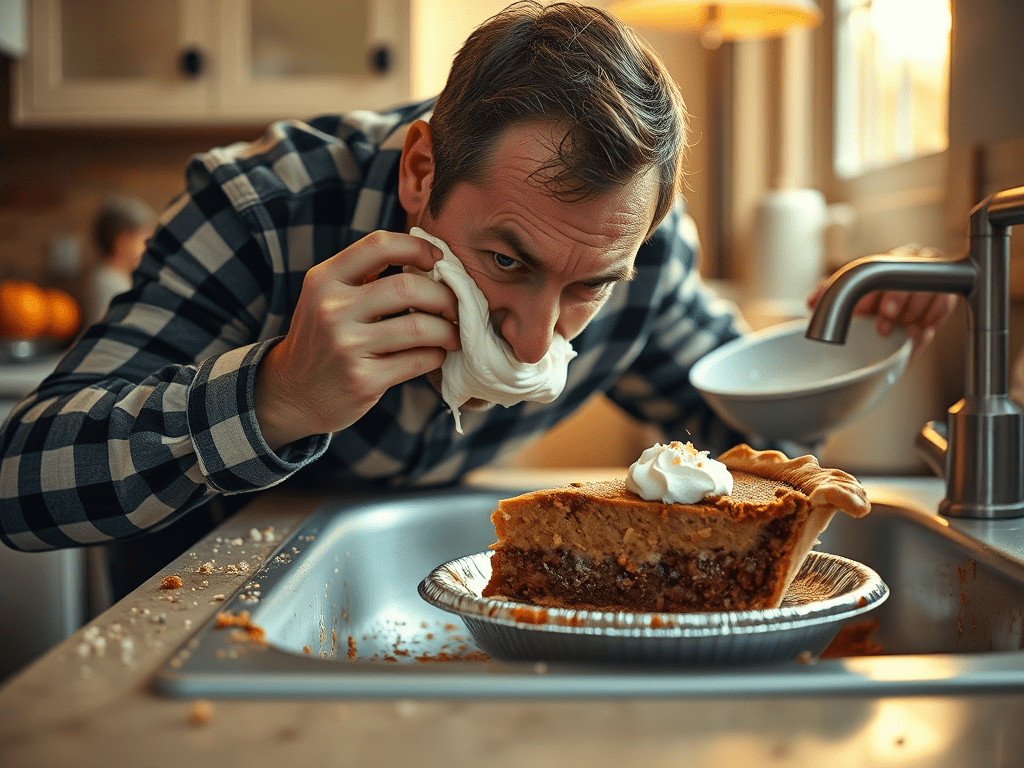
    I didn’t stand a chance. One second I was a man of discipline; the next, I was hunched over the sink, inhaling that pie like a raccoon who’d broken into a bakery. Crumbs flew. Filling oozed. I was mid-bite, feral and euphoric, when my daughter Alison entered the kitchen.

    She paused, surveyed the carnage, and with surgical precision asked, “When’s the last time you were on a diet?”

    I froze, mid-chew, cheeks ballooned like a chipmunk caught mid-heist. “It’s one slice of pie,” I sputtered, wiping whipped cream off my face. “Hardly a relapse worthy of a family intervention.”

    “Don’t be so defensive,” she replied, with the kind of tonal flatline only teenage girls can weaponize. “I’m just asking—when was the last time you had a strategy?”

    “I didn’t realize you were moonlighting as the historian of my weight management failures,” I muttered, scrambling for dignity.

    “What strategy?” she deadpanned, her eyes sliding toward the now-empty pie tin in the sink like a prosecutor resting her case.

    I opened my mouth in exaggerated mock offense, miming emotional devastation. We laughed, sort of. But her words hit like a sucker punch wrapped in fondant. Despite my kettlebell crusades and protein piety, my daughter saw me for what I was—a man-child undone by pastry.

    The truth hurt because it wasn’t just about pie. It was about a lifetime of performing duets with food, not as nourishment, but as codependence. My relationship with eating wasn’t a partnership; it was a soap opera—a never-ending saga of longing, betrayal, and deeply inappropriate snacking.

    I suffered from food noise—a chronic condition in which the brain becomes a 24-hour food court blaring meal ideas through a megaphone. It wasn’t a craving. It was a full-time broadcast. Even as I wiped pie filling off my shirt, some inner gremlin was planning breakfast, brunch, and an emotionally necessary mid-morning protein bar.

    I had, of course, tried everything. High-protein meals? Check. Fiber-packed produce? Ate it until I squeaked. “Permission to eat favorite foods”? Please. That just gave me moral cover for more cheesecake. As for “hunger cues”—those had long since been drowned in a Wagnerian opera of appetite, where every aria ended in a trip to the fridge.

    I didn’t eat because I was hungry. I ate because I was enchanted. Food was my symphony, and I was its slobbering conductor. While others savored notes of flavor, I devoured entire movements. Pie wasn’t dessert—it was the crescendo. A bag of chips? That was a tragic aria. My kitchen was a concert hall, and I, a helpless Snack Serenader, crooning sonnets to chicken shawarma and tearfully composing odes to sourdough.

    Romantic? Maybe. But make no mistake: this was less about joy than it was about entrapment. I didn’t eat food—I worshipped it. I wasn’t hungry for sustenance—I was desperate for an encore.

    And that’s when the memory landed with full force: the gluttonshame. A post-binge echo of mortification so potent it deserved its own DSM entry. Gluttonshame—the echoing pang of regret triggered by the memory of a food orgy, often witnessed, preferably by someone genetically programmed to judge you—is no passing embarrassment. It sticks, greasy and persistent, like pie filling on a dress shirt. It whispers, “This is why your jeans stage a mutiny every morning.”

    Symptoms? Defensive sarcasm. Performative chuckles. Sudden existential dread. And an uncontrollable urge to delete your food log and relocate to another time zone.

    I felt it all. But if the Great Life Purge taught me anything, it’s that these flashbacks are necessary. They remind me that change doesn’t happen without confession—and a little mockery. Because behind every gluttonshame echo is a man trying, however clumsily, to crawl his way back to self-control—one apple, one salad, one deeply judged slice of pie at a time.

  • Welcome to the Great Life Purge

    Welcome to the Great Life Purge

    When you cut junk food to lose weight, that’s just the beginning. Hundreds of dominoes fall. Welcome to The Great Life Purge—that glorious, semi-manic chain reaction where you set out to cut one small vice and suddenly find yourself Marie Kondo-ing your entire existence with a vengeance.

    You think weight loss is just about dialing back calories and hitting your macros? Think again. This isn’t a tweak. It’s a controlled burn. A purge. A full-blown exorcism of the clutter, chemicals, and chaos posing as comfort. You’re not escaping Fat Jail with a low-carb key and a side of willpower—you’re staging a prison riot and setting the whole institution on fire.

    Think of your life as a garage—no, not one of those Pinterest garages with labeled bins and mounted bikes. I’m talking about a real garage. The kind where a busted leaf blower shares space with a half-used tub of creatine and a pile of shame. That’s your psyche. And mine. Crammed with junk, denial, and forgotten intentions. And now? I’m hauling it all to the curb.

    It started with coffee. I used to down 36 ounces in the morning like a jittery insomniac in a diner scene. Now I’ve cut that to 18. Less milk. Less sweetener. Less gut turmoil. Fewer acid flashbacks from the third cup. Progress.

    Then came lunch. I evicted the canned fish—farewell, mercury-laced mackerel and gout-triggering sardines. My new midday ritual is an arugula salad with tempeh, beans, and cottage cheese—a meal so righteous it practically writes its own self-help book.

    Whey protein? Slashed in half. Just enough to lace my morning yogurt. Sure, I could use more protein, but I’m not going to burn down my 2,400-calorie ceiling just to keep my muscles Instagram-ready.

    Snacks? Gone. Munchdrift—my term for the unplanned snack spiral that sneaks calories into the bloodstream like an embezzler—has been cut off at the source. There’s no room for that soft betrayal anymore.

    Creatine? Down from 6 grams to 3. Why? Because I’m not trying to retain water like a Roman cistern. I’m done with the bloat masquerading as muscle.

    Social media? I nuked 97% of it. That dopamine circus was hijacking my focus, feeding my anxiety, and keeping me stuck in a loop of comparison, craving, and manufactured outrage. Cutting it wasn’t self-care. It was a hostage negotiation with my own sanity.

    Even my workout chalk had to go. Turns out those satisfying powder clouds were drying out my hands and spawning digital ulcers—tiny, furious paper cuts from hell. Three weeks off chalk, and the wounds are retreating like a bad memory.

    And yes—I quit buying watches. Why? Because a bloated watch collection leads to wrist rotation anxiety, which feeds decision fatigue, which then morphs into existential despair that can only be soothed by ice cream. Every anxiety becomes a hunger. I had to cut it at the root.

    Notice the verbs: cut, quit, slashed, purged. This isn’t moderation. This is triage. What started as a diet became a full-scale reckoning. Because once you yank one loose thread, the whole costume of denial begins to unravel. You’re not just quitting sugar and processed carbs—you’re firing the whole cabinet of coping mechanisms.

    The Great Life Purge doesn’t just empty your garage—it changes your address. You’re no longer living in the house of excuses. You’re moving into something leaner, meaner, and unmistakably yours.

    Now, if you’ll excuse me, I have a fat mountain to climb—and I don’t need a sugar crash, a digital ulcer, or a six-watch rotation slowing me down.

  • Victory Lapnesia

    Victory Lapnesia

    For most of my adult life, I’ve been stalked by a sneaky, waistline-widening predator I now call Munchdrift—the stealth snacking habit that brings in a slow-motion avalanche of calories like a drip IV of lard straight to the gut. I didn’t even realize it was happening. One minute, I’m nibbling on a handful of almonds “for heart health,” the next I’m housing a Costco tub of peanut butter with a ladle. Result? I’ve been fat four times. 1996: 235 lbs. 2003: 253 lbs. 2017: 245 lbs. And now, 2025: 247 lbs. Like clockwork. Like a cursed zodiac of self-sabotage.

    I don’t have the luxury of “body acceptance” or any other hashtagged delusion. When I weigh over 230, my body throws a biochemical tantrum: cholesterol, triglycerides, and blood pressure all go full DEFCON 2. This isn’t about self-love. It’s about not dying in the next decade.

    The pattern’s always been the same. I muscle my way down to 200 on 2,400 calories a day, white-knuckling my appetite like I’m defusing a bomb. And then—poof. The discipline vanishes. I get smug. The weight loss high wears off and I forget every methodical trick that got me there. Slowly, entropy creeps in, disguised as “flexibility,” “moderation,” and “deserved treats.” The order collapses. Munchdrift returns. Pride dies. And I wake up bloated and furious, wearing sweatpants that used to hang loose and now plead for mercy.

    Now I’m 63, and I’m done playing Groundhog Day with my waistline. I needed a name for this psychological sabotage—the specific kind of pride-drunk amnesia that ruins everything. And here it is:

    Victory Lapnesia.

    It’s that delusional post-weight-loss fugue state where, drunk on success, I forget every sweaty, hungry, unsexy tactic that got me to 200. Suddenly, the rules become negotiable. “Moderation” sneaks in. Maintenance becomes an endless cheat day. And my once-disciplined mind turns into a TED Talk on rationalization. The result? Munchdrift relapse. Button-flying denial. A renewed subscription to regret, with auto-renew turned on.

    But not this time. I’ve drawn the line. Here are 7 unforgiving strategies to keep Victory Lapnesia from moving back into my love handles like a squatter with squatters’ rights:

    1. Celebrate with Systems, Not Sweets
    No more “I deserve this” cake. That’s how the descent begins—frosted and full of lies. My real reward is knowing what works. So instead of high-fiving myself with a slice of cheesecake, I schedule my next month of meals, workouts, and weigh-ins like a man preparing for war—not a man planning brunch.

    2. Install Post-Goal Protocols
    The scale hitting 200 isn’t the end. It’s the beginning of a long maintenance trench war. I now have a one-page “Maintenance Manifesto” taped to my fridge, my bathroom mirror, and the dashboard of my car. It’s non-negotiable, like brushing teeth or paying taxes.

    3. Rebrand Maintenance as a Project
    Maintenance isn’t a passive state—it’s my next mission. I’ve dubbed it Project Anti-Rebound. Think Marvel meets middle-age. This isn’t about keeping weight off—it’s about defending the citadel of sanity against the invading hordes of snack-based betrayal.

    4. Weigh Myself Like It’s Church
    Sunday mornings. Same time. Same scale. No excuses. I treat the weigh-in like mass: a ritual of reckoning. The scale doesn’t care about my feelings, my schedule, or how “good” I was. It tells the truth like an indifferent god.

    5. Make Munchdrift Illegal
    Snacking is banned. Full stop. No more “just a bite” diplomacy. No handfuls. No desk-side almonds. No post-dinner kitchen loitering. Every bite is logged. Every calorie accounted for. If it’s not a meal, it doesn’t go in my mouth. Period.

    6. Hang My Fat Pants Like a War Trophy
    I’ve kept my largest jeans. They hang like a scarecrow in my closet. A denim warning sign. Every time I feel tempted to “ease up,” I look at them and hear them whisper, We remember who you were. I do too.

    7. Outsource the Shame (Productively)
    I text my weight to a friend every Friday. I blog about my progress for strangers who don’t care but might someday. Shame kept secret is corrosive. Shame shared is accountability. I’ve turned my relapse history into content—and I dare my ego to screw it up again.

    This isn’t a journey anymore. Journeys end. This is a regimen. A regime. A ruthless campaign against the soft tyranny of my own bad habits. Because I’ve learned the hard way: if you don’t fight for maintenance like you fought for weight loss, you’ll lose everything—and you’ll gain it all back.

  • My Personal Sane Eating Lexicon: Cravattenuation, Savorosity, and Munchdrift

    My Personal Sane Eating Lexicon: Cravattenuation, Savorosity, and Munchdrift

    On April 10th, fresh off a family vacation in Miami and still spiritually sticky with airport pastrami sandwich guilt, I stepped on the scale and was greeted with a soul-curdling 247 pounds. Yes, some of it is lifelong muscle from half a century of hoisting kettlebells and playing Hercules in the garage. But make no mistake—this number was a slap in the face, a statistical insult to my dignity. Fueled by a righteous anger I can only describe as metabolic revenge, I went to war.

    First, I cut my meals down to three per day and gamified the system like a psychological Jedi. My lunchtime yogurt-and-berries bowl got reassigned as a post-nap “treat,” and a humble apple—normally the most boring fruit in the bowl—was elevated to nightly “dessert,” strategically scheduled for 8 p.m. to give my inner child something to cling to as the kitchen closed. I also slashed my coffee intake from 36 to 18 ounces (don’t worry, I’m still barely human), and dropped my creatine from 6 grams to a mere 3—enough to retain my swole, but not enough to float like a sodium balloon.

    Meanwhile, I came to grips with the ugly truth that I was overstuffing both my freezer and my face. The freezer had become a metaphor for my appetite: jammed with frozen berries, low-carb snacks, and delusions of future discipline. Constantly raiding it created two problems: overconsumption and literal water puddles from a clogged defrost drain. My wife and I emptied the thing out like detoxing hoarders, and miraculously, the fridge stopped weeping. I then purchased a chest freezer for the garage to create a buffer zone—a cold storage moat to protect the kitchen from my impulsive nibbling.

    By April 19, I had dropped to 240 pounds—a loss of seven pounds in nine days, even with an Easter cheat day that involved chocolate cake and blueberry pie, which I regret nothing about. Today I weigh again after my workout, prepared to assess the pastry fallout. But here’s the real revelation from those ten days: the hunger I thought I was feeling wasn’t hunger—it was performance anxiety from my stomach, a neurotic need to react to every twitch of emptiness like it was a national emergency. That, my friends, is where Cravattenuation comes in.

    Cravattenuation is the noble and necessary art of muting your inner snack gremlin—the one who panics at the first polite growl of your stomach and demands cheese. It’s the mental and metabolic recalibration that teaches you this: real hunger is not a 3 p.m. yawn with a craving for almonds. It’s a deeper emptiness, one you can actually enjoy. Because when you let your appetite stretch out and breathe, you arrive at meals not with guilt or compulsion, but with appetite and joy. Hunger becomes less of a trigger and more of a drumroll.

    Cravattenuation the deliberate process of retraining your body to interpret minor hunger signals not as existential emergencies but as low-priority system notifications: “You might want to eat in a bit” instead of “RAID THE PANTRY OR DIE.” Just as meditation teaches you to sit with discomfort rather than react impulsively, Cravattenuation teaches you that a little hunger isn’t a crisis—it’s foreplay for a better meal.

    We’ve been conditioned by snack culture and anxiety-driven consumption to treat hunger as something to be feared and fixed immediately, like a smoke alarm or a toddler tantrum. But when you practice Cravattenuation, something remarkable happens: your threshold for hunger strengthens, and the urgency softens. You learn to sit with a mild stomach pang without spiraling into carb-lust. Over time, you develop what can only be described as Hunger Discernment: the ability to separate emotional nibble-itching from true physiological need.


    The Unexpected Perk:

    By making your body earn the meal—not through punishment, but patience—you begin to eat with a clarity and joy that’s been missing since the dawn of office vending machines. Food tastes better when you’re actually hungry for it. Not “kinda bored” hungry, not “scrolling through cheese reels” hungry, but real hungry. Cravattenuation helps you not only manage your weight with more ease and grace, it re-enchants the eating experience itself. You’ll start treating meals like mini homecomings rather than pit stops at a dopamine gas station.


    Name for the Healthy State: Savorosity

    (savor + satiety + curiosity)

    Savorosity is the elegant state you enter after mastering Cravattenuation—a zone where hunger feels less like a hostage crisis and more like an invitation. It’s when you greet mealtime with curiosity and pleasure, not guilt or compulsion. It’s when you chew slower, taste deeper, and know you’ve arrived not because you gave in to a craving, but because you earned your appetite.

    Cravattenuation gets you there. Savorosity keeps you there. And together, they free you from the tyranny of the pantry’s siren call.

    Of course, the desired state of Savorosity has an opposite condition: Munchdrift, which is the mindless, momentum-driven eating that results from random grazing, emotional nibbling, and culinary boredom. It’s what happens when hunger is no longer a signal but a background noise, muffled by routine snacking and phantom cravings. In the Munchdrift state, meals are neither anticipated nor savored—they’re accidental. A handful of nuts here, a swipe of hummus there, three spoonfuls of cottage cheese at midnight, and suddenly, you’ve eaten 1,200 calories without ever feeling either full or satisfied. The food doesn’t taste bad; it just doesn’t taste like anything—because your palate is bored and your appetite never had a chance to sharpen.

    While Savorosity is marked by intentionality, restraint, and presence, Munchdrift is all drift and no anchor. It’s eating as ambient noise. It’s the cognitive equivalent of scrolling Instagram while watching TV while wondering why you’re still chewing. 

  • How to Stop Your Appetite from Heckling You and Achieve Savorosity

    How to Stop Your Appetite from Heckling You and Achieve Savorosity

    Coined Term: Cravattenuation

    (craving + attenuation)


    Extended Definition:

    Cravattenuation is the psychological and physiological art of turning down the volume on your inner snack gremlin—the one who starts kicking the back of your consciousness the moment your stomach makes a polite gurgle. It’s the deliberate process of retraining your body to interpret minor hunger signals not as existential emergencies but as low-priority system notifications: “You might want to eat in a bit” instead of “RAID THE PANTRY OR DIE.” Just as meditation teaches you to sit with discomfort rather than react impulsively, Cravattenuation teaches you that a little hunger isn’t a crisis—it’s foreplay for a better meal.

    We’ve been conditioned by snack culture and anxiety-driven consumption to treat hunger as something to be feared and fixed immediately, like a smoke alarm or a toddler tantrum. But when you practice Cravattenuation, something remarkable happens: your threshold for hunger strengthens, and the urgency softens. You learn to sit with a mild stomach pang without spiraling into carb-lust. Over time, you develop what can only be described as Hunger Discernment: the ability to separate emotional nibble-itching from true physiological need.


    The Unexpected Perk:

    By making your body earn the meal—not through punishment, but patience—you begin to eat with a clarity and joy that’s been missing since the dawn of office vending machines. Food tastes better when you’re actually hungry for it. Not “kinda bored” hungry, not “scrolling through cheese reels” hungry, but real hungry. Cravattenuation helps you not only manage your weight with more ease and grace, it re-enchants the eating experience itself. You’ll start treating meals like mini homecomings rather than pit stops at a dopamine gas station.


    Name for the Healthy State: Savorosity

    (savor + satiety + curiosity)

    Savorosity is the elegant state you enter after mastering Cravattenuation—a zone where hunger feels less like a hostage crisis and more like an invitation. It’s when you greet mealtime with curiosity and pleasure, not guilt or compulsion. It’s when you chew slower, taste deeper, and know you’ve arrived not because you gave in to a craving, but because you earned your appetite.

    Cravattenuation gets you there. Savorosity keeps you there. And together, they free you from the tyranny of the pantry’s siren call.

  • The Kettlebell Monk and the Return of the Yoga Cult

    The Kettlebell Monk and the Return of the Yoga Cult

    I’ve been lifting weights since I was 12 years old—long enough to have calluses older than some of my students. My loyalty has always been to iron, not incense. And yet, twice in my life I’ve flirted with the cult of yoga. First from 2005 to 2008, when Power Yoga made me sweat like a sinner in a sweat lodge, and again recently, from 2023 to 2024, when something primal in me remembered the bliss of holding Warrior Two while the room turned into a personal rainforest.

    But iron always calls me back. Resistance training, especially kettlebells, is my native language. It’s the blunt poetry of movement: swing, squat, grind. There’s no chanting, no ambient whale noises—just the thud of steel against gravity and the holy ache of delayed-onset muscle soreness. Still, yoga lingered in my subconscious like a forgotten lover with a very flexible spine.

    Then came the dream.

    I was living in what could only be described as a monastic exercise gulag perched high in the Swiss Alps—imagine if The Sound of Music were choreographed by a CrossFit cult and everyone smelled faintly of magnesium chalk and regret. My cell was a minimalist slab of concrete, colder than a Russian novel and just as unforgiving. There I was, hammering out kettlebell swings with the grim dedication of a prisoner serving a life sentence for crimes against rest days, when it hit me—not just a muscle cramp, but a full-body epiphany.

    I missed the sweat.

    But not just any sweat. Not the stoic, industrial, man-against-iron kind that kettlebells demand. I missed yoga sweat. That slow, creeping, mind-liquefying ooze you earn by holding Crescent Lunge for six minutes while your brain gently transitions from “I am one with the universe” to “I am dying alone on this mat.” It’s the kind of sweat that doesn’t just leave the body—it evacuates your ego with it.

    The sense of FOMO hit me like a rogue medicine ball to the face. I wasn’t just missing out on yoga—I was exiled from it, cast into the outer darkness where there is weeping, gnashing of teeth, and tight hip flexors. The regret was theological. Yoga wasn’t just an option anymore. It was a spiritual ventilator.

    In the dream, I staggered from my training cell like a sinner leaving the confessional. I entered my quarters—bare except for a desk, a lamp, and the faint scent of despair—and rearranged it like a man staging his own resurrection. Then, with the urgency of a convert and the shame of a backslider, I Googled yoga poses. Warrior. Triangle. Pigeon. All the old apostles.

    I wandered the grounds like a deranged prophet in compression leggings, possessed by a holy compulsion to evangelize. I whispered gospel truths: “Downward Dog is deliverance,” “You are your breath,” “Meat is a distraction.” People followed. Of course they did. We began practicing together, flowing through vinyasas with cult-like synchronicity. We ate vegan three times a day, spoke only in Sanskrit-inflected aphorisms, and achieved a level of hamstring enlightenment most people only dream about.

    It was utopia, with better posture.

    Then I woke up.

    Still in a fog of sacred revelation, I marched to my computer, opened my long-neglected list of yoga sequences in Google Docs, and committed to the third phase of my yoga life: twice a week, no excuses. Five days of kettlebell discipline to keep me grounded, two days of yoga to unlock whatever transcendental weirdness lives in my hips.

    Because as much as I love kettlebells—and I do—they’ve never given me that hallucinatory bliss, that euphoric disintegration of self, that only comes from holding Triangle Pose until your consciousness starts leaking out of your ears.

    Iron builds the body. Yoga does something else. And I’m not going to miss out this time. 

  • 3 College Writing Prompts: Willpower Is Not a Weight-Loss Strategy: Rewriting the Narrative of Obesity in an Age of Ozempic

    3 College Writing Prompts: Willpower Is Not a Weight-Loss Strategy: Rewriting the Narrative of Obesity in an Age of Ozempic

    Essay Prompt:

    In contemporary culture, weight loss is often framed as a matter of individual discipline: eat less, move more, stay motivated. This narrative, reinforced by diet culture, media messaging, and public health campaigns, reduces a complex biopsychosocial phenomenon into a moral test of willpower. But what if this view is not only incomplete, but damaging?

    This essay invites you to critically analyze the myth of weight loss as a simple formula of personal responsibility, using the following readings:

    • Rebecca Johns, “A Diet Writer’s Regrets”
    • Johann Hari, “A Year on Ozempic Taught Me We’re Thinking About Obesity All Wrong”
    • Harriet Brown, “The Weight of the Evidence”
    • Sandra Aamodt, “Why You Can’t Lose Weight on a Diet”

    Drawing on these texts, write a 1,700-word argumentative essay that explores the deeper systemic, biological, and psychological forces that influence body weight. In your analysis, define what is meant by diet culture, obesity stigma, metabolic adaptation, and the illusion of control. Consider how economic privilege, the Industrial Food Complex, and the Diabetes-Management Complex affect who gets access to treatment and who gets blamed for their bodies.

    Reflect on the question: Is obesity the result of failed individual discipline—or a condition shaped by biology, capitalism, and inequality? And what are the ethical and political consequences of continuing to frame weight as a personal failing?


    Key Themes and Concepts to Define in Essay:

    • Diet culture: The belief system that prioritizes thinness as a moral virtue and equates weight loss with health and worth.
    • Obesity stigma: The systemic dehumanization, bias, and blame placed on people in larger bodies.
    • Metabolic adaptation: The body’s physiological resistance to weight loss, often leading to weight regain.
    • Ozempic and GLP-1 drugs: Medications that challenge traditional weight-loss advice by offering pharmacological interventions, often accessible only to the wealthy.
    • Industrial Food Complex: The economic system that prioritizes hyper-palatable, processed foods for profit.
    • Diabetes-Management Complex: The medical-industrial apparatus that profits from managing obesity-related conditions without addressing root causes.

    10-Paragraph Essay Outline


    Paragraph 1 – Introduction

    • Begin with a personal or cultural anecdote about dieting, body shame, or the weight-loss industry.
    • State the prevailing myth: that weight loss is just about willpower, calories, and exercise.
    • Introduce the core idea: this myth obscures structural, biological, and psychological realities.
    • End with a strong thesis: The cultural obsession with personal discipline in weight loss not only ignores science but perpetuates economic injustice, medical misinformation, and moral shame.

    Paragraph 2 – The Myth of Personal Responsibility

    • Explore how diet culture frames obesity as a personal failure.
    • Use Johns and Brown to show how this narrative is reinforced by health media and public policy.
    • Define diet culture and obesity stigma as forms of social control.

    Paragraph 3 – The Science of Weight and Metabolism

    • Explain Aamodt’s key argument: the body defends a weight range through metabolic adaptation.
    • Introduce the concept of the set point and how dieting can backfire physiologically.
    • Emphasize the biological limits of “discipline” in long-term weight maintenance.

    Paragraph 4 – Ozempic and the Medical Disruption of Diet Culture

    • Analyze Hari’s experience with Ozempic as a reframing of what obesity is and isn’t.
    • Explain how drugs like Ozempic challenge the calorie-math logic of diet culture.
    • Raise the question: if a drug changes appetite, was willpower ever the issue?

    Paragraph 5 – Economic Access and the Ozempic Divide

    • Examine the cost of GLP-1 drugs and the class-based disparity in access.
    • Discuss how the rich can “solve” obesity pharmacologically while others are blamed.
    • Introduce the concept of the Diabetes-Management Complex and its profit motives.

    Paragraph 6 – The Industrial Food Complex and Engineered Cravings

    • Analyze the food industry’s role in promoting addictive, ultra-processed foods.
    • Use Brown and outside data (optional) to show how working-class communities are targeted by fast food and soda industries.
    • Connect this to systemic inequality: people are set up to fail and then blamed for it.

    Paragraph 7 – Psychological Toll and the Shame Cycle

    • Highlight the emotional and mental health damage caused by diet failure and stigma.
    • Reference Johns and Aamodt: shame is not a motivator—it’s a trap.
    • Argue that repeated dieting often leads to worse health outcomes, not better ones.

    Paragraph 8 – Counterargument: Isn’t Some Responsibility Necessary?

    • Acknowledge the argument that individuals do make choices about food and movement.
    • Rebut by showing how choice is constrained by biology, environment, and marketing.
    • Emphasize that awareness and access—not shame—should guide public health.

    Paragraph 9 – Reframing Obesity: Toward Compassionate Policy and Practice

    • Suggest new narratives: body neutrality, medical compassion, anti-poverty approaches.
    • Point to Hari’s conclusion: we must rethink how we talk about food, body, and health.
    • Argue for policies that regulate Big Food and expand access to affordable treatment—not just lectures on willpower.

    Paragraph 10 – Conclusion

    • Reaffirm thesis: The weight-loss myth isn’t just scientifically flawed—it’s morally dangerous.
    • Remind the reader that bodies are not math problems to be solved.
    • End with a call to change the story: from blame to understanding, from shame to structural justice.

    Three Sample Thesis Statements


    Thesis 1:
    Despite decades of public health messaging urging personal responsibility, evidence from metabolic science and socioeconomic analysis shows that weight loss is rarely a matter of willpower; rather, it is shaped by systemic inequalities, industrial food marketing, and biological resistance that diet culture refuses to acknowledge.


    Thesis 2:
    Ozempic has exposed the hollowness of traditional dieting advice by proving that appetite, metabolism, and weight are governed by mechanisms beyond discipline—forcing us to rethink obesity not as moral failure, but as a condition entangled in capitalism, privilege, and biology.


    Thesis 3:
    While self-discipline plays a role in shaping health behaviors, framing obesity as a personal choice erases the complex realities faced by those in larger bodies—and perpetuates a culture that profits from their shame while denying them access to real solutions.

    Prompt Variation #1:

    Title:

    Ozempic Nation: Rethinking Health, Shame, and the New Politics of Body Control

    Prompt:

    In recent years, the rise of weight-loss drugs like Ozempic has disrupted the cultural script about how people should lose weight. For decades, Americans were taught that health was a product of self-control, calorie-counting, and personal virtue. Now, pharmaceutical interventions are reframing obesity not as a failure of discipline, but as a medical condition treatable through science—at least, for those who can afford it.

    In a 1,700-word argumentative essay, use the following sources to explore the tension between medical innovation and cultural shame in the weight-loss conversation:

    • Rebecca Johns, “A Diet Writer’s Regrets”
    • Johann Hari, “A Year on Ozempic Taught Me We’re Thinking About Obesity All Wrong”
    • Harriet Brown, “The Weight of the Evidence”
    • Sandra Aamodt, “Why You Can’t Lose Weight on a Diet”

    Your essay should analyze the shifting meanings of health, body control, and legitimacy in the age of Ozempic. What happens when pharmaceutical shortcuts challenge decades of moral messaging around food and fitness? Who benefits from this shift—and who is still left behind?

    Define and explore key concepts such as obesity stigma, the illusion of dietary control, medical privilege, and the cultural performance of health. Consider how these sources challenge or reinforce the idea that technology can “fix” what social systems continue to break.


    Sample Thesis Statements:

    Thesis 1:
    Ozempic reveals the deep contradictions at the heart of American health culture: while it promises to liberate people from shame and failed diets, it reinforces an unequal system in which the wealthy gain slimness without stigma while the poor remain trapped in cycles of blame and exclusion.

    Thesis 2:
    The pharmaceutical rebranding of obesity as a treatable disease may signal progress, but it risks medicalizing a problem rooted in inequality and cultural cruelty—shifting the solution from public reform to private access.

    Thesis 3:
    Even as Ozempic offers a scientific disruption of diet culture, the surrounding narrative still clings to old myths of self-control, body optimization, and moral value, showing that shame is more durable than even the most effective drug.


    Prompt Variation #2:

    Title:

    The Hunger Trap: How Diet Culture Profits from Our Failure

    Prompt:

    For decades, diet culture has promised transformation through willpower: thinner bodies, better health, and a more valuable self. Yet mounting evidence suggests that these promises are not only false but economically and biologically rigged to ensure failure.

    Using the following texts, write a 1,700-word argumentative essay examining how diet culture operates as an economic and psychological trap:

    • Rebecca Johns, “A Diet Writer’s Regrets”
    • Johann Hari, “A Year on Ozempic Taught Me We’re Thinking About Obesity All Wrong”
    • Harriet Brown, “The Weight of the Evidence”
    • Sandra Aamodt, “Why You Can’t Lose Weight on a Diet”

    Your task is to explore how the weight-loss industry—and the broader systems of food production, health marketing, and cultural control—profits from the manufactured failure of diets. Analyze how this industry shapes individual psychology while diverting attention from systemic issues such as poverty, food engineering, and medical access.

    Define key terms such as the weight-loss industrial complex, metabolic resistance, social shame as behavioral control, and the commodification of insecurity. Ask: who profits when we hate our bodies, and what changes when we stop believing weight loss is the solution?


    Sample Thesis Statements:

    Thesis 1:
    Diet culture functions less as a roadmap to health than as a profit engine fueled by failure, shame, and false hope—ensuring that the more we try to lose weight, the more the system wins.

    Thesis 2:
    The illusion of dietary control is not a harmless myth but a profitable one, carefully engineered by the Industrial Food Complex and the diet industry to keep consumers trapped in a cycle of craving, guilt, and spending.

    Thesis 3:
    By exposing how diets are designed to fail and shame is weaponized for profit, these texts argue that weight loss is not a health goal—it is an industry built on emotional extraction and economic exploitation.