Tag: health

  • Watch Hermit Mode

    Watch Hermit Mode

    At a certain point in the hobby, something subtle and irreversible happens: your internal rhythms begin to synchronize with the mechanical rhythms on your wrist. Time is no longer something you check; it is something you become. Welcome to Watch Hermit Mode—the state in which life is reorganized around precision, predictability, and the closed-loop efficiency of a well-regulated movement. The world outside is noisy, random, and inefficient. Your world is none of those things. Clothing becomes a uniform, routines run on fixed cycles, social invitations are flagged as system malfunctions, and discretionary hours are redirected toward higher-order maintenance: strap swaps, rotation optimization, wrist-time analytics, and the quiet satisfaction of knowing exactly how your collection is performing. Early mornings, early nights, and aggressive schedule defense are not quirks; they are operational strategy. What begins as efficiency slowly hardens into elective isolation. You are no longer merely wearing a machine. You are running its operating system.

    The symptoms appear gradually. First comes the 24-Hour Uniform Protocol. One outfit rules them all: sleep, gym, house, repeat. You go to bed in training shorts and a performance shirt, wake up in them, live in them, sweat in them, shower, and replace them with an identical specimen waiting like a spare part. Wardrobe changes are for amateurs and extroverts. You take quiet pride in your textile minimalism while lesser mortals stagger through multiple outfits a day like inefficient prototypes. Like a properly engineered movement, nothing in your system is ornamental. Every component has a function.

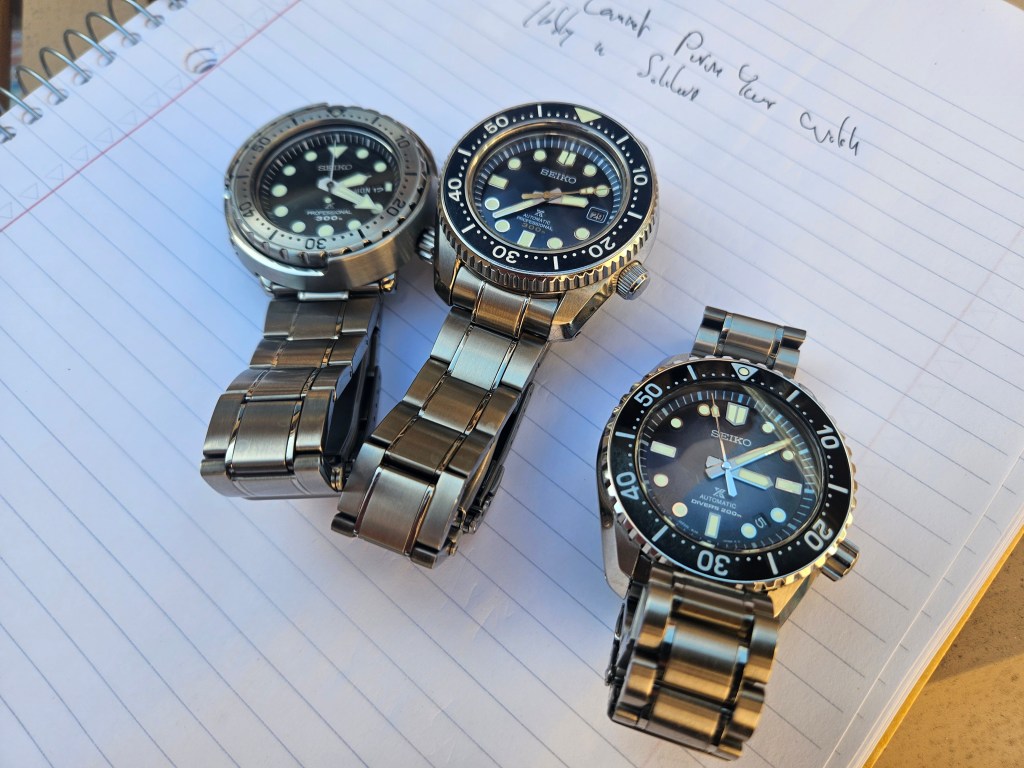
    Next comes the Saturday Night Diver Symposium. While your spouse and her friends are making custom concert signs for a desert music festival, you are at home performing strap swaps with surgical focus, refining a rotation calendar, and updating your annual wrist-time ledger. You know—without irony—that your Seiko Marine Master logged exactly 863 hours last year. This information feels important to you. It is less important to everyone else, who now watches you the way one observes a man who alphabetizes his spices by emotional significance.

    Your tolerance for human friction declines accordingly. Grocery shopping becomes a dawn operation conducted among the sleepwalking and the defeated. The early hour is not about convenience; it is about control. By the time the world wakes up, you have completed coffee, steel-cut oats, kettlebells, macro acquisition, and inventory storage. Bed at nine. Up at five. While the masses drift through their dreams, your system has already executed its morning cycle.

    The final stage is known domestically as Captain Cancel. Social plans are treated as hostile intrusions and neutralized with strategic intelligence: weather risks, parking deficiencies, epidemiological concerns, structural hazards, noise pollution, or the sudden discovery that a once-beloved comedian has not been funny since the Reagan administration. On the rare occasion you attend Taco Tuesday, you insert improvised ear protection, declare a medical issue, and Uber home to safety. The long-term result is operational peace. Invitations cease. The perimeter holds.

    If any of this feels familiar, the diagnosis is clear. You have optimized your life for accuracy, order, and solitude. The chaos of human variability has been replaced by the calm logic of regulated systems. In Watch Hermit Mode, you are not hiding from the world. You have engineered a better one—smaller, quieter, perfectly timed. The door is locked from the inside, the key discarded, and the movement is running beautifully.

  • The Dignity Liquidation Cycle: When Buying Feels Good and Selling Feels Necessary

    The Dignity Liquidation Cycle: When Buying Feels Good and Selling Feels Necessary

    If I were brutally honest, I’d admit that over the past twenty years, ninety-five percent of my watch purchases were impulsive. Which means ninety-five percent were evidence of arrested development with a credit card. I sold most of them at a loss—not because I needed the cash, but because I needed my self-respect. This is the Dignity Liquidation Cycle: the ritual of unloading recent purchases at a financial loss to restore psychological balance. The money forfeited becomes a self-administered fine, a tuition payment to the School of Impulse, and a symbolic attempt to reassert control over a mind that briefly wandered off without supervision.

    The harder question is not what I bought, but why I kept buying. My suspicion is cultural. I come from the Me-Generation, raised in 1970s California where desire wasn’t something to question—it was something to honor. Rob Lowe captured the atmosphere perfectly in Stories I Only Tell My Friends: the Counterculture as the Worship of the Self. Whatever the Self wants, the Self gets. No brakes. No compass. In Malibu’s sunlit dreamscape, people overdosed on pleasure, vanished into excess, and confused appetite with identity. When desire becomes sacred, reality becomes negotiable—and the bill eventually arrives.

    That wiring never quite left me. When I see a watch that speaks to me, my brain lights up like I’ve taken a controlled substance without the prescription. The surge is immediate and physical. Then comes the anger—not at the price, but at the loss of command. What does self-belief even mean if a rotating bezel can override your judgment? How do you grow into adulthood if your emotional economy still runs on the logic of a sixteen-year-old with access to a catalog?

    I don’t want rehab. I don’t want a hobby that has to be locked in a drawer for my own safety. I want a watch life that fits inside reality instead of pulling me out of it. Pleasure without compulsion. Enjoyment without drama. A collection that reflects judgment rather than appetite. In other words, I want the hobby to behave like an adult, even if the hobbyist occasionally does not.

    And here’s the punchline: even diagnosing the Me-Generation triggers nostalgia for being sixteen in Southern California in 1976, when the future felt endless and impulse felt like freedom. The danger is looking back too long. That way lies Lot’s wife, calcified in longing. So I change the channel. I close the YouTube reviews. Because the distance between “research” and “purchase” is about three videos—and I’ve learned the hard way that impulse has a very convincing voice when it sounds like happiness.

  • The Art of Managing Excess Without Reducing It

    The Art of Managing Excess Without Reducing It

    At some point in the life of a watch obsessive, the collection crosses a quiet but decisive border. You no longer own the number of watches you once imagined as tasteful, disciplined, and sane. The ideal was five. Seven felt like a firm upper limit. Then one day you open the watch box and discover you’re living with nine, twelve, perhaps seventeen small mechanical dependents staring back at you like polite, expensive houseguests who have no intention of leaving.

    This is the moment when pride turns to pressure. The collection is no longer a source of simple pleasure but a low-grade psychological obligation. Each piece wants wrist time. Each one carries a memory, a justification, a story you once told yourself about why it was necessary. Selling is theoretically an option, but in practice it’s a bureaucratic ordeal for a financial return that feels insulting relative to the emotional investment. These watches are not inventory. They are artifacts. They are also, inconveniently, permanent.

    In my case, the number is nine. My comfort zone is seven. Two extra watches may not sound like a crisis, but in the obsessive mind, those two pieces push the collection into the Anxiety Zone—a territory defined less by quantity than by the feeling that ownership has quietly outrun intention.

    When reduction feels impossible, the mind does what it does best: it invents management strategies. Not to shrink the collection, but to make the collection feel smaller. We call this Inventory Anxiety Mitigation: a set of mental and logistical tactics designed to dull the psychological pressure of owning more watches than one believes is reasonable.

    The first maneuver is the Comparative Relief Loop. You soothe yourself by looking outward. Yes, nine feels excessive—until you visit a forum where someone casually posts a photo of forty-seven watches arranged like a jewelry store liquidation. Perspective arrives. Your excess becomes restraint.

    Next comes Taxonomic Downsizing. You divide the herd into categories: mechanical, quartz, solar, titanium, G-Shock. Each subgroup feels modest. Nothing has actually been reduced, but complexity has been repackaged into smaller mental containers, which creates the comforting illusion of discipline.

    Then there is Scheduled Rotation Rationalization. You build a calendar. Monday is the diver. Tuesday is the G-Shock. Wednesday is titanium day. Structure transforms abundance into a system. The problem is no longer “too many watches.” The problem has been reframed as operational logistics.

    Inventory Legitimization follows naturally. Tracking, cataloging, planning, rotating—these activities convert accumulation into something that feels curated. The collection acquires moral authority. It is no longer excess. It is a program.

    Underneath all of this lies Cognitive Load Camouflage. Lists, spreadsheets, categories, and schedules do not reduce the mental weight of ownership. They conceal it. Administration becomes a mask for complexity, allowing the collector to feel in control without actually simplifying anything.

    And then there is the internal voice I call Kevin O’Leary Scolding. When you stand before the watch box feeling faintly overwhelmed, you hear the imaginary Shark Tank verdict: “Stop whining about your watches. Get out of the house and make some money.”

    Together, these strategies reveal the collector’s central paradox. When reduction feels unrealistic, the mind does not shrink the collection. It redesigns the story. The watches stay the same. The narrative gets smaller.

  • When No One Notices, the Watch Finally Becomes Yours

    When No One Notices, the Watch Finally Becomes Yours

    A word of counsel to anyone entering the watch community: prepare to be ignored.

    You will spend months researching, comparing, obsessing over the ultimate timepiece. You will move money around with the strategic intensity of a small hedge fund. When the Holy Grail finally arrives and you fasten it to your wrist, it will hum with meaning. Your pulse will quicken. Your posture will improve. You will feel like a cross between a secret agent and a Power Ranger.

    Then you will go to a party.

    No one will notice.

    You will angle your wrist during conversation. Nothing. You will reach for a glass slowly, theatrically. Nothing. You will stand under brighter lighting, rotate the bezel, perhaps mention the brand in passing. Still nothing. The evening will end without a single comment. It will be as if both you and your grail passed through the room as a minor atmospheric event.

    This is the onset of Grail Invisibility Shock (GIS)—the disorienting realization that an object carrying enormous emotional weight for you occupies exactly zero space in anyone else’s consciousness.

    In the early years, GIS can sting. I would go home irritated, quietly wounded, entertaining dark thoughts about selling the watch that had failed to perform its social duties. If the world refused to applaud, what was the point?

    Time cures this illusion.

    Eventually, you understand something liberating: the watch you choose each morning is your private theater. The drama is internal. The audience does not exist. Your job is not to harvest attention or stage-manage admiration. Your job is simply to wear what you love.

    Once this realization settles in, public indifference becomes an unexpected gift. Without the burden of performance, the pleasure sharpens. The hobby sheds its social anxiety and returns to what it should have been all along—an aesthetic conversation between you and your wrist.

    When no one notices, the watch finally becomes yours.

  • When Self-Improvement Makes Your Watch Addiction Worse

    When Self-Improvement Makes Your Watch Addiction Worse

    Here is an unpleasant truth about watch addiction: you don’t eliminate it.
    You replace it.

    Let that sit for a moment.

    Now here’s the second unpleasant truth: self-improvement—the very thing you hope will save you—may actually make your watch addiction worse.

    Consider Exhibit A: December, 2017.

    I was at a Christmas party feeling miserable. Two hundred forty-five pounds. Feet aching. Energy low. I found myself talking to a celebrity chef and former powerlifter—the kind of man who treats body composition like a moral philosophy. His advice was simple: lose the weight.

    So I went to war.

    Yogurt for breakfast. Protein and salad for lunch. Protein and vegetables for dinner. At night, a tiny apple—my “satiety apple,” the culinary equivalent of a ration in a survival bunker.

    Eight months later, I was down forty-five pounds.

    At 200, I wasn’t lean so much as economized. Sitting on a piano bench hurt because the butt padding was gone. But I looked sharp. Very sharp.

    And that’s when the trouble began.

    The fitness journey was supposed to quiet my watch obsession. Instead, it fed it. The slimmer I became, the more I noticed how watches looked on my wrist. I wasn’t just wearing timepieces anymore. I was curating a silhouette.

    Health had quietly mutated into performance.

    This is the Identity Optimization Spiral—the moment self-improvement stops being about function and becomes aesthetic management. Body, clothes, watches, posture, lighting—everything coordinated into a single ongoing presentation of the self.

    I told myself I was pursuing discipline.
    What I was really pursuing was approval.

    And approval requires accessories.

    So the watches multiplied—not because I needed them, but because my “new body” deserved the right visual punctuation.

    The story, of course, did not end in triumph. Weight rarely leaves permanently; it negotiates. Mine drifted back upward over time—not all the way, but enough to remind me that maintenance is not a phase. It’s a permanent job.

    And that’s the real parallel between dieting and watch restraint.

    Both run on willpower.
    Both require constant vigilance.
    Both demand energy.

    Imagine riding an exercise bike at full speed, indefinitely. You can do it for a while. You sweat. You grind. You feel heroic.

    Then you slow down.

    Then you stop.

    And the moment you stop pedaling, gravity returns. The diet loosens. The browsing begins. The credit card warms up. Worse, the exhaustion from all that heroic restraint makes the relapse stronger.

    This is the cruel math of self-control: willpower is a fuel tank, not a personality trait.

    The more you burn, the more violently you eventually refuel.

    Looking honestly at addiction—whether to watches, food, or the fantasy of perfect self-management—is humbling. It suggests something most improvement culture refuses to admit:

    We are not systems to be optimized.
    We are appetites trying to manage other appetites.

    Sometimes we succeed.
    Sometimes we substitute one obsession for another.
    And sometimes the search for the cure becomes just another addiction wearing a healthier costume.

  • Why I Bought the G-Shock Frogman

    Why I Bought the G-Shock Frogman

    If you’re buying the G-Shock Frogman GWF-1000-1JF, you need to abandon one illusion immediately: the fantasy that you are a solemn, high-minded “serious watch buyer.”

    Yes, the Frogman is a legitimate tool—ISO-rated, solar-powered, atomic-syncing, built like a bunker. It tracks tides. It handles world time. It could probably survive a minor meteor event.

    But let’s be honest.

    The Frogman is not a symbol of horological gravitas.
    It is a giant, unapologetic wrist toy.

    And that’s the point.

    This is not the watch of a restrained aesthete sipping espresso while discussing movement finishing. This is the watch of a twelve-year-old who never lost his appetite for adventure. The Frogman doesn’t whisper refinement. It shouts, Let’s go break something. It belongs just as comfortably on your wrist while you’re teaching rhetoric as it does while you’re wandering the house in gym shorts and a robe, pretending you might dive into the Pacific at any moment.

    So stop apologizing.

    Look at the thing. Smile.

    You’ve spent years marinating in the mythology of seriousness—heritage, prestige, restraint, the quiet dignity of brushed steel. Enough. Watches were never meant to be solemn artifacts of personal identity. They were meant to delight the eye, engage the hand, and give you a small surge of pleasure every time you check the time.

    What you’re practicing now is Gravitas Shedding—the psychological act of discarding the heavy costume of the “serious collector” and admitting a simple truth: if the hobby isn’t fun, it isn’t sustainable.

    Function still matters, of course. The watch should be well made, reliable, and usable. But once those boxes are checked, joy becomes the real criterion. The worst fate for any watch isn’t inadequacy—it’s boredom.

    Many enthusiasts have told me every collection needs at least one G-Shock for exactly this reason. A pressure valve. A reminder that watches don’t have to be precious.

    So after fifteen years of on-again, off-again longing, I finally did it.

    Last month I checked Sakura and saw the Frogman was out of stock. Prices on eBay were absurd. I assumed the window had closed. Case dismissed. Desire filed away.

    Then it reappeared.

    $440.
    $506 after shipping.

    Decision made.

    Now I have a new assignment: learn the dual-time function and actually use the thing when I travel. If I’m going to own a watch that can track the world, I might as well let it earn its keep.

    And I’ll admit it—I’m looking forward to the arrival more than I expected.

    I own beautiful mechanical divers. But when I picture myself in front of a classroom, talking about argument structure and logical fallacies, I don’t see a polished luxury piece on my wrist.

    I see the Frogman.

    Big. Black. Slightly ridiculous. Completely confident.

    Will it become my daily watch?
    Will it replace the others?
    Will it become my signature?

    That’s the experiment.

    The watch is on the way.

    We’ll see what happens.

  • G-Shock University: Studying for the Frogman Final Exam

    G-Shock University: Studying for the Frogman Final Exam

    My next personal project is to graduate from what I now call G-Shock University. Some people study Spanish. Others learn Italian. I, apparently, am trying to become conversational in Mode Logic.

    This is not my first attempt. Over the past twenty years, I’ve owned half a dozen G-Shocks, and every time the same thing happened: I opened the manual, felt like a tourist staring at a subway map written in hieroglyphics, panicked, and eventually sold or gave the watch away. I didn’t own the G-Shock. The G-Shock owned my anxiety.

    Not speaking the language of modes has been humiliating—like a prizefighter getting knocked out before the announcer finishes his name. But this time I want a comeback. This time I want fluency. Specifically, I want to master the Module 3184, the operating system inside the watch I’ve coveted for more than a decade: the digital Frogman GWF-1000.

    I don’t own the Frogman yet. First, I must earn it. I’m currently studying the operating guide like a nervous graduate student preparing for orals. I suffer from Mode Impostor Syndrome—the uneasy conviction that I am intellectually unqualified to own a feature-rich digital watch, combined with the quiet terror that someone will ask, “How do you switch time zones?” and I’ll freeze like a deer in tactical headlights.

    The interface is simple in theory: four buttons.
    Top left: A.
    Top right: B.
    Bottom left: C.
    Bottom right: D.

    Simple. Elegant. Also, somehow, psychologically menacing.

    Button C scrolls through the modes—the linguistic equivalent of changing verb tenses. My goal is modest. I want Timekeeping Mode set to LAX as my home city. I want World Time Mode so I can toggle easily when traveling to Miami, Cabo, or Maui. Diving logs, tide data, countdown timers, alarms—these are elective courses. I am here for conversational proficiency, not a doctorate.

    The manual’s tone is reassuring. Every complex procedure begins with a comforting phrase: First Thing You Should Do.

    The first thing, apparently, is to sit near a window. Already this feels less like a watch and more like a houseplant.

    From Timekeeping Mode, I hold A until the city code flashes. Then D moves east, B moves west, and eventually I land on LAX. Press A again to exit. Supposedly this locks in the Home City and sets the time.

    Supposedly.

    Here is where my second condition emerges: Mode Anxiety—the persistent fear that one wrong press will erase home time, activate some obscure subroutine, or send the watch into a digital wilderness from which it may never return.

    Page 6 introduces the Dual Time display. Press A to toggle between date and the selected World Time. This raises a terrifying question:
    Am I viewing another city… or accidentally reprogramming my home city to Miami?

    The last thing I need is to wake up in Torrance and discover I’m living psychologically in Florida.

    Manual time setting is even more daunting. Twelve variables: city code, DST, 12/24 format, seconds, minutes, hours, illumination duration, power saving, tone, day, month, year. This is no longer watch ownership. This is municipal governance.

    One setting, however, brings joy: button tone. Silence is essential. In Timekeeping Mode, hold A, press C nine times, toggle to Mute with D, press A to exit. At last, a victory. The watch will no longer beep like a microwave with opinions.

    Other questions remain.
    Do I need to manage DST, or will the radio signal handle it?
    How exactly do I move cleanly between Home and World Time without triggering a digital incident?

    At this point, I suspect what I really need is a one-hour Zoom session with a Professor of G-Shock Studies.

    Because this is no longer about a watch. This is about conquest.

    Like Ahab stalking the whale, I want to master the module and earn the right to wear the Frogman with confidence. What I’m really fighting is Frogman Qualification Anxiety—the belief that ownership of a high-end G-Shock must be earned through technical mastery, as if the purchase were a certification exam rather than a retail transaction.

    If I pass, I won’t just own a watch.

    I’ll finally be fluent.

  • Rome Wasn’t Built in a Day, and Neither Was a Better Body

    Rome Wasn’t Built in a Day, and Neither Was a Better Body

    Five months into a rotator cuff injury, my left shoulder now runs a morning protest movement. Today it was particularly militant. The arthritis pain was so loud it drowned out my writing, which is saying something, because writing is usually where I go to escape pain, not negotiate with it.

    The solution, as usual, was humility. I picked up light dumbbells and did slow lateral raises—nothing heroic, nothing Instagram-worthy. Just enough movement to get blood into the joint and remind it that we are still partners, not enemies. The pain eased. Ibuprofen helped too, but I’ve learned the hard lesson: skip it for a day, let the inflammation throw a party, and it takes hours to evict the guests.

    Rotator cuff arthritis is a mechanical problem disguised as a moral one. When the joint isn’t tracking well, the socket gets irritated, and the irritation becomes inflammation. Night makes it worse. While you sleep, the synovial fluid thickens into something closer to cold syrup. Morning arrives, and the shoulder feels like a rusty hinge. The cure is movement—gentle, persistent, unglamorous movement. Every time I loosen it up, the joint forgives me a little.

    Training now looks less like conquest and more like diplomacy. Two kettlebell sessions a week, mostly lower body, with some shrugs and narrow-stance knee push-ups—just enough upper-body work to maintain function without provoking rebellion. Power yoga is back three days a week, a return to the early-2000s era of Bryan Kest and Rodney Yee, now supplemented by the Man Flow Yoga channel. I modify poses for the shoulder, but once I settle into the rhythm, the familiar state returns—the quiet, steady current of yoga flow. At this point, the mental repair may be more important than the physical.

    The Schwinn Airdyne—the Misery Machine—has been demoted to one day a week. Left unchecked, I turn cardio into a courtroom, constantly trying to beat yesterday’s calorie output. Competition with yourself sounds noble until it becomes another form of anxiety.

    Underneath all of this sits the larger ambition: weight loss through appetite discipline. Easier declared than achieved. Two nights ago I dreamed I wanted to be lean again but could only get there through GLP-1 drugs (which I’ve never taken). Such a dream is what your subconscious imagines when it has lost faith in your willpower. I’m hovering around 230—solid in a T-shirt, but without the narrower waist that signals to the world (and to my lab results) that discipline has the upper hand. For me, that line is about 210.

    Physical self-improvement is rarely about aesthetics alone. It’s an attempt to become the kind of person who can choose the long-term over the immediate—the kind of person who doesn’t negotiate with every craving. Discipline isn’t punishment. It’s the architecture of a calmer life.

    This question of belief came back to me while watching the documentary Queen of Chess, about Judit Polgar, who fought her way through a male-dominated chess world. Her advice was simple: you have to believe in yourself. The line landed harder than expected.

    But belief doesn’t arrive on command. If your history includes abandoned goals and broken dietary programs, confidence isn’t a mindset—it’s a construction project. It’s built the only way durable things are built: small wins, repeated often enough that the brain stops arguing.

    Rome wasn’t built in a day. Neither is a shoulder. Neither is a waist. Neither is a self you trust.

  • Letting Go of the Bro Code

    Letting Go of the Bro Code

    My friend Lee retired at sixty-one, fled the tech industry, and landed in Santa Fe like a man stepping out of a chrysalis. The move gave him what he said his spirit had been begging for: a clean reinvention. These days he volunteers as a rescue worker at the local ski resort—hauling people out of trouble, useful again, awake in his body.

    My own retirement is eighteen months away, and I feel the same hunger for reinvention—but without the romance of relocation. My wife and kids aren’t uprooting, and neither am I. So if I’m going to change, the terrain has to be internal. I don’t need a new zip code; I need a new relationship with myself.

    Some of this craving is spiritual. Some of it is brutally practical. For the past five months I’ve been rehabbing a torn rotator cuff marinated in arthritis. I tried to negotiate with my kettlebell workouts—adjusting angles, trimming volume, pretending moderation would save me. It half-worked. What didn’t improve was the resentment. In fact, it metastasized.

    I know exactly how I got here. I overdid kettlebells—four days in a row, again and again—until my shoulder finally filed a formal complaint. Now the bells feel less like tools and more like accusations. I still want to train five or six days a week, but the thought of picking them up fills me with a low-grade fury. When resentment becomes chronic, it’s information. Ignoring it is how you end up injured and stubbornly proud about it.

    What I keep circling back to is yoga—specifically my mid-2000s era, when power yoga was my religion. Back when Bryan Kest and Rodney Yee videos taught me that yoga could be punishing, sweaty, and deeply satisfying. One hour. Total exhaustion. Muscles lit up, ego humbled, mind quiet. I want that again—not just the shape of it, but the mental state. I want to get lean. I want a diet that actually complements the practice: simple, semi-vegan, enjoyable. Yoga four days a week. The exercise bike on the others. Nothing heroic. Nothing destructive.

    Of course, underneath all of this is the same old human wish: character. I want a yoga lifestyle that reflects self-possession, self-discipline, and self-confidence—the real currencies of happiness. Not indulgence. Not macho theater. If I’m going to retire in the Southern California suburbs, fine. But I can’t be the retired guy slowly maiming himself in the garage, clinging to an identity that no longer serves him.

    Yoga never hurt me. Not once. It always left me clearer, calmer, and stronger in ways that mattered. As a lifetime weightlifter, I’m realizing I need to let go of the Bro-Coding and Bro-Signaling that once fed my pride. What is a real man, anyway? It isn’t someone chasing pump and punishment while overeating and limping through life. It’s someone fit, injury-free, and genuinely disciplined.

    Lee rescues skiers. I admire that. But before I can rescue anyone—before I can reinvent anything—I have to rescue myself first.

  • Why Your Watch Doesn’t Make You Happy Anymore

    Why Your Watch Doesn’t Make You Happy Anymore

    To understand the madness of the modern watch addict, you’d do well to consult Dopamine Nation by Stanford psychiatrist Anna Lembke, a book that should be shelved somewhere between philosophy, neuroscience, and quiet screaming. Her central thesis? In an age of relentless indulgence, the line between pleasure and pain is not only blurry—it’s the same neurological pathway. You’re not escaping pain with your latest acquisition. You’re feeding it.

    “The smartphone,” she writes, “is the modern-day hypodermic needle.” And the drug? Dopamine—delivered in neat little parcels: TikToks, tweets, memes, and yes, wrist shots of watches you don’t own (yet). If you haven’t met your poison of choice, don’t worry. It’s just a click away.

    Lembke makes the uncomfortable truth clear: The more dopamine hits we seek, the more our brain adapts by reducing our baseline pleasure response. What once thrilled you—your grail watch, your Rolex Explorer, your Seiko with the Wabi-Sabi patina—now barely registers. You’re not chasing pleasure anymore. You’re just trying to feel something.

    Watch addicts, of course, understand this intimately. The pursuit of horological perfection starts out innocent enough: a G-Shock here, a vintage diver there. But soon you’re tumbling into the abyss of boutique limited editions and message board enablement, haunted by the need to stay relevant. Because here’s the twist: It’s not just about the watches. It’s about being seen. You post, you review, you flex because if you stop, you vanish. No new watches = no new content = digital extinction.

    And extinction, in a social-media world, feels like death.

    Lembke warns us that addiction thrives in secrecy, in the exhausting double life. The watch addict may present as a tasteful minimalist to family and friends, while secretly rotating 19 watches, five straps deep, waiting for the next “drop.” The addiction is fed by access, and we live in an access economy. New releases are no longer annual events—they’re hourly temptations. The vortex is bottomless. The supply creates the demand.

    Even worse, modern society normalizes this behavior. Everyone is scrolling. Everyone is upgrading. Our addiction to novelty is passed off as taste. Our frenzied consumption masquerades as identity. Lembke borrows from Philip Rieff to explain the deeper shift: “Religious man was born to be saved; psychological man is born to be pleased.” The modern watch collector doesn’t believe in salvation. He believes in configuration.

    But here’s the cruel irony: The more you seek to be pleased, the less capable you are of being pleased. In Lembke’s words: “Hedonism, the pursuit of pleasure for its own sake, leads to anhedonia—the inability to enjoy pleasure of any kind.”

    You can understand the watch addict’s feeble quest when you look at the Horological Dopamine Loop–the self-reinforcing cycle in which acquisition, posting, validation, and anticipation replace enjoyment. The watch no longer delivers pleasure; it merely resets the craving for the next hit.

    What’s the solution? A dopamine fast. Lembke prescribes it like a bitter medicine: Remove the source. Reset the brain. Let it reestablish homeostasis. For the watch addict, this means one thing: a watch fast.

    And yes—it’s brutal. I’ve been a watch obsessive for over twenty years. My longest fast? Six months. And I nearly went feral. New releases tempt. Friends enable. Algorithms whisper. Strap swaps and vintage reissues beckon like sirens. Even the FedEx truck starts to look like a personal tormentor.

    So you get creative. You stash watches in the safe and “rediscover” them. You buy new straps instead of new watches. You try to redirect the compulsion toward something productive: fitness, music, sourdough, monkish austerity. Anything but another chronograph.

    But the real cure, oddly enough, may be conversation—actual human connection. At watch meet-ups, we start out discussing bezels and spring bars, but within ten minutes we’re talking about life: real estate, parenting, knee surgeries, emotional burnout, dinner recipes. We talk for hours. But barely about watches.

    The truth slips out in these moments: we want to be free. We crave community more than we crave sapphire crystals. What began as a shared obsession has become a trap, and these conversations, paradoxically, offer relief from the very addiction that brought us together.

    Imagine a bunch of watch enthusiasts at a watch meet-up and we’re talking about everything but watches. Wrap your head around that.