Tag: horror

  • The Everyday Vampires Who Feed on Chaos

    The Everyday Vampires Who Feed on Chaos

    Olga Khazan’s article “There’s a Name for the People Who Drain You” examines one of the unavoidable pests of human civilization: the hassler. Hasslers are the emotional pickpockets of everyday life. They drain those around them through relentless criticism, selfishness, bitterness, narcissism, cruelty, cynicism, and, in extreme cases, outright sociopathy. They appear everywhere—in workplaces, families, neighborhoods, and friend groups. No community is immune to them.

    The consequences of prolonged exposure are hardly trivial. To spend years trapped in the orbit of one or more hasslers is to live inside a low-grade psychological emergency. Anxiety rises. Cortisol surges. Depression follows. Autoimmune disorders become more likely. The body keeps score while the hassler keeps talking.

    One of the defining characteristics of the hassler is an appetite for friction. Hasslers are rarely content with peace and stability. They stir the pot, manufacture grievances, incite drama, and transform minor disagreements into theatrical productions. To ordinary people, conflict is exhausting. To the hassler, it is entertainment. The discomfort of others becomes a form of nourishment. Their preferred habitat is chaos because chaos guarantees attention, and attention is the oxygen they breathe.

    Unfortunately, hasslers cannot be avoided entirely. If you belong to a family, workplace, church, club, school, or neighborhood, you will eventually encounter one. They emerge with the reliability of weeds breaking through concrete.

    As I read Khazan’s article, I found myself thinking about the horror film Weapons and its sinister figure, Aunt Gladys. Gladys operates less like a conventional villain than a supernatural parasite. She feeds upon the misery of others with such potency that she seems less human than witch-like. Her power lies not in physical force but in her ability to infiltrate the emotional lives of her victims and convert their suffering into sustenance.

    Viewed through Khazan’s framework, Aunt Gladys may be the ultimate hassler.

    What fascinates me about figures like Gladys is that they often appear strangely hollow. They possess no stable center of their own. They are ciphers, vacuums, nonentities. Because they lack an inner life rich enough to sustain them, they must draw energy from the emotional resources of others. To feed, they must first weaken their prey. They create confusion, vulnerability, self-doubt, and dependency. Only then can they begin extracting what they need.

    In this sense, the hassler resembles a vampire. Not the elegant aristocrat in a velvet cape, but a psychological vampire who feeds not on blood but on attention, anxiety, and emotional exhaustion. The vampire drains the body. The hassler drains the spirit.

    Perhaps this is why hasslers appear so frequently in horror stories. They embody a fear that feels immediately recognizable. Most of us have never encountered a werewolf. Few of us have met a ghost. But nearly everyone has known someone who seemed to feed on conflict, manipulate relationships, and leave every room darker than they found it. Horror films merely give supernatural form to a creature we already know.

    The hassler, then, is not merely a difficult person. The hassler is an archetype. Long before horror movies invented monsters lurking in haunted houses, human beings were already living among people who fed on chaos and misery. The monsters came later. The hasslers came first.

  • Tuna on the Cheek, Blood on the Screen: Review of “Send Help”

    Tuna on the Cheek, Blood on the Screen: Review of “Send Help”

    When I watched Send Help two nights ago, I kept waiting for the horror to announce itself with a straight face. It never did. The film opens in a fluorescent office where Bradley Preston—an heir in a blazer, a man-child in executive drag—struts through a company he inherited the way one inherits a bad habit. His confidence is all surface tension: glossy, brittle, and one sharp object away from collapse. From the first scene, it plays less like a fright fest and more like a comedy that knows its punchlines will land harder if they’re soaked in blood.

    The supporting cast speaks fluent “bro,” a dialect of buzzwords and chest-thumping that echoes the bleak satire of In the Company of Men—only here the jokes move faster and the air is less suffocating. Early on, the movie tips its hand with a small, perfect humiliation: Linda Liddle, a socially awkward office worker with Survivor dreams, approaches Bradley with a chunk of tuna clinging stubbornly to her cheek. He can’t hear a word she says. The camera betrays him—cuts to a close-up of his eye, deranged and hypnotized by that fleck of fish like it’s a moral crisis. The gag is surgical. It reduces Bradley to appetite and Linda to spectacle in a single, merciless beat.

    The degradation doesn’t stop there. Bradley and his phalanx of bros revel in their own language, a lexicon designed to inflate mediocrity into swagger. Then the film detonates its premise: a flight to Thailand, a thunderstorm, a crash, an island. Suddenly the hierarchy flips. Bradley’s confidence evaporates in the salt air, and Linda—quietly competent, long dismissed—becomes indispensable. Her survival skills, once a punchline, turn into the only currency that matters. The movie sharpens into what it always wanted to be: a comedy of reversal, where a cocky lightweight is schooled by the person he spent years underestimating.

    Yes, there’s horror here—gore, shocks, the occasional indulgence in spectacle—but it all feels enlisted in the service of the joke. The violence doesn’t deepen the dread; it punctuates the satire. The film moves briskly, with clever turns that keep it buoyant where LaBute’s film sinks into a kind of moral tar. And yet the two works feel like distant relatives: both obsessed with cruelty, both fascinated by the theater of male arrogance, both willing to strip their characters bare. The difference is that Send Help has the decency to laugh while it does the stripping—and in that laughter, it finds its edge.

  • Why My G-Shock Saga Refuses to Become a YouTube Video

    Why My G-Shock Saga Refuses to Become a YouTube Video

    What follows is the essay that will serve as the basis for my YouTube video explaining why no such video can, in fact, be made from it.

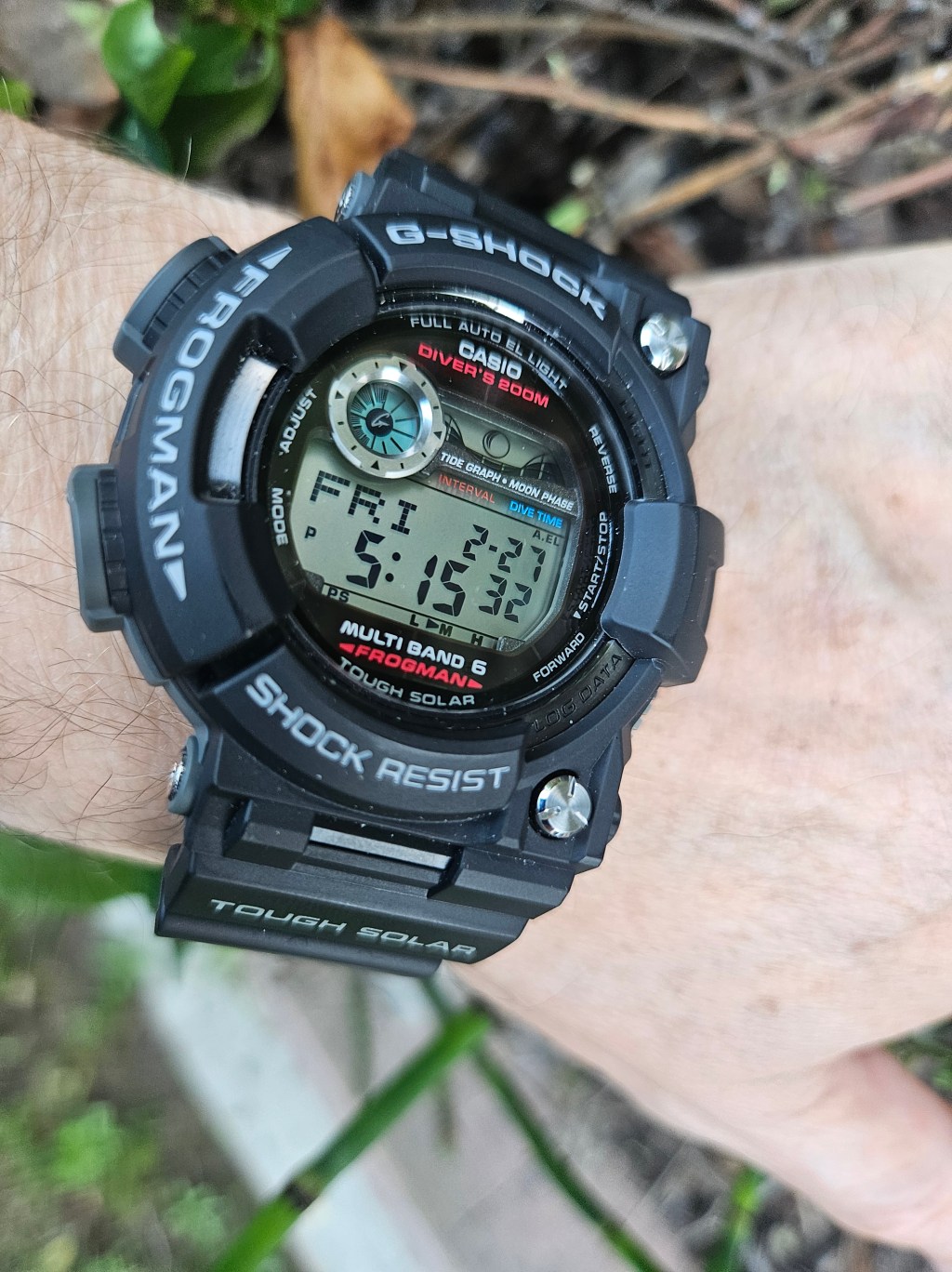
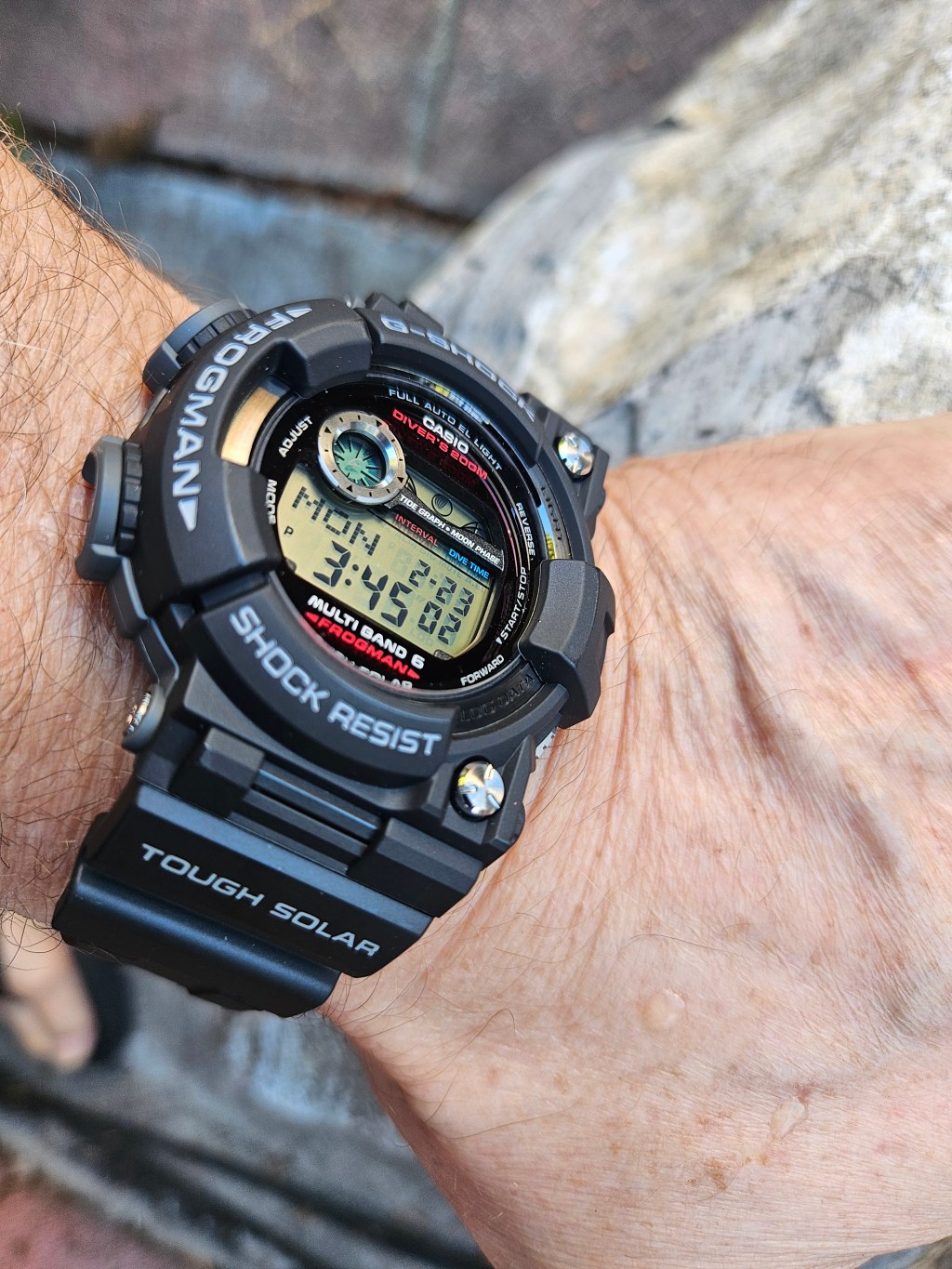
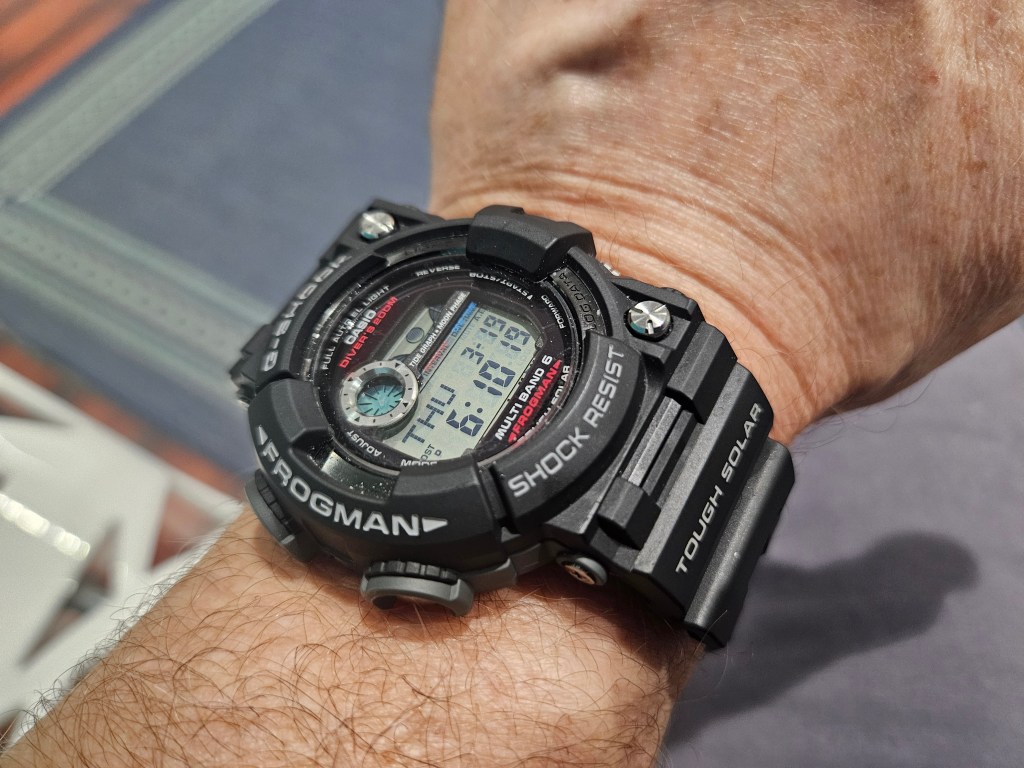
    Six weeks ago, I received my G-Shock Frogman and promptly lost my mind. Not gradually. Not with dignified hesitation. I went down hard. The more I studied its lopsided, industrial architecture, the more I found myself staring at it the way one stares at brutalist buildings—confused at first, then strangely moved. Black resin, thick as a tire wall, sat on my wrist with the quiet confidence of a machine that does not care if you approve of it. No one told me industrial black resin could look so beautiful. 

    This startled me. I had long filed resin under “gym timer” and “Office Space despair”—the sort of material worn by men who have stopped expecting things from life. What kind of man sidelines a stable of expensive mechanical divers—curated, polished, lovingly rationalized—for a slab of molded polymer that costs a fraction of the least expensive piece in the box? The answer, apparently, is me. Something shifted. I can’t explain it. It may take years, or therapy, or both.

    Naturally, I doubled down.

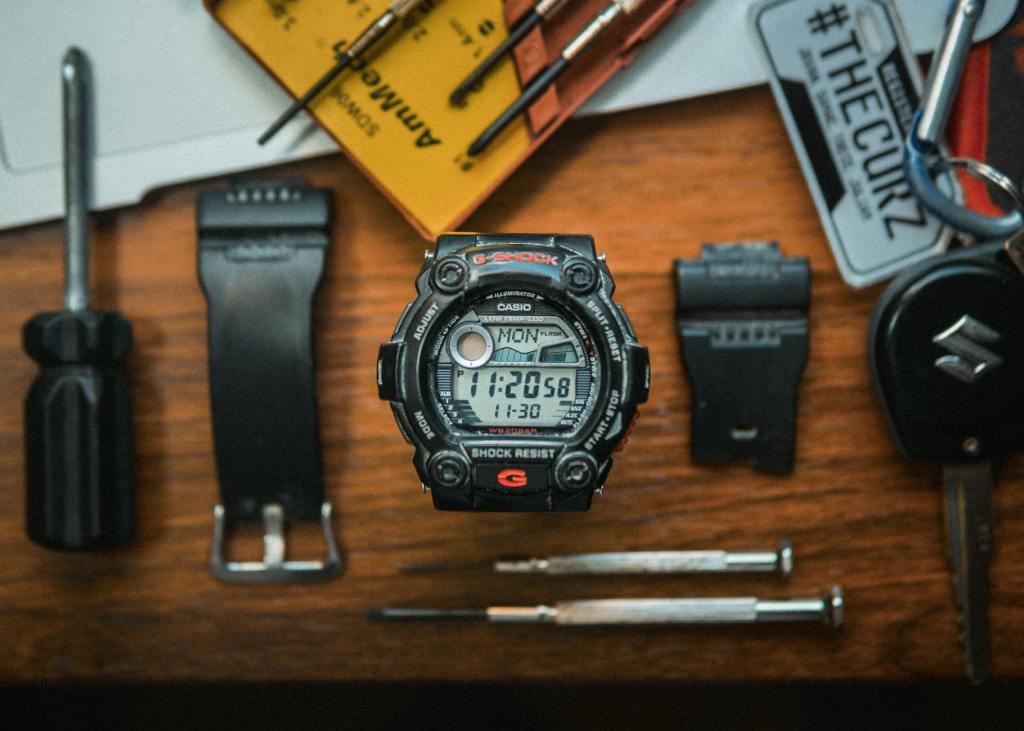
    Intoxicated by the Frogman, I added the GW-7900 Rescue, a watch that costs about one-fifth as much and delivers five times the daily utility. It is padded, legible, and indifferent to my previous standards. Its numerals are large enough to read without squinting, which, at this stage of life, qualifies as a luxury feature. It became my daily wearer within a week, displacing watches that once required white gloves and a sense of occasion.

    Still unsatisfied, I escalated. The Mudman GW-9500 arrived next, with numerals that resemble municipal signage. If the Rescue was readable, the Mudman is unavoidable. Together, the three form what I have come to call—without irony—the Hero Triad.

    All three are Multiband-6 with Tough Solar, which means they spend their nights quietly consulting the atomic clock in Fort Collins and correcting themselves with a level of discipline I have never achieved in any area of my life. The Frogman and Mudman prefer to be placed carefully—on a desk, or hanging from my T-bar like well-behaved instruments. The Rescue, by contrast, syncs wherever it pleases. It has the personality of a straight-A student who does not need supervision.

    These three watches now consume over ninety percent of my wrist time. My mechanical divers sit in their box like retired generals, decorated but irrelevant. When I told my wife this, she paused and asked, “Wrist time? Who uses that term?”

    I do. We do. We count wrist time the way bodybuilders count macros—with vigilance, denial, and occasional self-deception. And lately, my wrist time has been taken over by G-Shock.

    I’ve written about this infatuation on my blog, but my YouTube audience has made something clear: words are no longer enough. We live in an age where ideas must be performed, not merely stated. If I want to be understood, I must produce a video.

    And yet, I cannot make this video.

    First, the landscape is saturated. There are already hundreds of G-Shock videos—reviews, tutorials, warnings about imminent discontinuations delivered with the urgency of a public safety alert. To add my voice would be to echo the chorus, and I have no desire to hear myself harmonizing with better singers.

    Second, I refuse to become an evangelist. I am not here to declare a holy war against Seiko, Tudor, or Omega. This is not a zero-sum game. I have not betrayed mechanical watches with a Judas Iscariot kiss and fled into the desert with a resin accomplice. I still believe in their beauty. I simply no longer rely on them for giving me accurate time. That distinction is subtle, and subtlety does not perform well on YouTube.

    Third, I lack a coherent explanation for my conversion. I cannot tell you whether this shift is driven by age, by proximity to retirement, or by a growing intolerance for approximation in a world already saturated with it. Perhaps I simply escaped Seikotraz—the self-imposed prison of mechanical devotion—and ran toward the first open door. Whatever the cause, I am not yet qualified to narrate it.

    Fourth, my story is not unique. Millions discovered G-Shock long before I arrived, breathless and late, to report that it works. To stand before an audience and announce this would reduce me to a background character—another man discovering electricity and insisting on a press conference.

    Fifth—and most damning—this narrative reads like a watch downgrade. The story people want is ascent: the climb, the conquest, the triumphant pose at the summit. I have done the opposite. I have descended, calmly, into black resin. I have traded filet mignon for a protein bar and now stand before you insisting it is not only sufficient, but superior. This is not a heroic arc. It is a dietary confession. And possibly a sign of a pathology. 

    So no, I cannot make this video. 

    My escape from Seikotraz may or may not be complete. What I can promise is this: when the next chapter reveals itself—and it will—I’ll report back, possibly with less confusion, but no guarantees. Aren’t you glad I didn’t make this video? 

  • Frogman Monstrosity Acceptance

    Frogman Monstrosity Acceptance

    I’ve tried to be candid about where my watch hobby is headed. For years I lived in the land of mechanical divers—those charming little machines that require winding, adjusting, and periodic visits to a watchmaker who looks at you the way a veterinarian looks at a sick horse. Lately, however, I seem to be drifting toward a different ecosystem: Multiband 6 atomic time delivered by my G-Shock Frogman, a watch that feeds on sunlight and quietly synchronizes itself with atomic clocks while I sleep. It is difficult to compete with a device that performs its duties with the calm efficiency of a Swiss train conductor who never needs coffee. The responses to this confession have been varied. Some readers nod knowingly and say they went through the same conversion. Their mechanical watches now sit motionless in drawers like retired prizefighters who once thrilled crowds but now spend their days remembering the old days. One friend is currently wandering around Thailand with a GW-5000U on his wrist and reports a level of contentment normally associated with Buddhist monks. Others have taken the opposite path and begun collecting Frogman models the way medieval villagers stockpiled shields before a siege, as if surrounding themselves with these massive amphibious contraptions might repel the chaos of modern life.

    And then there are the critics. They inform me—sometimes gently, sometimes with theatrical alarm—that I have lost my mind, contracted a disease, and strapped a grotesque monstrosity to my wrist. I concede every point. I am indeed crazed with enthusiasm, and the Frogman is unquestionably a monstrosity. But it is the most magnificent monstrosity I have ever encountered. I appear to have entered what might be called Frogman Monstrosity Acceptance: the psychological stage in which the owner stops apologizing for the watch’s outrageous proportions and instead embraces them with pride. Yes, it is enormous. Yes, it looks like a small amphibious armored vehicle designed by engineers who distrust gravity. But once you surrender to its scale, the Frogman ceases to be embarrassing and becomes something far better—a gleefully excessive titan among polite timepieces.


  • The Watch You Love Is the One on Your Wrist (The Rest Are Fairy Dust)

    The Watch You Love Is the One on Your Wrist (The Rest Are Fairy Dust)

    I have painful news. We do not gather here to flatter one another’s delusions, so let’s drop the incense and speak plainly: you, me, and our inner watch cyborgs do not love our watches. We love saying we love them. We call them “beloved.” We insist they define our identity. We admire our “curated collections” as if they were doctoral theses in horological self-actualization. We stand before our watch boxes like minor kings surveying a conquered province. It feels noble. It sounds impressive. It is largely fiction.

    How do I know? Because of the evidence you provided. One of you tucked two dozen watches into a hidden trunk. Months passed. No withdrawal symptoms. No late-night longing. No tremor in the wrist. Just silence. These were not impulse purchases from a clearance bin. They were carefully researched, thoughtfully selected, celebrated arrivals. Each one represented taste refined, knowledge deepened, discernment sharpened. And yet, when placed out of sight, they might as well have been holiday decorations in July. That question now hovers over you like an uncomfortable relative at Thanksgiving: Do you love these watches—or do you love the idea of loving them?

    Here is what is happening. The inner watch cyborg is running the show. He is not sentimental; he is strategic. He manufactures urgency. He whispers about grails. He frames purchases as destiny. This is Cyborg Puppetmaster Theory in action: the internal algorithm that thrives on pursuit, not possession. The hunt is intoxicating. The checkout page is a sacrament. The shipping notification is foreplay. But once the box is opened and the novelty metabolized, the cyborg moves on. He feeds on anticipation and starves on contentment. The object was never the point. The chase was.

    And so we arrive at the diagnosis: Collection Delusion Syndrome—the condition in which a collector mistakes the performance of passion for the experience of it. The watches are polished, photographed, insured, cataloged, and then quietly exiled to a trunk where they gather dust without being mourned. The owner declares devotion, yet absence produces no ache. The romance was theatrical. The attachment atmospheric. The only watch that truly exists is the one on your wrist—the one that interrupts your day, absorbs your scratches, accumulates your hours. The rest are fairy dust with serial numbers.

    Let us be honest. This is not a dream. Real money left a real checking account. The fever swamp is funded.

    And now the confessor, staring at his untouched two dozen “prized” watches, considers the unthinkable: Perhaps I should let them go. Perhaps I should move along.

    Yes. Do so—if your inner watch cyborg permits parole.

  • Watch Potency Principle

    Watch Potency Principle

    In the late 1960s, I was watching The High Chaparral when a line lodged itself in my brain like a splinter of frontier wisdom: beware the dog who sees a second bone reflected in the water. He opens his mouth to grab more—and loses the one he already had. Even as a child, I understood the tragedy. Greed doesn’t always give you more. Sometimes it just subtracts.

    That old parable came back to me as I stared at my wrist, where a perfectly contented G-Shock Frogman has been living its best life. The temptation, of course, is to “complement” it with a Rangeman GW-9400. Complement is the polite word collectors use when they mean escalate. But a viewer on my YouTube channel issued a quiet warning: the magic of a single perfect Frogman might evaporate the moment I introduce a rival. In other words, I might reach for the reflection and drop the bone.

    This is where the psychology of the watch obsessive turns ruthless. The mind assumes addition will create abundance. In practice, it creates competition. Two watches don’t cooperate; they campaign. Wrist time fragments. Attention splits. The Frogman’s calm authority turns into a rotation debate, and the Rangeman, instead of enhancing the experience, becomes a co-conspirator in low-grade decision fatigue. Each piece loses the gravity it once held alone.

    This is the Watch Potency Principle: the hard law of emotional physics in collecting. The more you add, the weaker each piece becomes. What looks like expansion is often dilution. Instead of one watch with presence, you now have two candidates negotiating for relevance, each diminished by the other’s existence. Potency thrives on focus. Divide the focus, and the magic doesn’t multiply—it thins.

    So here I stand at the edge. The Rangeman might deliver fresh excitement. Or it might turn my singular satisfaction into a committee meeting. Like that dog at the water’s edge, I’m staring at the reflection—wondering whether reaching for more will leave me holding less.

  • The Man Who Moved to G-Shock Avenue

    The Man Who Moved to G-Shock Avenue

    Paul McCartney once admitted that after the Beatles broke up, he couldn’t bring himself to play their songs. Too much history. Too much emotion packed into every chord. The music wasn’t just music—it was a former life. That’s how you feel about your mechanical divers. They now sit in what you’ve come to call the Box of the Abandoned Past—not discarded, not unloved, but too heavy with memory to wear without reopening old chapters.

    Then the G-Shock Frogman arrived, and with it came a revelation: you hadn’t just bought a new watch—you had moved cities. For more than twenty years, you’d been living in Mechanical Town, polishing bezels and monitoring seconds like a municipal duty. Suddenly you realized you belonged somewhere else entirely. You packed your emotional bags and relocated to G-Shock Avenue. First the Frogman. Then the Rangeman. Then the high-end Square. No ceremony. No farewell speech. Just a quiet change of address.

    Years passed. Occasionally, you tried to revisit the old neighborhood. You’d take out a mechanical diver, strap it on, and see if the feeling returned. But like McCartney staring at a piano and deciding “Yesterday” could stay in the past, you always drifted back to the Frogman. It was lighter. Simpler. Emotionally frictionless. The past had craftsmanship. The present had peace.

    Still, you refuse to sell the mechanicals. They’re not watches anymore; they’re chapters. Expensive bookmarks in the autobiography of your former self. Once a year, you conduct the ritual. You open the Box of the Abandoned Past. You shine a small, theatrical light across the rows. You offer a quiet apology while Paul McCartney’s “Uncle Albert” plays in the background, the soundtrack of dignified transition.

    Your wife and daughters evacuate the premises during this ceremony, treating it with the same enthusiasm reserved for releasing an aerosol flea bomb in the living room.

    But alone in the room, you sing along, close the box, strap on the Frogman, and step back into the present—no longer a resident of the mechanical past, but a citizen, fully and permanently, of G-Shock City.

    You have entered painful terrain for the watch enthusiast: Emotional Migration. It is the moment a watch enthusiast changes allegiance not by selling a collection, but by quietly moving his identity to a new territory. The old watches may still sit in the box, polished and respectable, but the emotional address has changed. What once felt essential now feels historical; what once felt like an experiment now feels like home. There is no announcement, no dramatic purge—just the slow realization that your wrist no longer reaches for the past. Emotional Migration isn’t about acquiring something new. It’s about discovering that your center of gravity has relocated, and the watches you once loved now live where you used to live.

  • The G-Shock Exemption Doctrine: Why Some Watches “Don’t Count”

    The G-Shock Exemption Doctrine: Why Some Watches “Don’t Count”

    I have friends in the watch community who insist that “G-Shocks don’t count.” When they tally their collections, the squares and Frogmen are quietly left off the ledger. This is the G-Shock Exemption Doctrine—the unwritten rule that allows a collector to treat a G-Shock not as a watch, but as equipment, like a flashlight or a multi-tool. By this accounting magic, the collection remains disciplined, curated, respectable—untainted by the bulky, indestructible contraption sitting in the sock drawer, waiting for duty.

    The doctrine creates a bright border. On one side: mechanical divers, chronographs, heirlooms, objects of taste and tradition. On the other: the G-Shock. Yes, it tells time. But in the same way a Swiss Army knife contains scissors—it’s almost beside the point. To call a G-Shock a watch, in their view, is like calling a tricycle a bicycle. It operates in a different category of the brain, one less concerned with heritage and more concerned with survival, utility, and the quiet thrill of overcapacity.

    The psychology isn’t new. In the mid-1970s, the same reverence surrounded Texas Instruments calculators. They didn’t just crunch numbers; they conferred identity. The kid holding one wasn’t merely doing math—he was running systems. The G-Shock carries the same voltage. Atomic time. Solar charging. World time. Shock resistance. It doesn’t just tell you the hour; it implies operational readiness. You are synchronized, optimized, prepared—never mind that your most hazardous assignment today is grading essays or standing in line for almond milk. Press a button, and disorder yields to data. The fantasy is intoxicating: beneath the ordinary exterior lives a man quietly managing advanced capabilities.

    And the appeal goes deeper. The G-Shock is engineered for soldiers, divers, and field operators. It speaks not only to the analytical mind but to the tactical imagination. This is the fusion of Intellectual Man and Action Man—the spreadsheet warrior who is also, at least psychologically, deployment-ready.

    That’s the real divide. Mechanical watches point backward—to history, romance, and the comforting gravity of tradition. The G-Shock points forward. It belongs to the future, a small armored console strapped to the wrist, promising that whatever comes next, you will be ready for it.

  • Life Inside the Watch Relapse Cycle

    Life Inside the Watch Relapse Cycle

    For the watch obsessive, the most seductive experience is not the purchase.
    It’s the quiet and the possibility that his addiction is over.

    Every so often, something strange happens. The mind clears. The forums go unread. The YouTube algorithm loses its grip. The collection—miraculously—feels complete. No gaps. No missing category. No late-night searches for “best travel GMT under $5,000.”

    For a few fragile days, he wonders:

    Is this it?
    Am I… cured?
    Is this what normal people feel like?

    This state—call it Horological Remission—can be triggered by real life intruding. A demanding project at work. A family crisis. A trip to Maui where the ocean is more compelling than ceramic bezel technology. Or simple immersion in a good show—say, Fallout, where Walton Goggins and Kyle MacLachlan are busy navigating the apocalypse while, for once, the obsessive is not thinking about lug widths.

    During these rare intervals, he lives like a civilian. He checks the time without evaluating the watch. He moves through the day unaccompanied by reference numbers. He almost forgets that the phrase “micro-adjust clasp” exists.

    Hope appears.

    It never lasts.

    Because the obsession does not disappear. It waits.

    Somewhere in the unconscious lives the Octopus—patient, silent, its tentacles coiled around the deeper circuitry of attention. All it needs is a spark. A visual. A passing image. A drop of lighter fluid.

    Maybe it’s a scene in Homeland. A lean operative checks his watch. The obsessive leans forward.

    That looks like a Mudman.

    Now the cascade begins.

    Model number search.
    Variant comparison.
    Sapphire or mineral?
    Then: Full Metal series.
    Then: silver vs. black.
    Then: forum threads debating coating durability in “real-world tactical conditions,” most of which involve typing at a desk.

    This is Trigger Cascade—the rapid cognitive chain reaction in which a single exposure detonates into hours of research, comparison, and low-grade acquisition planning.

    Meanwhile, Homeland continues.

    The obsessive has no idea what’s happening.

    He cannot explain the plot, the characters, or the geopolitical stakes. But he now possesses a working knowledge of shock resistance standards across three generations of G-Shock metallurgy.

    This condition is known as Narrative Displacement Syndrome: the loss of engagement with the original activity as attention is hijacked by watch research, resulting in the peculiar outcome of knowing the reference number but not the story.

    At some point, awareness returns.

    He looks up from his phone. The episode is over. The room is quiet. Ten browser tabs glow like evidence.

    The Octopus has him again.

    In that moment, he experiences Relapse Lucidity—the painful clarity of recognizing the pattern while continuing to scroll.

    He may even feel cinematic about it. Like Charlton Heston on the beach at the end of Planet of the Apes, shaking his fist at the ruined monument of his attention span.

    You maniacs! You did it!

    Then another thought appears, calm and practical:

    If this is a relapse, should someone be filming me as I do my Charles Heston impersonation? And if that’s the case, should I be wearing the Black Bay… or the Planet Ocean?

    And just like that, the cycle resets.

  • When Loving Watches Starts to Feel Like a Job

    When Loving Watches Starts to Feel Like a Job

    In her darkly hilarious comedy special Father, Atsuko Okatsuka shares the origin story of her career in punchlines. Her schizophrenic mother once “kidnapped” her in Japan and whisked her away to the United States without warning, severing her ties to her father in the process. The trauma was so disorienting, so profound, that Atsuko now mines laughter for survival. She tells us, with a comedian’s grin and a survivor’s twitch, that she performs to fill an infinite hole in her soul with the validation of strangers.

    That hole is not unique to her. It’s a universal pit—bottomless and demanding. Validation comes in many flavors. For some, it’s esteem and admiration. For others, it’s expertise, artistry, the warm glow of audience approval. For Atsuko, it’s laughter. For others, it’s the faint buzz of a “like” on a post about a wristwatch.

    Let us now consider the watch obsessive, a different breed of relevance-seeker, but a kindred spirit nonetheless. He isn’t doing five-minute sets at the Laugh Factory, but he is performing—on Instagram, on forums, on YouTube, in the comment sections of strangers’ macro shots. He presents his taste, his “knowledge,” his ever-shifting collection. But underneath the sapphire crystals and brushed titanium is the same primal whisper:
    Do I still matter?
    Do they still see me?

    Here’s the tragic twist: he may already have the perfect collection. It gives him joy. It’s balanced. It fits in a single watch box. By all logic, he should stop. Buying another watch would be like adding a fifth leg to a table—wobbly and unnecessary. But he doesn’t stop. He can’t stop.

    Why? Because if he stops collecting, he stops posting. If he stops posting, he stops being seen. And in a world addicted to scrolling, disappearing feels like dying.

    Relevance is the new oxygen. And social media is a machine that runs on novelty, not legacy. The digital hive forgets fast. “Gangnam Style” is now a fossil. “Call Me Maybe” is background noise at the grocery store. To stay visible, you must be new. You must be shiny. You must offer dopamine.

    And what happens when the watch addict manages his demons, reaches peace, and stops feeding the machine?

    He becomes boring. He becomes silent. He becomes irrelevant.

    And the parasocial bonds he once had—those illusory friendships, those mutual obsessions—fade. The sense of exile is real. It doesn’t matter that the exile is self-imposed. The pain still lingers.

    That fear—that primordial fear of irrelevance, of being cast out from the tribe—can be so powerful it masquerades as passion. It convinces the watch obsessive to keep flipping, keep chasing, keep posting. Not out of love, but out of fear.

    In this crazed state, the obsessive has succumbed to Performative Collecting–the transformation of a private pleasure into a public act staged for recognition. Watches are curated less for personal resonance than for their ability to sustain audience attention. Silence is interpreted as failure.

    So the question becomes: Are we collectors? Or are we hostages? Do we love horology? Or are we simply terrified of vanishing?