In the late 1960s, I was watching The High Chaparral when a line lodged itself in my brain like a splinter of frontier wisdom: beware the dog who sees a second bone reflected in the water. He opens his mouth to grab more—and loses the one he already had. Even as a child, I understood the tragedy. Greed doesn’t always give you more. Sometimes it just subtracts.
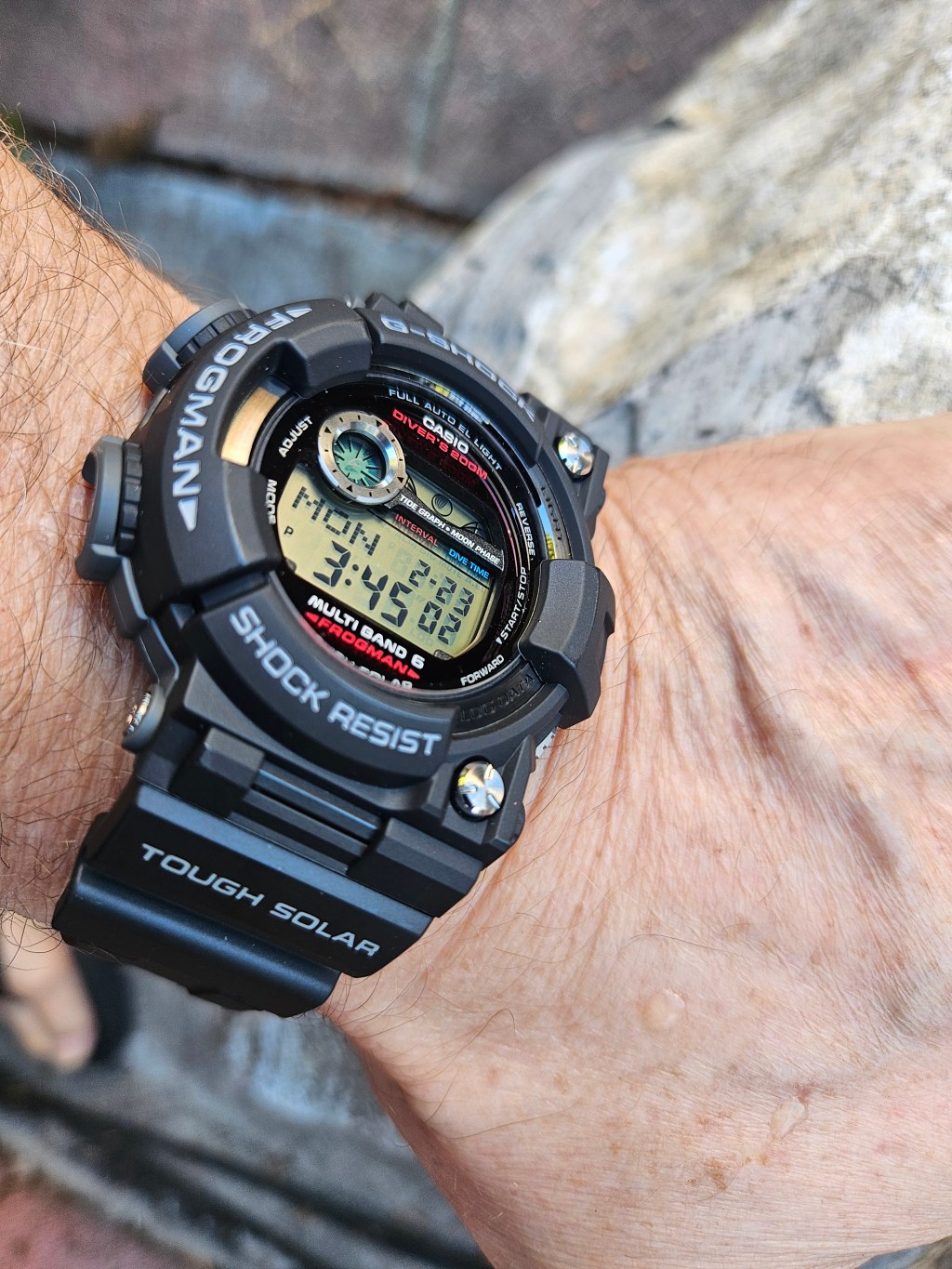
That old parable came back to me as I stared at my wrist, where a perfectly contented G-Shock Frogman has been living its best life. The temptation, of course, is to “complement” it with a Rangeman GW-9400. Complement is the polite word collectors use when they mean escalate. But a viewer on my YouTube channel issued a quiet warning: the magic of a single perfect Frogman might evaporate the moment I introduce a rival. In other words, I might reach for the reflection and drop the bone.
This is where the psychology of the watch obsessive turns ruthless. The mind assumes addition will create abundance. In practice, it creates competition. Two watches don’t cooperate; they campaign. Wrist time fragments. Attention splits. The Frogman’s calm authority turns into a rotation debate, and the Rangeman, instead of enhancing the experience, becomes a co-conspirator in low-grade decision fatigue. Each piece loses the gravity it once held alone.
This is the Watch Potency Principle: the hard law of emotional physics in collecting. The more you add, the weaker each piece becomes. What looks like expansion is often dilution. Instead of one watch with presence, you now have two candidates negotiating for relevance, each diminished by the other’s existence. Potency thrives on focus. Divide the focus, and the magic doesn’t multiply—it thins.
So here I stand at the edge. The Rangeman might deliver fresh excitement. Or it might turn my singular satisfaction into a committee meeting. Like that dog at the water’s edge, I’m staring at the reflection—wondering whether reaching for more will leave me holding less.
 Cinemorphosis
Leave a comment