Tag: horror

  • Professor Pettibone and the Chumstream Dream

    Professor Pettibone and the Chumstream Dream

    Merrickel T. Pettibone sat with a glare, Two hundred essays! All posted with flair. He logged into Canvas, his tea steeped with grace, Then grimaced and winced at the Uncanny Face.

    The syntax was polished, the quotes were all there, But something felt soulless, like mannequins’ stare. He scrolled and he skimmed, till his stomach turned green— This prose was too perfect, too AI-machine.

    He sipped herbal tea from a mug marked “Despair,” Then reclined in his chair with a faraway stare. He clicked on a podcast to soothe his fried brain, Where a Brit spoke of scroll-hacks that drive folks insane.

    “Blue light and dopamine,” the speaker intoned, “Have turned all your minds into meat overboned. You’re trapped in the Chumstream, the infinite feed, Where thoughts become mulch and memes are the seed.”

    And then he was out—with a twitch and a snore, His mug hit the desk, his dreams cracked the floor. He floated on pixels, through vapor and code, Where influencers wept and the algorithms goad.

    He soared over servers, he twirled past the streams, Where bots ran amok, reposting your dreams. Each tweet was a scream, each selfie a flare, And no one remembered what once had been there.

    He saw TikTok prophets with influencer eyes, Diagnosing the void with performative cries. They sold you your sickness, pre-packaged and neat, With hashtags and filters and dopamine meat.

    Then came the weight—the Mentalluvium fog, Thick psychic sludge, like the soul of a bog. He couldn’t move forward, he couldn’t float back, Just stuck in a thought-loop of viral TikTok hack.

    His lungs filled with silt, he gasped for a spark, And just as his mind started going full dark— CRASH! Down came the paintings, the frames in a spin, And there stood his wife, the long-suffering Lynn.

    “Your snore shook the hallway! You cracked all the grout! If you want to go mad, take the garbage out.”

    He blinked and he gulped and he sat up with dread, The echo of Chumstream still gnawed at his head.

    The next day at noon, in department-wide gloom, The professors all gathered in Room 102. He stood up and spoke of his digital crawl, And to his surprise—they believed him! Them all!

    “I floated through servers,” said Merrickel, pale, “I saw bots compose trauma and TikToks inhale.
    They feed on your feelings, they sharpen your shame, And spit it back out with a dopamine frame.”

    “Then YOU,” said Dean Jasper, “shall now lead the fight! You’ve gone through the madness, you’ve seen through the night! You’re mad as a marmoset, daft as a loon— But we need your delusions by next Friday noon.”

    “You’ll track every Chatbot, each API swirl, You’ll study the hashtags that poison the world. You’ll bring us new findings, though mentally bruised— For once one is broken, he cannot be used!”

    So Merrickel Pettibone nodded and sighed, Already unsure if he’d soon be revived. He brewed up more tea, took his post by the screen, And whispered, “Dear God… not another machine.”

  • Manchild Mail Euphoria: A Case Study in Horological Regression

    Manchild Mail Euphoria: A Case Study in Horological Regression

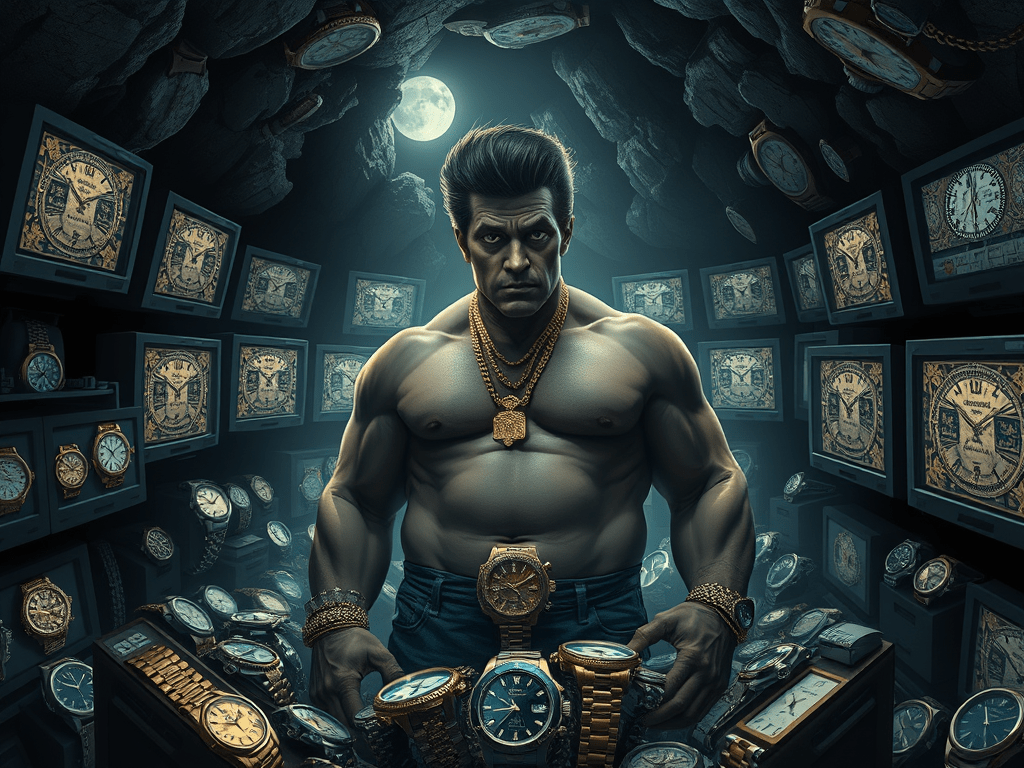
    If you’re a watch obsessive—and let’s face it, if you’re reading this, you probably are—then you need to come to terms with a condition known as Manchild Mail Euphoria: the dizzying, slightly shame-soaked high of waiting for your grown-up toy to arrive in the mail, fully aware that you’re a functional adult behaving like a child hopped up on Capri Sun and Saturday morning cartoons.

    Here’s how it manifests:

    A man—chronologically mature, fiscally semi-responsible, and in possession of at least one mortgage calculator app—orders a watch. Not just any watch. A timepiece so beautiful, so precise, so him, that he spirals into a state of pre-delivery delirium. He begins checking the tracking number with the devotion of a Wall Street analyst watching a volatile stock. “Shipment departed Osaka.” His soul ascends.

    But it doesn’t stop there. To sustain his anticipation, he re-watches YouTube reviews of the very watch he just purchased. Multiple times. Same watch, same narrator, same B-roll of gloved hands rotating the bezel in soft lighting. He knows it’s ridiculous. He watches anyway. It’s horological foreplay.

    As the days crawl by, he regresses—emotionally, spiritually, perhaps hormonally—back to the age of nine, when he mailed seven cereal boxtops to Battle Creek, Michigan, in exchange for a “free” plastic submarine that arrived six to eight weeks later in a box of dreams. Except now, the stakes are higher and the shame is real. Because unlike the submarine, this watch costs $1,500 and he’ll be explaining it to his spouse with a sentence that begins, “Well, technically, I sold two others…”

    He feels the absurdity of it all, of course. He knows that waiting for this package is giving him the same endorphin rush as a contestant winning a brand-new car on Let’s Make a Deal. But he can’t help it. The heart wants what it wants, and in this case, the heart wants sapphire crystal, applied indices, and 200 meters of water resistance he’ll never actually test.

    Manchild Mail Euphoria is real. It’s irrational, embarrassing, and deeply human. And the worst part? The moment the package arrives and he slices open the box like it contains the Ark of the Covenant… he’s already thinking about the next one.

    Because nothing tells time quite like your own arrested development.

  • Jia Tolentino Explores the Neverending Torments of Infogluttening

    Jia Tolentino Explores the Neverending Torments of Infogluttening

    In her essay “My Brain Finally Broke,” New Yorker writer Jia Tolentino doesn’t so much confess a breakdown as she performs it—on the page, in real time, with all the elegance of a collapsing soufflé. She’s spiraling like a character in a Black Mirror episode who’s accidentally binge-watched the entire internet. Reality, for her, is now an unskippable TikTok ad mashed up with a conspiracy subreddit and narrated by a stoned Siri. She mistakes a marketing email from Hanna Andersson for “Hamas,” which is either a Freudian slip or a symptom of late-stage content poisoning.

    The essay is a dispatch from the front lines of postmodern psychosis. COVID brain fog, phone addiction, weed regret, and the unrelenting chaos of a “post-truth, post-shame” America have fused into one delicious cognitive stew. Her phone has become a weaponized hallucination device. Her mind, sloshing with influencer memes, QAnon-adjacent headlines, and DALL·E-generated nonsense, now processes information like a blender without a lid.

    She hasn’t even gotten to the fun part yet: the existential horror of not using ChatGPT. While others are letting this over-eager AI ghostwrite their résumés, soothe their insecurities, and pick their pad thai, Tolentino stares into the abyss, resisting. But she can’t help wondering—would she be more insane if she gave in and let a chatbot become her best friend, life coach, and menu whisperer? She cites Noor Al-Sibai’s unnerving article about heavy ChatGPT users developing dependency, loneliness, and depression, which sounds less like a tech trend and more like a new DSM entry.

    Her conclusion? Physical reality—the sweaty, glitchy, analog mess of it—isn’t just where we recover our sanity; it’s becoming a luxury few can afford. The digital realm, with its infinite scroll of half-baked horror and curated despair, is devouring us in real time. To have the sticky-like tar of this realm coat your brain is the result of Infogluttening (info + gluttony + sickening)–a grotesque cognitive overload caused by bingeing too much content, too fast, until your brain feels like it’s gorged on deep-fried Wikipedia.

    Tolentino isn’t predicting a Black Mirror future. She is the Black Mirror future, live and unfiltered, and her brain is the canary in the content mine.

  • The Abbot’s Misfits

    The Abbot’s Misfits

    I arrived at the Palos Verdes trails just before ten, and the heat was already doing its best impression of a convection oven. The mountainous trails, baking under the relentless sun, were separated from the street by a chain-link fence that looked like it had given up on life years ago. Inside the confines of this makeshift pen, several dozen goats were having the time of their lives munching on dry grass as if it were the most gourmet hay in existence. Their faces were a mix of innocent curiosity and that absurd kind of adorableness that makes you momentarily consider swearing off lamb chops forever. I made a mental note to “consider veganism” again, a notion I promptly squashed with vivid memories of my O-positive blood rejoicing every time I indulged in a perfectly seared ribeye. Hello, goats—you’re safe because it looks like I’ll stick with beef.

    By the goats, a white tent had been pitched like some sort of mirage, and under it, a circle of chairs was arranged with the precision of a cult meeting—or worse, a corporate team-building exercise. The man who had the audacity to call himself the Abbot greeted me with a grin that suggested we were about to embark on a day of carefree yachting rather than whatever bizarre ritual he had planned. Forget the flowing robes and monastic aura—I was greeted by a fitness model straight out of an overenthusiastic health magazine. Neatly pressed cargo shorts hugged his cycler’s thighs like they had been tailored for the occasion, and his olive T-shirt clung to a body sculpted by what could only be an unholy alliance with a CrossFit gym. 

    A cross-body sling bag was slung over one of his thin yet annoyingly muscular arms, which were covered in veins that seemed to be competing in an under-skin relay race. His jawline could have cut glass, and his neatly sculpted silver hair made him look like he’d stepped out of an L.L.Bean catalog. But it was his eyes that really got me—blazing blue orbs that looked like they belonged on the figurehead of a Viking ship, ready to plunder and pillage. 

    “Graham, come join us,” he said with the kind of enthusiasm that suggested we were minutes away from sipping mimosas on a luxury yacht. “We are just moments away from the interrogation.” The way he said “interrogation” made it sound like a delightful little jaunt instead of, you know, something that involved possible torture or at least a really awkward group discussion.

    The most striking thing about the Abbot wasn’t his absurdly chiseled jawline or his militant posture; it was the overwhelming stench of lavender and rose water that assaulted my senses the moment I got within a hundred yards of him. This man hadn’t just splashed himself with these fragrances—he’d practically marinated in them. It was as if he’d decided to pickle himself in a floral potpourri so potent that it probably had bees tailing him for miles. I half-expected to find petals stuck to his skin.

    As I reluctantly made my way under the tent, I was greeted by the sight of six people slumped in those classic, soul-crushing folding chairs that practically shriek, “We’re only here for the free food.” These weren’t just any ordinary folks. No, these were the future friends, foes, and backstabbers who would weave themselves into the disaster that would soon be my life—though at that moment, they all just looked like they were wondering when the punchline of this bizarre setup was going to drop. Spoiler: It never did.

    Behind them, a table stood like a beacon of false hope. A giant pitcher of cucumber water glistened in the sunlight, promising hydration that would do nothing to wash away the impending madness. But what truly caught my eye was the stack of cakes beside it. They looked innocent enough, these little golden blocks, but I would soon discover that they were the Abbot’s specialty—cornbread cakes made with applesauce, honey, and some vanilla-flavored soy protein powder that tasted suspiciously delicious. These cakes weren’t just a snack; they were a trap, a gateway drug that would soon have me spiraling into a carb-induced dependency I hadn’t seen coming. But let’s not jump ahead—there’s plenty of time to explore how these seemingly harmless cakes would drag me into the Abbot’s world of sweet-smelling insanity.

    For now, let’s just say that in that moment, my biggest mistake wasn’t walking into the tent—it was deciding to stay. But hey, who could resist free “light refreshments”?

    With one arm draped around my back like a used car salesman about to seal a shady deal, the Abbot steered me toward the motley crew assembled under the tent. He flashed a benevolent smile, the kind that makes you wonder if he’s about to offer you enlightenment or swindle you into buying a timeshare in Cancun. “My friends,” he announced with all the pomp of a second-rate cult leader, “Graham has graced us with his presence. He is a college writing instructor with many gifts, though I’ll let him elaborate on those special talents later.” His smile suggested that whatever “gifts” I possessed were about to be squeezed out of me like juice from a lemon.

    He pointed at each member of the ragtag group, starting with Abigail, a woman in her early fifties who looked like she’d been carved out of a block of pale, pasty clay by a very angry sculptor. Her squat frame and monkish haircut didn’t do her any favors, but she smiled with the kind of pride usually reserved for people who’ve just completed their first marathon, despite the fact that she hailed from Gorman—a town so small it might as well not exist—where she’d spent her youth dodging aggressive chickens on her parents’ farm. Abigail proudly raised three fingers, showcasing them as if they were battle scars, and regaled us with tales of surviving on a teeth-rotting diet of PayDay bars and orange Fanta until she discovered The Abbot’s life-altering cornbread cakes. You’d think she’d found the Holy Grail, but instead, it was just some glorified baked goods.

    Next up was Larry, a man in his late forties who had apparently modeled his look on a 1970s mafia reject. His long, slicked-back hair and tinted sunglasses made him look like he was auditioning for the role of “Skeevy Casino Manager” in an off-off-Broadway production. Dressed in black jeans and a too-tight white T-shirt that clung to his muscular upper body like a bad decision, he had the kind of physique that screamed “I skipped leg day,” with spindly legs that looked like they’d snap under the weight of his overly pumped chest. Larry had once been a professional gambler until every casino in the area wisely decided he was bad for business. Now, he managed an upscale Mexican restaurant at Del Amo Mall—a stone’s throw from my house—where he spent his days chain-drinking Red Bull and dreaming of the good old days. “I was probably killing myself drinking all those chemicals and caffeine,” he said, “but thanks to the Abbot and his cornbread cakes, I’m learning the true path.” 

    Larry’s brother Stinky, who looked like he’d just crawled out of the primordial ooze, sat next to him. With shaggy blond hair, deep pockmarks, and a forehead that could have been used as a Neanderthal fossil exhibit, Stinky was the kind of guy who seemed to wear his heartbreak on his sleeve—and his face. In his late thirties and still stuck in a dead-end job at a Costco warehouse, he was the embodiment of a bad country song. His high school sweetheart had skipped town with his engagement ring and now worked as a “hostess” at various questionable establishments in Miami. “Self-pity is my addiction,” he confessed, as if he’d just admitted to a crippling heroin habit. But don’t worry—the Abbot was going to give him a “second shot at life,” presumably with a side of cornbread cakes.

    Maurice shuffled forward, a short, wiry guy with a dark complexion. Looking much younger than his age of forty, his kid’s face was set in a permanent grimace, like he’d just stepped in something nasty and couldn’t shake the stench. He was dressed with the precision of a man who either had nowhere else to go or was meticulously planning his escape. His crisp, white-collared sports shirt and navy blue shorts looked fresh out of the package as if he had bought them specifically for this occasion, only to instantly regret his decision. The sandals on his feet were so spotless they might as well have come with a warning label: “For display purposes only.”

    Maurice radiated the enthusiasm of someone attending a surprise tax audit. If this were a beach day, he’d be the guy hunched under a too-small umbrella, clutching a lukewarm beer like it was his only friend, and glaring daggers at the carefree seagulls circling above, as if they were personally responsible for all the miseries in his life. Every inch of him screamed that he’d rather be anywhere but here, and the irony was that he looked like he was dressed for a casual day out, just not one that involved other human beings.

    To Maurice, this gathering was less of a spiritual intervention and more of a cruel and unusual punishment. His body language said, “I’m here under duress,” and his eyes, narrowed to slits, darted around the group as if calculating the quickest exit. It was clear that Maurice wasn’t here to bare his soul—he was here to endure the ordeal with as much stoic misery as possible. With a degree in computer science and the personality of a dial-up modem, Maurice was the poster child for disillusionment. Recently divorced and demoted from homeowner to condo dweller in Harbor City, he shared this nugget of personal failure with all the enthusiasm of someone recapping their latest colonoscopy. His intro was short, sour, and dripping with enough bitterness to make a lemon blush. You could tell Maurice wasn’t here to find inner peace—he was here because the thought of a one-on-one with the Abbot made him more uncomfortable than the idea of being stuck in a dentist’s chair.

    Sitting next to Maurice was Jason, the group’s designated eye candy. With his languid gray eyes, full lips, and high cheekbones, Jason looked like he’d just stepped off the set of a Calvin Klein ad. But beneath the chiseled exterior was a life insurance salesman and mixed martial arts fighter who’d spent his formative years studying jiu-jitsu and muay thai to protect his siblings from their alcoholic father. His good looks and business success were a smokescreen for the social anxieties and commitment issues that plagued him. “I’m here to find answers,” he said, his voice dripping with the kind of melodrama usually reserved for soap operas.

    Finally, there was Howard Burn, the Abbot’s right-hand man, who looked like he’d been assembled from spare parts left over from a mad scientist’s experiment. Tall and lanky with a head of perfectly coiffed black hair, Howard had the angular, contemplative face of someone who took himself way too seriously. He clutched a notebook in his lap, furiously scribbling notes like a star student at Cult Leader 101. When he introduced himself, it was with all the joy of a man who’d just been informed his house was on fire. “It has been my great pleasure to work for the Abbot for the last three years,” he said, his tone suggesting that “pleasure” was a foreign concept to him. Before joining the Abbot’s merry band of misfits, Howard’s life had been a blur, a meaningless existence spent wandering from one menial job to the next. But the Abbot had changed all that, and for the first time, Howard felt like he had purpose—presumably one that involved handing out a lot of cornbread cakes.

    The Abbot beamed at Howard like a proud father, the kind who gives his kid a pat on the back for finally tying his own shoes. “Well said, my son,” his smile seemed to convey as if the entire room was one big happy family. 

    But then the interrogation began, and any illusion of a cozy kumbaya moment evaporated faster than a politician’s promise after election day.

    The Abbot, who’d suddenly transformed from a benevolent guru into a reality TV judge on a power trip, fixed his steely gaze on Abigail. “We’ll start with you,” he declared, like a dentist about to extract a tooth without anesthesia. “Small-town girl, former fast-food overlord, now a landscaper, and you’re still spiraling from that breakup. Jennifer, wasn’t it? She moved in with someone else—someone you actually considered a friend—and now you’re wallowing in betrayal like a sad country song. All this wallowing has blinded you from your gifts.”

    Abigail blinked, probably wishing she could shrink into her cargo shorts and disappear. “I don’t have any gifts that I know of,” she muttered, clearly hoping that modesty might serve as an escape hatch.

    The Abbot’s smile was as sharp as a guillotine. “Oh, but there’s the matter of your left pinkie, now a charming little hook, thanks to your early attempts at butchering a pumpkin with a serrated knife. What were you, eight years old? Trying to carve a jack-o’-lantern or auditioning for a role in Sweeney Todd?”

    Abigail nodded meekly.

    “Show them,” the Abbot commanded as if this was the grand unveiling of some macabre art piece.

    Obediently, Abigail held out her hand, and there it was: her pinkie, eternally frozen in a grotesque hook. The finger, sliced at the joint below the knuckle, was now more calcified appendage than human flesh—a monument to bad luck and worse kitchen skills.

    “Yes, the hook,” the Abbot intoned, as if he were introducing the world’s eighth wonder. “A marvel, truly. It saved your life during that robbery in Barstow, blinded your would-be thief like a weaponized claw, and has been a godsend for lugging groceries into the house. You’ve even used it to hook tools while landscaping, but you’ve been missing out on its real potential.”

    Abigail stared at the Abbot like he’d just told her she could time travel with her toenails.

    “What you don’t realize,” he continued, his voice dripping with condescension, “is that your little pinkie isn’t just a handy-dandy grocery hook. It’s a supernatural antenna. Whenever you’re near something or someone steeped in dark secrets or supernatural energy, your pinkie will tingle, twitch, or maybe even do the macarena—whatever it does to warn you that you’re in the presence of danger. You’ve got a sixth sense attached to your hand, my dear.”

    The Abbot then motioned for her to stand up. “Go on, stand next to Maurice and wave your pinkie in front of him like you’re dowsing for water. But don’t actually touch him; just let your psychic appendage do its thing.”

    Abigail, clearly wondering what sort of circus act she’d signed up for, obliged. As she moved her pinkie around Maurice’s head, she wrinkled her nose. “There’s something off about his head,” she announced, as Maurice stared ahead with the same enthusiasm as a DMV clerk.

    “Something wrong? With Maurice’s head?” the Abbot said, feigning shock like a bad soap opera actor. “You don’t say! But you’re right. His head is literally messed up.”

    Maurice, looking like he’d just been told his dog died, barely reacted.

    The Abbot turned to Maurice, his tone shifting to that of a doctor delivering a grim prognosis. “Maurice, my boy, you suffer from migraines, but not just any migraines. No, your headaches are like the universe’s cruel joke—they’re precursors to natural disasters, the kind of catastrophes people write disaster movies about. They’re called Black Swan Events. You’ve got the power to sense them before they happen, but until you harness this gift, you’re just a walking, talking barometer of doom. Learn to control it, and you might just be able to save us from the next apocalypse—or at least predict when we’ll need to evacuate.”

    Maurice’s expression remained blank, perhaps pondering whether he’d wandered into a cult or just the world’s weirdest self-help group.

    Abigail, meanwhile, looked at her pinkie like it was a divining rod, realizing that in this absurd reality, even her freakish hook might have its own twisted kind of magic.

    The Abbot, with an air of condescending benevolence, motioned to Abigail to walk toward Stinky. She raised her pinkie—now more hook than finger—over the simian-faced warehouse worker, who stared at it like it was a deranged bumblebee. 

    “His nose,” she declared with the gravitas of someone revealing the cure for cancer. “He can smell things.”

    “Very good,” the Abbot crooned as if speaking to a particularly dim-witted child.

    “But not normal things,” she added, turning to the Abbot for reassurance. “He can smell evil!”

    The Abbot nodded, his eyes twinkling with mock seriousness.

    “He can smell it in people. He knows when they’re lying.”

    “And what does it smell like, pray tell?” The Abbot asked, leaning in as if the answer might be the meaning of life.

    “Ammonia,” she said, wrinkling her nose.

    Stinky chimed in, “I smell ammonia all the time.”

    “Of course, you do,” the Abbot said, as if this were the most natural thing in the world.

    Stinky turned to his brother Larry with a smirk. “When you said you couldn’t loan me that money, I smelled ammonia. You were lying to me!”

    The Abbot, now in full guru mode, said, “Your nose, Stinky, is a lie detector.”

    Stinky’s face twisted into a look of bewildered relief. “All my life, I thought I had some kind of medical condition. When I was a kid, they ran all these tests because I kept saying everything smelled like cleaning supplies.”

    “Of course they found nothing,” the Abbot said, taking a languid sip of cucumber water as if he were above such pedestrian concerns.

    “But if the world is full of evil, why don’t I smell ammonia all the time?” Stinky asked, clearly not understanding the subtlety of his “gift.”

    “Evil, my dear boy, comes in shades,” the Abbot said, like he was explaining quantum physics to a toddler. “You need to fine-tune your nose to detect varying levels of malevolence.”

    He then turned his attention to Larry, who looked like he’d rather be anywhere but here. The Abbot motioned for Abigail to wave her pinkie hook over him, and she did so with all the enthusiasm of someone stirring a pot of gruel. She looked baffled. “I’m not getting anything… wait, there’s a pulse, like a two-four beat.”

    Larry grinned, “That’s ‘Float On’ by The Floaters. I listen to it whenever I’m anxious. Helps me chill.”

    The Abbot’s face soured at Larry as if his disciple’s slow thinking were testing his patience. “You don’t feel pain, do you?”

    “Not really,” Larry said, shrugging. “Last year, I had a root canal. Brought my earbuds and played ‘Float On’ on repeat, and it was like I wasn’t even in the chair.”

    The Abbot sighed, clearly disappointed. “You rely too much on your phone. You must learn to summon the song within your mind. Only then can you truly suppress pain.”

    Larry’s face twisted in confusion. “But isn’t pain a good thing? Like, a warning system?”

    The Abbot’s patience wore thin. “Most humans crumble at the slightest discomfort. Your power allows you to transcend pain, to unlock your full potential. Or would you rather remain a common oaf?”

    Larry still didn’t look convinced, but the Abbot wasn’t one to be deterred by something as trivial as logic. His gaze slid over to Jason, a guy who looked vaguely familiar, like one of those retail cashiers you always see but never remember where. Jason was already fidgeting like a kid caught sneaking candy, his nerves practically screaming “Get me out of here.” 

    “Now, let’s see what our friend Abigail can sense about you,” the Abbot said, leaning in with the kind of enthusiasm usually reserved for people about to tell you you’re in for the deal of a lifetime—if you just hand over your credit card first.

    Abigail, that beacon of confidence, hovered her pinkie in the air like she was trying to tune into Jason’s internal radio. Finally, her pinkie landed somewhere near his waist. “Your back… it’s messed up,” she declared, like she was diagnosing a flat tire.

    Jason winced. “Chronic pain from a car accident two years ago. Acupuncture helps, but it’s still pretty bad.”

    The Abbot sneered like Jason had just admitted to preferring instant coffee. “Acupuncture? Weakness incarnate. Your pain is a gift, Jason. Embrace it, and you’ll become five times stronger than the strongest man alive. Ignore it, and you’ll remain the pathetic creature you are.”

    Jason blinked, trying to process the avalanche of nonsense the Abbot had just unloaded. “So, my back pain is… super strength?” He looked like he was about to ask if this whole thing was an elaborate prank.

    “Precisely,” the Abbot said, with the smug satisfaction of a man who just solved the world’s energy crisis by suggesting we all power our homes with good intentions. “But only if you stop running from it.”

    I realized, with a sudden jolt, that Jason wasn’t just vaguely familiar—I knew him. But from where? Fidgeting in my seat, I blurted out, “Jason, do we know each other?”

    Before Jason could answer, the Abbot’s gaze swung toward me with all the subtlety of a wrecking ball. His nostrils flared like a bull about to charge, and I was suddenly sure he could smell my fear. “You’ll get your turn, but do not speak out of place,” he snapped, like a third-grade teacher reprimanding a kid for talking during recess.

    He turned back to Abigail, clearly eager to get back to his performance of “Mystical Leader Extraordinaire.” “See what you can find out about Graham,” he instructed, as though I were next in line at a spiritual deli counter.

    Abigail moved her magical pinkie over me, her face twisting in confusion like she was trying to figure out a Sudoku puzzle with half the numbers missing. “I’m getting… flapping. Like wings. Bats? No… crows! Huge crows!” She said this with the conviction of someone announcing the discovery of a new planet.

    The Abbot’s eyes gleamed like a kid who just found the last Golden Ticket. “Yes, Graham has an affinity for crows—Gravefeathers, to be exact. They bring him messages from the other side, but he must learn to listen.”

    I raised an eyebrow, now officially in *what the hell* territory. “Gravefeathers? Is this some kind of joke?”

    “Far from it,” the Abbot said with a smile so condescending it could curdle milk. “The Gravefeathers have chosen you. Your task is to decode their messages, to fulfill our mission.”

    “And what exactly is this mission?” I asked, now thoroughly regretting every life choice that had led me to this tent.

    “All in good time,” the Abbot said, his tone so patronizing it was a wonder he didn’t pat me on the head. “For now, you must prepare.”

    As if on cue, Howard Burn—looking like a villainous butler from a B-movie—emerged from the shadows carrying trays covered in tinfoil, like a waiter in some dystopian restaurant. “As a token of your commitment,” the Abbot intoned, “I offer you each a cornbread cake.”

    My skepticism reached new heights. “What’s the catch?” I asked, eyeing the tray like it might contain some kind of mind-control device. “Is this cake magic?”

    The Abbot’s face twisted into that all-too-familiar condescending smirk. “Magic? No. But consuming it is a test of trust, a way to align yourselves with the universe’s energies. And it tastes pretty damn good, too.”

    Howard handed me a slice, and against my better judgment, I took a bite. To my horror, it was delicious. The cake was a golden, moist masterpiece, with a caramelized top that hinted at hidden sweetness. The flavors of honey and vanilla danced with almond and cornmeal, while a subtle cinnamon undertone lingered just long enough to make me question all my life choices up to this point.

    I devoured the cake like a starving man, only to find myself choking on my own gluttony. The Abbot, ever the gracious host, handed me a glass of cucumber water, which I gulped down as if my life depended on it. 

    “I could eat this for breakfast, lunch, and dinner,” I mumbled, wiping crumbs from my face like the classy individual I am.

    Out of the corner of my eye, I noticed a large black crow perched on the gate post, its fiery eyes boring into me with the unmistakable message: Enjoy your cake, you idiot. You’re in for one hell of a ride.

  • The Lion Man

    The Lion Man

    I recently had a dream that put me face to face with evil—not the metaphorical kind, not garden-variety wickedness or tax-season despair. No, this was evil with a proper noun. The Lion Man. A creature of mythic malevolence, stitched together from nightmares and paranoia, and now inexplicably headlining a lecture in a packed auditorium.

    I was in the front row, naturally—because why wouldn’t my psyche give me VIP seating for its own unraveling?

    Onstage stood the Lion Man: nearly seven feet tall, dressed in a powder-blue gangster suit that shimmered with the kind of menace only polyester can summon. His face was unmistakably leonine, all fangs and symmetry, framed by a magnificent, thick mane that looked equal parts MGM mascot and Old Testament prophet gone feral. His eyes—icy blue and depthless—held the kind of hatred you don’t recover from. Looking into them felt like staring at the sun: too much exposure and you’re permanently damaged.

    He gripped a lectern and delivered a furious, gesticulating sermon, his arms slicing through the air like cleavers. But I couldn’t hear a word. Not one syllable. His mouth moved—angrily, emphatically—but all I heard was a dark, atonal soundtrack swelling behind him, as if his words existed in a frequency my soul refused to translate.

    Then, things got worse.

    At some invisible signal—maybe a silent scream—several people wheeled a phone booth onto the stage. It had the sad, sterile shine of a prop pulled from a David Lynch nightmare. The Lion Man stepped inside. The roof slid open like the lid of a cursed urn, and animals—real, living animals—were dropped in from above.

    What followed was carnage. He devoured them all. Cows, pigs, zebras, horses, dogs, cats. No hesitation. No remorse. I could hear the crunching—those surgically sharp teeth pulverizing bone like brittle kindling. One by one, their skeletons were spat out from the phone booth like nightmarish confetti. I sat paralyzed as femurs and ribs rained down, the floor littered with vertebrae and splintered jaws.

    When it was over, the Lion Man stepped out casually, as if he’d just wrapped a press conference. He dusted bits of fur and sinew off the lapel of his gleaming suit. Then he looked at me.

    No, into me.

    Our eyes locked. I wanted to recoil, hide, burst into flame—anything but be seen by that gaze. But I was frozen, a slab of pure terror, incapable of blinking. He stared at me as if to say, You’re next.

    I woke up at 4 a.m., choking on dread. But the dream hadn’t entirely ended. I could feel him in the room. He was sitting on the edge of my bed. Not metaphorically. Not symbolically. He was there—massive, radiating cold, breathing slowly. The terror was so complete I couldn’t move, couldn’t even gasp for air. It felt like being buried under ice.

    Then—tap tap tap.

    I turned my head, barely.

    Outside the window was Gravefeather—the crow. My familiar friend. My unsolicited spirit guide. He was perched on the sill, eyes glinting with that uncanny, measured intelligence. He tapped once more.

    The Lion Man noticed. And then he vanished—dissolved like fog in sunlight. Just like that. Gone.

    Gravefeather and I locked eyes. No theatrics. No nods. Just understanding.

    “Thank you,” I whispered aloud, the paralysis receding. Gravefeather paused a beat longer, then flapped into the night, leaving me shaken, grateful, and completely unable to sleep again.

  • Poseidon Can Wait: My Night at the Bodybuilder Carnival

    Poseidon Can Wait: My Night at the Bodybuilder Carnival

    About six months ago around my sixty-third birthday, I dreamed I was at a strange outdoor carnival—equal parts vintage bodybuilding expo and mythological sideshow. Imagine Venice Beach circa 1977 collided with a protein-scented Renaissance fair. Every booth was oiled, bronzed, and flexing. The air reeked of grilled meat and competitive ego.

    I found myself seated at a worn wooden picnic table across from none other than Frank Zane. Yes, the Frank Zane. He appeared cryogenically preserved—shimmering with coconut oil and the kind of disciplined grace that once made garage-dwelling teenagers across America pick up dumbbells in religious awe.

    Mid-bite into a hot dog (which I suspect he chewed with the calculated intensity of a surgeon), Zane leaned in and said, “I’m selling everything. Moving into a luxurious underwater mansion.” He said this with the calm gravity of a monk planning his final pilgrimage.

    No one questioned him. The idea of Frank Zane embracing Poseidon’s lifestyle apparently struck everyone but me as reasonable.

    I didn’t challenge him—this was a man who once ruled the pantheon of iron. But something felt off. Watching him trade barbells for barnacles stirred something protective in me. So I nodded and declared, with biblical authority, that he was one of the top three bodybuilders of all time.

    The crowd reacted like I had spoken in tongues. Gasps. Reverent murmurs. Zane glowed under the praise like a bronzed deity sunbathing in worship.

    Then, I leaned in.

    “Frank,” I said. “Maybe rethink the whole Poseidon thing.”

    “Why?”

    “Well,” I said, summoning the full absurdity of the dreamscape, “I’ve recently discovered—at 63—that I can throw a 100-mile-an-hour fastball.”

    Without delay, a 70-year-old French professor appeared, squatting behind a makeshift mound in catcher’s stance. I wound up and released pitch after blistering pitch, Zeus-style, slicing the air like divine vengeance.

    Zane’s eyes sparkled. His jaw dropped.

    “I can’t miss this,” he said. “Forget Atlantis. I’ll stay. I need to see you pitch.”

    Applause erupted. I had saved Frank Zane from a life of underwater exile. I had become the miracle.

    If the great psychologist Carl Jung were analyzing my dream, he might say this:

    “Frank Zane is not merely an icon of bodybuilding in this dream. He is the archetype of disciplined masculinity—the part of your psyche shaped by idol worship and heroic longing. His desire to retreat underwater speaks to the lure of fantasy, nostalgia, and detachment. But your fastball—that impossible, mythic feat at 63—is the dream’s axis of transformation. You are no longer the boy in awe of muscle-bound gods. You are the figure of agency, of miraculous reinvention. And the professor? He is the intellect, finally catching what the body has thrown.”

    “This dream isn’t a joke. It’s your soul’s comic book. Read it again. And then throw another pitch.”

  • Flex, Regret, Repeat: My Midlife Crisis, Sponsored by Conor McGregor

    Flex, Regret, Repeat: My Midlife Crisis, Sponsored by Conor McGregor

    My life as an aspiring narcissist hit a new low when my wife and I got home, plopped down on the couch, and decided to indulge in the cinematic masterpiece Road House. This film, if you can call it that, stars a Jake Gyllenhaal so chiseled that he looks like Michelangelo got bored and decided to make an action hero. In this gripping tale, Gyllenhaal plays a tough-as-nails fighter scraping a living in a Key West bar, doing what any self-respecting muscle mountain would do—protecting the bar and its lovely owner, played by Jessica Williams, from corrupt mob bosses. Naturally, this leads to the inevitable showdown with their number-one heavy, played by none other than a bulked-up, foaming-at-the-mouth Conor McGregor, who looks like he’s been subsisting on a diet of raw meat and anabolic steroids.

    The plot is thinner than a strand of dental floss—a Western rehash where an outsider rides into town to clean up the mess. But let’s be real: the story is just window dressing for the film’s true agenda, which is to showcase sweaty, glistening muscles and fight montages that could double as a fitness competition highlight reel. The camera lingers on every bulging bicep and rock-hard ab like a love-struck teenager, turning what should be an action movie into a high-budget commercial for protein powder, creatine, and whatever the hell UFC fighters are injecting these days.

    As Gyllenhaal and McGregor flexed and fought their way through scene after scene, I found myself reaching for my phone, not to check the time—oh no—but to Google “What is Conor McGregor’s diet?” Because watching this movie is less about enjoying a plot and more about realizing you’re a gelatinous blob compared to the human marble statues parading around on screen. Road House isn’t so much a movie as it is a two-hour reminder that you’re one donut away from needing a forklift to get off the couch.

    When the credits finally rolled, and I managed to peel my eyes away from the testosterone-soaked spectacle, I turned to my wife, feeling more deflated than a balloon at a porcupine convention. “I wish I could lose forty pounds and look the way I did when I entered Mr. Teenage San Francisco,” I lamented as if my sad sack of a body was just a protein shake away from making a comeback. I had the muscle once, I swear! But now it’s hidden under layers of adiposity that could cushion a fall from a ten-story building. If they ever invented an advanced generation of Ozempic that came in a pill form, had no side effects, and was covered by my insurance, I’d be the first in line, elbowing grannies out of the way to get my hands on it.

    My wife, however, had zero interest in my nostalgic waxing about the “great body” of my youth. This was not her first rodeo. In fact, she could probably recite my entire “glory days” speech from memory, down to the last calorie of the diet I used to follow. Rolling her eyes with the practiced ease of a wife who’s heard it all before, she suggested we watch a rerun of Northern Exposure—her go-to escape from my never-ending lament about the “Greek god” I used to be. But the seafood restaurant ordeal had left me more drained than a used dishrag, and I waved the white flag of surrender. “Nope, I’m hitting the sack,” I muttered, retreating to the bedroom like a defeated warrior, leaving my wife to her beloved reruns while I dreamed of a time when I was ripped, instead of just ripping on myself.

  • Contagion of Fear: World War Z and the Collapse of Global Order: A College Essay Prompt

    Contagion of Fear: World War Z and the Collapse of Global Order: A College Essay Prompt

    Essay Prompt:

    In World War Z, a global pandemic rapidly spreads, unleashing chaos, institutional breakdown, and the fragmentation of global cooperation. Though fictional, the film can be read as an allegory for the very real dysfunction and distrust that characterized the COVID-19 pandemic. Using World War Z as a cultural lens, write an essay in which you argue how the film metaphorically captures the collapse of public trust, the dangers of misinformation, and the failure of collective action in a hyper-polarized world. Support your argument with at least three of the following sources: Jonathan Haidt’s “Why the Past 10 Years of American Life Have Been Uniquely Stupid,” Ed Yong’s “How the Pandemic Defeated America,” Seyla Benhabib’s “The Return of the Sovereign,” and Zeynep Tufekci’s “We’re Asking the Wrong Questions of Facebook.”

    This essay invites you to write a 1,700-word argumentative essay in which you analyze World War Z as a metaphor for mass anxiety. Develop an argument that connects the film’s themes to contemporary global challenges such as:

    • The COVID-19 pandemic and fear of viral contagion
    • Global migration driven by war, poverty, and climate change
    • The dehumanization of “The Other” in politically polarized societies
    • The fragility of global cooperation in the face of crisis
    • The spread of weaponized misinformation and conspiracy

    Your thesis should not simply argue that World War Z is “about fear”—it should claim what kind of fear, why it matters, and what the film reveals about our modern condition. You may focus on one primary fear or compare multiple forms of crisis (e.g., pandemic vs. political polarization, or migration vs. misinformation).

    Use at least three of the following essays as research support:

    1. Jonathan Haidt, “Why the Past 10 Years of American Life Have Been Uniquely Stupid” (The Atlantic)
      —A deep dive into how social media has fractured trust, created echo chambers, and undermined democratic cooperation.
    2. Ed Yong, “How the Pandemic Defeated America” (The Atlantic)
      —An autopsy of institutional failure and public distrust during COVID-19, including how the virus exposed deep structural weaknesses.
    3. Seyla Benhabib, “The Return of the Sovereign: Immigration and the Crisis of Globalization” (Project Syndicate)
      —Explores the backlash against global migration and the erosion of human rights amid rising nationalism.
    4. Zeynep Tufekci, “We’re Asking the Wrong Questions of Facebook” (The New York Times)
      —An analysis of how misinformation spreads virally, creating moral panics and damaging collective reasoning.

    Requirements:

    • Use MLA format
    • 1,700 words
    • Quote directly from World War Z (film dialogue, plot events, or visuals)
    • Integrate at least two sources above with citation
    • Present a counterargument and a rebuttal

    Here’s a 9-paragraph outline and three sample thesis statements to guide students toward deep, layered analysis of World War Z as metaphor.

    Three Sample Thesis Statements

    World War Z presents zombies not just as flesh-eating threats but as avatars of global panic—embodying fears of pandemics, mass migration, and social collapse. Through its globe-hopping narrative and relentless spread of infection, the film critiques a world increasingly unprepared to manage the fallout of interconnected crises, echoing Haidt’s concerns about fractured public trust and Yong’s analysis of institutional fragility.

    In World War Z, the zombie outbreak functions as a metaphor for weaponized misinformation and the breakdown of global cooperation, dramatizing how societies consumed by fear and tribalism respond not with solidarity, but with suspicion and violence. The film anticipates the moral failures detailed by Haidt and Tufekci, making it less about monsters than about our inability to face crisis without self-destructing.

    Far from a typical horror film, World War Z is a global parable of dehumanization and displacement, where zombies symbolize both contagious fear and the faceless masses of migration and poverty. As Benhabib argues, the return of nationalism and the fear of the “Other” has shattered international solidarity—anxiety the film visualizes through barricades, lockdowns, and apocalyptic border control.

    9-Paragraph Outline

    Paragraph 1 – Introduction

    • Hook: Use an arresting visual to frame our world’s current instability.
    • Context: Introduce World War Z as more than a thriller—it’s an allegory of global collapse.
    • Thesis: State your central argument about how the zombies symbolize a deeper, contemporary fear (e.g., pandemic panic, social polarization, migration anxiety, misinformation, etc.).

    Paragraph 2 – The Metaphorical Function of Zombies

    • Discuss the symbolic role of zombies in film generally (fear of the masses, disease, mindlessness).
    • Explain how World War Z updates the metaphor to reflect 21st-century global anxieties.

    Paragraph 3 – Global Crisis and Institutional Collapse

    • Analyze scenes showing governments falling apart, the UN being sidelined, the world reduced to reactive chaos.
    • Connect to Ed Yong’s argument about institutional failure during COVID-19.

    Paragraph 4 – Fear of Migration and the Dehumanized Other

    • Examine the treatment of human mobs, refugees, and zombies in border scenes (e.g., Jerusalem wall, flight panic).
    • Use Seyla Benhabib’s piece to discuss the rising fear of displacement and the collapse of asylum ethics.

    Paragraph 5 – The Spread of Misinformation and Breakdown of Truth

    • Point to the conspiracy theories and media confusion in the film’s early scenes.
    • Use Tufekci’s argument to show how misinformation spreads like a virus—and how that’s reflected in the zombie metaphor.

    Paragraph 6 – The Psychology of Polarization and Fear

    • Explore the emotional tone of the film: anxiety, distrust, hyper-individualism.
    • Connect to Haidt’s claim that polarization has eroded rational cooperation and heightened mass irrationality.

    Paragraph 7 – Counterargument

    • Some may argue that World War Z is just a fast-paced action flick with no real political message.
    • Rebut by showing how even its structure—a global chase from chaos to cure—mirrors real-world anxieties about global crisis management and ethical triage.

    Paragraph 8 – Deeper Implications of the Metaphor

    • Push the metaphor further: zombies as collapsed selves, media-driven mobs, people stripped of identity.
    • Reflect on how the film doesn’t just diagnose fear—it reflects our inability to reckon with complexity in a globalized age.

    Paragraph 9 – Conclusion

    • Reaffirm your thesis.
    • Leave the reader with a provocative final thought: maybe the zombies aren’t the dead—they’re us, stripped of cooperation, overwhelmed by fear, and marching blindly toward collapse.

  • Siri, Am I Losing My Mind? Asking for Jia Tolentino

    Siri, Am I Losing My Mind? Asking for Jia Tolentino

    In her essay “My Brain Finally Broke,” New Yorker writer Jia Tolentino doesn’t so much confess a breakdown as she performs it—on the page, in real time, with all the elegance of a collapsing soufflé. She’s spiraling like a character in a Black Mirror episode who’s accidentally binge-watched the entire internet. Reality, for her, is now an unskippable TikTok ad mashed up with a conspiracy subreddit and narrated by a stoned Siri. She mistakes a marketing email from Hanna Andersson for “Hamas,” which is either a Freudian slip or a symptom of late-stage content poisoning.

    The essay is a dispatch from the front lines of postmodern psychosis. COVID brain fog, phone addiction, weed regret, and the unrelenting chaos of a “post-truth, post-shame” America have fused into one delicious cognitive stew. Her phone has become a weaponized hallucination device. Her mind, sloshing with influencer memes, QAnon-adjacent headlines, and DALL·E-generated nonsense, now processes information like a blender without a lid.

    She hasn’t even gotten to the fun part yet: the existential horror of not using ChatGPT. While others are letting this over-eager AI ghostwrite their résumés, soothe their insecurities, and pick their pad thai, Tolentino stares into the abyss, resisting. But she can’t help wondering—would she be more insane if she gave in and let a chatbot become her best friend, life coach, and menu whisperer? She cites Noor Al-Sibai’s unnerving article about heavy ChatGPT users developing dependency, loneliness, and depression, which sounds less like a tech trend and more like a new DSM entry.

    Her conclusion? Physical reality—the sweaty, glitchy, analog mess of it—isn’t just where we recover our sanity; it’s becoming a luxury few can afford. The digital realm, with its infinite scroll of half-baked horror and curated despair, is devouring us in real time. Tolentino isn’t predicting a Black Mirror future. She is the Black Mirror future, live and unfiltered, and her brain is the canary in the content mine.

  • Contagion of Fear: World War Z and the Collapse of Global Order: A College Essay Prompt

    Contagion of Fear: World War Z and the Collapse of Global Order: A College Essay Prompt

    Essay Prompt:

    In the film World War Z, the zombie apocalypse is more than a cinematic spectacle—it’s a fast-moving allegory for the collective anxieties plaguing our 21st-century world. As the undead swarm across borders and institutions collapse in real time, the movie confronts viewers with deep-rooted fears about globalization, pandemics, migration, misinformation, and the breakdown of social trust. The zombies are not just monsters—they are metaphors.

    This essay invites you to write a 1,700-word argumentative essay in which you analyze World War Z as a metaphor for mass anxiety. Using at least two of the research essays listed below, develop an argument that connects the film’s themes to contemporary global challenges such as:

    • The COVID-19 pandemic and fear of viral contagion
    • Global migration driven by war, poverty, and climate change
    • The dehumanization of “The Other” in politically polarized societies
    • The fragility of global cooperation in the face of crisis
    • The spread of weaponized misinformation and conspiracy

    Your thesis should not simply argue that World War Z is “about fear”—it should claim what kind of fear, why it matters, and what the film reveals about our modern condition. You may focus on one primary fear or compare multiple forms of crisis (e.g., pandemic vs. political polarization, or migration vs. misinformation).

    Use at least two of the following essays as research support:

    1. Jonathan Haidt, “Why the Past 10 Years of American Life Have Been Uniquely Stupid” (The Atlantic)
      —A deep dive into how social media has fractured trust, created echo chambers, and undermined democratic cooperation.
    2. Ed Yong, “How the Pandemic Defeated America” (The Atlantic)
      —An autopsy of institutional failure and public distrust during COVID-19, including how the virus exposed deep structural weaknesses.
    3. Seyla Benhabib, “The Return of the Sovereign: Immigration and the Crisis of Globalization” (Project Syndicate)
      —Explores the backlash against global migration and the erosion of human rights amid rising nationalism.
    4. Zeynep Tufekci, “We’re Asking the Wrong Questions of Facebook” (The New York Times)
      —An analysis of how misinformation spreads virally, creating moral panics and damaging collective reasoning.

    Requirements:

    • Use MLA format
    • 1,700 words
    • Quote directly from World War Z (film dialogue, plot events, or visuals)
    • Integrate at least two sources above with citation
    • Present a counterargument and a rebuttal

    Here’s a 9-paragraph outline and three sample thesis statements to guide students toward deep, layered analysis of World War Z as metaphor.


    Three Sample Thesis Statements

    World War Z presents zombies not just as flesh-eating threats but as avatars of global panic—embodying fears of pandemics, mass migration, and social collapse. Through its globe-hopping narrative and relentless spread of infection, the film critiques a world increasingly unprepared to manage the fallout of interconnected crises, echoing Haidt’s concerns about fractured public trust and Yong’s analysis of institutional fragility.

    In World War Z, the zombie outbreak functions as a metaphor for weaponized misinformation and the breakdown of global cooperation, dramatizing how societies consumed by fear and tribalism respond not with solidarity, but with suspicion and violence. The film anticipates the moral failures detailed by Haidt and Tufekci, making it less about monsters than about our inability to face crisis without self-destructing.

    Far from a typical horror film, World War Z is a global parable of dehumanization and displacement, where zombies symbolize both contagious fear and the faceless masses of migration and poverty. As Benhabib argues, the return of nationalism and the fear of the “Other” has shattered international solidarity—anxiety the film visualizes through barricades, lockdowns, and apocalyptic border control.


    9-Paragraph Outline

    Paragraph 1 – Introduction

    • Hook: Use an arresting visual to frame our world’s current instability.
    • Context: Introduce World War Z as more than a thriller—it’s an allegory of global collapse.
    • Thesis: State your central argument about how the zombies symbolize a deeper, contemporary fear (e.g., pandemic panic, social polarization, migration anxiety, misinformation, etc.).

    Paragraph 2 – The Metaphorical Function of Zombies

    • Discuss the symbolic role of zombies in film generally (fear of the masses, disease, mindlessness).
    • Explain how World War Z updates the metaphor to reflect 21st-century global anxieties.

    Paragraph 3 – Global Crisis and Institutional Collapse

    • Analyze scenes showing governments falling apart, the UN being sidelined, the world reduced to reactive chaos.
    • Connect to Ed Yong’s argument about institutional failure during COVID-19.

    Paragraph 4 – Fear of Migration and the Dehumanized Other

    • Examine the treatment of human mobs, refugees, and zombies in border scenes (e.g., Jerusalem wall, flight panic).
    • Use Seyla Benhabib’s piece to discuss the rising fear of displacement and the collapse of asylum ethics.

    Paragraph 5 – The Spread of Misinformation and Breakdown of Truth

    • Point to the conspiracy theories and media confusion in the film’s early scenes.
    • Use Tufekci’s argument to show how misinformation spreads like a virus—and how that’s reflected in the zombie metaphor.

    Paragraph 6 – The Psychology of Polarization and Fear

    • Explore the emotional tone of the film: anxiety, distrust, hyper-individualism.
    • Connect to Haidt’s claim that polarization has eroded rational cooperation and heightened mass irrationality.

    Paragraph 7 – Counterargument

    • Some may argue that World War Z is just a fast-paced action flick with no real political message.
    • Rebut by showing how even its structure—a global chase from chaos to cure—mirrors real-world anxieties about global crisis management and ethical triage.

    Paragraph 8 – Deeper Implications of the Metaphor

    • Push the metaphor further: zombies as collapsed selves, media-driven mobs, people stripped of identity.
    • Reflect on how the film doesn’t just diagnose fear—it reflects our inability to reckon with complexity in a globalized age.

    Paragraph 9 – Conclusion

    • Reaffirm your thesis.
    • Leave the reader with a provocative final thought: maybe the zombies aren’t the dead—they’re us, stripped of cooperation, overwhelmed by fear, and marching blindly toward collapse.