Tag: life

  • Geekee and the Alligator: A Tragedy in Silk

    Geekee and the Alligator: A Tragedy in Silk

    When I was a toddler, I had an unhealthy attachment to a raggedy white blanket I’d christened Geekee—a silken square of heaven that clung to me like a second epidermis. Geekee was not merely a blanket. Geekee was a lifestyle. Tattered, stained, and reeking of a distinct sour-milk-meets-armpit funk, Geekee looked like it had been rescued from the wreckage of a shipwreck and then dragged behind a Greyhound bus. But to me, Geekee was spun moonlight. Its frayed corners were my talismans, which I rubbed obsessively against my cheek like a junkie chasing the next dopamine hit. The soft tickle of that threadbare fabric was my lullaby, my Xanax, my spiritual compass.

    To my parents, however, Geekee was a public disgrace—a dingy square of shame that broadcast to the world that they were too cheap or too neglectful to buy their son a clean blanket. “It smells,” they complained, pinching their noses. “It’s disgusting.” They said I was too old to drag Geekee around like Linus with a trust fund. At four, I was allegedly a grown man in preschool years, and Geekee, they insisted, was holding me back like an emotional parasite in silk form.

    Thus began the war: child versus parental regime. I defended Geekee’s honor with the righteous fury of a mother bear protecting her cubs. I refused to eat unless Geekee was in my lap. I screamed during bath time if Geekee wasn’t nearby, watching like a guardian angel woven by machinery. I slept only under the comforting weight of its matted threads.

    My parents, of course, resorted to psychological warfare.

    Then came the infamous cross-country move—from Florida to California, land of palm trees, broken dreams, and emotional betrayals. Somewhere in the swamplands of Louisiana or perhaps the desolate asphalt wasteland of Texas, my father, who I now believe was channeling Machiavelli, pulled the ultimate con.

    “Look!” he said, pointing out the opposite car window. “A baby alligator!”

    I took the bait. Like the sucker I was, I turned my head. In that moment, my father performed the sleight of hand that would make a Vegas illusionist weep with envy. With the dexterity of a pickpocket, he yanked Geekee from my clutches and flung it out his open window like yesterday’s trash.

    The wind, he told me with faux solemnity, had sucked Geekee away. My cries reached operatic levels. I screamed, sobbed, demanded we stop the car, mount a rescue operation, conduct a blanket-recovery SWAT mission.

    But my father kept driving. “We can’t stop,” he said flatly, as though reading from a war manual. “Besides, Geekee is now keeping the baby alligator warm.”

    A lesser con artist would’ve stopped there, but my father gilded the lily. “The poor little guy has no mother. Geekee’s keeping him company now.”

    And just like that, my grief was hijacked by empathy. The idea of a lonely orphaned reptile swaddled in my beloved Geekee soothed me in a way no logic could. I imagined the baby alligator curled beneath Geekee’s filthy folds, comforted by the scent of my skin, the ghost of my touch. Geekee had found a higher calling.

    It was a lie so cunning, so diabolically effective, that it’s now family lore.

    That was the day I learned that grief, properly manipulated, could be repurposed into myth. And that sometimes, the only thing crueler than losing your favorite blanket is realizing your dad could have written propaganda for a dictatorship.

  • Worst College Student Ever

    Worst College Student Ever

    I was the worst college student ever. But before we get to that, let’s roll back to the fall of 1979 when I began my illustriously doomed university career. I was seventeen, an Olympic weightlifting champ and a competitive bodybuilder, laser-focused on my singular dream: win Mr. Universe, crush Mr. Olympia, and then ride that shredded glory to a personal gym empire in the Bahamas. My priorities were crystalline: achieve a beautiful body, maintain that body in a setting conducive to permanent oil-and-Speedo living, and ensure that the only clothes I wore for the rest of my life were posing trunks.

    This goal, as impractical as it was narcissistically vivid, never impressed my recently divorced mother. She called me a nincompoop every time I talked about opening a tropical gym. When I insisted my friends — Frank Zane, Tom Platz, Robbie Robinson, and the rest of the pantheon I knew only from the glossy pages of Muscle & Fitness — would come visit, she replied, “Those aren’t your friends. They’re from your magazines. I’m not stupid.”

    Contrary to the meathead stereotype, I graduated high school with straight A’s. But that was less a testament to my intellect and more an indictment of a system that funneled students through a bureaucratic sleepwalk. One of my classes was called “Money Matters.” We learned how to write checks and keep a budget. This was first-grade math masquerading as life skills. Another gem was “Popular Lit,” in which we read any three books of our choosing and wrote one-page reports so lax, you could submit a fever dream scrawled in pencil and receive an A. Our teacher looked like she lived under a freeway overpass and had the hygiene regimen to match. I never saw her do anything other than read People magazine and clip her nails with industrial wire cutters.

    It was abundantly clear that we weren’t being educated. We were being warehoused until adulthood. A teacher once muttered to a colleague in the hallway, “We’re training them to flip burgers.” And I believed him.

    But I didn’t care. I wasn’t going to flip burgers or go to college. I was going to sculpt my body into a Greek god, win a shelf of trophies, and retire to an island where protein shakes flowed like wine. And I had evidence of my imminent glory: I trained at The Weight Room in Hayward alongside John Matuszak, a defensive end built like a mythological beast and known for body-slamming offensive linemen and the occasional jukebox. We bonded over T-Bar rows and cheesy radio duets. Once, during a particularly syrupy ballad, Matuszak curled his lip in disgust, growled, “Bullshit,” and rep-pounded 400 pounds like he was hammering nails into sentimentality’s coffin.

    Then there was Joe Corsi, local supplement tycoon and aged bodybuilder with a Dracula-meets-Jack-LaLanne aesthetic. Jet-black hair, dyed eyebrows, and a sleeveless jumpsuit that gave off the vibe of an aging lounge lizard hawking protein powder. He praised my “exceptional structure” and called me the next big thing. I waited for the sponsorship that never came.

    Mother, skeptical of the steak delivery sponsorship I kept promising her, finally cornered me in the kitchen where she was butchering a raw chicken like it had committed a felony. “College,” she said. “It’s your only option.”

    “What about Joe Corsi?”

    “What about him? Unless he’s showing up with T-bones, you’ve got nothing.”

    So I swallowed my Speedo-clad pride and applied to Cal State. Tuition was seventy-eight dollars a quarter. Cheaper than buying meat from Louie Corsi, Joe’s brother, who had offered me a pyramid scheme disguised as an entrepreneurial opportunity.

    I entered college with all the enthusiasm of a man being marched to the gallows. I had no respect for my professors. They were walking, talking resumes with gourmet cookware fetishes and tales of their African safaris. My Ethics professor — the Dean of Philosophy — had recently left his wife for his secretary and cruised into the parking lot in a Porsche convertible, his toupee flapping like a bat out of hell. I despised him on sight.

    Despite my straight A’s in high school, the university diagnosed me as an academic disgrace. I was unfit even for “Bonehead English” and was relegated to “Pre-Bonehead,” held in a boiler room next to maintenance. Janitors poked their heads in to laugh at us. And I deserved it.

    I lacked academic skill, yes, but I also lacked common sense. One day, a neighbor’s Siberian Husky licked me on the mouth. Panicked about AIDS, I called a local radio station and asked a doctor if canine kisses could transmit the disease. The doctor assured me I was safe. My mother, emerging from her bedroom after hearing the broadcast, said, “Was that you on the radio? You thought dog spit gave you AIDS? Cool it, buster.”

    It was a humbling moment. But not humbling enough to help me pick a major.

    Criminal justice bored me. The legalese read like a Choose Your Own Adventure designed by Kafka. Sociology and psychology books were impenetrable clouds of jargon. Reading them felt like slashing through kudzu with a machete. History had the narrative flair of a warehouse inventory list. Oceanography was fine until I developed a Pavlovian twitch to the professor’s favorite words: “viscosity,” “liminal zone,” and “denitrification.”

    Accounting nearly broke me. Ten minutes in, I walked out. The professor asked for my name. I said, “That won’t be necessary. You’ll never see me again.”

    I was failing, flailing, and officially on academic probation by spring. The university handed me a letter saying, in essence, “Shape up or ship out.”

    So I turned to my father.

    He invited me over for steaks. On the patio, he asked how school was going. I confessed everything. He listened, chewed, and finally said, “You can’t be a garbage man.”

    “Why not?”

    “You’re too vain. Imagine telling people at a party you’re a sanitation engineer. You’ll crack under the weight of social disapproval.”

    He was right. My ego wouldn’t allow me to collect trash. I needed a title with cachet. So I returned to campus, hat in hand, to pick a major. English it was. Why? Because the prose in other fields made me want to fling myself into traffic. Because I longed for writing that didn’t sound like it was composed by a committee of caffeinated consultants.

    And because I couldn’t learn in a room full of thirty-five people. My mind jittered like a squirrel on espresso. I taught myself grammar from a handbook. Syntax became my sanctuary. Grammar gave me what life hadn’t: structure, coherence, and rules that actually worked.

    Nietzsche once said we haven’t gotten rid of God because we still believe in grammar. He had a point. Grammar was my personal theology. It saved me.

    My grades rose. My confidence grew. The tutoring center hired me. Then I was offered a teaching gig.

    The university that once tried to boot me now wanted me at the helm.

    I had become, with astonishing irony, the worst college professor ever.

  • The Effort Mandate: Why Your Milkshake Scene Matters More Than Your Netflix Queue

    The Effort Mandate: Why Your Milkshake Scene Matters More Than Your Netflix Queue

    My students read Cal Newport, who argues—rightly—that happiness has less to do with basking in self-care rituals and more to do with rolling up your sleeves and pursuing a life of relentless, purpose-driven work. Newport, like a modern-day monk with a MacBook, insists that true contentment doesn’t come from “finding your passion” or retiring to some fantasy Airbnb with pizza in one hand and a remote in the other. Instead, happiness is built the old-fashioned way: through grit, sweat, and enough existential gumption to brave the storms of effort.

    Alex Hutchinson, in “The Paradox of Hard Work,” asks why we pursue brutal, bone-crunching tasks when our evolutionary wiring is supposedly set to “energy-saving mode.” He calls it puzzling. I don’t. The so-called “Effort Paradox” isn’t a mystery; it’s a truth so obvious we dress it up in academic hand-wringing to avoid confronting it: people crave hard things because without them, we rot.

    Whether it’s Peter Gabriel locking himself in a farmhouse to claw So into existence, or Isabel Wilkerson spending fifteen years writing The Warmth of Other Suns, meaningful work demands blood. Even weekend warriors know this. Ask a suburbanite about their yearlong bathroom renovation—listen to them swell with the pride of a soldier recounting a siege.

    And then there’s art. Cheap, glossy, instant-gratification art that evaporates from your mind before you reach the parking lot. You didn’t watch a movie—you consumed a content burrito and forgot the taste. Contrast that with There Will Be Blood: a cinematic ordeal so dense and punishing that it leaves claw marks on your psyche. I think of that milkshake scene more than I think of most people I went to college with. That’s not paradox. That’s payoff.

    So let’s stop calling it a paradox and start calling it what it is: The Effort Mandate. Meaning isn’t a gift; it’s a byproduct of voluntary suffering. You want happiness? Go earn it.

  • Fear, Fat, and the Fickle Gods of Appetite: A Diet Writer’s Tale

    Fear, Fat, and the Fickle Gods of Appetite: A Diet Writer’s Tale

    Rebecca Johns spent decades whispering sweet, slimming nothings into the ears of women’s magazine readers—low-fat gospel by day, seductive chocolate cake recipes by night. In her Atlantic essay, “A Diet Writer’s Regrets,” she confesses the irony that while readers gobbled up her diet advice like SnackWell’s cookies, she was losing the battle against her own body. At twenty-three, fresh out of college and desperate to shrink her waistline, Johns eagerly volunteered for the magazine’s diet beat. She got the gig—and with it, a front-row seat to her own unraveling.

    As her writing career expanded, so did she. The more she advised others on portion control, the more food tightened its psychological grip on her. She became the oracle of thinness while secretly bingeing and self-loathing. And her audience? They were just as eager to read about lemon-water detoxes as they were molten lava cakes for their next dinner party. The entire racket, she realized, was built on contradiction and fantasy.

    By 2017, she weighed 298 pounds, with a BMI in “Call the doctor” territory. She had tried every acronym on the dieting menu—WW, keto, IF, CICO—but none of them stuck. Then, like a miracle in an injector pen, came Mounjaro. Prescribed in 2023, this GLP-1 wonder drug rewired her hunger like a tech support call for the brain. No more food noise. No more gnawing obsession. Eighty pounds evaporated. At last, she became the kind of person she had written about for thirty years but never met—herself, only thinner.

    But here’s the twist: now that she’s tasted liberation, she’s terrified. Insurance may soon ghost her, and Mounjaro, priced like a luxury car lease, will slip from reach. She knows too much to let herself go back, and not enough to know how to stay the course without her miracle molecule. The horror? She might have to white-knuckle her way through celery sticks and willpower.

    Johns doesn’t mince words when she calls body acceptance a euphemism for surrender. “If skinny were truly optional,” she writes, “we’d all choose it.” And she’s not wrong. If college is driven by fear of poverty, maybe dieting is driven by fear of dying too soon—or worse, returning to a body you fought so hard to escape.

    If fear gets the job done, Johns suggests, then let it. After all, if love won’t keep you away from the donuts, maybe dread will.

  • The Great, on Hulu, is your TV Mount Everest

    The Great, on Hulu, is your TV Mount Everest

    So, you’ve just finished watching the complete 3 seasons of The Great on Hulu, and now you’re a broken shell of a human being. This “anti-historical” comedy about Empress Catherine the Great, penned by the devilishly talented Tony McNamara, is hands-down the best thing you’ve ever seen on television. And now, you’re plunged into a depression so deep that not even Elle Fanning’s radiant smirk or Nicholas Hoult’s glorious, sociopathic wit can pull you out of it. Why? Because you know, deep in your soul, that you’ll never see a script with such biting humor, impeccable cadence, and penetrating insight again. Ever.

    The Great is your TV Mount Everest, and the air up there is so thin that coming back down to the ground feels like an existential freefall. Desperate for solace, you decide to drown your sorrows in another “costume comedy,” because clearly, nothing soothes the soul like more ruffles and wigs.

    Enter The Decameron on Netflix—a comedy about the bubonic plague in 14th Century Italy. Yes, someone thought it would be a good idea to wring laughs out of a pandemic that killed a third of Europe. And the shocking part? They actually pulled it off. You’re impressed. Sort of. But at the same time, let’s not kid ourselves—the writing is not even in the same universe as The Great. It’s like comparing a Michelin-starred meal to the tastiest TV dinner you’ve ever had. Sure, it’s good, but come on—it’s not The Great. But here’s the kicker: you can’t trust your judgment anymore. You’ve entered a full-blown Post-Masterpiece Meltdown. On one hand, you’re bending over backward to be generous toward The Decameron, because you know deep down it’s unfair to compare anything to the sheer brilliance of The Great. On the other hand, you’re haunted by the suspicion that your generosity might be blinding you to the show’s actual merits—or lack thereof. You’re like someone who’s just lost the love of their life and is now attempting to date again by swiping right on Tinder with tears streaming down their face.

    Can you really trust your post-Great heart to judge anything properly? To make matters worse, The Decameron features the enigma that is Tanya Reynolds, an actress whose face is a bafflingly delightful conundrum—one moment goofy, the next serenely beautiful, as if she’s somehow tapped into a facial time machine that can travel between awkward adolescence and timeless beauty at will. Her intoxicating, elastic pulchritude is the final nail in the coffin of your short-circuited judgment. Your critical faculties, once sharp as a chef’s knife, now resemble a spoon trying to slice through steak. And you used to take pride in your TV criticism! Now you’re floundering in a sea of existential doubt, questioning everything—your taste, your standards, your very identity as a TV aficionado. So here you are, a once-confident critic, now reduced to a quivering mass of uncertainty, all because you stumbled upon Tony McNamara’s masterpiece, The Great. It’s like finding out you’ve been living in Plato’s cave all along, and now you’ve seen the light, you’re doomed to spend the rest of your days in the shadows, longing for the brilliance you can never unsee. Welcome to your new life in the Post-Masterpiece Meltdown. Enjoy the view—such as it is.

  • The Los Angeles Wildfires Reconnected Me to Radio

    The Los Angeles Wildfires Reconnected Me to Radio

    The Los Angeles fires, blazing with apocalyptic fury, prompted me to do something I hadn’t done in years: dust off one of my radios and tune into live local news. The live broadcast brought with it not just updates but an epiphany. Two things, in fact. First, I realized that deep down, I despise my streaming devices—their algorithm-driven content is like an endless conveyor belt of lukewarm leftovers, a numbing backdrop of music and chatter that feels canned, impersonal, and incurably distant. Worst of all, these devices have pushed me into a solipsistic bubble, a navel-gazing universe where I am the sole inhabitant. Streaming has turned my listening into an isolating, insidious form of solitary confinement, and I haven’t even noticed.

    When I flipped on the radio in my kitchen, the warmth of its live immediacy hit me like a long-lost friend. My heart ached as memories of radio’s golden touch from my youth came flooding back. As a nine-year-old, after watching Diahann Carroll in Julia and Sally Field in The Flying Nun, I’d crawl into bed, armed with my trusty transistor radio and earbuds, ready for the night to truly begin. Tuned to KFRC 610 AM, I’d be transported into the shimmering world of Sly and the Family Stone’s “Hot Fun in the Summertime,” Tommy James and the Shondells’ “Crystal Blue Persuasion,” and The Friends of Distinction’s “Grazing in the Grass.” The knowledge that thousands of others in my community were swaying to the same beats made the experience electric, communal, alive—so unlike the deadening isolation of my curated streaming playlists.

    And then there was talk radio. Live conversations on KGO 810 AM with Jim Eason and Ronn Owens held a spellbinding charm. In the 70s, my mother and I would sit in the kitchen, enraptured, as they dissected controversies and gossip with the vigor of philosophers at a cocktail party. It was conversation as an art form, communal and vital, like cavemen telling stories around the fire. Contrast that with my podcasts: cherry-picked for my biases, carefully calibrated to affirm my tastes, locking me in an echo chamber so snug it could double as a straightjacket.

    The fires aren’t just devastating to the city—they’ve exposed the cracks in my own longing for connection. The nostalgic ache sent me down a rabbit hole of online research, hunting for a high-performance radio, convinced that it might resurrect the magic of my youth. But even as I clicked through reviews of antennas and AM clarity, a voice nagged at me: was this really about finding a better radio, or was it just another futile errand from a man in his sixties trying to outrun time? Could a supercharged radio transport me back to those transistor nights and kitchen conversations, or was I just tuning into the static of my own melancholia?

  • Something Strange Happened to Me When I Saw My Childhood Home on Zillow

    Something Strange Happened to Me When I Saw My Childhood Home on Zillow

    When I was a kid, my dad worked at IBM in San Jose, and we lived at the very end of Venado Court—a cul-de-sac so serene it felt like a cosmic loophole in suburban chaos. I loved everything about it, especially the absence of cross-traffic.

    Cross-traffic was anarchy—it was second base in Little League, where the game unraveled into sheer bedlam: runners stealing, coaches screaming, fielders panicking. But Venado Court? It was home plate. Safe. Untouchable. The kind of place where nothing bad could happen—unless you count the existential horror of eventually having to leave it.

    The analogy reminds me of George Carlin’s classic bit contrasting baseball and football: Baseball is a pastoral dream, all about going home. Football is military conquest, where you march into enemy territory and get your spine realigned by a 300-pound lineman. Venado Court was baseball. It was safety. It was home.

    Recently, I stumbled onto a real estate site featuring my childhood house—5700 Venado Court, San Jose, California, where I lived from 1968 to 1971. The photos were unsettlingly familiar. My old bedroom. The bathroom where Mr. Bubble and Avon’s Sesame Street shampoo bottles once stood like sentinels of childhood innocence. The backyard, still lush with fruit trees—apricot, peach, plum, and walnut—a miniature Garden of Eden where my mother and the neighbor ladies, in some kind of euphoric domestic alchemy, canned preserves like their lives depended on it.

    The kicker? That house, my sacred childhood sanctuary, is now worth $1.3 million—the same price as my current home in Southern California. A deranged part of me toyed with the idea: sell my house, buy my childhood back, step through the front door like some time-traveling prodigal son.

    But then sanity prevailed.

    I know exactly how that story would end. Not in horror, but in ennui. I’d be trapped in a slow-moving nightmare of banality, watching my enchanted memories dissolve under the fluorescent hum of reality. The house wouldn’t feel like home. It would feel like a set piece in a dismantled dream.

    Thomas Wolfe was right—you can’t go home again. Not because it’s scary. But because it’s boring.

  • The Day I Failed the Ishihara Color Blindness Test

    The Day I Failed the Ishihara Color Blindness Test

    For years, I harbored a vague but nagging suspicion that peanut butter was green. Why? No clue—until 1971, when the grim truth revealed itself under the fluorescent doom of Independent Elementary’s nurse’s office.

    It was the day of the Ishihara Color Blindness Test, a supposedly routine exercise in humiliation where each fifth grader took turns peering into an illuminated contraption to identify numbers and shapes hidden in a field of colored dots. My classmates breezed through it like game show contestants, rattling off answers with the breezy confidence of children who’d never questioned their own eyesight.

    Then it was my turn.

    I stared into the glowing abyss. Saw nothing. Blinked. Still nothing.

    The nurse grew impatient. “Well? Can’t you see anything?”

    I could not.

    The room erupted in laughter. Congratulations—I was officially hopelessly color-blind, a medical outcast, a social leper. For the remainder of the morning, my classmates regarded me like a rare museum specimen. This boy thinks peanut butter is green. Proceed with caution.

    But fate, as it turns out, is not without a sense of humor.

    During lunch recess, the hierarchy of fifth-grade cruelty shifted. Kickball—a sport where raw physical dominance could overwrite even the most damning personal defect—offered me an unexpected shot at redemption. As the ball rolled toward me, I summoned the might of my tree-trunk leg, swung with the force of a caffeinated mule, and launched that red rubber sphere over everyone’s heads. It sailed past the outfield, past the schoolyard, and over the fence—finally splashing down into the backyard swimming pool of a bewildered suburbanite several blocks away.

    For a brief, glorious moment, I was no longer the kid who saw peanut butter in the wrong spectrum. I was a legend. The freakishly strong fifth grader with the foot of an Olympian and the trajectory of a human cannon.

    Lesson learned: You may be ridiculed for believing peanut butter is green, but if you channel your inner Herman Munster and kick a ball into another ZIP code, nobody gives a damn about your defective eyeballs. Heroism comes in many shades—even if you can’t see them.

  • The FOMO Frequency: How I Tried to Tune Back into Real Life

    The FOMO Frequency: How I Tried to Tune Back into Real Life

    As I clawed my way out of my addiction to writing doomed novels (which were really short stories in disguise), a strange thing happened: buried emotions clawed back. It wasn’t pleasant. It was like peeling off a bandage only to discover that underneath was raw, exposed nerve endings. Turns out, the grandiose fever dream of writing had insulated me from reality. Now, stripped of that delusion, I was left unprotected, vulnerable, and completely awake to the world.

    And the world, in 2025, was on fire.

    Literally. The Los Angeles wildfires turned the sky into an apocalyptic hellscape—a choking haze of smoke and fury. The inferno forced me into an act I hadn’t performed in years: I dusted off a radio and tuned into live news.

    That’s when I had two epiphanies.

    First, I realized I despise my streaming devices. Their algorithm-fed content is an endless conveyor belt of lukewarm leftovers, a numbing backdrop of curated noise that feels canned, impersonal, and utterly devoid of gezelligheid, a sense of shared enjoyment. Worst of all, streaming had turned me into a passive listener, a zombie locked inside a walled garden of predictability. I spent my days warning my college students about AI flattening human expression, yet here I was, letting an algorithm flatten my own relationship with music.

    But the moment I switched on the radio, its warmth hit me like an old friend I hadn’t seen in decades. A visceral ache spread through my chest as memories of radio’s golden spell came rushing back—memories of being nine years old, crawling into bed after watching Julia and The Flying Nun, slipping an earbud into my transistor radio, and being transported to another world.

    Tuned to KFRC 610 AM, I was no longer just a kid in the suburbs—I was part of something bigger. The shimmering sounds of Sly and the Family Stone’s “Hot Fun in the Summertime” or Tommy James and the Shondells’ “Crystal Blue Persuasion” weren’t just songs; they were shared experiences. Thousands of others were listening at that same moment, swaying to the same rhythms, caught in the same invisible current of sound.

    And then I realized—that connection was gone.

    The wildfires didn’t just incinerate acres of land; they exposed the gaping fault lines in my craving for something real. Nostalgia hit like a sucker punch, and before I knew it, I was tumbling down an online rabbit hole, obsessively researching high-performance radios, convinced that the right one could resurrect the magic of my youth.

    But was this really about better reception?

    Or was it just another pathetic attempt to outrun mortality?

    Streaming didn’t just change my relationship with music; it hollowed it out.

    I had been living in a frictionless digital utopia, where effort was obsolete and everything was available on demand—and I was miserable. Streaming devices optimized convenience at the cost of discovery, flattening music into algorithmic predictability, stripping it of its spontaneity, and reducing me to a passive consumer scrolling through pre-packaged soundscapes.

    It was ironic. I had let technology lull me into the very state of mediocrity I warned my students about.

    Kyle Chayka’s Flatworld spells out the horror in precise terms: when you optimize everything, you kill everything that makes life rich and rewarding. Just as Ozempic flattens hunger, technology flattens culture into a pre-digested slurry of lifeless efficiency.

    I didn’t need Flatworld to tell me this. I had lived it.

    The day I flipped on a real radio again, I didn’t just hear a broadcast—I heard my brain rebooting. The warmth, the spontaneity, the realness of people talking in real time—it was the sonic equivalent of quitting Soylent and biting into a perfectly seared ribeye.

    If Flatworld taught me anything, it’s that aliveness is exactly what convenience culture is designed to eradicate.

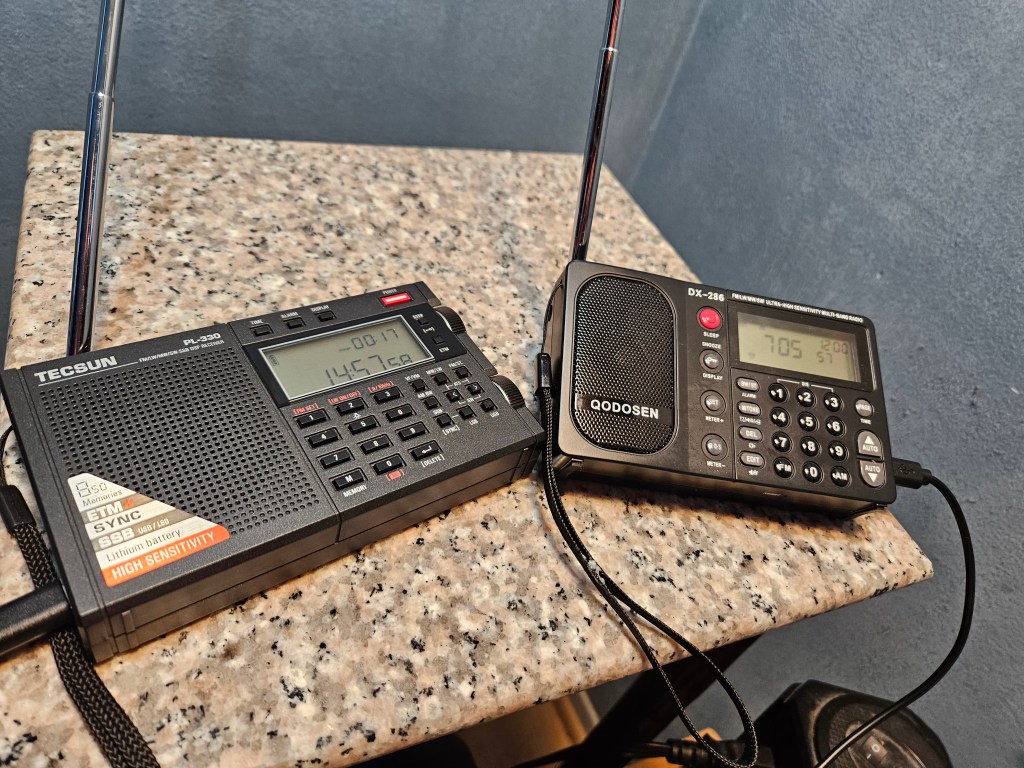
    Once I abandoned streaming, I filled every room in my house with a high-performance multiband radio. My love of music returned. A strange peace settled over me.

    The problem? My addictive personality latched onto radios with a zeal that bordered on the irrational.

    I began gazing at them with the kind of reverence normally reserved for religious icons. When I spotted a Tecsun PL-990, PL-880, PL-680, or PL-660, something in my brain short-circuited. I was instantly enchanted, as if I had just glimpsed an old friend across a crowded room. At the same time, I was comforted, as if that friend had handed me a warm cup of coffee and told me everything was going to be alright.

    But a radio isn’t just a device. It’s a symbol, though I’m still working out of what exactly.

    Maybe it represents the lost art of slowing down—of sitting in a quiet room, wrapped in a cocoon of music or familiar voices. Or maybe it’s something deeper, a sanctuary against the relentless noise of modern life, a frequency through which I can tune out the profane and tune into something sacred.

    The word that comes to mind when I hold a radio is cozy—but not in the scented-candle, novelty-mug kind of way. This is something deeper, something akin to the Dutch word gezelligheid—a feeling of warmth, belonging, and ineffable connection to the present moment.

    Radios don’t just play sound; they create atmosphere. They transport me back to Hollywood, Florida, sitting on the porch with my grandfather, the air thick with the scent of an impending tropical storm, the crackle of a ball game playing in the background like the heartbeat of another era.

    That’s the thing about gezelligheid—it isn’t something you can program into an algorithm. It isn’t something you can optimize. It’s a byproduct of presence, community, and shared experience—the very things convenience culture erodes.

    Many have abandoned radio for the cold efficiency of streaming and smartphones.

    I tried to do the same for over a decade.

    I failed.

    Because some things, no matter how old-fashioned, still hum with life.

    And maybe that’s what replacing streaming devices with radios is about—not just recovering from my addiction to writing abysmal novels, but recovering life itself from the grip of Flatworld.

  • FOMO: A Condition as Old as Childhood Tantrums

    FOMO: A Condition as Old as Childhood Tantrums

    Much has been made of FOMO—Fear of Missing Out—in the social media age, where we subject ourselves to an endless scroll of curated perfection, exotic vacations, and influencer brunches that remind us, yet again, that our lives are decidedly less fabulous. We are told, repeatedly, that comparison is the mother of misery, and we learn this lesson the hard way every time we doomscroll our way into existential despair.

    The connection between FOMO and social media is so well-documented that many assume it’s a modern affliction, a byproduct of algorithms and influencer culture. But this is nonsense. FOMO is primal. FOMO is childhood itself.

    It’s the feverish, anxiety-ridden anticipation that every child feels when something exciting is on the horizon—an internal combustion engine of eagerness, panic, and irrational urgency.

    I got my first brutal taste of FOMO-induced devastation in 1967, when my parents took me to Disneyland on Free Hat Day. In my young mind, this wasn’t just an outing—it was destiny. But instead of racing out the door at dawn, my parents had the audacity to languish over bacon and eggs while I vibrated with dread. By the time we arrived, the Mickey Mouse hats were long gone—claimed by early-rising, better-prepared children whose parents actually understood the stakes of childhood desire.

    And what did I get?

    A Donald Duck cap. A second-place trophy in the hierarchy of Disney headwear. It was my first true heartbreak, a cruel reminder that hesitation and breakfast foods could cost you everything.

    The beach was another FOMO battleground.

    As our car inched closer to the ocean, I could smell the saltwater, hear the cacophony of seagulls, and catch a tantalizing sliver of the horizon—and with each sensory cue, my stomach flipped with impatience.

    To my young mind, we weren’t just going to the beach—we were competing for a piece of it, and if my parents didn’t park immediately, we would lose our rightful claim to the best stretch of sand. I imagined other families staking their umbrellas, digging their trenches, laying territorial claim while we circled endlessly in a parking lot purgatory.

    Of course, there was always plenty of beach, and we always found a spot, but that’s the nature of FOMO—it turns everything into a high-stakes competition in which the difference between bliss and utter catastrophe comes down to how fast you can get there.

    FOMO isn’t new. It’s the original childhood affliction, the gnawing anxiety that life’s best moments are happening somewhere else—and you’re missing them because your parents won’t hurry the hell up.