Last night I dreamed myself into a surreal mashup of The Great British Bake Off, Yellowstone, and a calorie-induced nervous breakdown.
It began at a retirement party for D, a former colleague who had apparently left academia behind to study gourmet pastry arts in Europe. Now reborn as a culinary goddess, she presided over a dining room that looked like it had been styled by a Michelin-starred fever dream: trays of deconstructed brownies arranged like abstract sculpture, sourdough donuts with the texture of warm clouds, cinnamon rolls coiled with existential menace, and a chocolate cake so dense it might have had its own gravitational field.
In the corner sat a magical grand piano, humming with faint luminescence. I was meant to play it—perhaps to provide ambiance for the pastry rapture—but I never made it past the donuts. They called to me. I answered with both hands and minimal dignity.
Mid-binge, I was struck with a bolt of dietary guilt. I remembered I had a dinner date with my wife at her best friend C’s house. Worse, it wasn’t just any dinner—it was a social obligation. I arrived in C’s oversized dining room to find the ghost of a party long gone. Tables were abandoned like an upscale Pompeii, the air buzzing with lazy flies circling over still-warm piles of food: chicken pot pies glowing under golden crusts, French dips bleeding delicious regret, carne asada tacos wafting guilt into the air, and blueberry pie with a lattice crust so precise it looked like it had been braided by angels.
I ate. With one hand I fed myself; with the other, I held my phone to my ear, explaining the situation to my wife. She responded with calm detachment: “When you’re done, meet us in Montana.”
Of course. Montana.
I was then transported—no explanation needed, dream logic intact—to a bustling Montana restaurant. I wandered from table to table in search of my wife, passing clusters of archetypes: the Trust Fund Cowboy, the Patagonia-clad Nutrition Mystic, the Ex-Brooklyn Homesteader. They were deep in conversation about the social fault lines of modern Montana. At one table, a blonde woman lectured an enraptured audience. “There are only two kinds of people in Montana,” she declared. “Old-comers and New-comers. And the old-comers don’t want anyone else coming.”
Enter my friend Mike—ex-Navy SEAL, tropical city-builder, and walking rebuttal to provincial snobbery. He appeared like the Deus ex Machina he is, still radiating heat from his last humanitarian war-zone operation.
I turned to the blonde know-it-all. “Mike’s a new-comer,” I said, “but he built an entire city in the tropics in under forty-eight hours. Not only could he settle in Montana—he could govern the state.”
Silence fell. Victory was mine.
But before I could savor the moment, I was ambushed by a different horror: the specter of calories consumed. The desserts at D’s party, the savory gluttony at C’s—how much damage had I done? Had I ruined months of progress? Was I now one sourdough donut away from emotional collapse?
And then I woke up. The sweat was real. The calories were not.
Relief washed over me like cold Montana spring water. My body was intact. My diet undisturbed. I had survived the sugar apocalypse, and all of it—Mike, Montana, the magical brownies—had happened in the safe, consequence-free realm of REM sleep.
One of the bitter ironies of the watch addict is that he seeks a “manly watch” with “bold wrist presence,” yet much of his behavior as it pertains to his hobby is similar to that of a thirteen-year-old girl crying effusively as she leafs through her journals and scrapbooks in which she chronicles her “lost loves” and tries to mend her “broken heart” with the excessive self-regard one would expect from a thirteen-year-old. However, the watch addict, a man somewhere between his thirties and sixties, perhaps even older, is going down the same rabbit hole of melodrama as the thirteen-year-old. When he does a watch unboxing on his YouTube channel and trembles with tears running down his cheeks with anticipation, or does a YouTube rant about the regrets for all the prized watches that he “let get away” and left him with irreparable heartbreak, or stands before his YouTube watchers like a five-star-general as he announces with maniacal self-regard his “plans” to create his “ultimate collection,” or agonizes over the black and orange strap on his diver and goes back and forth over and over because he “loves both but can’t decide,” he probably doesn’t know that he is committing an act of colossal folly: He is embodying the Maudlin Man.
To understand the Maudlin Man and the folly he partakes in, we are well advised to consult Jeffrey Rosen’s book The Pursuit of Happiness. Rosen discovers that major American thinkers such as Benjamin Franklin draw their wisdom from Cicero’s Tusculan Disputations, which state that the soul must be “tranquilized by restraint and consistency.” In such a state, the soul “neither pines away in distress, nor is broken down by fear, nor consumed with a thirst of longing in pursuit of some ambition, nor maudlin in the exuberance of meaningless eagerness–he is the wise man of whom we are in quest, he is the happy man.”
There is much to unpack here. Perhaps the best way to do so is to divide man into two types: Restrained Man and Maudlin Man. Restrained Man is the type we should aspire to be. He is tranquilized by his own restraint, consistency, and self-agency and does not pine after things that cause him distress, anxiety, and FOMO.
Just reading the above words makes the addict inside me rebel. As a watch addict, I enjoy pining after watches and being caught in the melodrama of distress, FOMO, and desire for watches as shiny new objects my greedy little fingers can get a hold of. Wrap your head around that: I’m addicted to the very maudlin drama of my watch hobby. To be the Maudlin Man, therefore, is to be addicted to addiction.
But what Cicero is arguing is this: This melodramatic state that causes us to froth at the mouth for the things we desire is a form of “meaningless eagerness.”
Again, my inner addict rebels. It rages and counterargues, “Cicero, watches are my hobby. The very point of this hobby is that it is a benign and meaningless pastime that gives me enjoyment and relaxation.”
Of course, I am in denial. As I write this, I have a very beautiful diver watch with a wave-blue dial to be delivered from Singapore today from a DHL carrier. I’ve tracked the package six times since five this morning, and I couldn’t sleep last night because I agonized over whether I should keep it on the stock bracelet, put a sedate black Divecore on it, or put a loud orange Divecore on it. The stress is almost causing me to have a nervous breakdown.
I’m acting just like Maudlin Man. I’m experiencing effulgent emotions over something that is basically meaningless. As a result, I’m investing way too much energy and emotion toward my “watch situation,” and as a result, I am showing a lack of contact with reality.
Cicero’s point is that when we lack self-possession because we are in the maudlin state, we cannot be happy. Happiness is the byproduct of having self-agency and self-control.
I wince at Cicero’s words. Do I even want self-control? Do I not enjoy the drama of a watch strap “dilemma”? Do I not enjoy being an exuberant man-child?
Cicero would argue otherwise. He would argue that the “pleasures” I experience from my maudlin indulgences are at the root of my unhappiness. To understand Cicero’s argument better, let us look at the entire quotation:
Therefore the man, whoever he is, whose soul is tranquilized by restraint and consistency and who is at peace with himself, so that he neither pines away in distress, nor is broken down by fear, nor consumed with a thirst of longing in pursuit of some ambition, nor maudlin in the exuberance of meaningless eagerness–he is the wise man of whom we are in quest, he is the happy man.
My inner pessimist, which I call Glum, scoffs at Cicero’s words of wisdom and gives me a litany of my failures, which prove me unworthy of Cicero’s portrait of a happy man. Glum says to me the following:
“Regarding restraint, your appetites for tacos, spaghetti, garlic bread, homemade sourdough loaves stuffed with kalamata olives, semi-sweet chocolate chunk peanut butter cookies, chocolate cake, and pineapple cheesecake are so monstrous, you don’t have a chance in hell of exercising restraint when it comes to your appetites. Your very self is defined by your excesses, so good luck talking about restraint and moderation. You’re doomed.”
“Regarding ambition, it is only repeated failure of many decades, not humility, that abates your grandiose designs and fantasies of being famous and ubiquitous on television as a talking head whose opinions everyone greedily consumes as if your every word is a delicious morsel to be savored. So don’t go around bragging about your modesty and humble aspirations. Old age and an eye for the inevitability of your failure are your only salves, so you have no bragging rights.”
“Regarding maudlin exuberance and meaningless eagerness, you are the worst violator of these infractions, gushing with lame euphoria as you curate your watch collection to your YouTube viewers. Your entire enterprise of incorporating the wisdom of the Stoics and other classical thinkers is the biggest joke I’ve ever heard of and may qualify you for a life in comedy.”
My rebuttal to Glum is this. “With your keen insight into my wretched being, you have helped me see the very depth of my pathology. So thank you, Glum, you have helped me with an unflinching diagnosis of my spiritual dissolution, and thanks to you, this accurate diagnosis marks the beginning of my long road to recovery.”
I am grateful that I am both honest and smart enough to offer rebuttals to Glum, but having an intellectual grasp of what I should do and actually doing it are two vastly different things. For now, I have a clear grasp of Cicero’s notion of Maudlin Man. The seeds have been planted. I now hope that with those seeds, a counter self can grow that will put the Maudlin Man inside of me out of business.
The TV show Loudermilk is part sitcom, part group therapy, and part existential smackdown. Ron Livingston plays Sam Loudermilk, a grizzled music critic and recovering alcoholic with the face of a hungover basset hound and the social graces of a man allergic to kindness. He barrels through life offending everyone within a five-foot radius, insulting his fellow addicts with toxic flair. But beneath the wreckage lies a strange tenderness—a story not just about addiction, but about people trying to survive themselves.
Loudermilk lives in a halfway house with a cast of human tire fires, and the comedy burns hot: irreverent, profane, and deeply affectionate. The show loves its damaged characters even as it roasts them alive. Naturally, I love Loudermilk. Love it like a convert. I’ve become a low-key evangelist, promoting it to anyone within earshot—including the assistant at my local watch shop.
This isn’t just any watch shop. I’ve been going there for 25 years. The Owner and the Assistant know me well—well enough to have witnessed the slow, expensive progression of my watch addiction, including the day I came in twice because the first bracelet adjustment “didn’t feel quite right.” It’s my barbershop. My confessional. My dopamine dispensary.
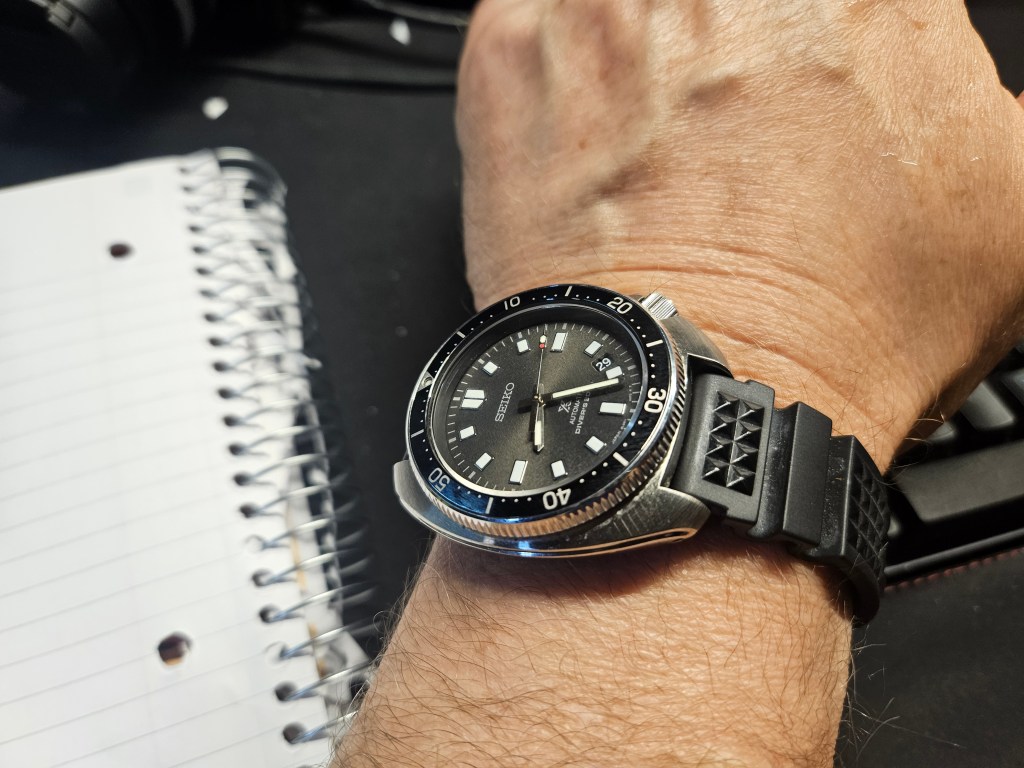
So one afternoon, I’m there getting a link removed from my Seiko diver and I bring up Loudermilk. I describe the show’s gallery of screwups—addicts clawing toward redemption by way of insults, setbacks, and semi-functional group hugs. The Assistant looks up from his tools and tells me something personal. He watches Loudermilk too. And he gets it. He’s thirteen days sober and goes to five meetings every morning—not because he’s a morning person. He tells me that in his culture, drinking into one’s eighties is just called “living.” But for him, it was a slow-motion self-immolation. Now, he’s trying to claw his way back.
Before I can respond, a woman with a chihuahua tucked under her arm chimes in from across the shop. She too is a Loudermilk fan. “What a shame it got canceled after three seasons,” she laments. The Assistant counters—there’s still hope for a revival. They argue lightly, both fully engaged, two strangers momentarily bonded over their shared love of a comedy about pain.
I say goodbye and step out of the store. That’s when it hits me.
I love Loudermilk because I see myself in it. I am an addict. Not just of watches, but of distraction, validation, control—whatever lets me delay the moment when I must confront the snarling voice inside me.
Writers like Steven Pressfield and Phil Stutz describe this inner saboteur with chilling clarity. Pressfield calls it Resistance, the destructive force that undermines your better self. Stutz names it Part X, the anti-you that wants you to abandon meaning and pursue comfort. Both insist the enemy must be fought daily.
And I know that voice. It’s lived in my head for decades.
Once, at an English Department Christmas party, a colleague called me “Captain Comedown.” I don’t remember what I said to earn the nickname, but it tracks. I’ve got that bleak edge, the voice that sees futility everywhere and calls it wisdom. But a better name than Captain Comedown comes from my childhood: Glum, the joyless little pessimist from The Adventures of Gulliver, whose go-to phrase was: “It will never work. We’ll never make it. We’re doomed.”
That’s my inner monologue. That’s my Resistance. That’s my Glum.
Every day I wrestle him. He tells me not to bother, not to try, not to hope. That joy is a scam and effort is for suckers. And some days, I believe him. Other days, I don’t. But the battle is constant. It doesn’t end. As Pressfield says, the dragon regenerates. My job is to keep swinging the sword.
And maybe, just maybe, buying a new watch is my way of telling Glum to shut up. It’s a shiny, ticking middle finger to despair. A symbolic declaration: The world still contains wonder. And precision. And brushed stainless steel.
But there must be cheaper ways to silence Glum. A walk. A song. A friend. A laugh. Even a half-hour with Loudermilk.
Because, irony of ironies, what addicts like me really want isn’t the next hit. It’s relief from the craving.
In her darkly hilarious comedy special Father, Atsuko Okatsuka shares the origin story of her career in punchlines. Her schizophrenic mother once “kidnapped” her in Japan and whisked her away to the United States without warning, severing her ties to her father in the process. The trauma was so disorienting, so profound, that Atsuko now mines laughter for survival. She tells us, with a comedian’s grin and a survivor’s twitch, that she performs to fill an infinite hole in her soul with the validation of strangers.
That hole is not unique to her. It’s a universal pit—bottomless and demanding. Validation comes in many flavors. For some, it’s esteem and admiration. For others, it’s expertise, artistry, the warm glow of audience approval. For Atsuko, it’s laughter. For others, it’s the faint buzz of a “like” on a post about a wristwatch.
Let us now consider the watch obsessive, a different breed of relevance-seeker, but a kindred spirit nonetheless. He isn’t doing five-minute sets at the Laugh Factory, but he is performing—on Instagram, on forums, on YouTube, in the comment sections of strangers’ macro shots. He presents his taste, his “knowledge,” his ever-shifting collection. But underneath the sapphire crystals and brushed titanium is the same primal whisper: Do I still matter? Do they still see me?
Here’s the tragic twist: he may already have the perfect collection. It gives him joy. It’s balanced. It fits in a single watch box. By all logic, he should stop. Buying another watch would be like adding a fifth leg to a table—wobbly and unnecessary. But he doesn’t stop. He can’t stop.
Why? Because if he stops collecting, he stops posting. If he stops posting, he stops being seen. And in a world addicted to scrolling, disappearing feels like dying.
Relevance is the new oxygen. And social media is a machine that runs on novelty, not legacy. The digital hive forgets fast. “Gangnam Style” is now a fossil. “Call Me Maybe” is background noise at the grocery store. To stay visible, you must be new. You must be shiny. You must offer dopamine.
And what happens when the watch addict manages his demons, reaches peace, and stops feeding the machine?
He becomes boring. He becomes silent. He becomes irrelevant.
And the parasocial bonds he once had—those illusory friendships, those mutual obsessions—fade. The sense of exile is real. It doesn’t matter that the exile is self-imposed. The pain still lingers.
That fear—that primordial fear of irrelevance, of being cast out from the tribe—can be so powerful it masquerades as passion. It convinces the watch obsessive to keep flipping, keep chasing, keep posting. Not out of love, but out of fear.
So the question becomes: Are we collectors? Or are we hostages? Do we love horology? Or are we simply terrified of vanishing?
Last night I dreamed I was adrift in a farmer’s market purgatory, toggling between two dried fruit stalls like a man on a doomed pilgrimage. At one end stood my friend Adam, hawking dried apricots beside his immaculate new Honda Accord, polished to a showroom glint. At the other, Andre offered prunes with the calm assurance of a man backed by a brand-new Toyota Camry.
I paced between them, acting like a mildly deranged Consumer Reports correspondent. I asked about mileage, comfort, tire pressure, road feel. Adam, ever candid, confessed that his Accord’s 19-inch tires required constant babysitting—a weekly ritual of crouching beside his car like a penitent monk, pumping air into finicky rubber. Andre, on the other hand, practically preened. His Camry had no such neediness. His tires, he implied, were stoic and self-reliant, like Roman centurions.
As my dithering grew more manic, Adam and Andre began to notice. They called each other—yes, in the dream they phoned each other mid-market—and the temperature dropped. Andre, initially genial, grew terse. Adam smirked defensively over his dried apricots. The whole affair soured like old fruit.
Then, like a man possessed, I made my declaration. I would buy the Camry. Not for the horsepower. Not for the design. But because I refused—refused!—to spend my golden years crouching beside a car, inflating tires like a desperate cyclist.
No sooner had I made my proclamation than the dream world pivoted sharply, as dreams do. I was no longer in a farmer’s market—I was on a college campus. But not my college. Not the place where I once held a proud tenure-track post. No, I had been demoted. My prestigious job had evaporated. I was now an adjunct at some podunk backwater school with low ceilings and fluorescent lights that hummed with institutional malaise.
Why the fall from grace? Simple. My years spent obsessing over the Camry-vs-Accord dilemma had not gone unnoticed. While I was inhaling tire PSI data and fondling prune samples, my absence from the college became conspicuous. The administrators, ruthless as vultures in blazers, terminated me. I had toggled too long. My career had flatlined.
I woke at 5 a.m. in a wash of dread and despair—not from the dream’s end, but from the clatter of the real world: an Amazon delivery person, fumbling at the gate, dropping a box on the porch like a coffin lid.
I opened it. Inside was a stainless steel bathroom trash can, taller, sleeker, with built-in liners—my daughter’s request. Unlike our old can, which was a rust-streaked monument to hygienic defeat, this one gleamed with a kind of futuristic dignity. Its surface mirrored my face: puffy, sleepless, faintly haunted.
And yet, in its shimmering steel, I saw something unexpected: hope. Renewal. The modest redemption of functional design.
Watch obsessives have more in common with Howard Ratner than we care to admit. Yes, that Howard Ratner—the unhinged gem pusher played with twitchy brilliance by Adam Sandler in the Safdie brothers’ cinematic panic attack, Uncut Gems. Ratner operates in the Diamond District behind bulletproof glass, drowning in sparkle and debt. We operate behind the bulletproof delusions of horological obsession, buried in brushed steel and moonphase complications.
Like Ratner, we gamble—not at sportsbooks, but with FedEx tracking numbers. We tell ourselves, this is the one as we refresh the delivery status of the next “grail” watch. The package might as well be glowing, Pulp Fiction-style. And like Ratner chasing a cursed Ethiopian black opal mined from the bloodied crust of the Earth, we twist ourselves into financial and emotional pretzels to score that one special piece—the wrist-mounted miracle that will finally quiet the voices.
Spoiler: it never does.
Ratner is a man who thinks more is the cure. More bets. More jewels. More chaos. The watch obsessive runs the same play. We soothe our midlife despair not with therapy or silence, but with spring drives, meteorite dials, and limited edition bronze cases. Our collections don’t grow—they metastasize.
Like Ratner, our problem isn’t the world. Our problem is internal. The call is coming from inside the skull. He can’t stop because he doesn’t want to stop. The thrill is the point. Every acquisition, every wrist shot, every gushing forum post—just another hit of synthetic joy to distract from the gnawing void. We call it a hobby. Let’s not kid ourselves. It’s dopamine addiction disguised as design appreciation.
Uncut Gems is a cinematic espresso shot laced with panic. My wife and brother couldn’t sit through thirty minutes. Too stressful, they said. Too jittery. I’ve watched it three times.
But of course I have. I’m a watch addict.
I live in Ratner’s world. The caffeinated chaos? That’s not discomfort. That’s home.
About eight years ago, I experienced the horological equivalent of speed dating. Two watches arrived on the same afternoon: a Seiko Sumo SBDC001 with a black dial and sapphire, and the sleeker SBDC051—a reissue of the classic 62MAS. I placed them side by side like two contestants in a Darwinian experiment, then strapped each one on as if I were auditioning them for the role of “forever watch.”
It wasn’t even close.
The 051 had the refinement and wrist presence of a watch that knew it belonged. Crisp finishing. Perfect proportions. Lume that could guide ships through fog. The Sumo? It felt cheap. It wasn’t worth half of the 051. I sold it before dinner. Brutal, but deserved.
Fast-forward eight years. I’m hunting again—not for a grail, but for something that will sing when paired with my beloved orange Divecore strap, the one accessory that unlocks my inner Watch Beast. Naturally, I thought about giving the Sumo a redemption arc—maybe the gray-wave dial SBDC177? But my instincts flared. Once a dud, always a dud?
Then I spotted the polygonal Seiko SBDC203 (SPB483), aka the “Coastline,” and something clicked. This one looks like it could go toe-to-toe with the 051. Sharp lines, killer specs, and the kind of tactile satisfaction you only get when Seiko decides to actually try.
Two closing thoughts:
First, nothing has made me feel more bonded to my watch obsession than the orange Divecore strap. It’s not just a strap—it’s a mood, an identity, a wrist-based mission statement.
Second, I’ve come to believe the real addiction isn’t the watches. It’s the brain hijack you constantly crave. The way your brain lights up when The Next Thing to Get starts coming into focus. That little thrill of clarity when you think, Yes, this is the one. It’s the same buzz I get from customizing a Camry XSE in Heavy Metal Gray on Fletcher Toyota’s website and seeing it listed for “only” $38K—a car I may or may not buy but already love as if it’s parked in my soul’s garage.
Humans are a deranged species. We crave imaginary ownership like it’s the secret to inner peace.
Another Flex Day had dawned—yet again a gaudy parade of icebreaker drivel, PowerPoint piety, and educational workshops led by people who looked like they’d been conjured by a bureaucratic séance. Against my better instincts—and with a flicker of masochistic hope I should’ve interrogated—I signed up for a session titled Exercise and Mental Wellness. It was being held in the Hobcallow campus gym, a crumbling monument to deferred maintenance and broken promises. If buildings could sigh, this one would’ve let out a long, exhausted groan. Everything about it screamed “run,” but I ignored the sirens blaring in my skull and walked straight in, armed with denial and a water bottle.
The gym was a fluorescent-lit dungeon, the kind of place where even the light seemed desperate to escape. The air reeked of mildew, ancient sweat, and the crushed dreams of generations who’d suffered through dodgeball and underfunding. I could practically hear the scent—a low moan of institutional despair.
Then the “fitness expert” took the stage. He looked like he subsisted on steamed kale and unprocessed anxiety. His limbs were pipe cleaners, and his tube socks rode high up his shins like he was waving tiny surrender flags. A whistle hung from his neck, though it clearly served more as costume than command. The guy had the aura of a substitute gym teacher in a 1979 after-school special—minus the charm. With the fervor of a man unveiling the cure for cancer, he launched into a sermon on the redemptive power of push-ups. According to him, daily push-ups could defeat depression, boost classroom charisma, and chisel us into statues Michelangelo would envy.
I sat among fifty or so other professors, all of us bearing the glazed, shell-shocked expressions of people who’d just survived a bureaucratic earthquake. When the whistle-wielder asked for a volunteer to demonstrate the proper push-up, silence fell across the gym like a dropped curtain. Heavy. Suffocating. It was the sound of collective academic burnout, of souls ground into dust by budget cuts and endless committee meetings.
Eventually, someone was nudged forward. “Volunteer” was a generous word. The man was more of a human offering. He shuffled onto the stage in a suit that draped off him like wet laundry. His glasses clung to his face like they were afraid to be part of what came next. He moved like a man who had made a series of increasingly regrettable choices that had all led here.
Then he went down for the push-up—and the moment collapsed into slapstick tragedy. His arms gave out instantly, like a folding chair kicked from behind. His glasses launched from his face and slid across the gym floor, desperate for escape. He lay there wheezing like a deflating accordion, the very embodiment of what happens when the intellect thrives and the body is left for dead.
You’d think someone might offer sympathy. A supportive chuckle. Maybe a smattering of ironic applause. Nope. The room was pure stone—emotionally fossilized. A few professors exchanged murmured postmortems. Most stared ahead with the blank-eyed stillness of DMV patrons or people deep into a hostage negotiation.
And when it finally ended, I fled. I bolted, heart pounding, mind racing, lungs grateful just to be outside again. It wasn’t enlightenment I’d found that day. Just confirmation: some kinds of despair really do come with a whistle.
After surviving thirty Flex Days—each one more spiritually numbing than the last—I’ve come to a grim conclusion: these spectacles aren’t designed to make us better instructors. No, they’re the bureaucratic equivalent of waterboarding. Their true purpose is to remind us, in the most humiliating way possible, that we are not free agents but indentured servants to a cabal of institutional overlords who wouldn’t recognize actual education if it bit them on their lanyards. The activities they concoct—team-building scavenger hunts, trust falls, and workshops on how to smile while grading—aren’t just irrelevant to higher learning. They are a brazen insult to critical thinking itself, proof that the people orchestrating these charades are not only disconnected from the classroom, but from basic cognitive function. Flex Days are not professional development; they’re intellectual purgatory dressed up in business casual.
Last night, I had a dream so vivid it might as well have come with a recruitment brochure. Word had spread—apparently my reputation as the guy who could teach college football players to write sentences that didn’t cause nosebleeds had reached mythical status. Somewhere in South Carolina, perched on a beach with the casual arrogance of a luxury condo, a university decided they needed me. Urgently.
Some guy—I don’t remember his name, only that he had the calm urgency of a cult recruiter—convinced me to hop on a bus. The ride took five seconds. Not metaphorically. Five actual seconds. Blink and boom: there I was, standing on a beach so perfect it made the California coast look like an overhyped sandbox.
The air was humid but in a sensual, Southern Gothic sort of way. The kind of air that makes you forgive mosquitoes and contemplate linen pants. The sun was melting into the Atlantic like it had nowhere better to be. I was home, or something like it.
Coaches greeted me like I’d just been drafted into sainthood. Players clapped me on the back and called me “Coach,” which I didn’t correct because, frankly, it felt good. Then came the arm wrestling. One by one, I took them down like some middle-aged Hercules hopped up on tenure and protein powder. Elbow to the table, bicep to the heavens. I wasn’t just respected—I was essential.
It wasn’t about strength. It was about belonging. Every laugh, every handshake, every ridiculous display of masculine absurdity made me feel needed in a way that was almost embarrassing. I wasn’t just part of the team. I was the team.
I wanted to call my wife back in California, to tell her we were moving. I had found the Promised Land, and it came with free gym access and a faculty parking permit. But the joyous noise around me was too loud. The players were hooting, the coaches were laughing, and the ocean kept slapping the shore like it had something to prove. I’d call her later, I told myself.
Then I woke up.
The ceiling fan was rattling. My desire for dark roast coffee was pressing. And I was back in the real world, where my inbox was probably filled with late assignments and vague threats from the IT department.
Still, the dream stuck with me. Not because of the location, or the humidity, or the freakish arm strength—but because of the feeling. That feeling of being wanted. Of being part of something. Of mattering.
Fresh off the bus from the bustling Bay Area, you found yourself marooned in Hobcallow—a sun-bleached corner of California that could only be generously described as a town. With zero friends and even fewer social obligations, you embraced your solitude like a monk taking a vow of silence. Your one-bedroom apartment became your sanctuary—no roommates, no forced small talk, just you and the sweet luxury of never having to negotiate chores or TV channels.
Your companions? A stack of CDs featuring Morrissey, The Smiths, and other bands that sounded like group therapy sessions set to a minor key. The soundtrack was perfect as you labored over your novel Hercu-Dome, your dystopian magnum opus in which society punished the overweight with Orwellian fervor for failing to meet state-mandated body standards.
When you weren’t writing, you plinked away on your Yamaha ebony upright, conjuring self-indulgent sonatas that only the most pretentious muses could appreciate. You didn’t read music so much as let it ooze out of you—luscious chords here, shameless glissandos there—while imagining some ethereal goddess materializing in your living room to stroke your ego as you struck a soulful pose.
Compared to the misery of your college days in the Bay Area, your Hobcallow digs felt like a five-star resort. Back then, you hadn’t been living so much as squatting in a glorified crawlspace. That room had a gaping hole in the wall, perfectly positioned at bed level, letting in gusts of cold air so vengeful it felt like the Bay’s fog had developed a personal vendetta against you. Sleeping wasn’t rest—it was combat. You huddled under layers like you were gearing up for an Everest summit—jacket, hat, and gloves included, if the wind got particularly sassy.
Your diet back then was a tragicomedy in three acts: breakfast, lunch, and dinner. Cheerios were the lead performer, while bean-and-cheese burritos played the understudy when you felt adventurous. These “burritos” were little more than refried sludge folded into tortillas with all the flexibility of a sheet of drywall. The cheese? The kind that refused to melt out of pure spite, clinging to the tortilla like it was serving a life sentence. Each bite reminded you that you weren’t starving—but you were nowhere near thriving either.
Your transportation situation was another chapter in your tale of woe. You drove a ten-year-old Toyota Tercel that was less car and more haunted maraca. Every time you touched the brakes, the thing let out a tortured groan, like it wanted to die with dignity. Navigating the Bay Area hills required a white-knuckled grip and a whispered prayer that the Tercel wouldn’t roll backward into a bus full of nuns and cyclists. Fixing it became a twisted game of financial Russian roulette: either repair the brakes or buy groceries. One of you had to suffer.
Money? Scarcer than warmth in that arctic excuse for a room. Every broken item—of which there were many—demanded a patch job involving duct tape, superstition, and whatever scraps you could scavenge. Gathering enough quarters for the laundromat felt like winning a regional lottery. “Luxury” meant adding an extra spoonful of salsa to your burrito—living on the edge by upgrading the spice level in a meal otherwise soaked in depression.
Looking back, it was a miracle you escaped that purgatory with your sanity—or whatever passed for it. That drafty hellhole taught you resilience, sure, but more than anything, it taught you to laugh at the sheer absurdity of trying to survive in a city that demanded gold while you were scraping together lint and hope.
So there you were, newly settled in this desert hideaway, craving a hint of the luxury you’d never known. On weekends, you tanned your lean, 195-pound frame beside The Springs’ apartment pool—a so-called “luxury” pool that only deserved the title because the sign said so. Real friendships didn’t blossom there—friendships were messy and overrated—but you collected a small cluster of “acquaintances,” a bizarre cast of characters who could only exist in this sun-scorched limbo.
You weren’t thriving, but at least you weren’t freezing or chewing on cardboard disguised as food. And in a place like Hobcallow, that was as close to paradise as you were ever going to get.