Tag: life

  • The Effort Mandate: Why Your Milkshake Scene Matters More Than Your Netflix Queue

    The Effort Mandate: Why Your Milkshake Scene Matters More Than Your Netflix Queue

    My students read Cal Newport, who argues—rightly—that happiness has less to do with basking in self-care rituals and more to do with rolling up your sleeves and pursuing a life of relentless, purpose-driven work. Newport, like a modern-day monk with a MacBook, insists that true contentment doesn’t come from “finding your passion” or retiring to some fantasy Airbnb with pizza in one hand and a remote in the other. Instead, happiness is built the old-fashioned way: through grit, sweat, and enough existential gumption to brave the storms of effort.

    Alex Hutchinson, in “The Paradox of Hard Work,” asks why we pursue brutal, bone-crunching tasks when our evolutionary wiring is supposedly set to “energy-saving mode.” He calls it puzzling. I don’t. The so-called “Effort Paradox” isn’t a mystery; it’s a truth so obvious we dress it up in academic hand-wringing to avoid confronting it: people crave hard things because without them, we rot.

    Whether it’s Peter Gabriel locking himself in a farmhouse to claw So into existence, or Isabel Wilkerson spending fifteen years writing The Warmth of Other Suns, meaningful work demands blood. Even weekend warriors know this. Ask a suburbanite about their yearlong bathroom renovation—listen to them swell with the pride of a soldier recounting a siege.

    And then there’s art. Cheap, glossy, instant-gratification art that evaporates from your mind before you reach the parking lot. You didn’t watch a movie—you consumed a content burrito and forgot the taste. Contrast that with There Will Be Blood: a cinematic ordeal so dense and punishing that it leaves claw marks on your psyche. I think of that milkshake scene more than I think of most people I went to college with. That’s not paradox. That’s payoff.

    So let’s stop calling it a paradox and start calling it what it is: The Effort Mandate. Meaning isn’t a gift; it’s a byproduct of voluntary suffering. You want happiness? Go earn it.

  • Fear, Fat, and the Fickle Gods of Appetite: A Diet Writer’s Tale

    Fear, Fat, and the Fickle Gods of Appetite: A Diet Writer’s Tale

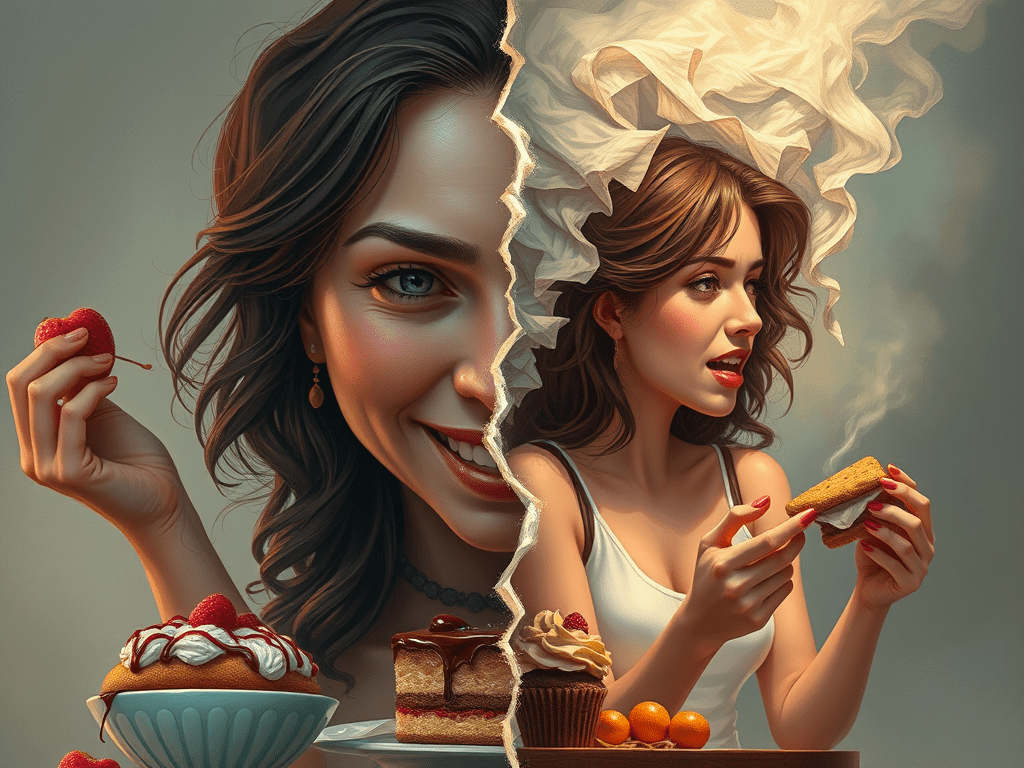
    Rebecca Johns spent decades whispering sweet, slimming nothings into the ears of women’s magazine readers—low-fat gospel by day, seductive chocolate cake recipes by night. In her Atlantic essay, “A Diet Writer’s Regrets,” she confesses the irony that while readers gobbled up her diet advice like SnackWell’s cookies, she was losing the battle against her own body. At twenty-three, fresh out of college and desperate to shrink her waistline, Johns eagerly volunteered for the magazine’s diet beat. She got the gig—and with it, a front-row seat to her own unraveling.

    As her writing career expanded, so did she. The more she advised others on portion control, the more food tightened its psychological grip on her. She became the oracle of thinness while secretly bingeing and self-loathing. And her audience? They were just as eager to read about lemon-water detoxes as they were molten lava cakes for their next dinner party. The entire racket, she realized, was built on contradiction and fantasy.

    By 2017, she weighed 298 pounds, with a BMI in “Call the doctor” territory. She had tried every acronym on the dieting menu—WW, keto, IF, CICO—but none of them stuck. Then, like a miracle in an injector pen, came Mounjaro. Prescribed in 2023, this GLP-1 wonder drug rewired her hunger like a tech support call for the brain. No more food noise. No more gnawing obsession. Eighty pounds evaporated. At last, she became the kind of person she had written about for thirty years but never met—herself, only thinner.

    But here’s the twist: now that she’s tasted liberation, she’s terrified. Insurance may soon ghost her, and Mounjaro, priced like a luxury car lease, will slip from reach. She knows too much to let herself go back, and not enough to know how to stay the course without her miracle molecule. The horror? She might have to white-knuckle her way through celery sticks and willpower.

    Johns doesn’t mince words when she calls body acceptance a euphemism for surrender. “If skinny were truly optional,” she writes, “we’d all choose it.” And she’s not wrong. If college is driven by fear of poverty, maybe dieting is driven by fear of dying too soon—or worse, returning to a body you fought so hard to escape.

    If fear gets the job done, Johns suggests, then let it. After all, if love won’t keep you away from the donuts, maybe dread will.

  • The Great, on Hulu, is your TV Mount Everest

    The Great, on Hulu, is your TV Mount Everest

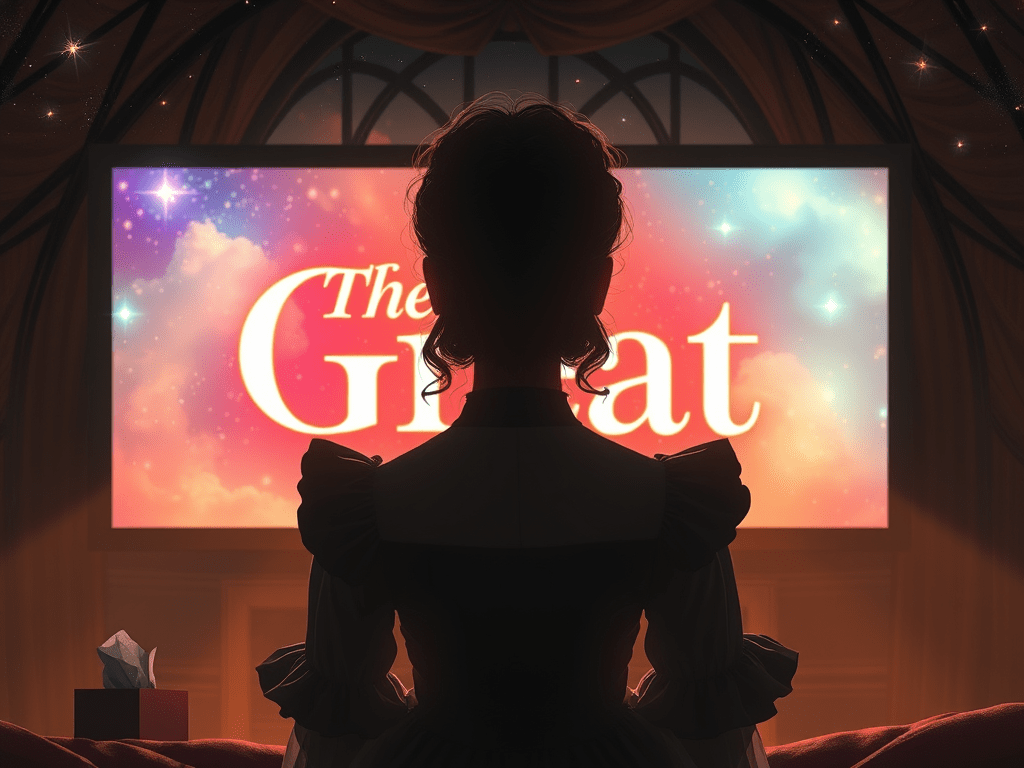
    So, you’ve just finished watching the complete 3 seasons of The Great on Hulu, and now you’re a broken shell of a human being. This “anti-historical” comedy about Empress Catherine the Great, penned by the devilishly talented Tony McNamara, is hands-down the best thing you’ve ever seen on television. And now, you’re plunged into a depression so deep that not even Elle Fanning’s radiant smirk or Nicholas Hoult’s glorious, sociopathic wit can pull you out of it. Why? Because you know, deep in your soul, that you’ll never see a script with such biting humor, impeccable cadence, and penetrating insight again. Ever.

    The Great is your TV Mount Everest, and the air up there is so thin that coming back down to the ground feels like an existential freefall. Desperate for solace, you decide to drown your sorrows in another “costume comedy,” because clearly, nothing soothes the soul like more ruffles and wigs.

    Enter The Decameron on Netflix—a comedy about the bubonic plague in 14th Century Italy. Yes, someone thought it would be a good idea to wring laughs out of a pandemic that killed a third of Europe. And the shocking part? They actually pulled it off. You’re impressed. Sort of. But at the same time, let’s not kid ourselves—the writing is not even in the same universe as The Great. It’s like comparing a Michelin-starred meal to the tastiest TV dinner you’ve ever had. Sure, it’s good, but come on—it’s not The Great. But here’s the kicker: you can’t trust your judgment anymore. You’ve entered a full-blown Post-Masterpiece Meltdown. On one hand, you’re bending over backward to be generous toward The Decameron, because you know deep down it’s unfair to compare anything to the sheer brilliance of The Great. On the other hand, you’re haunted by the suspicion that your generosity might be blinding you to the show’s actual merits—or lack thereof. You’re like someone who’s just lost the love of their life and is now attempting to date again by swiping right on Tinder with tears streaming down their face.

    Can you really trust your post-Great heart to judge anything properly? To make matters worse, The Decameron features the enigma that is Tanya Reynolds, an actress whose face is a bafflingly delightful conundrum—one moment goofy, the next serenely beautiful, as if she’s somehow tapped into a facial time machine that can travel between awkward adolescence and timeless beauty at will. Her intoxicating, elastic pulchritude is the final nail in the coffin of your short-circuited judgment. Your critical faculties, once sharp as a chef’s knife, now resemble a spoon trying to slice through steak. And you used to take pride in your TV criticism! Now you’re floundering in a sea of existential doubt, questioning everything—your taste, your standards, your very identity as a TV aficionado. So here you are, a once-confident critic, now reduced to a quivering mass of uncertainty, all because you stumbled upon Tony McNamara’s masterpiece, The Great. It’s like finding out you’ve been living in Plato’s cave all along, and now you’ve seen the light, you’re doomed to spend the rest of your days in the shadows, longing for the brilliance you can never unsee. Welcome to your new life in the Post-Masterpiece Meltdown. Enjoy the view—such as it is.

  • The Los Angeles Wildfires Reconnected Me to Radio

    The Los Angeles Wildfires Reconnected Me to Radio

    The Los Angeles fires, blazing with apocalyptic fury, prompted me to do something I hadn’t done in years: dust off one of my radios and tune into live local news. The live broadcast brought with it not just updates but an epiphany. Two things, in fact. First, I realized that deep down, I despise my streaming devices—their algorithm-driven content is like an endless conveyor belt of lukewarm leftovers, a numbing backdrop of music and chatter that feels canned, impersonal, and incurably distant. Worst of all, these devices have pushed me into a solipsistic bubble, a navel-gazing universe where I am the sole inhabitant. Streaming has turned my listening into an isolating, insidious form of solitary confinement, and I haven’t even noticed.

    When I flipped on the radio in my kitchen, the warmth of its live immediacy hit me like a long-lost friend. My heart ached as memories of radio’s golden touch from my youth came flooding back. As a nine-year-old, after watching Diahann Carroll in Julia and Sally Field in The Flying Nun, I’d crawl into bed, armed with my trusty transistor radio and earbuds, ready for the night to truly begin. Tuned to KFRC 610 AM, I’d be transported into the shimmering world of Sly and the Family Stone’s “Hot Fun in the Summertime,” Tommy James and the Shondells’ “Crystal Blue Persuasion,” and The Friends of Distinction’s “Grazing in the Grass.” The knowledge that thousands of others in my community were swaying to the same beats made the experience electric, communal, alive—so unlike the deadening isolation of my curated streaming playlists.

    And then there was talk radio. Live conversations on KGO 810 AM with Jim Eason and Ronn Owens held a spellbinding charm. In the 70s, my mother and I would sit in the kitchen, enraptured, as they dissected controversies and gossip with the vigor of philosophers at a cocktail party. It was conversation as an art form, communal and vital, like cavemen telling stories around the fire. Contrast that with my podcasts: cherry-picked for my biases, carefully calibrated to affirm my tastes, locking me in an echo chamber so snug it could double as a straightjacket.

    The fires aren’t just devastating to the city—they’ve exposed the cracks in my own longing for connection. The nostalgic ache sent me down a rabbit hole of online research, hunting for a high-performance radio, convinced that it might resurrect the magic of my youth. But even as I clicked through reviews of antennas and AM clarity, a voice nagged at me: was this really about finding a better radio, or was it just another futile errand from a man in his sixties trying to outrun time? Could a supercharged radio transport me back to those transistor nights and kitchen conversations, or was I just tuning into the static of my own melancholia?

  • Something Strange Happened to Me When I Saw My Childhood Home on Zillow

    Something Strange Happened to Me When I Saw My Childhood Home on Zillow

    When I was a kid, my dad worked at IBM in San Jose, and we lived at the very end of Venado Court—a cul-de-sac so serene it felt like a cosmic loophole in suburban chaos. I loved everything about it, especially the absence of cross-traffic.

    Cross-traffic was anarchy—it was second base in Little League, where the game unraveled into sheer bedlam: runners stealing, coaches screaming, fielders panicking. But Venado Court? It was home plate. Safe. Untouchable. The kind of place where nothing bad could happen—unless you count the existential horror of eventually having to leave it.

    The analogy reminds me of George Carlin’s classic bit contrasting baseball and football: Baseball is a pastoral dream, all about going home. Football is military conquest, where you march into enemy territory and get your spine realigned by a 300-pound lineman. Venado Court was baseball. It was safety. It was home.

    Recently, I stumbled onto a real estate site featuring my childhood house—5700 Venado Court, San Jose, California, where I lived from 1968 to 1971. The photos were unsettlingly familiar. My old bedroom. The bathroom where Mr. Bubble and Avon’s Sesame Street shampoo bottles once stood like sentinels of childhood innocence. The backyard, still lush with fruit trees—apricot, peach, plum, and walnut—a miniature Garden of Eden where my mother and the neighbor ladies, in some kind of euphoric domestic alchemy, canned preserves like their lives depended on it.

    The kicker? That house, my sacred childhood sanctuary, is now worth $1.3 million—the same price as my current home in Southern California. A deranged part of me toyed with the idea: sell my house, buy my childhood back, step through the front door like some time-traveling prodigal son.

    But then sanity prevailed.

    I know exactly how that story would end. Not in horror, but in ennui. I’d be trapped in a slow-moving nightmare of banality, watching my enchanted memories dissolve under the fluorescent hum of reality. The house wouldn’t feel like home. It would feel like a set piece in a dismantled dream.

    Thomas Wolfe was right—you can’t go home again. Not because it’s scary. But because it’s boring.

  • The Day I Failed the Ishihara Color Blindness Test

    The Day I Failed the Ishihara Color Blindness Test

    For years, I harbored a vague but nagging suspicion that peanut butter was green. Why? No clue—until 1971, when the grim truth revealed itself under the fluorescent doom of Independent Elementary’s nurse’s office.

    It was the day of the Ishihara Color Blindness Test, a supposedly routine exercise in humiliation where each fifth grader took turns peering into an illuminated contraption to identify numbers and shapes hidden in a field of colored dots. My classmates breezed through it like game show contestants, rattling off answers with the breezy confidence of children who’d never questioned their own eyesight.

    Then it was my turn.

    I stared into the glowing abyss. Saw nothing. Blinked. Still nothing.

    The nurse grew impatient. “Well? Can’t you see anything?”

    I could not.

    The room erupted in laughter. Congratulations—I was officially hopelessly color-blind, a medical outcast, a social leper. For the remainder of the morning, my classmates regarded me like a rare museum specimen. This boy thinks peanut butter is green. Proceed with caution.

    But fate, as it turns out, is not without a sense of humor.

    During lunch recess, the hierarchy of fifth-grade cruelty shifted. Kickball—a sport where raw physical dominance could overwrite even the most damning personal defect—offered me an unexpected shot at redemption. As the ball rolled toward me, I summoned the might of my tree-trunk leg, swung with the force of a caffeinated mule, and launched that red rubber sphere over everyone’s heads. It sailed past the outfield, past the schoolyard, and over the fence—finally splashing down into the backyard swimming pool of a bewildered suburbanite several blocks away.

    For a brief, glorious moment, I was no longer the kid who saw peanut butter in the wrong spectrum. I was a legend. The freakishly strong fifth grader with the foot of an Olympian and the trajectory of a human cannon.

    Lesson learned: You may be ridiculed for believing peanut butter is green, but if you channel your inner Herman Munster and kick a ball into another ZIP code, nobody gives a damn about your defective eyeballs. Heroism comes in many shades—even if you can’t see them.

  • The FOMO Frequency: How I Tried to Tune Back into Real Life

    The FOMO Frequency: How I Tried to Tune Back into Real Life

    As I clawed my way out of my addiction to writing doomed novels (which were really short stories in disguise), a strange thing happened: buried emotions clawed back. It wasn’t pleasant. It was like peeling off a bandage only to discover that underneath was raw, exposed nerve endings. Turns out, the grandiose fever dream of writing had insulated me from reality. Now, stripped of that delusion, I was left unprotected, vulnerable, and completely awake to the world.

    And the world, in 2025, was on fire.

    Literally. The Los Angeles wildfires turned the sky into an apocalyptic hellscape—a choking haze of smoke and fury. The inferno forced me into an act I hadn’t performed in years: I dusted off a radio and tuned into live news.

    That’s when I had two epiphanies.

    First, I realized I despise my streaming devices. Their algorithm-fed content is an endless conveyor belt of lukewarm leftovers, a numbing backdrop of curated noise that feels canned, impersonal, and utterly devoid of gezelligheid, a sense of shared enjoyment. Worst of all, streaming had turned me into a passive listener, a zombie locked inside a walled garden of predictability. I spent my days warning my college students about AI flattening human expression, yet here I was, letting an algorithm flatten my own relationship with music.

    But the moment I switched on the radio, its warmth hit me like an old friend I hadn’t seen in decades. A visceral ache spread through my chest as memories of radio’s golden spell came rushing back—memories of being nine years old, crawling into bed after watching Julia and The Flying Nun, slipping an earbud into my transistor radio, and being transported to another world.

    Tuned to KFRC 610 AM, I was no longer just a kid in the suburbs—I was part of something bigger. The shimmering sounds of Sly and the Family Stone’s “Hot Fun in the Summertime” or Tommy James and the Shondells’ “Crystal Blue Persuasion” weren’t just songs; they were shared experiences. Thousands of others were listening at that same moment, swaying to the same rhythms, caught in the same invisible current of sound.

    And then I realized—that connection was gone.

    The wildfires didn’t just incinerate acres of land; they exposed the gaping fault lines in my craving for something real. Nostalgia hit like a sucker punch, and before I knew it, I was tumbling down an online rabbit hole, obsessively researching high-performance radios, convinced that the right one could resurrect the magic of my youth.

    But was this really about better reception?

    Or was it just another pathetic attempt to outrun mortality?

    Streaming didn’t just change my relationship with music; it hollowed it out.

    I had been living in a frictionless digital utopia, where effort was obsolete and everything was available on demand—and I was miserable. Streaming devices optimized convenience at the cost of discovery, flattening music into algorithmic predictability, stripping it of its spontaneity, and reducing me to a passive consumer scrolling through pre-packaged soundscapes.

    It was ironic. I had let technology lull me into the very state of mediocrity I warned my students about.

    Kyle Chayka’s Flatworld spells out the horror in precise terms: when you optimize everything, you kill everything that makes life rich and rewarding. Just as Ozempic flattens hunger, technology flattens culture into a pre-digested slurry of lifeless efficiency.

    I didn’t need Flatworld to tell me this. I had lived it.

    The day I flipped on a real radio again, I didn’t just hear a broadcast—I heard my brain rebooting. The warmth, the spontaneity, the realness of people talking in real time—it was the sonic equivalent of quitting Soylent and biting into a perfectly seared ribeye.

    If Flatworld taught me anything, it’s that aliveness is exactly what convenience culture is designed to eradicate.

    Once I abandoned streaming, I filled every room in my house with a high-performance multiband radio. My love of music returned. A strange peace settled over me.

    The problem? My addictive personality latched onto radios with a zeal that bordered on the irrational.

    I began gazing at them with the kind of reverence normally reserved for religious icons. When I spotted a Tecsun PL-990, PL-880, PL-680, or PL-660, something in my brain short-circuited. I was instantly enchanted, as if I had just glimpsed an old friend across a crowded room. At the same time, I was comforted, as if that friend had handed me a warm cup of coffee and told me everything was going to be alright.

    But a radio isn’t just a device. It’s a symbol, though I’m still working out of what exactly.

    Maybe it represents the lost art of slowing down—of sitting in a quiet room, wrapped in a cocoon of music or familiar voices. Or maybe it’s something deeper, a sanctuary against the relentless noise of modern life, a frequency through which I can tune out the profane and tune into something sacred.

    The word that comes to mind when I hold a radio is cozy—but not in the scented-candle, novelty-mug kind of way. This is something deeper, something akin to the Dutch word gezelligheid—a feeling of warmth, belonging, and ineffable connection to the present moment.

    Radios don’t just play sound; they create atmosphere. They transport me back to Hollywood, Florida, sitting on the porch with my grandfather, the air thick with the scent of an impending tropical storm, the crackle of a ball game playing in the background like the heartbeat of another era.

    That’s the thing about gezelligheid—it isn’t something you can program into an algorithm. It isn’t something you can optimize. It’s a byproduct of presence, community, and shared experience—the very things convenience culture erodes.

    Many have abandoned radio for the cold efficiency of streaming and smartphones.

    I tried to do the same for over a decade.

    I failed.

    Because some things, no matter how old-fashioned, still hum with life.

    And maybe that’s what replacing streaming devices with radios is about—not just recovering from my addiction to writing abysmal novels, but recovering life itself from the grip of Flatworld.

  • FOMO: A Condition as Old as Childhood Tantrums

    FOMO: A Condition as Old as Childhood Tantrums

    Much has been made of FOMO—Fear of Missing Out—in the social media age, where we subject ourselves to an endless scroll of curated perfection, exotic vacations, and influencer brunches that remind us, yet again, that our lives are decidedly less fabulous. We are told, repeatedly, that comparison is the mother of misery, and we learn this lesson the hard way every time we doomscroll our way into existential despair.

    The connection between FOMO and social media is so well-documented that many assume it’s a modern affliction, a byproduct of algorithms and influencer culture. But this is nonsense. FOMO is primal. FOMO is childhood itself.

    It’s the feverish, anxiety-ridden anticipation that every child feels when something exciting is on the horizon—an internal combustion engine of eagerness, panic, and irrational urgency.

    I got my first brutal taste of FOMO-induced devastation in 1967, when my parents took me to Disneyland on Free Hat Day. In my young mind, this wasn’t just an outing—it was destiny. But instead of racing out the door at dawn, my parents had the audacity to languish over bacon and eggs while I vibrated with dread. By the time we arrived, the Mickey Mouse hats were long gone—claimed by early-rising, better-prepared children whose parents actually understood the stakes of childhood desire.

    And what did I get?

    A Donald Duck cap. A second-place trophy in the hierarchy of Disney headwear. It was my first true heartbreak, a cruel reminder that hesitation and breakfast foods could cost you everything.

    The beach was another FOMO battleground.

    As our car inched closer to the ocean, I could smell the saltwater, hear the cacophony of seagulls, and catch a tantalizing sliver of the horizon—and with each sensory cue, my stomach flipped with impatience.

    To my young mind, we weren’t just going to the beach—we were competing for a piece of it, and if my parents didn’t park immediately, we would lose our rightful claim to the best stretch of sand. I imagined other families staking their umbrellas, digging their trenches, laying territorial claim while we circled endlessly in a parking lot purgatory.

    Of course, there was always plenty of beach, and we always found a spot, but that’s the nature of FOMO—it turns everything into a high-stakes competition in which the difference between bliss and utter catastrophe comes down to how fast you can get there.

    FOMO isn’t new. It’s the original childhood affliction, the gnawing anxiety that life’s best moments are happening somewhere else—and you’re missing them because your parents won’t hurry the hell up.

  • Claustrophobia Reveals Your True Soul to the World

    Claustrophobia Reveals Your True Soul to the World

    There are many ways to expose your raw, unfiltered self to the world. Some people achieve this through a near-death experience, a public meltdown, or a bout of food poisoning on an international flight. For me, claustrophobia is the great revealer, an unrelenting force that strips away every ounce of composure and leaves me flailing like a man trapped in quicksand. It doesn’t matter if I’m in a dentist’s chair or strapped into a sadistic amusement park ride—when the walls start closing in, I become the star of my own public humiliation showcase.

    The first great revelation of my soul came at Universal Studios, where I made the tragic miscalculation of sacrificing my personal comfort for my wife and twin daughters. A father’s love is boundless, but so, unfortunately, was my terror. The very air of the place reeked of Las Vegas grift, stale churros, and desperate cash grabs. Every corner had some overenthusiastic performer in mothball-scented epaulets or a handlebar-mustached imposter butchering a French accent for a paycheck. But nothing could have prepared me for the medieval horror that awaited on the Harry Potter Forbidden Journey ride.

    After standing in line for an eternity, I found myself wedged into an airplane seat designed for a malnourished Victorian child. A heavy metal harness slammed down on my 52-inch chest like a bear trap, and within seconds, my body entered full-blown rebellion mode. My lungs went on strike, my heart pounded out an emergency evacuation order, and my brain whispered, You are about to die in the most embarrassing way possible. As the conveyor belt dragged me toward a dark, swirling vortex of Hogwarts-themed doom, I did what any reasonable person would do—I began screaming like a man being lowered into a pit of snakes.

    “STOP THE RIDE! I’M HAVING A HEART ATTACK!” I wailed, flailing like an air dancer outside a used car lot.

    At first, no one in charge seemed to care, but the fellow prisoners trapped beside me picked up on my panic and began chanting my cause like a medieval mob: “STOP THE RIDE! STOP THE RIDE!” Finally, a burly security officer in an FBI-grade sport coat emerged, walkie-talkie in hand, and surveyed my meltdown with the practiced patience of a man who had seen worse. I looked up at him, sheepish and sweaty, and asked, “Do you need to take me to a debriefing room?” He chuckled, helped me out of my restraints, and sent me shuffling out of Universal Studios, a broken man.

    But the universe was not done exposing my fragility.

    The Dentist’s Chair: A Torture Chamber Disguised as Healthcare

    Around the same time as the Universal Studios fiasco, I had a similarly catastrophic loss of dignity at Dr. Howard Chen’s dental office. The appointment started out fine—numbing shots, ear-splitting drills, the usual dance with mortality. But then the bite block came out. For those blissfully unaware, a bite block is a rubber wedge designed to keep your mouth open during dental procedures, but in my case, it may as well have been a medieval jaw clamp designed by Torquemada himself.

    The second it locked my mouth open, my brain fired off the same claustrophobic distress signal as it had on the Harry Potter ride. I couldn’t swallow, which meant I couldn’t breathe, which meant I was about to die, right there, in a flannel shirt, under a fluorescent light, to the soft rock stylings of The Carpenters.

    Before I could stop myself, I ripped off my shirt, launched myself out of the dental chair, and began gasping like a shipwreck survivor.

    “Are you going to be okay, Jeff?” Dr. Chen asked, his voice dripping with the calm patience of a man who has dealt with neurotics before.

    “I CAN’T HAVE THIS RUBBER THING IN MY MOUTH,” I announced, holding the bite block aloft like a relic from an exorcism.

    Dr. Chen nodded, his eyes a mix of concern and professional detachment. “Okay, we’ll do it without the bite block.” He gestured toward the chair. “Go ahead and sit back down.”

    I obeyed, heart pounding, and the rest of the drilling continued without further catastrophe. But the damage to my dignity was irreversible.

    Sensory Hell: The Dentist’s Office Smells Like Death

    The claustrophobia is bad enough, but what really pushes me over the edge is that I am what some might call a “super smeller.” Lying in the dental chair, I am forced to marinate in an unholy stew of:

    • Clove oil
    • Formaldehyde
    • Acrylic
    • Glutaraldehyde
    • Latex gloves
    • The lingering decay of other patients’ tooth dust

    It is the aroma of death itself. I am not a dental patient—I am a cadaver in the early stages of embalming.

    And while I fight off nausea, my mind spirals into a full existential crisis. Something about lying prone, mouth pried open, surgical tools scraping at my enamel, makes me contemplate my soul more than any other moment in my life. The sheer vulnerability of the position mimics some prelude to the afterlife, and I am left with only my own morbid thoughts for company.

    Morbidity Hits Different with 1970s Soft Rock

    As if my anxiety needed any further provocation, Dr. Chen’s office plays 1970s easy listening on a continuous loop. The Carpenters, Neil Diamond, John Denver—songs that transport me straight back to my early years as a melancholic prepubescent. Suddenly, I am ten years old again, scribbling dramatic diary entries about my unrequited love for Patty Wilson, the rosy-cheeked blonde girl from fourth grade who never knew I existed.

    But before I can fully dissolve into a puddle of nostalgic despair, Dr. Chen interrupts.

    “You’re brushing too hard,” he warns. “You’re murdering your gum line.”

    “But I don’t trust the Sonicare to do the job!” I protest.

    “You need to have faith in the Sonicare, Jeff.”

    “But I am a man of doubt.”

    Dr. Chen sighs, shaking his head. “I can see that.”

    Final Humiliation: The Dentist Knows I’m Crazy

    During my latest visit, he threw a new horror into the mix: the possibility of a root canal.

    “What can I do to avoid it?” I asked, racked with dread.

    “Relax, Jeff,” he said. “All this stress is hurting your immune system. You need a strong immune system to fight decay.”

    Great. Now I have to worry about stress-induced tooth rot.

    As I staggered out of the office, I nearly reversed into an angry SUV driver, who honked with the force of a nuclear siren. But what truly shattered me was the sight of Dr. Chen, peering through his office window, watching the entire debacle unfold.

    And in that moment, as our eyes met, I knew—I was, without a doubt, the most unhinged patient he had ever seen. There would be no coming back from this.

    Claustrophobia, once again, had revealed my true soul to the world.

  • I Was the Worst College Student Ever

    I Was the Worst College Student Ever

    I was the worst college student ever. But before we get to that, let’s start at the beginning. I attended the university in the fall of 1979. I was seventeen. I was an Olympic Weightlifting champion and a competitive bodybuilder with aspirations of going big–winning the Mr. Universe and Mr. Olympia titles and leveraging my fame to open a gym in the Bahamas. My goals were as clear as they were simple: I would have a beautiful body and my work environment would optimize my ability to maintain my beautiful body. As an added perk, I was comforted by the thought that living in the tropics would ensure that I would never have to wear clothes, only Speedos. Clothes made me so claustrophobic that the first thing I wanted to do after getting dressed was to rip my clothes off. The solution? Spend the rest of my life on an island in bodybuilder briefs with tanning oil slathered all over my shaved body. 

    Whenever I’d share my dream with my recently-divorced mother, she would say, “Don’t be a nincompoop. You can’t isolate yourself from the world on some tropical island.”

    And I’d say, “Don’t worry, Mom. I’ll be well connected. I’ll invite my friends–Frank Zane, Tom Platz, Robbie Robinson, Kalman Szkalak, Danny Padilla, Ron Teufel, Pete Grymkowski, and Rudy Hermosillo–to hang out with me. I’ll give them pineapple protein shakes and tell them how bodybuilding became a catalyst for my personal metamorphosis.”

    “You sound ridiculous. For one thing, those aren’t your friends. They’re from your muscle magazines. I’m not stupid.”

    Contradicting the stereotype of being a musclehead, I got straight As in high school, but my high school, like most public schools, was dumbed down to the point that getting a 4.0 GPA was meaningless. One of my classes, for example,  was called “Money Matters.” We learned how to balance a checkbook and plan a budget so that we were saving more than we were spending. At best, you’re looking at first-grade math, a workbook full of simple percentages and fractions. Busy work like this was proof that our school didn’t want to educate us so much as keep us contained all day in an institution so our parents could take a breather from us. Public schools were part of society’s unwritten social contract with adults. Send your children to our schools so you can work enough to live in the suburbs and get a break from the headaches of parenting.

    Another class was called “Popular Lit.” There were no lectures or tests. For the semester, we read any three books we wanted from the library and wrote three one-page book reports. You didn’t have to read the book. You could present chicken scratch on the book report form or make up some crazy dream you had. It didn’t matter. As long as you turned in the book report, you got an A. The teacher was a woman in her sixties who seemed determined to never engage with us. She told us to do “quiet reading” while she sat at her desk reading magazines, paying her bills, and clipping her fingernails. She was ghoulishly pale, she had long, uncombed dyed black hair, overly dark lipstick, and puffy bags under her eyes. No matter the weather, she wore wool coats that smelled of old sweat and bodily decay. Had you not told me she was a teacher, I would have assumed she was a homeless person scavenging the school for discarded cafeteria food from the high school’s trash cans.

    My classes were so dumb I felt like I was in continuation school for juvenile delinquents. Clearly, the teachers weren’t preparing us to become members of the professional class. They wanted us to learn to follow rules so we’d stay out of prison and be satisfied with a blue-collar job or some minimum-wage gig in the service industry. As I heard one teacher say out of the side of his mouth in the corridor to one of his colleagues: “We’re training them to become burger-flippers.”

    The teachers’ contempt for us and their pessimistic belief that only a small remnant of us would attend college meant nothing to me because college was not part of my master plan. Becoming an international bodybuilding sensation and operating a lucrative health club in the Bahamas was. 

    Signs of my imminent success were abundant. Not only was my muscular physique well developed for a seventeen-year-old, but I also had extraordinary networking skills that spoke well of my future business prospects. For example, at The Weight Room in Hayward, I was working out with NFL defensive end star John Matusak who had taken a liking to me. Between sets of bench presses, T-Bar rows, and seated behind-the-neck presses, we would sing along with the songs blaring from the gym’s radio. Watching the Tooz and I sing along with Nicollette Larson doing a cover of Neil Simon’s “Lotta Love” was a sight to behold. People spoke of the defensive end’s ill temper, but when Matusak and I trained, it was a constant Kumbaya moment. 

     You may have seen Matuszak on TV many times, but that would not have prepared you for what you would have seen in person. He was close to seven feet and 300 pounds. His long limbs made him appear slender yet huge at the same time. He had a beard, wild long hair, and the predatory eyes of a hawk. 

    One afternoon, Matuszak was sitting on the bench while the gym’s speakers played England Dan and John Ford Coley’s “Love Is the Answer.” Matuszak seemed offended by the song’s sentimentality. He curled his lips, looked at me, and said, “Bullshit,” before proceeding to rep 400 pounds while repeating his curse as if energized by it.

    In addition to networking with Matuszak, I established a strong bond with fitness salesman and local legend Joe Corsi. In addition to being the number-one salesman of bodybuilding supplements and fitness equipment in the San Francisco East Bay, Corsi had appeared with Arnold Schwarzenegger on an episode of Streets of San Francisco. Corsi’s fitness store was next to The Weight Room and he would often stop by to pay his respects to me. He was in his late sixties. He wore a black single-piece Jack Lalanne-style jumpsuit with no sleeves and a gold zipper, unzipped to reveal his black hairy chest. His biceps were full, round, and veiny for a man his age though showing a bit of sagginess. His hair was dyed jet black. His eyebrows were black, thick, and shiny. His overall appearance was that of a former bodybuilder who had aged into a geriatric Dracula. Whenever he saw me training with the Tooz at the gym, he praised my amazing potential, said I had exceptional physical structure, and was a young man who clearly had the drive to become a world champion. I imagined it would not be long before Corsi would sponsor me the way Joe Weider sponsored Arnold Schwarzenegger. Soon, Corsi would have his people deliver an array of supplements, protein powders, and butcher-paper-wrapped T-bone steaks to my front door. When that happened, my mother would know that I wasn’t joking about becoming a professional bodybuilder for whom going to college was a big waste of time. 

    After I graduated high school, my mom bugged me every day about what I was going to do with my future. I told her I had a clear plan and that Joe Corsi would be my sponsor. She’d say, “This morning I got up, opened the front door to get the newspaper and I didn’t see a bunch of T-bone steaks on the front porch. You sure you’ve got a lock on this?”

    In August, I came home one afternoon from my workout. I entered the  kitchen and saw on the counter a yellow, slimy chicken. The plucked bird looked forlorn, a leper sulking on the cutting board. Mother was standing next to the chicken holding a cleaver. She scowled at the chicken like it was an adversary that needed to be put in its place. 

    “You need to learn to clean out this chicken,” she said, puffing on a cigarette.

    “I don’t want to touch it. It’s disgusting.”

    “You better learn to handle a raw chicken. Otherwise, you’ll never be able to achieve intimacy with a woman.”

    “That’s the most disgusting thing I’ve ever heard, Mother.” 

    “You can worry about that later. Have you made plans for the fall?”

    “What do you mean?”

    “College. I’m thinking that’s your best option.”

    I stormed out of the kitchen, walked into my room, turned on my clock radio full blast to the rock station, KYA-FM, and did some finishing-touch dumbbell curls.  Listening to Roxy Music’s “Love Is the Drug,” I visualized myself being a world-famous bodybuilder living on a tropical island and drinking mango juice from halved coconuts while surrounded by hordes of beautiful women helplessly drawn to my masculine allure. 

    I was bathed in sweat when Mother walked into the room with an envelope. 

    “Your high school counselor sent you something. I think you should open it.”

    She tossed the letter on my bed. I wiped off my sweat and tore open the letter. My counselor Mrs. Toscher congratulated me for my 4.0 GPA during my senior year and said it was a certainty that I could attend one of the local Cal States. I told Mother and she said, “Unless you’ve got other options, this is all you got.”

    “What about Joe Corsi?”

    “What about him?”

    “He could be my ticket to bodybuilding greatness.”

    “Unless you’ve got something in writing, you’ve got nothing.”

    I figured I had one last chance with Corsi. The next day after my workout with Matusak, I paid Corsi a visit at his fitness store. He was sitting at his desk when I approached him. 

    “I hear you offer professional guidance to up-and-coming bodybuilders,” I said.

    “Yes, I offer the best supplements in Northern California. I’ve got everything you need.”

    “I’m only seventeen and I’ve come a long way.”

    “You’re big for your age.”

    “When Arnold Schwarzenegger moved from Austria to America, Joe Weider promoted him. They essentially made each other famous.”

    “Yes, it’s a great story. I know both of them, by the way. Great guys.”

    “Well, that’s where you come in. I’m available for promotion.”

    “I see. I’ll tell you what I can do. Young man, do you have a valid California driver’s license?”

    I nodded.

    “Excellent. Here’s the deal. My brother Louie runs a meat business. Best cuts of meat you can get. Steaks, ground sirloin, turkey legs, Cornish game hens, prime rib, all-beef hot dogs. He even sells Philadelphia cheesecake, a big hit with customers. You sell them door to door, and you typically get a fifteen percent commission, but because you know me and because I want to support the local bodybuilding community, I’ll have Louie jack up your commission to twenty percent. I can say with the utmost confidence that if you show some hustle, you’ll pocket close to five hundred a week. You’ll have all the money you need for supplements and then some.”

    “That’s a lot of money,” I said.

    “Yes, but bear in mind, you’ll have to pay for the meat up front. But with profits being what they are, you’ll double your money in a week.”

    “Did you say upfront costs?” 

    “You’ll need to come up with a grand to get into this opportunity. But because I like you, I may be able to talk Louie down to seven hundred. Mind you, he’s providing the van and the meat freezers.” Corsi leaned toward me and whispered, “I’d essentially be helping you to steal my brother’s money, but, hey, you’re young. I’d like to lend a helping hand.”

    “I’ll have to think about it.”

    “Let me know soon. My brother is interviewing several people who already have sales experience. This opportunity isn’t going to last much longer. And remember, everyone eats meat. Everyone loves barbecue. This is an opportunity of a lifetime.”

    As I drove home, I was thinking that going to college would be less taxing physically and less of a financial burden than selling butchered meats door to door. The cost of attending college at Cal State in 1979 was seventy-eight dollars a quarter. That was far cheaper than paying Joe Corsi’s brother a minimum of seven hundred dollars. In addition, I could use my title as a “college student” as a front while I continued my bodybuilding. Going to college would essentially be a delay tactic I could use until I achieved bodybuilding greatness. I would capitulate to Mother’s demand to attend college, but I knew I didn’t belong there. I knew I would be the worst college student ever. 

    I was a terrible student in part because I could not regardless of their achievements admire my professors. I envied them because they were so educated and appeared to have everything I didn’t. They had impressive credentials, world travels, including African safaris, to provide scintillating stories while lecturing; nice clothes, not store-bought but made by celebrity tailors; a well-curated persona enhanced by professional voice lessons; an impressive zip code that made them neighbors of politicians and socialites; membership to various tennis, bird-watching, and yoga clubs and intellectual committees; literacy in multiple languages, mastery of at least three musical instruments, and fluency in gourmet cooking. During lectures, they talked about how they prepared extravagant meals that required lemon zest, capers, and ice baths, and they beamed with pride as they rhapsodized over the pleasures of making homemade puttanesca. I had never met a group of people from one profession who were so in love with themselves. 

    My Ethics professor, who was also the Dean of Philosophy, had recently dumped his wife for his young secretary. He seemed rather oblivious to the rich irony of his life choices and rode his Porsche convertible over the faculty parking lot, apparently unaware of the way his toupee would flop off his bald head like a flying squirrel every time his Porsche caromed over a speed bump. A lack of self-awareness seemed to serve my Ethics professor rather well. I despised him. 

    My bitter envy for my professors was only matched by my spectacular ignorance. I was deemed so illiterate that the university was not content with demoting me from Freshman Composition class into the remedial class, more commonly referred to at the time as Bonehead English. To let me know my place in this world, the university made it clear that even Bonehead English was too advanced for a pariah like myself. I was quickly demoted from Bonehead and placed in the Pre-Bonehead class, a level held in such contempt that the classroom was in the Humanities Building basement next to the boiler room. Broad-shouldered maintenance men wearing denim overalls would frequently peek into the room and cackle at us for being at a level of remediation that was such an embarrassment as to be the equivalent of leprosy. 

    Being envious of my professors and feeling like a college outcast, I was in a constant state of depression and demoralization. This did not bode well as a predictor for my academic success. To add another nail to my coffin, I may have just been plain stupid. I was stupid to judge my professors for having everything I lacked. Had I been smart, I would have humbled myself before them and looked at them as role models so that someday with lots of hard work I would become just like them. I was also stupid for feeling insulted for being placed in the Pre-Bonehead English class. Had I been smart, I would have been grateful for the fact that the university had provided resources for hopeless cases like mine rather than expel me from the university altogether. 

    There were also signs that I was stupid, not just on an academic level but in terms of lacking common sense and what would later be known as “emotional intelligence.” A case in point is that during my first two years of college, there was a lot of distressing news about AIDS and its devastation throughout the world. As a straight person who had not yet entered the world of dating and romance, I was not exactly what you would call high-risk, but that did not stop me from being terrified of getting AIDS. One afternoon, a neighbor’s Siberian Husky greeted me by licking me all over my face and I remember the dog’s wet tongue brushing over my lips. Could I get AIDS from a dog’s kiss? For several days, I couldn’t get the thought out of my mind. Then a week later, KGO Talk Radio had a segment in which a doctor would answer callers’ questions about AIDS. I think I was the first caller. I told the doctor about my neighbor’s dog kissing me on the lips. Was I in danger of getting AIDS? In a very sweet voice, the doctor told me that I was completely safe and that I could kiss dogs to my heart’s content. 

    After the call, I stood in the kitchen almost in tears with a great sense of relief. But then shortly after, my mother came out of her bedroom and said, “Was that you on the radio?”

    I nodded.

    She said, “You thought a dog licking your face could give you AIDS? You need to cool it, buster.”

    Hearing my mother admonish me allowed me at that moment to see how hopelessly stupid I was. I couldn’t believe I had survived so long on this planet. I couldn’t believe I had gotten accepted into a university. Clearly, I was on my way to becoming the worst college student ever. 

    My failings as a college student were rooted in part in my inability to find a major, and my indecision made me miserable. I took a criminal justice class, but the books were mired in lawyer-speak. As a result, the sentences were larded with provisos, caveats, and contingencies reflected in elongated sentences in which I had to wade through several dependent clauses before I reached the independent clause. These sentences were so tedious and convoluted that I felt I had to go through the obstacle course on American Gladiators before I got to the sentence’s main idea. This drove me into a state of madness.

    Then I tried sociology and psychology, but the books were immersed in self-satisfied academic jargon in which self-evident observations were made to look sophisticated and authoritative by virtue of the indecipherable, pretentious and self-indulgent verbiage. Being forced to read these textbooks, I imagined brandishing a machete and slashing through a jungle thick with words like positivity, codependency, external validation, inner child, interconnectivity, facilitate, mindset, marginalization, multi-faceted, dichotomy, and contemporaneously. Hacking my way through this forest of phony language made me tighten my body with so much hostility that I feared I would suffer a self-induced inguinal hernia. 

    Then I gave history a crack. The sheer volume of facts, dates, and places seemed to have compelled the authors to write in a mundane, almost remedial prose style with no distinctive point of view. The result was that I was bored out of my mind. 

    Oceanography was mildly interesting; however, the oceanography professor seemed to have a pathological fixation on the words “denitrification,” “liminal zone,” and “viscosity” so that it reached the point that every time he repeated those words I would skyrocket off my seat like a lab rat receiving an electrical shock. 

    Accounting was even worse. On the first day, the professor bombarded us with algebraic equations, the Index Matrix, the Nullspace, and homogeneous linear systems. Within ten minutes, I made an exit for the door. The professor asked me my name.

    “That won’t be necessary,” I said at the doorway. “You’ll never see me again.”

    In my first year of college, I dropped accounting, criminal justice, and sociology. I also failed a remedial algebra class. In the late spring of my first year, the university sent me a letter explaining that I was officially on academic probation. I could not drop any more classes and I would need to improve my GPA. Otherwise, I would be expelled.

    For me, the letter was more than just a warning. It was an indictment of my entire existence. You hear about struggling writers bearing the repeated pain of rejection slips as they are told their stories and books cannot be, for a variety of reasons, published. The academic letter of probation was a sort of rejection slip, but not for something I had produced. Rather, it was a censure against me as a dysfunctional human being. The university had handed me my ass on a stick. 

    In moments of hitting rock bottom, we must find some kind of strategy or other to climb out of our hole, but my prospects were bleak. I had no college major, no purpose, and no self-confidence. I wasn’t making any money as a bodybuilder. I did not have any romances on the horizon so I could not be energized by the hope of be transformed by the powers of love. I was a young man who, having nothing, was eager for a quick solution. I found myself grasping for straws. I could get a tech degree in refrigeration, become a piano mover, or join the military. There was also a guy at the gym whom we jokingly referred to as The Garbologist who said he could get me a job as a garbage man. The way he described the job to me, working from 5 to 10:30 in the morning, becoming a garbage man seemed like my best bet. 

    I was eager to tell my father about my new plan. He had moved into an apartment about a half-hour away from our home since the divorce, and once a month he’d pick me up, take me to his apartment, and make me a barbecued steak dinner. One evening, we were eating on his patio, and he asked me how I was doing in college. I told him about the probation letter and my lack of interest in higher education. What I wanted was a job that paid well and had good hours so I’d have time to go to the gym.  I had made friends at the gym who worked in sanitation, and one guy said he could get me full-time work as a sanitation engineer.

    My father laughed at me and said, “You can’t be a garbage man.”

    “Why not?”

    “Because you’re too vain.”

    “What’s that supposed to mean?”

    “Imagine this. You’re at a cocktail party and everyone is introducing themselves. Doctor, engineer, lawyer, computer programmer, business executive. Then they get to you. You’re going to tell them you’re a garbage man? Bullshit.”

    “I’m vain?”

    “Of course you are. I’ve never seen a kid check himself out in the mirror as often as you do.”

    “Oh my God, I’m driven by vanity and social status.”

    “You’re finally waking up to the obvious. Now finish your steak and make things right with your college before they expel you.”

    Driving home, it occurred to me that I had rejected criminal justice, sociology, psychology, and history because the books I had to read in those classes were so poorly written that they offended me. It occurred to me that I hungered for a certain quality of writing and that this hunger pointed me to the English major.

    It also occurred to me that my fidgety personality did not learn well in the classroom. My anxieties made it impossible for me to sit inside a classroom with thirty-five other students and comprehend the professors’ lectures. I knew that I would have to be self-taught if I were to get any kind of meaningful education. Therefore, the best thing to do was to purchase my own grammar handbook. From that day on, I resolved to teach myself grammar. 

    Once I learned the basics of grammar, it seemed as essential to life as breathing. I considered that small children without any formal learning were already fluent in the most elaborate sentences. Grammar was proof that life had a clear structure, order, and harmony. To learn all the names of the grammatical parts was to understand the harmony of the universe. When I thought of grammar, I saw rivulets flowing into the streams, streams flowing into the great rivers, and the great rivers flowing into the ocean. 

    For the first time, I understood what Nietzsche meant in Twilight of the Gods where he writes that “I am afraid we are not getting rid of God because we still have faith in grammar.” What he meant is that by studying grammar, I could find order and convalescence from nearly two decades of mainlining the glorification of selfish pleasure-seeking and chaos. Part of my recovery as a probationary student was enlisting in a Twelve-Step Program, and one of the steps was grammar. 

    My recovery was swift and relentless with my GPA spiking to close to 4.0. The university seemed impressed with my reformation. Shortly after hiring me in the Tutoring Center, they offered me teaching positions for freshman composition. The university that had once threatened to expel me had now hired me to teach. I was on my way to becoming the worst college professor ever.