Tag: mental-health

  • The House at the Edge of the Woods

    The House at the Edge of the Woods

    I dreamed last night that I was lost along the California–Oregon border, swallowed by those lush, overconfident woods that seem to grow not just trees but disorientation itself. Out of that green excess, I stumbled onto a large house. It was too warm, too lit, too certain of its place in the world. Inside were people I hadn’t seen in decades: my old high school acquaintances. They had aged on paper–engineers, doctors, the usual résumé parade–but at the dinner table they wore their adolescent selves like a second skin. The same faces, the same postures, as if time had added credentials but declined to age them physically.

    They kept arriving from side rooms, as if the house were a memory with too many doors. Soon there were a dozen of them seated at a long table, the surface crowded with platters, tureens, and bowls exhaling fragrant steam like a benevolent fog. They welcomed me with an ease that felt rehearsed by kindness itself. Dishes appeared, were passed, insisted upon. They asked what had become of me. The question was polite on its face, but they implicitly felt sorry for me. 

    For a while I occupied the heady seat of attention. Then, as naturally as a tide recedes, their focus shifted back to one another–the practical side of their lives: projects, patients, schedules, mortgages. I felt the small withdrawal and, in that petty reflex one hates to recognize, tried to reclaim the floor. I blurted out a macabre fact about how some ordinary food, under the right conditions, could turn lethal. I pitched it as a funny tidbit, but it landed like a dropped utensil. They didn’t rebuke me; they simply continued, the conversation closing over my interruption as water splashes over a stone.

    Ignored but not injured, I watched them. What struck me wasn’t their success; it was their wholesomeness and innocence. No guile, no ambient spite, none of the low-grade cynicism that passes for sophistication. Their intelligence didn’t sour into cleverness; it steadied into clarity. They had chosen this life—steady, decent, bounded—not because they were naive, but because they had measured the alternatives and declined them. That was the unsettling part: their goodness was not accidental. It was willed.

    I felt a quiet melancholy then, a recognition as clean as it was unwelcome. Between us stood an invisible partition—no hostility, just difference. They were the children of light. I was the man who had wandered out of the woods and discovered, too late, that I was still lost.

  • The Weight of a Ringing Phone During the Landline Era

    The Weight of a Ringing Phone During the Landline Era

    I remember the Landline Era with a kind of reverence that borders on disbelief. Back then, I inhabited a different self. Those heavy rotary phones were not appliances; they were portals. You dialed into a world where connection had weight, where conversations stretched for hours until your ear burned raw against the receiver. When the phone rang, it didn’t interrupt life—it elevated it. The call carried you from ordinary time into something charged and consequential. Someone wanted you. Someone chose you. That alone conferred meaning.

    Even the timing of a call had its own grammar. A phone ringing before dawn meant dread. I was eleven on December 31, 1972, when my best friend Marc Warren called early to deliver news that felt too large for our age: Our beloved baseball hero Roberto Clemente had died in a plane crash while bringing aid to earthquake victims in Nicaragua. The call itself became part of the tragedy—a ritual of shared shock, proof that grief demanded a witness.

    In my late twenties, after I moved from the Bay Area to the California desert for my first full-time teaching job, the phone remained a lifeline. Friends scattered across Denver, Eureka, and back home would call, or I would call them, and we would talk—really talk—for two hours or more. We told stories not just to report events but to interpret them, to make sense of who we were becoming. The underlying message was never spoken, yet it saturated everything: you matter enough for this kind of time. Your life deserves this level of attention. I never questioned my worth because it was constantly affirmed in the currency of sustained conversation.

    By the early 2000s, the erosion had begun. Calls shrank to thirty minutes, sometimes less. You could feel the shift before you could name it. Texting arrived first, then the slow takeover of online life—relationships diluted into fragments, attention splintered across endless digital surfaces. The word “engagement” was repurposed into something thin and transactional. It came to mean clicks, likes, metrics—fleeting signals that mimicked connection without ever achieving it. No surge of digital attention could rival the steady gravity of a two-hour conversation in which your existence was never in doubt.

    In what I think of as the Parasocial Era, self-worth became unstable, tied to numbers that refreshed by the second. Real relationships receded as people adapted to simulations of connection. You watched others contort themselves to stay visible—posting constantly, performing outrage, dispensing optimism like a drug, chasing relevance as if it were oxygen. It was easy to recognize the pathology in others and harder to admit its presence in yourself. That recognition, uncomfortable as it was, pushed me to step back from social media, though not entirely free of its pull.

    Around 2006, I started a blog about my obsession with radios. It wasn’t really about radios. It was about reaching out, about recreating some version of the connection I had lost. When I joined social media a few years later, I found myself tracking engagement numbers with a vigilance that bordered on compulsion. Each fluctuation felt like a verdict. For the first time, I didn’t take my self-worth for granted; I monitored it, measured it, doubted it.

    Meanwhile, the practical demands of life closed in. Raising twin daughters, managing time, keeping everything afloat—these became the organizing principles of my days. Friendships didn’t end so much as they withered. Meeting someone in person required planning, travel, coordination—all the friction that digital life had taught me to avoid. Plans were made and then canceled. Illness intervened. Weeks turned into years. Absence became normal.

    I understand now that these simulated connections cannot supply what they promise. They offer stimulation, not sustenance. They mimic affirmation but cannot anchor it. I wish I had protected a handful of friendships with more stubbornness, more intention. Not out of nostalgia, but out of necessity—for myself, and for the people closest to me. A man with real friendships is a steadier presence at home. Deprive him of those, and something essential erodes.

    I don’t pretend there’s a way back to the Landline Era. I don’t see myself as a casualty either. I made choices. I accepted the bargain of convenience and efficiency, believing I could preserve deep connection while embracing frictionless substitutes. I believed I could have my cake and eat it too. That belief was naïve. The system was designed to flatter that illusion.

    Still, I return to that Sunday morning in 1972. A tragedy had occurred, and my friend needed to tell me—not broadcast it, not post it, not signal it to a crowd, but tell me. Because I mattered. The call was the message.

  • Why the Word “Stress” Has Outlived Its Usefulness

    Why the Word “Stress” Has Outlived Its Usefulness

    The word stress has been talked into exhaustion. It shows up everywhere—therapy sessions, productivity podcasts, corporate memos—until it becomes a kind of verbal white noise. Everything is stressful. Traffic is stressful. Email is stressful. Existence itself is apparently one long panic attack. The result is not clarity but numbness. A word that once pointed to something real now floats, bloated and imprecise, over every inconvenience and calamity alike. It needs to be stripped down, cleaned up, and returned to service.

    Start by dividing what we lazily call “stress” into three distinct experiences.

    First, there is what we might call existential friction—the strain that comes from living a life that actually matters. Sartre described it as getting your hands dirty. It is the tension of responsibility, of choosing action over comfort. Think of Viktor Frankl, who could have escaped a concentration camp but stayed to tend to the suffering around him. To say he was “stressed” is to trivialize the moment. He was engaged in a moral confrontation with evil. The discomfort was not a malfunction; it was the price of meaning. A bodybuilder tears muscle to grow stronger. A moral person strains against life’s conflicts to become more fully human. This is not pathology. It is construction.

    Second, there is narcissistic agitation—the counterfeit version of stress, self-generated and corrosive. This is the anxiety of the addict chasing relief, the restless paranoia of the status-obsessed, the brittle ego that reads every room as a threat. Here the individual is both the engine and the victim of the distress. It is not the friction of purpose but the turbulence of misalignment. To confuse this with existential friction is not just sloppy; it is morally obtuse. One builds character. The other erodes it.

    Finally, there is existential overload—the strain that arrives uninvited and exceeds your capacity to absorb it. This is not heroic and not self-inflicted. It is what happens when life stacks too many weights on the bar at once. Divorce, illness, financial collapse—events that don’t ask for your permission before they rearrange your nervous system. In this state, the body begins to narrate what the mind cannot contain. Appetite disappears. Sleep fractures. Symptoms bloom. There is no lesson neatly packaged inside it, no redemptive arc guaranteed. It is endured, not chosen.

    I think of my brother in 2020. His marriage collapsed. He was suddenly alone during the pandemic, financially strained, disoriented. Then came the diagnosis: Burkitt lymphoma. Two months to live. That is not “stress.” That is existential overload in its purest form. And yet, against those odds, he found a narrow corridor of hope—a CAR T-cell therapy trial at UCSF. He took it. He survived. He is in remission. The word stress does not belong anywhere near that story.

    This is why the word needs to be retired from serious use. It flattens distinctions that matter. It places the inconvenience of a crowded inbox on the same plane as a confrontation with mortality. Better to replace it with terms that carry weight: existential friction, narcissistic agitation, existential overload. Precision is not pedantry; it is navigation. If you’re trying to find your way out of the dark, you don’t need a vague feeling. You need a compass that actually points somewhere.

  • Social Capital and the Art of Not Being Chosen

    Social Capital and the Art of Not Being Chosen

    Not all rejection deserves to be filed under the same heading. Romantic rejection—the operatic kind—arrives with violins, moonlight, and a certain built-in alibi. You fall hard, you overestimate your odds, and when the other person declines to co-star in your fantasy, you can console yourself with the obvious: the whole thing was inflated from the start. You were auditioning for a role that rarely gets cast.

    But the quieter rejections—the ones that occur under fluorescent lighting and polite conversation—cut deeper. They lack drama but not consequence. In fact, they feel more diagnostic, as if they’ve been administered by a committee.

    Consider friendship rejection. You meet someone, exchange a few promising signals, and then—nothing. Or worse, a friendship that once had momentum slows, then stalls, then disappears entirely. This is not a stranger declining your advances; this is someone who had enough data to make a decision and chose, calmly, not to proceed. The verdict feels less like bad luck and more like a character assessment.

    Then there is colleague rejection, which operates with corporate efficiency. Alliances form. Cliques crystallize. You are not invited into the warm circle of inside jokes and informal influence. You do your work—flawlessly, even—but without the buoyancy that comes from being wanted. You become competent but peripheral, visible but not included. This is where you begin to suspect you suffer from what might be called Social Capital Deficit Syndrome: a condition marked by a shortage of the invisible currency that makes social and professional life glide instead of grind.

    And here is the uncomfortable truth: social capital is not a luxury; it is infrastructure. Without it, you are left to interpret every silence, every omission, every polite deflection. The temptation is to diagnose yourself—too blunt, too quiet, too something—and then to launch a campaign of correction. This is where things get worse. Self-blame mutates into paranoia. Self-improvement becomes performance. You start sanding down your edges in public, hoping to emerge as a more acceptable version of yourself, and end up as a less convincing one.

    At some point, a harsher but cleaner realization presents itself: your personality comes with a certain gravitational pull, and not everyone will orbit it. No amount of forcing will change that. Trying to wedge yourself into every available opening only advertises the mismatch.

    The more durable response is less theatrical and more disciplined. Accept that people respond rather than decide. They are not conducting formal evaluations of your worth; they are reacting to chemistry, timing, and preference—most of which lie outside your control. This does not excuse cruelty, but it does eliminate the fantasy that everyone owes you affinity.

    So you take the higher road—not as a moral performance, but as a practical strategy. You remain courteous when ignored, steady when excluded, and restrained when slighted. You refuse to become the bitter man who proves his critics right simply by reacting exactly as expected.

    This runs counter to a culture that treats every problem as fixable with the right toolkit. You can, of course, pursue therapy, charisma workshops, confidence training—the whole catalog of self-upgrades. Some of it may help. Some of it may turn you into a louder version of the same problem. There is a fine line between improvement and overcorrection, and many people sprint past it.

    What remains, then, is a quieter ambition: to live without rancor. To accept your limits without turning them into grievances. To maintain a sense of integrity that does not depend on applause. The chip on your shoulder may feel like armor, but it is really a signal—confirmation to others that their instincts about you were correct. Let it go.

    You may lose the small comforts of self-pity. In return, you gain something sturdier: a life not governed by who did or did not choose you.

  • When Time Stops Asking and Starts Telling

    When Time Stops Asking and Starts Telling

    At sixty-four and four months, you thought you were still wading—water warm, footing reliable, the shoreline within easy reach. Then, without warning, the bottom vanished. One step of confidence, followed by that cold, immediate truth: you are no longer in control of the depth. The drop-off doesn’t negotiate. It doesn’t slope politely. It takes you.

    This particular plunge announced itself through something as mundane—and as revealing—as a watch. For decades, you wore mechanical divers with analog dials, small, intricate machines that whispered of heritage, craft, and a certain gentlemanly patience. That language no longer translated. You didn’t want poetry. You wanted coordinates.

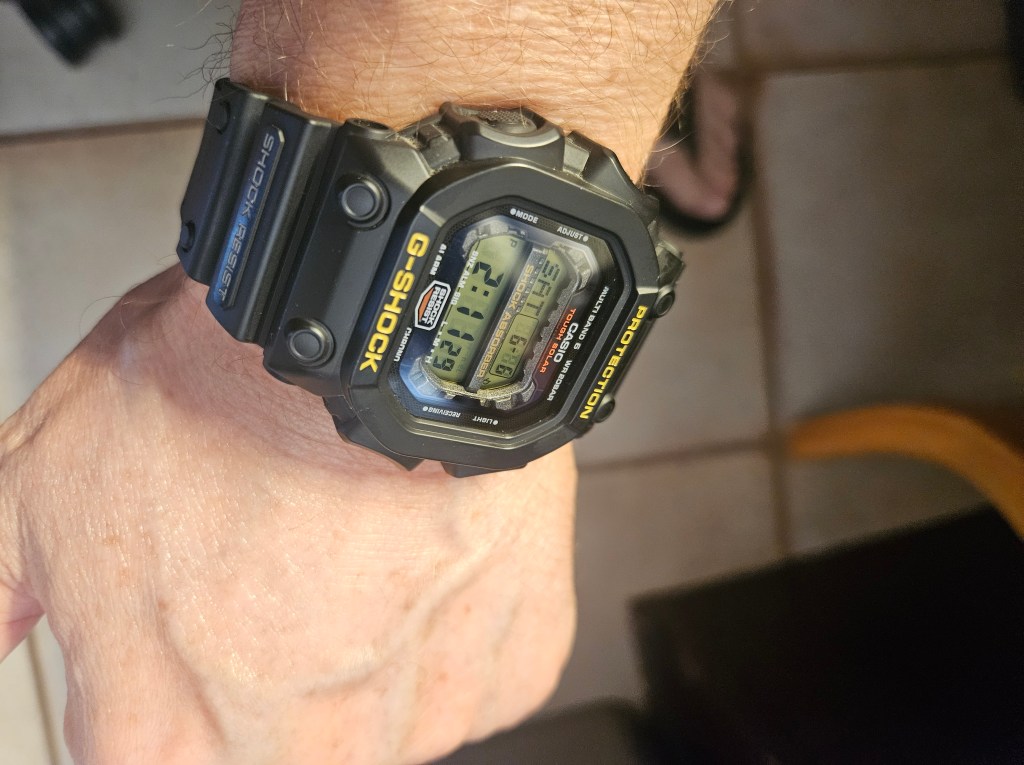
    So you defected. You strapped on Tough Solar, Multiband-6 atomic G-Shocks—watches that don’t ask what time it feels like but what time it is, down to the second, corrected nightly by a signal from a tower you will never see. This was not a style change. It was an Atomic Conversion Event: the moment when nostalgia is exposed as a luxury item and precision becomes a survival tool. Time ceased to be something you admired. It became something you obeyed.

    You found yourself thinking of that Robinson family from Lost in Space—before stepping onto an alien surface, they consulted their robot, which scanned the air and issued a verdict: breathable or lethal. You needed your own robot now, but smaller, quieter, strapped to your wrist. Not to tell you whether the atmosphere would kill you, but whether you were wasting it.

    Because the deeper realization was not horological. It was existential. You no longer had the bandwidth for drift. “Fiddlefaddling,” once an acceptable pastime, now read like malpractice. Clarity was no longer optional; it was oxygen. You had to extract meaning from the noise and live with an alignment that would have bored your younger self. The watch change was merely the visible symptom of an internal regime shift.

    And this was not your first encounter with the abyss. A decade earlier, you performed a similar surgery on your life: you quit sports. Not gradually, not ceremoniously—just stopped. You recognized the structure for what it was: three-hour games followed by hours of commentary, followed by meta-commentary, followed by the analysis of the analysis. An infinite regress disguised as entertainment. You didn’t taper off. You cauterized the habit. Torch, not scalpel.

    That’s when the pattern revealed itself. Life is not a smooth shoreline; it is a series of drop-offs. Each one demands a new posture, a new set of tools, a new tolerance for truth. You don’t get to choose whether they arrive—only whether you adapt before you drown.

    There will be more. Of course there will. The only sensible response is not optimism but readiness.

    Buckle up.

  • From Lecture Hall to Checkout Line: A Better Second Act

    From Lecture Hall to Checkout Line: A Better Second Act

    Over the past several years, I’ve watched a pattern unfold. A colleague retires, disappears for a while, and then—two years later—reappears in the writing center as a volunteer. On paper, it looks noble. In person, it looks something else.

    They don’t return with ease or quiet confidence. They return looking unsettled—eyes fixed forward, posture stiff, like deer caught in headlights that never turn off. I’ve seen them alone on the writing lounge couch, staring straight ahead, as if waiting for something that never quite arrives. The impression is hard to shake: retirement didn’t liberate them; it hollowed something out. And so they came back to the place where their sense of worth once had structure and witnesses.

    Students, however, are not sentimental. They don’t greet these returnees as beloved elders. They approach them the way one approaches a last option—politely, cautiously, and only when necessary. The exchange feels inverted. Instead of giving value, the retiree seems to be extracting it: a little affirmation, a little proof of continued relevance, a small ration of being needed.

    The idea of volunteering after retirement sounds admirable in theory. In practice, it reminds me of Lot’s wife—turning back, unable to release the past, even when the mandate is to move forward.

    And I say all this with some unease, because I’m about fifteen months away from retirement myself. My job has kept my mind engaged for decades—lectures, lesson plans, essays, the constant friction of thinking. I can’t pretend I’m immune to the same forces that seem to have pulled my colleagues back: the slow creep of isolation, the loss of structure, the quiet erosion of purpose. Sloth and complacency don’t arrive dramatically; they seep in.

    Still, I’m fairly certain of one thing: I won’t be returning as a volunteer tutor. I see too much of Lot’s wife in that gesture and not enough of a forward-facing project that justifies it.

    There’s also the matter of audience. Students gravitate toward youth. My own teen daughters regard “Boomers” like me with a mix of mild embarrassment and occasional alarm, as if we are well-meaning but out of date. I’m not eager to test that perception in a room where attention is already scarce.

    If pride is a vice, it’s at least an honest one here. My read on younger students, combined with my own instincts, tells me that the writing center would not be my best second act.

    There may be other roles. I’ve entertained, half-seriously, the idea of working part-time at my local Trader Joe’s. I know the staff. I could use the income for health insurance. And I have a skill set that would actually translate: I can talk to people, keep a line moving, and bag groceries without turning it into a philosophical crisis. There’s dignity in that—perhaps more than in hovering around a former life, waiting to be needed.

    One thing I do know: wherever I land, I don’t intend to sit there staring into the middle distance, hoping someone will give me back a version of myself I’ve already lived.

  • You Can’t Hack Friendship

    You Can’t Hack Friendship

    A shortage of friendship seeps into everything. It distorts your thinking, magnifies your obsessions, and turns both your work and your home life into echo chambers. What begins as a quiet absence becomes a governing condition. The burden doesn’t stay neatly contained within you; it spills outward, pressing on your family, altering the atmosphere of every room you occupy.

    Active friendship is not a luxury. It is a nutrient. Deprive the soul of it and you don’t merely feel a little off—you begin to atrophy. The comparison is almost clinical: friendship is to the psyche what protein is to muscle. Neglect it long enough and weakness follows, then dysfunction, then a kind of emotional brittleness that snaps under ordinary strain.

    Your predicament has a familiar shape. You reach out. The response is lukewarm, delayed, or politely distant. You respect boundaries—yours and theirs—so you retreat. The retreats accumulate. What began as courtesy hardens into habit. Eventually, not seeing friends stops feeling like a temporary lull and starts to resemble a lifestyle. The absence becomes routine, then normal, then invisible.

    The culture is more than happy to bless this arrangement. Adults, we’re told, naturally drift into smaller circles. Life is busy. Everyone is tired. The internet offers a thin, flickering substitute for presence. Add in economic pressure—the side hustles, the quiet anxiety about money—and friendship begins to look like a discretionary expense. Time becomes a zero-sum game, and friendship is the line item that keeps getting cut.

    Age compounds the problem. The older you get, the more fixed your habits become. The friction of meeting new people increases. The old friendships fade—some through neglect, some through conscious uncoupling, most through the slow erosion of time. Replacements don’t arrive. They rarely do.

    Then there’s pride, that silent enforcer. You don’t talk about the absence. You don’t announce your loneliness. The first rule is to pretend there is no problem. You keep your complaints internal, your need concealed. You perform composure. You suffer privately, as if dignity requires it.

    You may even suspect this was always your trajectory. You look back at your parents and see hints of the same pattern—difficult temperaments, limited circles, a tendency toward inwardness. You begin to wonder if you’re not simply repeating a script written long before you understood it.

    Over time, solitude becomes architecture. You build a small, fortified life and call it independence. It starts to resemble something like C. S. Lewis’s description of hell: a self-constructed enclosure where nothing enters and nothing leaves. You seal the doors, throw the key beyond the walls, and then convince yourself this arrangement is freedom. It is, in fact, a perfectly engineered loneliness.

    Inside the fortress, you have time—too much of it. Memory begins to intrude. You recall childhood, when friendship required no strategy and no scheduling. It was as natural as breathing. You laughed without agenda. You learned who you were in the presence of others. Those early alliances—messy, loud, unfiltered—helped shape your sense of right and wrong, belonging and identity.

    Adulthood replaces that immediacy with calculation. Time fragments. Obligations multiply. Your circle shrinks. The hunger for connection doesn’t disappear; it mutates. You turn to social media, posting curated glimpses of a life that appears connected. The response—likes, comments, brief exchanges—offers a diluted version of what you’re actually missing. It looks like friendship at a distance, but it lacks weight. Eventually, even that thin substitute fails to satisfy, and you drift away from it too.

    You try another route: creation. You write. You play music. You hope that expression will generate connection. People may admire what you produce. They may even love it. But admiration is not friendship. Applause is not companionship. A well-received paragraph cannot sit across from you at a table.

    There is no workaround. No clever substitution. No technological proxy or “life hack” that fills the gap.

    At some point, you have to say it plainly: the absence of friendship is a problem.

    What follows that admission is uncertain. There is no neat solution waiting on the other side of the sentence. But there is at least this: you are no longer pretending. You are no longer calling deprivation a preference or isolation a virtue.

    You are, finally, telling the truth.

  • Two Hours in a Hotel Room: My Mechanical Watch Purgatory

    Two Hours in a Hotel Room: My Mechanical Watch Purgatory

    At night, I go to bed wearing one of my Tough Solar, Multiband-6 G-Shocks. When I wake up, it’s still there—quietly correct, indifferent to my dreams. I make coffee. I eat porridge fortified with protein powder, as if I’m feeding a machine that happens to have a pulse. I write. I take my daughters to school. I return home, sit at the piano, and tap out something halfway between discipline and distraction before changing into workout clothes.

    Then the ritual begins.

    Before I train, I remove the G-Shock and place it—carefully, almost ceremonially—into an open ceramic butter dish. Inside are two watch pillows, like small upholstered altars. I set the dish by the living room window, perched on actual pillows, and let the watches drink sunlight. I don’t charge them. I feed them. They sit there absorbing photons like obedient livestock while I sweat through my penance.

    After the workout, after the shower, after lunch, I leave the G-Shocks at the window, basking in their solar feast, and I reach for a mechanical Seiko diver. This is where things get strange.

    I wear the mechanical for my nap.

    Not because I prefer it. Not because I need it. But because I feel I owe it something.

    For two hours, I strap on a relic of my former life—polished steel, automatic movement, the old romance of gears and springs. I rotate through four of them, day after day, as if fulfilling a contractual obligation. They sit on my wrist like ghosts with good machining.

    And then I take them off.

    I return to my G-Shock the way a traveler returns home after a brief, awkward stay in a hotel. The mechanical watch is the Holiday Inn—clean, respectable, vaguely unsettling in its impermanence. I check out after two hours, hand in the key to a staff member in the hotel lobby, and fly back to where I actually live: atomic time, solar power, numbers that tell the truth without flourish.

    Something happened to me. I can feel it, but I can’t fully explain it yet.

    For twenty years, I was immersed in mechanical dive watches. Not casually—devotionally. They were objects of study, desire, identity. And now, when I look at them, I don’t feel longing. I feel… residue. A faint aftertaste of something that once promised more than it could deliver.

    Pain might be too strong a word. But it’s in the neighborhood.

    I find myself wondering if addiction—because let’s stop pretending it wasn’t that—is less about pleasure and more about escape. About trying to solve something internal with something external. A watch becomes a talisman, a small, gleaming object that whispers: This will fix it. This will complete you.

    It never does, of course. It just resets the hunger.

    Maybe that’s what I’m processing now. Not just the watches, but what they stood in for. The idea that acquiring the right object could quiet something restless inside me. The belief that completion was one purchase away.

    Now I’m in a strange in-between state. Not fully attached to the old world, not entirely settled into the new one. The two-hour mechanical watch session feels like a concession—an obligation to a former self I haven’t fully buried. It’s polite. It’s controlled. It’s also faintly absurd.

    The G-Shocks, by contrast, feel like clarity. They don’t seduce. They don’t promise transcendence. They just tell the time—accurately, relentlessly, without commentary. And for now, that’s enough.

    But I don’t fully understand what’s happened to me yet.

    Give me a year.

    I suspect I’ll have a better answer—or at least a more honest question.

  • Stop Chasing the Perfect Watch–It Doesn’t Exist

    Stop Chasing the Perfect Watch–It Doesn’t Exist

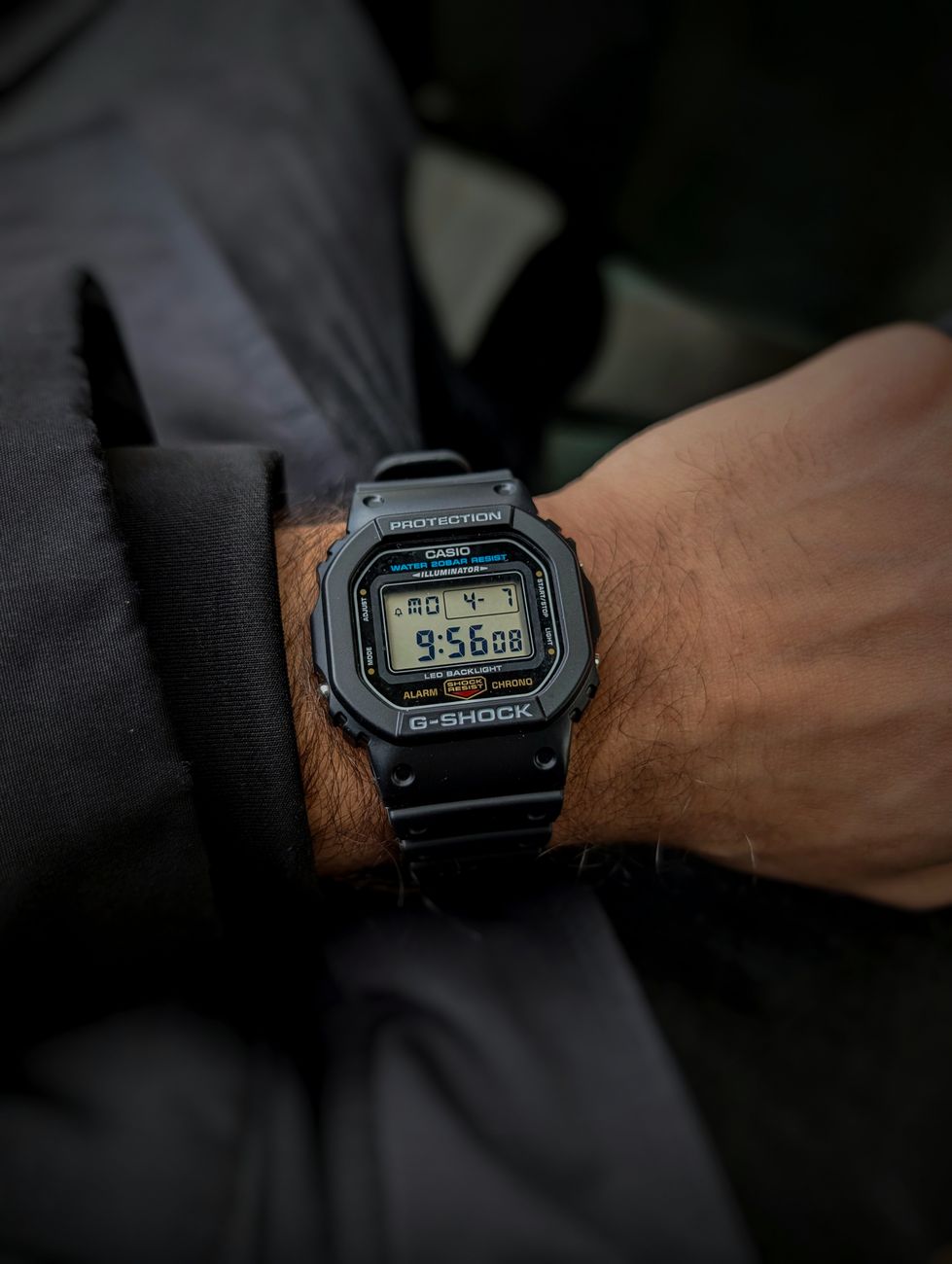
    I love the digital displays on my Casio G-Shock Frogman GWF-1000 and Casio G-Shock GW-7900. They tell me the time with blunt authority. No interpretation. No ceremony. Just numbers that land in the brain like a verdict.

    And yet, apparently, that isn’t enough.

    Somewhere along the way I developed a new appetite—no, let’s call it what it is, greed. I don’t just want clear numerals anymore. I want absurdly large numerals. I want wrist-mounted billboards. I want a wall clock strapped to my arm so I can read the time from across the room like a man who refuses to participate in subtlety.

    Naturally, the good people of G-Shock Nation pointed me toward the Casio G-Shock GW-9500 Mudman. The Mudman, they said, has the numbers. Big, bold, unapologetic digits that look like they were designed for someone who has lost patience with squinting.

    And they’re right—mostly.

    Mudman owners speak about their watch with a curious mix of affection and confession. They praise the size of the numerals, the rugged build, the sheer presence of the thing. Then, almost sheepishly, they admit that the display can blur at certain angles, that the duplex layering introduces a faint haze, that it’s not quite as clean as they’d like. They dock it a star. Four out of five.

    Then they shrug and say they love it anyway.

    That’s the part that matters.

    Because it raises a question most of us spend years avoiding: is there such a thing as a five-star watch?

    I’ve finally accepted the answer. There isn’t. There are only trade-offs you can tolerate without resentment.

    I’ve been chasing a very specific fantasy: huge numerals, high contrast, perfect viewing angles, and zero cognitive load. A watch that doesn’t need to be read so much as absorbed. A watch that behaves like a wall clock—instant, effortless, undeniable. What I’ve discovered is that watches can deliver three of those qualities with confidence. They just can’t deliver all four at once.

    My GW-7900 comes closest to frictionless clarity. Its display is stable, legible, and immediate. But the digits, while excellent, don’t quite scratch that billboard itch. The Mudman 9500 pushes in the opposite direction. It gives me the numbers—big, thick, impossible to ignore—but introduces a new problem: at certain angles, the display hesitates. Instead of receiving the time, I have to negotiate with it.

    Then there are the Pro Trek models, with their crisp, high-contrast STN displays. Technically superior. Visually disciplined. And yet, in their refinement, they lose that blunt, wall-clock immediacy. They are precise, but not emphatic.

    What fascinates me is how quickly Mudman owners make peace with imperfection. They acknowledge the flaws, subtract a star, and keep wearing the watch. That’s not compromise in the defeated sense. It’s acceptance. They’ve decided which imperfection they can live with, and they’ve moved on.

    That realization forced me to confront what I’m actually chasing. It isn’t a watch. It’s a state of mind—frictionless time perception. I want to glance at my wrist and have the time imposed on me without effort, hesitation, or ambiguity. But a wristwatch isn’t built for that ideal. It’s constrained by size, power, durability, and the stubborn limits of display technology. Something always gives.

    There is, to be fair, a strong case for the Mudman. Bigger numerals do make the time easier to read most of the time. Its toughness invites confidence. Its design has a certain muscular charisma. For many people, that combination outweighs the occasional moment of haze or glare.

    But I’ve had to admit something about myself: I value consistency over peak performance. A watch that is occasionally perfect but intermittently irritating will wear me down. I don’t want to negotiate with my watch. I want to glance and know.

    So the conclusion is both obvious and oddly liberating. There is no perfect watch. Once you accept that, the chase loses its urgency. You stop looking for the mythical five-star object and start making deliberate choices.

    The real question isn’t, “Which watch gets me closest to perfection?”

    It’s this: Which imperfection can I live with—and still enjoy checking the time a hundred times a day?

  • Take a Year Off Buying Watches—And See What’s Left

    Take a Year Off Buying Watches—And See What’s Left

    Daniel Samayoa and I met at several watch meet-ups in Long Beach, just outside Mimo’s Jewelry. We quickly discovered a shared fascination not only with watches themselves, but with the strange ways timepieces take hold of the mind. With that in mind, Daniel offers a guest post for my blog Cinemorphosis, examining the psychology of watch addiction and the habits that keep collectors in its grip:

    At a certain point, the habit stops being a hobby and starts looking like compulsion dressed up as enthusiasm.

    We all like new watches. We also all like taking a good shit. That doesn’t mean you should do it ten times a day and call it a hobby.

    The same principle applies to watch collecting. Just because you feel the urge doesn’t mean you need to act on it. That “great value” diver you just discovered—the one you’re convinced is different this time—will likely be worn twice before it disappears into the padded anonymity of your watch box.

    And that’s the problem.

    You tell yourself you’re building a collection, but what you’re really doing is chasing a small hit of excitement with every purchase. The watch isn’t the point. The transaction is. The anticipation is. The brief illusion of completion is.

    Then it fades, and you’re back where you started.

    It shows.

    Some of you don’t have collections. You have accumulation—watch boxes that resemble clearance racks, full of pieces that once felt essential and now feel optional at best.

    Here’s a simple experiment: stop buying watches for a year. Not a month. Not a “cooling-off period.” A full year.

    A one-year hiatus isn’t punishment; it’s diagnostic. When you remove the option to buy, you strip away the easiest form of self-distraction and force the habit into the open. The itch doesn’t disappear—it sharpens. You start to notice when it shows up: late at night, after a long day, in those idle gaps where boredom masquerades as curiosity. Without the relief of a purchase, you’re left to examine the mechanism itself—the rationalizations, the urgency, the quiet belief that the next watch will complete something that has never quite been defined. Over time, the noise subsides. What remains is clarity: which watches you actually reach for, what you value in them, and how much of your “collection” was built on impulse rather than need. The hiatus doesn’t take anything away. It reveals what was never there to begin with.

    More importantly, you’ll be forced to confront what you actually enjoy wearing. Not what impressed you in a YouTube review. Not what felt like a smart deal. The watches that earn wrist time—the ones that fit your life without effort.

    If you own nineteen watches and rotate through four, then you already have your answer. The rest are noise.

    The next time the urge hits, pause. Ask a direct question: does this watch have a clear role in my collection, or am I just bored and looking for stimulation?

    That question alone will eliminate most purchases.

    Then take it one step further: sell what you don’t wear. Not someday. Not when the market is better. Now.

    What remains won’t just be smaller—it will be coherent. Intentional. Yours.

    Because most people don’t need another watch.

    They need restraint.

    And a watch box that reflects decisions, not impulses.