Tag: music

  • The Frogman and the Music of Atlantis

    The Frogman and the Music of Atlantis

    My junior year of high school was my “Deacon Blues” year. I wore it like a religious creed. The song played, and I nodded along as if I’d been admitted to some nocturnal order of the misunderstood. Only decades later did I realize the joke was on me. The narrator isn’t a tragic hero; he’s a suburban man with a good stereo and a better imagination, building a flattering alternate reality to anesthetize his boredom. What I mistook for transcendence was mood lighting. I wasn’t ascending; I was dimming the room.

    Satire thrives on mockery because it exposes the soft spots we’d rather not touch. But self-mockery can metastasize. It can turn your life into a punchline so comprehensive that nothing is left standing—not even the truth that your choices matter. High stakes persist whether you acknowledge them or not. We are, to put it plainly, creatures who want more than a clever story about ourselves. We want something that holds when the music stops.

    For that, I have to go back a year. I was a sophomore who encountered “Zoom,” written by Lionel Richie and Ronald LaPread of The Commodores. The song arrived like a quiet command. You can hear the Gospel in its bones—the upward pull, the refusal to collapse into self. The voice in “Zoom” isn’t asking for a better seat at the table; it’s asking for the table to be remade so everyone can eat. It’s not self-improvement. It’s a prayer for shared elevation.

    I remember where I was when it came on—KSFX, KSOL—the speakers on my Realistic Radio Shack clock radio doing their best, the world suddenly holding its breath. I stopped. Not figuratively. I stopped. The song spoke to my heart: Be better. Not for your reputation, not for your résumé—for people. That’s a different order of demand.

    That same year, “Voyage to Atlantis” by The Isley Brothers performed a similar operation. It promised return—home not as geography but as fidelity, as a place you carry and keep. Between those two songs was a paradox I could feel even if I couldn’t name it: you root yourself in a clean intention, and from that grounding you rise. No theatrics required. No persona. Just alignment.

    Listening to them felt like church without the building. Something gathered. Something clarified. You left with less noise and more direction.

    What is music, after all, if not the part of life that refuses translation and still manages to tell the truth?

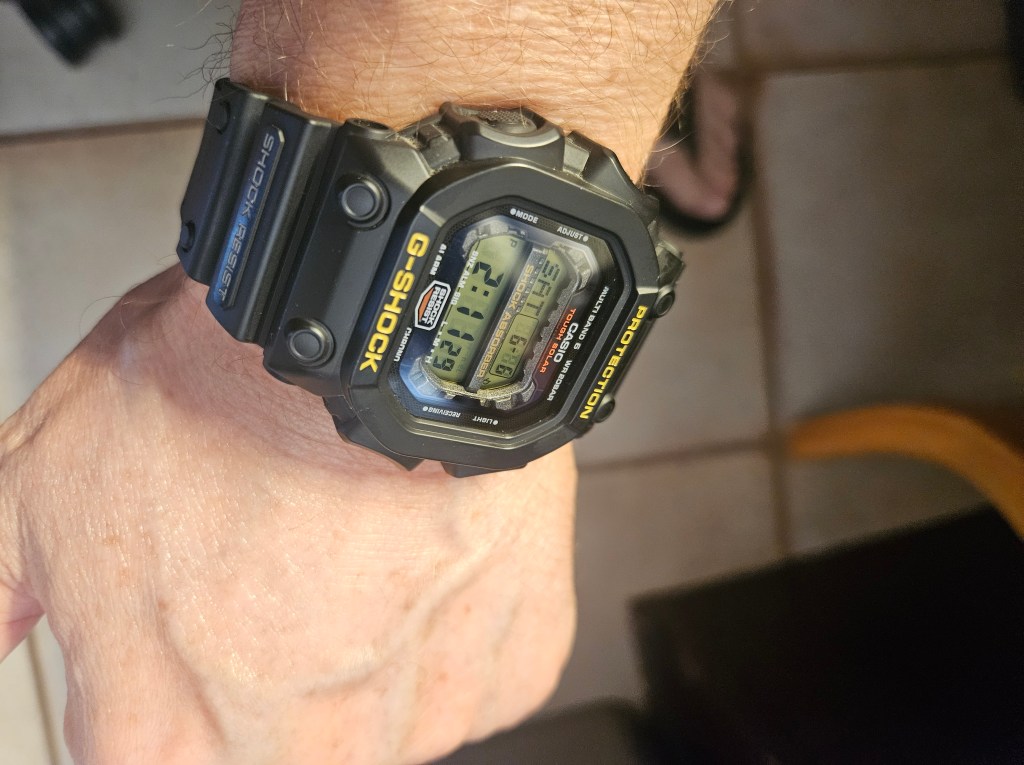
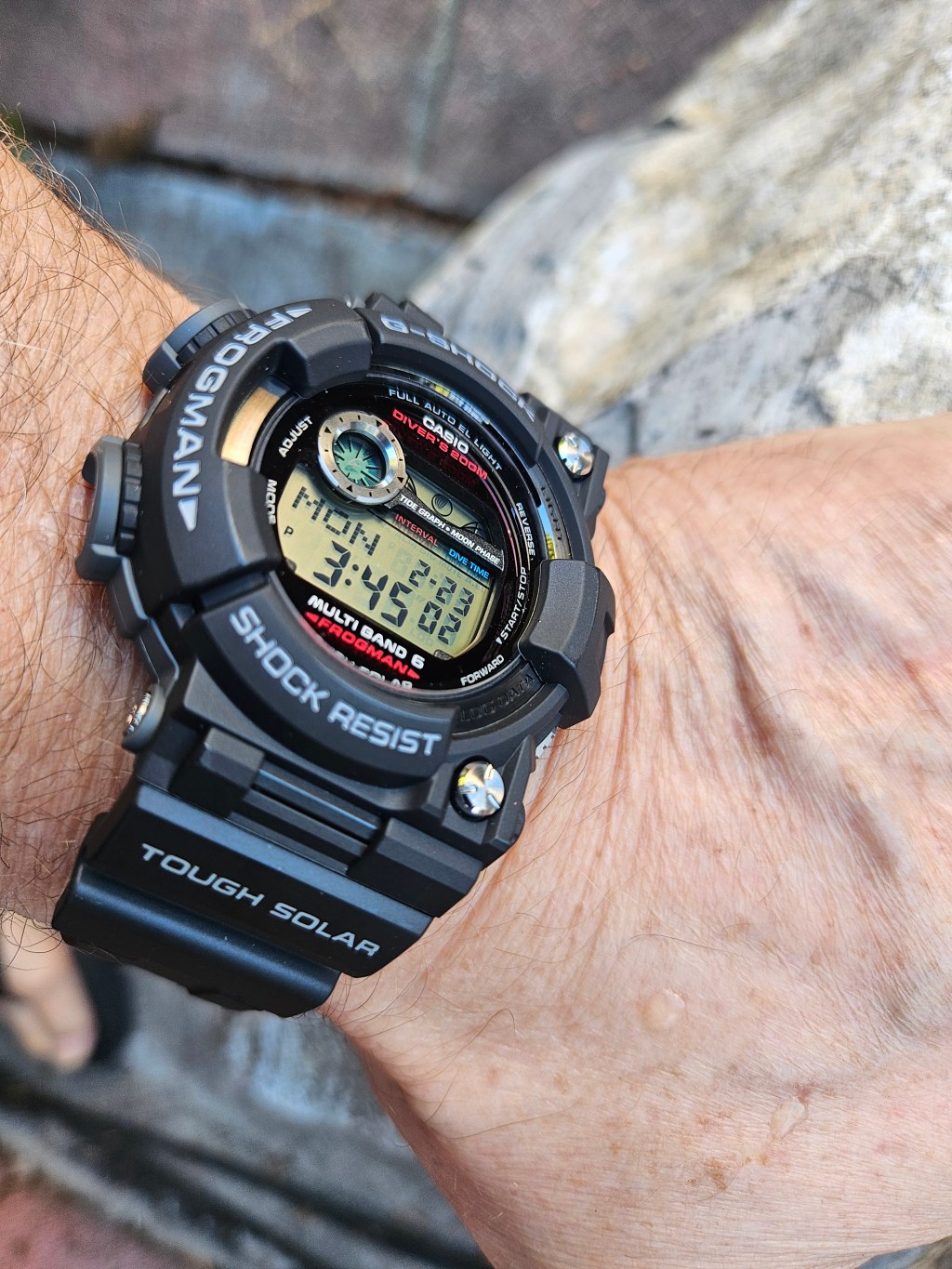
    Which brings me to an embarrassment I’ll risk anyway: in watch circles, we talk about a “grail” watch that will “sing” on the wrist. It’s a ridiculous phrase—until it isn’t. Because this hulking slab of resin I’m wearing—the G-Shock Frogman—does something adjacent to that metaphor. It doesn’t produce music. It points to it. It behaves like a reference, a small, stubborn reminder that there is a cleaner version of me available if I’d like to stop auditioning and start choosing.

    The Frogman is not an upgrade. It’s an accusation shaped like a tool. It suggests a man with a steadier pulse, a man less interested in narrating his life and more interested in living it. A man who could hear “Zoom” and “Voyage to Atlantis” and respond the way that sophomore did—by stopping, by listening, by letting the moment ask something of him.

    I don’t need to recover youth. I need to recover that pause—the willingness to be addressed by something better and not immediately turn it into a story about myself.

    The songs didn’t change. I did.

    The question is whether I can change back.

  • The Night the Mechanical Diver Stayed Home

    The Night the Mechanical Diver Stayed Home

    Last night I escorted my family and in-laws to a breezy bistro in Redondo Beach, the kind of place where the ocean air does half the marketing. We sat on the patio while a two-man cover band—guitar and bass, faces cured by sun and time—worked their way through the canon: Gordon Lightfoot, Jim Croce, James Taylor. Their voices had the texture of driftwood. The songs arrived like postcards from a quieter century.

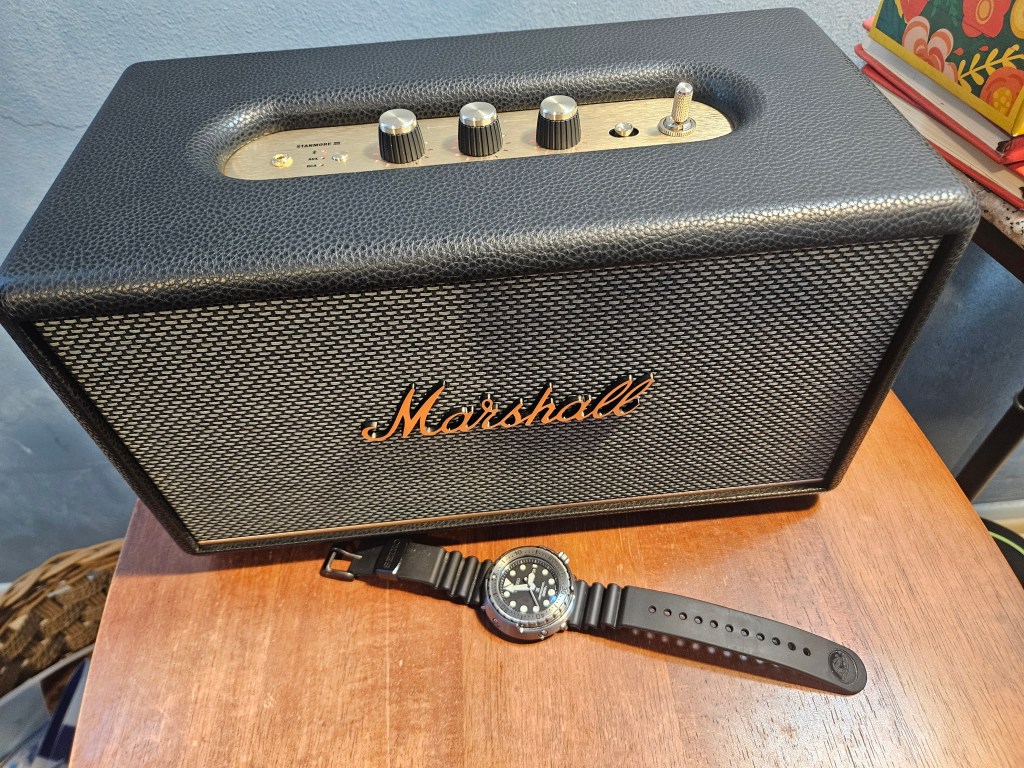
    For twenty years, a restaurant meant ceremony. I would strap on an expensive mechanical diver—the horological equivalent of cufflinks—and let it glint under low lighting as if I were auditioning for a role called “Man of Taste.” Five weeks ago, that instinct died without a funeral. In its place: a $110 Casio G-Shock GW-7900. No romance, no pretense, just a blunt instrument that tells time with the indifference of a wall clock. I wore it and felt, not diminished, but strangely settled. Our server had on a Casio Pro Trek. We exchanged a nod—the quiet recognition of two men who had defected from the same aesthetic regime.

    Two weeks ago, I sold off a pair of mechanical divers. The absence registered as silence, not loss. Five weeks ago, I bought my first Tough Solar, Multiband-6 G-Shock—a Casio G-Shock Frogman GWF-1000. It feels like I’ve owned it for a decade. Time has warped, stretched, lost its usual proportions. My working theory is this: when an obsession mutates—when it takes a hard, unexpected turn—the brain lingers over the wreckage and the new terrain at once. Every moment gets over-processed, as if your mind is trying to reconcile two incompatible identities. The result is temporal inflation. Five weeks feel like ten years. Meanwhile, the watches I once coveted sit in their box like artifacts from a civilization I can’t quite remember belonging to.

    I’ve made a few videos documenting this conversion. To my mild alarm, a handful of people have followed suit—buying the GW-7900, aiming their watches toward the Fort Collins signal tower like amateur astronomers chasing a frequency instead of a star. It’s absurd, and yet there it is: evidence that I may have drifted, however briefly, into the low orbit of influence. Not authority. Not expertise. Influence—the most accidental and least deserved of modern currencies.

    The question now hovers: is this a phase or a verdict? Will some future mood—call it nostalgia, call it vanity—dust me with longing and send me back to my mechanical divers? Or have I crossed a line I can’t uncross, sealed inside a G-Shock logic that values precision over poetry? I don’t know. The future, like the tide, refuses to take requests.

    What I do know is this: today I’ll need to punish myself with extra work in the garage gym. Last night I demolished a crispy chicken sandwich on brioche while listening to “If You Could Read My Mind,” and the song’s quiet sorrow did nothing to slow me down. If anything, it provided a soundtrack for excess—the softest possible music for a thoroughly unrestrained appetite.

  • Treat Your Watches Like Playlists, Not Religion

    Treat Your Watches Like Playlists, Not Religion

    For decades, your identity was secure. High-end mechanical divers. Steel, weight, heritage, tolerances measured in microns. A small, loyal brotherhood of engineering purity lived in your watch box, and you knew exactly who you were.

    Then the fairy tale cracked.

    A G-Shock Frogman entered your life.

    You told yourself it was a novelty. A tool. A temporary experiment.

    Then came the Rangeman.
    Then the premium Square.

    Now you’re standing over your watch box like a man who has betrayed his own lineage.

    Who am I?
    What have I done?
    What happened to my mechanical diver heritage?

    Relax.

    You’re not having a crisis. You’re experiencing Genre Guilt.

    Genre Guilt is the uneasy sensation that enjoying a new category somehow betrays the old one. The mechanical diver sits in the box like a disappointed mentor while the G-Shock hums cheerfully on your wrist, and suddenly you feel the need to justify yourself—to your friends, to your former self, possibly to the watches themselves.

    But the anxiety has nothing to do with enjoyment or function. It comes from a simple mistake: treating collecting like a moral code instead of a mood.

    Here’s the truth.
    Watches are not a marriage.
    Categories are not religions.
    Your collection is not a pledge of allegiance.

    It’s a playlist.

    Your streaming app doesn’t panic when you move from jazz to electronic. It doesn’t accuse you of betraying classical. It simply plays what fits your mood.

    Your collection works the same way.

    Mechanical divers: one playlist.
    G-Shocks: another.

    Millions of collectors do this. You haven’t broken tradition. You haven’t reinvented the hobby. You’re not undergoing a transformation.

    You’re a suburban enthusiast who briefly mistook preference for drama.

    So take a breath. Close the courtroom in your head. There is no betrayal here.

    Add the playlist. Wear the Frogman. Enjoy the Square.

    Your blood pressure—and your hobby—will run a lot smoother once you stop treating mood swings like moral events. Instead, treat your watches like playlists, not religion. 

  • The Geology of Your Obsession

    The Geology of Your Obsession

    You’re three-quarters of the way through a book about the madness of the watch hobby when the plot turns on you.

    The culprit is your first G-Shock—specifically, the digital Frogman GWF-1000. You expected a curiosity, maybe a temporary diversion. What you got instead was a new form of obsession. Not stronger than your mechanical diver fixation. Not weaker. Just different—like discovering that the disease you thought you understood has multiple strains.

    You didn’t see it coming.

    Some of your watch friends are unimpressed. They never drank the G-Shock Kool-Aid, or they did once and recovered. To them, the brand is soulless—plastic, clinical, emotionally sterile. A tool without romance.

    They’re wrong.

    G-Shock has a soul. It’s just a different kind of soul—one built from precision, autonomy, indifference to status, and the moral clarity of a watch that refuses to pretend it’s jewelry. And with that soul comes its own species of madness: atomic-sync monitoring, solar anxiety, display legibility debates, module archaeology, and the quiet satisfaction of a machine that never asks for your attention and never apologizes for it.

    The revelation is unsettling.

    You thought watch madness was a single condition. Mechanical romance, heritage narratives, the poetry of gears. But the Frogman teaches you something more troubling: this hobby doesn’t produce one madness. It produces subgenres. Each category brings its own emotional logic, its own rituals, its own vocabulary of justification. Your mind begins to look less like a collection strategy and more like a geological survey—layers of enthusiasm stacked over time like soil, shale, coal, and volcanic glass.

    You now live in a state of Layered Madness.

    Layered Madness is the realization that obsession in this hobby doesn’t replace itself—it accumulates. What feels like a fresh start—I’m done with mechanical divers; now I’m a G-Shock guy—isn’t a reset. It’s a new deposit in an expanding psychological landscape. Each phase arrives with total confidence that this is the rational version of the hobby. Meanwhile, the earlier passions don’t disappear. They settle below the surface—compressed, preserved, and waiting for the right emotional pressure to re-emerge.

    Over time, the enthusiast stops being a collector of watches and becomes an archaeologist of his own compulsions.

    Layered Madness is the moment you understand the truth: you’re not evolving beyond obsession.

    You’re building a cross-section of it.

  • Cultural Laundering: How Icons Lose Their Soul

    Cultural Laundering: How Icons Lose Their Soul

    Something strange happened to Dark Side of the Moon. It didn’t fade. It didn’t age. It got laundered.

    The damage began when a Circuit City commercial decided the album’s atmosphere was perfect for selling surround sound. The ad ran constantly—radio, television, everywhere—until the music stopped belonging to Pink Floyd and started belonging to electronics. The songs no longer opened a private space; they demonstrated speaker range. Listening became confusing, like running into an old friend who now works exclusively as a showroom model.

    The music itself hadn’t changed, but the experience had. Its emotional chemistry felt altered. The closest comparison is a fine wool sweater tossed into a hot wash and a brutal dry cycle. You pull it out and the fibers are technically still there, but the shape is warped, the color dulled, the elegance gone. Popular culture does not use the gentle setting. It scours, shrinks, and standardizes. What comes back looks familiar and feels counterfeit.

    This isn’t an indictment of Dark Side of the Moon. The loss isn’t in the album. The loss is in the relationship. I simply can’t hear it the way I once did.

    The Beatles present the same problem on a larger scale. Their music arrives with a convoy—decades of mythology, endless airplay, cultural worship. Some songs have been polished into museum glass. I don’t dislike “Blackbird.” I’m exhausted by it. I could go the rest of my life without hearing it again. Yet “Hey Jude” and “Something” still breathe for me. Not everything survives the laundering equally.

    The same phenomenon explains my resistance to Rolex. The watches may be superb, but the brand has been scrubbed and pressed into a universal symbol of success. People who know nothing about watches know Rolex. That level of cultural saturation creates distance. I’m not looking at a tool or a piece of craft. I’m looking at a billboard strapped to a wrist.

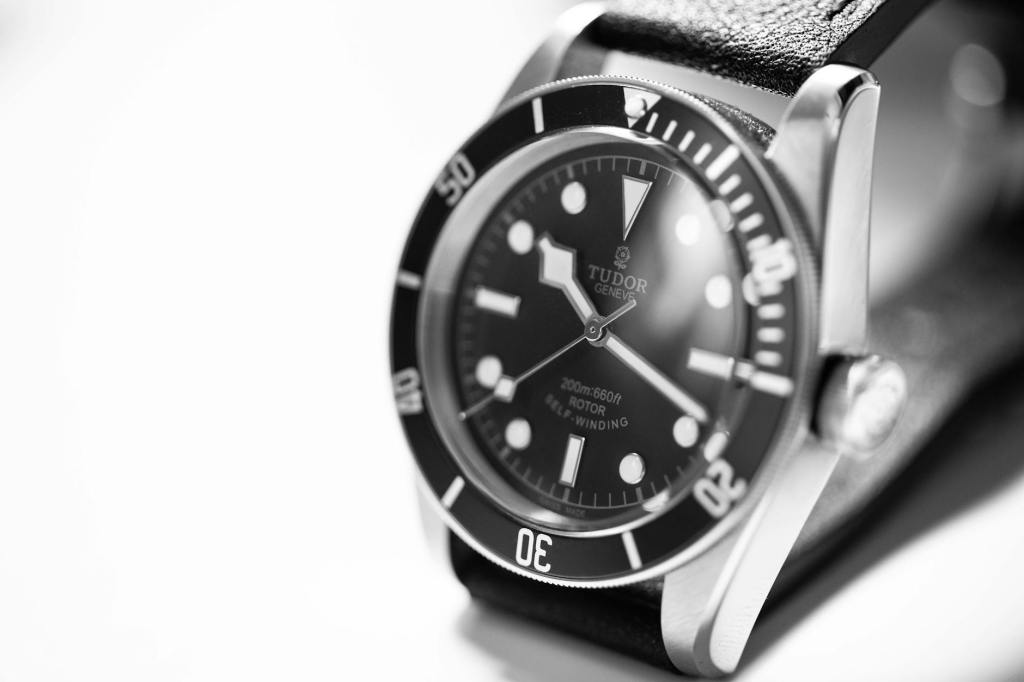
    In this sense, “Blackbird” is a Rolex—iconic, immaculate, and emotionally unreachable. But Paul McCartney after the Beatles feels different. Those solo records land with less mythology and more humanity. They feel like Tudor: born from the shadow of a giant, technically serious, culturally quieter, and easier to meet on personal terms. My preference for Tudor over Rolex isn’t about specifications. It’s about psychological noise.

    The pattern behind all this is Cultural Laundering. This is what happens when art goes through the cultural washing machine and comes out bright, recognizable, and strangely dead. Repetition, advertising, branding, and mass exposure scrub away texture, risk, and private meaning until the work stops feeling like an encounter and starts functioning like a symbol. The song hasn’t changed. The watch hasn’t changed. The audience has been crowded out. You’re no longer meeting the work itself—you’re meeting its reputation, its marketing history, and the millions of people who got there before you. Nothing has been altered chemically. Everything has been altered psychologically. The artifact survives. The intimacy doesn’t.

  • The High Isn’t the Watch–It’s the Rabbit Hole

    The High Isn’t the Watch–It’s the Rabbit Hole

    One of my favorite pastimes is watching YouTube comparison videos of the Toyota Camry vs. the Honda Accord. I’m not shopping for a car. I don’t need a car. I may never buy another car. 

    But these videos? They soothe the savage beast inside of me. They go down like a smooth bourbon, with notes of ABS braking and a smoky finish of fuel economy.

    While others go to YouTube to meditate or do yoga, I fall into the hypnotic cadence of two grown men comparing rear-seat legroom and infotainment systems with the solemnity of Cold War negotiators. 

    I’m riveted. Parsing the pros and cons of these two sedans gives me a focus so intense it borders on religious ecstasy. I study engine specs like they’re verses from Leviticus. My concentration sharpens, my anxiety fades. I am, for a brief and blissful moment, free.

    And then it hits me: I don’t want the car. I want the focus. The Camry and Accord are just placeholders in the temple of obsession.

    This revelation sheds light on my watch obsession. It helps me realize that acquiring a watch in most cases is a bitter letdown. A $3,000 watch on the wrist is like a Tinder date at Denny’s: out of place and super embarrassing. 

    I’ve worn $5,000 watches while taking my daughters to YogurtLand and I’ve said to myself, “Dude, you’ve lost the plot.”

    How did I get here with expensive watches that I wear when I’m buying pretzels and diet soda at Target?

    And then I realize. The same drive to focus on Camry-Accord comparisons is the same drive that makes me do “timepiece research.”  Watching my fellow timepiece obsessives drool over bezels and lume shots is the real high. That’s what lights me up. That’s what gets the adrenaline surging through my veins. 

    So as watch obsessives, we need to understand that, even more than watches, we are addicted to focus. We are afflicted with Focus Addiction–the true dependency hiding beneath consumer desire: the craving for intense, narrowing concentration that drowns out modern life’s chaos, even if it must be chemically replicated through YouTube reviews and lume shots.

    I’ve spent years confusing consumer acquisition with personal transformation. Getting this thing or that thing will change me inside. I want to be courageous, dignified, courteous, disciplined, fit, and healthy. A watch can’t redeem me. It can’t make me whole. It can’t make me the person I wish I were. Not once have I ever put a new watch on my wrist, gave my wife a wrist shot, and said, “Look, honey, I’ve achieved a metamorphosis.”

    She’ll just look at me and say, “Dude, clean the leaves out of the rain gutters.”

    The material thing in my hands is a letdown because what I really want is the chase and the intense focus. The glorious plunge down a rabbit hole lined with brushed stainless steel and leather-wrapped dashboards. My consumerism isn’t about consumption—it’s about cultivating a state of intense obsession that drowns out the shrieking absurdity of modern life.

    So no more mistaking adrenaline for fulfillment. No more clicking “Buy Now” hoping for transcendence in a shipping box. 

    I’ll keep researching. That’s my Prozac. That’s my monastery. 

    But buying something has proven to be a fool’s errand. And if doing so-called research inflames my consumer appetites, then I should probably put my foot on the brakes when it comes to the research because it can be a prelude to making a purchase I don’t want to make.

    Let me give you an analogy. Let’s say you’re back in high school and you’re at the high school dance, but your girlfriend isn’t there because she’s on a ski trip. While bored at the dance, your ex shows up. She looks more beautiful than you remember her. She approaches you and asks you to dance. “Nothing will happen,” she says. “It will be completely innocent.” You dance with her and something happens. 

    That’s what watch research is like. You tell yourself the research is innocent. You’re just reading forums. Watching a video or two. Maybe checking inventory. 

    But then you wake up and you’re shopping at Target with a $5,000 watch on your wrist and you feel both embarrassed and ashamed.

    Doing research on watches is like having that dance with your ex-girlfriend: Something is going to happen. And it’s not going to be pretty. 

    Have a wonderful day, everyone. Don’t forget to smash that Like button of your soul.

  • When Your Bodybuilding Past Still Haunts You

    When Your Bodybuilding Past Still Haunts You

    Last night I dreamed I was illegally transporting a piano.

    This was not a metaphorical illegality. It was a regulatory one. The kind involving helpers, permits, and fines. According to Dream Law, moving a piano required two assistants. I only had one. If caught, I’d be cited. Possibly shamed. I loaded the piano anyway—my beautiful, expensive ebony instrument—into the back of an open truck and drove it from the Bay Area to Southern California, white-knuckled and guilty, like a man smuggling contraband Chopin.

    I was living, temporarily, on a compound owned by a vaguely unsavory man. He was tall, pinch-faced, and always wore a blue suit, the uniform of people who know things you don’t want to know. He had the aura of a community fixer—part mentor, part hustler, part moral hazard. He gave me piano lessons, encouraged me to keep lifting weights, and introduced me to restaurants with the enthusiasm of someone laundering taste through generosity. 

    On the day I was supposed to leave, my anxiety peaked. Rain was coming. The piano sat exposed in the truck bed like a sacrificial offering. One good storm and the ebony would swell, crack, die. I panicked. The trickster waved it off. Go eat lunch, he said. By the time you’re done, the rain might stop. This was either sage advice or the kind of line uttered by men who profit from delay.

    I drove to a nearby restaurant. It was mobbed. People stood outside drinking champagne as if waiting for a table were a lifestyle choice. Inside, servers were popping bottles at a frantic pace—corks flying, foam spilling, the atmosphere halfway between celebration and collapse.

    Then I saw it.

    Mounted beside the menu was a massive poster advertising a local bodybuilding exhibition. And there I was. Not the man I am now. Not the sixty-four-year-old who qualifies for senior discounts and considers fiber intake a moral issue. This was me in my mid-twenties: thick, swollen, carved out of stubborn protein and vanity. A human monument to leg day. I was the marquee attraction.

    The trickster, it turned out, had signed me up to pose in a bodybuilding exhibition without telling me.

    How did he know I’d be staying long enough to star in this marquee event? How did he know the rain would delay me? How did he still have a photo of a body I no longer inhabited? 

    When the diners saw me standing outside, recognition rippled through the room. Glasses paused midair. Heads turned. Then applause broke out. Cheers. My name—my old name—chanted with conviction. I tried to explain. I gestured at my face, my posture, the subtle collapse of time. I wanted to tell them I wasn’t that man anymore. That I now stretch before standing. That I wake up injured. That my biggest competition is inflammation.

    They refused to listen.

    The cheering swallowed my protests. Reality bent. And I understood, I would be showing up to that exhibition—dragging with me a body, an identity, and a past I no longer owned, but which apparently still had bookings.

  • I Forgot the Song, But the Song Didn’t Forget Me

    I Forgot the Song, But the Song Didn’t Forget Me

    Last night I dreamed I was attending an English Department meeting held, for reasons no dream ever explains, in a recreation room with an adjoining outdoor patio. The setting suggested morale had once been a priority, sometime around 1987.

    Inside the rec room, my friend S pressed a pair of earbuds into my hand. They were attached—not metaphorically, but literally—to a CD, which already felt like an archaeological artifact.
    “Do you know this song?” she asked.

    The music was exquisite. Airy. Radiant. It carried that dangerous quality of being both unfamiliar and deeply known, as if it had once lived inside me and quietly moved out without leaving a forwarding address. I admitted I didn’t recognize it.

    She looked at me with the gentlest possible contempt.
    “You burned this for me ten years ago.”

    I felt properly humiliated. Not embarrassed—abased. As if I’d forgotten the name of a childhood friend or my own middle initial. Then she summoned the band’s leader the way dreams do—no door, no introduction, just a man appearing fully formed.

    He was in his late forties, courteous, faintly exhausted, with the posture of someone who has spent years loading gear into vans at 2 a.m. I apologized to him for not recognizing his work. I blamed streaming—how it turns music into sonic wallpaper, a perpetual ambient fog where nothing has to be remembered because everything is always available. In a fit of dream-piety, I vowed to delete every streaming account I owned and return to vinyl, to sacred listening, to LPs spinning on absurdly expensive turntables like a penitent monk.

    He nodded shyly, as if he’d heard this promise before, and vanished.

    The departmental meeting began outside on the patio, but I lingered inside the rec room instead. I changed into a swimsuit for reasons that felt urgent at the time. I ate snacks—salty, comforting, vaguely institutional—and watched my colleagues through the glass as they discussed the usual bullet points: outcomes, alignment, initiatives. I meant to join them. Truly. But the snacks induced a narcotic drowsiness, and I collapsed onto a yellow beanbag chair like a defeated child at a daycare center. I fell asleep.

    When I woke, the meeting was still going on.

    Wrapped in a towel over my bathing suit, I finally wandered outside. My younger colleagues informed me I needed to sign the attendance sheet to get my FLEX hours. Unfortunately, the sign-up sheet had already been placed in a wooden box and sent to Human Resources, which in dream logic felt ominous and final, like evidence sealed in a cold case.

    The secretary waved it off. She would “put me in the system.”

    I thanked her. The meeting droned on. Words floated by without meaning. And all I could think about was that music—its beauty, its ache, its brief visitation. And then, with a second, sharper jolt of recognition, I realized I had forgotten it again.

    The song.
    The band.

    Gone.

  • The Greatest Flex Is Self-Denial

    The Greatest Flex Is Self-Denial

    In case anyone has missed it, Bruce Springsteen is seventy-five years old and still looks like he could outrun most men half his age while singing at full volume. He has the same chiseled body that powered “Born to Run” during my junior year—the song that injected an entire generation with adolescent adrenaline and the belief that escape was always one chorus away. The mystery is not that Springsteen is still performing. The mystery is how he’s performing while appearing carved out of disciplined granite.

    The answer, it turns out, is brutal in its simplicity. Springsteen eats one meal a day. That’s it. No grazing. No late-night negotiations with the pantry. His self-control has apparently spread, too. Chris Martin of Coldplay—another famous man who could afford to eat like a Roman emperor—has sworn off dinner entirely. I find all of this deeply unsettling, not because it’s unhealthy or extreme, but because it’s practiced by people who could easily afford indulgence as a full-time lifestyle.

    That’s the real flex. Not yachts. Not villas. Not decadent excess. The most impressive display of power available to the wealthy is self-denial. These men don’t lack access. They lack excuses. Their discipline quietly points an accusatory finger at the rest of us, and unfortunately, that finger lands squarely on my plate.

    If I’m being honest—and honesty is the whole problem here—I’m indulgent when it comes to food. Portions creep. Snacks multiply. I carry about twenty pounds that no amount of kettlebells or Schwinn Airdyne heroics can fully offset. Springsteen himself has said that fitness is ninety percent diet, and I resent him for being right. You can’t out-train a refrigerator you keep reopening out of habit.

    So tonight, instead of reaching for another snack, I may watch the latest Bruce Springsteen documentary for moral reinforcement. The man who once soundtracked youthful restlessness may now be offering something rarer: a model of restraint with dignity intact. Cheers to Bruce Springsteen—patron saint of senior citizens who refuse to let dinner win.

  • Applause Collapse and the Perils of a “New Direction”

    Applause Collapse and the Perils of a “New Direction”

    There comes a moment in every watch influencer’s career when he believes—sincerely, even nobly—that his audience is ready to applaud his growth. He has done the hard work. He has pared down. He has purified. Five watches remain, all on straps, each presented as evidence of restraint and moral clarity. The comments are approving. The tone is reverent. He is, at last, becoming free.

    Naturally, this serenity bores him.

    So he shakes things up. Three new watches enter the fold. The collection now stands at eight—four on straps, four on bracelets—symmetry restored, balance achieved. He announces a “new direction.” He films a YouTube video about his “evolving philosophy.” He speaks earnestly of equilibrium, versatility, and personal growth. The framing is careful. The lighting is soft. The music is tasteful. He waits for the applause.

    It does not come.

    Instead, the comment section turns cold. The audience, once indulgent, becomes prosecutorial. I thought you were healing. This feels like relapse. You were doing so well at five. The verdict is unanimous and devastating: the addiction has returned. What’s worse is not the criticism itself, but its accuracy. The influencer feels it immediately, like a clean punch to the ribs. The comments articulate the doubt he was trying not to hear.

    Shame sets in. He replays the video and cringes at his own rhetoric. “Quest for balance” now sounds like a euphemism. The watches feel heavier on the wrist. Within weeks, he detonates the entire enterprise. Seven watches are given away. One remains, kept on a strap, stripped of pleasure and worn more as a reminder than an object of joy. He deletes his YouTube channel. He nukes Instagram. He earns a kettlebell certification. He eats clean. He helps clients. He speaks of social media with quiet contempt, like someone describing a former addiction he has sworn never to touch again.

    This is Applause Collapse: the moment an influencer unveils a carefully staged transformation, expecting affirmation, only to encounter moral disappointment so severe that disappearance feels like the only honest response. It is not the loss of praise that breaks him. It is the realization that the crowd was not watching his journey—they were auditing his compliance.