Tag: poetry

  • Hugh Hefner’s Watchbox from Hell

    Hugh Hefner’s Watchbox from Hell

    Chapter Three from The Watch Whisperer of Redondo Beach


    When I got home, I collapsed into a dream-heavy sleep—the kind you don’t choose but fall into like a trapdoor.

    I dreamed I was back with the Watch Master, only this time we were in a cave—his new lair, apparently—where flickering monitors lined the stone walls like cursed flat-screens. Each displayed a parallel universe, a version of me shaped entirely by my watch collection.

    One screen showed me with a massive, vulgar collection: gold bezels, diamond indices, stainless steel bracelets so chunky they could anchor a yacht. In that reality, I was obese. Bloated. A Las Vegas lounge lizard with a double chin, a sprayed-on tan, and a wig styled into a pompadour so high it had its own zip code. A gold-plated microphone dangled from my sweaty fingers as I crooned like Elvis, Tom Jones, and Michael Bolton—simultaneously. Around my neck: ropes of gold. On my wrist: a diamond-studded Rolex that practically screamed for an exorcism.

    When I opened my mouth to speak, no words came out—just a guttural, distorted sound, like a demon gargling battery acid. I had abandoned my family. I lived in a velvet-curtained grotto that looked like Hefner’s afterlife man-cave. I wasn’t just a parody of myself. I was a possession.

    That’s when I woke up—slick with sweat, lungs full of dread. But the nightmare wasn’t over. I could still feel him—it—the beast version of me, 300 pounds of ego and regret, pressing down on my mattress. The sag was real. I swear it. My bed bowed like I was hosting a sumo wrestler from the spirit world.

    Later that night, I sat at the Watch Master’s kitchen table and told him the whole thing while he sipped from a chipped mug under the soft glow of moonlight. His gaunt face lit up with delight. He laughed—not cruelly, but knowingly.

    “Textbook,” he said. “You’re a classic case. A fractured soul, split by overexposure to bezel lust. Watch addiction creates avatars. You’ve conjured a grotesque mirror of your worst impulses. The doppelgänger is real, and he’s hungry.”

    “What do I do?” I asked, sounding more like a haunted child than a man who once justified paying four figures for a dive watch he never actually dove with.

    The Master leaned back and cracked his neck like a man preparing to file a warranty claim on your soul. “You ever hear the saying, ‘You’ve got to go to hell before you get to heaven?’”

    I nodded.

    “Well,” he said, rising slowly, “That’s where you are. Right on schedule.”

    “Can you be more specific?”

    “Later. Right now, just hearing your dream has worn me out. It’s not just the nightmare—it’s you. Your whole aura is exhausting. You radiate crisis. Come back tomorrow, same time. We’ll discuss logistics.”

    And just like that, he disappeared down a hallway, leaving me with my own haunted watch box, and the question of whether I was still awake—or just in a deeper layer of the dream.

  • Crying at the Sink: The Dishwashing Grammy Awards

    Crying at the Sink: The Dishwashing Grammy Awards

    Don’t ask me why, but there’s something about doing dishes after dinner that turns me into a soft-focus emotional wreck. Somewhere between the soap suds and the rinse cycle, I cue up Rickie Lee Jones’s “Living It Up”—one of my all-time favorite songs—and without fail, it punctures the heart like a stiletto dipped in nostalgia. Tonight, it brought on another weepy micro-moment, which means it’s time to officially give it The Most Likely to Make Me Cry from Too Much Beauty Award.

    This of course sent me spiraling into my own kitchen-sink Grammy ceremony, where I began handing out awards like a deranged emotional sommelier.

    • Todd Rundgren’s “Can We Still Be Friends” wins The Song That Makes You Recommit to Being a Half-Decent Human Being Award. It’s the sonic equivalent of an awkward apology after ruining Thanksgiving.
    • The Isley Brothers’ “Living for the Love of You” earns The Track Most Likely to Be Playing in Heaven When You Arrive Award—assuming heaven has good speakers and excellent taste.
    • Yes’s “And You and I” takes home The Sounds-Like-It-Was-Composed-by-Angels-on-a-Mountain-Top Award. I don’t know what dimension that song came from, but it wasn’t this one.
    • John Mayer’s “No Such Thing” is given The Makes You Happy to Be a Living, Breathing Fool Award. It’s that rare pop song that makes you want to fist-pump your own mediocrity.
    • The Sundays’ “You’re Not the Only One I Know” walks away with The Makes Sadness So Gorgeous You Forget to Be Upset Award. It’s a musical sigh pressed between lace and rain.

    I could keep going—my brain has a whole red carpet lined up—but I’ve got another episode of Sirens on Netflix to cry through. Turns out the best part of my day is a cross between dish soap, beautiful songs, and low-level existential unraveling. What a life.

  • Borderline Strauss Disorder: A Dream of Intellectual Despair

    Borderline Strauss Disorder: A Dream of Intellectual Despair

    Last night, around 2 a.m., just as Jonah Goldberg of The Remnant podcast was deep in philosophical flirtation with Yale’s Steven Smith over Leo Strauss, I passed out—headphones still in, brain still humming.

    And then the dream began.

    I found myself in my grandfather’s old house in San Pedro, a stuccoed mid-century bunker that always smelled faintly of pipe smoke and baked ziti. Inside the library—yes, he had a library—Goldberg and Smith were now with me, and the three of us were doing what all good podcasters and aging humanities majors dream of doing: pulling crumbly tomes off dusty shelves, quoting Epictetus, Hobbes, and Plato as if our curated selections might finally bring Western Civilization back from the brink.

    Each book we grabbed opened, magically, to the exact passage we were about to reference—as if we were wielding Philosopher’s Stones bound in cracked leather. This was not casual reading. It was apocalypse-proof intellectual spelunking.

    Then I noticed something troubling.

    Through the window, I saw a teenage blonde girl in a baby-blue station wagon idling at the curb. She looked like a cross between a cheerleader and a Bond villain’s niece—beautiful, yes, but with the dead-eyed calm of someone about to burn down your ideas with surgical precision. Turns out she was an operative, dispatched by some shadowy organization convinced that our late-night Straussian exegesis was a threat to human progress.

    Naturally, I sprinted outside, confronted her, and commandeered the station wagon—which, of course, was loaded with weapons. Jonah, ever the podcast professional, called “his people” to secure the contraband.

    But there was a cost.

    Simply standing too close to the weapons cache scrambled the circuitry of my brain. My synapses went sideways, and a mysterious doctor appeared—seemingly conjured from a BBC miniseries and a Jungian archetype—with a scroll. Not a Kindle, not a clipboard. A scroll.

    He began to read aloud. Stories, essays, fragments—some of it fiction, some of it possibly academic, none of it optional. He read in a solemn, droning cadence, pausing only to gesture that I join in. At times, we performed the text together like an absurd Socratic duet. This was not medicine. It was literary waterboarding.

    The treatment drew attention.

    Soon, Goldberg turned the whole ordeal into a dinner party. Somehow, he located several of my retired faculty colleagues and invited them, with their long-suffering wives, to my grandfather’s house. I wanted to talk to them—reconnect, reminisce—but the doctor stuck to me like a parasite with tenure. Wherever I went, he followed, reading, always reading.

    My colleagues grew irritated and drifted off one by one, muttering about boundaries and bad acoustics. I tried to hide in the bean bag room—yes, this house apparently had a bean bag room—but the doctor found me, unfurled his accursed scroll, and picked up where he left off.

    I realized, in that moment, I was trapped. Pinned inside a philosophical purgatory where the punishment wasn’t fire or ice, but relentless interpretation. Eternal footnotes. Bibliographic water torture. I would never leave. Not until I understood the real meaning of the text. Or until a full bladder awakened me.

    Thankfully, the latter came first.

  • Dreams of Debt, Pastries, and Postponed Purpose

    Dreams of Debt, Pastries, and Postponed Purpose

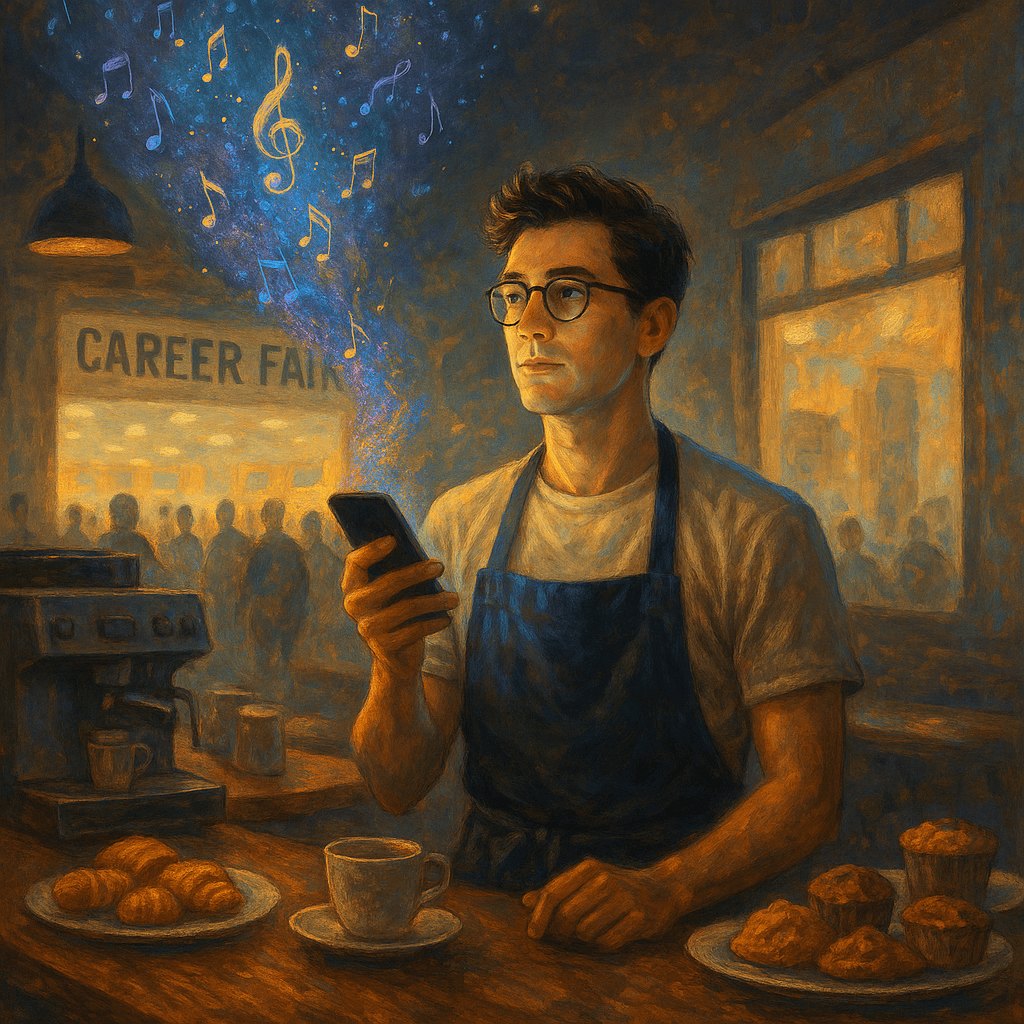
    I dreamed I was working in a café—one of those indie joints that sells artisanal pastries dusted with powdered irony—while slogging through my Master’s in English. Picture a barista apron slung over a grad student’s existential dread.

    I carried a phone that wasn’t just smart—it was sorcerous. With one tap, it summoned a stream of music from a satellite orbiting somewhere above Earth’s pettiness. This music wasn’t Spotify-tier. It was celestial—otherworldly symphonies that made Bach sound like background noise at a carwash. The entire café basked in it, as if rapture had been accidentally triggered over the scones.

    Then he appeared. A mysterious man—part career counselor, part trickster god—told me that if I attended a career convention, I could buy a van for my family. Not just any van. A magical, dream-fulfilling van priced at $400, which in dream economics is about the cost of a single textbook in grad school.

    The convention was a riot of lanyards and desperation. Voices swirled about the final class I needed to finish my degree: the dreaded seminar with Professor Boyd, a real professor from my waking life, whose lectures felt like intellectual CrossFit and whose office smelled faintly of despair and dry-erase markers.

    I never found the van man.

    The dream logic began to wobble. Doubt crept in like a late fee. I wandered through the convention’s gray carpeted purgatory and began rehearsing how I’d tell my family we would remain vanless, bound to our modest, immobile fate.

    And then—like a plot twist penned by a sentimental sportswriter—I ran into two Hawaiian brothers I hadn’t seen since Little League. We were kids once. They were legends. One of them, Wesley, struck me out four times in a single game, and I still remembered the way the ball moved like it had free will. Decades later, we were all adrift—middle-aged, mildly broke, and marvelously unsure of ourselves.

    We stood there, in that convention center of failed ambitions and discounted dreams, and talked about what we could’ve been. I told them they had enough charisma to turn their names into brands. I hugged Wesley and said, “You struck me out four times, and it’s a privilege to see you again.”

    None of us had a career. But we had memories. And love. And the unspeakable beauty of a satellite song that once played over cinnamon rolls.

  • College Essay Prompt: Beyond Authentic: How Evolving Cuisines Tell Stories of Survival, Adaptation, and Identity

    College Essay Prompt: Beyond Authentic: How Evolving Cuisines Tell Stories of Survival, Adaptation, and Identity

    Overview:

    Write a 1,700-word argumentative essay examining whether dishes like birria ramen, orange chicken, Korean tacos, or Tex-Mex fajitas should be dismissed as inauthentic or embraced as culturally rich, adaptive expressions of immigrant creativity. Using the evolution of Mexican and Chinese food in the U.S. as your focus, evaluate how culinary “impurity” may reflect resilience more than betrayal.

    This assignment challenges the simplistic binary of cultural appropriation vs. cultural preservation by exploring how food evolves through migration, racism, class, capitalism, and the human need to survive—and thrive.


    Central Claim to Defend, Refute, or Complicate:

    Criticizing American Chinese and modern Mexican cuisine as “inauthentic” oversimplifies the historical, cultural, and economic forces that drive culinary evolution.


    Required Sources (Use at least 4, MLA format):

    • Gustavo Arellano – “Let White People Appropriate Mexican Food”
    • The Search for General Tso (dir. Ian Cheney, 2014)
    • Charles W. Hayford – “Who’s Afraid of Chop Suey?”
    • Cathy Erway – “More Than ‘Just Takeout’”
    • Kelley Kwok – “‘Not Real Chinese’: Why American Chinese Food Deserves Our Respect”
    • Jiayang Fan – “Searching for America with General Tso”

    Focus Questions to Consider:

    • What is gained or lost when immigrant cuisines adapt to mainstream tastes?
    • How have Mexican and Chinese-American dishes reflected creative survival strategies in the face of xenophobia or marginalization?
    • Is culinary “authenticity” a meaningful cultural value or an exclusionary myth?
    • How do evolving cuisines challenge stereotypes and redefine American identity?
    • Should food be judged by origin or by impact?

    Essay Requirements:

    • Length: 1,700 words
    • Format: MLA (12 pt font, double-spaced, Times New Roman)
    • Sources: At least 4 from the required list
    • Tone: Academic and analytical, but open to personal insight or cultural experience
    • Structure: Use the suggested outline below or build your own coherent structure

    Suggested Structure:

    Intro (200–300 words):

    • Open with the “authenticity” debate in food culture
    • Present the evolution of Mexican and Chinese cuisine as a case study
    • Clearly state your thesis: whether you defend, challenge, or complicate the rejection of “inauthentic” foods

    Section 1: Culinary Evolution as Cultural Power (400–500 words)

    • Use Arellano’s “adaptability” argument and The Search for General Tso
    • Explore how adaptation expands—not erases—culinary traditions

    Section 2: Food as a Tool of Survival (400–500 words)

    • Use Jiayang Fan and Cathy Erway to show how these cuisines offered paths to economic mobility and belonging
    • Address how racism shaped what was “acceptable” for the mainstream palate

    Section 3: Rethinking Authenticity (400–500 words)

    • Use Kelley Kwok and Hayford to interrogate what we even mean by “authentic”
    • Acknowledge that tradition matters—but argue that hybridity is the tradition of diaspora

    Section 4: Counterargument & Rebuttal (300–400 words)

    • Address critics who claim fusion or Americanized food dilutes culture
    • Rebut: show how adaptation often preserves a culture’s essence in new form

    Conclusion (200–300 words)

    • Reaffirm your thesis: evolving cuisine reflects the ingenuity, creativity, and endurance of immigrant communities
    • Reflect on how accepting culinary adaptation challenges us to redefine American identity itself

    Final Notes to Students:

    This essay isn’t just about food—it’s about the stories food tells. Let your argument reflect that complexity. Engage deeply with your sources, and don’t be afraid to explore tensions: pride vs. commodification, tradition vs. survival, innovation vs. erasure.

  • Manuscripnosis: A Vexing Tale of Self-Sabotage

    Manuscripnosis: A Vexing Tale of Self-Sabotage

    I suffer from a humiliating literary affliction: when I’m not trying to write a book—when I’m simply crafting loose, witty blog posts—my prose sings. It breathes. It struts across the page like it owns the place. In those moments, I’m not an “author,” I’m just a clever diarist with decent rhythm and a nose for irony.

    But then comes the fatal whiff—that intoxicating scent of a book deal drifting in from the distance like a mouth-watering freshly-baked coconut macaroon. Suddenly, I begin to try. I sit up straighter. I structure. I strategize. I lean into “craft.” And that’s when my prose, once alive and sinewy, collapses like a soufflé that sensed it was being watched. Gone is the energy, the voice, the mischievous verve. What remains is a flaccid husk of what could have been—something that reads less like a potential bestseller and more like a workshop handout no one asked for.

    This, dear reader, is the vicious, looping paradox I call Unintended Book Syndrome. The moment I stop writing and start authorshipping, my words die on the vine.

    The clinical term, I believe, is Manuscripnosis: a trance-like state in which blog-worthy brilliance is transfigured into joyless literary taxidermy the moment the idea of a “real book” enters the room. I have lived with this disorder for decades. I’ve tried everything—lowering expectations, denying ambition, even faking indifference. Nothing works. The moment I think this could be a book, the prose curls up and dies like a Victorian heroine too delicate for publication.

    Sometimes I fantasize about quitting writing altogether. But abstinence only makes it worse. The despair of not writing eclipses even the misery of writing badly. Which means I am doomed to live forever in this creative purgatory—hovering between genius and garbage, blog post and book, dopamine and dread.

  • Gravefeather and the Temple of Iron

    Gravefeather and the Temple of Iron

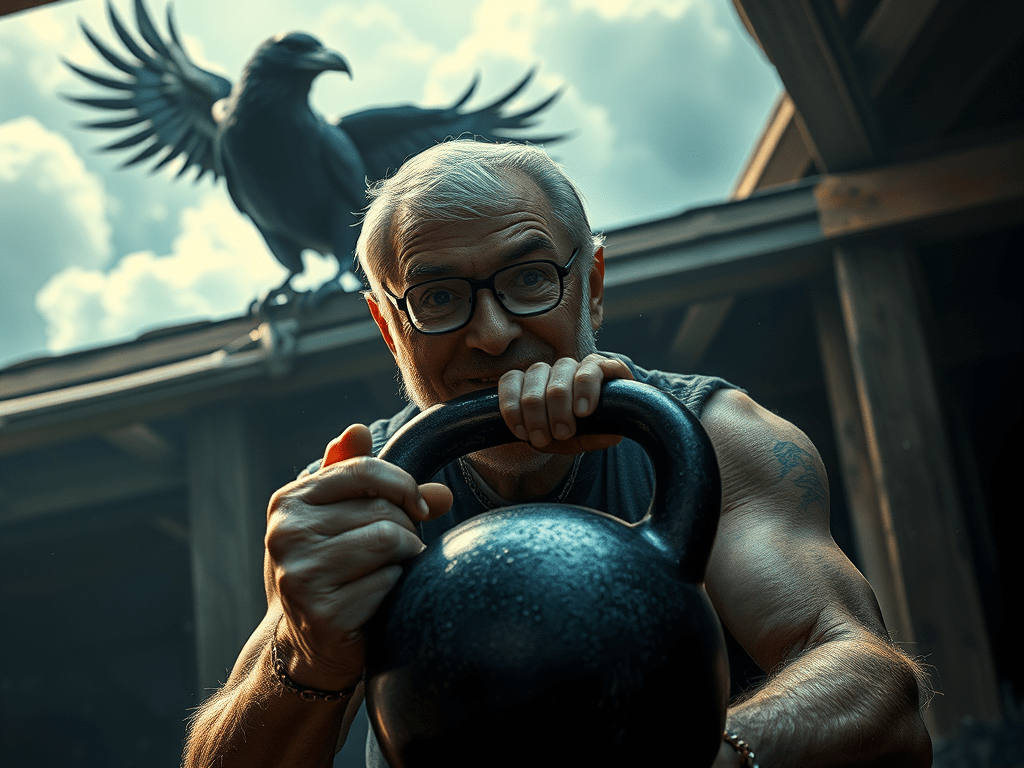
    At 63, with fifty years of training behind me and enough injuries to fill a radiologist’s scrapbook, I don’t pay a therapist two hundred bucks an hour to dissect my existential drift. No, I take my angst to the garage and sweat it out under the cold, unforgiving eye of a steel kettlebell.

    This isn’t the gym-as-penance nonsense of my youth. I’m in it for the long haul now—grease in the joints, not fire. I train smart. No heroic max-outs, no flirtations with the ER. I chant my gospel, delivered by YouTube prophet Mark Wildman: “The purpose of working out today is to not hurt yourself so you can work out tomorrow.”

    Prepped with a concoction of 50 grams of protein (half yogurt, half whey, all optimism) and 5 grams of creatine, I step into the garage like a monk entering a steam-soaked temple. Within minutes, I’m sweating like a politician in a polygraph booth, slipping into that endorphin-laced trance where everything hurts and yet somehow heals.

    But my solitude never lasts.

    The parade begins: delivery drivers dropping packages by the gate like sacrificial offerings. They nod. We chat. They ask about my workouts. Sometimes they want kettlebell tips, which I deliver like the gym-floor Socrates I’ve become.

    Then come the other visitors—the crows. Not just crows. Hypercrows. Schwarzenegger crows. Hulking, obsidian-feathered beasts with the posture of Roman generals and the swagger of barbell-swinging demons. These things don’t fly—they strut. They don’t chirp—they taunt.

    One in particular has claimed me. I’ve named him Gravefeather, which feels appropriately mythic. He has the pecs of a cartoon strongman and the gaze of someone who’s seen civilizations fall and isn’t impressed. He parks himself on the fence or the garage roof, staring me down mid-swing with an expression that says, “Your form is garbage and mortality is laughing at you.”

    I know he remembers me. Crows do that. He remembers that I’m no threat. He remembers I talk to myself. He probably knows my macros. And when I lock eyes with him, mid-swing, sweat blurring my vision, I swear he’s thinking, “Nice hinge, old man. Shame about your knees.”

    Sometimes he’s perched twenty feet away while I’m gasping through Turkish get-ups, his eyes drilling into me with cosmic disdain. I hear him say, without speaking, “Enjoy your little routine, fleshbag. Entropy is undefeated.”

    But I argue back. I say, “Just because we’re mortal doesn’t mean we surrender to chaos. This is my sanctuary. I honor it. I will not be mocked by a sentient pigeon in a tuxedo.”

    Gravefeather cocks his head. He seems to consider this. Then, with the faintest nod of something like respect, he lifts off into the blue, cawing a tune that sounds like the chorus of a forgotten Paul McCartney song—melancholy, strangely triumphant, vaguely judgmental.

    And I return to the bell. I swing. I breathe. I endure. Gravefeather may be watching, but the iron remains mine.

  • Moses Meets the App Store in My Descent to Hell

    Moses Meets the App Store in My Descent to Hell

    Five years ago, I had a dream that still clings to me like the stench of sulfur on an unwashed sinner. In it, I found myself suspended over a chasm so vast and foreboding it made Dante’s Inferno look like a weekend at Lake Tahoe. This wasn’t just your garden-variety pit of despair. No, this one was styled by some deranged horror set designer who clearly had unresolved issues with gravity and geometry. The rocks jutted out like they’d been forged in spite, sharp enough to slice light itself. Below me? Nothing but an infinite abyss—pitch black, indifferent, and curling with smoke as if Hell had sprung a leak.

    My right hand clutched a pulley system that seemed to have been engineered by Torquemada during a particularly creative phase. It squealed and groaned like it hated me personally. Each tug upward felt like hauling an anchor through molasses with a rotator cuff made of stale bread. My muscles howled, my fingers cramped into arthritic claws, and I could practically hear my body whispering, “Let’s just give up and fall dramatically.”

    Above me, a shaft of light flickered—not a beacon of salvation, but more like someone had dropped a flashlight into a well and forgot about it. It promised hope the way a gas station burrito promises nutrition: with cruel intent.

    Now here’s where the dream leaned hard into surrealism. In my left hand, I held a tablet—equal parts Moses and Steve Jobs. One moment it gleamed with digital sleekness, the next it was stone, chiseled with ancient script and glowing like radioactive guilt. It was a device caught in an existential crisis, flipping between iPad and Ten Commandments with the kind of indecision reserved for suburban dads browsing Netflix.

    On one side of this metaphysical gadget was a tableau of indulgence—a pulsating carousel of temptation: flesh, flames, laughter, madness. The orgy of excess, curated in high definition. On the other side? A searing Divine Light—pure, unblinking, and full of that holy judgmental glow that makes you instinctively cover your bits.

    As I strained upward—toward gray light, away from that unholy carnival—I had the sinking realization that I might not make it. My body was mutinying. My mind, riddled with indecision. And I knew, deep in my marrow, that if I let go, I’d drop—not just into the pit, but into a punchline told by angels over drinks: “Remember that guy who thought he could have both salvation and the sex party?”

    I hung there, torn between moral clarity and high-def carnality, between stone tablet and glowing screen, between self-destruction and self-delusion. And all I could do was pray that I’d wake up before gravity made the decision for me.

  • Return to Purgatory: A Packing Dream from Hell

    Return to Purgatory: A Packing Dream from Hell

    Last night, I found myself trapped in a sprawling compound of crumbling houses that looked like they were built during the Carter administration and never cleaned since. A communal frenzy was underway: the packing of thousands—yes, thousands—of food items and random clothing for a temporary exodus. Why the mass exodus? Unclear. Fumigation? Apocalypse? A reboot of The Grapes of Wrath? Whatever the reason, it was purgatorial.

    The mood? Moronic cheer. My fellow inmates—let’s not flatter them by calling them neighbors—were sipping drinks, cackling, and treating this Herculean labor like a godforsaken block party. Meanwhile, I hovered at the edge of the scene, paralyzed by the Sisyphean logistics of it all. Every cabinet I opened unleashed another avalanche of expired beans and mismatched Tupperware lids. The collective merriment felt obscene, as if they were toasting the Titanic’s elegant descent into the sea.

    And just when I thought salvation had arrived—in the form of a 2 a.m. bathroom break—I awoke, staggered to the toilet, and stumbled back to bed hoping to reset my brain. No such luck. The dream resumed exactly where I left off, like I’d hit pause on Netflix and walked back into my own streaming nightmare. There I was again, back in the compound, surrounded by half-drunk revelers blissfully ignoring the sheer futility of their packing, while I stood, a one-man FEMA unit, dreading every box and can like they were symbols of existential despair.

    I suppose, in some Jungian corner of my subconscious, this was meant to be cathartic. Maybe a soul purge. Maybe a late-night psychological CrossFit session designed to wring out my nervous system like a filthy sponge. All I know is, I woke up feeling like I’d done emotional burpees for eight hours straight—but to my surprise, I was eager to get out of bed, made a pot of coffee like it was a holy sacrament, and gleefully planned a one-hour kettlebell workout. 

  • Beauty Without Performance: The Quiet Legacy of The Sundays

    Beauty Without Performance: The Quiet Legacy of The Sundays

    Harriet Wheeler and David Gavurin of The Sundays gave the world my favorite song of all time: “You’re Not the Only One I Know.”
    I didn’t just fall for that song — I tumbled headfirst into their entire body of work across three albums, each one a quiet masterclass in melancholy and grace. I saw them live twice, but the 1990 show at Slim’s in San Francisco left a scar on my heart that never quite healed. Somewhere between the ringing guitars and Harriet’s bittersweet voice, I understood something about beauty that hurt — the way only true beauty can.
    I bought a Sundays T-shirt that night, and decades later, my teenage daughter wears it like a badge of honor as if carrying the torch for a band she never saw but somehow still feels.

    Wheeler and Gavurin, true to form, refused to play the roles we demanded of them.
    After making their brief, brilliant splash on the music scene, they disappeared — not in disgrace, but in quiet triumph.
    No messy social media fade-outs. No tragic reunion tours at casino amphitheaters. Just two people choosing domestic obscurity over the ceaseless meat grinder of public performance.
    Rumor has it Harriet became a schoolteacher. I hope that’s true. There’s something magnificent about the idea of her trading in the spotlight for a chalkboard, living in the kind of real, unperformed life that fame devours.

    Meanwhile, their fanbase — myself included — obsessed for years, combing through blogs and Reddit threads for any sign of a comeback that never arrived.
    But the more I think about it, the more I admire Wheeler and Gavurin’s refusal to extend the brand of themselves indefinitely.
    The same beauty that made their music shimmer with timeless sadness likely steered them away from the terminal exhibitionism that seems to consume so many artists.
    Their art wasn’t a ladder to fame — it was a lifeboat out of it.

    They should know this much:
    The same Sunday’s T-shirt I once wore to death now lives on, worn proudly by my daughter, proof that real magic — the kind you don’t sell, the kind you don’t explain — doesn’t need an encore.