Tag: poetry

  • The Ghost Story of Sid Briggs

    The Ghost Story of Sid Briggs

    You can’t understand what it meant to be a teenage boy in 1970s California without inhaling the thick, narcotic perfume of banana-coconut tanning oil. It wasn’t a scent so much as a doctrine. You lay on a beach towel the size of a small sailboat and basted yourself in that viscous syrup as if you were preparing your own body for display. No one spoke of melanoma. The goal was simple: darken, gleam, radiate. Bronze was not just a color—it was a declaration of sexual arrival. For a teenage bodybuilder, it was mandatory. Muscles alone were not enough; they needed lacquer, shine, theatrical finish. We weren’t just building bodies—we were curating mythologies.

    The culture supplied its own scripture. Xaviera Hollander hovered over the decade like a secular saint of libido, her memoir The Happy Hooker tucked into suburban living rooms beside purple bongs that leaned like exhausted sentinels. Her voice—thick Dutch vowels, half invitation, half sermon—drifted through late-night radio, as intoxicating as the oil we poured over ourselves like maple syrup on pancakes. If Hollander provided the gospel, Eric Weber supplied the tactics. His book, How to Pick Up Girls!, read like a field manual for social siege warfare: pursue, persist, override refusal, wear resistance down to compliance. It was less romance than strategy, less courtship than conquest. And like all bad ideas, it traveled quickly among teenage boys who didn’t yet know the difference between confidence and predation.

    At Lake Don Castro in the summer of 1977, we found the living embodiment of this philosophy: Sid Briggs, a thirty-five year-old demigod in blue Speedos. He stood on the grassy knoll above the sand like a monument to self-belief—wavy hair, sculpted mustache, gold chain glinting against a chest that looked permanently backlit. A Playboy cooler at his feet, a boombox humming, a Frisbee orbiting his charisma—Sid was less a man than a recurring performance. We studied him like apprentices. His lines never changed. 

    Every Saturday I heard the following: Sid paid his uncle five hundred dollars for a custom paint job on his Camaro. His father owned expensive real estate in the Bay Area. He had helped manage his father’s properties since he was in high school. He was waiting to hear from a Hollywood studio for a small role as a fighter in a martial arts movie. Even though he never attended college, he had his own house in a desirable part of town called Parsons Estates. Sid would throw in the words “Parsons Estates” as if they were a magical mantra that would make stars sparkle over his coiffed hair.

    Every Saturday, Sid arrived at the man-made beach with a new blonde draped at his side, each one somehow more dazzling and surgically assembled than the last, as if he were upgrading girlfriends through a mail-order catalog of California delusions. They’d toss a Frisbee on the grassy knoll above the imported sand, laughing too loudly, performing youth and leisure for anyone within eyesight. Sid treated the entire shoreline like a stage set built exclusively for his mythology.

    That was when the lies began breeding like bacteria in warm water.

    He inflated his real estate career into the legend of a ruthless young mogul when in reality he was little more than a glorified rent collector for his father’s properties. He claimed to hold a business degree, though everyone knew he’d been booted out of community college after throwing a volcanic tantrum over not getting the campus radio disc jockey position. In Sid’s version of events, he wasn’t a failed student; he was a misunderstood prince denied his throne.

    Then came the aristocratic nonsense. According to Sid, his bloodline could be traced back to Belgian nobility. Somewhere, apparently, stood a family estate complete with a coat of arms, ancestral portraits, and a sacred genealogy book displayed in a special foyer like the Dead Sea Scrolls of mediocre white privilege. The more he lied, the more intoxicated he became by the sound of his own inventions. You could watch it happen in real time. One fabrication fed the next until he drifted into a narcotic haze of self-creation, trapped inside a fantasy version of himself that felt more pleasurable than reality ever could.

    By that point, the women were almost incidental. The true seduction was the performance. Sid didn’t lie to get the conquest. The lies were the conquest.

    I was eager to hear Sid’s lies because, if I’m being honest, I possessed a small talent for self-mythologizing myself. Watching Sid perform his fabrications was like studying my own bad habits through a carnival mirror. I wanted to observe what happened when a man fed himself a steady diet of invented grandeur and then mistook the swelling for genuine substance.

    My greatest obstacle to catching every word was the bees.

    The grassy knoll above the beach was infested with tiny white flowers, and the flowers, in turn, were infested with bees drunk on pollen and purpose. Their buzzing rose and fell in thick waves, sometimes louder than Sid himself. I’d lean forward in my beach chair, squinting through the sunlight, straining to catch the choicest portions of his nonsense as if I were listening to bootleg radio transmissions from a collapsing dictatorship. One moment I’d hear fragments about Belgian aristocracy or shadowy business deals, and the next moment the bees would surge into a collective electric hum, swallowing entire sections of his fantasy whole.

    Oddly enough, the interruptions improved the stories. The missing pieces forced my imagination to collaborate with Sid’s dishonesty. His fabrications became serialized entertainment, half confession and half hallucination, drifting across the hot afternoon air with the smell of Coppertone, cut grass, and imported saltwater.

    ***

    To be called “Bridge and Tunnel” in 1970s San Francisco was not a description; it was a diagnosis. It marked you as a provincial organism, a life-form that had migrated from the East Bay—Hayward, San Leandro, Castro Valley—regions the city regarded as a kind of cultural quarantine zone. By San Francisco standards, we didn’t simply live elsewhere; we existed at a lower altitude of refinement.

    My teenage bodybuilding friends and I would cross the Bay Bridge like contaminants slipping past a border checkpoint, only to be received with the sort of polished contempt reserved for the uninvited. The girls—urban aristocrats of posture and irony—would glance at us, lips tightening into a surgical line, and murmur “Bridge and Tunnel” as if naming a disease. The implication was clear: we had not arrived so much as oozed in, crawling through some damp civic artery to stain their carefully curated world.

    We did little to disprove their assessment. We spent our afternoons at the lake, marinating our skin in tropical bronzing oil with the reckless confidence of men who believed melanoma was a rumor. Between sets of posing and flexing, we argued with prosecutorial intensity over the great philosophical question of our time: Ginger or Mary Ann. This was not idle chatter. This was a loyalty test. Imagine a bare bulb swinging in a concrete cell, a man with broken teeth asking you to choose. Your answer wasn’t right or wrong—it was a measure of your authenticity.

    In truth, there was one answer: Mary Ann. Ginger was spectacle—too lacquered, too deliberate. Mary Ann had gravity. Especially in cut-offs. She was the apex until Daisy Duke arrived and raised the stakes, turning denim cut-offs into doctrine and ushering in a new era of televised exhibitionism.

    Bull, however, took these matters beyond reason. We didn’t realize the depth of his devotion to Gilligan’s Island until KTVU quietly removed it from the schedule. He responded as one might to a death in the family. He kicked his mother’s Sony Trinitron while wearing combat boots—an act of passion undermined by poor planning. The television survived. His shin did not. We spent the afternoon at Eden Medical Center watching him bleed through a makeshift bandage.

    We offered no sympathy.
    “You made us miss Pec Day,” Falco said.

    “And forget donkey calf raises,” I added. “You’re benched for a month. Congratulations.”

    Bull slumped in his chair, a chastened creature with curly hair and wounded pride. “Mary Ann’s gone,” he muttered, staring into middle distance as if mourning a lost lover.

    “At least there’s Jeannie,” I said.
    “Barbara Eden never lets you down,” he replied.
    “And Charlie’s Angels,” I added.

    Bull kept a poster of Farrah Fawcett in his room. Once a week, he arranged protein pills on a velvet pillow beneath it, as if offering tribute to a benevolent deity of blonde perfection.

    Reality intruded. His mother, unimpressed with his theatrical grief, demanded repayment for the damaged television. He had already failed a security job test at Gemco. He was supposed to run up a staircase while holding a fire extinguisher in fewer than fifteen seconds. He gave up midway, keeling over and trying to catch his breath.

    “What does it profit a man to have bulging muscles if he is not functional?” I asked.

    “Shut up, loser,” Bull snapped.

    He had rank—he and Falco were seniors; I was a sophomore with a loose mouth and poor instincts for hierarchy.

    Now, with a bandaged leg, he faced a new problem: no job, no training, no progress. Falco, ever the strategist, offered his usual solutions in single-word fragments.

    “Refrigeration.”
    “I failed that test three times.”
    “Take it again. Cold air builds muscle.”

    Bull shook his head. “Fifty bucks a test.”

    As always, we retreated into fantasy. We would win international bodybuilding titles, open a gym in the Bahamas, and spend our days in Speedos while sunlit goddesses delivered protein drinks in coconut shells and validated our existence. Bull embellished the vision with architectural details and swimsuit specifications. He looked almost peaceful.

    Which is why I had to ruin it.

    “And maybe,” I said, “while you’re selling memberships, you’ll run into Mary Ann.”

    “Shut up, loser,” he said again, clutching his leg.

    The pain had sharpened. Not just the injury—the realization. One impulsive kick had cost him weeks of training, a job opportunity, and delayed the imaginary migration to a tropical paradise where everything made sense and nothing required discipline.

    For the first time, Bull looked less like a future champion and more like what he was: a kid being forced to accept the fact that the Bahamas were postponed indefinitely. Accountability had arrived early. 

    Our concern for Bull evaporated the moment Sid Briggs burst through the ER turnstile, a spectacle wrapped in gauze and self-regard. His right hand was bandaged into a blunt white cudgel, as if he’d lost a fight with a plaster cast. The rest of him, however, was in peak exhibition form: cut-offs surgically trimmed, a white tank top clinging to a torso that glistened with oil. Whether he’d applied it before or after entering the ER was unclear, but the principle was not—Sid Briggs did not enter public space without proper lubrication. His neck carried enough gold chain and oversized pukka shells to suggest he had just taken first place in a luau dance-off, and he wore the prize with priestly seriousness.

    Sid’s hair was sun-bleached into submission, his mustache aggressively bushy, and his cheeks sucked inward, as if he were practicing for a portrait no one had commissioned. He looked pleased with himself in the way only a man can who has mistaken persistence for success.

    He recognized us and approached with theatrical urgency, holding up his bandaged hand like a prop. “Nasty bee sting,” he said, as if recounting a battlefield injury. He’d been tanning at Lake Don Castro when the incident occurred. The doctor, he reported, had warned him about a possible allergy: future stings could escalate, even turn life-threatening. 

    “The lake is a bee magnet,” I said.

    Briggs rolled his eyes at me with the practiced contempt of a man who has never allowed facts to interrupt his narrative.

    “As if I’m going to stop tanning at Don Castro,” he said. “That is my home, bro.”

    We laughed, not because it was funny, but because it was airtight. Sid Briggs without Don Castro would be like a peacock without a parking lot—technically possible, but existentially absurd. He lived there in spirit: beside the snack bar, beside his Playmate cooler, white Frisbee at the ready, launching pickup lines with the confidence of a man who believed rejection was a clerical error. Even now, the word “disco” conjures him for me—bronzed in Speedos, snapping his fingers to KC and the Sunshine Band as if rhythm itself were part of his personal brand.

    As he spoke, he sucked in his cheeks and scanned the room, locking onto a blonde nurse with the focus of a guided missile. “Well, amigos,” he said, adjusting his posture to maximum visibility, “I need to get back to the beach. The ladies are waiting.”

    He patted Bull on the shoulder—carefully, as if blessing a lesser mortal—wished him a speedy recovery, and strode back into the sunlight, a man convinced that even a bee sting was just another opportunity to be seen.

    ***

    About a month later, my bodybuilder buddies and I saw Sid in his usual spot, the grassy knoll, where he was tossing his Frisbee to two blonde girls in white bikinis. I had my towel spread out close by so I could study Sid’s methods among the drone of buzzing bees. I was half-listening to him talk about how amazing he was and half-reading my parents’ dog-eared copy of The Happy Hooker.

    That’s when I heard Sid give out an alarming howl.

    “Oh my God,” one of the bikini-clad girls said. “You stepped on a bee.”

    I saw the bee spinning in the grass for its final moments before it would die without its stinger.

    The bee sting’s effects were immediate. Sid began to sweat and limp while trying to walk through the pain. The two blonde girls looked at the wincing pick-up artist with concern. One of them asked if he was all right.

    “No big deal,” he said. “Just a little bee sting.”

    “Are you sure you’re okay?” one of the girls asked as the man’s body was covered with a shiny sheen of sweat.

    “I’m fine. Really, I am.”

    “I think you should sit down,” one of the girls said.

    “No, we can still play. I’m fine. Don’t worry about me.”

    By now, Sid’s foot had swollen into a giant ham. He looked down at the inflamed flesh, and his tumescent foot was proof of the severity of his situation. His eyes bulged with fear, and then he collapsed, and lying prone on his back he began to hyperventilate.

    An ambulance came soon after. Sid was in the throes of anaphylactic shock. The paramedics did their best, but Sid died on the spot.

    I was never the same after Sid died. The whole thing lodged inside me like a splinter beneath the skin. I obsessed over the details of his death with the unhealthy devotion usually reserved for unsolved murders and failed romances. I had nightmares. I stopped going to the beach with my buddies. The grassy knoll, the imported sand, the Frisbees arcing against the sky—all of it felt contaminated now, like the set of a sitcom where somebody had quietly died backstage.

    About six months after Sid’s death, a peculiar dream began visiting me with unnerving regularity.

    In the dream, my friends and I gathered at the lake at twilight for a wake. We sat around a bonfire drinking cheap beer while the last ribbons of orange light dissolved across the water. Then someone would fall silent and point toward the horizon.

    There was Sid.

    Far out on the lake, he appeared as a small silhouette walking across the water toward us with calm, impossible strides. No thunder cracked. No heavenly choir sang. He simply kept approaching, closer and closer, until he reached the shore, brushed lakewater from his pant legs, and sat beside the fire as casually as a man returning late to a barbecue.

    That was when he told us about his final moments.

    The paramedics were working frantically over his body, he explained, when suddenly he looked upward and saw the counterfactual version of his life—the life he might have lived had he not spent decades performing for strangers like a peacock drunk on its own feathers. In that vision he was no longer prowling the beach with pickup lines and fraudulent pedigrees. He was a husband. A father. He walked peacefully along the shoreline beside a woman who genuinely loved him. Four children orbited around them in bursts of laughter while two rescue dogs exploded through the surf in ecstatic loops.

    Everything glowed with an unbearable softness.

    The sky was pale blue, not dramatic enough for cinema but beautiful in the way honest things often are. Sunlight fell gently across the water as though the world itself had abandoned judgment. Somewhere in the distance there was music—not literal music, but the emotional equivalent of it, the kind that arrives when your nervous system finally unclenches after years of pretending.

    And in that impossible stillness, Sid turned toward God.

    Not toward status. Not toward women. Not toward applause. Toward God.

    He begged for another chance. He promised he would abandon the counterfeit life and live honestly at last. It was as if existence itself had paused to offer him one final rehearsal for redemption. For the first time in his life, he experienced something that required no performance whatsoever: peace stripped of vanity. Beauty without spectators.

    Then the bee venom reached his heart.

    That was the cruelty of it.

    Just as he believed grace had opened a door for him, his body failed. The bee won. Sid Briggs—master raconteur, counterfeit aristocrat, beach peacock, human smoke machine—died mid-negotiation with eternity.

    Around the bonfire, dream-Sid spoke to us without swagger, without embellishment, without the narcotic glaze of self-invention. He told us he was not a man to imitate but a cautionary tale with suntan oil on it. A fraud. An impostor. A man who had spent so much time manufacturing an image that he neglected the architecture of an actual soul.

    He made us swear we would not waste our lives chasing the same hollow performance.

    And once we promised him—once he was convinced we understood—he rose quietly from the fire, walked back across the water toward the horizon, and disappeared into the dark.

    A few years later, when I took music theory in college, I carried that dream with me to the piano. I tried to process Sid’s death the only way I knew how: by turning grief into melody. For nearly two years I worked obsessively on a composition called “The Ghost Story of Sid Briggs.”

    Almost fifty years later, I still play it.

    The notes have never dulled. Neither has the warning hidden inside them.

    Some performances do not end with applause or redemption. Some end with collapse. Too little truth. Too much theater. And no encore.

  • Bridge and Tunnel Bodybuilders

    Bridge and Tunnel Bodybuilders

    We were teenage bodybuilders in the East Bay—Hayward, San Leandro, Castro Valley—territory that might as well have been stamped unfit for human company by San Francisco standards. In the city, we were a contaminant. The girls would look at us with elegant disdain, lips curled, and whisper “Bridge and Tunnel,” as if we had crawled through some damp subterranean artery to trespass upon their polished world.

    We did little to disprove their assessment. We spent our afternoons at Lake Don Castro, marinating our skin in tropical bronzing oil with the reckless confidence of men who believed melanoma was a rumor. Between sets of posing and flexing, we argued with prosecutorial intensity over the great philosophical question of our time: Ginger or Mary Ann. This was not idle chatter. This was a loyalty test. Imagine a bare bulb swinging in a concrete cell, a man with broken teeth asking you to choose. Your answer wasn’t right or wrong—it was a measure of your authenticity.

    In truth, there was one answer: Mary Ann. Ginger was spectacle—too lacquered, too deliberate. Mary Ann had gravity. Especially in cut-offs. She was the apex until Daisy Duke arrived and raised the stakes, turning denim cut-offs into doctrine and ushering in a new era of televised exhibitionism.

    Bull, however, took these matters beyond reason. We didn’t realize the depth of his devotion to Gilligan’s Island until KTVU quietly removed it from the schedule. He responded as one might to a death in the family. He kicked his mother’s Sony Trinitron while wearing combat boots—an act of passion undermined by poor planning. The television survived. His shin did not. We spent the afternoon at Eden Medical Center watching him bleed through a makeshift bandage.

    We offered no sympathy.
    “You made us miss Pec Day,” Falco said.

    “And forget donkey calf raises,” I added. “You’re benched for a month. Congratulations.”

    Bull slumped in his chair, a chastened creature with curly hair and wounded pride. “Mary Ann’s gone,” he muttered, staring into middle distance as if mourning a lost lover.

    “At least there’s Jeannie,” I said.
    “Barbara Eden never lets you down,” he replied.
    “And Charlie’s Angels,” I added.

    Bull kept a poster of Farrah Fawcett in his room. Once a week, he arranged protein pills on a velvet pillow beneath it, as if offering tribute to a benevolent deity of blonde perfection.

    Reality intruded. His mother, unimpressed with his theatrical grief, demanded repayment for the damaged television. He had already failed a security job test at Gemco. He was supposed to run up a staircase while holding a fire extinguisher in fewer than fifteen seconds. He gave up midway, keeling over and trying to catch his breath.

    “What does it profit a man to have bulging muscles if he is not functional?” I asked.

    “Shut up, loser,” Bull snapped.

    He had rank—he and Falco were seniors; I was a sophomore with a loose mouth and poor instincts for hierarchy.

    Now, with a bandaged leg, he faced a new problem: no job, no training, no progress. Falco, ever the strategist, offered his usual solutions in single-word fragments.

    “Refrigeration.”
    “I failed that test three times.”
    “Take it again. Cold air builds muscle.”

    Bull shook his head. “Fifty bucks a test.”

    “Meat,” Falco said, referring to his door-to-door sales job of premium cuts of meat—a scheme so vague it sounded like folklore.

    “I’m on crutches,” Bull said. “I’m not selling rib-eyes and Cornish game hens.”

    As always, we retreated into fantasy. We would win international bodybuilding titles, open a gym in the Bahamas, and spend our days in Speedos while sunlit goddesses delivered protein drinks in coconut shells and validated our existence. Bull embellished the vision with architectural details and swimsuit specifications. He looked almost peaceful.

    Which is why I had to ruin it.

    “And maybe,” I said, “while you’re selling memberships, you’ll run into Mary Ann.”

    “Shut up, loser,” he said again, clutching his leg.

    The pain had sharpened. Not just the injury—the realization. One impulsive kick had cost him weeks of training, a job opportunity, and delayed the imaginary migration to a tropical paradise where everything made sense and nothing required discipline.

    For the first time, Bull looked less like a future champion and more like what he was: a kid being forced to accept the fact that the Bahamas were postponed indefinitely. Accountability had arrived early. 

  • When Writing Stops You From Lying to Yourself

    When Writing Stops You From Lying to Yourself

    Kafka called writing a form of prayer. Not as piety, but as precision. Prayer, properly understood, is the act of stepping out of ordinary time—the noisy, transactional churn—and entering a space where attention is no longer scattered but gathered. Writing does the same. It refuses the chaos of profane time and insists, however briefly, on the discipline of the sacred.

    The sacred is not mystical fog. It is clarity stripped of dopamine. It is the quiet room where you examine the state of your own soul without distraction or performance. It is where you test whether your words can survive contact with your actions. It demands humility because it exposes how often they don’t. And it offers a kind of nourishment the chronophage—the great time-eating machine—cannot provide, because it cannot be consumed passively. It must be earned.

    To live thoughtfully is to move between two worlds: the sacred and the profane. You cannot remain in either one. You must descend into the ordinary—work, errands, obligations—but carry with you the standards forged in that quieter space. Otherwise, the sacred becomes theater, and the profane becomes drift.

    So the question arrives, unwelcome but necessary: Do my actions align with my ideals? No. Not yet.

    If they did, my life would contract, not expand. I would eat with intention—three meals, no grazing—and call the absence of snacks what it is: a fast, not a deprivation. I would step away from the digital carnival that thrives on FOMO, because I know its rewards are counterfeit—brief spikes followed by longer, duller lows.

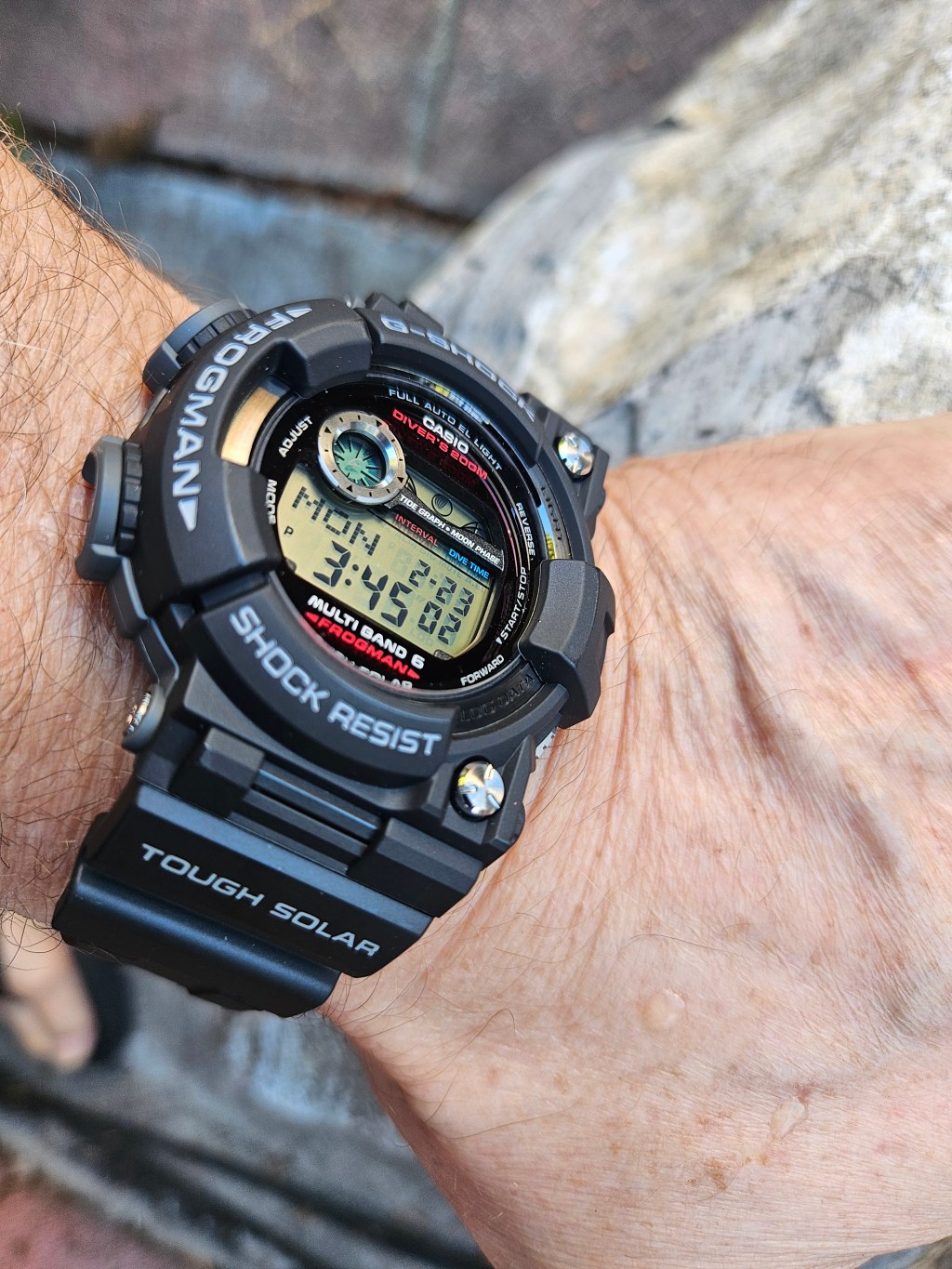
    I would stop buying watches. I already own more than I can meaningfully wear. Two G-Shocks tell perfect time. The rest sit like artifacts of former appetites. Rotation is not variety; it is indecision dressed as sophistication.

    And I would reconsider what I make. If my videos exist to chase attention, to measure my worth in clicks and spikes of approval, then they are extensions of the same problem. The medium is different; the mechanism is identical. But if a video can carry an idea forward—if it can clarify rather than agitate—then it earns its place.

    Writing, then, is not an escape. It is a reckoning. It is the act of bringing the sacred into contact with the profane and asking, without flinching, whether they agree. Most days, they don’t. The work is to narrow that distance.

  • The Theology of the Watch Addict

    The Theology of the Watch Addict

    You cannot understand watch obsession without understanding religious conversion. At some point, the hobby stops being about objects and starts behaving like faith.

    No one would seriously claim a timepiece is divine. And yet the devoted enthusiast approaches the hobby with the discipline, ritual, and emotional seriousness of a Trappist monk. This is not shopping. This is vocation.

    Every serious collector eventually enters the desert.

    There comes a period of withdrawal—no forums, no influencers, no hype lists—just the quiet work of figuring out what you actually like. The goal is purity. To borrow from René Girard, mimetic desire is heresy. Buying what the tribe loves is imitation. Discovering your own taste is revelation.

    But the desert is temporary. No believer practices alone forever.

    Soon enough, the enthusiast returns to the congregation: YouTube channels, forums, group chats, wrist-shot threads. What gets called “research” becomes a daily ritual. Hours pass in a fever swamp of comparisons, debates, rumors, and release speculation.

    The information is secondary.

    The real function is Research Communion—the comfort of shared obsession, the quiet reassurance that you belong to a fellowship that speaks your language and validates your concerns about case thickness and lume performance.

    Like any conversion, the watch enthusiast lives in two eras: Before Watches and After Watches.

    Before was vague. Time passed unnoticed. Evenings disappeared into the fog.

    After is different. The day has structure. The wrist has meaning. Life feels sharper, more intentional, more alive—because something small and precise is always there, quietly marking your existence.

    But faith has its trials.

    There are dark nights: compulsive buying, financial regret, obsessive comparison, the creeping suspicion that you’ve become what outsiders call a Watch Idiot Savant. Friends don’t understand. Some quietly decide you’ve become strange.

    If the devotion is real, this doesn’t weaken the believer. It deepens the bond with the tribe.

    An us-versus-them mentality emerges. Non-watch people become a separate species—citizens of a dull world where time is checked on phones and meaning is measured in convenience. Meanwhile, a private conviction grows stronger: the world doesn’t understand your discernment, your discipline, your eye.

    But beneath all the brands, movements, and materials lies the true object of devotion.

    The enthusiast is not chasing watches.

    He is chasing order.

    He is chasing the feeling that somewhere, something is precise, aligned, and under control. He is searching for the pure and absolute in the form of Sacred Time.

    This condition has a name: Sacred Time Syndrome.

    It is the quiet belief that a watch is not merely a tool but a wearable altar where chaos is subdued and existence ticks in disciplined submission. The wearer does not simply check the hour; he consults it. Atomic synchronization feels like divine correction. A perfectly regulated movement suggests moral virtue. Drift becomes an existential failure.

    Underneath the talk of lume, tolerances, and finishing lies the real motive: the hope that if time on the wrist is exact, then life itself might also be brought into alignment.

    Because the deeper fear is this:

    Time is vast.
    Time is indifferent.
    Time is not impressed by your collection.

    So the enthusiast keeps buying, adjusting, comparing—not for status, not for craftsmanship, not even for pleasure.

    He is purchasing small, precise moments of reassurance that the universe, at least on his wrist, still answers to order.

  • When Bold Becomes Desperate: The Toxic Green Frogman I Didn’t Buy

    When Bold Becomes Desperate: The Toxic Green Frogman I Didn’t Buy

    The limited-edition G-Shock Frogman GW-8200TPF-1 is called the “Three-Striped Poison Dart Frog,” a name that tells you everything you need to know. Its case and bezel are streaked in oily black and radioactive neon green, a visual homage to the rainforest amphibians whose skin carries enough toxin to tip a hunting arrow. The watch doesn’t whisper. It hisses. It looks less like a timepiece and more like something that escaped from a biohazard lab. And I have to admit: I could see it on my wrist.

    Which is precisely the problem.

    I am sixty-four years old. This watch belongs on the arm of a young man who still believes the world is a stage and he is the headliner. On me, it risks reading like a cautionary tale. I picture myself as the suburban retiree on a zebra-striped Harley, shirtless under a leather vest, ponytail fluttering, ears weighed down with fishing-lure jewelry. Not rebellion—neediness. Not confidence—pleading. In this light, the Poison Dart becomes what I now recognize as a Final Cry Watch: the late-career purchase meant to shout, I’m still dangerous, when the quieter truth is that one is negotiating a truce with time.

    And yet the attraction persists. That’s the uncomfortable part. Awareness does not cancel desire; it merely narrates it. A part of me even welcomes the idea of restraint—the sedation that comes from declining the spectacle, choosing dignity over fluorescent self-advertisement.

    In the end, what saved me was not wisdom but suspicion. That dramatic spray coating—how long before it fades, chips, or peels? And when the neon begins to die, what remains? Not a bold statement. Not a heroic relic. An Insult Watch—a once-loud object aging badly, like a midlife impulse left out in the sun.

    So the purchase died where many impulses should: in the quiet courtroom of anticipated regret. The Poison Dart remains what it probably was all along—not destiny, not transformation, just a bright, dangerous flirtation with caprice.

  • Feedback Latency Intolerance

    Feedback Latency Intolerance

    Feedback Latency Intolerance is the conditioned inability to endure even brief gaps between action and response, produced by prolonged immersion in systems that reward instantaneous acknowledgment. Under its influence, ordinary delays—seconds rather than minutes—register as emotional disturbances, triggering agitation, self-doubt, or irritation disproportionate to the circumstance. The condition collapses temporal perspective, converting neutral waiting into perceived absence or rejection. What is lost is not efficiency but patience: the learned capacity to exist without immediate validation. Feedback latency intolerance reveals how algorithmic environments retrain emotional regulation, replacing mature tolerance for delay with a reflexive demand for constant confirmation.

    The extent of my deterioration revealed itself recently at a new pancake house. I took my daughter, asked the server what he actually liked on the menu, and obediently ordered the fried chicken biscuit sandwich. Then—already overplaying the moment—I texted my wife to announce my choice, as if this were actionable intelligence. I stared at my phone, waiting for the small red numeral to appear, the sacred 1 that would certify my existence. Forty seconds passed. Forty. I refreshed my screen like a lab rat pressing a lever, convinced something had gone wrong with the universe.

    In that absurd interval, it dawned on me: I had entered a state of pathological impatience, the natural byproduct of prolonged residence in the dopamine swamp of algorithmic life, where self-worth is measured by speed and volume of response. The sensation felt disturbingly familiar. My mind snapped back to stories my mother told about feeding me as a baby. The spoon, freshly loaded with mashed potatoes, would leave my mouth for a brief, necessary refill—and I would erupt in fury, unable to tolerate the unbearable injustice of the spoon’s absence. I screamed not from hunger, but from interruption. Sitting there in the pancake house, refreshing my phone, I realized I had simply upgraded the spoon. This is what too much time inside these machines does to a person: it doesn’t make you faster or smarter—it makes you an adult who can’t survive a forty-second gap between bites.

  • We All Wanted to be Adopted by The Brady Bunch

    We All Wanted to be Adopted by The Brady Bunch

    In the hellfire of the summer of 1971—sun like a coin press and every pine needle a tiny oven—I was nine and certain the world owed me a miracle. My family and four others had staked a two-week claim on a rugged patch of Mount Shasta: we fished, water-skied, swatted hornets, and lazed beneath the buzzing halo of a massive battery radio that vomited The Doors, Paul McCartney, Carole King, and Three Dog Night into the pines. It should have been Eden. It should have been bliss. Instead it felt like the production meeting for a childhood trauma.

    One dawn I lay cocooned in my tent, not merely asleep but translating into the rarest dream of my short life. In that vivid pantomime I’d been plucked off our campsite and dropped into San Francisco, standing before a gleaming red cable car with the Brady Bunch beaming at me like a panel of missionary saints. Mike and Carol had already signed the papers. I was family now—promised the split-level, the avocado-green kitchen, my very own bunk. My brain supplied questions with the urgency of a petition: Would I get a room? Would Greg tolerate me? When would they shoot my induction episode?

    Then Mark and Tosh—the twin saviors of sobriety—tore the dream away like a curtain ripped mid-scene. “C’mon, man, fishing,” they croaked, their voices the sound of gravestones being lowered. Fishing? Fishing?! I had been adopted by television perfection and now I was expected to sniff out worms like a commoner. I sulked with the theatricality of a miniature tyrant, trudging the rest of the day with the scowl of a man exiled from paradise, my secret grief lodged like a splinter under the skin of my soul. There was no way to explain. “Sorry, I can’t bait a hook—my new stepfamily needs me on stage.” Right. I bit my lip and chewed on humiliation.

    My father barked like a sergeant and cut the melodrama down with a single order: “Get with the program. We’re living in the wild.” The wild, he meant, with its yellowjackets circling our biscuits and a lake full of indifferent fish. I wanted the Brady kitchen, not a fishing pole and a chorus of stings. The pointy little deaths of mosquito bites and the cheap tin of powdered pancake mix were the actualities. The dream stayed lodged; reality kept showing us its rough, unvarnished palm.

    That sulking boy at Mount Shasta believed his fantasy was a portal out of chaos—a personal miracle nobody else would imagine. The joke is that it wasn’t original. Millions of American children were fed the same sedatives: thirty-minute morality plays in which family harmony was manufactured to lipstick level. While we bathed in their canned warmth, the actors backstage were burning through lives: addiction, affairs, fights that would make our own messy households look like spas. The dissonance between stage-gleam and soap-opera sludge is almost religious in its cruelty.

    Should we expect actors’ private lives to line up with the squeaky-clean product they sell? Of course not. It would be as reasonable to expect Superman to sort his recycling. Hollywood is a factory of facades: glossy façades varnished over dysfunction. The Brady Bunch was the perfect exhibit—an engineered Eden whose actors were stuck inside their own human messes. Yet we kept praying to that televised altar because fantasy is sweet and often cheaper than facing the real family across your table.

    Decades later, the fantasy will still sneak up on me. Sometimes I dream my face is a square in that opening montage—cheeks plump, grin kerchiefed to perfection—living, forever, inside a clapboard postcard where problems resolve in thirty minutes. In the dream I am blissfully ignorant of the backstage carnage. I wake up with that small, ridiculous ache—a taste for a world that never existed, an appetite for a comfort that, like cheap candy, rots faster than it satisfies.

  • Rising Above the Wreckage: Finding Meaning in the Broken Phase

    Rising Above the Wreckage: Finding Meaning in the Broken Phase

    For the last several years, I have been haunted by the lines of Yeats’s poem The Second Coming: the center will not hold; anarchy is loosed upon the world.” A.I., deepfakes, the social media fever swamp, and deranged populists seem to have splattered into a chaotic universe. It’s tempting to surrender to nihilism, declare it all over, and use that declaration as an excuse to live with reckless disregard—eat chocolate cake three times a day and go completely to pot.

    But I know that impulse is folly. Viktor Frankl is right: we don’t get to choose the meaning of our lives. Life presents challenges within our particular circumstances that force us to rise up, stand to attention, and embrace the meaning laid before us. To live this way is to live in kairos—meaningful time.

    So what does it mean to rise above? What are the circumstances we now inhabit? These questions animate Alana Newhouse’s essay Everything Is Broken.” Written ten months after the pandemic, in January 2021, Newhouse and her husband know something is wrong with their newborn son but cannot get answers from the medical establishment as they undergo what she calls a Kafkaesque medical mystery journey.” By sheer luck, they finally discover their son’s rare disease. When they ask a family friend, physician Norman Doidge, why so many medical “experts” failed to diagnose it, he delivers the following diatribe:

    “There are still many good individuals involved in medicine, but the American medical system is profoundly broken. When you look at the rate of medical error—it’s now the third leading cause of death in the U.S.—the overmedication, creation of addiction, the quick-fix mentality, not funding the poor, quotas to admit from ERs, needless operations, the monetization of illness vs. health, the monetization of side effects, a peer review system run by journals paid for by Big Pharma, the destruction of the health of doctors and nurses themselves by administrators, who demand that they rush through 10-minute patient visits, when so often an hour or more is required, and which means that in order to be ‘successful,’ doctors must overlook complexity rather than search for it . . . Alana, the unique thing here isn’t that you fell down so many rabbit holes. What’s unique is that you found your way out at all.”

    After diagnosing the ills of medicine, Norman pivots to journalism. Aware he is speaking to two journalists, he asks: Now, can I ask you two something? How come so much of the journalism I read seems like garbage?”

    Realizing the truth of Norman’s rant, Alana wonders if not just medicine and journalism, but everything, is broken. She resists the thought as hyperbolic, even doomsday, but after reflection she concludes: the center isn’t holding; anarchy has indeed been loosed upon the world. The institutions that once gave us sense, order, and trust are fractured.

    When did the fracturing begin? She traces it back to the 1970s, when business lowered labor costs with “labor-saving technology” and offshore jobs. The tech revolution followed, making the American Dream more precarious than ever. As workers were paid less and less, they entered what she calls a condition of flatness—a hollowed uniformity in which institutions persist yet fail in eerily similar ways.

    We now live in an age of commodified experience—flat, Uncanny Valley-like, predictable. In a state of flatness, critical thinking atrophies and people can be led to believe almost anything: that Iran is trustworthy, that there are no biological differences because gender is purely social construction, or that tech lords can transfer massive assets to themselves and polarize society without consequence. She writes, “Seduced by convenience, we end up paying for the flattening of our own lives.” Stupid ideas proliferate because flatness produces stupidity.

    Newhouse reserves most of her ire for the Woke as the source of stupidity, which to my consternation means she leaves equally idiotic Right-wing trolls comparatively unscathed. Still, her central thesis—that we are in a Broken Phase, that cycles of collapse are part of the human condition, and that our current state is not permanent—gives me a measure of comfort. It reminds me to be strong, to rise up, and to embrace a life of meaning.

  • Return to the Womb

    Return to the Womb

    I’m three months shy of turning sixty-four, which means I’m old enough to know better and still young enough to entertain delusions. This is a warning to the under-sixties: prepare yourselves. At some point in your late fifties, strange desires start slithering into your psyche like vines through the cracks of a neglected greenhouse. With every new creak of the knees and fresh batch of funeral notices, a part of you will yearn for what I call the Return to the Womb.

    No, not literally—though if you could slide back into a warm amniotic bath and unplug the Wi-Fi, you just might. I’m talking about a psychological regression: the desperate, half-sane longing to be swaddled in tropical heat, to dissolve into mango-scented breezes, and to vanish into a seaside stupor under a drizzle that feels vaguely divine. The dream? To marinate in comfort, far from the cacophony of deadlines and dental appointments, in a climate designed by God for the perpetually tired.

    I was born in Gainesville, Florida in 1961, and to this day I remember the fetid perfume of alligator swamps—a heady, sulfuric funk that now strikes me as oddly comforting. Like Vicks VapoRub for the soul. Is it any surprise that I scroll Zillow listings for barrier islands in South Carolina, Georgian marshlands, and steamy Floridian enclaves? I’m not looking for a home. I’m looking for a feeling—a fetal, lizard-brained feeling that I’ve convinced myself might still be hiding in the heat.

    But here’s the rub: I don’t trust this impulse. This Return to the Womb isn’t a noble call to simplicity. It’s a siren song, crooned by the dark twin of the Life Force—the same demon that tells you to skip your workout, order DoorDash, and stream ten hours of King of the Hill in a comfort-food trance. It whispers of paradise, but it’s peddling paralysis. It’s not vitality. It’s a prelude to decay, dressed in Tommy Bahama and sipping a piña colada.

    Writers like Steven Pressfield and Phil Stutz have been wise to this force for years. Pressfield calls it the Resistance. Stutz names it Part X. Adam Smith, bless his powdered wig, simply called it the need for “self-command”—the daily decision to wrest meaning from entropy, to choose virtue over sloth, action over inertia.

    During the pandemic lockdown, I got a taste of this regression. Sitting masked in my accountant’s office in February 2021, she asked if I was thinking of retirement. Was I thinking of it? Lady, I was living it—in pajamas, in slow motion, surfing real estate listings for stilt houses on Key Biscayne while sipping overpriced Nespresso and pretending buckwheat groats were the secret to immortality. My body had synchronized with the rhythm of a hot tub. I wanted nothing more than to stay submerged.

    Four years later, I still want it. I still want the warm drizzle, the midnight ocean swims, the faint smell of coconuts mingled with chlorine and sea rot. And yet—I know. I know. I know that the moment I submit to this dream of endless hammock-lounging is the moment the soul begins to curdle.

    Phil Stutz, in Lessons for Living, writes about Father Time as a pitiless, judgmental figure—not the kindly old man of greeting cards, but a stern cosmic accountant. He doesn’t care how many steps you walked or how clean your macros were. He wants to know: Did you spend your time on Earth doing something that mattered?

    As someone who’s worshipped at the altar of diver watches for two decades, who has pondered the geometry of bezels and the metaphysics of lume, I took this personally. Time is not just money. Time is judgment. Time is an indictment.

    And the Return to the Womb? It’s a slow lobotomy in paradise. It’s “brain rot” dressed as a beach vacation. It’s the comforting lie that you’ve earned an escape from purpose. But the truth is, the older I get, the stronger this impulse grows. And that, frankly, terrifies me.

    Still—and here’s the kicker—as I type this, I want it. I want the coconuts. I want the warm rain. I want the mangoes. I want the beach walks at twilight where nothing hurts and no one needs anything from me.

    We are mad creatures, aren’t we? Our intellect sees the trap. Our soul feels the pull. And some part of us, no matter how wise or weathered, still wants to disappear into the dream.

  • The Wind Stole My Midterm

    The Wind Stole My Midterm

    Last night I dreamed I was co-teaching a college course on health and mixed martial arts with Eliot—the bearded jazz musician who moonlights as a Trader Joe’s clerk. He was fired up like a preacher at a tent revival. I, on the other hand, had the enthusiasm of a dogwalker who’s just spotted a fresh pile and no bag.

    Eliot, bless his plaid soul, had prepped a morning exam for his students—neatly typed, stapled, and probably color-coded. Meanwhile, I forgot I was even supposed to give a test. My lectures were improvised jazz solos, long on flair and short on structure. I’d wander into class and riff about cholesterol, Muay Thai, or the history of granola, depending on my mood or what I’d eaten for breakfast.

    But here’s the kicker—I had better material. Buried under the kitchen of my imaginary mansion was a secret archive: white binders filled with decades of syllabi, obscure readings, quizzes, interviews, and errant genius. I never used them. Too lazy. Too proud. Too me.

    Eliot, the eager grasshopper, somehow discovered the hidden staircase that led to the front porch—don’t ask how dream architecture works—and climbed it with evangelical zeal. I watched from my perch in a bathrobe, coffee in hand, while he scaled those steps like a man training for the Tour de France. When he reached the door, breathless and bright-eyed, he begged for the archive.

    So I gave it to him—several white binders, edges fraying like the conscience of a plagiarist. He held them like sacred scrolls, eyes gleaming with the same reverence I once had before tenure made me soft and cynical. I felt a flicker of gratitude. At least someone would use them. At least the work would live on.

    Then came the twist.

    He informed me, with the officious glee of a parking enforcer, that according to some obscure clause in the college handbook, I’d have to sit for his early-morning exam to renew my credential. Me—the man who had literally written the test’s DNA. I considered studying, briefly. Then I took a nap instead.

    The exam was held in the middle of a chaotic street fair, somewhere between a kettle corn booth and a band playing off-key Fleetwood Mac covers. Wind tore through the papers like it was auditioning for a disaster movie. Test pages flew like startled pigeons, and students chased them in panic. It was academic absurdism, pure and uncut.

    And me? I was at peace. I knew—somehow, with prophetic clarity—that there would be no consequences. That the wind, the noise, the anarchy, would camouflage my ignorance. Eliot’s students would struggle. I’d bluff. The test would become performance art, and no one would remember the score.

    What separated me from Eliot wasn’t intelligence or experience. It was weariness. He was still playing to win. I was waiting for the buzzer. He taught with the fire of the newly converted. I taught like a man allergic to rubrics and enthusiasm. He saw a future. I saw a pension.

    And maybe, in that dream, I realized I had already started to retire—from effort, from purpose, from caring about the difference between good teaching and showing up with anecdotes and gumption. Eliot wanted to be me. I wanted to be gone.