Tag: politics

  • From Coffeehouse to Clickbait

    From Coffeehouse to Clickbait

    Invoking the word democracy in an essay feels like trying to sell a ghost–intangible, shapeless, and increasingly irrelevant to an audience fixated on the price of eggs and the cost of gasoline. We live in a state of Democratic Abstraction Fatigue, where civic ideals have been repeated so often and defined so poorly that they’ve lost all emotional voltage. Democracy has become a word people nod at politely while checking their grocery receipts.

    Salience is the problem. Democracy competes poorly in a culture that values immediacy over abstraction, sensation over structure. A fluctuating gas price commands attention because it hurts now. Democracy, by contrast, whispers about norms, institutions, and procedures–important, yes, but bloodless in the moment. When everything urgent is concrete and everything essential is abstract, the essential loses.

    We can attempt a definition to anchor the word: a democracy is a system of fair elections, peaceful transfers of power, and a citizenry capable of resisting manipulation by charlatans, influencers, and political opportunists whose incompetence would, in a sane society, disqualify them on sight. But even this definition now feels aspirational, almost quaint.

    Because the truth is harder: those guardrails are eroding. Adam Kirsch, in “The Era of Rational Discourse Is Over,” reminds us that American wars have often been sold under false pretenses–the Spaniards sank the USS Maine, Iraq hoarded weapons of mass destruction. But what distinguishes the present is not deception; it is indifference. The machinery no longer bothers to persuade. There is no narrative to construct, no public to convince, no Congress to consult. The decision is the justification. We have entered a phase of Executive Drift, where power operates with minimal friction and even less explanation.

    How did we arrive here? Kirsch turns to Jürgen Habermas, who witnessed the collapse of Nazism and the fragile rebirth of democratic life in Germany. For Habermas, democracy depended on what he called “communicative action”–a culture of dialogue where ideas are tested, challenged, refined, and, occasionally, improved. Democracy was not just a system of voting; it was a system of thinking.

    That system now shows signs of collapse. We inhabit an era of Communicative Decay, where discourse has splintered into tribal fragments, each sealed off from contradiction, each sustained by outrage. Argument has been replaced by performance. Listening has been replaced by waiting for your turn to strike.

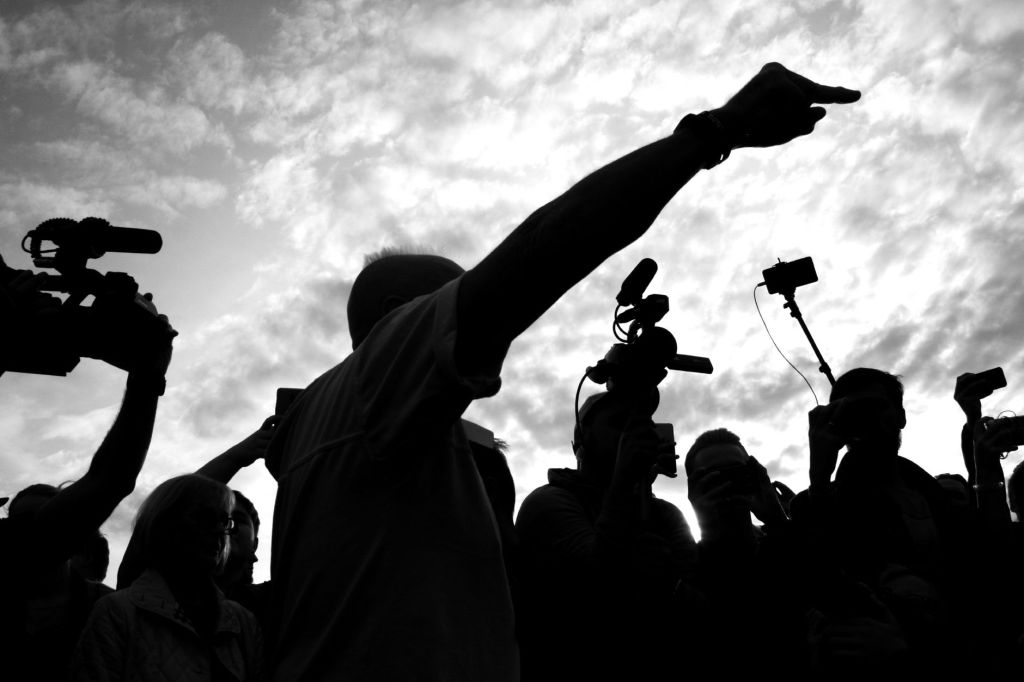
    In The Structural Transformation of the Public Sphere, Habermas imagined democracy as an expanded coffeehouse—a literate, engaged public exchanging ideas with rigor and civility. It was a world in which communication flowed in two directions: we spoke, and we listened. Today, we scroll. We absorb. We react. But we do not engage.

    The modern condition might be better described as a dopamine democracy, where public opinion is shaped not by deliberation but by stimulation. Algorithms reward the loudest, the angriest, the most unhinged voices. Complexity is punished. Nuance is buried. What rises instead is spectacle–content engineered to trigger, not to inform.

    The consequences are predictable. Citizens become passive, then inert. Critical thinking atrophies. Conspiracy theories flourish in the vacuum. Truth becomes negotiable, then irrelevant. We do not fall from democracy in a single dramatic collapse; we degrade into a version of ourselves that no longer demands it.

    Mass media and weaponized misinformation accelerate the decline. Lies are no longer liabilities; they are tools. Identity replaces evidence. Tribe replaces truth. You are not expected to think–you are expected to align.

    And so we arrive at the most unsettling feature of our moment: the people who ascend in this environment are not the most disciplined, the most thoughtful, or the most competent, but the most performative, the most shameless, the most willing to exploit the system’s weaknesses. Infantilism becomes a strategy. Narcissism becomes an asset.

    A culture that rewards such traits should provoke alarm. It should trigger a course correction. But instead, we drift–distracted, entertained, anesthetized.

    Democracy has not been overthrown.

    It has been neglected.

    And like anything neglected long enough, it begins to disappear–quietly, gradually, while most of us are still asleep.

  • When Theft Becomes a Fashion Statement

    When Theft Becomes a Fashion Statement

    In his Atlantic essay “Theft Is Now Progressive Chic,” Thomas Chatterton Williams takes a scalpel to a peculiar strain of moral vanity—the kind that treats petty theft as a political accessory. His targets include Jia Tolentino and Hasan Piker, figures who flirt with the idea that swiping lemons from Whole Foods, sharing passwords, or hopping paywalls is not merely harmless but faintly heroic. Williams calls it what it is: a breezy contempt for the social contract dressed up as rebellion. When small theft is rebranded as civic virtue, even Vicky Osterweil, the author of In Defense of Looting, begins to look like the sober one in the room.

    I confess the whole thing landed on me with the sting of belated education. I had not realized there were circles where breaking the law could be laundered into moral performance. Apparently, this is not an isolated glitch but a trend. The next day, another Atlantic writer, Graeme Wood, weighed in with “Something Is Happening to America’s Moral Code,” invoking James C. Scott’s notion of “anarchist calisthenics”—those small acts of rule-breaking meant to keep the spirit of rebellion limber. Wood’s diagnosis is less romantic: a set of half-formed ethics, offered with confidence and examined with indifference.

    What came to mind was Rob Henderson’s idea of “luxury beliefs”—ideas that burnish the speaker’s status while exporting the costs to people who can’t afford them. Consider the casual encouragement of shoplifting. In theory, it’s a minor jab at corporate excess. In practice, it lands on the backs of people like my students—working-class college kids who clock retail hours to pay for what they own.

    They tell me what it looks like on the floor. Managers instruct them not to intervene—too risky, too litigious. So they stand there, professionally inert, as merchandise walks out the door. The result isn’t liberation; it’s demoralization. They watch others take what they themselves budget and sweat to buy. And the losses don’t evaporate into the ether—they reappear as higher prices, a quiet tax that falls hardest on those already counting dollars.

    This is the part that doesn’t make it into the manifesto. It’s easy to romanticize petty theft when you’re insulated from its consequences. It’s harder to maintain the pose when you’re the one absorbing the cost.

    There’s a particular kind of intellectual decay that sets in when smart people talk only to one another, applauding the cleverness of their own provocations. The room gets warmer, the ideas get softer, and reality is politely asked to wait outside. I’ve admired Tolentino’s work for its sharpness and nuance. But there’s a difference between insight and indulgence, and when the latter starts masquerading as the former, credibility takes a hit.

    At some point, the performance of rebellion stops looking brave and starts looking careless. And the people paying for it are the ones least invited to the conversation.

  • The Business Model of Suffering and Abuse on Reality TV

    The Business Model of Suffering and Abuse on Reality TV

    We were discussing their current essay assignment: an excavation of cruelty masquerading as inspiration in the TV show The Biggest Loser. The facts alone read like satire written by a misanthrope: contestants more than 200 pounds overweight were pushed through eight-hour training days, incinerating close to 8,000 calories while being rationed roughly 800. Add caffeine pills, a chorus of screaming trainers, and the steady drip of public humiliation, and you have less a fitness program than a stress test for organ failure. That none of the contestants died feels less like good management and more like statistical luck. That millions watched—enthusiastically—says something unflattering about us.

    I show them Fit for Life documentary, which functions as a kind of aftermath report. Former contestants speak with the clarity that only distance provides. They describe trauma, yes, but also something more complicated: the show gave them structure, purpose, a narrative. It brutalized them and, perversely, steadied them. Most gained the weight back. Some now lean on GLP-1 drugs, their appetites chemically negotiated into submission. But all of them remember the same thing—the mercilessness was not incidental; it was the engine.

    I asked my students why I had assigned this essay. What, exactly, were they supposed to uncover?

    At the micro level, we peeled back the familiar myths. The cult of self-discipline—so comforting in its simplicity—lets us ignore biology, environment, and the sheer stubbornness of appetite. Bodies become symbols: power or failure, virtue or laziness, depending on who’s looking. We noted the obvious but rarely confronted statistic—most Americans are overweight—and the uncomfortable reality that GLP-1 drugs may be the only intervention that consistently works at scale.

    Then the room shifted. One student volunteered that she was on a GLP-1. The first weeks were a gauntlet of nausea and vomiting, but now the drug—Mounjaro—had quieted her hunger to a whisper. Thirty pounds gone in two months. Another student offered a counterpoint that landed harder: her father had been one of the exceptions. The drug didn’t help him lose weight. It helped him lose kidney function. As she spoke, she mentioned he was now on dialysis. The room absorbed that in silence. Miracle and risk, side by side, no clean narrative available.

    So we zoomed out.

    To design a show that courts physical danger and guarantees humiliation—for ratings, for merchandise, for the grotesque satisfaction of watching someone crack—is not an accident. It’s a business model. That’s the first kind of evil: deliberate, calculated, fully aware. Cynical evil. The producers know exactly what they’re doing. They understand the cruelty, and they monetize it.

    The second kind is quieter and more common. It belongs to the audience. Viewers sense the moral problem—on some level they know this is exploitation—but they file that knowledge away so it won’t interfere with their evening entertainment. They watch, they flinch, they keep watching. Call it willed ignorance. A cultivated habit of not asking questions that might ruin the pleasure.

    I told them, half-serious but not really joking, that if we were ranking things, cynical evil is a ten. Willed-ignorant evil sits comfortably at a seven—less flamboyant, more pervasive.

    Something clicked. The word evil—unfashionable, blunt, almost embarrassing in academic settings—cut through the fog. The discussion woke up. Students leaned in, argued, confessed discomfort, revised their positions in real time. The assignment stopped being an exercise and became a lens.

    That was the moment worth noticing. Sometimes you have to pull the camera back. Stop pretending the essay is about structure and sources and let students see the larger architecture: what the topic reveals about us, what it demands we confront, and why it matters that we do.

  • The Sovereign Appetite: How Wealth Devours the Soul

    The Sovereign Appetite: How Wealth Devours the Soul

    In “What I Learned About Billionaires at Jeff Bezos’s Private Retreat,” filmmaker Noah Hawley dissects the moral corrosion that accompanies extreme wealth—a corrosion fueled not by scarcity but by excess. The old adage comes to mind: the more you feed the demon, the hungrier it gets. Only now the demon eats without consequence, outside the jurisdiction of any moral law. The rules that bind ordinary people—limits, restraint, accountability—simply dissolve. In their place emerges what can only be called the Sovereign Appetite Doctrine: an unspoken creed in which desire, once backed by sufficient capital, becomes its own justification, rendering restraint unnecessary and morality negotiable.

    Hawley’s invitation to a 2018 Bezos retreat in Santa Barbara offered a front-row seat to this phenomenon. What he encountered was not insight but spectacle: a carousel of TED Talk-style presentations untethered from any coherent theme, a parade of ideas without consequence or urgency. These talks did not enlighten so much as signal—a kind of intellectual flex, as obligatory to the setting as Wagyu skewers and caviar. Surrounded by this polished emptiness, Hawley found himself asking the only honest question available: “Why am I here?”

    The retreat itself bordered on the absurd. His wife slipped on wet grass and broke her wrist; he and his children contracted hand, foot, and mouth disease, their faces erupting in red blisters. It was less a summit of visionaries than a fever dream of excess, where discomfort and decadence coexisted without irony.

    Bezos, at the time, still seemed to believe in performance. Clad in a tight T-shirt, laughing a little too hard, projecting a curated affability, he appeared invested in being seen as morally intact. There was effort in the act—a sense that the audience still mattered. He had not yet fully surrendered to the Sovereign Appetite Doctrine.

    But, as Hawley notes, that restraint has since evaporated. Today, figures like Bezos, Mark Zuckerberg, and Elon Musk no longer perform for approval. They have crossed into something colder and more insulated. In Hawley’s words, “They float in a sensory-deprivation tank the size of the planet, in which their actions are only ever judged by themselves.”

    Here lies the true seduction of wealth. It is not the acquisition of luxury goods but the eerie power of living in a world where everything is “effectively free.” Loss—the very mechanism that gives life weight—disappears. When nothing can be meaningfully lost, nothing can be meaningfully gained. Stakes vanish. Experience flattens. Life becomes curiously hollow, a theater without tension. This is the Infinite Buffer Effect: wealth so vast it absorbs every setback, neutralizing consequence and draining life of narrative shape.

    And yet, this emotional flattening coincides with a grotesque expansion of power. The wealthy, insulated from consequence, begin to experience a counterfeit omnipotence. They act without friction and, in doing so, lose the ability to perceive others as real. As Hawley writes, “If everything is free and nothing matters, then the world and other people exist only to be acted upon, if they are acknowledged at all.”

    At this point, they no longer inhabit the same moral universe as the rest of us. Cause and effect no longer apply in any meaningful way. They have become full converts to the Sovereign Appetite Doctrine.

    The word that clarifies this condition is solipsism—not as an abstract philosophy but as a lived reality. The world contracts until only the self remains vivid. Everything else fades into backdrop. Hawley shows how extreme wealth accelerates this contraction. When “everything is free and nothing matters,” the presence of other people—their inner lives, their suffering—loses its immediacy. Power without resistance breeds a dangerous illusion: that one’s actions carry no moral weight. Others become instruments, props, scenery. Empathy atrophies. Reality itself begins to feel negotiable. The self expands to fill the entire field of meaning, mistaking insulation for sovereignty.

    Hawley closes by contrasting today’s ultra-wealthy with the robber barons of the Gilded Age. However ruthless, those earlier figures “engaged with the world around them.” Today’s elite, by contrast, drift above it, severed from consequence, history, and meaning. They suffer from what Hawley calls “a disassociation from the reality of cause and effect, from meaning, and history.”

    This is not freedom but its grotesque parody—a form of plutocratic dissociation in which the individual floats outside shared reality, unbound not only from constraint but from significance itself.

    It is no accident that Hawley, the creator behind Fargo, can render this psychological landscape with such precision. He has long been fascinated by characters who drift beyond moral gravity. Here, he turns that same lens on the most powerful figures in our world—and what he reveals is not triumph, but a slow and chilling disappearance of the human.

  • When “Your Truth” Stops Being Believable

    When “Your Truth” Stops Being Believable

    Helen Lewis’ Atlantic essay “The Death of Millennial Feminism” observes that Lindy West “is the most successful feminist writer of her (and my) generation,” propelled by raw, often self-deprecating confessionals and “viral takedowns.” She had the ears of women everywhere. She became the loudest evangelist for feminism and a tireless promoter of “fat positivity.” Then she wrote a memoir that brought it all to a halt. Adult Braces reverses many of the feminine ideals she once championed.

    Much in the book makes Lewis cringe, but one detail stands out: West allows her partner to enter a throuple with another woman—someone significantly thinner than West. She concedes that her once-admired feminist life was, in Lewis’s words, “a buffed-up version of the truth.” She describes feeling alienated from like-minded writers in editorial spaces. The online scorn she endured was more debilitating than she had admitted. And her body-positivity project falters under the weight of her own confession: “I am at my biggest when I am at my saddest.”

    West’s self-mythologizing of her past undermines the credibility of her present claims. Lewis is therefore skeptical of West’s assertion that she finds fulfillment in a polyamorous relationship in which her partner pursues other women, while West herself undergoes cosmetic dentistry—perhaps to remain competitive in these newly charged dynamics. 

    Equally dubious is West’s claim that she is rejecting monogamy, framed as “a system of ownership,” partly to please her mixed-race partner. The reliance on progressive clichés to justify what appears to be a self-abasing arrangement lends her argument an air of strained rationalization. It also reflects the same intellectual evasiveness that helped fuel her rise in the 2010s, when social media rewarded this kind of performative certainty.

    If Lewis finds any consolation in her irritation, it is that “basically no one else believes” West’s claims of polyamorous happiness. The book has not landed as intended.

    Lewis is at her sharpest when she expresses a dry, almost surgical pity for West’s disbelief that readers are unconvinced. She writes: “Nonetheless, I do feel great sympathy for West. How was she to know that the great omerta of Millennial Feminism—that we had to take whatever people said about their life stories at face value—had broken?”

    As Lewis pulls back the curtain on West’s method, she arrives at a harsher conclusion: feminism was never the central principle. The organizing force was a highly curated self, elevated by moral certainty and insulated from critique. West’s work encouraged others—teenagers included—to treat intense emotion as authoritative truth, to equate feeling with reality.

    Lewis argues that this elevation of emotion was not liberating but coercive. “Perhaps the greatest hallmark of Millennial Feminism was how harshly it treated women,” she writes. “We were the ones who were supposed to give up our boundaries, rewrite our sexualities, and defenestrate our heroines.” Doubt became a liability. Fallibility, a form of shame. In reality, both are conditions of sanity.

    For that reason, many women—including Lewis—walked away. To remain required submission to groupthink and to a mythology that, as she puts it, “required submitting ourselves to a voluntary lobotomy.”

    Meanwhile, as this strain of feminism frayed, countervailing forces emerged on the right—forces often just as reductive, just as intellectually numbing. The result is not correction but polarization: competing orthodoxies shouting past one another, while common sense and moral clarity struggle to regain a foothold.

  • The Narrative of Justified Cruelty and Heroic Delusion (college essay prompt)

    The Narrative of Justified Cruelty and Heroic Delusion (college essay prompt)

    When disturbing acts of manipulation or cruelty appear in documentaries, viewers often search for a simple explanation. One explanation is psychological: the person must be mentally unstable. Another explanation is moral: the person knowingly chose to harm others. Yet many real cases resist this clean distinction. Individuals who commit harmful acts rarely see themselves as villains. Instead, they construct narratives that justify their behavior. They portray themselves as victims, defenders, truth-tellers, or heroes correcting an injustice.

    The documentaries The Perfect Neighbor and High School Catfish explore this unsettling dynamic. In both films, individuals escalate conflict through patterns of deception, resentment, and obsessive grievance. At times their behavior appears irrational or emotionally unstable. At other moments their actions seem deliberate, strategic, and calculated. What makes these stories disturbing is not simply the harm they cause, but the way the individuals involved interpret their own actions. Each person constructs a story that makes their behavior appear reasonable—even righteous—from their own perspective.

    These documentaries raise an important question about human behavior:

    How do people justify cruelty to themselves?

    Psychologists often describe this process as moral disengagement—the ability to harm others while preserving the belief that one is still a good or justified person. People may blame the victim, exaggerate their grievances, reinterpret their actions as self-defense, or frame themselves as the victim of a hostile world. Or they may see themselves as heroes in their own drama. Some people commit harmful acts while believing they are the morally righteous or aggrieved protagonist in a moral drama. Both documentaries actually illustrate that pattern remarkably well. When these narratives take hold, the line between psychological instability and moral wrongdoing becomes difficult to distinguish.

    Essay Task

    Write a 1,000-word comparative argumentative essay analyzing how The Perfect Neighbor and High School Catfish portray the stories people tell themselves to justify harmful behavior.

    Your essay should develop a thesis that addresses this question:

    Do the individuals in these documentaries appear primarily mentally unstable, morally responsible for their actions, or trapped inside narratives that allow them to see cruelty as justified?

    Thesis Requirement

    Your introduction must include a thesis that:

    1. Takes a clear position on the role of self-justifying narratives in the documentaries.
    2. Maps the major reasons that will organize your body paragraphs.

    Example thesis with mapping:

    The destructive behavior portrayed in The Perfect Neighbor and High School Catfish becomes understandable when we examine the self-justifying narratives constructed by the individuals involved: each person frames themselves as a victim of injustice, interprets retaliation as moral correction, and gradually loses the ability to see their actions from the perspective of others.

    Mapping components:

    • victim narratives
    • retaliation framed as justice
    • loss of empathy or perspective

    Each of these becomes a body paragraph.

    Essay Requirements

    Your essay must include:

    • a clear thesis with mapping components
    • comparison of both documentaries throughout the essay
    • analysis of specific moments from the films
    • a counterargument that challenges your interpretation
    • a rebuttal defending your position
    • a concluding paragraph reflecting on what these documentaries reveal about human moral reasoning

    Possible Directions for Your Argument

    You might argue that:

    • people justify cruelty by constructing victim narratives
    • resentment allows individuals to reinterpret retaliation as justice
    • deception becomes easier when someone believes they are morally right
    • psychological instability intensifies but does not fully explain destructive behavior
    • the documentaries reveal how ordinary people can become morally dangerous when they stop questioning their own stories

  • Narcissism, Status Anxiety, and the Manosphere: College Writing Prompt

    Narcissism, Status Anxiety, and the Manosphere: College Writing Prompt

    In recent years, online communities sometimes described as the “manosphere” have attracted attention for their discussions about masculinity, dating, gender roles, and male identity. Supporters often argue that these spaces help men discuss frustrations they feel are ignored elsewhere. Critics argue that many of these communities promote resentment toward women and normalize misogyny.

    One way to analyze this phenomenon is to examine the relationship between male self-absorption and misogyny. When a person’s worldview centers heavily on personal validation, recognition, or entitlement, other people may begin to appear primarily as tools for confirming one’s identity. In this framework, rejection or disagreement can feel like a personal injury rather than a normal part of human interaction. Some analysts argue that this dynamic can turn frustration or disappointment into resentment toward women. Others argue that such explanations oversimplify the motivations of men who participate in these communities.

    For this assignment, watch the Netflix documentary Inside the Manosphere. Then write a 1,000-word argumentative essay that explores the relationship between male self-absorption and misogyny in the communities portrayed in the film.

    In your essay, you may choose to:

    • Defend the claim that self-absorption and status anxiety play a major role in producing misogynistic attitudes within the manosphere.
    • Challenge the claim by arguing that the documentary overlooks other social, economic, or cultural factors that shape the behavior of men in these communities.
    • Complicate the claim by arguing that both personal psychology and broader social forces contribute to the dynamics seen in the film.

    As you develop your argument, consider questions such as:

    • How do the men in the documentary describe their frustrations or grievances?
    • In what ways do issues of status, recognition, or entitlement appear in their narratives?
    • How does the documentary portray the role of women in these communities’ discussions?
    • To what extent do these attitudes reflect individual psychology versus broader cultural changes?
    • Does the documentary present a balanced explanation of the problem, or does it simplify the issue?

    Your essay should include a clear thesis, specific references to scenes or ideas from the documentary, careful reasoning, and engagement with possible counterarguments. The goal is not merely to summarize the film but to analyze the deeper connection—if any—between self-focused identity narratives and the emergence of misogynistic beliefs.

  • Death by Beauty: Looksmaxxing and the Collapse of Meaning

    Death by Beauty: Looksmaxxing and the Collapse of Meaning

    Thomas Chatterton Williams takes a scalpel to the latest mutation of social-media narcissism in his essay “Looksmaxxing Reveals the Depth of the Crisis Facing Young Men,” and what he exposes is not a quirky internet fad but a moral and psychological breakdown. Looksmaxxing is decadence without pleasure, cruelty without purpose, vanity stripped of even the dignity of irony. It reflects a culture so hollowed out that aesthetic dominance is mistaken for meaning and beauty is treated as a substitute for character, responsibility, or thought.

    I first encountered the term on a podcast dissecting the pronouncements of an influencer called “Clavicular,” who dismissed J.D. Vance as politically unfit because of his face. Politics, apparently, had been reduced to a casting call. Vote for Gavin Newsom because he’s a Chad. At first, this struck me as faintly amusing—Nigel Tufnel turning the cosmetic dial to eleven. Williams disabuses us of that indulgence immediately. Looksmaxxing, he writes, is “narcissistic, cruel, racist, shot through with social Darwinism, and proudly anti-compassion.” To achieve their idealized faces and bodies, its adherents break bones, pulverize their jaws, and abuse meth to suppress appetite. This is not self-improvement. It is self-destruction masquerading as optimization, a pathology Williams rightly frames as evidence of a deeper moral crisis facing young men.

    Ideologically, looksmaxxers are incoherent by design. They flirt with right-wing extremism, feel at home among Groypers, yet will abandon ideology instantly if a rival candidate looks more “alpha.” Their real allegiance is not conservatism or liberalism but Looksism—a belief system in which aesthetics trump ethics and beauty confers authority. Williams traces the movement back to incel culture, where resentment and misogyny provide a narrative to explain personal failure. The goal is not intimacy or community but status: to climb the visual pecking order of a same-sex digital hive.

    At the center of Williams’ essay is a quieter, more unsettling question: what conditions have made young men so desperate to disappear into movements that erase them? Whether they become nihilistic looksmaxxers or retreat into rigid, mythic religiosity, the impulse is the same—to dissolve the self into something larger in order to escape the anxiety of living now. As Williams notes, this generation came of age online, during COVID, amid economic precarity, social fragmentation, and the reign of political leaders who modeled narcissism and grifting as leadership. Meaning became scarce. Recognition became zero-sum.

    Williams deepens the diagnosis by invoking John B. Calhoun’s infamous mouse-utopia experiment. In conditions of peace and abundance, boredom metastasized into decadence. A subset of male mice—“the beautiful ones”—withdrew from social life, groomed obsessively, avoided conflict, and stopped reproducing. Comfort bred collapse. Beauty became a dead end. Death by preening. These mice didn’t dominate the colony; they hollowed it out. NPCs before the term existed.

    The literary echo is unmistakable. Williams turns to Oscar Wilde and The Picture of Dorian Gray, where beauty worship corrodes the soul. Wilde’s warning is blunt: the belief that beauty exempts you from responsibility leads not to transcendence but to ruin. Dorian’s damnation is not excess pleasure but moral vacancy.

    The final irony of looksmaxxing is that it produces no beauty at all. The faces are grotesque, uncanny, AI-slicked, android masks stretched over despair. Their ugliness is proportional to their loneliness. Reading Williams, I kept thinking of a society fractured into information silos, starved of trust, rich in spectacle and poor in care—the perfect compost for a movement this putrescent. Looksmaxxing is not rebellion or politics. It’s a neglected child acting out. Multiply that child by millions and you begin to understand the depth of the crisis Williams is naming.

  • Transactional Transformation Fallacy

    Transactional Transformation Fallacy

    noun

    The Transactional Transformation Fallacy is the belief that personal change can be purchased rather than practiced. It treats growth as a commercial exchange: pay the fee, swipe the card, enroll in the program, and improvement will arrive as a deliverable. Effort becomes optional, discipline a quaint accessory. In this logic, money substitutes for resolve, proximity replaces participation, and the hard interior work of becoming someone else is quietly delegated to a service provider. It is a comforting fantasy, and a profitable one, because it promises results without inconvenience.

    ***

    I once had a student who worked as a personal trainer. She earned decent money, but she disliked the job for reasons that had nothing to do with exercise science and everything to do with human nature. Her clients were not untrained so much as uncommitted. She gave them solid programs, explained the movements, laid out sensible menus, and checked in faithfully. Then she watched them vanish between sessions. They skipped workouts on non-training days. They treated nutrition guidelines as aspirational literature. They arrived at the gym exhaling whiskey and nicotine, their pores broadcasting last night’s bad decisions like a public service announcement. They paid her, showed up once or twice a week, and mistook attendance for effort. Many were lonely. Others liked telling friends they “had a trainer,” as if that phrase itself conferred seriousness, discipline, or physical virtue. They believed that money applied to a problem was the same thing as resolve applied to a life.

    The analogy to college is unavoidable. If a student enters higher education with the same mindset—pay tuition, outsource thinking to AI, submit algorithmically polished assignments, and expect to emerge transformed—they are operating squarely within the Transactional Transformation Fallacy. They imagine education as a vending machine: insert payment, press degree, receive wisdom. Like the Scarecrow awaiting his brain from the Wizard of Oz, they expect character and intelligence to be bestowed rather than built. This fantasy has always haunted consumer culture, but AI supercharges it by making the illusion briefly convincing. The greatest challenge facing higher education in the years ahead will not be cheating per se, but this deeper delusion: the belief that knowledge, discipline, and selfhood can be bought wholesale, without friction, struggle, or sustained effort.

  • Weapons of Fear: Epistemic Collapse in Eddington and Weapons (college writing prompt)

    Weapons of Fear: Epistemic Collapse in Eddington and Weapons (college writing prompt)

    Over the last decade, American culture has undergone a profound crisis of shared reality—what scholars call an epistemic collapse. In the vacuum created by fractured institutions, algorithm-driven outrage, political opportunism, and a populace trained to distrust expertise, communities have turned inward, building their own private universes of truth. Two recent films—Ari Aster’s Eddington (2024) and Zach Cregger’s Weapons (2025)—stand at the center of this cultural conversation. While their genres differ—Eddington as a neo-Western political drama and Weapons as a folk-horror anthology—both films dramatize the same underlying catastrophe: when people no longer agree on what is real, they become dangerously easy to manipulate, divide, and weaponize.

    In Eddington, the small New Mexico town is already fractured before the plot begins. The COVID-19 pandemic becomes the spark that exposes deep fault lines: anti-mask sheriff Joe Cross stokes resentment and paranoia, pro-mandate Mayor Ted Garcia attempts to preserve public health in a community that no longer trusts him, and the town’s institutions melt under the weight of political rage, conspiracy theories, and personal vendettas. Masks, lockdowns, land rights, and municipal policy become symbols of existential war. Citizens drift into echo chambers where identity outweighs truth and where “freedom” can be invoked to justify violence. Through these tensions, Eddington examines how tribal politics, misinformation, and fear transform ordinary people into agents of chaos—into what the film metaphorically frames as “weapons.”

    Weapons begins in a seemingly different register—a folk-horror narrative involving children, trauma, and community superstition—but it ultimately reveals itself as a story about the same phenomenon: collective panic filling the void left by failed institutions. When mysterious events shake the town, people reach not for evidence, reason, or communal deliberation, but for myths. Rumors calcify into “truth,” grief mutates into paranoia, and the community turns against itself in a desperate search for someone to blame. In this atmosphere, children, grief-stricken parents, and unstable townspeople all become susceptible to narratives that promise clarity and purpose, even at the price of cruelty. Like Eddington, Weapons suggests that the human need for certainty can be exploited, turning vulnerable people into instruments of violence.

    Both films take place in communities that feel abandoned—by government, by truth, by stability, by the social contract. In Eddington, the pandemic reveals a town already primed for collapse: neighbors distrust each other, public servants abuse their power, and media ecosystems churn conspiracies at a devastating pace. In Weapons, the terror centers on mysterious disappearances and supernatural dread, but the underlying cause is similar: when people feel unmoored, they grasp at stories—however irrational—that make sense of suffering. In both cases, the crisis is not just external; it is psychological, emotional, and cultural. These films argue that a society that no longer shares a framework of truth inevitably begins producing its own monsters.

    Your task is to write a comparative, argumentative essay that analyzes how both Eddington and Weapons depict the collapse of shared reality and the transformation of ordinary individuals into “weapons”—tools of fear, ideology, grief, or superstition. You will argue how each film uses different storytelling techniques to illuminate the same cultural trauma: a nation where trust in institutions has eroded, where truth is increasingly privatized, and where communities respond to uncertainty with tribalism, scapegoating, and paranoia.

    To frame your argument, consider the following thematic questions:

    1. Epistemic Crisis: What happens when communities no longer share the same reality?

    In Eddington, the pandemic becomes a catalyst for unraveling collective trust. Sheriff Joe Cross exploits the crisis for personal power, leveraging fear and resentment to undermine public-health directives. Misinformation spreads faster than illness, and political theater replaces governance. In Weapons, suspicion and folk belief dominate; characters construct supernatural explanations for grief they cannot otherwise process. How do these fictional communities illustrate the broader national struggle to maintain a shared understanding of truth?

    2. Scapegoating and Manufactured Monsters

    Both films show societies that create monsters when reality becomes intolerable. In Weapons, grief and superstition lead to scapegoating—outsiders, children, even supernatural entities become symbols of community anxiety. In Eddington, “the monster” is political: masks, mandates, immigrants, liberals, conservatives—whatever the tribe defines as the existential threat. Analyze how each film uses its respective genre (horror vs. political drama) to critique the human impulse toward blame when confronted with collective fear.

    3. The Weaponized Individual: When people become instruments of chaos

    Sheriff Cross turns himself into a political weapon; Vernon weaponizes conspiracy thinking; Brian transforms a viral video into a career. Meanwhile, characters in Weapons become pawns of rumor and superstition. How do the films examine the way individuals can be radicalized or repurposed by fear, trauma, or ideological narratives?

    4. Institutional Failure and the Vacuum It Creates

    In Eddington, institutions collapse under pressure: public health, municipal leadership, local law enforcement, media, and even basic civic trust. In Weapons, institutions either fail or play no meaningful role, leaving individuals to fill the void with folklore and violent improvisation. Compare how each film portrays the consequences of institutional breakdown—and how that vacuum shapes community behavior.

    5. The Loss of Humanity in a Post-COVID World

    Even though Weapons is not explicitly a pandemic film, its emotional landscape reflects post-COVID anxieties: loneliness, grief, mistrust, and the longing for clear explanations. Eddington addresses the pandemic head-on, depicting how fear strips people of empathy and connection. In both films, humanity erodes as people prioritize survival, identity, or belonging over compassion. Analyze how each story portrays this transformation.

    6. The Role of Media, Algorithmic Influence, and Storytelling

    Eddington explicitly critiques media spectacle and algorithmic manipulation; Weapons does so more subtly through mythmaking and rumor. Compare how each film reveals the power of narrative—factual or fictional—to shape belief, identity, and behavior. What does each film suggest about the modern American hunger for stories that confirm our fears, validate our tribal loyalties, or simplify our grief?

    7. The Nietzschean Last Man: A Society Without Higher Purpose

    For extra depth, you may choose to integrate the concept of Nietzsche’s “Last Man”—the individual who seeks comfort over purpose, safety over meaning, distraction over responsibility. Which characters in each film exemplify this drift toward nihilism? Does each film suggest that the Last Man is a symptom of cultural decay—or part of its cause?


    Write a comparative essay of 1,800–2,200 words that argues how Eddington and Weapons portray the following intertwined themes:

    • the breakdown of shared reality
    • the rise of tribalism and paranoia
    • the transformation of ordinary people into “weapons”
    • the creation of monsters—psychological, political, or supernatural—to fill the void left by institutional failure
    • the erosion of humanity in a culture defined by fear, spectacle, and algorithmic influence

    Your thesis must make a clear, debatable claim about what these films reveal about post-COVID American society. You must support your analysis with close reading of key scenes, comparison of cinematic techniques, and sustained argumentation.

    Your essay must also include:

    1. A Counterargument

    Acknowledge at least one opposing view—for example, the claim that Eddington is primarily about political extremism while Weapons is primarily about horror and grief, and therefore the comparison is forced. Then rebut that view by showing that genre differences sharpen, rather than undermine, the thematic parallels.

    2. A Rebuttal

    Explain why your central claim still holds. You may argue that both films are ultimately parables about epistemic breakdown and human vulnerability in the absence of trusted institutions.

    3. A Conclusion That Opens Outward

    Discuss what these films suggest about where American culture may be heading if fragmentation, mistrust, and weaponized narratives continue.

    Your writing should demonstrate:

    • analytical depth
    • clarity
    • engagement with cinematic detail
    • strong comparative structure
    • thoughtful paragraph organization
    • precise sentence-level control

    This essay invites you not only to compare two compelling films, but also to reflect on the cultural moment that shaped them—and the uncertain landscape we now inhabit.