Tag: short-story

  • When I Met the SpaghettiOs Overlord

    When I Met the SpaghettiOs Overlord

    In June of 1999, I did what a college professor cannot do: I lost the classroom key. Yes, the sacred, university-issued key that was supposedly worth more than its weight in gold and was meant to be guarded as if it were the last surviving relic of Atlantis. After a frantic week of turning my Redondo Beach condo upside down—searching under couch cushions, rifling through laundry baskets, and even interrogating the houseplants—I had to admit defeat. I was summoned to face the wrath of the university’s ice queen of administration, who greeted me with a glare that could freeze lava. “The one thing a college instructor does not do,” she said, as if reciting an ancient curse, “is lose his key.” She inspected me as if I were a criminal in a bad noir film, and then informed me that I had to make a pilgrimage to the edge of campus, to the mythical and dreaded realm known as Plant Ops, to pay for a key replacement with cash only. I felt like I was being sent to Mordor to drop off a pizza. 

    So, I embarked on this perilous quest, driving east from campus. At first, the road was a decent pavement. But soon, it disintegrated into a wasteland of dirt, rubble, and potholes the size of small craters. My car bucked and jolted over the rocky path, like an old west wagon on a treasure hunt, as I passed ghostly rows of cow skulls and tumbleweeds rolling by in the wind like some grim, dusty parade. Above me, buzzards circled, perhaps in anticipation of a fresh meal or merely to witness my impending doom.

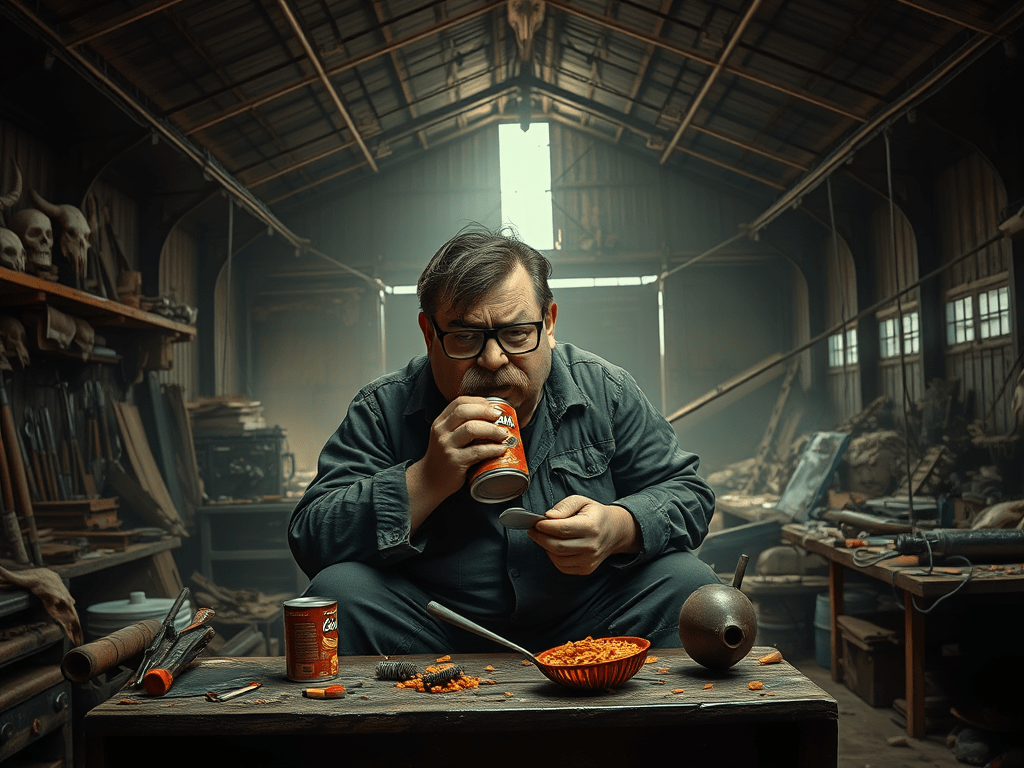
    Just as despair was about to pull me under, a nauseating aroma of glue, pickles, and formaldehyde wafted through the air, signaling the arrival of my destination. I squinted through the gloom to see a structure emerge from the fog—a dilapidated hangar that looked like it had been plucked from a post-apocalyptic movie set. Inside was the world’s most disgruntled handyman, a short, rotund man with glasses thick enough to start a small library, a bushy mustache that looked like it was trying to escape his face, and a head bald enough to use as a landing strip for insects. He was hunched over a workbench, devouring SpaghettiOs straight from the can with the kind of focus usually reserved for nuclear codes. His irritation at being interrupted was palpable, like I’d crashed his private spaghetti party.

    “Twenty dollars cash,” he grunted, extending his hand with the authority of a toll collector in the underworld. I handed him the bill with the reverence of a pilgrim offering gold to a god. He stuffed it into his grease-splattered apron, took another spoonful of his cold, canned meal, and scowled at me like I’d personally betrayed him. With the wind howling through the thin steel walls of the hangar, I half expected the place to take off and join Dorothy’s house in the sky. The handyman delivered his parting words with the gravitas of a crypt keeper: I must never lose a key again, lest I face the incompetence of his replacement, who was, according to him, a veritable nincompoop with the locksmithing skills of a potato. I thanked him, exited the hangar, and raced straight to the nearest hardware store. I bought a keychain made of Kevlar, equipped with a tether reel and a high-density nylon belt loop—basically, a key-keeping apparatus that could survive a nuclear blast. It was clear I’d never let my keys out of my sight again, lest I face another odyssey to the land of a disgruntled Plant-Ops overlord.

  • I Had to Choose to Either be a Thief Or Superman

    I Had to Choose to Either be a Thief Or Superman

    When I was six years old in 1968, I lived for a year with my grandparents in Belmont Shore. One day after school, a distraught neighbor, a 79-year-old widow named Mrs. Davis, said she locked herself out of her house. Could she borrow me to climb through her bedroom window and unlock the front door for her? With my grandmother’s approval, I did just that. I pretended to be a cat burglar, slithered through the ajar window, and walked through her house. With great curiosity, I examined the interior of the living room.  The floor was covered with a plush, floral-patterned rug. The centerpiece of the room was a large, floral-patterned couch. It was flanked by two wingback chairs, upholstered in a velvety red fabric. Each chair had a lace doily draped over the backrest. A coffee table with spindly legs sat in front of the couch, its surface crowded with an assortment of knickknacks: a porcelain figurine of a ballerina, a small crystal bowl filled with wrapped candies, and a couple of framed photos. The walls were adorned with family portraits, framed cross-stitch samplers, and a large, oval mirror with a gold frame. A grandfather clock ticked methodically in the background, its pendulum swinging with a steady rhythm that made me feel lost in time. Something came over me. Being alone, I felt possessed with a transgressive spirit, and I lifted the candy jar’s lid and stuffed a butterscotch candy in my pocket before opening the front door for Mrs. Davis. I felt guilty for my act of theft because Mrs. Davis proclaimed me to be her newly-minted hero and handed me a crisp one-dollar bill, which I would later spend on Baby Ruth and Almond Joy Bars. I had difficulty sleeping that night. I worried that Mrs. Davis might feel inclined to take inventory of her candies and discover that one was missing, prompting her to demote me from hero to villain. My career as a thief had come to a quick end. On the other hand, I had a glimpse of what it was like to be a superhero entering houses and saving people in distress. I convinced myself that my career as Superman was just beginning. 

  • LARRY SANDERS: WHEN YOUR ONLY MEASURE OF SELF-WORTH IS THE NIELSEN RATING

    LARRY SANDERS: WHEN YOUR ONLY MEASURE OF SELF-WORTH IS THE NIELSEN RATING

    The Larry Sanders Show is, at its core, a study in impoverishment—not financial, mind you, but emotional, existential, and spiritual. It’s a bleak yet hilarious portrait of men so starved for validation that their only measure of self-worth is the Nielsen rating. Without it, they might as well not exist. The three principals—Larry Sanders, Hank Kingsley, and Artie the producer—are all flailing in different shades of desperation, their egos so fragile they make pre-teen TikTok influencers look well-adjusted.

    What’s astonishing is that these men are emotional dumpster fires in a pre-social media era. Had they been forced to navigate Instagram, they’d have suffered full mental collapse long before season six. Larry, in particular, embodies this fragile insecurity perfectly: there he is, night after night, lying in bed with some beautiful woman, but his true lover is the TV screen, where he watches his own performance with a mix of self-loathing and obsessive scrutiny. His actual partner—flesh, blood, and pleading for his attention—might as well be a houseplant.

    Hank Kingsley, meanwhile, is a slow-motion trainwreck of envy and delusion. He loathes Larry with the fire of a thousand suns, seeing his role as sidekick as a cosmic insult to a man of his alleged grandeur. His existence is a never-ending, one-man King Lear, with far more Rogaine and far less dignity.

    Then there’s Artie, the producer, the closest thing the show has to a functional adult. He wrangles chaos with a cigarette in one hand and a whiskey in the other, managing to keep the circus running even as its ringleader is in freefall. But Artie, too, is an emotional casualty. He can juggle Larry’s neuroses and Hank’s tantrums with military precision, yet his own life is a shipwreck, his ability to maintain order confined strictly to the world of late-night television.

    Yet for all its cynicism, the show doesn’t just leave us gawking at these wrecked souls—it makes us care. We want them to wake up, to claw their way out of their vanity-driven stupor, to abandon the mirage of celebrity and seek something real. But they won’t. They can’t. They are too drunk on the high of public approval, too lost in the spectacle of show business, too incapable of self-awareness to change course. And so we watch them burn out in real time, laughing through the tragedy, absorbing its lessons like a cautionary tale wrapped in razor-sharp wit.

    In the end, The Larry Sanders Show is the perfect showbiz fable: hilarious, cutting, deeply sad, and just self-aware enough to let us laugh at the madness while secretly wondering if we, too, are addicted to the same empty validation.

  • TRAINING WITH THE WRESTLING STARS ON TV FELT LIKE A FEVER DREAM

    TRAINING WITH THE WRESTLING STARS ON TV FELT LIKE A FEVER DREAM

    Training at Walt’s Gym in the mid-70s wasn’t just about lifting weights—it was an unfiltered, sweat-drenched fever dream where my adolescent reality collided head first with the muscle-bound mythology of Big Time Wrestling. For two years in the early 70s, I had religiously watched Big Time Wrestling on Channel 44, glued to my TV screen, captivated by the larger-than-life personas of Pat Patterson, Rocky Johnson, Kinji Shibuya, Pedro Morales, and Hector Cruz. Then, as if fate had decided to prank me, a few years later I found myself sharing dumbbells with these very same legends as a clueless, starstruck thirteen-year-old Olympic weightlifter.

    At first, it was thrilling—until my big mouth turned the dream into a farce. Despite carrying a respectable amount of muscle for my age, I had the survival instincts of a gazelle on tranquilizers. Take, for example, the time I was doing cable lat rows next to Hector Cruz, a man whose forehead looked like a war zone of scar tissue. In a stunning act of idiocy, I casually mentioned that I’d heard rumors that wrestling might, gasp, be fake.

    Cruz, mid-rep, snapped his head toward me with the kind of stare that could curdle milk. “Look at these scars on my face! Do they look fake to you?” he growled, his voice carrying the weight of a man who had spent years being thrown into turnbuckles for a living. I nodded solemnly, silently wondering if plastic surgery had advanced to the point of replicating decades of chair shots and steel cage matches.

    Then there was the Great Towel Incident, in which my ignorance of gym etiquette nearly got me suplexed into another dimension. Spotting a towel draped over the calf raise machine, I assumed—like a naive idiot—that it was communal property, perfect for mopping my sweat-drenched forehead. A fraction of a second later, a mountain of muscle erupted from a nearby bench press, veins bulging, eyes locked onto me like a heat-seeking missile.

    “That YOUR towel, kid?” he snarled, his biceps twitching in a way that suggested he resolved most disputes with his fists. Before I could sputter out an excuse, he made it abundantly clear that swiping another man’s gym towel was the equivalent of stealing his car, his wife, and his dog in one fell swoop. Lesson learned: gym towels are sacred artifacts, and touching one without permission is an offense punishable by immediate death or, worse, public humiliation.

    But the crowning jewel of my social missteps at Walt’s Gym was my commitment to primal, theatrical grunting—a misguided attempt to add some dramatic flair to my workouts. I thought my earth-shaking screams made me sound like a warrior; in reality, they made me sound like someone having an exorcism mid-bench press.

    One day, my sound effects finally pushed a competitive bodybuilder—who looked like a bronze statue of vengeance—to his breaking point. He pulled me aside, his stare filled with enough hostility to burn a hole through my skull. “Kid,” he said, his voice dangerously low, “if you don’t cut the screaming, someone’s going to shut you up permanently. And trust me, they’ll get a standing ovation for it.”

    That was my wake-up call. Surviving Walt’s Gym wasn’t just about lifting heavy—it was about mastering the unspoken social codes that separated the seasoned warriors from the clueless rookies. The iron jungle had rules, and I was learning them one near-death experience at a time.

  • DREAMING OF BARBARA EDEN

    DREAMING OF BARBARA EDEN

    I grew up in VA housing, transplanted army barracks rebadged “Flavet Villages,” in Gainesville, Florida. The barracks were close to an alligator swamp and a forest where a Mynah bird was always perched on the same tree branch so it was a favorite pastime before bedtime for my father and me to visit the bird on the edge of the forest and converse with it. At dusk, there was a low tide so the alligator dung was particularly pungent. While the smell repelled most, I found the strong aroma strangely soothing and stimulating in a way that made me feel connected to the universe. One evening while my father and I visited the Mynah bird, we could hear a distant radio playing “Bali Ha’i,” sung so beautifully by Juanita Hall. From the Rodgers and Hammerstein musical South Pacific, “Bali Ha’i” is about an island paradise that seems so close but always remains just out of reach by those who are tantalized by it, causing great melancholy. But I suffered no such melancholy. Paradise was in my presence as my father and I stood by the enchanted forest and spoke to the talking Mynah bird. 

    The ache of an elusive paradise didn’t afflict me until I discovered I Dream of Jeannie in 1965. The blonde goddess Barbara Eden lived in her genie bottle, a luxurious enclosure with a purple circular sofa lined with pink and purple satin brocade pillows and the inner wall lining of glass jewels shining like mother of pearl. More than anything, I wanted to live inside the bottle with Jeannie. To be denied that wish crushed me with a pang of sadness as deeply as Juanita Hall’s rendition of “Bali Ha’i.” That Jeannie’s bottle was in reality a painted Jim Beam Scotch Whiskey decanter speaks to the intoxication I suffered from my incessant dreams of Barbara Eden. 

    Living in the bottle with Barbara Eden was my unconscious wish to never grow up, to live forever in the womb with my first crush. I realized I had the personality of a man-child who never wanted to enter the adult world in 1974 when as a thirteen-year-old bodybuilder, I had started my training at Walt’s Gym in Hayward, California. Converted from a chicken coop in the 1950s, the gym was a swamp of fungus and bacteria. Members complained of incurable athlete’s foot and some claimed there were strains of fungus and mold that had not yet been identified in scientific journals. Making a home in the fungal shower stalls was an oversized frog. The pro wrestlers had nicknamed the old-timer frog Charlie. The locker always had a bankrupt divorcee or other in a velour top and gold chain hogging the payphone while having a two-hour-long talk with his attorney about his bleak life choices. There was an unused outdoor swimming pool in the back with murky water black with plague and dead rats. A lonely octogenarian named Wally, who claimed to be a model for human anatomy textbooks, worked out for several hours before spending an equal time in the sauna and shower, completing his grooming with a complete-body talcum powder treatment so that when he spoke to you, he did so embalmed in a giant talcum cloud. The radio played the same hits over and over: Elvin Bishop’s “Fooled Around and Fell in Love” and The Eagles’ “New Kid in Town.” What stood out to me was that I was just a kid navigating in an adult world, and the gym, like the barbershop, was a public square that allowed me to hear adult conversations about divorces, hangovers, gambling addictions, financial ruin, the cost of sending kids to college, the burdens of taking care of elderly parents. I realized then that I was at the perfect age: Old enough to grow big and strong but young enough to be saved from the drudgery and tedium of adult life. It became clear to me then that I never wanted to grow up. I wanted to spend my life luxuriating inside the mother of pearl bottle with Barbara Eden in a condition of perpetual adolescence.

    Wanting to live in Jeannie’s bottle wasn’t just about being joined to the hip with the one I loved. It was about protection from evil. This became apparent in 1972 when I was ten, and I watched an ABC Movie of the Week, The Screaming Woman. Based on a Ray Bradbury short story, the movie was about a woman buried alive. Her screams haunted me so much that I could not sleep for two weeks as I imagined the mud-covered lady under my bed crying for my help. I swore I would never watch a scary movie again, but a year later when my parents had left for a party, I was bored, so I watched Night of the Living Dead. What I learned from watching these scary movies is that when you see depictions of evil, you can’t “unsee” them. Those visions leave a permanent mark so that nothing is ever the same again. What was once the happy, innocent sound of the neighborhood jingle of the ice cream truck is now a jalopy full of devil-clowns ready to exit the vehicle and kidnap me from my room. I tried to remedy my trauma by watching The Waltons and Little House on the Prairie, but these wholesome depictions of family life could not bring back the innocence that was lost forever, so at age eleven, I was already conceiving my elaborate bunker for the Great Zombie Apocalypse. And that bunker, of course, was Jeannie’s bottle.

    In my early teens, my life became a futile quest to find substitutes for living inside Jeannie’s bottle. For example, in 1974 I visited several friends and neighbors who had recently purchased waterbeds, tried them out, and became convinced that waterbeds would afford me a life of luxury, unimagined pleasures, and relaxation that life had so far denied me. I persuaded my parents to buy me one. My love affair with the contraption proved to be short-lived. Its temperature was either too hot or too cold. It leaked. It often smelled like a frog swamp. I remember if I moved my body, there would be a counterreaction, like some invisible wave force fighting me as I tried to get comfortable. One day the waterbed leaked so badly that the floorboards were damaged and my bedroom looked like something out of Hurricane Katrina. What was supposed to be a revolution in sleep proved to be a nightmare, and my quest to find a substitute for Jeannie’s bottle had to be started afresh.

    The longing to be inside Jeannie’s bottle is a regression impulse, and I can’t talk about regression without mentioning Cap ‘N Crunch. My mother indulged my appetite for this sugary cereal and bought me all its variations: Cap ‘N Crunch with Crunch Berries, Peanut Butter Cap ‘N Crunch, and then the renamed versions of the same-tasting cereal: Quisp, Quake, and King Vitamin. Quaker cereals took their winning formula of corn and brown sugar flavors and sold several variations with different mascots and names. 

    As a kid watching these cereals being advertised on TV, it was clear that too much of a good thing was not a problem. On the contrary, I felt compelled to taste-test all these cereal varieties the way a sommelier would taste dozens of Zinfandel wines from the same region or a musicologist would listen to hundreds of different versions of Rachmaninoff’s Second Symphony.

    Eating six versions of Cap ‘N Crunch afforded me the illusion of variety while eating the same cereal over and over. I was a seven-year-old boy who wanted to believe I had choices but at the same time didn’t want any choices. 

    You will sometimes hear about the man who is in his sixth marriage and his wives in terms of appearance, temperament, and personality are all more or less the same. The man keeps going back to the same woman but wants to believe he has “found someone new” to give him the hope of a new life. 

    That was essentially my relationship with Cap ‘N Crunch. Not only was I stagnant in my food tastes, but I was also regressing into sugar-coated pablum. My love of cereal, which endures to this day, was the equivalent of finding comfort in Jeannie’s bottle. 

    In addition to sweetened cereal as evidence of my emotional stagnation was my choice of damaged role models. While I was fixated on I Dream of Jeannie, my bodybuilding partner Bull was fixated on Gilligan’s Island. Choosing Bull as my role model must have prolonged my delayed development. Bull was not known for his social decorum and gallantry. One example that stands out is that one night we were swimming at the Tanglewood apartments swimming pool when Bull found a giant orange fluorescent bra hanging by its strap on the diving board. It practically glowed in the dark. Bull grabbed the bra and twirled it above his head as if he were going to fling it. Then he stopped and said it was his sister’s birthday the next day, and he had forgotten to buy her a present. He didn’t even wrap it. He just gave his sister this orange bra, and she wasn’t even shocked. For her, it was just another day in the life of having a crazy brother. When I think back to my delayed development in the world of dating and relationships, I have to attribute much of that delay to my misguided choices of male role models. It would be unfair, after all, to lay all the blame on Jeannie. The fact was that I was in love with Jeannie as a fantasy, but as a real woman she terrified me.

    This was evident on one warm California spring afternoon in 1973.  After sixth-grade classes were over and the bus dropped us off at Crow Canyon Road, we would often walk across the street to 7-Eleven to get a Slurpee before trekking up the steep hill that was Greenridge Road. I was standing inside 7-Eleven with my friends listening to “Brandy, You’re a Fine Girl” playing on the store radio when the Horsefault sisters, both freckled with long blonde hair and beaming, mischievous blue eyes, came into the store and asked me if I wanted to see a rabbit inside their cage. One was an eighth-grader and the other a high school sophomore. They lived in a farmhouse behind the 7-Eleven. I had no interest in seeing a rabbit inside a cage, but the girls had high cheekbones and figures that reminded me of my first crush, Barbara Eden, so I told them I was very interested in seeing their caged rabbit. I exited 7-Eleven with the girls, and we walked about a hundred yards on a trail that was covered with dry horse dung and surrounded by a field of grass before we reached the outskirts of their farmhouse. Behind a thicket of bushes was a large cage, with the door slightly ajar. A heavy chain lock hung on the door latch. I looked inside the cage, but I saw that there was no rabbit. At this point, the sisters, cackling like witches, grabbed me and tried to drag me into the cage. It was clear that they were attempting to prank me, put me inside the cage, lock the door, and make me their prisoner. But I was too strong for them, and as we wrestled outside the cage and rolled on the grass, we became enveloped in a cloud of dust and hay. In a nearby coop, chickens were clucking and flapping their wings with great alarm and alacrity. When the sisters, now covered in sweat, realized they did not have the strength to carry on with their mission, I fled them and rushed home. I was outraged that they had tried to steal my freedom,  and I diverted myself by watching my favorite TV show, I Dream of Jeannie, starring the gorgeous Barbara Eden, who played a lovelorn genie trapped in a bottle except when summoned by her master. Clearly, I was still too young to understand the exquisite pleasures of irony.