Tag: short-story

  • The Man Who Always Waved

    The Man Who Always Waved

    When my twins were born in 2010, I spent years pacing the sidewalks of my Torrance neighborhood with them—first in a stroller, then a wagon, and eventually on their own unsteady feet. Along those same sidewalks shuffled old couples with dogs, walkers, and time to spare. Sometimes one half of a pair would vanish, leaving the other to walk alone, and soon enough that figure too disappeared from the neighborhood stage. I never knew most of their names, yet I felt tethered to them; they would smile at my daughters, wave with fragile hands, and in that exchange I saw the cycle of life laid bare: the beginning in my stroller, the ending in their absence.

    One man I did know by name—Frank. I don’t recall how we met, but I remember the details: his beige Volvo station wagon, the clever mirror nailed to the tree behind his house so he could back out with precision. Frank looked to be in his late sixties in 2010. He walked the neighborhood with brisk efficiency, always in uniform—olive shorts, white T-shirt, glasses perched on his nose, a beige bucket hat shading his face, and a small wristwatch on a leather band, which he consulted like a man keeping an appointment with life itself.

    He reminded me of a restrained Ned Ryerson from Groundhog Day: perhaps square at first glance, but steady, decent, reliable. No matter how intent he was on his route, he never failed to lift a hand in greeting. The wave was never exuberant, never perfunctory—it was graceful, automatic, the gesture of a man who seemed stitched together with quiet goodness. His wife matched him in cheer, and though I never learned her name, she radiated authenticity. They were a pair who seemed to exist outside of fashion, untouched by fads or pretensions.

    Over time, I realized they had become more than neighbors to me. They were a balm against my cynicism, proof that stability, kindness, and simple decency still existed in a world that seemed allergic to all three. Which is why, six months ago, while lifting weights in my garage, I felt a chill: What happened to Frank? I hadn’t seen him in ages. He would be in his eighties now. Surely he hadn’t slipped away unnoticed?

    Then, this morning, as I turned into my neighborhood after dropping my daughters at high school, I saw him. Frank, unchanged, same outfit, same bucket hat, same little watch. I raised my hand. He raised his. And before I knew it, a tear streaked my cheek.

  • Sangean PR-D12 Is Solid on FM and AM in the Right Environment

    Sangean PR-D12 Is Solid on FM and AM in the Right Environment

    The following is from my now defunct Herculodge blog. I realized when I did radio testing again in 2025 that RFI (radio frequency interference) is a far greater challenge than it was in 2008. I need to play my radios on batteries, not AC adapters, and keep them away from walls, which is a shame because I really want the Sangean HDR-19, a wall adapter-only radio, which has gone up in price about $80 since even a couple of months ago.

    Since the Los Angeles Fires tore through Southern California in January 2025, I realized my household was embarrassingly underprepared for live news coverage. Streaming devices and smart speakers suddenly felt flimsy when the sky turns orange. I needed something sturdier, more reliable—like a good, old-fashioned radio.

    Enter Sangean, a brand I trusted a decade ago. I fondly remembered their radios delivering a warm, bass-heavy sound—pleasant, if not exactly hi-fi. My ancient PR-D4 still hums along in the garage, proof that Sangean builds workhorses. So, naturally, I picked up their new DSP-chip PR-D12, curious to see how it stacked up against its analog ancestor.

    The verdict? The D12 is brighter and more balanced than the D4, though the warmth I loved has cooled a bit. FM reception is a mixed bag. From Torrance, Pasadena’s 89.3 comes in strong with three bars and crystal clarity on the D12. On the D4? Same signal strength but with a thin veil of static, unless I awkwardly angle the antenna like I’m searching for alien life.

    But then things get weird. 91.5, my go-to classical station, sings smoothly on the D4 but sputters on the D12—two weak bars and static, no matter how I threaten the antenna.

    AM? Forget it. 640 AM is listenable but laced with floor noise on both radios. I twist and turn the radios to align the internal ferrite antennas like I’m cracking a safe, but the noise stays. Worse, AM talk radio voices sound like they’re broadcasting through a burlap sack. Long-term listening? Not a chance.

    What the D12 does have going for it is user-friendliness. Four preset pages with five slots each make navigating stations painless—perfect for my wife, who refuses to wrestle with complex manuals that read like an SAT prep book. She’s happy with 89.3 and 89.9 blasting clear and loud, so the D12 earns its spot in the kitchen.

    Still, I can’t shake the feeling I need something more commanding, like the soon-to-arrive Tecsun PL-990x. Maybe it’ll crack the code on AM audio bliss. Until then, the PR-D12 holds the line—solid, if not inspiring.

    Moderate recommendation.

    Update:

    I told my fellow radio enthusiast friend Gary about how I could not listen to the AM sound on the PR-D12 or my PR-D4, and he expressed the same sentiment. He said the only AM he can listen to from his vast radio collection is his now defunct C.Crane CC Radio-SW, which is a clone of the Redsun RP-2100. This made me sad because many years ago I enjoyed listening to AM on my Redsun RP-2100, but I fried it when I put the wrong AC adapter in it. Getting good AM sound out of a radio is hard these days. 

    Second Update:

    Three days after writing this review, I moved the PR-D12 to the garage where it sounds great on AM so I blame the kitchen, not the PR-D12. 

  • The Fallacy of False Priorities, Watch Edition

    The Fallacy of False Priorities, Watch Edition

    “The double-minded man is unstable in all his ways.” Guilty as charged. Case in point: my tortured relationship with FKM Divecore straps.

    The Notre Dame study had me spiraling—researchers tortured the material with solvents, heat, and abrasion until they squeezed out PFAS “forever chemicals” and then warned these might leach into human skin. Ever since, I’ve gone back and forth, back and forth, like a malfunctioning metronome, on whether to keep wearing the straps I love more than any other rubber I’ve tried in two decades of watch collecting.

    Of course, no one wants to think of their wristwear as a poison delivery system. But context matters. First, FKM is highly stable under real-world conditions; the lab tests were more horror show than practical scenario. Second, it’s the manufacturing process that endangers workers, not the end-user. Third, if we’re ranking PFAS risks, drinking unfiltered water, eating from PFAS-coated packaging, or cooking on scratched Teflon are solid tens on the risk scale, while wearing an FKM strap is a lonely little one. That’s the Fallacy of False Priorities: panic over the trivial while ignoring the obvious.

    Even so, the issue isn’t a Nothing Burger. Divecore’s own Paul admits handling FKM worries him, and he’s working on alternative materials—silicone, vulcanized silicone, HNBR—to protect his workers and reassure consumers. That’s just smart business.

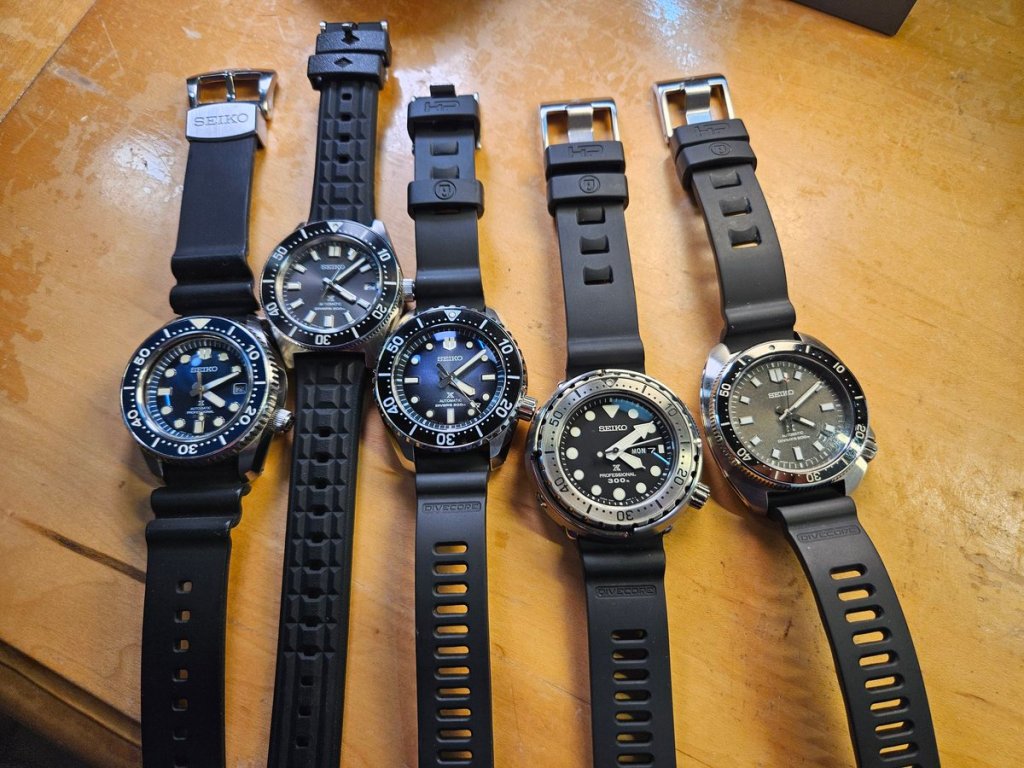
    Meanwhile, I’m not without options. My strap drawer holds factory Seiko silicones and urethanes, plus top-tier Tropic straps made of vulcanized rubber. They’re fine, but none hold a candle to the sleek perfection of Divecore FKM. I tried swapping them in, but they feel like consolation prizes—serviceable, never glorious.

    So I made a deal with myself: enjoy my pristine FKMs for now, and when the new HNBR or silicone Divecore straps arrive, I’ll switch. Sounds reasonable. Except once you’ve let the idea of PFAS seeping into your skin lodge in your brain, it refuses to leave. I’ve written about it on Instagram, made a YouTube video, and now I’m stuck in an obsessive loop, second-guessing every strap change as though I were rewriting my will.

    Which brings me back to my original point: the double-minded man is unstable in all his ways. And right now, that man is staring at seven watches, toggling between glory and paranoia, wishing he could strap on peace of mind.

  • Scaling the Walls of Forgetting

    Scaling the Walls of Forgetting

    Last night I dreamed I was trapped between two bodies—one fixed at nineteen, the other at sixty-three—and the hands kept swinging me back and forth. Each shift rewired me. My skin would tighten, my mind sharpen, and then in the next instant my knees ached, my thoughts clouded, and the mirror refused to settle on one face.

    In the confusion, I kept losing my keys. Not just keys—wallet, watch, phone. Every few minutes I’d pat my pockets and feel the hollow absence. I lived in a commune that was equal parts office, recording studio, and half-forgotten alumni reunion. The place was enclosed by towering steel walls, the kind that promised protection while making you wonder what you were being kept from.

    We scaled those walls to glimpse the outside world and, somehow, the higher we climbed, the further we could travel through our own memories. But altitude brought obstacles—massive gates stacked one atop another, each locked, each requiring a key.

    I had a locker at the base of the camp with everything I needed: my belongings, my one precious key. And then it was gone, lost to the dream’s careless currents. I cursed myself, replaying the loss in my mind until it stung.

    Kevin, an old friend with a voice like a warm blanket, told me it was fine. Not to worry. That I was okay. Ted, wiry and restless, was already at the top, peering over. He called down, telling us to follow his example, that freedom was just beyond the next barrier.

    Meanwhile, Charlie lounged at the compound’s base, getting his hair trimmed and his shoes polished by a contented employee, as if this walled-in world was good enough.

    The forgetting pressed in on me, thick and airless. Ted’s optimism couldn’t lift me, Kevin’s comfort couldn’t steady me. Without the key, I felt stripped of competence. I teetered there—between the clock faces, between the steel walls—on the edge of hopelessness, afraid that even if I found the lock, I wouldn’t remember what it opened.

  • The Other Place Has QR Codes

    The Other Place Has QR Codes

    Of all the Twilight Zone episodes that have taken up residence in my psyche, none clings more tenaciously than “A Nice Place to Visit.” A petty crook named Rocky Valentine gets gunned down during a botched robbery and wakes up in what appears to be paradise. He’s greeted by Pip, a genial, rotund guide played by Sebastian Cabot, who grants him everything his larcenous heart ever wanted: money, women, luck, luxury. No struggle, no stress. Every desire fulfilled on command.

    At first, Rocky revels in this frictionless dreamscape. It’s Vegas without losing streaks, heaven without requirements. But gradually, pleasure without purpose curdles into a thick, syrupy dread. He realizes that gratification without resistance is just another form of punishment. Bored out of his mind and desperate for meaning, Rocky pleads with Pip to send him “to the other place.”

    Pip laughs and delivers the gut punch: “Heaven? Whatever gave you the idea that you were in Heaven, Mr. Valentine? This is the other place!” And then, with glee, Pip cackles like the well-fed devil he is.

    Which brings me to paid parking.

    There is a hell, and it lives in the infrastructure of modern urban parking. It’s a realm of QR codes, license plate entries, and apps that want your soul—or at least your email and billing zip code. Some kiosks accept coins, others demand smartphone apps, two-step verification, and an MFA code just to stand still without being ticketed. My wife, tech-literate and cool-headed, usually handles this logistical hellscape while I loiter nearby, pretending to study the map of downtown like it’s a sacred text.

    But this week she’s out of town at a teaching convention, and I’m taking our twin daughters to Laguna Beach. This means I have to drive, find a parking structure, and—here’s the true horror—navigate the digital rigmarole of paid parking without her guidance. The thought of it has me sweating harder than Rocky in his silk suit.

    The absurd part? It’s not the traffic, the tides, or the teenagers that unnerve me. It’s the parking meter. The existential shame of standing in front of a digital payment kiosk, poking at it like a confused ape while my daughters wait patiently (or impatiently) beside me. I don’t fear the unknown. I fear looking like an idiot in front of my kids.

    But here’s the deeper, darker realization: this is just a symptom. My wife, through years of effort and mental load, has become the de facto logistics commander of our household. She knows which airport lines move faster. She’s the one strangers approach at terminals, sensing her Jedi-level calm. Meanwhile, I shuffle behind her like an NPC in a bad video game—directionless, frictionless, practically translucent.

    Frictionless living has a cost. It breeds detachment. It robs you of engagement, resilience, and presence. And like Rocky Valentine, I’ve grown too used to being served instead of showing up.

    Ironically, I’m obsessed with watches—those exquisite tools designed to remind you where you are in time. And yet, I’ve spent years drifting, distracted, floating outside the dial. It takes a solo day trip with my daughters—an hour drive, some shopping, a good lunch, and possibly a tantrum or two—to pull me back into the present.

    When my wife heard about my plan, she said, “You don’t know how happy this makes me.” And I believed her. She wasn’t just relieved that I was giving her a break. She was glad to see me step into the friction. To stop spectating and start parenting in real time.

    No, I don’t want to be Rocky. I don’t want a life where every parking spot is perfect, every line is short, and every meal arrives on time. I want the chaos. I want the curveballs. I want the real thing.

    Even if it means downloading the stupid parking app.

  • This Is the Life You Have Chosen

    This Is the Life You Have Chosen

    I’ve never forgotten a story one of my college students told me back in the fall of 1998. She was a re-entry student—a nurse in her early forties—juggling coursework at UCLA with overnight hospital shifts. The kind of woman who sticks in your memory: short, sturdy, glasses perched low on her nose, with the weary, perceptive eyes of someone who’d seen too much and lips that knew how to pace a punchline.

    Most afternoons, after class let out, she’d linger by my desk and recount episodes from her Louisiana backwoods childhood or from the fluorescent netherworld of her hospital’s VIP wing. Her stories ricocheted between absurdity and horror—tales told with the calm authority of someone who could handle arterial spray with one hand and chart notes with the other.

    But one story gripped me by the spine and never let go. It wasn’t about dying celebrities or ER gore. It was about something far worse. A visitation. A monster.

    She and her cousin Carmen were feral children, raised in the lawless heat of rural Louisiana, where school attendance was optional and adult supervision was more myth than fact. Left to their own devices, the two girls invented what she called “mean games”—they tortured frogs, pulled wings off insects, and hinted at darker cruelties she refused to name. Lord of the Flies in sundresses.

    And then one afternoon, the visitor arrived.

    They were holed up in a decaying house, conspiring over their next cruelty, when the porch door creaked open and something stepped inside. It looked like a man. But it wasn’t. It had a tail—thick, muscled, and disturbingly animate. It moved with a will of its own, curling and flicking behind him like a fleshy metronome. His body was bristled with wiry hair. His voice? Low, hoarse, and calm in the most terrifying way. He didn’t threaten. He simply listed.

    Sitting in a rocking chair, the creature described, in brutal detail, everything the girls had done—every frog mutilated, every insect dissected. Nothing vague. He named the acts like he had them on file. And then he made his offer: Keep going, he said, and I’ll recruit you.

    He stayed for three hours. Just sat there. Breathing. Flicking that tail. Describing their path toward damnation with the steady tone of a bureaucrat explaining retirement benefits. When he finally left, dissolving into the heat shimmer of the Louisiana dusk, the girls were too stunned to move. Carmen whispered, “Did you see that?” My student just nodded.

    They never spoke of it again. But they changed. Overnight. Sunday school. Prayer. Kindness, enforced not by conscience but by fear. The kind that settles in your bones and never leaves. Whatever that thing was, it did its job.

    And this is the part that haunts me: she wasn’t a kook. She wasn’t mystical, manic, or given to exaggeration. She was a nurse—clear-eyed, grounded, more familiar with death than most people are with taxes. She wasn’t telling a ghost story. She was giving a deposition.

    To this day, I see those two girls, wide-eyed and paralyzed, staring down a thing that knew them intimately and promised them a future in hell’s apprenticeship program. Whether it was a demon, a shared psychotic break, or some mythological construct formed by childhood guilt and Southern humidity, I don’t know. But I do know what it meant.

    The creature’s message was brutal in its simplicity: Keep practicing cruelty, and you’ll lose the ability to stop. You’ll become it.

    That’s not just folklore. That’s biblical. The idea that if you repeat your wickedness long enough, God—or whatever you believe in—stops interrupting you. He doesn’t smite you. He simply steps aside and says, Go ahead. This is the life you’ve chosen.

    No wonder Kierkegaard was obsessed with working out your salvation with fear and trembling. There’s nothing more terrifying than the idea that damnation is self-inflicted, not by a thunderbolt, but by repetition. That the road to hell is paved with muscle memory.

  • Reginald, Kent, and the Shark-Infested Sea of Self-Improvement

    Reginald, Kent, and the Shark-Infested Sea of Self-Improvement

    Last night, I dreamed I was twenty again. I was in attendance at a spectral dinner party filled with strangers and vague regret. I was young again, which is to say, raw and restless, clutching a satchel full of unformed ambitions and unfiltered loneliness. 

    A wealthy young man appeared, oozing charisma and vaguely European cheekbones, a demigod of fashion and cosmetics, the kind of person whose cologne smells like entitlement. He leaned in and offered me a revelation disguised as skincare: two miracle creams. One, to be applied to the crown of my head, was called Reginald. The other, for my back, was Kent. He spoke of them with the hushed reverence usually reserved for ancient scrolls or Swiss watches. These weren’t mere moisturizers—they were spiritual lubricants. Balms that promised not just hydration, but orientation. 

    Then, as if summoned by a higher capitalist calling, he vanished mid-conversation, leaving me with a business card and a lead on where to find a lifetime supply—somewhere by the sea. And so began the quest.

    To be worthy of Reginald and Kent, one had to wear formal attire, because of course one did. I found myself in a tailored black suit, wading through surf with fellow seekers, sharks gliding around our ankles like corporate anxieties. I held my leather dress shoes in hand, lest the saltwater stain them—a fool’s hope, given the bloodthirsty tide. Later, I caravanned with aging rock royalty—Peter Gabriel, Jackson Browne, Boz Scaggs—who casually discussed their rendezvous plans in Capri or St. Barts. For a moment, I basked in the illusion of belonging. But as the conversation turned to private jets and generational wealth, the truth descended: I was no musician. I had no bookings. My only claim to transformation lay in acquiring my precious creams.

    The journey devolved into a surreal slog. It rained as I crossed a deserted college courtyard. My business shoes were doomed. A younger version of S—someone I wouldn’t meet until decades later—appeared like a ghost from my professional future, pointing the way with a sense of urgency. I ran, I hitchhiked, I boarded phantom trains, only to land back at the shark-infested beach, no closer to the mythic Land of Body Cream. 

    Then, through the humid haze of beachside commerce and quaint seaside cafes, I saw Rachel—yes, that Rachel—from a hot tub party in Livermore, 1988. 

    Seated at a weathered café table under a string of flickering patio lights, I unspooled my sorrow before her, pouring it out like a battered thermos with a cracked seal—dripping, lukewarm, and uninvited. I mistook my own rawness for profundity, believing that the sheer weight of my unfiltered confession would conjure tenderness, maybe even love. But Rachel didn’t flinch. She studied me like a dissection project and began her work with clinical precision. Her words carved deep and clean, a verbal autopsy that exposed every rot-soft corner of my character. And just when I thought the vivisection complete, she found new organs of dysfunction to prod and slice. Her fury wasn’t wild—it was righteous, surgical, sustained.

    She stormed off, heels tapping out a verdict on the pavement. I sat stunned in the wreckage of myself, staring at the space she had vacated, still warm with contempt. That’s when the restaurant owner appeared—a woman with the weary kindness of someone who’s witnessed too many romantic collapses and kept score. She told me she’d filmed the entire scene. “You’ll want to study this,” she said, handing me the video with a nod toward the attic stairs. “It might help.” I obeyed without a word.

    I climbed into that attic, its rafters bowed with time, and watched the footage on an aging monitor. Again and again. I rewound every insult, paused on each flinch of mine, cataloged every truth she hurled like a polished blade. It became my gospel of failure. I spent the rest of my life up there—alone with my ghosts and her voice—striving to earn back something I’d never really had: the right to reenter the world and claim Reginald and Kent, the sacred creams of redemption I still believed might set me right.

  • Influencer or Inmate? Life Inside the Fitness Content Machine

    Influencer or Inmate? Life Inside the Fitness Content Machine

    There’s a fitness influencer I’ve followed on YouTube for a while—a guy who blends science-based insights with bro-tier charisma, serving up advice on hypertrophy, fat loss, and the alchemy of supplements with the confidence of a man who knows his macros better than his mother’s birthday.

    He’s shredded, of course—because on YouTube, being credible in fitness means having the torso of a Greek statue and the face of someone who hasn’t eaten a donut since the Obama administration. As another influencer once confessed, the price of entry into fitness fame isn’t just knowledge. It’s abs sharp enough to julienne zucchini.

    But lately, something’s changed. The man looks wrecked. Gaunt. Like he’s been sleeping in a protein tub and bathing his eyes in pool chemicals. His cheekbones could slice paper. His eyes are red and sunken, with the haunted look of someone who’s either seen a ghost or hasn’t blinked since hitting “record.”

    I don’t think this is just lighting or a bad filter. I think this guy is overworked, underfed, and teetering on the edge of burnout. He probably wakes up at 4 a.m. to research clinical studies on mitochondrial function, spends six hours editing thumbnails and B-roll, then crushes a fasted two-hour workout before filming five segments in a single dry-scooped breath. If he’s eating more than 2,000 calories a day, I’ll eat my creatine scoop straight from the tub.

    The irony is hard to miss: he’s the poster boy for health and vitality, yet he looks like a prisoner in the content mines. At nearly four million subscribers, maybe it’s time he hires an editor, gets a co-host, and reclaims his circadian rhythm. Right now, he looks less like a beacon of wellness and more like an exhausted monk, punishing himself in service to the Algorithmic God.

  • The Pool of Sorrow, the Magic Towel, and the Heavy-Duty Radio

    The Pool of Sorrow, the Magic Towel, and the Heavy-Duty Radio

    Last night, I dreamed I was nineteen again—muscular, misfit, and miserably alone. In this grim redux of my youth, I spent my days floating in what I now call The Pool of Sorrow, a sunlit rectangle of water where I wept at the shallow end, pressed against the concrete like a man sentenced to purgatory via chlorination. Beside me sat a black labrador, nameless but noble, whose soft howls echoed my despair. I stroked his damp fur. He leaned into my touch. We were two abandoned souls, bound by melancholy and mutual need.

    Something changed. Maybe it was the dog’s quiet loyalty, or the absurd beauty of the moment. I returned to bodybuilding with manic fervor and resumed clean eating as if redemption could be measured in grams of protein. My body sculpted itself back into its mythic prime, and soon I was posing poolside in black-and-white glamour shots—oiled up like a Greek statue, grinning with an almost religious clarity. The dog watched my transformation with admiration, tail thumping like a metronome of approval.

    Now that I looked like a well-oiled demigod, I needed to promote myself. I searched the streets of San Francisco for an influencer. I found him in a San Francisco alley behind a velvet curtain. Tom Wizard. Pale, lanky, vaguely elfin, Tom agreed to help me make my photos go viral. But there was a catch. “You love the dog too much,” he warned. “Be more aloof.”

    Naturally, I did the opposite. I hugged the dog. Whispered sweet canine nothings. Called him my soulmate. Tom watched this display of defiance and smiled like a gatekeeper pleased with an unexpected answer.

    “You’ve passed the Dog Test,” he said, handing me two gifts. The first: a large, coral-orange Magic Towel, woven with healing properties. It could dry you off and erase your deepest psychological wounds. The second: admittance to a Harvard night class where I’d learn to wield the towel’s powers properly.

    Harvard, it turns out, was a dump. The class was run by Professor Kildare, a stout bureaucrat with the warmth of a refrigerator. He vanished often—wrapped up in legal issues—leaving the course in the calloused hands of three grad students who resembled hungover dockworkers. They smoked indoors, bickered about their failed marriages, and offered nothing resembling instruction.

    In that dimly lit classroom, I met a woman who looked exactly like Sutton Foster. She whispered that her eczema came from childhood trauma. I swore on my Magic Towel I’d cure her. She believed me. That was enough.

    One day, one of the grad students—Jimbo, a lemon-faced scowler in sun-bleached overalls—presented a radio. “Useless junk,” he said. “Dead as a doornail.”

    I stood, seized the radio, adjusted its telescopic antenna, and revealed its miraculous clarity. Music blared. Static disappeared. Everyone gawked like I’d just raised Lazarus with a dial.

    Jimbo lunged for it. I blocked him. “You had your chance,” I said. “This radio is mine now.”

    I flapped the Magic Towel with dramatic flair. A colossal truck, part semi, part spaceship, pulled up outside. Sutton and I climbed its twenty-foot ladder toward the cockpit. Jimbo and his cronies gave chase, but I yanked the ladder up behind us, sending them tumbling like sitcom villains. The truck roared to life.

    Sutton sat beside me, silent but radiant with hope. The Heavy-Duty Radio crackled softly behind us, the Magic Towel folded in my lap like a relic of prophecy. We barreled into the night. I didn’t know if I could cure her eczema or heal her past, but I knew this: I had a truck, a towel, a miracle radio, and a mission. And sometimes, that’s enough.

  • Heaven, Apparently, Has a Library

    Heaven, Apparently, Has a Library

    A month ago, I dreamed I was already in heaven—which is to say, I was somewhere astonishing and didn’t realize it, because apparently that’s the human condition.

    It started in a classroom, naturally. I was teaching at a college that felt familiar but off—like a liberal arts Hogwarts or a Wes Anderson remake of Dead Poets Society. The students were unnervingly sharp. Not freshmen. These were postgrads of the soul—opinionated, caffeinated, and engaged with the material in ways that implied they’d actually done the reading.

    We were knee-deep in discussion when I glanced out the window and saw the rain falling—not pelting, but gliding, like silk scarves from the sky. I drifted for one moment. That was all Tim Miller needed.

    Tim, a student and part-time podcast prophet, seized the room like a man born to lecture. He told everyone to open the expensive blue textbook. The one I assigned. The one I had never read. I stared at the cover like it was an unfamiliar casserole I’d brought to a potluck. “What did you think?” I asked, bluffing. “It’s okay,” they said. The academic equivalent of a shrug at your own funeral. I nodded, defeated, and dismissed them early—a mercy for us all.

    Outside the door, a nearsighted colleague half my age pushed a convoy of book carts like a noble foot soldier. I offered help. He smiled, already finished. I was obsolete, politely.

    I wandered the campus like a ghost who hadn’t been told he was dead. Then I saw it: a green coffee mug I’d left behind earlier, now glowing like a sacred artifact on a forgotten table. I snatched it and jogged through the rain to the library. I placed it on a windowsill with reverence, and two librarians appeared—silent, reverent, stunned. I’d returned the Holy Mug. They smiled as if I’d cured blindness.

    Still raining. Still warm. Still beautiful. I pulled out my phone—also green, because apparently I was living inside an emerald dream. It was dusted with beach sand, and I wiped it down like it was a relic I wasn’t worthy to hold.

    I wasn’t driving. I never drove. Why ruin the moment? I walked. Five miles, barefoot, maybe. The rain was gentle, more sacrament than storm.

    Then, through the mist, I saw my home.

    Three pyramids, each one the size of a small mountain, woven from stone in purple and gold. They spiraled into the sky like something the gods forgot to take with them. I’ve always loved purple. It makes sense now. But the gold—that was new. I’ve spent a lifetime disliking gold. Too gaudy. Too Trump Tower. Too cheap. But this gold wasn’t decoration—it was divine. It pulsed. It whispered. It glowed like it remembered being forged in the heart of stars.

    And it hit me.

    I lived there. In that zigzagged trio of pyramids, tucked in the mist. It was mine. I’d always been there. Somehow, until that moment, I’d failed to see it.

    Then I woke up.

    No rain. No pyramids. Just me, blinking in the early gray, stunned by the feeling that I’d glimpsed something holy and managed to mistake it for Tuesday.

    And I wondered: How much of life am I sleepwalking through? What miracles have I mislabeled as mundane? What if heaven isn’t a reward but a frequency we forget to tune in?