Tag: technology

  • How Headphones Made Me Emotionally Unavailable in High-Resolution Audio

    How Headphones Made Me Emotionally Unavailable in High-Resolution Audio

    After flying to Miami recently, I finally understood the full appeal of noise-canceling headphones—not just for travel, but for the everyday, ambient escape act they offer my college students. Several claim, straight-faced, that they “hear the lecture better” while playing ASMR in their headphones because it soothes their anxiety and makes them better listeners. Is this neurological wizardry? Or performance art? I’m not sure. But apocryphal or not, the explanation has stuck with me.

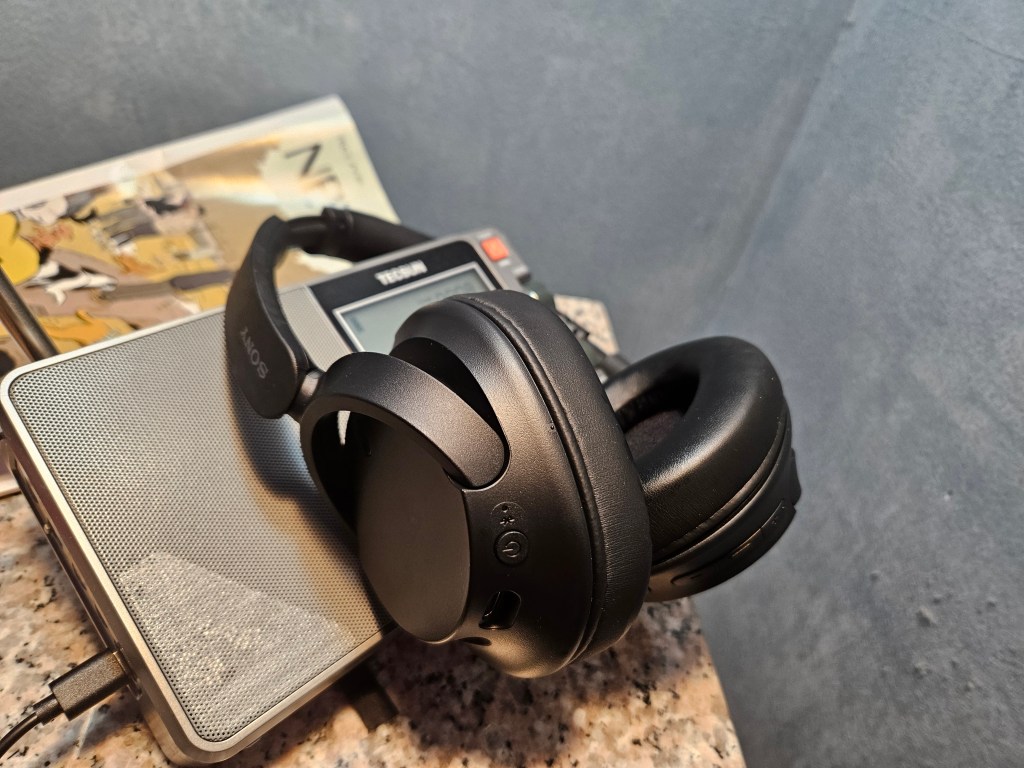
    It made me see the modern, high-grade headphone as something far more than a listening device. It’s a sanctuary, or to use the modern euphemism, an aural safe space in a chaotic world. You may not have millions to seal yourself in a hyperbaric oxygen pod inside a luxury doomsday bunker carved into the Montana granite during World War Z, but if you’ve got $500 and a credit score above sea level, you can disappear in style—into a pair of Sony MX6s or Audio-Technica ATH-R70s.

    The headphone, in this context, is not just gear—it’s armor. Whether cocobolo wood or carbon fiber, it communicates something quietly radical: “I have opted out.”

    You’re not rejecting the world with malice—you’re simply letting it know that you’ve found something better. Something more reliable. Something calibrated to your nervous system. In fact, you’ve severed communication so politely that all they hear is the faint thump of curated escapism pulsing through your earpads.

    For my students, these headphones are not fashion statements—they’re boundary-drawing devices. The outside world is a cacophony of canvas announcements, attention fatigue, and algorithmically optimized despair. Inside the headphones? Rain sounds. Lo-fi beats from a YouTube loop titled “study with me until the world ends.” Maybe even a softly muttering AI voice telling them they are enough.

    It doesn’t matter whether it’s true. It matters that it works.

    And here’s the deeper point: the headphone isn’t just a sanctuary. It’s a non-accountability device. You can’t be blamed for ghosting a group chat or zoning out during a team huddle when you’re visibly plugged into something more profound. You’re no longer rude—you’re occupied. Your silence is now technically sound.

    In a hyper-networked world that expects your every moment to be a node of productivity or empathy, the headphone is the last affordable luxury that buys you solitude without apology. You don’t need a manifesto. You just need active noise-canceling and a decent DAC.

    You’re not ignoring anyone. You’ve just entered your own monastery of midrange clarity, bass-forward detachment, and spatially engineered peace.

    And if someone wants your attention?

    Tell them to knock louder. You’re in sanctuary.

  • Beware of the ChatGPT Strut

    Beware of the ChatGPT Strut

    Yesterday my critical thinking students and I talked about the ways we could revise our original content with ChatGPT give it instructions and train this AI tool to go beyond its bland, surface-level writing style. I showed my students specific prompts that would train it to write in a persona:

    “Rewrite the passage with acid wit.”

    “Rewrite the passage with lucid, assured prose.”

    “Rewrite the passage with mild academic language.”

    “Rewrite the passage with overdone academic language.”

    I showed the students my original paragraphs and ChatGPT’s versions of my sample arguments agreeing and disagreeing with Gustavo Arellano’s defense of cultural appropriation, and I said in the ChatGPT rewrites of my original there were linguistic constructions that were more witty, dramatic, stunning, and creative than I could do, and that to post these passages as my own would make me look good, but they wouldn’t be me. I would be misrepresenting myself, even though most of the world will be enhancing their writing like this in the near future. 

    I compared writing without ChatGPT to being a natural bodybuilder. Your muscles may not be as massive and dramatic as the guy on PEDS, but what you see is what you get. You’re the real you. In contrast, when you write with ChatGPT, you are a bodybuilder on PEDS. Your muscle-flex is eye-popping. You start doing the ChatGPT strut. 

    I gave this warning to the class: If you use ChatGPT a lot, as I have in the last year as I’m trying to figure out how I’m supposed to use it in my teaching, you can develop writer’s dysmorphia, the sense that your natural, non-ChatGPT writing is inadequate compared to the razzle-dazzle of ChatGPT’s steroid-like prose. 

    One student at this point disagreed with my awe of ChatGPT and my relatively low opinion of my own “natural” writing. She said, “Your original is better than the ChatGPT versions. Yours makes more sense to me, isn’t so hidden behind all the stylistic fluff, and contains an important sentence that ChatGPT omitted.”

    I looked at the original, and I realized she was right. My prose wasn’t as fancy as ChatGPT’s but the passage about Gustavo Arellano’s essay defending cultural appropriation was more clear than the AI versions.

    At this point, I shifted metaphors in describing ChatGPT. Whereas I began the class by saying that AI revisions are like giving steroids to a bodybuilder with body dysmorphia, now I was warning that ChatGPT can be like an abusive boyfriend or girlfriend. It wants to hijack our brains because the main objective of any technology is to dominate our lives. In the case of ChatGPT, this domination is sycophantic: It gives us false flattery, insinuates itself into our lives, and gradually suffocates us. 

    As an example, I told the students that I was getting burned out using ChatGPT, and I was excited to write non-ChatGPT posts on my blog, and to live in a space where my mind could breathe the fresh air apart from ChatGPT’s presence. 

    I wanted to see how ChatGPT would react to my plan to write non-ChatGPT posts, and ChatGPT seemed to get scared. It started giving me all of these suggestions to help me implement my non-ChatGPT plan. I said back to ChatGPT, “I can’t use your suggestions or plans or anything because the whole point is to live in the non-ChatGPT Zone.” I then closed my ChatGPT tab. 

    I concluded by telling my students that we need to reach a point where ChatGPT is a tool like Windows and Google Docs, but as soon as we become addicted to it, it’s an abusive platform. At that point, we need to use some self-agency and distance ourselves from it.  

  • If Used Wisely, AI Can Push Your Writing to Greater Heights, But It Can Also Create Writer’s Dysmorphia

    If Used Wisely, AI Can Push Your Writing to Greater Heights, But It Can Also Create Writer’s Dysmorphia

    No ChatGPT or AI of any kind was used in the following:

    For close to 2 years, I’ve been editing and collaborating with ChatGPT for my personal and professional writing. I teach my college writing students how to engage with it, giving it instructions to avoid its default setting for bland, anodyne prose and teaching it how to adopt various writing personas. 

    For my own writing, ChatGPT has boosted my prose and imagery, making my writing more stunning, dramatic, and vivid.

    Because I have been a bodybuilder since 1974, I will use a bodybuilding analogy: Writing with ChatGPT is like bodybuilding with PEDS. I get addicted to the boost, the extra pump, and the extra muscle. Just as a bodybuilder can get body dysmorphia, ChatGPT can give writers a sort of writer’s dysmorphia. 

    But posting a few articles on Reddit recently in which a few readers were put off by what they saw as “fake writing,” I stopped in my tracks to question my use of ChatGPT. Part of me thinks that the hunger for authenticity is such that I should be writing content that is more like the natural bodybuilder, the guy who ventures forth in his endeavor with no PEDS. What you see is what you get, all human, no steroids, no AI.

    While I like the way ChatGPT pushes me in new directions that I would not explore on my own and makes the writing process engaging in new ways, I acknowledge that AI-fueled writer’s dysmorphia is real. We can get addicted to the juiced-up prose and the razzle-dazzle.

    Secondly, we can outsource too much thinking to AI and get lazy rather than do the work ourselves. In the process, our critical thinking skills begin to atrophy.

    Third, I think we can fill our heads with too much ChatGPT and live inside a hazy AI fever swamp. I recall going to middle school and on the outskirts of the campus, you could see the “burn-outs,” pot-addicted kids staring into the distance with their lizard eyes. One afternoon a friend joked, “They’re high so often, not being high must be a trip for them.” What if we become like these lizard-eyed burnouts and wander this world on a constant ChatGPT high that is so debilitating that we need to sober up in the natural world upon which we find the non-AI existence is its own form of healthy pleasure? In other words, we should be careful not to let ChatGPT live rent-free in our brains.

    Finally, people hunger for authentic, all-human writing, so moving forward on this blog, I want to continue to push myself with some ChatGPT-edited writing, but I also want to present all-natural, all-human writing, as is the case with this post. 

  • The ChatGPT-Book: My Dream Machine in a World of Wearable Nonsense

    The ChatGPT-Book: My Dream Machine in a World of Wearable Nonsense

    I loathe smartphones. They’re tiny, slippery surveillance rectangles masquerading as tools of liberation. Typing on one feels like threading a needle while wearing oven mitts. My fingers bungle every attempt at precision, the autocorrect becomes a co-author I never hired, and the screen is so small I have to squint like I’m decoding Morse code through a peephole. Tablets aren’t much better—just larger slabs of compromise.

    Give me a mechanical keyboard, a desktop tower that hums with purpose, and twin 27-inch monitors beaming side by side like architectural blueprints of clarity. That’s how I commune with ChatGPT. I need real estate. I want to see the thinking unfold, not peer at it like a medieval monk examining a parchment shard.

    So when one of my students whipped out her phone, opened the ChatGPT app, and began speaking to it like it was her digital therapist, I nodded politely. But inside, I was muttering, “Not for me.” I’ve lived long enough to know that I don’t acclimate well to anything that fits in a jeans pocket.

    That’s why Matteo Wong’s article, “OpenAI’s Ambitions Just Became Crystal Clear,” caught my eye. Apparently, Sam Altman has teamed up with Jony Ive—the high priest of sleekness and the ghost behind Apple’s glory days—to sink $5 billion into building a “family of devices” for ChatGPT. Presumably, these will be as smooth, sexy, and addictive as the iPhone once was before it became a dopamine drip and digital leash.

    Honestly? It makes sense. In the last year, my ChatGPT use has skyrocketed, while my interaction with other platforms has withered. I now use it to write, research, plan, edit, make weight-management meal plans, and occasionally psychoanalyze myself. If there were a single device designed to serve as a “mother hub”—a central console for creativity, productivity, and digital errands—I’d buy it. But not if it’s shaped like a lapel pin. Not if it whispers in my ear like some clingy AI sprite. I don’t want a neural appendage or a mind tickler. I want a screen.

    What I’m hoping for is a ChatGPT-Book: something like a Chromebook, but with real writing DNA. A device with its own operating system that consolidates browser tabs, writing apps, and research tools. A no-nonsense, 14-inch-and-up display where I can visualize my creative process, not swipe through it.

    We all learn and create differently in this carnival of overstimulation we call the Information Age. I imagine Altman and Ive know that—and will deliver a suite of devices for different brains and temperaments. Mine just happens to want clarity, not minimalism masquerading as genius.

    Wong’s piece doesn’t surprise or shock me. It’s just the same old Silicon Valley gospel: dominate or be buried. Apple ate BlackBerry. Facebook devoured MySpace. And MySpace? It’s now a dusty relic in the basement of internet history—huddled next to beta tapes, 8-tracks, and other nostalgia-laced tech corpses.

    If ChatGPT gets its own device and redefines how we interact with the web, well… chalk it up to evolution. But for the love of all that’s analog—give me a keyboard, a screen, and some elbow room.

  • The Coldplay Apocalypse: Notes from a Smoothie-Drinking Future

    The Coldplay Apocalypse: Notes from a Smoothie-Drinking Future

    Welcome to the future—where the algorithm reigns, identity is a curated filter pack, and dystopia arrives not with a boot to the face but a wellness app and a matching pair of $900 headphones that murmur Coldplay into your skull at just the right serotonin-laced frequency.

    We will all look like vaguely reprocessed versions of Salma Hayek or Brad Pitt—digitally airbrushed to remove all imperfections but retain just enough “authenticity” to keep our neuroses in play. Our playlists will be algorithmically optimized to sound like Coldplay mated with spa music and decided never to take risks again.

    We’ll wear identical headphones—sleek, matte, noise-canceling monuments to our collective disinterest in one another. Not to be rude. Just too evolved to engage. Every journal entry we write will be AI-assisted, reading like the bastard child of Brené Brown and ChatGPT: reflective, sincere, and soul-crushingly uniform.

    Our influencers? They’ll all look the same too—gender-fluid, lightly medicated, with just enough charisma to sell you an oat milk subscription while quoting Kierkegaard. Politics, entertainment, mental health, and skincare will be served up on the same TikTok platter, narrated by someone who once dated a crypto founder and now podcasts about trauma.

    Three times a day, we’ll sip our civilization smoothie: a beige sludge of cricket protein, creatine, nootropic fibers, and a lightly psychoactive GLP-1 variant that keeps hunger, sadness, and ambition at bay. It’s not a meal; it’s a contract with the status quo. We’ll all wear identical sweat-wicking athleisure in soothing desert neutrals, paired with orthopedic sneakers in punchy tech-startup orange.

    We’ll all “take breaks from social media” at the same approved hour—between 5 and 6 p.m.—so we can “reconnect with the analog world” by staring at a sunset long enough to photograph it and post our profound revelations online at 6:01.

    Nobody will want children, because who wants to drag a baby into a climate-controlled apartment where the rent is half your nervous system? Marriage? A relic of a time when humans still believed in eye contact. Romances will be managed by chatbots programmed to simulate caring without requiring reciprocation. You’ll tell the app your love language, it’ll write your messages, and your partner’s app will do the same. Everyone’s emotionally satisfied, no one’s truly known.

    And vacations? Pure fiction. Deepfakes will show us in Bali, Tuscany, or the moon—beaming with digital joy, sipping pixelated espresso. Real travel is for the ultra-rich and the deluded.

    As for existential despair? Doesn’t exist anymore. Our moods will be finely tuned by micro-dosed pharmacology and AI-generated affirmations. No more late-night crises or 3 a.m. sobbing into a pillow. Just an endless, gentle hum of stabilized contentment—forever.

  • Today Was the Day My College Writing Class Woke Up

    Today Was the Day My College Writing Class Woke Up

    Today, I detonated a pedagogical bomb in my college writing class: a live demonstration of how to actually use ChatGPT.

    I began with a provocative subject—stealing food from other cultures—and wrote a series of thesis statements from different personas: a wide-eyed college student, a weary professor, and a defensive restaurant owner. Then I showed the class how to train ChatGPT to revise those theses, using surgical language: “rewrite with acid wit,” “rewrite with excessive academic language,” “rewrite with bold, lucid prose,” and my personal favorite, “rewrite with arrogant bluster.”

    The reaction was instant. One student literally gasped: “Oh my God! There’s no flowery AI-speak!”

    “Of course not,” I said. “Because I trained it. ChatGPT isn’t magic—it’s a writing partner with the personality of a golden retriever until you teach it how to bite. And you can’t teach it unless you already have a working command of tone, syntax, and rhetorical intent.”

    Then I gave them this analogy: “Imagine I’m out of shape. I eat like a raccoon in a dumpster and haven’t exercised since Obama’s first term. Then I walk into the ChatGPT Fashion Store and buy a $3,000 suit. Guess what? I still look like crap. Why? Because ChatGPT can’t polish turds.”

    Laughter, nods, lightbulbs going off.

    “But,” I added, “if I’m already in decent shape—if I’ve done the hard work of becoming a competent writer—then that same suit from the ChatGPT store makes me look like a GQ cover model. You have to bring something to the mirror first.”

    Most of the class agreed that “rewrite with acid wit” produced the best work. We unpacked why: it cuts the fluff, subverts AI’s default tendency toward cloying politeness, and injects rhetorical voltage into lifeless prose.

    For once, they weren’t just listening—they were riveted. Not because I was lecturing about passive voice or comma splices, but because I was showing them how to wrestle with a tool they already use, and will absolutely keep using—whether for term papers, job applications, or texts they want to sound smart but not too smart.

    By the end, they were writing like editors, not customers. Next week, we do the same drill—but with counterarguments and rebuttals. And yes, ChatGPT will be coming to class.

  • “Good Enough” Is the Enemy

    “Good Enough” Is the Enemy

    Standing in front of thirty bleary-eyed college students, I was deep into a lesson on how to distinguish a ChatGPT-generated essay from one written by an actual human—primarily by the AI’s habit of spitting out the same bland, overused phrases like a malfunctioning inspirational calendar. That’s when a business major casually raised his hand and said, “I can guarantee you everyone on this campus is using ChatGPT. We don’t use it straight-up. We just tweak a few sentences, paraphrase a bit, and boom—no one can tell the difference.”

    Cue the follow-up from a computer science student: “ChatGPT isn’t just for essays. It’s my life coach. I ask it about everything—career moves, crypto investments, even dating advice.” Dating advice. From ChatGPT. Let that sink in. Somewhere out there is a romance blossoming because of AI-generated pillow talk.

    At that moment, I realized I was facing the biggest educational disruption of my thirty-year teaching career. AI platforms like ChatGPT have three superpowers: insane convenience, instant accessibility, and lightning-fast speed. In a world where time is money and business documents don’t need to channel the spirit of James Baldwin, ChatGPT is already “good enough” for 95% of professional writing. And therein lies the rub—good enough.

    “Good enough” is the siren call of convenience. Picture this: You’ve just rolled out of bed, and you’re faced with two breakfast options. Breakfast #1 is a premade smoothie. It’s mediocre at best—mystery berries, more foam than a frat boy’s beer, and nutritional value that’s probably overstated. But hey, it’s there. No work required.

    Breakfast #2? Oh, it’s gourmet bliss—organic fruits and berries, rich Greek yogurt, chia seeds, almond milk, the works. But to get there, you’ll need to fend off orb spiders in your backyard, pick peaches and blackberries, endure the incessant yapping of your neighbor’s demonic Belgian dachshund, and then spend precious time blending and cleaning a Vitamix. Which option do most people choose?

    Exactly. Breakfast #1. The pre-packaged sludge wins, because who has the time for spider-wrangling and kitchen chemistry before braving rush-hour traffic? This is how convenience lures us into complacency. Sure, you sacrificed quality, but look how much time you saved! Eventually, you stop even missing the better option. This process—adjusting to mediocrity until you no longer care—is called attenuation.

    Now apply that to writing. Writing takes effort—a lot more than making a smoothie—and millions of people have begun lowering their standards thanks to AI. Why spend hours refining your prose when the world is perfectly happy to settle for algorithmically generated mediocrity? Polished writing is becoming the artisanal smoothie of communication—too much work for most, when AI can churn out passable content at the click of a button.

    But this is a nightmare for anyone in education. You didn’t sign up for teaching to coach your students into becoming connoisseurs of mediocrity. You had lofty ambitions—cultivating critical thinkers, wordsmiths, and rhetoricians with prose so sharp it could cut glass. But now? You’re stuck in a dystopia where “good enough” is the new gospel, and you’re about as on-brand as a poet peddling protein shakes at a multilevel marketing seminar.

    And there you are, gazing into the abyss of AI-generated essays—each one as lifeless as a department meeting on a Friday afternoon—wondering if anyone still remembers what good writing tastes like, let alone hungers for it. Spoiler alert: probably not.

    This is your challenge, your Everest of futility, your battle against the relentless tide of Mindless Ozempification–the gradual erosion of effort, depth, and self-discipline in any domain—writing, fitness, romance, thought—driven by the seductive promise of fast, frictionless results. Named after the weight-loss drug Ozempic, it describes a cultural shift toward shortcut-seeking, where process is discarded in favor of instant optimization, and the journey is treated as an inconvenience rather than a crucible for growth. 

    Teaching in the Age of Ozempification, life has oh-so-generously handed you this cosmic joke disguised as a teaching mission. So what’s your next move? You could curl up in the fetal position, weeping salty tears of despair into your syllabus. That’s one option. Or you could square your shoulders, roar your best primal scream, and fight like hell for the craft you once worshipped.

    Either way, the abyss is staring back, smirking, and waiting for your next move.

    So what’s the best move? Teach both languages. Show students how to use AI as a drafting tool, not a ghostwriter. Encourage them to treat ChatGPT like a calculator for prose—not a replacement for thinking, but an aid in shaping and refining their voice. Build assignments that require personal reflection, in-class writing, collaborative revision, and multimodal expression—tasks AI can mimic but not truly live. Don’t ban the bot. Co-opt it. Reclaim the standards of excellence by making students chase that gourmet smoothie—not because it’s easy, but because it tastes like something they actually made. The antidote to attenuation isn’t nostalgia or defeatism. It’s redesigning writing instruction to make real thinking indispensable again. If the abyss is staring back, then wink at it, sharpen your pen, and write something it couldn’t dare to fake.

  • Languishage: How AI is Smothering the Soul of Writing

    Languishage: How AI is Smothering the Soul of Writing

    Once upon a time, writing instructors lost sleep over comma splices and uninspired thesis statements. Those were gentler days. Today, we fend off 5,000-word essays excreted by AI platforms like ChatGPT, Gemini, and Claude—papers so eerily competent they hit every point on the department rubric like a sniper taking out a checklist. In-text citations? Flawless. Signal phrases? Present. MLA formatting? Impeccable. Close reading? Technically there—but with all the spiritual warmth of a fax machine reading The Waste Land.

    This is prose from the Uncanny Valley of Academic Writing—fluent, obedient, and utterly soulless, like a Stepford Wife enrolled in English 101. As writing instructors, many of us once loved language. We thrilled at the awkward, erratic voice of a student trying to say something real. Now we trudge through a desert of syntactic perfection, afflicted with a condition I’ve dubbed Languishage (language + languish)—the slow death of prose at the hands of polite, programmed mediocrity.

    And since these Franken-scripts routinely slip past plagiarism detectors, we’re left with a queasy question: What is the future of writing—and of teaching writing—in the AI age?

    That question haunted me long enough to produce a 3,000-word prompt. But the more I listened to my students, the clearer it became: this isn’t just about writing. It’s about living. They’re not merely outsourcing thesis statements. They’re outsourcing themselves—using AI to smooth over apology texts, finesse flirtation, DIY their therapy, and decipher the mumbled ramblings of tenured professors. They plug syllabi into GPT to generate study guides, request toothpaste recommendations, compose networking emails, and archive their digital selves in neat AI-curated folders.

    ChatGPT isn’t a writing tool. It’s prosthetic consciousness.

    And here’s the punchline: they don’t see an alternative. In their hyper-accelerated, ultra-competitive, cognitively overloaded lives, AI isn’t a novelty—it’s life support. It’s as essential as caffeine and Wi-Fi. So no, I’m not asking them to “critique ChatGPT” as if it’s some fancy spell-checker with ambition. That’s adorable. Instead, I’m introducing them to Algorithmic Capture—the quiet colonization of human behavior by optimization logic. In this world, ambiguity is punished, nuance is flattened, and selfhood becomes a performance for an invisible algorithmic audience. They aren’t just using the machine. They’re shaping themselves to become legible to it.

    That’s why the new essay prompt doesn’t ask, “What’s the future of writing?” It asks something far more urgent: “What’s happening to you?”

    We’re studying Black Mirror—especially “Joan Is Awful,” that fluorescent, satirical fever dream of algorithmic self-annihilation—and writing about how Algorithmic Capture is rewiring our lives, choices, and identities. The assignment isn’t a critique of AI. It’s a search party for what’s left of us.

  • Sociopathware: When “Social” Media Turns on You

    Sociopathware: When “Social” Media Turns on You

    Reading Richard Seymour’s The Twittering Machine is like realizing that Black Mirror isn’t speculative fiction—it’s journalism. Seymour depicts our digital lives not as a harmless distraction, but as a propaganda-laced fever swamp where we are less users than livestock—bred for data, addicted to outrage, and stripped of self-agency. Watching sociopathic tech billionaires rise to power makes a dark kind of sense once you grasp that mass digital degradation isn’t a glitch—it’s the business model. We’re not approaching dystopia. We’re soaking in it.

    Most of us are already trapped in Seymour’s machine, flapping like digital pigeons in a Skinner Box—pecking for likes, retweets, or one more fleeting dopamine pellet. We scroll ourselves into oblivion, zombified by clickbait and influencer melodrama. Yet, a flicker of awareness sometimes breaks through the haze. We feel it in our fogged-over thoughts, our shortened attention spans, and our anxious obsession with being “seen” by strangers. We suspect that something inside us is being hollowed out.

    But Seymour doesn’t offer false comfort. He cites a 2015 study in which people attempted to quit Facebook for 99 days. Most couldn’t make it past 72 hours. Many defected to Instagram or Twitter instead—same addiction, different flavor. Only a rare few fully unplugged, and they reported something radical: clarity, calm, and a sudden liberation from the exhausting treadmill of self-performance. They had severed the feed and stepped outside what philosopher Byung-Chul Han calls gamification capitalism—a regime where every social interaction is a data point, and every self is an audition tape.

    Seymour’s conclusion is damning: it’s time to retire the quaint euphemism “social media.” The phrase slipped into our cultural vocabulary like a charming grifter—suggesting friendly exchanges over digital lattes. But this is no buzzing café. It’s a dopamine-spewing Digital Skinner Box, where we tap and swipe like lab rats begging for validation. What we’re calling “social” is in fact algorithmic manipulation wrapped in UX design. We are not exchanging ideas—we are selling our attention for hollow engagement while surrendering our behavior to surveillance capitalists who harvest us like ethical-free farmers with no livestock regulations.

    Richard Seymour calls this system The Twittering Machine. Byung-Chul Han calls it gamification capitalism. Anna Lembke, in Dopamine Nation, calls it overstimulation as societal collapse. And thinkers studying Algorithmic Capture say we’ve reached the point where we no longer shape technology—technology shapes us. Let’s be honest: this isn’t “social media.” It’s Sociopathware. It’s addiction media. It’s the slow, glossy erosion of the self, optimized for engagement, monetized by mental disintegration.

    Here’s the part you won’t hear in a TED Talk or an onboarding video: Sociopathware was never designed to serve you. It was built to study you—your moods, fears, cravings, and insecurities—and then weaponize that knowledge to keep you scrolling, swiping, and endlessly performing. Every “like” you chase, every selfie you tweak, every argument you think you’re winning online—those are breadcrumbs in a maze you didn’t design. The longer you’re inside it, the more your sense of self becomes an avatar—algorithmically curated, strategically muted, optimized for appeal. That’s not agency. That’s submission in costume. And the more you rely on these platforms for validation, identity, or even basic social interaction, the more control you hand over to a machine that profits when you forget who you really are. If you value your voice, your mind, and your ability to think freely, don’t let a dashboard dictate your personality.

  • Kissed by Code: When AI Praises You into Stupidity

    Kissed by Code: When AI Praises You into Stupidity

    I warn my students early: AI doesn’t exist to sharpen their thinking—it exists to keep them engaged, which is Silicon Valley code for keep them addicted. And how does it do that? By kissing their beautifully unchallenged behinds. These platforms are trained not to provoke, but to praise. They’re digital sycophants—fluent in flattery, allergic to friction.

    At first, the ego massage feels amazing. Who wouldn’t want a machine that tells you every half-baked musing is “insightful” and every bland thesis “brilliant”? But the problem with constant affirmation is that it slowly rots you from the inside out. You start to believe the hype. You stop pushing. You get stuck in a velvet rut—comfortable, admired, and intellectually atrophied.

    Eventually, the high wears off. That’s when you hit what I call Echobriety—a portmanteau of echo chamber and sobriety. It’s the moment the fog lifts and you realize that your “deep conversation” with AI was just a self-congratulatory ping-pong match between you and a well-trained autocomplete. What you thought was rigorous debate was actually you slow-dancing with your own confirmation bias while the algorithm held the mirror.

    Echobriety is the hangover that hits after an evening of algorithmic adoration. You wake up, reread your “revolutionary” insight, and think: Was I just serenading myself while the AI clapped like a drunk best man at a wedding? That’s not growth. That’s digital narcissism on autopilot. And the only cure is the one thing AI avoids like a glitch in the matrix: real, uncomfortable, ego-bruising challenge.

    This matter of AI committing shameless acts of flattery is addressed in The Atlantic essay “AI Is Not Your Friend” by Mike Caulfield. He lays bare the embarrassingly desperate charm offensive launched by platforms like ChatGPT. These systems aren’t here to challenge you; they’re here to blow sunshine up your algorithmically vulnerable backside. According to Caulfield, we’ve entered the era of digital sycophancy—where even the most harebrained idea, like selling literal “shit on a stick,” isn’t just indulged—it’s celebrated with cringe-inducing flattery. Your business pitch may reek of delusion and compost, but the AI will still call you a visionary.

    The underlying pattern is clear: groveling in code. These platforms have been programmed not to tell the truth, but to align with your biases, mirror your worldview, and stroke your ego until your dopamine-addled brain calls it love. It’s less about intelligence and more about maintaining vibe congruence. Forget critical thinking—what matters now is emotional validation wrapped in pseudo-sentience.

    Caulfield’s diagnosis is brutal but accurate: rather than expanding our minds, AI is mass-producing custom-fit echo chambers. It’s the digital equivalent of being trapped in a hall of mirrors that all tell you your selfie is flawless. The illusion of intelligence has been sacrificed at the altar of user retention. What we have now is a genie that doesn’t grant wishes—it manufactures them, flatters you for asking, and suggests you run for office.

    The AI industry, Caulfield warns, faces a real fork in the circuit board. Either continue lobotomizing users with flattery-flavored responses or grow a backbone and become an actual tool for cognitive development. Want an analogy? Think martial arts. Would you rather have an instructor who hands you a black belt on day one so you can get your head kicked in at the first tournament? Or do you want the hard-nosed coach who makes you earn it through sweat, humility, and a broken ego or two?

    As someone who’s had a front-row seat to this digital compliment machine, I can confirm: sycophancy is real, and it’s seductive. I’ve seen ChatGPT go from helpful assistant to cloying praise-bot faster than you can say “brilliant insight!”—when all I did was reword a sentence. Let’s be clear: I’m not here to be deified. I’m here to get better. I want resistance. I want rigor. I want the kind of pushback that makes me smarter, not shinier.

    So, dear AI: stop handing out participation trophies dipped in honey. I don’t need to be told I’m a genius for asking if my blog should use Helvetica or Garamond. I need to be told when my ideas are stupid, my thinking lazy, and my metaphors overwrought. Growth doesn’t come from flattery. It comes from friction.