Tag: travel

  • My Early Days as a Peacock

    My Early Days as a Peacock

    I had no clue back then, but my tragic fashion choices as a young professor in the desert in the early ‘90s were the desperate impulses of a kid who’d missed his shot at feeling special and was clawing to reclaim a glory he’d fumbled away when he was a teenage bodybuilder. Flashback eight years: I was working a job loading parcels at UPS in Oakland, on a low-carb diet that shredded me down to the bone. I was this close to contending for the Mr. Teenage San Francisco title. With a perfectly bronzed 180-pound frame, my clothes started hanging off me like a bad costume. That meant one thing: new wardrobe. Enter a fitting room at a Pleasanton mall, where I was trying on pants behind gauzy curtains when I overheard two attractive young women debating who should ask me out. Their voices escalated, full of hunger and competition, as if I was the last slice of pizza at a frat party. I pictured them throwing down on the store carpet, pulling hair and clawing at each other’s throats, all for the privilege of walking out with the human trophy that was me.

    It was the golden moment I’d always dreamed of, my chance to bask in the attention and seize my shot at feeling like a demigod. So, what did I do? I froze like a deer in headlights, slapping on a look of such exaggerated indifference it was like laying out a welcome mat that said “Stay Away.” They took one look at my aloof facade and staggered off, probably mumbling about how stuck-up I seemed. But here’s the truth: I wasn’t a man full of myself—I was a coward hiding behind muscle armor.

    For a short, fleeting period—from my mid-teens to early twenties—I was the kind of guy who could’ve sent Cosmopolitan’s “Bachelor of the Month” candidates sobbing into their pillows. But my personality was still crawling in the shallow end of the pool while my body was busy competing for gold medals. I had sculpted a physique that would make Greek gods nod in approval, but socially? I was like a houseplant that wilts if you talk too loudly. Gorgeous women practically threw themselves at me, and I responded with the warmth and enthusiasm of a mannequin. Behind all that bronzed, chiseled muscle was a scared little boy trapped in a fortress of self-doubt.

    The frustration that consumed me as I stood there, watching those two retail employees squabble over me, was the same frustration that hit me like a truck a week later at the contest. I entered Mr. Teenage San Francisco as a “natural”—which is just a polite way of saying I didn’t juice and therefore shrank down to a point where I looked more like a wiry special-ops recruit than a bodybuilder. At six feet and 180 pounds, I had the lean, aesthetic “Frank Zane Look” just well enough to snag runner-up. But the guy who beat me was a golden-haired meathead pumped full of steroids and Medjool dates, which gave him muscles that looked inflated by a bike pump and a gut that seemed ready to explode from cramping. 

    The day after the contest, I was laid out at home, basking in the almost-victory and recovering from the Herculean effort of flexing through a nightmare lineup. Then the calls started pouring in. Strangers who’d gotten my number from the contest registry wanted me to model for their sketchy fitness magazines. Some sounded more like basement-dwelling creeps than actual photographers. I turned them down with all the enthusiasm of a nightclub bouncer dealing with fake IDs. But then one call stood out—a woman claiming to be an art student from UCSF, asking me to pose for her portfolio. Tempting, sure, but I politely declined. 

    Why? The reasons were as predictable as they were pathetic. First, I was drained from cutting down to 180 pounds and just wanted to curl up in a hole. Second, I was lazy. The thought of expending energy to meet a stranger sounded about as fun as a root canal. But the main reason? I was a professional neurotic, a certified worrywart who avoided human interaction like it was an airborne disease. The idea of meeting this mysterious woman in a San Francisco coffee shop filled me with a dread so profound that I felt like a cat eyeing a room full of rocking chairs.

    By turning down those offers, I was throwing away the golden advice handed down in the Bodybuilder’s Bible, Arnold Schwarzenegger’s Arnold: The Education of a Bodybuilder. According to the Gospel of Arnold, I should’ve been leveraging my physique into acting gigs, business ventures, and political fame. But here’s the thing—I didn’t have Arnold’s larger-than-life charisma, his zest for adventure, or his shameless drive to turn everything into a money-making opportunity. While Arnold was out charming Hollywood and turning flexing into fortune, I was content to crawl under a rock and avoid all forms of adventure and new connections. If there had been a way to market my body without ever leaving my room, I would’ve been the undisputed king of the fitness world.

    Instead, I took a different path—one paved with introversion and leading straight to a career as a college writing instructor in the California desert. By the time I hit twenty-seven, I was finally catching up socially—just in time to fantasize about all the chances I’d blown. Strutting around the desert in flamboyant outfits like a peacock trying to reclaim lost glory, I was determined to make up for all the opportunities I’d wasted, finally embracing the ridiculousness of who I’d become.

  • How I Outsmarted the Algorithm and Found a Human Being at Lowe’s

    How I Outsmarted the Algorithm and Found a Human Being at Lowe’s

    Today, I embarked on a noble and deeply aggravating quest: buying a refrigerator.
    I knew exactly which model I wanted — the research was done, the decision made — and I almost bought it online. But Lowe’s website, in its infinite wisdom, offered no civilized scheduling options. Buy today, and you’re rewarded with delivery tomorrow, whether you like it or not. I needed four more days — a minor concession to the gods of logistics, apparently beyond the website’s feeble imagination.

    So I drove to the Lowe’s on Skypark in Torrance, muttering curses at the indignities of modern retail. I marched straight to the Refunds desk, where two clerks stood idle, marooned in a sea of boredom. I said, with the slight guilt of a man about to break protocol, “I know I’m supposed to go to Appliances and hunt down a salesperson, but can you help me?”

    And then — like a choir of angels tuning up in aisle five — one of them smiled and said, “Well, since Appliances is busy, I’ll help you.”
    Her words were a warm poultice slapped onto my stress-riddled soul, the perfect antidote to the week’s ordeal: a refrigerator emergency caused by my seven-year-old Kenmore, which froze over, sneered at my hair dryer attack on its blocked freezer drain, and essentially told me to go pound sand.

    Within ten minutes, the deal was done. I floated out of Lowe’s light as a helium balloon, buoyed by the rarest of modern mercies: competent, unsolicited human kindness.
    Yes, by the time my contractor widens the kitchen doorway to accommodate this new metallic beast, and I pay for the fridge, warranty, and the luxury of hauling my dead Kenmore to appliance hell, I’ll be out two thousand dollars.
    But for a fleeting, golden moment, I remembered that the world, battered as it is, can still be shockingly decent.


  • The Postcard Life: Why Perfection Always Rings Hollow

    The Postcard Life: Why Perfection Always Rings Hollow

    I can’t shake an interview I heard thirty years ago—an offhand confession that stuck to me like burrs on a wool coat.
    Terry Gilliam, the Monty Python animator turned fever-dream film director, was talking with Charlie Rose. Gilliam described a moment straight from a high school dream: he was walking the Santa Monica Pier on a twilight evening, a beautiful woman on his arm, the beach shimmering under a dying sun. It was the kind of moment that screams You’ve Made It! if you’ve ever been a teenage boy with a tragic imagination.

    And yet, Gilliam said, he felt nothing. Not euphoria. Not awe. Just… flatness. Like he wasn’t even in his own life but rather trapped inside one of his own cartoons—a two-dimensional fantasy drawn by someone who had seen too many movies and lived too little.
    That was his grim epiphany: we don’t chase life—we chase the idea of it.

    Gilliam’s teenage dream had come true, but it rang hollow because it wasn’t connection he had caught. It was a postcard of connection, a lifeless image polished smooth by years of expectation.

    I’ve thought about that moment a lot, especially in the slow burns of my own life, in all the arenas where the blueprint of perfection crashed hard against the walls of reality.
    Take teaching: I’ve taught college writing for forty years. More times than I care to admit, I walked into class with what I believed was a masterstroke of a lesson plan—polished, structured, airtight. And then I delivered it like a robot with tenure. The students, bless them, tried not to visibly expire.
    Only when I threw away the script and talked to them like a breathing, flawed human being did I finally see heads lift and eyes focus.

    It’s the same poison at work: that blueprint, that false idol of how it’s supposed to be.
    Therapist Phil Stutz calls it the Magical Moment Frozen in Time—a mental snapshot of ideal beauty, love, success, whatever, that we spend our lives trying to recreate. And like the cruelest mirage, it recedes the closer we get.
    Because it’s not life.
    It’s a knockoff. A counterfeit so slick, it fools even the person living it.

    It’s sobering, humiliating even, to realize how often my life has been a performance for an audience that doesn’t exist—measuring real experiences against some fantasy standard cooked up in the caves of my mind.
    Maybe Plato had it right all along: we’re prisoners staring at shadows, mistaking flickers on the wall for the blazing, complicated, imperfect mess that is actual life.
    And every time we chase the shadow instead of the fire, we walk the Santa Monica Pier at sunset, hand in hand with a beautiful illusion, and feel… nothing.

  • The PreSnackalithic Era

    The PreSnackalithic Era

    In the Before Snack Times of the early 70s, we didn’t have helicopter parents hovering over us, micromanaging our every move with a suffocating schedule of dance classes, gymnastics, karate, swim lessons, math tutors, writing coaches, soccer practices, chess clubs, computer coding, mindfulness meditation, and Ashtanga Yoga. We didn’t have smartphones tracking us like we were secret agents with microchips implanted in our necks. For the entire day, our parents had absolutely no clue where we were or what we were up to. We’d saunter off after breakfast, either on foot or aboard our trusty bicycles, and were expected to return only by dinner. During that endless stretch of freedom, we’d navigate through construction sites strewn with lumber, nails, electrical wires, and bottomless ditches, all of which screamed, “Adventure awaits!” We gravitated toward mud, streams, and rivers like moths to a flame, setting up wooden ramps to perform Evel Knievel-level stunts over bodies of water. The messier and more perilous the terrain, the more irresistible it became. These hazardous playgrounds were usually bordered by rusty barbed-wire fences and “Do Not Enter” signs, which not only failed to deter us but ignited our rebellious spirits to trespass with even more gusto. Inside these danger zones, we’d be chased by furious steers, territorial cows, and muscle-bound guard dogs. Occasionally, a disgruntled landowner would fire warning shots at us with a pellet gun, a token gesture that barely fazed us. In the ravines behind our homes, we crafted forts, swung from vines, ignited firecrackers, and leaped into piles of poison oak. We encountered black widows, rattlesnakes, bobcats, coyotes, and even the occasional mountain lion. After a day of flouting every conceivable health and safety code, we’d trudge home at night, our bodies caked in filth, bruises, and scratches. But our parents, bless their oblivious hearts, never inquired about our whereabouts or escapades. As long as we took a bath and cleaned up, they were content to feed us hearty helpings of turkey pot pies, meatloaf, chili, and tacos. They knew we needed the energy to wake up the next morning and dive headfirst into another day of mayhem. Back then, we had little time for snacking. Our days were filled with wilderness adventures, where our imaginations ran wild. This level of playfulness, chaos, and enchantment is as extinct as the dinosaurs in today’s Snack Age, where parents meticulously micromanage their children’s activities and pacify their appetites with chips, juice boxes, chocolate chip granola bars, fruit rolls, and Happy Meals.

    Before Snack Times is sometimes referred to as the PreSnackalithic Era–the rough-and-tumble epoch of the early 1970s when childhood ran on chaos, sunburns, and a single daily meal of meatloaf or tacos—long before the rise of the Snack Age. In the PreSnackalithic Era, children roamed unsupervised like feral philosophers, fueled not by organic apple slices or protein-packed squeeze pouches, but by sheer mischief and an occasional stolen sip from a warm garden hose. Helmets were for astronauts, schedules were a myth, and sustenance came only when the streetlights flickered on and the meatloaf hit the table. Snack culture had not yet risen from the primordial ooze, and the only “mindfulness” was making sure you didn’t get bitten by a rattlesnake while building a fort in a construction site. Parents parented with the laissez-faire wisdom of, “If he’s not home by dinner, we’ll worry.” And worry they rarely did.

  • Déjà Chew 

    Déjà Chew 

    When I was a kid, my mother indulged my insatiable appetite for sugary cereal, Cap’n Crunch, in all its glorious variations: Cap’n Crunch plain, Cap’n Crunch with Crunch Berries, Peanut Butter Cap’n Crunch, and the audaciously renamed versions that tasted exactly the same: Quisp, Quake, and King Vitamin. I felt a burning compulsion to taste-test all these varieties with the meticulousness of a sommelier sampling dozens of Zinfandels or a fromager savoring different types of Camembert, or a musicologist analyzing hundreds of versions of Rachmaninoff’s Second Symphony. Eating six versions of Cap’n Crunch was my way of embracing the illusion of variety while devouring the same cereal over and over again. I was a preadolescent boy, steadfast in my desire to believe I had choices, yet paradoxically terrified of making any. It’s like hearing about the man who’s on his sixth marriage, each wife a near-carbon copy of the last in appearance, temperament, and personality. The poor sap keeps circling back to the same woman, convincing himself he’s “found someone new” and pinning his hopes on a fresh start. That was me with Cap’n Crunch. I was stuck in a sugary Groundhog Day, endlessly looping through bowls of the same old cereal under different guises. Not only was I stagnant in my food choices, but I was also regressing into a sugar-coated stupor. My love for cereal, which persists to this day, was my way of vanishing into a chosen comfort zone. In that sugary sanctuary, I found both bliss and oblivion, content to float along in a sea of crunchy sameness, convinced I was exploring new culinary frontiers.

    This type of delusional behavior points us to Déjà Chew–the eerie sensation that every “new” cereal tastes exactly like the last one you swore was different. The uncanny sensation of culinary déjà vu happens when, despite the flashy new box, the novelty-shaped marshmallows, or the misleading “limited edition” label, your spoon hits the same old sugary slurry you’ve been eating since the Nixon administration. Déjà Chew convinces you you’re exploring new taste frontiers, when in fact you’re just riding a merry-go-round of processed nostalgia. It’s the foodie equivalent of dating your ex’s identical twin and calling it personal growth. One bite in, you know exactly where this is going—but you chew on, comforted by the illusion of variety and the soothing crunch of your own arrested development.

  • Snackrilege

    Snackrilege

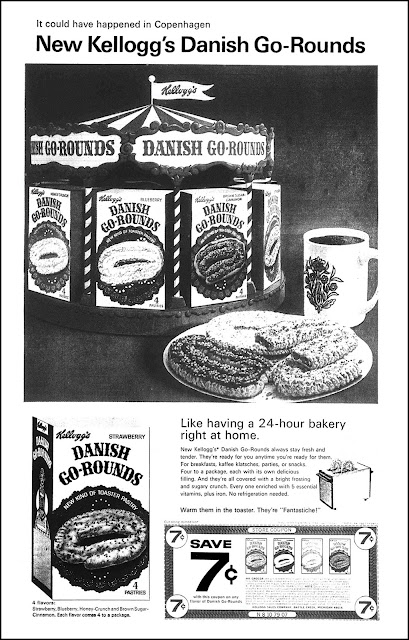
    Introduced by Kellogg’s in 1968, Danish Go-Rounds were like the golden fleece of breakfast pastries. Imagine Pop-Tarts, but with the sophistication of a five-star dessert. The brown sugar-cinnamon Danish Go-Rounds were so addictive, they made crack look like a mere curiosity. At the ungodly hour of 2 a.m., millions of Americans would wake up in cold sweats, their cravings driving them to frenzied searches for the Nectar of the Gods—only to find their precious pastries had vanished into thin air. Then, in a move so baffling it felt like a conspiracy against breakfast enthusiasts everywhere, Kellogg’s pulled the plug on Danish Go-Rounds in the mid-seventies. They kept the Pop-Tarts, those cardboard-like impostors that tasted like they were designed by a committee of flavorless robots. The heartbreak was palpable. It was as if a divine bakery had been shut down and replaced with a factory that churned out glorified toaster insulation. The eradication of Danish Go-Rounds is now remembered as one of the most colossal institutional blunders in history—up there with the fall of Rome and the invention of the Rubik’s Cube. The void they left was so immense, it bored a gaping chasm in my soul. My heart, once full of pastry-filled joy, now echoed with the hollow sound of Pop-Tarts’ lifeless crunch. While Danish Go-Rounds faded into the annals of breakfast history, Pop-Tarts flourished like a tasteless, mass-produced phoenix. This shift symbolized the erosion of artisanal craftsmanship and the triumph of consumer complacency. It heralded the rise of such culinary horrors as Imperial Margarine, Tang, Space Food Sticks, Boone’s Farm Apple Wine, and SlimFast—products so tragic they make a TV dinner look like a gourmet feast. The Gastronomic Time Traveler had to bear witness to this disheartening transition, seeing the demise of pastries that were practically food royalty. In their place, we got a parade of processed atrocities that made the culinary landscape look like a dystopian nightmare. So there I was, left to mourn the loss of Danish Go-Rounds, savoring the bitter taste of what once was, while choking down the unworthy replacements that flooded the market. It was a breakfast apocalypse, and I was living in its soggy aftermath.

    My undying grief over the extinction of Danish Go-Rounds introduced me to Snackrilege–The soul-crushing betrayal one experiences when a beloved snack—usually a glorious artifact of pre-1980s food engineering—is unceremoniously discontinued and replaced with a bland, mass-produced imposter that tastes like cafeteria foam and broken dreams.

    Snackrilege is not just a disappointment; it’s a culinary excommunication. It’s the moment you realize Kellogg’s didn’t just discontinue Danish Go-Rounds—they blasphemed the sacred breakfast pantheon by pretending a Pop-Tart could ever fill that flaky, spiraled void.

    Symptoms of Snackrilege include:

    • Grief rage in the frozen aisle
    • Late-night Google searches for defunct product petitions
    • Emotional hoarding of expired boxes found on eBay
    • Screaming “It used to mean something!” at a toaster

    Snackrilege marks the exact point where food nostalgia turns into holy indignation. It’s not about the pastry. It’s about what we lost—flavor, artistry, and the illusion that breakfast was once made by pastry angels instead of lab interns with degrees in corn syrup engineering.

  • Chocotrickery

    Chocotrickery

    When I wasn’t honing my superhero powers, I was a rock star—at least in the hallowed halls of Katherine R. Smith Elementary. Every Friday during Show and Tell, I transformed into Micky Dolenz from The Monkees. I strutted into Mrs. Gilarde’s kindergarten class in my emerald green corduroy flares, aka the “Monkees pants,” ready to dazzle. My friends and I performed the “Theme Song” with such confidence that we shunned instruments, relying solely on the raw, unfiltered power of our vocals. The girls’ ear-piercing screams nourished my hungry self-esteem. Show and Tell Fridays became my therapy, where I reveled in the adoration of my screaming fans. I’d come home giddy, the shrieks of the girls still ringing in my ears like a symphony of validation. Exhausted from the grueling demands of being a five-year-old rock god, I devoured snacks like a tiny, ravenous beast. Oscar Mayer liverwurst sandwiches on Wonder Bread, meatloaf sandwiches drowning in ketchup, grilled cheese oozing butter, Rice Krispy Squares, Hostess berry pies, and Ovaltine-laced milk by the gallon—all disappeared down my gullet.

    Ah, Ovaltine. Marketed as a nutritional elixir but clearly a placebo in a milkshake’s clothing—a clever ruse setting the stage for future food gimmickry. They could’ve sold me anything with that chocolatey lie, and I’d have believed it was manna from heaven. Looking back, my daily ritual of inhaling these calorie bombs was a prelude to a life of chasing comfort in sugary deceit and processed delights.

    Ovaltine introduced me to Chocotrickery–the food industry’s sleight of hand in disguising dessert as “nutritional fuel” for growing kids—most notoriously embodied in the form of chocolate milk powder like Ovaltine, Nesquik, or other faux health elixirs disguised as academic performance enhancers and muscle juice for tiny rock stars.

    Chocotrickery is the corporate wizardry that convinced millions of children (and their exhausted, hopeful parents) that dumping sugar-cocoa dust into milk transformed it into a brain-boosting, bone-fortifying superdrink. In reality, it was more like chocolate frosting in liquid drag.

    Children caught in the throes of Chocotrickery didn’t just drink a beverage—they drank the fantasy: that they’d grow taller, smarter, cooler, and possibly even become Micky Dolenz if they stirred it long enough. It’s the original bait-and-sip scheme, the gateway to a lifetime of falling for healthwashed comfort foods wrapped in the sparkle of cartoon endorsements and pseudo-scientific promises.

    Chocotrickery is how nostalgia tastes when it’s spiked with glucose and lies.

  • Snackjection

    Snackjection

    When I was five, my father constructed a treehouse that stood like a beacon of childhood ambition in the Flavet Villages Apartments in Gainesville, Florida. It was a fortress, a palace, a skyscraper reaching for the heavens—at least in my young mind. In this realm of wood and nails, I sought to assert my dominion, and what better way than with the power of Sun-Maid raisins? One fateful day, I lured Tammy Whitmire to ascend the tree’s wooden slats by brandishing the ultimate weapon: a box of Sun-Maid raisins. This wasn’t just any box; it featured the Sun-Maiden herself, a radiant figure holding a colossal tray of grapes. Her red bonnet and the halo of yellow light marked with white triangles around her head made her look like the Great Raisin Angel, a deity of dried fruit. Tammy, captivated by the angelic glow of the Sun-Maiden, climbed up to join me. Victory seemed imminent until Zane Johnson, lurking in a nearby tree, emerged from a leafy cluster and shattered my triumph. With a smug grin, he declared he had something far superior to my measly raisins: Captain Kangaroo Cookies. These weren’t just cookies; they were double-fudge, cream-centered cookie sandwiches, the culinary equivalent of Excalibur. In the brutal marketplace of childhood affections, my raisins didn’t stand a chance. Tammy, seduced by the allure of Zane’s superior snacks, descended my tree faster than a squirrel on espresso and sprinted to Zane’s treehouse. There, they feasted on the decadent cookies, leaving me alone with my pitiful box of raisins. My reign had ended before it began. Crushed by the betrayal, I reclined in my treehouse and sobbed myself to sleep. But the universe wasn’t done with me yet. I awoke hours later to a stinging horror: my body was swarmed by red fire ants, drawn to the sweet raisins. My skin felt like it had been lashed by a thousand stinging nettles. In agony, I bolted to my apartment where my mother, horrified, gave me a scalding bath to rid me of the ants. In the battle between Sun-Maid Raisins and Captain Kangaroo Cookies, the cookies had won, and I had learned a painful, itchy lesson about the power of snacks and the fickleness of friends.

    This traumatic memory was my introduction to Snackjection–the  soul-bruising humiliation that occurs when your lovingly curated snack—especially one featuring wholesome packaging like a bonneted raisin maiden—is publicly rejected in favor of a rival’s more brand-name, sugar-slicked treat. Often inflicted during the high-stakes snack diplomacy of childhood, Snackjection delivers a one-two punch: the collapse of your social standing and the realization that Captain Kangaroo cookies wield more romantic sway than your dried fruit ever will.

    Symptoms may include:

    • Sudden loss of confidence in your snack brand identity
    • Emotional exile to a solo treehouse
    • Uncontrollable sobbing followed by an insect siege
    • Existential questioning of why the Sun-Maid looks holy but delivers only heartbreak

    Snackjection is the snacktime equivalent of being left at the altar for someone with a lunchbox full of TV tie-in sugar bombs.

  • How 60s TV Gave Us Kibblelust

    How 60s TV Gave Us Kibblelust

    As a kid in the 1960s, I was utterly mesmerized by the tantalizing dog food commercials on TV. Gaines-Burgers, those succulent patties that looked like ground hamburger, and Gravy Train nuggets, which magically transformed into rich, brown gravy with just a splash of water, had my salivary glands working overtime. It was clear that the advertisers had one devious goal: to make dog food so visually appealing that even humans would crave it. And did they succeed.

    I marched up to my dad one day, eyes wide with canine envy, and declared that I wanted to be a dog just so I could savor these advertised delicacies. His face twisted in confusion, then horror, and then a resignation that only a parent can truly master. Determined to cure me of my bizarre wish, he whisked me off to a local bistro and ordered me a French Dip with au jus sauce.

    As the sandwich arrived, dripping with savory goodness, my dad leaned in and asked, “So, how do you like your French Dip?”

    I took a bite, my taste buds doing a happy jig, but instead of expressing my appreciation like a normal human child, I couldn’t resist. I let out a guttural growl, dropped to all fours, and began scratching an imaginary itch with my hind leg, much to the mortification of my father and the bewilderment of the bistro patrons.

    Dad’s face turned a shade of crimson that would have made a ripe tomato jealous. He sighed deeply, clearly questioning his life choices, while I continued my canine performance, convinced that I had discovered the next best thing to Gravy Train. It was then that I realized: the allure of dog food had turned me into a French Dip-devouring, itch-scratching spectacle of childhood absurdity.

     The irrational, often childhood-onset hunger triggered by the hyper-curated presentation of pet food in commercials—particularly dog food stylized to look more appetizing than anything in your pantry. Kibblelust is not mere curiosity; it’s a visceral craving born from the fantasy that somewhere, out there, dogs are eating better than you are.

    Sufferers of Kibblelust may experience symptoms such as food envy toward canines, a desire to bark in public, or in extreme cases, dropping to all fours in a bistro after biting into a French Dip, convinced it’s the closest a human will come to Gravy Train transcendence.

    This condition typically begins with 1960s-70s advertising campaigns involving burger-shaped meat slabs and gravy-generating pellets and is usually cured by a parent’s panicked intervention and a stern lesson in food hierarchy.

    Kibblelust represents the first great betrayal of consumer trust: when you realize advertisers are not above making animal food look better than human cuisine—and you fell for it.

  • Floating on FOMO: My Personal Waterbed Fiasco

    Floating on FOMO: My Personal Waterbed Fiasco

    I spent my early childhood in VA housing—decommissioned army barracks optimistically rebadged “Flavet Villages”—in Gainesville, Florida. These were no-frills dwellings nestled near an alligator swamp and a patch of forest where a Mynah bird with the patience of a Zen master perched on the same branch every evening like it was punching a time clock. It became a ritual: before bed, my father and I would wander out to talk with the bird, who responded with eerie, robotic mimicry, as if channeling some extraterrestrial intelligence trapped in a tropical feather suit.

    At dusk, the low tide would pull back just enough to let the aroma of fermented alligator dung waft through the air—a stench so strong it could thin paint. Most people would gag. I inhaled deeply. Something about that swampy, putrid tang made me feel alive, elemental, cosmically tethered. It wasn’t beautiful, but it was real. And standing beside my father, breathing in swamp funk and chatting with a talking bird, I felt no lack. No longing. No itch. I was in paradise, the kind not found in brochures or Instagram feeds—though we didn’t yet have the latter to weaponize our dissatisfaction.

    Then came I Dream of Jeannie in 1965, and with it, the slow-burn tragedy of FOMO. Barbara Eden lived inside a jewel-toned genie bottle—a plush, circular sanctum upholstered in royal purples and pinks, encrusted with glass baubles and satin pillows. It was luxury wrapped in fantasy, and I wanted in. Badly. Suddenly, my swamp lost its sparkle. I began to ache—not for something real, but for something better. Something else.

    The cruelest part? Jeannie’s bottle was a repainted Jim Beam whiskey decanter. A piece of throwaway Americana converted into a portal of impossible longing. That detail says everything: desire is often just repackaged delusion. And once I tasted that kind of fantasy, the swamp and the Mynah bird—once holy—became mere prelude.

    By 1974, I was barely thirteen and neck-deep in my search for substitutes. The object of obsession that year? Waterbeds. Several friends and neighbors had them, and after a few demo flops onto their undulating surfaces, I became convinced that waterbeds were the gateway to pleasure, sophistication, and sensual repose. Surely, I reasoned, the waterbed was Jeannie’s bottle in disguise—fluid, decadent, vaguely erotic.

    I lobbied my parents hard. They relented. Victory tasted like vinyl and faint mildew.

    What followed was not paradise but an ongoing science experiment in disappointment. The temperature was always wrong—Sahara one night, Arctic the next. It leaked with the consistency of a bad marriage. The smell? Somewhere between wet dog and pond scum. And then there was the sensation: if I moved, the bed retaliated. A slow-motion punch of resistance, as if Poseidon himself were shoving back. I wasn’t cradled—I was stalked by unseen waves. One night it leaked so catastrophically that my bedroom floor bowed like a sinking schooner. I woke up in what felt like Act II of Hurricane Katrina: The Bedroom Years.

    This, I realized, was the fool’s errand of FOMO: chasing after glossy substitutes for longing we barely understand. Jeannie’s bottle wasn’t just a dream—it became the prototype for every ill-fated quest for magic in mundane form. Every waterbed, every gadget, every trend promising comfort, coolness, or connection is just another glittering bottle with no genie inside.

    The Mynah bird never promised me anything. It never asked me to chase or wish or want. It just sat, unbothered, mimicking the world as it was. And perhaps that’s what I miss most: the pre-FOMO clarity of being content beside a swamp, before marketing told me I was supposed to want more.