
Tag: wine

  • The Great Lachyrmose

    The Great Lachyrmose

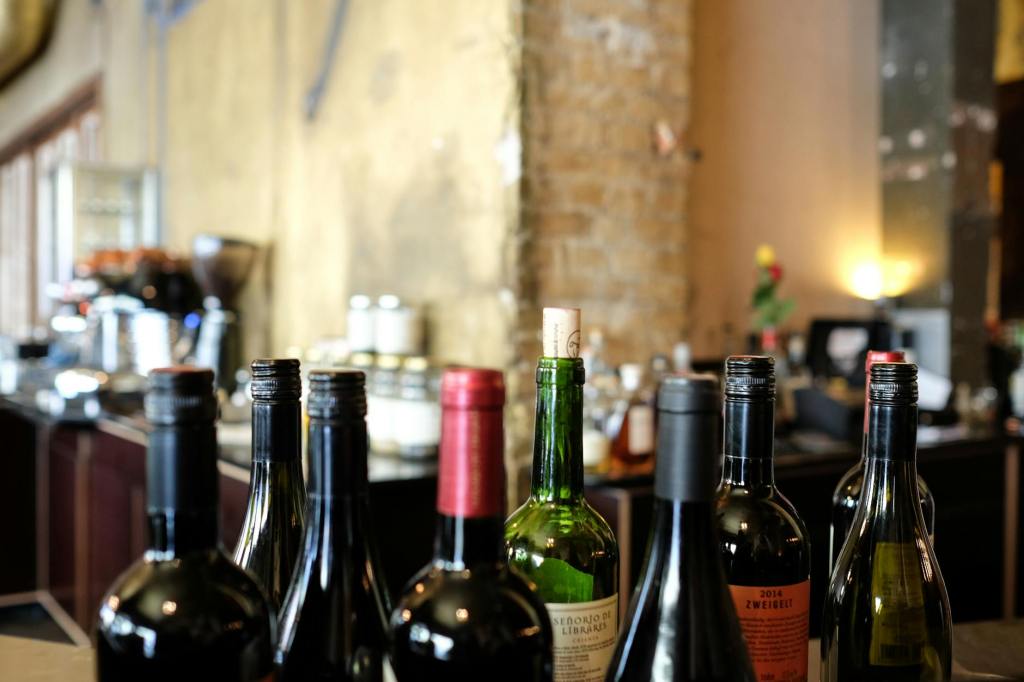
    The Great Lachyrmose was the stage name bestowed upon Jeff McMahon, a college writing student, bodybuilder, and part-time laborer at Jackson’s Wine and Spirits on Tunnel Road beside the Claremont Hotel. From 1983 to 1987, the store hosted wine tastings three evenings a week. There were bottles from Bordeaux, Napa, and Tuscany, a polished grand piano in the corner, and customers who came expecting Cabernet, Brie, and melancholy in equal measure.

    The ritual never varied.

    McMahon would be hidden away in the walk-in cooler stacking cases of beer or downstairs wrestling heavy crates of wine. His black T-shirt was perpetually torn, his forearms tattooed with cardboard abrasions, nicks from broken bottles, and fresh cuts courtesy of overzealous box cutters. He looked less like a concert pianist than a dockworker who had taken a wrong turn into a music conservatory.

    Soon someone at the tasting bar would ask, “Where’s Lachyrmose?”

    Another voice would join in. Then another. Before long the room itself seemed to chant for him.

    Store owner Solomon Khan, who understood that theater sells almost as well as Chardonnay, would smile knowingly. If every chair around the tasting bar had been claimed, he would haul out more until the room resembled an impromptu recital hall. Only then would the Great Lachyrmose make his entrance, emerging dramatically from the cellar or the refrigerator like some wounded Romantic hero ascending from the underworld.

    Without ceremony he would sit at the piano and spend the next hour filling the room with mournful nocturnes, elegiac waltzes, and slow-moving ballades that drifted through the store like woodsmoke on a winter evening. Conversations softened. Wine glasses paused halfway to waiting lips. Even the cash register seemed embarrassed to interrupt.

    The most enchanting audience members were the neighborhood’s young mothers.

    They would arrive carrying restless infants whose nightly resistance to sleep had exhausted every parental strategy except surrender. Somehow the Great Lachyrmose accomplished what rocking chairs, lullabies, and desperate pacing could not. One melancholy piano piece after another worked its quiet spell until tiny eyelids surrendered. The babies collapsed into peaceful sleep with astonishing reliability. Their grateful parents would offer Lachyrmose a smile and a gentle nod before slipping out into the Berkeley night, precious cargo cradled carefully in their arms.

    It became one of the strangest guarantees in town. Jackson’s could promise good wine. Lachyrmose could promise sleeping babies.

    As the years passed, however, something inside the pianist began to shift. He grew restless with his own success. He wanted brighter harmonies, quicker tempos, unexpected turns. He wanted music that laughed as often as it sighed.

    His audience revolted.

    The regulars did not come for experimentation. They came for emotional comfort. They wanted the familiar sorrow they had come to love, returning to those melancholy melodies with the same devotion families reserve for a grandmother’s chicken pot pie. Every new composition was politely tolerated before someone inevitably asked for one of the old sad songs.

    Success had quietly become a cage.

    The Great Lachyrmose had become a prisoner of his own repertoire.

    So when McMahon accepted his first college teaching position, he quietly retired the character and left Jackson’s behind. For the first time, he could play whatever music interested him rather than whatever melancholy his audience wished to hear.

    He gained artistic freedom, but he lost something as well.

    He lost the strange little community that had gathered around a grand piano in the corner of a wine shop. He lost the nightly ritual of emerging from the cellar to a room full of expectant faces. He lost the grateful parents carrying sleeping babies into the darkness.

    Even now, decades later, he occasionally misses the Great Lachyrmose. The music has changed. Life has changed. But belonging—that rare feeling that one’s peculiar gifts answer someone else’s unspoken need—is not so easily replaced.
  • Cork Dorks and the Road to Nowhere

    Cork Dorks and the Road to Nowhere

    In the mid-1980s, I funded my so-called college education as an English major by slinging bottles at Jackson’s Wine & Spirits in Berkeley, strategically nestled near the ritzy Claremont Hotel on Ashby Avenue. The job itself was an exercise in absurdity, not because of the work, but because of my coworkers—an ensemble of walking encyclopedias who were grossly overqualified to stock shelves and ring up Chardonnay. We’re talking PhDs in linguistics, anthropology, chemistry, physics, philosophy, and musicology—each degree worth less than a tenured spot in a clown college, yet brandished like medals in an intellectual arms race. These were people who read Flaubert in the original French and practically spat on anyone who dared pick up an English translation. The mere thought of working for a corporation or any institution that might impose a dress code or, heaven forbid, expect them to “synergize” was beneath their dignity. Selling fine wines and imported beers became their ironic playground, a place where they could cultivate a sense of elitism thicker than the crust on a neglected wheel of Brie. Their unofficial motto? “Service with a smirk.”

    These intellectual peacocks, not particularly rich or buff, took immense pride in flexing the one muscle they deemed worthy: the brain. Their idea of a power pose wasn’t a bulging bicep but a razor-sharp quip delivered with surgical precision. For them, intellectual one-upmanship was the true path, with the mind as the muscle to be sculpted. Their version of bodybuilding legend Sergio Oliva’s “Myth Pose” was a finely tuned discussion about Adorno’s critique of culture or a multi-hour debate comparing two French Beaujolais, all sprinkled with quotes from Camus. They taught me that flexing didn’t require dumbbells; it just needed the right amount of pretension and a willingness to alienate everyone around you.

    During slow hours, we gathered near the cash registers like a cabal of cynical sages, dissecting the philosophical curiosities of Nietzsche, the overwrought bombast of Wagner, and the labyrinthine despair of Kafka. The job became less of an occupation and more of a sanctuary for delusional self-importance. I found myself believing that I was somehow smarter than most, despite the glaring fact that I was working in a retail wine store with zero career prospects. But who needed money when you could live on the heady fumes of intellectual superiority? The longer I marinated in that environment, the more I realized I was becoming gloriously, irreparably unemployable.

    While shuffling between dead-end teaching gigs at various colleges—where my enthusiasm quickly flatlined—I always found solace in returning to my wine snob cocoon. There, surrounded by these proud misfits who’d traded ambition for esoteric chatter, I could pretend that debating the nuances of Hegel was more fulfilling than climbing any traditional career ladder. Truth be told, I might’ve happily stagnated in that dead-end job forever if fate hadn’t intervened in the form of an administrator at Merritt College who inexplicably liked my teaching style. He pulled me aside one day and whispered that there was a full-time gig open at some desert outpost called Bakersfield. He and his colleagues were prepared to write me “sterling letters of recommendation” to ensure I got the job.

    “What’s Bakersfield like?” I asked, a vague unease bubbling up as memories of my family stopping there to gas up our station wagon drifted into my mind like a bad smell.

    “Don’t worry about that,” he replied, his tone thick with the kind of unearned confidence that only comes from never having to live in a place like Bakersfield. “Just move your butt down there and take things as they come.”

    And so, in the span of a few short months, I traded intellectual elitism for a one-way ticket to the middle of nowhere, chasing a full-time paycheck while my wine store days—and the delusions that came with them—slowly receded into the rearview mirror.