Tag: workout

  • The Farmer’s Walk of Shame and Glory

    The Farmer’s Walk of Shame and Glory

    At thirteen, I became an Olympic weightlifter—because what else does a wiry, overachieving kid from suburban California do when puberty arrives like a freight train full of testosterone and insecurity? My coach, Lou Kruk, had the gruff certainty of a war general. His command: Squats. Lots of them. Squats were the foundation, the gospel, the holy writ. Lou didn’t care if your femurs screamed or your glutes cried for mercy—he wanted you buried under iron like a potato under mulch.

    And I obeyed. I squatted in the gym. I squatted while playing goalie in soccer. I squatted in line during PE roll call, waiting for Ernie Silvera to butcher yet another attendance list. I even squatted in front of my locker, hoping posture would hide the acne. Eventually, the kids at Earl Warren Junior High stopped calling me by my name. I was simply: Squats.

    But here’s the thing: squats weren’t just reps. They were a romantic infatuation with self-improvement. A ritual. A sacrament. I didn’t fall into squats—I plunged, like a lovesick poet into madness.

    Fast-forward to middle age—forty years and one mid-life crisis later—I traded barbell bravado for kettlebells and met a new myth: the Turkish Get-Up. It felt like choreography from some warrior ballet: lie down like a slain gladiator, then rise with a kettlebell overhead like a triumphant god reanimating himself for vengeance.

    Then came the Farmer’s Walk, and I was undone.

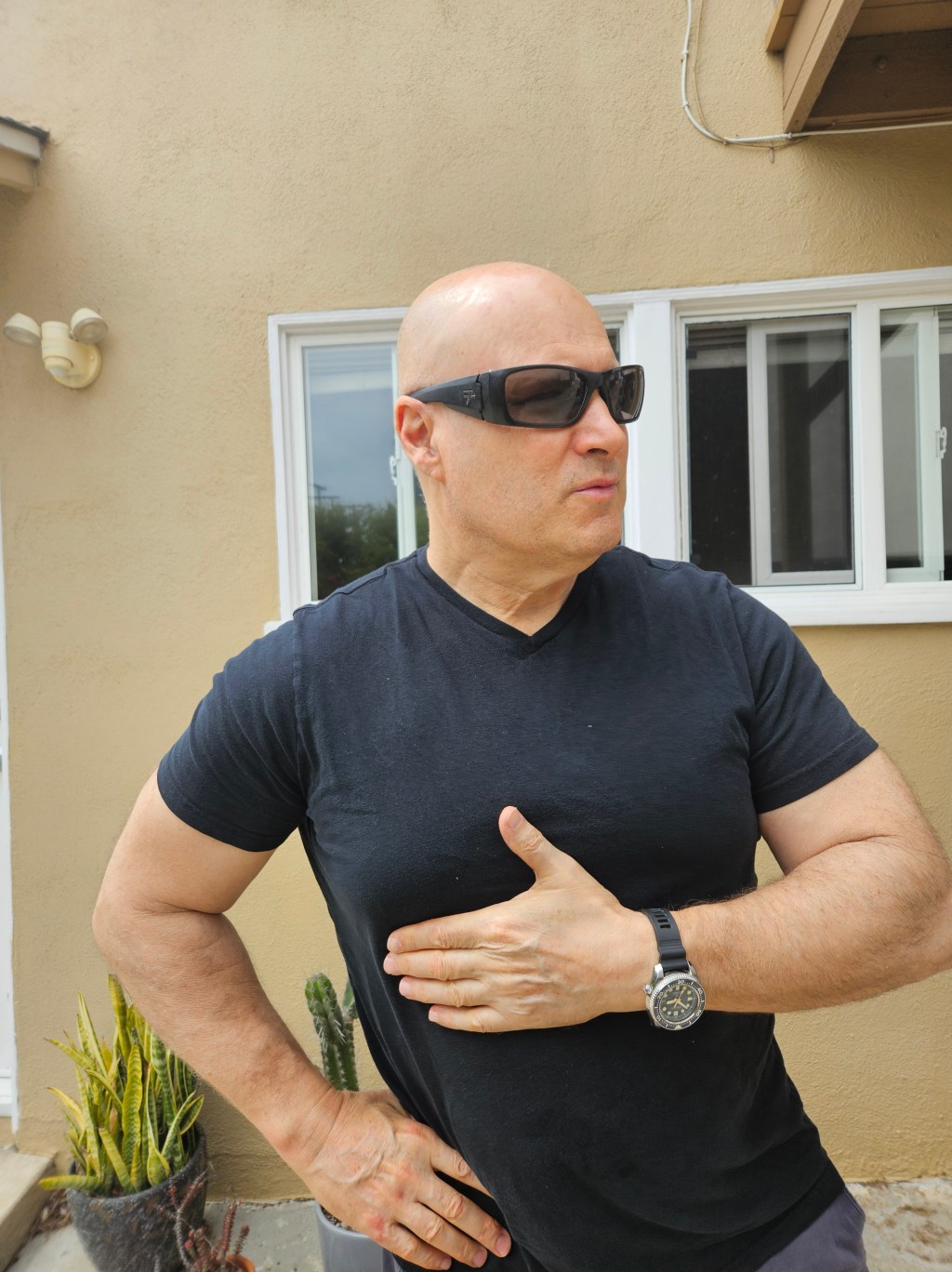
    Here’s the scene: I grab a 48-pound kettlebell in one hand, a 53-pounder in the other, and saunter out of my garage barefoot like a lunatic monk of pain. I circle my Honda Accord, not for superstition, but for symmetry. Then I march around the front lawn, beads of sweat trickling down my temples, tank top clinging to my body like a polyester declaration of war.

    The burn in my delts and forearms? Biblical. Especially when I’ve just finished kettlebell swings and around-the-worlds like some masochistic circus act.

    Why do I love the Farmer’s Walk?

    First: its austere simplicity. It’s manual labor disguised as exercise. I’m hauling metaphorical water, carrying invisible suitcases packed with existential weight.

    Second: it taps into a fantasy. I imagine I’m a young, vigorous farmhand, righteous and virtuous, about to earn a sizzling plate of bacon and eggs just for showing up to life.

    Third: it’s primal. I’m walking twin beasts, two snarling metal bulldogs, and I’m the alpha. My heart rate spikes, my skin gleams, and I feel, absurdly, alive.

    But with greatness comes peril. I go barefoot, which means one mistimed drop and I’m dialing podiatry from the ER. If I stub my toe, I’ll be hobbling like a Dickensian orphan. Then there’s the risk of dinging my Accord, which would be both tragic and hilarious.

    Yet the greatest threat isn’t physical—it’s psychological. I am, without a doubt, the neighborhood oddity.

    My neighbors stare. They whisper:

    “What’s he trying to prove?”
    “Is he unraveling?”
    “Is this a cry for help or a cry for gains?”
    “Why doesn’t he take up pickleball like a normal old man?”
    “Oh dear, that poor wife.”

    But despite the scrutiny, I press on. I rise each morning with the enthusiasm of a caffeinated Spartan. I brew my coffee, stir my buckwheat groats, and prepare for my ritual. And when it’s time to perform my ceremonial promenade across the lawn, kettlebells in hand and sweat on brow, I do so with one thought:

    Let them watch.

  • The Gospel According to Arnold

    The Gospel According to Arnold

    At thirteen, you weren’t just growing—you were bulking. You launched yourself headfirst into the gladiatorial quest for muscle supremacy, wolfing down 200 grams of protein a day in four frenzied “feedings,” as if you were a ravenous prehistoric beast on a cutting-edge strength cycle. While other kids were figuring out how to talk to girls without combusting from nerves, you were busy calculating amino acid ratios and chasing the elusive state of protein-muscle synthesis like it was the Holy Grail.

    Your kitchen became a makeshift laboratory of gains. You blended protein shakes with powders hawked by the beefy prophets in Strength and Health magazine—chalky concoctions that tasted like regret mixed with drywall. You drank them anyway. Satiety was sacred.

    After a year of racking up Junior Olympic Weightlifting trophies—hoisting iron like a Cold War super-soldier on state-sponsored hormones—your well-meaning mother tried to support your calling. On your fourteenth birthday, she handed you what you assumed would be a Soviet-tier weightlifting manual. Instead, it was Pumping Iron—a glossy coffee-table tome filled with baby-oiled men in banana hammocks. Bodybuilders. Flexing. Posing. Pouting.

    You had to sit her down.

    “Mom,” you said, as diplomatically as a hormonal adolescent can, “weightlifters move heavy things. Bodybuilders pose in sequined underwear and shave their armpits.”

    To you, weightlifters were Spartans. Bodybuilders were Vegas lounge acts with glutes.

    Still, curiosity got the better of you. You flipped through Pumping Iron with a mixture of revulsion and wonder. The men on those pages didn’t look human. They looked like sculptures that got bored and decided to bench press.

    You imagined them living in their parents’ houses, drinking protein sludge while their heat-addled mothers babbled to parakeets and dabbed their foreheads with cold washcloths. They were carnival beasts. You, however, were a noble practitioner of Olympic Weightlifting—a sport so pure it belonged in the actual Olympics, unlike the oiled-up beauty pageants you now held in low regard.

    Your hero was Vasily Alekseyev, the 350-pound Russian colossus who looked like he ate livestock for brunch. You watched him waddle onto the platform, glare at a loaded barbell like it owed him money, and launch it overhead like a man tossing furniture in a domestic dispute. When that barbell hit the floor, it echoed through your ribcage. That, you told yourself, was true strength.

    But then… Arnold happened.

    You’d seen him before, sure. But when you saw Pumping Iron—saw him—something shifted. It wasn’t just admiration. It was conversion. Arnold wasn’t a man. He was a solar flare with biceps. A deity with an accent.

    Soon, you were hanging around Walt’s Gym, where the walls smelled like testosterone and chalk dust, and where the guys wore cutoffs like they were Roman togas. One afternoon, you spotted a bodybuilder straight out of central casting: a tall, tanned fireman who had just placed in the Mr. California competition. Blond hair, thick broom-handle mustache, horn-rimmed glasses that screamed “Clark Kent just deadlifted a Buick.”

    He bench-pressed over 300 pounds, stood up, and stared into the mirror like Narcissus on creatine. “The first time I saw Arnold,” he said with reverence, “I felt I was in the presence of the Lord. I said to myself, ‘There stands the Messiah. There stands God Almighty, come to bring good cheer to this world.’”

    And you believed him.

    Because Arnold wasn’t just jacked—he was divine. He was the Pied Piper of Pecs, leading you out of your ordinary life and into a new religion: Bodybuilding Fever. There was no vaccine. No mercy. Just the cure: protein shakes, gym mirrors, and relentless flexing.

    You no longer lifted just to be strong. You lifted to be seen. To be admired. To become an icon. You drank from the sacred chalice of the dumbbell and chased the gleam of your own reflection. You weren’t just lifting—you were becoming.

  • Cling to Your Lead and You’ll Lose: A Midlife Playbook

    Cling to Your Lead and You’ll Lose: A Midlife Playbook

    I don’t take the Life Force lightly. It’s the mysterious voltage that animates us, that flicks the switch from sloth to spark. One minute you’re groggy and half-dreaming, the next you’re lacing up your sneakers, firing up the espresso machine, and attacking your kettlebell workout like you’re in a Rocky montage scored by Miles Davis. The Life Force says: Get up. Get after it. Drink, eat, laugh, lift, love, live—before the curtain drops.

    Even when we’re slumped in a funk, sulking like a teenager who just discovered Camus, the Life Force doesn’t vanish. It simply retreats, muffled beneath layers of melancholy and cheap self-pity, waiting for the clouds to lift so it can slip back in with a jolt.

    I’ve been thinking about this lately as I inch toward sixty-four. The aging brain doesn’t hide its compromises. The body offers new aches like parting gifts from yesterday’s workout. And I keep reading about public figures—my age or younger—dropping dead from heart attacks and cancer, as if the universe is whispering, “You’re next.”

    The awareness of mortality, while useful in the Stoic-philosopher sense, has a dark gravitational pull. It makes you want to swaddle yourself in self-pity, curl up with grim hypotheticals, and mentally prewrite your own eulogy. I’m no sage, but I’ve noticed: the older you get, the easier it is to start thinking about death instead of living your life.

    And that’s where the football metaphor barges in—uninvited, but apt. Picture a team nursing a small lead. Instead of playing their usual game, they start playing not to lose. They abandon boldness, creativity, and flow. They tighten up. They stall. They cling. And then they lose.

    That’s what obsessing over death becomes: Playing Not to Lose Syndrome. You stop being you. You start tiptoeing through your own damn life, hands over your eyes, praying not to fall. But life’s not won through timid pacing. You win by doing what got you here in the first place—living like hell, moving the ball down the field, trusting your strength, and swinging the kettlebell with fury and joy.

    Yes, I’ll admit it: the fearful doppelgänger lives in me too. He bites his nails and speaks in doomsday whispers. But so does the joyful lifer, the one who’s still in love with breakfast, jazz, hard workouts, and writing rants like this one. Maybe being fully human means acknowledging both—the brave and the cowardly—and choosing, as often as possible, to side with the one who gets up and dances anyway.

    Life doesn’t reward those who cling. It rewards those who play to win—until the final whistle.

  • Neddy Merrill Disease: Lifting Weights to Outrun the Abyss

    Neddy Merrill Disease: Lifting Weights to Outrun the Abyss

    I take no glory in training through my 60s. At nearly 64, with a lifting life that began in 1974 amid the clang of Olympic barbells and testosterone-choked gyms, I no longer chase records or applause. These days, I chase mobility. I chase not falling apart. A nagging flare of golfer’s elbow—inner right, thank you very much—has made its uninvited return, forcing me to swap kettlebell rows for gentler “lawnmower” pulls and abandon my beloved open-palm curls in favor of reverse curls, the orthopedic equivalent of safe sex.

    There was a time, of course, when I confused self-worth with showing off. I strutted under heavy weights in the ‘70s through the ‘90s like a tragic extra from Pumping Iron, nursing shredded rotator cuffs and wrecked lumbar discs in my quest to impress… well, no one, really. The mirror? My dad? Arnold? These days I tiptoe a tightrope between intensity and injury, trying to silence the reckless ghost of my twenty-year-old self who still believes he’s indestructible.

    This tug-of-war with time reminds me of Neddy Merrill, the doomed protagonist in John Cheever’s “The Swimmer,” who tries to recapture youth by swimming across his neighbors’ pools like a suburban Odysseus, only to arrive at his own foreclosed house—empty, echoing, and final. I see flashes of my own Neddy Merrill alter ego every time I glimpse my neighbor, a sturdy cop in his early 40s, shepherding his twin teenage sons off to jiu-jitsu. I envy them—their youth, their purpose, their untouched joints. But I remind myself that comparison is the mother of misery. I don’t train for glory anymore. I train because the alternative is to surrender to frailty, to collapse into a slow-motion horror film of decay. I train because being strong is still cheaper than therapy, and it’s the only middle finger I can raise at time’s relentless advance.

  • From Shawarma to Swing Sets: A Kettlebell Fitness Cultist Takes a Break

    From Shawarma to Swing Sets: A Kettlebell Fitness Cultist Takes a Break

    I took a rare sabbatical from my kettlebell gospel this Memorial Sunday to bask in the company of my cousin Pete and Aunt Sherry in Studio City—because even iron addicts need a cheat day, preferably one involving shawarma and nostalgia. We spent eight hours doing what old relatives do best: eating like we’re about to hibernate, name-dropping concerts that smelled like patchouli and regret, and arguing over which decade had the best moral compass (spoiler: none of them).

    Pete and I go way back—Haight-Ashbury, San Francisco clambakes, enough Passover seders to qualify for spiritual overtime. Our shared memories stretch across seven decades like a shag carpet in a time-warped rec room.

    The weather, because of course it was, clocked in at 75 degrees—sunny, breezy, and just obnoxiously pleasant. So much so, we weren’t content with one perfect meal. We closed the day with Korean barbecue that tasted like it had been grilled by angels on a smoke break. Then came the real miracle: we took the 405 back to Torrance and hit no traffic. That’s not just a good omen—it’s borderline apocalyptic.

    When we got home, I turned to my wife and said, “The day was too perfect. Should I call a priest or a statistician?”

    Once the existential dread of joy wore off, I returned to my senses and thought I’ll be 64 soon. I need to map out my plan to slam heavy iron for the rest of my natural life. A sacred vow, if you will:

    • Follow Mark Wildman’s mantra: “Train injury-free today so you can train tomorrow”—not “break yourself now to impress your ego.”
    • Heed Pavel’s wisdom: Push to 80–90% failure, not 100%, because no one gets a trophy for tearing their rotator cuff.
    • Devour 200 grams of protein a day like it’s my job—and in a way, it is.
    • Keep calories under 2,400 so I don’t end up looking like I survived Passover but lost to diabetes.
    • Be grateful for my garage gym—no excuses, no sweaty strangers, no corporate playlists.
    • Appreciate that my workout intensity still rivals that of my teenage self in the 1970s, minus the acne and naïve dreams of Olympic glory.
    • And above all, give thanks that my family doesn’t stage an intervention every time I start rhapsodizing about kettlebell geometry.

    In conclusion, it was a dangerously perfect day—full of grilled meats, shared myths, and suspiciously easy freeway exits. I’m not saying I’m suspicious of happiness, but I’m definitely side-eyeing it.

  • From Sweat Temple to Spa Prison: My Gym Breakup Story

    From Sweat Temple to Spa Prison: My Gym Breakup Story

    There was a time, back in the sepia-toned haze of the 1970s, when the gym was my church and iron was my sacrament. I was a teenage bodybuilder, baptized in sweat and testosterone, and the gym was a crude sanctuary—part locker room, part gladiator pit—where you could grunt, curse, and lift until your eyeballs threatened to pop like grapes. No frills, no air freshener, no nonsense. Just clang, bang, and the occasional chest-pounding primal scream.

    Then came the 1980s, when gyms got a makeover. They went corporate. The rusted barbells got swapped for chrome. The boom boxes were silenced in favor of syrupy pop music so chirpy it made your teeth ache. Suddenly, everyone wore genie pants and strutted between machines like peacocks dipped in glitter. I soldiered on, of course, slogging through the artificial sweetness and protein-powdered small talk. But the joy had drained from the dumbbells.

    By 2005, I snapped. The gym had become a perfume counter with resistance bands. I fled to the one place where the spirit of muscle still breathed: my garage. I bought a set of kettlebells and never looked back. No waiting for equipment. No toe fungus lurking in communal showers. No ex-frat boys flexing in front of mirrors while discussing their smoothie macros. Just me, my iron cannonballs, and the relentless clang of salvation.

    As I reflect on my exile from Gym Nation, I’ve made peace with my reasons. Let me count the ways:

    I like people. I enjoy storytelling, especially if it involves morally questionable behavior and a dash of scandal. But I can’t dish gossip and deadlift at the same time. I’m not that talented. The gym wants you to be a social butterfly with deltoids, but I want solitude and sweat.

    I used to catch colds with the regularity of a school nurse—four times a year like clockwork. Every cardio machine was a petri dish disguised as fitness equipment.

    And don’t get me started on the showers. You haven’t known dread until you’ve seen a septuagenarian air-drying his nether regions for forty-five minutes like a puffy white heron. Showering was a biohazard. Not showering meant marinating in my own musk, turning my car into a rolling terrarium of mildew and despair.

    Gyms also close for holidays, which is when I need them most—Thanksgiving rage, New Year’s guilt, Fourth-of-July shame. My garage, on the other hand, never takes a day off. It’s always open, always angry, always welcoming.

    And the waiting. Dear God, the waiting. I train fast, like I’m running from the ghosts of carbs past. Having to wait ten minutes for a squat rack while someone scrolls Instagram is a crime against the pump.

    I spent about a thousand bucks on kettlebells, from 10 to 80 pounds. That may sound steep, but compared to a decade of gas, membership fees, and viral exposure? It’s a steal.

    This garage of mine—it’s not just a space. It’s a holy temple of kettlebell discipline. A shrine to simplicity, sweat, and solitude. And I’ll keep swinging those iron orbs until I drop dead—or transcend into Valhalla, kettlebell in hand.