Tag: writing

  • Ghosts at Pearl Harbor: A Morning of Reverence and Unease

    Ghosts at Pearl Harbor: A Morning of Reverence and Unease

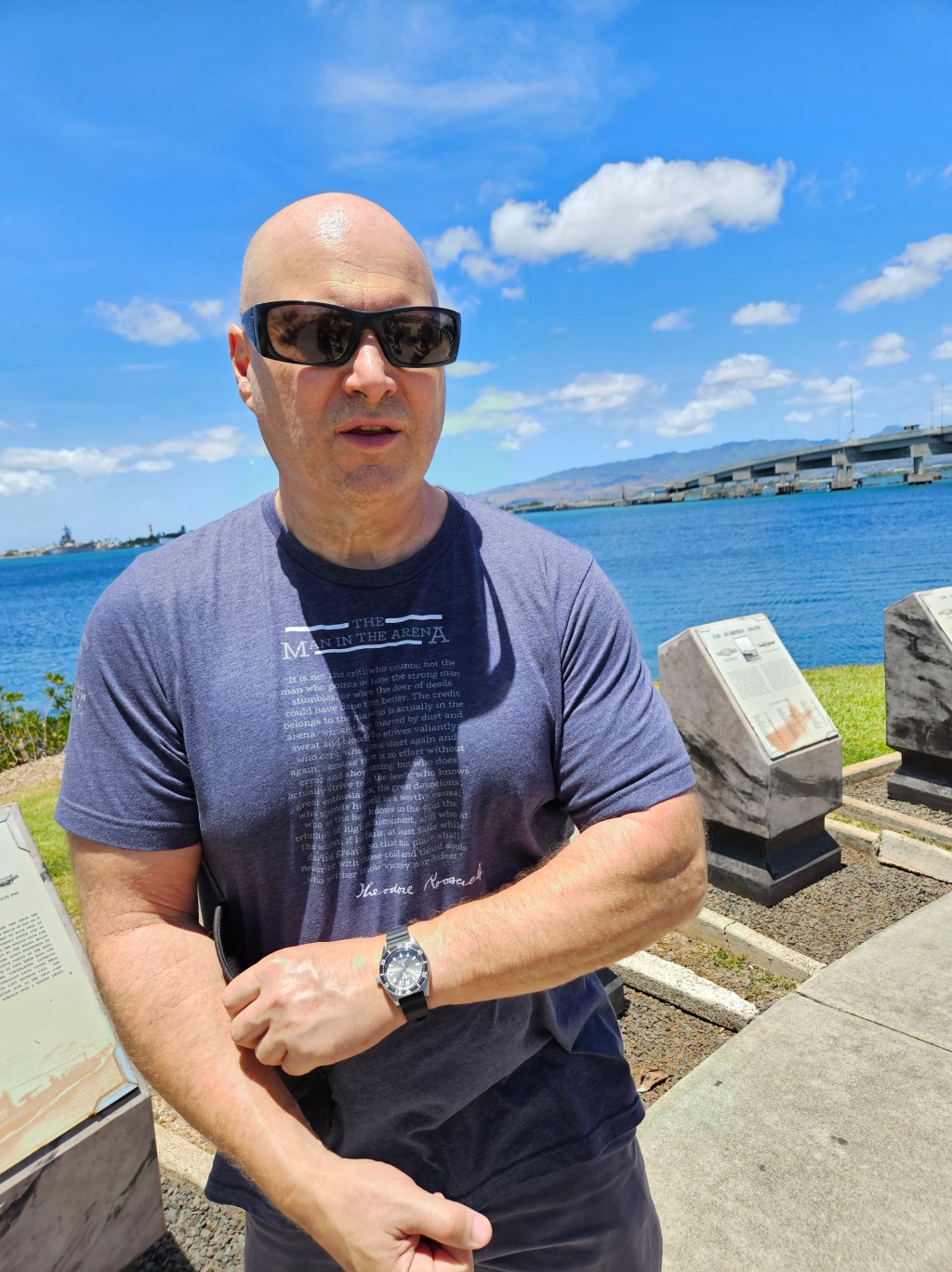
    Yesterday we drove thirty minutes from the Embassy Suites in Waikīkī to the Pearl Harbor Memorial, where solemnity hangs in the air like thick humidity. The journey from beachfront ease to battlefield remembrance felt immediate and irreversible.

    Inside the visitor center’s theater, a National Park spokesperson stood behind a lectern—short, compact, dark-haired, with the confident charisma of someone who has delivered this message a thousand times, and still means every word.

    “You’re not on a must-see tour,” he said, with an edge of reprimand. “You’re visiting a mass military gravesite. This is more than a military tragedy—it’s familial. Thousands of children lost their parents that day. That grief doesn’t expire. It echoes. Please treat this place with respect—not as a TikTok backdrop.”

    I thanked him on the way to the dock. His words stripped away any residue of tourism and replaced it with reverence.

    We boarded a navy-operated boat alongside a quietly murmuring mix of global visitors—Germans, Japanese, mainland Americans, Australians. The boat was packed, but no one jostled or joked. You could feel the history pressing in from all directions.

    At the memorial itself, I tried to read the names etched into white marble. I tried to focus. But I was distracted—haunted—by two figures lingering at the edge of my vision.

    They were brothers, unmistakably. In their thirties, pale as winter ash, with dirty-blond hair and heads shaped like crude pyramids. Their eyes—almond-shaped, off-kilter—glinted with something sharp. Their teeth were crooked and small, the kind that suggest years of silent snarling. They were so wiry, so sunken, that even their frosted skinny jeans hung like surrender flags around their twiggy legs. Nicotine-stained, post-industrial, almost spectral.

    They spoke in rapid whispers—something Slavic, maybe Czech or Slovak—always leaning close, always glancing. They radiated the kind of anxious secrecy that suggested they were either up to something or simply never learned how not to seem that way.

    Everyone avoided them. Even when we were asked to scoot together on the boat to make room, the brothers sat untouched—shunned like they carried some forgotten plague. They were the kind of figures who seem pulled from the margins of a Dostoevsky novel or the casting list of a horror film.

    I can’t stop thinking about them. What drew them to Pearl Harbor? What shadow were they following? Their presence felt less like tourism and more like reconnaissance. In another life, in another medium, they could be characters in a Safdie brothers film—like John the heavy from Uncut Gems, who wasn’t an actor at all, just a force of nature discovered on the street.

    You can’t invent that kind of menace. You can only observe it, marvel at it, and wonder: what story did they bring to the memorial, and what story did they take away? And why in my heart do I see them less as tourists and more as criminals embarking on some kind of scheme? 
  • The Accidental Tourist, Redux

    The Accidental Tourist, Redux

    Yesterday, we flew from LAX to Honolulu aboard a gargantuan United jet so large I half expected to see shag carpet and a spiral staircase to a smoking lounge. The thing was practically a flying condominium—wide-bodied, high-ceilinged, and just roomy enough to avoid triggering my usual claustrophobia. Even while pinned to the aisle seat as fellow passengers formed a stagnant TSA-themed flash mob to jam their overpacked luggage into the overhead bins, I managed to breathe.

    I passed the flight in my usual state of high-functioning dread, retreating into Jim Bouton’s Ball Four on Audible through my Sony noise-canceling headphones—the only legal form of sedation I can stomach at 35,000 feet. Forget reading, forget movies, forget chit-chat. Air travel reduces me to a vibrating vessel of cortisol unless I can disappear into the low, comforting drone of a narrator’s voice. It’s less entertainment and more emergency emotional triage.

    Mid-flight, I spotted a man in first class—reclined, smug, his chest puffed like a hawk surveying the terminal. He wore a Rolex Submariner, its gleaming bracelet catching the light like a flex. For a moment I considered violating my long-standing ban on watch bracelets. But then I re-centered myself. No, I thought. No shiny metal shackles. Stay true to your rubber-strap asceticism.

    As we deplaned and shuffled past the first-class cabin, it looked less like a luxury lounge and more like the aftermath of a Roman orgy. Gargantuan seats sat slumped under rumpled cashmere blankets, like spent emperors. Empty champagne flutes glistened in the overhead lights. Half-melted caviar pearls clung to fine china, and artisanal pizza crusts lay abandoned, their truffle oil sheen dulled by neglect. It was less aviation and more archaeological dig—excavating the indulgences of the airborne elite.

    After getting our luggage, we skipped the usual rental car shuttle chaos (unlike in Maui or Kauai) and simply walked across the street to pick up our reserved vehicle. It was almost… dignified.
    Pro Tip: Disconnect your Sony headphone app before navigating to the hotel, or your phone will whisper silent directions to your eardrums while you make wrong turns into private military roads.

    This morning’s Embassy Suites breakfast buffet was a competent affair—dark coffee, lukewarm eggs, and a waffle station overseen by a teenager with the haunted eyes of someone six minutes into an eight-hour shift. Still, it did the job. Sustenance secured.

    Before the trip, friends warned me that Oahu lacks the charm of the smaller islands. So far, I find that advice overstated. Yes, there are people. But they’re spread out, like tourists in a theme park operating at 60% capacity. Manageable. Tolerable. Occasionally amusing.

    What continues to fascinate me is the ABC Store phenomenon. Every island has them, and each one is a bustling shrine to overpriced macadamia nuts, sunburned tourists, and cold bottled water with just enough condensation to feel spiritual. They are the Walmarts of Waikiki, the cathedrals of caffeine and aloe, always stocked, always staffed by saints, always crawling with those of us trying to patch together a sense of stability while wearing flip-flops and SPF 70.

    As I sit here contemplating the beach and the impossibility of relaxing, I realize something: I don’t know how to vacation. I don’t know how to unplug. I don’t know how to vanish. Perhaps it’s time I reread Anne Tyler’s The Accidental Tourist and finally admit I’m the kind of man who travels with headphones, anxieties, and an internal spreadsheet of projected discomforts.

  • Naked at the Piano Store

    Naked at the Piano Store

    Last night I dreamed I was dragged, not willingly, to what can only be described as a nocturnal daycare megachurch for toddlers. A female friend insisted I come with her, and because I lack boundaries in dreams, I agreed. It was night—an odd time for finger paints and tantrums—but the daycare manager, a woman in her forties with the strained face of someone who’d long since traded dreams for wet wipes, greeted us like this was normal.

    Almost immediately, a child began howling with the primal rage of someone denied a third juice box. I was conscripted to console him. My solution? A trip to a movie theater—because nothing says early childhood healing like surround sound. The child settled, spellbound by whatever played on screen. The strange part? I couldn’t see it. Or hear it. Apparently, the film was perceptible only to children. Perhaps it was Baby’s First Metaphysics. Or an encrypted Pixar feature accessible only through a purified heart.

    At some point, without ceremony or explanation, I slipped away and found myself on a college campus in daylight. My brother was waiting in a parking lot that looked like a car dealership I had overfunded. I had more cars than common sense and a key ring jangling with so many keys it looked like I had robbed a locksmith. He wanted me to follow him to our mother’s house. It suddenly felt urgent. Cosmic, even.

    I got in my vehicle—a car awkwardly tethered to a trailer—and, for reasons known only to dream logic, I drove from the trailer. It took me several minutes to realize I was operating a vehicle from behind, without a windshield or visibility. I was essentially piloting a missile blindfolded.

    Eventually I stopped—miraculously not dead—and found myself balanced at a deadly incline on an overpass. I had parked inches from becoming a traffic statistic. Bystanders stood around, but no one was mad. No one honked. It was as if my recklessness had occurred in a different dimension of social expectation.

    Near the overpass stood a shopping plaza featuring Yamaha grand pianos, each with the sticker shock of a midlife crisis: $26,000 apiece. I considered entering, comforted by the notion that I had “deep pockets”—but the moment I thought it, I realized I was naked. Fully, publicly naked. Oddly, this didn’t mortify me. I was as invisible as a ghost no one remembered to summon.

    Still, I decided not to enter the piano store and sit bare-bottomed on an $8,000 piano bench. Even dream logic has hygiene limits.

    I wandered into a pair of adjacent, carefully curated Edens—two burial gardens laid side by side, one Jewish, one Christian. Both were equal parts reverence and real estate, immaculately landscaped like death had hired a design team. The air was golden with sunlight, the kind that flatters grief and makes you forget about decay.

    Mourners floated among the headstones in their ceremonial best—linen suits, black veils, tailored despair. The Jewish and Christian worshippers moved in peaceful parallel, as if the afterlife had negotiated a truce that the living never quite managed. Gift shops nestled among the tombstones sold tasteful souvenirs—stone etchings, pressed lilies, probably a limited-edition Torah-meets-Gospels keychain. Everything was clean, sacred, and suspiciously well-funded.

    That’s when she appeared—a Quaker woman in a starched bonnet, all radiant calm and pioneer wisdom. She approached like someone who could knit an entire theological treatise while making a pot of herbal tea. Her smile was unshakeable, beatific in that unnerving Quaker way that suggests she knows something you don’t, but she’ll never say it out loud.

    She asked, in a voice smooth as chamomile, why I looked so troubled.

    I told her the truth: “I’m lost. I’ve been driving blind—literally—and now I’ve crash-landed in a dual-faith necropolis. Also, I’m naked. No clothes, no GPS, no plan. I think I took a wrong turn at sanity.”

    She didn’t flinch. Of course she didn’t. She’d seen worse. She probably taught Sunday school to ghosts.

    She smiled. Help was at hand.

    She summoned a tall man in a radiant yellow tunic—somewhere between a monk and a spa manager—who told me the directions home were complicated and could only be followed on foot. What about my car? My trailer? My sprawling fleet of unnecessary transportation?

    “Let it go,” he said, as if he’d read Marie Kondo for the Soul.

    Suddenly, I was surrounded by Quakers. They had me sit on a wooden chair as the daylight shifted to an amber hush. They prayed in Latin, pouring syllables over me like baptismal water. It was solemn. It was sacred. It was disorienting.

    When it ended, the woman in the bonnet asked if I’d been converted.

    “Not exactly,” I said. “But I did have a religious phase in high school. I was a big fan of Rufus Jones. Fundamental Ends of Life—ever read it?”

    She hadn’t. She was more of a George Fox girl. Fair enough.

    I thanked them for the baptism but declined the full spiritual onboarding. I had priorities: get to my mother’s house, find some clothes, and maybe return for the piano if I could be properly trousered.

    I descended a steep, stone staircase into dense green foliage. At the bottom, I hoped, would be pants—and clarity.

  • Return to the Womb

    Return to the Womb

    I’m three months shy of turning sixty-four, which means I’m old enough to know better and still young enough to entertain delusions. This is a warning to the under-sixties: prepare yourselves. At some point in your late fifties, strange desires start slithering into your psyche like vines through the cracks of a neglected greenhouse. With every new creak of the knees and fresh batch of funeral notices, a part of you will yearn for what I call the Return to the Womb.

    No, not literally—though if you could slide back into a warm amniotic bath and unplug the Wi-Fi, you just might. I’m talking about a psychological regression: the desperate, half-sane longing to be swaddled in tropical heat, to dissolve into mango-scented breezes, and to vanish into a seaside stupor under a drizzle that feels vaguely divine. The dream? To marinate in comfort, far from the cacophony of deadlines and dental appointments, in a climate designed by God for the perpetually tired.

    I was born in Gainesville, Florida in 1961, and to this day I remember the fetid perfume of alligator swamps—a heady, sulfuric funk that now strikes me as oddly comforting. Like Vicks VapoRub for the soul. Is it any surprise that I scroll Zillow listings for barrier islands in South Carolina, Georgian marshlands, and steamy Floridian enclaves? I’m not looking for a home. I’m looking for a feeling—a fetal, lizard-brained feeling that I’ve convinced myself might still be hiding in the heat.

    But here’s the rub: I don’t trust this impulse. This Return to the Womb isn’t a noble call to simplicity. It’s a siren song, crooned by the dark twin of the Life Force—the same demon that tells you to skip your workout, order DoorDash, and stream ten hours of King of the Hill in a comfort-food trance. It whispers of paradise, but it’s peddling paralysis. It’s not vitality. It’s a prelude to decay, dressed in Tommy Bahama and sipping a piña colada.

    Writers like Steven Pressfield and Phil Stutz have been wise to this force for years. Pressfield calls it the Resistance. Stutz names it Part X. Adam Smith, bless his powdered wig, simply called it the need for “self-command”—the daily decision to wrest meaning from entropy, to choose virtue over sloth, action over inertia.

    During the pandemic lockdown, I got a taste of this regression. Sitting masked in my accountant’s office in February 2021, she asked if I was thinking of retirement. Was I thinking of it? Lady, I was living it—in pajamas, in slow motion, surfing real estate listings for stilt houses on Key Biscayne while sipping overpriced Nespresso and pretending buckwheat groats were the secret to immortality. My body had synchronized with the rhythm of a hot tub. I wanted nothing more than to stay submerged.

    Four years later, I still want it. I still want the warm drizzle, the midnight ocean swims, the faint smell of coconuts mingled with chlorine and sea rot. And yet—I know. I know. I know that the moment I submit to this dream of endless hammock-lounging is the moment the soul begins to curdle.

    Phil Stutz, in Lessons for Living, writes about Father Time as a pitiless, judgmental figure—not the kindly old man of greeting cards, but a stern cosmic accountant. He doesn’t care how many steps you walked or how clean your macros were. He wants to know: Did you spend your time on Earth doing something that mattered?

    As someone who’s worshipped at the altar of diver watches for two decades, who has pondered the geometry of bezels and the metaphysics of lume, I took this personally. Time is not just money. Time is judgment. Time is an indictment.

    And the Return to the Womb? It’s a slow lobotomy in paradise. It’s “brain rot” dressed as a beach vacation. It’s the comforting lie that you’ve earned an escape from purpose. But the truth is, the older I get, the stronger this impulse grows. And that, frankly, terrifies me.

    Still—and here’s the kicker—as I type this, I want it. I want the coconuts. I want the warm rain. I want the mangoes. I want the beach walks at twilight where nothing hurts and no one needs anything from me.

    We are mad creatures, aren’t we? Our intellect sees the trap. Our soul feels the pull. And some part of us, no matter how wise or weathered, still wants to disappear into the dream.

  • Richard Brody vs. the Algorithm: A Critic’s Lament in a Post-Print World

    Richard Brody vs. the Algorithm: A Critic’s Lament in a Post-Print World

    In his essay “In Defense of the Traditional Review,” New Yorker critic Richard Brody goes to battle against The New York Times’ editorial decision to shift arts criticism—from the long-form written review to short-form videos designed for a digital audience. It’s a cultural downgrade, Brody argues, a move from substance to performance, from sustained reflection to algorithm-choked ephemera. The move may be pitched as modernization, but Brody sees it for what it is: intellectual compromise dressed up as digital innovation.

    Brody’s stance isn’t anti-technology. He concedes we can chew gum and walk at the same time—that written essays and short videos can coexist. But his core concern is that the center of criticism is the written word. Shift the balance too far toward video, and you risk gutting that center entirely. Worse, video reviews tend to drift toward celebrity interviews and promotional puffery. The fear isn’t hypothetical. When given the choice between a serious review and a clip featuring a celebrity making faces in a car, algorithms will reward the latter. And so criticism is flattened into entertainment, and standards dissolve beneath a rising tide of digital applause.

    Brody’s alarm resonates with me, because I’ve spent the last four decades teaching college writing and watching the same cultural drift. Long books are gone. In many cases, books are gone altogether. We assign short essays because that’s what students can handle. And yet, paradoxically, I’ve never seen such sharp classroom discussions, never written better prompts, never witnessed better argumentation than I do today. The intellectual work isn’t dead—it’s just found new vessels. Brody is right to warn against cultural decay, but the answer isn’t clinging to vanished ideals. It’s adaptation with integrity. If we don’t evolve, we lose our audience. But if we adapt wisely, we might still reach them—and even challenge them—where they are.

  • Reginald, Kent, and the Shark-Infested Sea of Self-Improvement

    Reginald, Kent, and the Shark-Infested Sea of Self-Improvement

    Last night, I dreamed I was twenty again. I was in attendance at a spectral dinner party filled with strangers and vague regret. I was young again, which is to say, raw and restless, clutching a satchel full of unformed ambitions and unfiltered loneliness. 

    A wealthy young man appeared, oozing charisma and vaguely European cheekbones, a demigod of fashion and cosmetics, the kind of person whose cologne smells like entitlement. He leaned in and offered me a revelation disguised as skincare: two miracle creams. One, to be applied to the crown of my head, was called Reginald. The other, for my back, was Kent. He spoke of them with the hushed reverence usually reserved for ancient scrolls or Swiss watches. These weren’t mere moisturizers—they were spiritual lubricants. Balms that promised not just hydration, but orientation. 

    Then, as if summoned by a higher capitalist calling, he vanished mid-conversation, leaving me with a business card and a lead on where to find a lifetime supply—somewhere by the sea. And so began the quest.

    To be worthy of Reginald and Kent, one had to wear formal attire, because of course one did. I found myself in a tailored black suit, wading through surf with fellow seekers, sharks gliding around our ankles like corporate anxieties. I held my leather dress shoes in hand, lest the saltwater stain them—a fool’s hope, given the bloodthirsty tide. Later, I caravanned with aging rock royalty—Peter Gabriel, Jackson Browne, Boz Scaggs—who casually discussed their rendezvous plans in Capri or St. Barts. For a moment, I basked in the illusion of belonging. But as the conversation turned to private jets and generational wealth, the truth descended: I was no musician. I had no bookings. My only claim to transformation lay in acquiring my precious creams.

    The journey devolved into a surreal slog. It rained as I crossed a deserted college courtyard. My business shoes were doomed. A younger version of S—someone I wouldn’t meet until decades later—appeared like a ghost from my professional future, pointing the way with a sense of urgency. I ran, I hitchhiked, I boarded phantom trains, only to land back at the shark-infested beach, no closer to the mythic Land of Body Cream. 

    Then, through the humid haze of beachside commerce and quaint seaside cafes, I saw Rachel—yes, that Rachel—from a hot tub party in Livermore, 1988. 

    Seated at a weathered café table under a string of flickering patio lights, I unspooled my sorrow before her, pouring it out like a battered thermos with a cracked seal—dripping, lukewarm, and uninvited. I mistook my own rawness for profundity, believing that the sheer weight of my unfiltered confession would conjure tenderness, maybe even love. But Rachel didn’t flinch. She studied me like a dissection project and began her work with clinical precision. Her words carved deep and clean, a verbal autopsy that exposed every rot-soft corner of my character. And just when I thought the vivisection complete, she found new organs of dysfunction to prod and slice. Her fury wasn’t wild—it was righteous, surgical, sustained.

    She stormed off, heels tapping out a verdict on the pavement. I sat stunned in the wreckage of myself, staring at the space she had vacated, still warm with contempt. That’s when the restaurant owner appeared—a woman with the weary kindness of someone who’s witnessed too many romantic collapses and kept score. She told me she’d filmed the entire scene. “You’ll want to study this,” she said, handing me the video with a nod toward the attic stairs. “It might help.” I obeyed without a word.

    I climbed into that attic, its rafters bowed with time, and watched the footage on an aging monitor. Again and again. I rewound every insult, paused on each flinch of mine, cataloged every truth she hurled like a polished blade. It became my gospel of failure. I spent the rest of my life up there—alone with my ghosts and her voice—striving to earn back something I’d never really had: the right to reenter the world and claim Reginald and Kent, the sacred creams of redemption I still believed might set me right.

  • Open House: A Dream of Chaotic Enlightenment

    Open House: A Dream of Chaotic Enlightenment

    Last night, I dreamt that my wife and twin daughters converted our quiet domestic haven into a full-blown educational commune for the neighborhood. The front door was flung open like we were hosting a TED Talk and a bake sale simultaneously. Strangers streamed through the kitchen in orderly lines, signing up for courses with the brisk determination of people enrolling in Pilates or personal enlightenment. No one had asked me. No one had told me what the curriculum was. My role? Apparently, ornamental.

    But oddly enough, I didn’t throw a tantrum or fake a migraine. Instead, I adapted. I bought a new outfit—something suitably intellectual yet vaguely cinematic—and began holding spontaneous salon-style lectures in the bedroom, where I engaged in hushed conversations with film critics about the forgotten brilliance of F. Scott Fitzgerald. I planted my flag on “Winter Dreams,” declaring it the Rosetta Stone of his genius. While chaos bloomed in the kitchen and children shrieked over multiplication tables or modern dance or whatever anarchic pedagogy my family had cooked up, I stood in front of my closet planning my next wardrobe change like a one-man off-Broadway production.

    My lectures—always held in the bedroom, never the common areas—became my sanctum. The rest of the house was a beehive of subjects I neither taught nor understood. Adults hunched over tables. Kids ran mock elections. My family presided over it all with evangelical confidence, while I stayed in my curated corner, delivering monologues in crisp linen. The living room had been repurposed into something between a Montessori lab and a call center. It was, frankly, terrifying.

    What astonished me most was not the unannounced academic uprising, but my unexpected willingness to go along with it—as long as I could dress the part. Normally, I recoil from hosting so much as a dinner party, but here I was, participating in a family-led movement to educate the masses. Maybe I was possessed. Or maybe I’ve reached a stage in life where purpose can be borrowed, like a blazer, so long as it fits well and looks good under good lighting.

  • Influencer or Inmate? Life Inside the Fitness Content Machine

    Influencer or Inmate? Life Inside the Fitness Content Machine

    There’s a fitness influencer I’ve followed on YouTube for a while—a guy who blends science-based insights with bro-tier charisma, serving up advice on hypertrophy, fat loss, and the alchemy of supplements with the confidence of a man who knows his macros better than his mother’s birthday.

    He’s shredded, of course—because on YouTube, being credible in fitness means having the torso of a Greek statue and the face of someone who hasn’t eaten a donut since the Obama administration. As another influencer once confessed, the price of entry into fitness fame isn’t just knowledge. It’s abs sharp enough to julienne zucchini.

    But lately, something’s changed. The man looks wrecked. Gaunt. Like he’s been sleeping in a protein tub and bathing his eyes in pool chemicals. His cheekbones could slice paper. His eyes are red and sunken, with the haunted look of someone who’s either seen a ghost or hasn’t blinked since hitting “record.”

    I don’t think this is just lighting or a bad filter. I think this guy is overworked, underfed, and teetering on the edge of burnout. He probably wakes up at 4 a.m. to research clinical studies on mitochondrial function, spends six hours editing thumbnails and B-roll, then crushes a fasted two-hour workout before filming five segments in a single dry-scooped breath. If he’s eating more than 2,000 calories a day, I’ll eat my creatine scoop straight from the tub.

    The irony is hard to miss: he’s the poster boy for health and vitality, yet he looks like a prisoner in the content mines. At nearly four million subscribers, maybe it’s time he hires an editor, gets a co-host, and reclaims his circadian rhythm. Right now, he looks less like a beacon of wellness and more like an exhausted monk, punishing himself in service to the Algorithmic God.

  • Eschatology with a Side of Mangoes

    Eschatology with a Side of Mangoes

    Exactly three months from today, I’ll turn 64. Which means I now live in that strange hinterland between actuarial footnote and walking myth. If adolescence introduces a 13-year-old to waves of chemical chaos and operatic feelings, one’s sixties bring their own interior weather system—gusts of existential dread, sudden squalls of nostalgia, and long humid stretches of unnameable longing.

    One thing I’ve learned: I detest cowardice in the face of mortality. I’m not after false bravado or some barrel-chested denial of death. What I want is a middle path—courage without spiritual negligence, composure without cosmic amnesia. My Jewish relatives on my mother’s side don’t see the need for salvation—certainly not in the harrowing Christian sense of eternal stakes. Meanwhile, my Catholic father’s family insists you better not die with your pants down. Meaning: be ready. Eternity, like a TSA agent, does not tolerate surprises.

    These opposing legacies leave me bouncing between Kierkegaard’s Fear and Trembling and Pascal’s cold-blooded Wager. What if belief is a cosmic bet and I’m holding a busted flush? The writer Jerry L. Walls offers a possible lifeline with his arguments for post-mortem salvation—but only if you squint hard enough and don’t mind a theological gray zone. Still, I’m annoyed—and I mean truly annoyed—that I remain agnostic on the most important question of all. 

    But let’s leave eschatology for now and talk about something far more pressing: my inexplicable, almost primal desire to move to the tropics.

    More specifically, Florida. Yes, that Florida—the state of my birth, the national punchline. But in my dreams, it’s not today’s meth-and-misrule Florida. It’s a mythic, fragrant Eden—a sensual vision of coconut palms, mango air, tropical rain falling like music, and an ocean that feels more like the Mother’s Womb than a giant salty death trap. It’s not a real place. It’s Jung’s beach resort.

    Unfortunately, my wife refuses to move there. Too many reasons to name. So I’ve drafted a respectable Plan B: South Carolina. Still sticky, still green, still filled with those sweet tropical mangoes that perfume your skin. Close enough to my psychic homeland. Good enough for the myth to survive.

    And while we’re speaking of myths—let’s talk about the one in my mirror.

    I want to look like the teenage Adonis I once was. Not in some delusional “Silver Sneakers” sort of way, but with genuine conviction. I hit the garage gym, slam down protein and fish oil, and pop creatine like I’m prepping for Mr. Olympia 2089. Deep down, I know my aging joints and erratic hormones are staging a quiet rebellion. But I lift anyway, as if my Mythical Self must match the Mythical Seascape. Call it folly, call it denial—but when reality stings, myth becomes the better moisturizer.

    Then there are The Big Questions, hovering like philosophical fruit flies:
    Does life have meaning?
    Is ennui a moral failure or simply being awake in a stupid world?
    Is anhedonia just a side effect of broadband internet?
    Are our souls sculpted by divine intention or evolutionary leftovers?
    Why are the most sincere believers often either morally wholesome or the most toxic people alive?
    And why is sincerity—God help us—no guarantee of goodness?

    I should care about these questions. But honestly, I care more about my morning bowl of buckwheat groats slathered with mango slices and a French-press tsunami of dark roast. I care about losing ten pounds before my doctor lectures me about cholesterol. I care about making it to 64 with most of my joints intact and my mind still more interested in Kierkegaard than clickbait.

    And I suppose that’s the final humility: I’ve lived long enough to know I don’t have the answers. Like any person, I wish I could be comforted by certainty and absolutes. The only certainty and absolute I have is to be humble in the face of my skepticism and doubts. 

  • Royal Palm Mirage: A Midlife Fantasy in Flip-Flops

    Royal Palm Mirage: A Midlife Fantasy in Flip-Flops

    I am in agony—real, soul-bruising agony—because for the past few months, I have been drunk on the seductive fumes of a dream: early retirement in Royal Palm Beach, Florida. Not Palm Beach proper—no, that would be too garish, too Gatsby. I mean the inland cousin, fifteen humid miles from the Atlantic, nestled inside a gated community with a neighborhood pool, a bubbling hot tub, and the promise of palms swaying while my family lounges like extras in a Jimmy Buffett fever dream.

    This fantasy has infected my sleep, crept into the margins of my Google Maps history, and left me hypnotized by listing photos of stucco homes with outdoor ceiling fans and screened-in lanais. I dared to believe I could trade my overworked California existence for a new life—a life of 5 a.m. swims, grocery runs in flip-flops, and the quiet joy of hearing my daughters say, “I’m bored,” while floating in chlorinated bliss.

    And then—smack. My wife crushed the dream with one phrase: “Florida’s a big no.”

    Just like that, the mirage dissolved. I am at the age—let’s not name it—where the idea of fleeing to a tropical holding cell with reliable AC and an HOA that enforces silence after 9 p.m. sounds not just reasonable but romantic. But maybe that’s the trick. Maybe Florida isn’t salvation. Maybe it’s a siren song crooned by real estate agents with perfect teeth and mosquito-resistant tans.

    Next week we fly to Oahu, and yes, I hope my family finds some version of the enchantment I’ve been chasing. But let’s be honest: deep in the humid corners of my heart, I’ll still be yearning for Royal Palm Beach—a gated Eden with pool rules and a hot tub that works.