Tag: writing

  • The Watch You Love Is the One on Your Wrist (The Rest Are Fairy Dust)

    The Watch You Love Is the One on Your Wrist (The Rest Are Fairy Dust)

    I have painful news. We do not gather here to flatter one another’s delusions, so let’s drop the incense and speak plainly: you, me, and our inner watch cyborgs do not love our watches. We love saying we love them. We call them “beloved.” We insist they define our identity. We admire our “curated collections” as if they were doctoral theses in horological self-actualization. We stand before our watch boxes like minor kings surveying a conquered province. It feels noble. It sounds impressive. It is largely fiction.

    How do I know? Because of the evidence you provided. One of you tucked two dozen watches into a hidden trunk. Months passed. No withdrawal symptoms. No late-night longing. No tremor in the wrist. Just silence. These were not impulse purchases from a clearance bin. They were carefully researched, thoughtfully selected, celebrated arrivals. Each one represented taste refined, knowledge deepened, discernment sharpened. And yet, when placed out of sight, they might as well have been holiday decorations in July. That question now hovers over you like an uncomfortable relative at Thanksgiving: Do you love these watches—or do you love the idea of loving them?

    Here is what is happening. The inner watch cyborg is running the show. He is not sentimental; he is strategic. He manufactures urgency. He whispers about grails. He frames purchases as destiny. This is Cyborg Puppetmaster Theory in action: the internal algorithm that thrives on pursuit, not possession. The hunt is intoxicating. The checkout page is a sacrament. The shipping notification is foreplay. But once the box is opened and the novelty metabolized, the cyborg moves on. He feeds on anticipation and starves on contentment. The object was never the point. The chase was.

    And so we arrive at the diagnosis: Collection Delusion Syndrome—the condition in which a collector mistakes the performance of passion for the experience of it. The watches are polished, photographed, insured, cataloged, and then quietly exiled to a trunk where they gather dust without being mourned. The owner declares devotion, yet absence produces no ache. The romance was theatrical. The attachment atmospheric. The only watch that truly exists is the one on your wrist—the one that interrupts your day, absorbs your scratches, accumulates your hours. The rest are fairy dust with serial numbers.

    Let us be honest. This is not a dream. Real money left a real checking account. The fever swamp is funded.

    And now the confessor, staring at his untouched two dozen “prized” watches, considers the unthinkable: Perhaps I should let them go. Perhaps I should move along.

    Yes. Do so—if your inner watch cyborg permits parole.

  • Watch Potency Principle

    Watch Potency Principle

    In the late 1960s, I was watching The High Chaparral when a line lodged itself in my brain like a splinter of frontier wisdom: beware the dog who sees a second bone reflected in the water. He opens his mouth to grab more—and loses the one he already had. Even as a child, I understood the tragedy. Greed doesn’t always give you more. Sometimes it just subtracts.

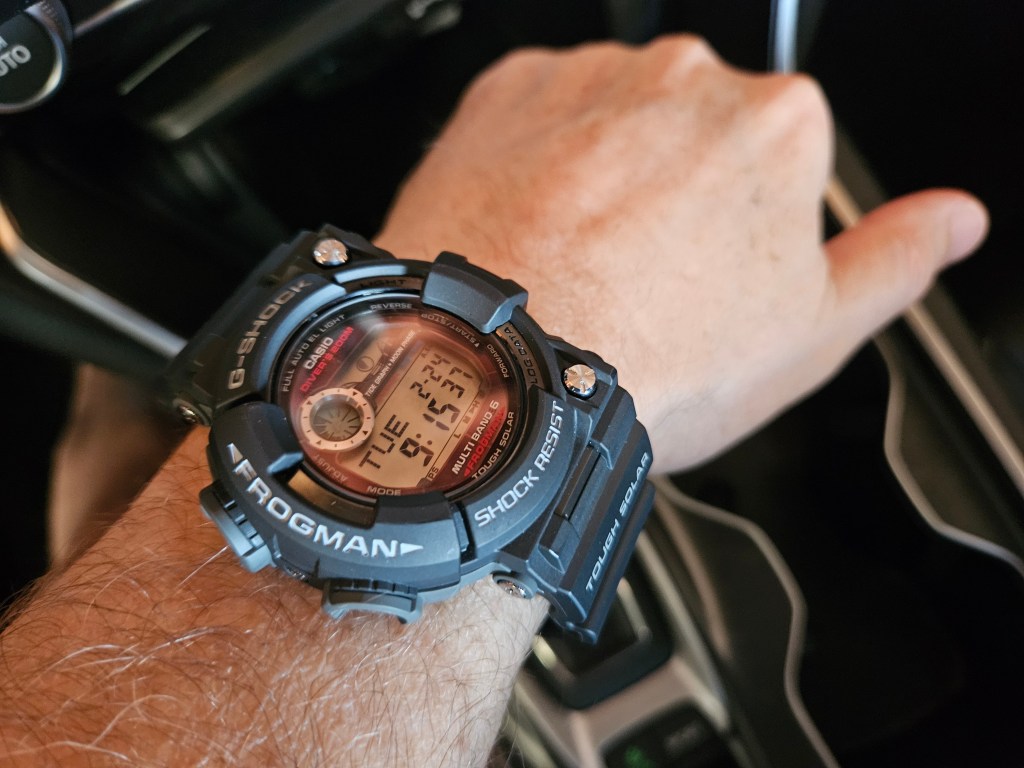
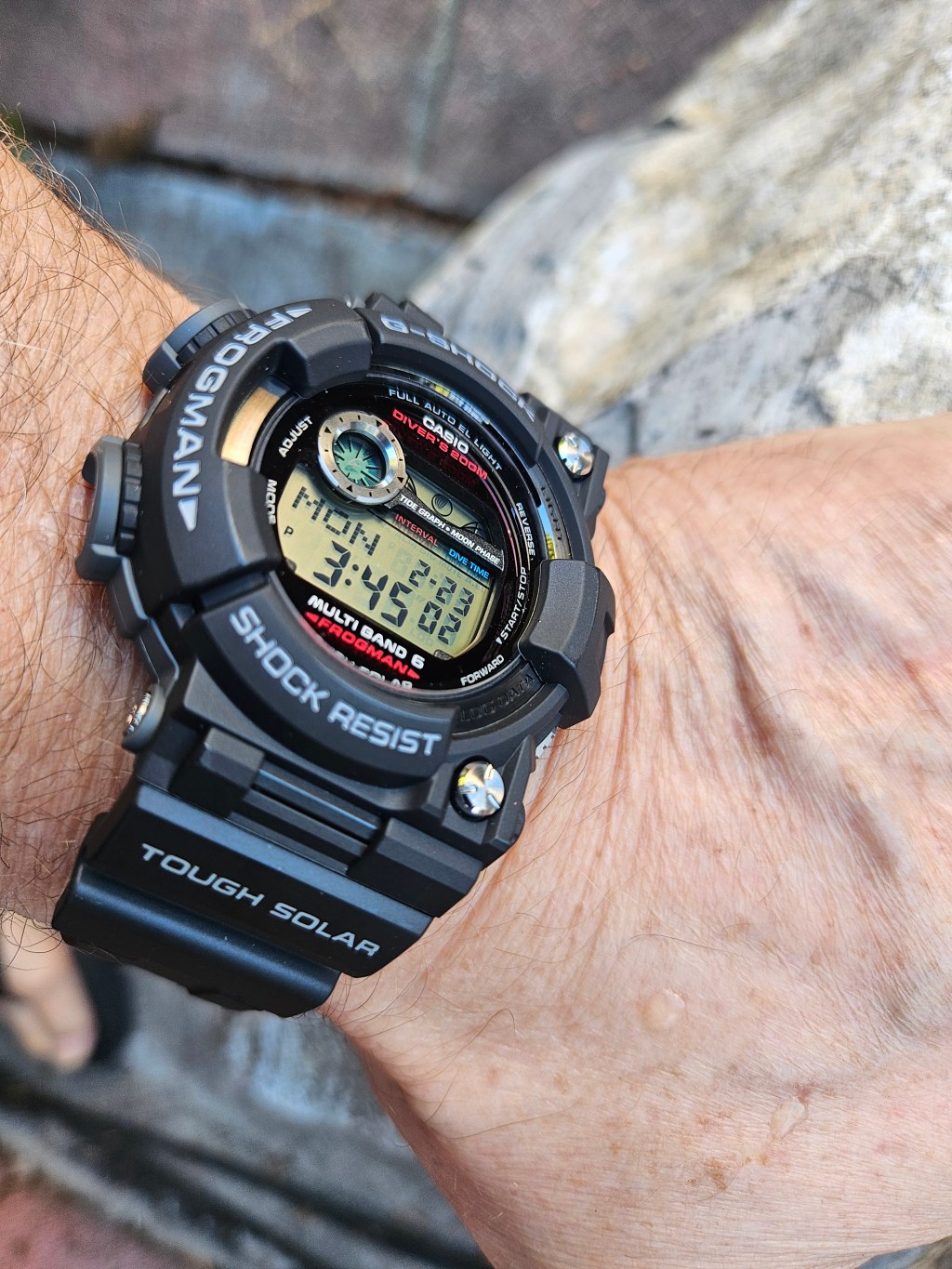
    That old parable came back to me as I stared at my wrist, where a perfectly contented G-Shock Frogman has been living its best life. The temptation, of course, is to “complement” it with a Rangeman GW-9400. Complement is the polite word collectors use when they mean escalate. But a viewer on my YouTube channel issued a quiet warning: the magic of a single perfect Frogman might evaporate the moment I introduce a rival. In other words, I might reach for the reflection and drop the bone.

    This is where the psychology of the watch obsessive turns ruthless. The mind assumes addition will create abundance. In practice, it creates competition. Two watches don’t cooperate; they campaign. Wrist time fragments. Attention splits. The Frogman’s calm authority turns into a rotation debate, and the Rangeman, instead of enhancing the experience, becomes a co-conspirator in low-grade decision fatigue. Each piece loses the gravity it once held alone.

    This is the Watch Potency Principle: the hard law of emotional physics in collecting. The more you add, the weaker each piece becomes. What looks like expansion is often dilution. Instead of one watch with presence, you now have two candidates negotiating for relevance, each diminished by the other’s existence. Potency thrives on focus. Divide the focus, and the magic doesn’t multiply—it thins.

    So here I stand at the edge. The Rangeman might deliver fresh excitement. Or it might turn my singular satisfaction into a committee meeting. Like that dog at the water’s edge, I’m staring at the reflection—wondering whether reaching for more will leave me holding less.

  • The Day the Watch Cyborg Found Me

    The Day the Watch Cyborg Found Me

    I did not wake up one morning and decide to become a watch obsessive. No sober adult says, “My life lacks turmoil. I should find something small, expensive, and unnecessary to dominate my mental real estate.” The watch hobby did not enter politely. It arrived like a chrome-plated cyborg from the future—metallic, relentless, humorless about its mission. If you’ve seen The Terminator, you understand. Something inhuman drops from the sky, scans the room, locks onto a target, and does not blink. That was the watch addiction. It didn’t ask for consent. It assessed, targeted, and possessed.

    The possession began on an unremarkable Sunday in August 2005. My wife and I went to the mall for something innocent: a battery change. On the way out of the store, one foot inside, one foot outside, I turned my head and saw it—my first true enabler—the Citizen Ecozilla. The bezel alone looked like it had been machined for a submarine hatch: thick, L-shaped, deeply notched, unapologetically stainless. It wasn’t elegant. It was infrastructural. I was a lifelong bodybuilder raised on 1970s images of Arnold flexing under theatrical lighting, and there, in that watch case, was a wrist-mounted barbell. I wasn’t a diver. I didn’t own a wetsuit. But I could cosplay as a man who detonates underwater mines before breakfast.

    I walked five feet out of the store, stopped, executed a full U-turn like a man who had left his child behind, and returned for one final look. My inner cyborg engaged photographic memory mode. Screenshot acquired. Target locked. At home, I found it online for $205. That was the down payment on twenty years of psychological turbulence.

    For a year, I wore the Ecozilla daily. Then I committed the first of many aesthetic crimes: I drifted into the swamp of television-brand watches—oversized, gaudy, the horological equivalent of energy drinks. They accumulated in my drawers like glittering mistakes. It took a Seiko Black Monster—first generation, lume like a radioactive halo—to wake me from my stupor. Its quality was not subtle. It was the difference between steak and beef jerky. I sold the TV watches in a purge that felt like shedding adipose tissue on The Biggest Loser. Each sale was a small moral victory.

    And then the real religion began: Seiko diver devotion. Fifteen years of it. SLA models entered the collection, whispered about by influencers as if assembled in some mythic atelier. Whether they were built in a sacred Grand Seiko studio or a fluorescent-lit factory, I didn’t care. They scratched the itch. Or so I told myself.

    Friends loaned me Rolex, Tudor, Omega—fine watches, impressive watches. I enjoyed them the way one enjoys visiting a well-appointed home. But I never felt the urge to move in. Tastes, like obsessions, are not democratic. We do not vote on them. We discover them the way we discover allergies—after the reaction.

    Then came the surprise. At sixty-four, long after I thought my trajectory was fixed, I bought the watch my inner cyborg had been whispering about for a decade: the G-Shock Frogman GWF-1000. It hasn’t left my wrist. Not for ceremony. Not for nostalgia. Not even for the Seiko elders in their box, who now stare at me like retired generals. The Frogman is frictionless. Accurate. Indifferent to admiration. It feels less like a purchase and more like a jailbreak.

    This book is my attempt to understand the madness. It is personal—because the watch cyborg lives in my head—but it is also communal. Over decades, fellow travelers have confessed their anxieties, their grail delusions, their rotation guilt, their midnight research spirals. The watch obsessive speaks a dialect all his own. So I built a lexicon—a taxonomy of the strange mental weather patterns that govern this hobby. I began thinking I might squeeze out a modest essay. Instead, the terms multiplied. The categories metastasized. Sixty thousand words later, I had to concede the obvious: I am sufficiently mad to write a sufficiently long book about it.

    Even now, as I finish this introduction to The Man Who Lost His Mind to Watches, my inner watch cyborg stirs. He is suggesting sapphire upgrade versions of the Frogman. Larger numerals. Limited editions that cost twice what I paid for the one on my wrist. He is persuasive. He does not sleep.

    I protest weakly.

    He is already browsing.

  • The Gospel of the Multiband 6 Solar G-Shock

    The Gospel of the Multiband 6 Solar G-Shock

    If you’re drawn to a Multiband 6 solar G-Shock, you may possess what could be called the engineer mind—the temperament that treats maintenance as failure and automation as a moral good. You don’t want a watch so much as a system instance or virtual machine running on your wrist.

    A proper watch, in your view, should set itself, power itself, correct itself, and never—under any circumstances—require the fussy rituals of mechanical ownership. Manual winding feels like typing commands that should have been automated. Battery changes feel like scheduled downtime. Service intervals feel like flawed architecture. What you want is operational silence: install once, forget forever.

    For you, reliability isn’t a feature; it’s a philosophy. Drift is offensive. Inaccuracy produces low-grade anxiety. Atomic synchronization delivers more than precision—it delivers relief, the quiet satisfaction of knowing the number is exactly right, the emotional equivalent of clean code and zero errors. 

    Solar power satisfies the same instinct. External dependency is weakness. Self-sustaining systems feel intelligent. Over time, the watch stops feeling like an object and starts behaving like a background process—always running, never demanding attention, never crashing.

    Status signaling holds no appeal. Flash invites conversation, and conversation about objects is noise. A Multiband G-Shock communicates competence the way a well-organized server rack does: quietly, efficiently, and without asking to be admired. Like a good waiter, it serves your needs without being intrusive.

    Adding to its appeal, its overbuilt case, shock resistance, and water tolerance reflect your respect for systems designed for field conditions rather than showroom lighting. It performs like good infrastructure—essential, invisible, and indifferent to opinion.

    You may tell yourself it’s just a tool, but the attachment runs deeper. You move through a world that feels increasingly unstable, and the watch becomes an ally in your search for order. Each morning glance is less a habit than a systems check. Did it sync overnight? Is everything aligned? That small confirmation carries disproportionate comfort: something, somewhere, is still working exactly as designed.

    This is the onset of Operational Silence Dependency—the quiet attachment that forms when you come to value a device not for what it does, but for what it never asks you to do. The ideal tool makes no demands, sends no alerts, requires no rituals, and never interrupts your day with the mechanical equivalent of small talk. It sets itself, powers itself, corrects itself, and disappears. Over time, you stop noticing its presence and start depending on its absence of problems.

    You’ll know the shift is complete when you wear it through everything—sleep, showers, travel, deadlines, minor crises—because taking it off feels less like removing a device and more like disconnecting a trusted process.

    The depth of the bond becomes obvious when “upgrades” appear. New models promise new features, but you hesitate. Bluetooth, for example, strikes you as a category error. You prefer Multiband for the same reason a systems administrator prefers a cron job to a phone call: one is infrastructure; the other is a relationship. Atomic sync happens quietly in the night—no pairing, no permissions, no firmware prompts, no cheerful reminders to “stay connected.” Bluetooth drags the watch into the emotional ecosystem of the smartphone: updates, battery anxiety, dropped connections, and the faint suspicion that something somewhere needs your attention.

    Multiband 6 is operational dignity—set once, corrected by physics and radio towers that don’t need passwords. To the engineer mind, atomic time isn’t just elegant. It’s morally superior. Bluetooth asks for interaction. Multiband delivers silence—and silence, in your worldview, is the sound of a system working perfectly.

    So you won’t be replacing your Multiband 6 watch with the new Bluetooth model. The current one has proven itself. Replacing it would feel less like upgrading hardware and more like retiring a colleague who has never missed a deadline.

    Over the years, the watch absorbs your history—projects completed, trips survived, long stretches of life that passed without drift or failure. At that point, it is no longer equipment. It is continuity on the wrist: an uncomplaining witness, a small island of order carried through a world that rarely behaves as predictably as your watch does.

    The story doesn’t stop here. Over time, something subtle happens. The watch stops being something you wear and becomes something you operate with. Your rhythms align. You wake, it has already corrected itself. You move through deadlines, travel, minor crises, and long uneventful stretches, and it keeps the same quiet pace—never drifting, never asking, never failing. You stop thinking about it the way a pilot stops thinking about a reliable instrument: not because it’s unimportant, but because it’s always right. Somewhere along the way, the relationship shifts from ownership to partnership. You handle the chaos; it handles the time. Together you form a small, efficient system—human judgment paired with mechanical certainty. In a noisy, unreliable world, the two of you run clean, synchronized, and uninterrupted, less like a man and his watch and more like a single unit that simply works.

  • The Great Rangeman Dilemma

    The Great Rangeman Dilemma

    You should be grading over a hundred student essays right now—papers waiting patiently for marginal comments, thesis corrections, and the quiet mercy of a final score. Instead, you are wrestling with a question of far greater cosmic importance, a problem so profound it makes theological disputes such as substationary atonement look like small talk: Should you buy the positive or negative display of the G-Shock Rangeman GW-9400?

    After hundreds of hours on Reddit and YouTube—an advanced degree in amateur Rangeman studies—you have learned the central truth of the universe. The negative display looks better. The positive display works better. And now you stand at the fork in the road where beauty and usability glare at each other like rival theologians.

    Choose the negative display and you will live with Legibility Anxiety—the persistent suspicion that your watch looks magnificent but requires negotiation every time you want the hour. Choose the positive display and you inherit Aesthetic Anxiety—the quiet sense that you chose practicality at the expense of tactical cool. Either way, you lose something essential.

    Of course, there is the nuclear option: buy both. But this only deepens the disorder. Now each morning becomes a moral trial. Whichever watch you choose indicts the other. You will experience Rotational Guilt, the daily awareness that satisfaction has been structurally engineered out of the system.

    Welcome to the Great Rangeman Dilemma—the condition in which a minor consumer choice expands into a metaphysical crisis because every option comes preloaded with future regret. Time disappears into comparison videos, comment threads, lighting tests, and wrist shots while your actual obligations—those hundred essays—sit quietly aging like milk on the counter. The dilemma is not about watches. It is about the mind’s ability to convert a simple decision into a no-win psychological contract where perfection is mandatory, satisfaction is temporary, and productivity flatlines.

    Do not berate yourself for failing to solve it. Many have entered this labyrinth. None have emerged with certainty.

    Now close the browser.

    Your students are waiting.

  • The Cure for Function Abandonment Syndrome

    The Cure for Function Abandonment Syndrome

    You encounter a Rangeman owner who worships the stealth blacked-out model with a devotion bordering on performance art. He will tell you, calmly and without irony, that he can’t actually read the time on the negative display. It doesn’t matter. The watch stays on the wrist because it looks lethal—pure shadow, pure attitude, pure presence. Time, apparently, is now a secondary feature.

    Think about the pivot this represents. The man did not buy a timepiece; he bought an image. The geometry, the matte darkness, the tactical aura—these are the real functions. The digits exist somewhere inside the case, like a ceremonial appendix. If the light is right and the wrist is angled just so, the hour may reveal itself. But that’s incidental. The watch is no longer consulted. It is displayed.

    He resembles the fellow who once insisted he read glossy magazines for the articles, only to admit later that the articles had become irrelevant long ago. Content is gone. Only the visuals remain. In the same way, this enthusiast has crossed the line from horology to aesthetic intoxication. The watch no longer tells time. It tells a story about the man wearing it.

    Such a man is suffering from Function Abandonment Syndrome—the condition that sets in when a watch enthusiast quietly releases the expectation that the watch perform its basic task and begins wearing it purely for appearance, mood, or identity. Legibility becomes optional. Accuracy becomes theoretical. The time is technically available somewhere—under ideal lighting, at a cooperative angle—but that’s no longer the point. The owner has crossed the invisible threshold where tool becomes sculpture and utility becomes a nostalgic rumor. He doesn’t check the watch anymore; he acknowledges it. Function Abandonment Syndrome is what happens when style overwhelms purpose and the job description is politely retired without ceremony.

    Is there a cure for his condition? Yes. Imagine this: He lives happily in the glow of his blacked-out Rangeman until the day function suddenly matters again. Picture this: he’s driving a lonely stretch of highway at dusk when the fuel light comes on and the next gas station is closing in five minutes. His phone is dead. The dashboard clock is gone. All he has is the watch he chose for its “presence.” He lifts his wrist. Tilts. Squints. Rolls it toward the fading light like a man trying to read smoke signals from the wrist. The digits hover there, shy and evasive, revealing nothing but his own poor life choices. The station lights flicker off in the distance. In that moment—heart rate climbing, range dropping, darkness settling—he experiences the cold, clarifying terror that ends Function Abandonment Syndrome forever. Because style is thrilling in the showroom. But when the world gets real, the most beautiful watch on earth is the one that will tell you the time the first time you ask.

  • Avoid the Trap of Negative Display Frustration

    Avoid the Trap of Negative Display Frustration

    You saw them everywhere—YouTube thumbnails glowing with reverence, Reddit threads humming like revival meetings. The stealth blacked-out Rangeman was spoken of in near-mythic tones: the ultimate G-Shock, the watch for men who preferred shadow to spotlight. Yes, a few owners admitted the legibility could be… aspirational. But they waved off the concern with a shrug and a grin. One YouTuber confessed he could barely read the time at all, then declared it didn’t matter because he was “Mr. Rangeman.” He slipped into his convertible, wrist angled heroically toward the camera, and drove into the sunset wearing a watch he couldn’t read. He looked happy. Convincingly happy. You believed him.

    You loved the look too. This wasn’t vanity, you told yourself—it was discipline. The negative display felt tactical, restrained, professional. Less gadget, more issued equipment. On the wrist it carried authority without noise. In photos it was perfect: dark, serious, quietly dangerous. The positive display suddenly seemed cheerful, almost friendly—the wristwear equivalent of smiling too much in a job interview. You chose the darker path, convinced you were choosing character over comfort.

    At first, the illusion held. Outdoors, under strong light, the display looked sharp and purposeful. The watch projected competence. It matched the identity you’d purchased along with it: efficient, understated, immune to flash. But then the watch met real life—offices with flat lighting, restaurants with mood lighting, mornings before coffee, evenings after fatigue, quick glances from imperfect angles. The time was always there in theory. In practice, it behaved like a reluctant witness.

    This is the quiet prelude to Negative Display Frustration—the slow erosion that begins when a watch chosen for its stealthy authority requires negotiation for the basic privilege of reading the hour. It starts small: a longer glance indoors, a wrist tilt here, a button press there. Over time, the effort accumulates into low-grade irritation. The display still looks magnificent, but the relationship has shifted. The watch no longer serves effortlessly; it asks for cooperation.

    And the case studies are everywhere. Thousands of owners eventually surrender, trading their negative Rangeman for the positive version and reporting something close to psychological recovery. The lesson is not subtle. In the long run, aesthetics create admiration—but legibility creates peace. Cool impresses the eye. Clarity keeps the mind quiet.

  • Power Jewelry Rejection

    Power Jewelry Rejection

    Many of you have written to me about your migration from luxury mechanical watches to G-Shocks. In your telling, it wasn’t a casual shift. It was a renunciation. The grails were sold, the bracelets retired, the safe emptied. The wrist went digital and never looked back.

    Your stories are not universal. They are personal, situational, shaped by your own history with status, money, and identity. But taken together, they reveal a pattern worth examining.

    The turning point for many of you was a growing discomfort with what your watches had become: power jewelry. The grail that once represented achievement began to feel like a performance—an expensive signal broadcast to strangers. What had felt like success started to feel like theater. The watch no longer told time. It told a story about you, and you were tired of telling it.

    That moment marked the beginning of Power Jewelry Rejection.

    Power Jewelry Rejection is the instant a collector looks down and realizes he isn’t wearing a tool—he’s wearing a résumé. The rejection isn’t driven by finances or fashion. It comes from fatigue with the performance itself. The grail is sold. In its place comes something blunt, durable, socially invisible. And with that change comes an unexpected sensation: relief. Not the thrill of acquisition, but the quiet authority of no longer needing to explain yourself. This isn’t anti-luxury. It’s anti-broadcast. The real power is wearing a watch that does its job and asks nothing about your status in return.

    Once the performance ends, something else appears: a different kind of attachment.

    Many of you described a bond with your G-Shocks that never existed with your luxury pieces. Not pride. Not admiration. Something quieter. The watch became a companion rather than a symbol. You wore it hard. You stopped worrying about it. You trusted it. The relationship shifted from ownership to reliance. For the first time, the watch served you instead of representing you.

    Interestingly, this conversion produced very little missionary zeal.

    There was no urge to persuade others, no need to defend the choice. G-Shock Nation, as you quickly discovered, requires no recruitment. The community is vast, stable, and unconcerned with validation. Evangelism felt unnecessary, even absurd. Confidence made persuasion irrelevant.

    But honesty required one more admission.

    Yes, you had abandoned the idolatry of luxury. But you had not escaped devotion. You had simply changed altars. The emotional intensity remained—only the object had become more practical, more affordable, less socially conspicuous. The new attachment felt healthier, but it was still an attachment.

    And here is where the tone of your stories becomes notable: there was no triumphalism.

    You did not claim enlightenment. You did not declare moral victory. You acknowledged the obvious truth: you hadn’t left consumerism. You had changed its form. The new version felt cleaner, quieter, more aligned with your values. Less performance. More use. Less anxiety. More stability.

    No revolution. Just a recalibration.

    And that may be the most honest outcome the watch hobby ever produces.

  • You Are in the State of Watch Sovereignty

    You Are in the State of Watch Sovereignty

    Much to your surprise, you’ve fallen in love with a watch—and the evidence isn’t emotional. It’s behavioral. The watch won’t come off.

    You try to rotate. After all, there are other watches in the box—serious watches, expensive watches, watches that once occupied entire weeks of your attention. They deserve wrist time. You reach for the box.

    And then you don’t open it.

    The watch stays on.

    It isn’t a decision. It’s a quiet takeover. The watch has moved past preference and into authority. You don’t command it. It commands you. Rotation is no longer a system; it’s a memory. The rest of the collection waits like passengers at a station where the trains no longer stop.

    What surprises you most is your reaction.

    You feel relief.

    No more morning negotiations. No more outfit coordination. No more low-grade anxiety about neglecting the others. The wheel of choice has stopped spinning, and with it goes a constant, invisible mental tax. The watch is driving now, and you’re happy to sit in the passenger seat and watch the scenery.

    You have entered the realm of Wrist Sovereignty.

    This is the moment when one watch quietly dissolves the democracy of your collection and installs itself as a benevolent dictator. There is no ceremony, no dramatic declaration. One day you simply stop reaching for alternatives. The others remain—polished, impressive, expensive—but they now resemble retired generals: decorated, respected, and no longer deployed.

    The sovereign holds power for a simple reason: it never gives you a reason to remove it. It’s comfortable. Accurate. Reliable. Emotionally frictionless. It doesn’t ask to be protected, admired, or managed. It just works, and it keeps working.

    The true miracle of Wrist Sovereignty isn’t dominance.

    It’s peace.

    The endless comparison loops disappear. The rotation strategies evaporate. The hobby stops being a daily decision and becomes a settled fact. You are no longer managing your watches.

    The watch is managing you.

    And in the rare political systems of the wrist, this is the one where surrender feels like freedom—and the ruler gives you your time back.

  • Treat Your Watches Like Playlists, Not Religion

    Treat Your Watches Like Playlists, Not Religion

    For decades, your identity was secure. High-end mechanical divers. Steel, weight, heritage, tolerances measured in microns. A small, loyal brotherhood of engineering purity lived in your watch box, and you knew exactly who you were.

    Then the fairy tale cracked.

    A G-Shock Frogman entered your life.

    You told yourself it was a novelty. A tool. A temporary experiment.

    Then came the Rangeman.
    Then the premium Square.

    Now you’re standing over your watch box like a man who has betrayed his own lineage.

    Who am I?
    What have I done?
    What happened to my mechanical diver heritage?

    Relax.

    You’re not having a crisis. You’re experiencing Genre Guilt.

    Genre Guilt is the uneasy sensation that enjoying a new category somehow betrays the old one. The mechanical diver sits in the box like a disappointed mentor while the G-Shock hums cheerfully on your wrist, and suddenly you feel the need to justify yourself—to your friends, to your former self, possibly to the watches themselves.

    But the anxiety has nothing to do with enjoyment or function. It comes from a simple mistake: treating collecting like a moral code instead of a mood.

    Here’s the truth.
    Watches are not a marriage.
    Categories are not religions.
    Your collection is not a pledge of allegiance.

    It’s a playlist.

    Your streaming app doesn’t panic when you move from jazz to electronic. It doesn’t accuse you of betraying classical. It simply plays what fits your mood.

    Your collection works the same way.

    Mechanical divers: one playlist.
    G-Shocks: another.

    Millions of collectors do this. You haven’t broken tradition. You haven’t reinvented the hobby. You’re not undergoing a transformation.

    You’re a suburban enthusiast who briefly mistook preference for drama.

    So take a breath. Close the courtroom in your head. There is no betrayal here.

    Add the playlist. Wear the Frogman. Enjoy the Square.

    Your blood pressure—and your hobby—will run a lot smoother once you stop treating mood swings like moral events. Instead, treat your watches like playlists, not religion.