Tag: writing

  • You Are in the State of Watch Sovereignty

    You Are in the State of Watch Sovereignty

    Much to your surprise, you’ve fallen in love with a watch—and the evidence isn’t emotional. It’s behavioral. The watch won’t come off.

    You try to rotate. After all, there are other watches in the box—serious watches, expensive watches, watches that once occupied entire weeks of your attention. They deserve wrist time. You reach for the box.

    And then you don’t open it.

    The watch stays on.

    It isn’t a decision. It’s a quiet takeover. The watch has moved past preference and into authority. You don’t command it. It commands you. Rotation is no longer a system; it’s a memory. The rest of the collection waits like passengers at a station where the trains no longer stop.

    What surprises you most is your reaction.

    You feel relief.

    No more morning negotiations. No more outfit coordination. No more low-grade anxiety about neglecting the others. The wheel of choice has stopped spinning, and with it goes a constant, invisible mental tax. The watch is driving now, and you’re happy to sit in the passenger seat and watch the scenery.

    You have entered the realm of Wrist Sovereignty.

    This is the moment when one watch quietly dissolves the democracy of your collection and installs itself as a benevolent dictator. There is no ceremony, no dramatic declaration. One day you simply stop reaching for alternatives. The others remain—polished, impressive, expensive—but they now resemble retired generals: decorated, respected, and no longer deployed.

    The sovereign holds power for a simple reason: it never gives you a reason to remove it. It’s comfortable. Accurate. Reliable. Emotionally frictionless. It doesn’t ask to be protected, admired, or managed. It just works, and it keeps working.

    The true miracle of Wrist Sovereignty isn’t dominance.

    It’s peace.

    The endless comparison loops disappear. The rotation strategies evaporate. The hobby stops being a daily decision and becomes a settled fact. You are no longer managing your watches.

    The watch is managing you.

    And in the rare political systems of the wrist, this is the one where surrender feels like freedom—and the ruler gives you your time back.

  • Treat Your Watches Like Playlists, Not Religion

    Treat Your Watches Like Playlists, Not Religion

    For decades, your identity was secure. High-end mechanical divers. Steel, weight, heritage, tolerances measured in microns. A small, loyal brotherhood of engineering purity lived in your watch box, and you knew exactly who you were.

    Then the fairy tale cracked.

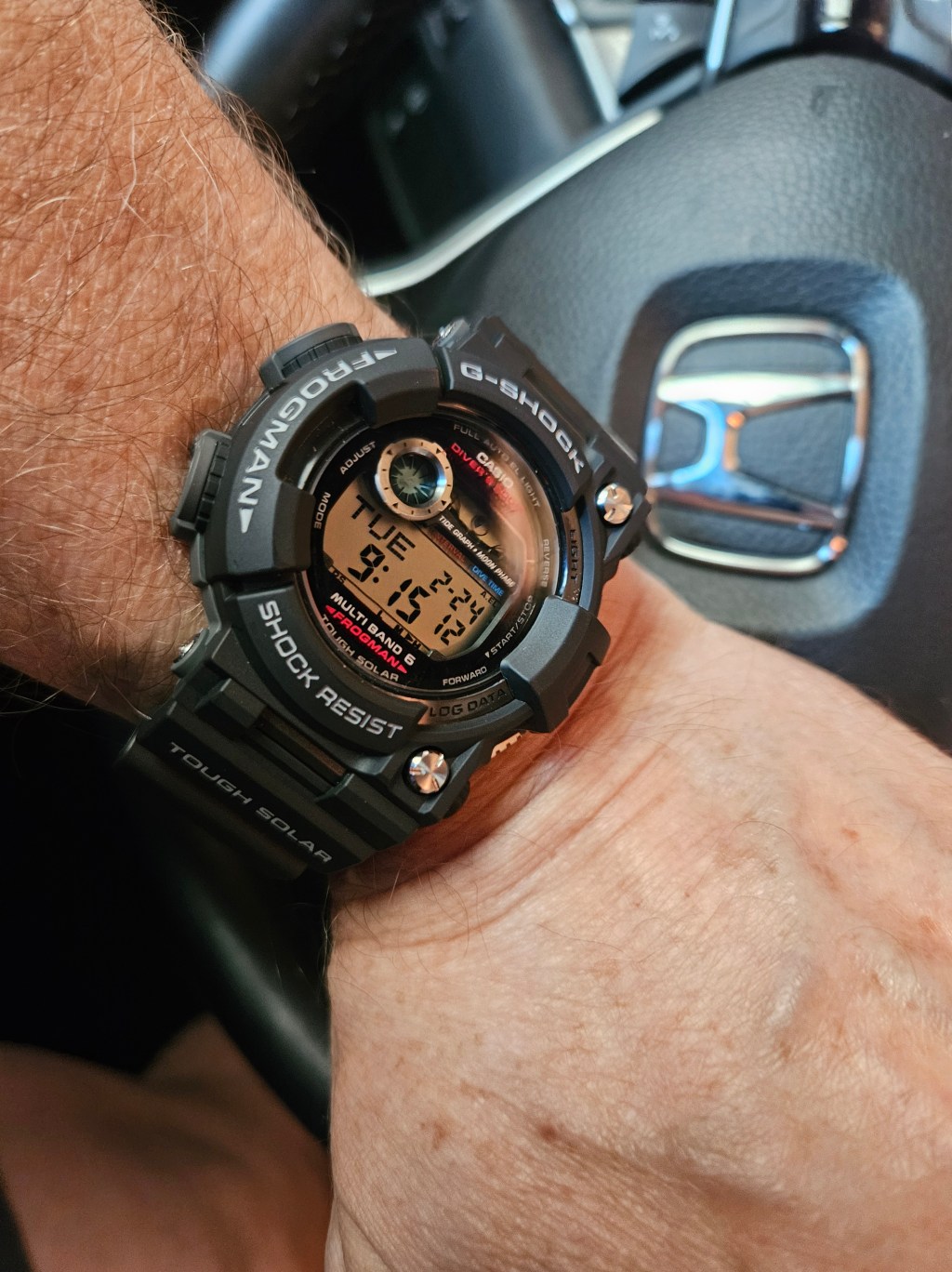
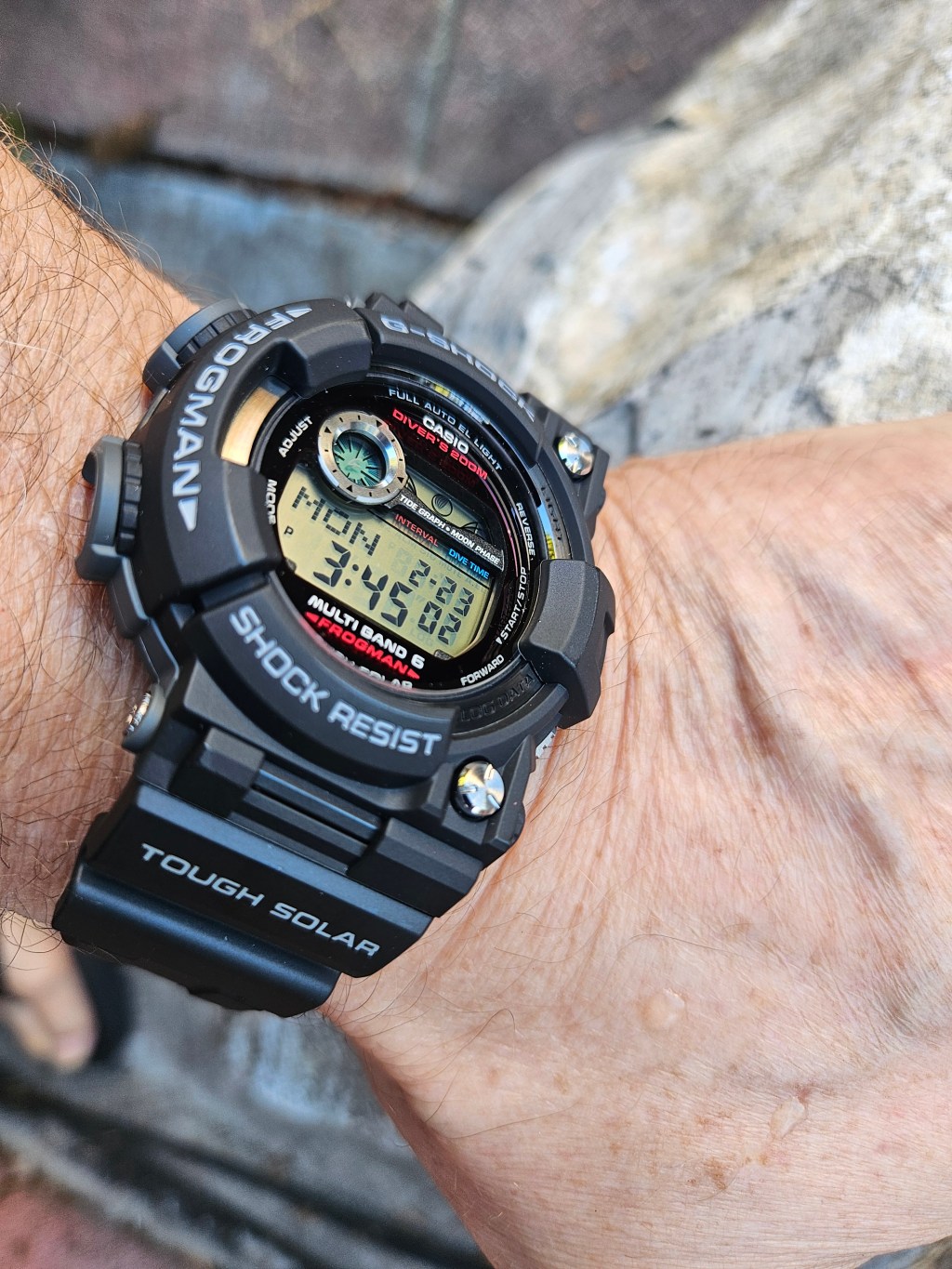
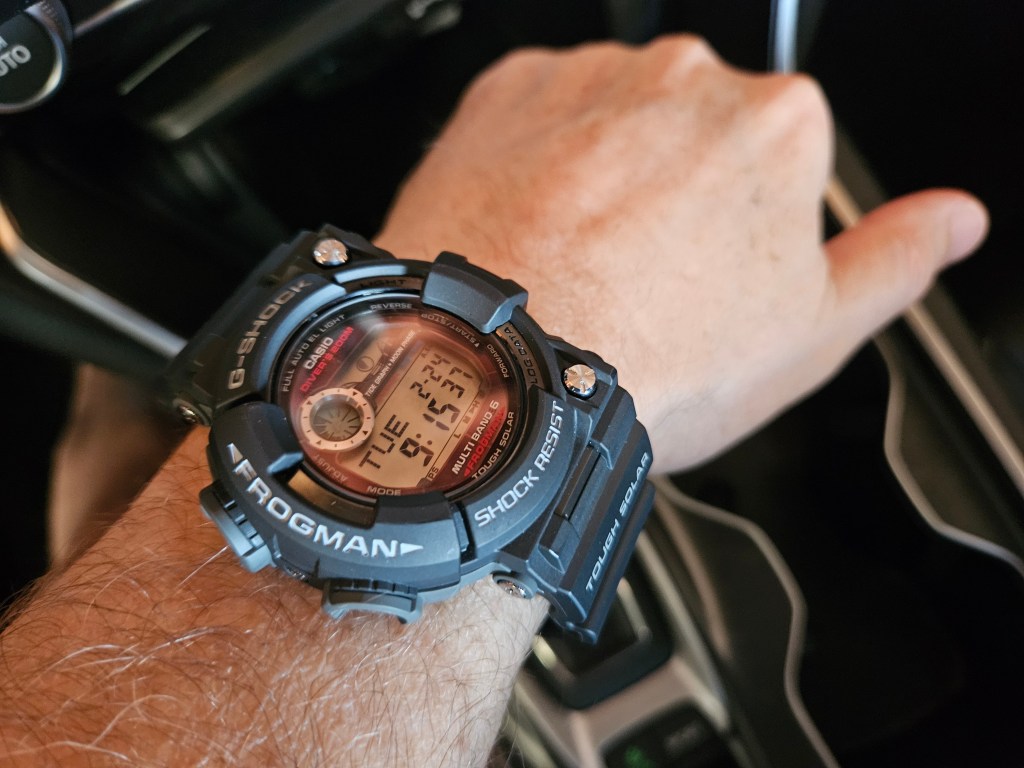
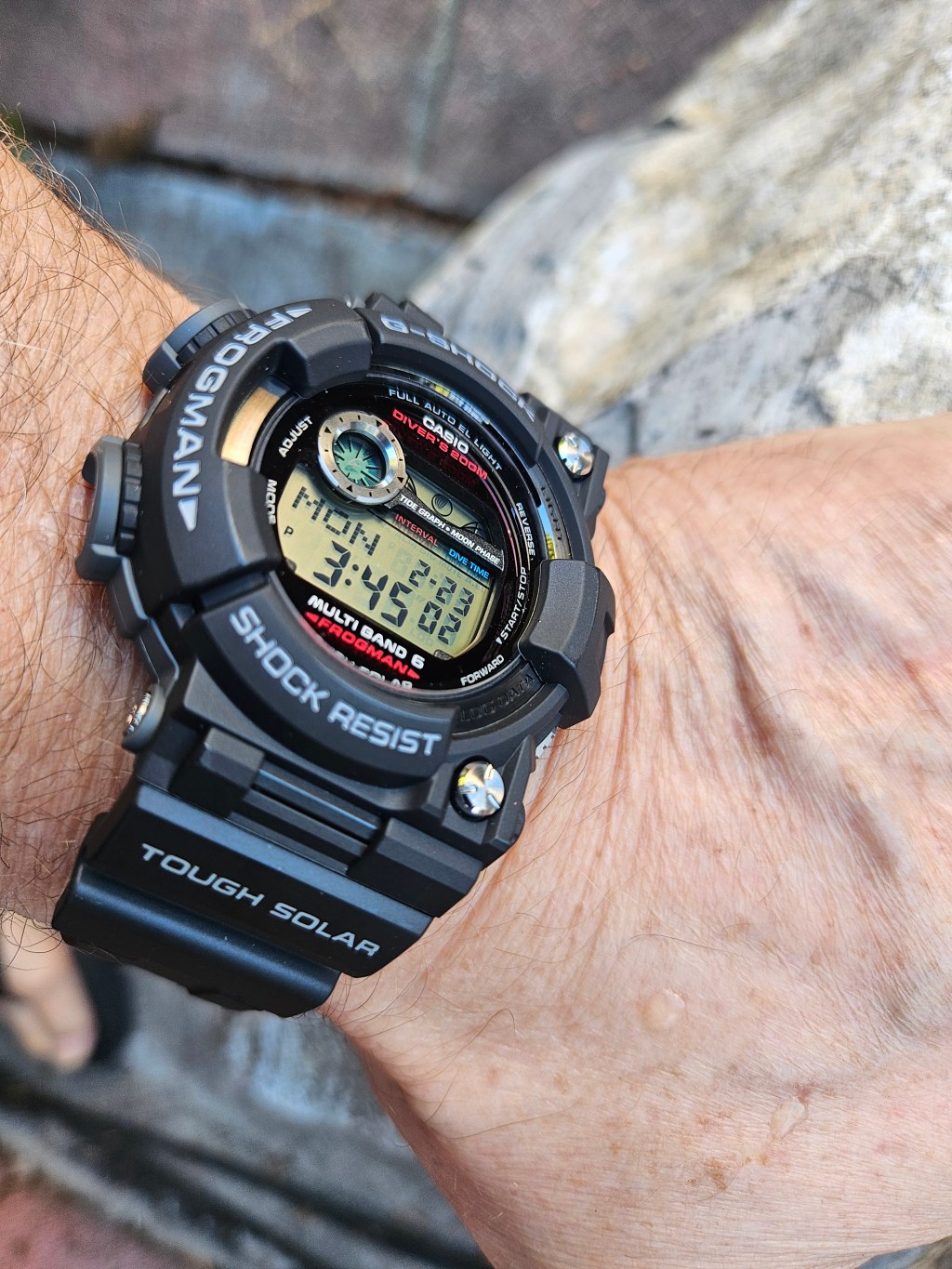
    A G-Shock Frogman entered your life.

    You told yourself it was a novelty. A tool. A temporary experiment.

    Then came the Rangeman.
    Then the premium Square.

    Now you’re standing over your watch box like a man who has betrayed his own lineage.

    Who am I?
    What have I done?
    What happened to my mechanical diver heritage?

    Relax.

    You’re not having a crisis. You’re experiencing Genre Guilt.

    Genre Guilt is the uneasy sensation that enjoying a new category somehow betrays the old one. The mechanical diver sits in the box like a disappointed mentor while the G-Shock hums cheerfully on your wrist, and suddenly you feel the need to justify yourself—to your friends, to your former self, possibly to the watches themselves.

    But the anxiety has nothing to do with enjoyment or function. It comes from a simple mistake: treating collecting like a moral code instead of a mood.

    Here’s the truth.
    Watches are not a marriage.
    Categories are not religions.
    Your collection is not a pledge of allegiance.

    It’s a playlist.

    Your streaming app doesn’t panic when you move from jazz to electronic. It doesn’t accuse you of betraying classical. It simply plays what fits your mood.

    Your collection works the same way.

    Mechanical divers: one playlist.
    G-Shocks: another.

    Millions of collectors do this. You haven’t broken tradition. You haven’t reinvented the hobby. You’re not undergoing a transformation.

    You’re a suburban enthusiast who briefly mistook preference for drama.

    So take a breath. Close the courtroom in your head. There is no betrayal here.

    Add the playlist. Wear the Frogman. Enjoy the Square.

    Your blood pressure—and your hobby—will run a lot smoother once you stop treating mood swings like moral events. Instead, treat your watches like playlists, not religion. 

  • The Geology of Your Obsession

    The Geology of Your Obsession

    You’re three-quarters of the way through a book about the madness of the watch hobby when the plot turns on you.

    The culprit is your first G-Shock—specifically, the digital Frogman GWF-1000. You expected a curiosity, maybe a temporary diversion. What you got instead was a new form of obsession. Not stronger than your mechanical diver fixation. Not weaker. Just different—like discovering that the disease you thought you understood has multiple strains.

    You didn’t see it coming.

    Some of your watch friends are unimpressed. They never drank the G-Shock Kool-Aid, or they did once and recovered. To them, the brand is soulless—plastic, clinical, emotionally sterile. A tool without romance.

    They’re wrong.

    G-Shock has a soul. It’s just a different kind of soul—one built from precision, autonomy, indifference to status, and the moral clarity of a watch that refuses to pretend it’s jewelry. And with that soul comes its own species of madness: atomic-sync monitoring, solar anxiety, display legibility debates, module archaeology, and the quiet satisfaction of a machine that never asks for your attention and never apologizes for it.

    The revelation is unsettling.

    You thought watch madness was a single condition. Mechanical romance, heritage narratives, the poetry of gears. But the Frogman teaches you something more troubling: this hobby doesn’t produce one madness. It produces subgenres. Each category brings its own emotional logic, its own rituals, its own vocabulary of justification. Your mind begins to look less like a collection strategy and more like a geological survey—layers of enthusiasm stacked over time like soil, shale, coal, and volcanic glass.

    You now live in a state of Layered Madness.

    Layered Madness is the realization that obsession in this hobby doesn’t replace itself—it accumulates. What feels like a fresh start—I’m done with mechanical divers; now I’m a G-Shock guy—isn’t a reset. It’s a new deposit in an expanding psychological landscape. Each phase arrives with total confidence that this is the rational version of the hobby. Meanwhile, the earlier passions don’t disappear. They settle below the surface—compressed, preserved, and waiting for the right emotional pressure to re-emerge.

    Over time, the enthusiast stops being a collector of watches and becomes an archaeologist of his own compulsions.

    Layered Madness is the moment you understand the truth: you’re not evolving beyond obsession.

    You’re building a cross-section of it.

  • When Enthusiasm Becomes a Sermon

    When Enthusiasm Becomes a Sermon

    Your fellow watch obsessives will tolerate your excitement—up to a point. Enthusiasm is welcome. Testimony is not. There comes a moment when you cross the invisible line from collector to missionary, and that’s when the room cools. The wrist shots multiply. The tone shifts. Conversations begin to sound less like sharing and more like recruitment. That’s when your friends deliver the social equivalent of a gentle intervention: Get a room.

    What they’re reacting to is Acquisition Afterglow—that brief, intoxicating window after a new watch arrives when the purchase doesn’t merely feel satisfying; it feels revelatory. The watch appears flawless. Doubts evaporate. The owner speaks with the calm authority of a man who has solved time itself. Posting frequency increases. Explanations lengthen. The watch stops being an object and becomes a philosophy. The danger isn’t the joy. The danger is the certainty. What feels like permanent clarity is usually just dopamine with a publicist.

    This is especially true when the revelation is G-Shock. You strap on atomic accuracy, solar autonomy, and blunt utility, and suddenly the mechanical world looks theatrical, sentimental, inefficient. It feels like you’ve discovered plutonium. But here’s the problem: millions discovered it before you. Some stayed in G-Shock Fever for life. Others burned hot for a year or two and drifted back to gears and springs. The experience feels revolutionary. Historically, it’s routine.

    So when the community quietly labels you a Watch Evangelist, the correct response is not denial—it’s calibration. Acknowledge the afterglow. Admit the volume got high. Then stop apologizing. Because enthusiasm is honest, and honesty is the only currency that matters in a hobby built on obsession.

    What you must make clear is this: you are not prescribing. You are not declaring a final truth. You are reporting weather conditions from your wrist. Today it’s G-Shock. Tomorrow, who knows. The emotional terrain shifted—that’s the story. The future is not.

    This is the posture of maturity in the hobby. Not certainty. Not conversion.
    You are not a Watch Evangelist.
    You are a Watch Agnostic.

  • The Watch That Doesn’t Need Your Approval

    The Watch That Doesn’t Need Your Approval

    Spend enough time in the comment section of a G-Shock review and you’ll see the same confession repeated with surprising consistency: I own Rolex. I own Omega. I own watches worth thousands. But my G-Shock gives me more satisfaction.

    Most people leave it there, baffled by their own admission.

    The explanation, however, is not mysterious. It has a name: Utility Purity.

    Utility Purity is what happens when a watch does exactly what a watch is supposed to do—accurate time, legible display, solar power, atomic synchronization, shock resistance, dependable alarms and timers—and refuses to turn the experience into anything more complicated than that. The effect feels like truth. No symbolism. No heritage narrative. No prestige hierarchy. Just performance. Luxury watches can be beautiful, but they also carry social meaning. A G-Shock feels like choosing function over theater—and for many people, that choice feels like integrity, especially after years of wearing objects that double as personal statements.

    Utility Purity also delivers something rarer than accuracy: cognitive ease.

    A G-Shock is psychologically light. No winding schedule. No time drift to monitor. No anxiety about door frames, desk edges, or metal bracelets scratching polished surfaces. No constant background calculation about risk and wear. The brain relaxes because the object doesn’t require caretaking. Luxury ownership often includes a quiet layer of vigilance. G-Shock satisfaction comes from the opposite experience—the relief of a tool that refuses to become a relationship.

    There’s another benefit: freedom from social noise.

    Luxury watches speak even when you don’t. They invite attention, assumptions, silent status calculations, and the occasional internal question: What does this say about me? A G-Shock shuts that conversation down. It’s socially neutral. Invisible. The pleasure becomes private. Much of the satisfaction comes from negative space—the absence of being evaluated.

    Then there is the emotional power of reliability.

    Atomic synchronization. Solar autonomy. Shock and water resistance. The message is simple: This will not fail you. Humans attach quickly to dependable systems. The watch becomes a small island of certainty—always correct, always ready, always indifferent to your moods. Mechanical charm offers personality. Utility Purity offers security. For many people, certainty is the deeper comfort.

    Finally, Utility Purity produces a cleaner dopamine cycle.

    Luxury acquisitions often follow a dramatic curve: anticipation, unboxing euphoria, validation, then the quiet descent into worry, justification, and the next rung of the ladder. G-Shocks operate differently. Lower cost. Lower risk. Fewer regrets. You wear them hard, not carefully. The emotional pattern shifts from I need to justify this to I can just use this.

    And that difference matters.

    Because in the end, Utility Purity isn’t about affordability.

    It’s about the rare satisfaction of owning something that asks nothing from you—no protection, no explanation, no performance.

    It just works.

    And after a lifetime of managing objects that carry meaning, status, and expectation, that kind of silence can feel like freedom.

  • Lost Inside the Time Matrix

    Lost Inside the Time Matrix

    Fun has never come naturally to me. When laughter showed up in my life, it arrived like an unscheduled visitor—pleasant, surprising, and slightly suspicious. Childhood wasn’t organized around fun. It was organized around performance, comfort, and controlled pleasure. If reality felt unpredictable, I built systems to keep it at a safe distance.

    Bodybuilding became one of those systems.

    I loved the structure. The measurable progress. The illusion that strength and discipline could turn life into something orderly and manageable. But let’s be honest: bodybuilding wasn’t fun. It was work disguised as purpose. My real occupation wasn’t lifting weights. It was self-soothing.

    And like any good neurotic, once I found a soothing routine, I locked onto it with the emotional flexibility of a steel beam.

    One week before placing second in the Mr. Teenage San Francisco contest, I finished a psychology exam and was talking after class with a girl who looked like she had been designed by a committee of Renaissance painters. Roxanne was nearly six feet tall, with sharp cheekbones, green eyes that moved slowly and confidently, and long honey-colored hair that suggested she lived in better weather than the rest of us.

    She invited me to the campus ale house. We could talk psychology. And, presumably, other matters.

    I checked my watch.

    It was Pec Day.

    I declined.

    There it was: paradise extending an invitation, and me consulting my schedule like a prison guard checking the lights-out list.

    I wasn’t choosing discipline over fun. I was trapped inside time itself. The routine didn’t support my life—it enclosed it. Roxanne wasn’t competing with the gym. She was competing with the system that kept the world at a safe emotional distance.

    The watch hobby operates in much the same way.

    At its core, it is a self-soothing mechanism—precision, order, control, measurable certainty in a world that offers very little of any of those things. But when the soothing becomes rigid, something strange happens. You stop living in time and start living inside a time matrix, where research replaces experience and optimization replaces spontaneity.

    At that point, the enthusiast risks becoming what the world casually calls a nerd—not someone who loves a subject, but someone who uses structure to avoid the unpredictable mess of actual life.

    The deeper lesson is the danger of the Schedule Fortress.

    A Schedule Fortress begins as discipline and ends as defense. Every hour has a purpose. Every deviation feels like a breach. Spontaneity becomes a hostile force that must be repelled. Inside the walls, you feel productive, controlled, even virtuous.

    But the cost is quiet and cumulative.

    Invitations get declined. Detours get avoided. Unexpected moments bounce off your life like rain off concrete.

    What began as time management slowly becomes life management.

    Then life avoidance.

    The fortress protects you from chaos, disappointment, and uncertainty.

    Unfortunately, it also protects you from surprise, connection, and the inconvenient truth that the best moments rarely arrive on schedule.

    Somewhere out there, Roxanne is still waiting at the ale house.

    And it’s still Pec Day.

  • When the Hobby Becomes the Opponent

    When the Hobby Becomes the Opponent

    The three-season comedy Loudermilk follows Sam Loudermilk, a recovering alcoholic played by Ron Livingston with the weary eyes and emotional gravity of a man who has seen too much of himself. Loudermilk is a music critic and group-therapy counselor operating out of a church run by a priest who tolerates him the way a landlord tolerates a tenant who pays on time but keeps starting small fires. Loudermilk insults everyone in sight—clients, friends, strangers, furniture—but beneath the sarcasm is a man fighting the most difficult opponent there is: himself. The misfits around him bicker, sabotage one another, and occasionally behave like emotional demolition crews, yet they remain bound by a shared reality. Addiction is not a single enemy. It is a civil war.

    Watching the show clarified something about obsessive personalities: the real damage comes from the voice inside the head. Addicts rarely need outside criticism. They are already running a full-time internal tribunal.

    Watch obsessives understand this well.

    Many of us live under a regime of Precision Self-Punishment—the habit of applying the same microscopic standards we use to judge watches to our own decisions, purchases, impulses, and regrets. Alignment must be perfect. Judgment must be flawless. Every mistake is measured in tolerances.

    The community, like Loudermilk’s circle, exists partly for the same reason: belonging. We gather because the outside world doesn’t understand why a dial texture can occupy the mind for hours or why a purchase can trigger both joy and self-reproach. We come looking for a place where our obsession isn’t dismissed—and where our self-criticism might soften.

    But there’s a pattern most enthusiasts eventually recognize.

    We are too hard on ourselves.

    We laugh at the madness. We make jokes about “the addiction.” But the humor doesn’t erase the anxiety, the late-night research spirals, the quiet exhaustion that comes from caring too much, too often, for too long.

    The deeper problem isn’t weakness.

    It’s stamina.

    Obsessive personalities can endure astonishing amounts of mental strain. We can run the hobby like a marathon at sprint pace—research, compare, doubt, regret, repeat—long after the activity has stopped being restorative.

    At some point, exhaustion becomes the only honest signal.

    That’s when a few enthusiasts do something radical: they tap out.

    No drama. No manifesto. They simply stop. They step back, lie down on the mat, and let the hobby breathe without them. Some return later with healthier boundaries. Others recognize that the hobby has become a 300-pound opponent they were never meant to fight and quietly leave the ring for good.

    This moment is the Tap-Out Threshold.

    It’s the point where the hobby has crossed an invisible line—from pleasure to pressure, from curiosity to compulsion. What once gave energy now drains it. Late-night research feels heavy instead of exciting. The next purchase feels like obligation instead of discovery.

    And here’s the crucial part: the threshold does not arrive with drama.

    It arrives with fatigue.

    At that point, the solution is no longer refinement, consolidation, or one final “correction purchase.” The solution is surrender—stepping back, stepping away, or stepping out entirely.

    The Tap-Out Threshold isn’t failure.

    It’s the moment when clarity finally outweighs momentum—and the enthusiast chooses peace over the fight.

  • Cultural Laundering: How Icons Lose Their Soul

    Cultural Laundering: How Icons Lose Their Soul

    Something strange happened to Dark Side of the Moon. It didn’t fade. It didn’t age. It got laundered.

    The damage began when a Circuit City commercial decided the album’s atmosphere was perfect for selling surround sound. The ad ran constantly—radio, television, everywhere—until the music stopped belonging to Pink Floyd and started belonging to electronics. The songs no longer opened a private space; they demonstrated speaker range. Listening became confusing, like running into an old friend who now works exclusively as a showroom model.

    The music itself hadn’t changed, but the experience had. Its emotional chemistry felt altered. The closest comparison is a fine wool sweater tossed into a hot wash and a brutal dry cycle. You pull it out and the fibers are technically still there, but the shape is warped, the color dulled, the elegance gone. Popular culture does not use the gentle setting. It scours, shrinks, and standardizes. What comes back looks familiar and feels counterfeit.

    This isn’t an indictment of Dark Side of the Moon. The loss isn’t in the album. The loss is in the relationship. I simply can’t hear it the way I once did.

    The Beatles present the same problem on a larger scale. Their music arrives with a convoy—decades of mythology, endless airplay, cultural worship. Some songs have been polished into museum glass. I don’t dislike “Blackbird.” I’m exhausted by it. I could go the rest of my life without hearing it again. Yet “Hey Jude” and “Something” still breathe for me. Not everything survives the laundering equally.

    The same phenomenon explains my resistance to Rolex. The watches may be superb, but the brand has been scrubbed and pressed into a universal symbol of success. People who know nothing about watches know Rolex. That level of cultural saturation creates distance. I’m not looking at a tool or a piece of craft. I’m looking at a billboard strapped to a wrist.

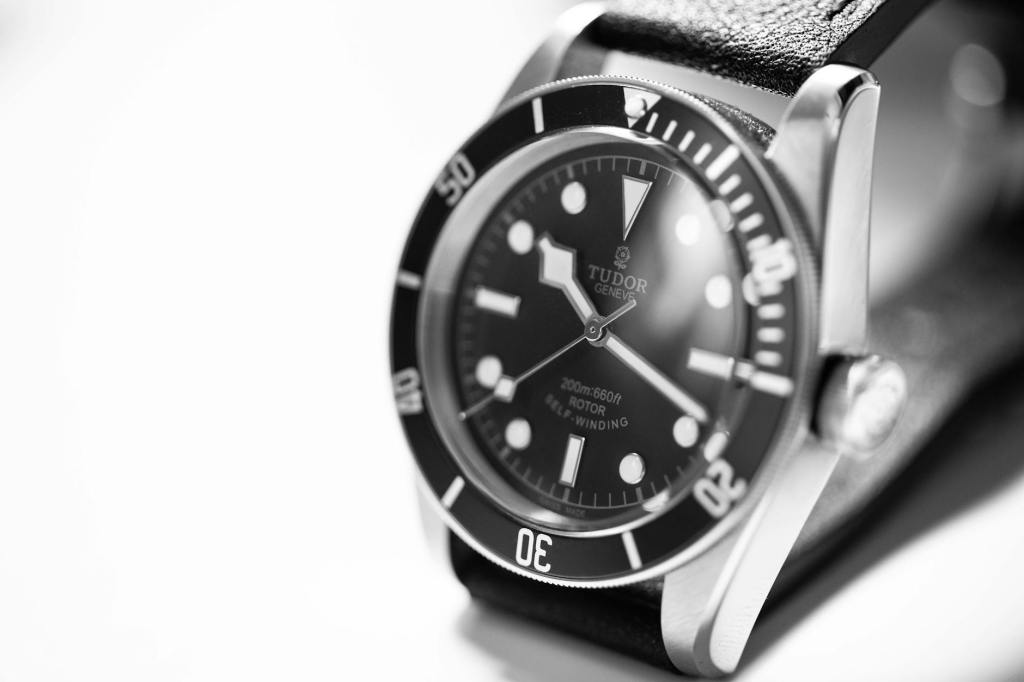
    In this sense, “Blackbird” is a Rolex—iconic, immaculate, and emotionally unreachable. But Paul McCartney after the Beatles feels different. Those solo records land with less mythology and more humanity. They feel like Tudor: born from the shadow of a giant, technically serious, culturally quieter, and easier to meet on personal terms. My preference for Tudor over Rolex isn’t about specifications. It’s about psychological noise.

    The pattern behind all this is Cultural Laundering. This is what happens when art goes through the cultural washing machine and comes out bright, recognizable, and strangely dead. Repetition, advertising, branding, and mass exposure scrub away texture, risk, and private meaning until the work stops feeling like an encounter and starts functioning like a symbol. The song hasn’t changed. The watch hasn’t changed. The audience has been crowded out. You’re no longer meeting the work itself—you’re meeting its reputation, its marketing history, and the millions of people who got there before you. Nothing has been altered chemically. Everything has been altered psychologically. The artifact survives. The intimacy doesn’t.

  • The Old Man Warner in Your Watch Box

    The Old Man Warner in Your Watch Box

    Shirley Jackson’s “The Lottery” endures because every community has its Old Man Warner—the pinch-faced guardian of tradition who defends the barbaric ritual of human sacrifice not because it makes sense, but because it has always been done. When someone questions the practice, he delivers his familiar verdict: “There’s always been a lottery. Pack of crazy fools.”

    Since putting a G-Shock Frogman on my wrist and leaving my mechanical divers in their boxes, I’ve discovered my own Old Man Warner.

    He lives in my head.

    He is deeply offended that I am no longer winding, regulating, and emotionally tending to my mechanical watches. He blames outside influence. “G-Shock Nation,” he mutters darkly. “Pack of crazy fools.” He reminds me that I have always been a mechanical man. That I built an identity around springs and gears. That abandoning them isn’t a preference—it’s a betrayal.

    This condition has a name: Inner Warner Syndrome—the internal voice of tradition that condemns any deviation from established practice, even when the change makes your life better.

    And here’s the inconvenient truth.

    The Frogman has made my life better.

    When I open the watch box, the mechanical divers don’t whisper craftsmanship. They whisper obligation—winding schedules, accuracy drift, the quiet pressure to care. The Frogman, by contrast, asks nothing. It brings something I didn’t expect from a watch: serenity.

    Which leaves me in an awkward middle ground.

    My mechanical friends keep asking the same question: “How long is this phase going to last? When are you coming back to your real watches?”

    My honest answer: I don’t know. The Frogman could be on my wrist for another week, another month, another year. I really don’t know. 

    Meanwhile, Old Man Warner continues his running commentary from the background: “Pack of crazy fools.”

    This tension has a deeper structure. It isn’t about quartz versus mechanical. It’s about identity versus relief.

    I’m living through Ritual Loyalty Conflict—the uneasy state that arises when a long-cherished practice stops delivering pleasure but continues to demand allegiance. The new path is easier: no winding, no fuss, no emotional maintenance. But the old ritual carried a story about who you were—disciplined, devoted, serious.

    The discomfort isn’t practical.

    It’s ceremonial.

    I don’t miss the ritual itself so much as the identity it once confirmed. Every time the Frogman delivers quiet satisfaction, a small internal tribunal convenes to ask whether convenience has replaced character.

    Because beneath the surface, Ritual Loyalty Conflict isn’t about watches at all.

    It’s about the lingering suspicion that if something becomes easier—if it becomes peaceful—you may have abandoned not just effort, but virtue.

    And somewhere in the distance, Old Man Warner is still shaking his head.

  • From Luxury Dreams to G-Shock Atomic Reality

    From Luxury Dreams to G-Shock Atomic Reality

    I made a YouTube video about my G-Shock Frogman and my growing inability to take it off my wrist. The response was immediate and disproportionate. The video drew ten times the comments I typically get when I talk about mechanical watches.

    That told me something important.

    The passion inside the G-Shock world isn’t just strong. It’s combustible.

    What surprised me even more was the pattern many viewers described. It ran directly against the standard collector narrative—the familiar climb from inexpensive watches up the luxury ladder, the gradual refinement that ends with an Omega, a Tudor, and the quiet satisfaction of having “arrived.”

    Many G-Shock owners reported the opposite trajectory.

    They did climb the ladder. They bought the Swiss pieces. They tasted the luxury world. And then something happened.

    They discovered atomic time.

    One comment captured the shift perfectly: the plan had been to move from entry-level divers into Tudor. But after experiencing the precision of a radio-controlled G-Shock, mechanical watches stopped making sense. The Tudors remained—for weddings, formal events, the occasional appearance—but daily life belonged to the digital watch.

    The romance didn’t fade gradually.

    It collapsed.

    What replaced it wasn’t thrift or minimalism. It was something colder and far more powerful: precision, efficiency, optimization. The watch was no longer a story. It was a system.

    This transformation deserves a name: Precision Conversion.

    Precision Conversion is the moment a collector crosses an invisible line. He stops wearing watches for heritage, craftsmanship, or the poetry of miniature machinery and starts wearing them for one unforgiving reason: they are correct.

    It often begins quietly. One morning, the atomic watch has synchronized overnight. No drift. No adjustment. No uncertainty. The time is simply right—down to the second, without effort, without supervision.

    After that, the mechanical watch changes character.

    What once felt soulful now feels approximate. What once felt charming now feels like a pleasant but unreliable narrator. The convert doesn’t lose respect for craftsmanship. He loses tolerance for romance that runs five seconds fast.

    Accuracy begins to feel like moral clarity. Self-correction feels like intelligence. A watch that needs adjusting starts to look less like a companion and more like a hobby that forgot its primary responsibility.

    And here’s the important part.

    Money never came up.

    Not once.

    These comments weren’t about saving cash or avoiding luxury. For true G-Shock converts, the affordability is incidental—almost accidental. The lower price isn’t the motivation. It’s simply a pleasant side effect.

    In this world, G-Shock isn’t the budget choice.

    It’s the rational one.

    The price, as the believers would say, is just icing on the cake.