Tag: writing

  • The Smart-Right Principle

    The Smart-Right Principle

    One afternoon in Mrs. Eckhart’s fifth-grade class, I finished my reading assignment with nearly an hour to spare. Faced with that glorious stretch of unclaimed childhood time, I did what any aspiring future contributor to Mad Magazine might have done.

    I built a submarine.

    Not an actual submarine, of course. I drew an enormous one on a sheet of white construction paper, complete with rows of portholes. Every window framed a tiny character, and every character had something ridiculous to say.

    One man was making pancakes and inviting the crew to breakfast.

    A woman with curlers in her hair refused to leave her cabin because she wasn’t presentable.

    Another sailor complained that his cereal box had promised a free toy that was nowhere to be found.

    Someone couldn’t nap because everyone else was making too much noise.

    Another had a piece of apple peel wedged between his teeth and regarded this minor inconvenience as civilization’s greatest crisis.

    The submarine was less a military vessel than an underwater apartment complex populated entirely by neurotics.

    I loved it.

    I imagined myself one day writing and illustrating absurd little worlds where everyone took trivial problems with magnificent seriousness.

    Then Mrs. Eckhart stopped beside my desk.

    Her red bouffant seemed to rise another inch as she studied my masterpiece. Her eyebrows arched with the unmistakable expression adults reserve for children who have somehow managed to disappoint them in unusually creative ways.

    “Is this how you spend your time in my classroom?” she asked.

    “I finished the assignment,” I said. “I was just drawing quietly.”

    She ignored my explanation.

    Instead, she began reading the dialogue bubbles aloud in a voice dripping with sarcasm. The class erupted in laughter.

    My submarine, moments earlier the crown jewel of my artistic career, had become evidence in a public trial.

    Then came the sentence.

    “I want your parents to sign this.”

    She turned the paper over and wrote a note explaining that I had spent class drawing cartoons instead of doing schoolwork.

    That evening I presented the evidence to my father.

    He read the note.

    He looked at me.

    Then he sighed.

    “You pissed off your teacher.”

    “I don’t know why,” I protested. “I finished my work. I wasn’t bothering anybody.”

    “That doesn’t matter.”

    “I didn’t do anything wrong.”

    “You insulted her.”

    I stared at him.

    “I don’t understand.”

    He leaned back in his chair.

    “By finishing early and drawing cartoons, you told her her work wasn’t challenging enough.”

    “But I never said that.”

    “You didn’t have to.”

    “I wasn’t criticizing her.”

    “She thought you were.”

    I still resisted.

    “But I was right.”

    My father nodded.

    “Maybe.”

    Then he delivered one sentence I have remembered for more than half a century.

    “It’s better to be smart than to be right.”

    At ten years old, I found this profoundly irritating.

    “I thought they were the same thing.”

    “They aren’t.”

    He explained that technical correctness and practical wisdom often occupy different neighborhoods.

    Perhaps I had violated no classroom rule.

    Perhaps I had every right to draw after completing my assignment.

    None of that altered the outcome.

    My teacher felt disrespected.

    Once that happened, being right became largely irrelevant.

    Only years later did I understand that my father had given me a lesson far more valuable than any fifth-grade reading assignment.

    He had introduced me to The Smart-Right Principle: the recognition that factual correctness often matters less than the social intelligence required to achieve a constructive outcome. Winning the argument while damaging the relationship is rarely a genuine victory.

    Children naturally believe that justice consists of discovering who is objectively correct.

    Adults eventually discover that human beings seldom react to objective correctness.

    They react to perceived respect.

    Or disrespect.

    Intention often loses to interpretation.

    I intended nothing more inflammatory than entertaining myself after finishing my work.

    Mrs. Eckhart interpreted my drawing as a silent declaration that her assignment had failed to occupy me.

    Whether she was objectively right no longer mattered.

    Her perception became reality.

    I have watched this drama replay itself countless times throughout adulthood.

    Employees prove their managers wrong while destroying their careers.

    Husbands win arguments that cost them intimacy.

    Politicians deliver devastating rebuttals that persuade no one.

    Professors publicly expose weak reasoning while privately humiliating students who might otherwise have remained eager to learn.

    Every participant leaves convinced that truth prevailed.

    Usually only resentment does.

    The Smart-Right Principle does not ask us to abandon truth.

    It asks us to recognize that truth travels through relationships.

    People rarely remember whether you were technically correct.

    They remember how you made them feel while proving it.

    Ironically, my father never suggested that Mrs. Eckhart had behaved wisely.

    He simply understood something I did not.

    Life is not graded like a geometry proof.

    You do not receive full credit merely because your logic is impeccable.

    Human beings are not propositions.

    They are creatures of pride, dignity, insecurity, gratitude, vanity, and interpretation.

    Ignore those realities, and you may spend the rest of your life winning arguments while quietly losing people.


  • The Character Paradox

    The Character Paradox

    If you believe that human beings are capable of genuine self-improvement, Jeffrey Rosen’s The Pursuit of Happiness is an excellent place to begin. On its opening page, Rosen quotes the Renaissance physician Paracelsus: “Even as man imagines himself to be, such he is, and he is also that which he imagines.”

    Most of us imagine ourselves becoming happier. That is hardly surprising. The more revealing question is what kind of life we imagine will make us happy.

    A little philosophy quickly dispels the fantasy that happiness can be built from immediate gratification. Pleasure is fleeting. Appetite is insatiable. Every indulgence briefly satisfies only to awaken the desire for another. The great philosophical tradition proposes a different path. Happiness is not something we consume. It is something we become.

    Rosen traces this tradition through Benjamin Franklin and ultimately back to Cicero’s Tusculan Disputations. There, Cicero argues that the soul must be “tranquilized by restraint and consistency.” The happy person is neither consumed by fear nor driven by restless ambition. He is not perpetually distressed, intoxicated by meaningless excitement, or enslaved by craving. He possesses something rarer: inner equilibrium. His happiness rests not upon favorable circumstances but upon a well-ordered character.

    Rosen summarizes the idea with admirable clarity. The pursuit of virtue is about being good, not feeling good. Feelings are unstable companions. Character endures. America’s Founders therefore understood the pursuit of happiness as a lifelong effort to cultivate virtue by using reason to govern destructive emotions, improve oneself, and become more capable of serving others.

    The argument is compelling.

    It also raises an unsettling question.

    Can moral character actually be cultivated, or is philosophy merely watering seeds that were already planted?

    Over the years I have spoken with many people whose childhoods were marked by neglect, abuse, or abandonment. A few told me they made a solemn vow that their own children would never endure what they had suffered. Their painful upbringing became a moral education. They transformed misery into compassion.

    Others traveled a different road.

    Their adult lives became faithful reproductions of the homes that had wounded them. Chaos produced more chaos. Addiction generated more addiction. Cruelty echoed across another generation.

    Why?

    Why does one person convert suffering into wisdom while another converts it into repetition?

    Were different choices responsible?

    Or were deeper differences already present long before those choices appeared?

    Perhaps character truly is destiny.

    But if so, where does character come from?

    Is it patiently built through discipline, habit, and moral instruction?

    Or does moral instruction simply awaken something that was already waiting to be awakened?

    I sometimes wonder whether the very act of picking up Rosen’s The Pursuit of Happiness hints at an answer. Perhaps people do not seek goodness by accident. Perhaps they are drawn toward it because some quiet part of them already recognizes its voice.

    That possibility reveals what I call The Character Paradox: the enduring question of whether moral character is principally cultivated through disciplined choice or gradually revealed by the dispositions already present within us.

  • Soul Foreclosure

    Soul Foreclosure

    I recently dreamed that I committed an act of generosity so spectacularly foolish that it could only occur in a dream.

    A stranger down on his luck needed a car.

    I rented him mine.

    Not for an afternoon.

    For a week.

    When the week ended, the car was supposed to return.

    It didn’t.

    The rental agency proved as reachable as Atlantis. Every phone call dissolved into voicemail. Every inquiry disappeared beneath geological layers of paperwork. Somewhere inside an administrative labyrinth, my car had ceased being an automobile and become a bureaucratic rumor.

    At first I searched.

    Then I inquired.

    Eventually I surrendered.

    I began the strange process of constructing a life around the absence of something I had once considered indispensable.

    That was when the letters started arriving.

    Apparently my missing car had been abandoned in some restricted location, and because it remained there, I was responsible for an endless procession of fines. Whose property it occupied could not be determined. Every answer generated three new forms. Every digital trail branched into ten more dead ends. Bureaucracy reproduced like mold in a damp basement.

    No one could tell me where my car was.

    Everyone could tell me I owed more money.

    The dream became increasingly surreal.

    The car was gone.

    Yet it continued ruining my life.

    I woke with the uneasy conviction that the car had never been a car.

    It was something far more important.

    The dream reminded me of Thomas Dolby’s haunting 1982 song “One of Our Submarines,” in which loss lingers like an unanswered transmission from beneath dark water. Something precious has vanished. The silence becomes its own form of communication.

    That is exactly how the dream felt.

    Looking back, I think it illustrates what I call Soul Foreclosure: the unsettling conviction that something essential to one’s identity has quietly slipped beyond one’s reach, leaving behind an acute sense of incompleteness whose object cannot be clearly named.

    The dream never directly told me what had been lost.

    It merely allowed me to experience the loss.

    The missing car became the perfect symbol because a car is more than transportation. It carries us through the world. It grants direction, mobility, and agency. To lose it is to lose not merely a possession but the very instrument by which one moves toward the future.

    The bureaucratic nightmare only deepened the metaphor.

    The missing soul could not be recovered through diligence.

    Forms multiplied.

    Digital records contradicted one another.

    Every attempt at resolution produced another layer of confusion.

    The system itself had become the villain, a paper-pushing Minotaur guarding a labyrinth whose prize no one could locate.

    Perhaps that is why I woke with such melancholy.

    I wasn’t grieving a car.

    I was grieving the suspicion that somewhere along the journey through adulthood, paperwork, obligations, and the thousand administrative distractions of modern life, I had mislaid some vital part of myself.

    The truly unsettling part was not that I couldn’t find it.

    It was that life kept sending me invoices for its absence.

  • The Bad Apple Principle

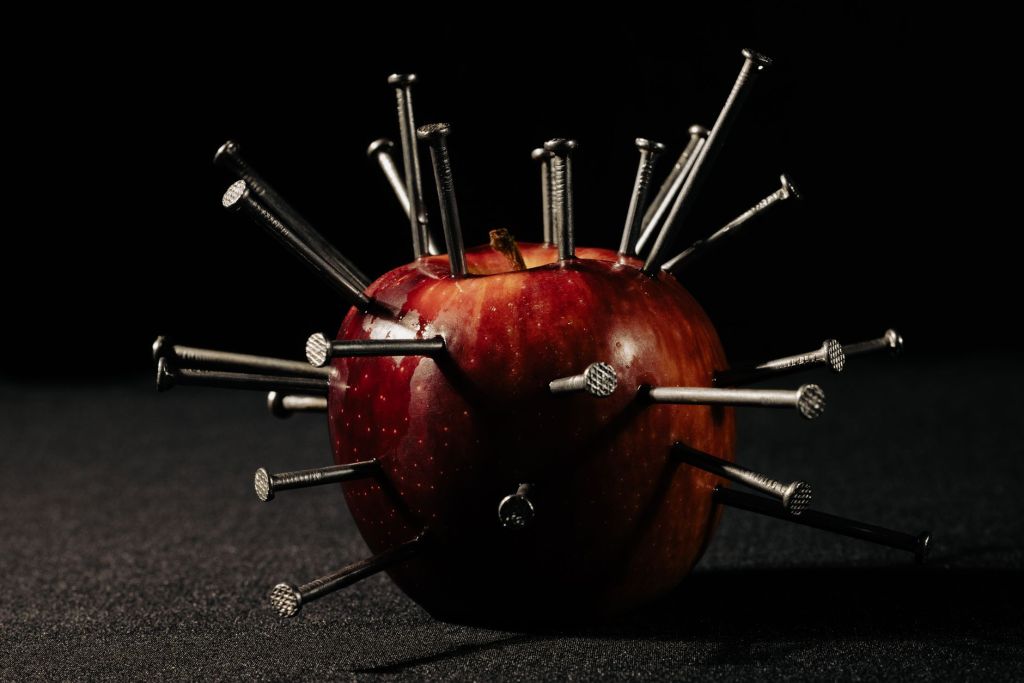
    The Bad Apple Principle

    This morning, while swinging kettlebells in my garage, I listened to Larry Mantle’s AirTalk. The topic was dogs in restaurants, or more precisely, the small but talented minority of dog owners determined to convince the rest of us that civilization has been overrated.

    The complaints were familiar. Dogs licked strangers’ hands. Seemingly placid dogs lunged at smaller ones. Playful dogs darted under servers carrying trays of hot food. Then came the owners of “service dogs” who informed restaurant staff that the rules were for lesser mortals. Their pets, like minor royalty, possessed diplomatic immunity.

    I suspect more than ninety percent of dog owners are perfectly considerate. They keep their dogs under control, respect boundaries, and would never dream of turning a restaurant into an off-leash park.

    They are also irrelevant.

    Restaurants don’t write policies for them.

    They write policies for the other ten percent.

    That observation led me to a melancholy truth about institutions. Bureaucracies are not designed around our best behavior or even our typical behavior. They are designed around our worst behavior. They must assume that somewhere, someone will abuse every privilege, exploit every loophole, and confuse entitlement with freedom.

    That is The Bad Apple Principle: the misconduct of a small minority determines the restrictions imposed upon the responsible majority.

    The principle explains far more than dogs in restaurants. It explains airport security, locked toothpaste at CVS, liability waivers, plagiarism software, surveillance cameras, password requirements, and a thousand other bureaucratic irritations. Every rule we grumble about has a backstory, and that backstory almost always begins with someone who behaved just badly enough to make the rule inevitable.

    The idea reminded me of a book I devoured when I was ten: Laurence J. Peter’s The Peter Principle. Ever since, I’ve had a weakness for elegant ideas distilled into memorable names.

    Naturally, I immediately imagined writing my own bestseller:

    The Bad Apple Principle: Why Good People Live by Bad People’s Rules.

    Then reality intruded.

    The entire thesis fits comfortably inside a single paragraph.

    Knowing the publishing industry, however, I’m sure a seasoned nonfiction writer could stretch it into fifteen brisk chapters, three airport interviews, a TED Talk, and a podcast tour. My contribution would simply be to wave wistfully from the sidelines, muttering, “Yes, but the title was mine.”

  • Waiting for My Redemptive Metamorphosis

    Waiting for My Redemptive Metamorphosis

    Perhaps every human being spends part of life waiting for a Great Mutation.

    Mine arrived on Saturday evenings in 1978.

    I sat alone in the living room watching The Incredible Hulk.

    Dr. David Banner was gentle, decent, almost saintly. He endured humiliation with the patience of Job until one indignity too many awakened something volcanic inside him. Then came the transformation. Muscles swelled. Clothes exploded into ribbons. The ordinary man disappeared, replaced by a mythical giant who seemed immune to every weakness that had tormented him only moments before.

    The scenes overwhelmed me.

    I cried.

    Not because they frightened me.

    Because I wanted them to happen to me.

    I didn’t merely want to become stronger.

    I wanted to mutate.

    I wanted my own body to erupt into something so magnificent that weakness, humiliation, fear, and self-consciousness would vanish forever.

    Then the rage would subside.

    The green giant would disappear.

    David Banner would return.

    And every week came the scene that broke my heart.

    Banner walked alone down a deserted highway while Joe Harnell’s haunting piano theme, “The Lonely Man,” floated over the closing credits.

    That was the person I recognized.

    Not the Hulk.

    David Banner.

    The solitary wanderer searching for redemption.

    As a child, I mistook that longing for innocence.

    Only much later did I recognize the quiet narcissism hidden inside the fantasy. I imagined myself not simply misunderstood but somehow destined for an extraordinary transformation that would finally justify my existence. I wasn’t content to become a better version of myself. I wanted to become another kind of being altogether.

    Looking back, I can see that I was already rehearsing the emotional architecture of the religious conversion that awaited me only a year later.

    Long before I met Jesus, I was already waiting for salvation.

    Lou Ferrigno represented one path.

    Jesus represented another.

    Both promised transformation.

    Both seemed capable of replacing the frightened, inadequate boy with someone purified, powerful, and whole.

    The muscles were never the destination.

    They were the sacrament.

    What I truly longed for was what I now call Redemptive Metamorphosis: the hope that one overwhelming transformation—physical, spiritual, artistic, or psychological—could permanently redeem a life by replacing the flawed self with a new and purified identity.

    For years I believed that transformation might begin with a barbell.

    Only later did I realize I had been searching for something far heavier to lift than iron.

  • Why I Can’t Let Go of G-Shock’s Chromatic Certainty

    Why I Can’t Let Go of G-Shock’s Chromatic Certainty

    Before the technical specifications, before the discussion of movements, and before the endless debates about quartz versus mechanical watches, something unexpected happened inside my head.

    Six months ago I underwent what now strikes me as a genuine conversion. I almost stopped wearing analog mechanical watches and entered the world of G-Shock Multiband-6 digital watches. To my surprise, a number of my YouTube subscribers later described the very same journey. They had once adored mechanical watches, only to discover that after living with atomically synchronized digital time, they could never comfortably return.

    At first glance, the conversion makes little sense.

    A quality mechanical watch running five seconds fast per day is an astonishing feat of engineering. For every practical purpose, it tells the correct time. It gets you to appointments. It catches flights. It reminds you when class begins. Its error is so small that it almost never matters.

    And yet it no longer feels right.

    That is the mystery.

    Objectively, nothing important has changed. Subjectively, everything has.

    What changes is not the watch but the standard by which the watch is judged.

    Before owning a Multiband-6 G-Shock, my standard was simple: close enough.

    After Multiband-6, my standard became: exactly right.

    Every night my watch quietly synchronizes with the atomic clock. Every morning I wake knowing—not hoping, not estimating, not approximating—that the time on my wrist is identical to the world’s official standard. Five seconds fast, once a badge of mechanical excellence, now feels oddly imprecise.

    I call this Chronometric Certainty: the psychological satisfaction that arises from knowing one’s timepiece is synchronized with an external objective standard, eliminating even trivial uncertainty about its accuracy.

    The difference is not practical.

    It is psychological.

    An analog watch always feels like an interpretation of time. The hands point. They suggest. They approximate.

    A digital display does something altogether different.

    It declares.

    When my G-Shock reads 12:37:42, there is no interpretation. It does not hint at the time. It announces it with unapologetic authority. One of my favorite G-Shocks, the enormous King, reinforces this feeling. Its giant television-shaped display gives me the uncanny impression that I am not wearing a watch at all. It feels like I have strapped a broadcast monitor to my wrist, one that receives the world’s official time directly from reality itself.

    The mechanical watch, by contrast, quietly asks for my participation.

    I know it gains a few seconds.

    I occasionally reset it.

    I mentally compensate.

    None of this requires much effort, but each act reminds me that the watch is only approximating reality.

    The G-Shock abolishes those tiny negotiations.

    It simply tells the truth.

    This realization has convinced me that my conversion was never really about watches.

    It was about certainty.

  • The Strange Beauty of Boring Things

    The Strange Beauty of Boring Things

    I’m almost sixty-five, yet some stubborn part of me remains a man-child, forever scanning the horizon for the next shiny object. There is always another watch to admire, another gadget to research, another purchase that whispers the ancient promise: This one will finally complete you.

    It never does.

    Still, I’m not without hope.

    Lurking beneath my acquisitive instincts is another impulse—one that longs for restraint, clean lines, quiet competence, and the elegant marriage of form and function. I have begun to suspect that growing up is not the abandonment of desire but its refinement.

    The first clue arrived six months ago when it came time to buy a personal desktop computer.

    The younger version of me might have ogled a hulking gaming tower glowing like a radioactive Christmas tree, festooned with RGB lights and fans loud enough to suggest an imminent liftoff. Instead, I bought a Mac Mini with Apple’s M4 chip and 32 gigabytes of RAM. It sits on my desk in near silence, doing exactly what I ask of it without begging for applause. It is the technological equivalent of a competent butler: always present, never theatrical.

    The pattern continued.

    When I think about replacing my car, I don’t fantasize about a German sports sedan or some aggressively sculpted SUV that looks eager to challenge strangers at stoplights. I picture a white or silver Honda Accord Hybrid EX-L.

    It’s boring.

    That is precisely the point.

    It is vanilla and Zen fused into one magnificent state of automotive enlightenment.

    Call it Zen-illa.

    The same instinct explains why I keep gravitating toward a ThinkPad T14 Gen 7. There is nothing glamorous about it. It resembles a laptop designed by accountants who moonlight as structural engineers. It doesn’t seduce you. It reassures you. It quietly announces, “I was built to work, not to pose.”

    Then there is the watch.

    If I buy another G-Shock, it will almost certainly be the GW-5000U—not because it is flashy, but because it isn’t. It is, in many ways, the highest expression of the original Square: understated, overengineered, supremely comfortable, and utterly indifferent to fashion. It doesn’t ask to be admired. It asks to be worn.

    These objects all embody what I call Instrumental Nobility: the quality of an object whose excellence derives from uncompromising function, durability, and thoughtful engineering rather than luxury, prestige, or visual spectacle.

    Increasingly, that is the beauty I find myself pursuing.

    Perhaps this is what maturity looks like.

    Not losing the desire to acquire, but acquiring things that quietly disappear into your life because they perform their task so faithfully that they free your attention for higher pursuits.

    I still have traces of the man-child in me. Every now and then he wakes up and points excitedly at some gleaming bauble, convinced that salvation is only one purchase away.

    The adult has learned to smile politely, pat him on the head, and say, “No. We have a manuscript to finish.”

    If all goes well, by the time I turn seventy, the adult may finally win.

  • When Father Time Becomes Your Authorized Watch Dealer

    When Father Time Becomes Your Authorized Watch Dealer

    At sixty-five, with retirement approaching, I have aged out of five-thousand-dollar watches.

    Not because I can’t appreciate them.

    Not because they aren’t beautiful.

    Because I no longer have the wrist time.

    Twenty more years—if fortune is generous—is not enough to justify rotating my current collection alongside two additional grail pieces that would spend most of their lives quietly aging in a watch box. I call this Chronological Misalignment: the condition in which a person’s remaining lifetime no longer justifies acquiring possessions intended to be enjoyed over a much longer horizon.

    Time eventually becomes the harshest accountant.

    But time is only half the problem.

    The other half is geography.

    Or, more accurately, lifestyle.

    I still admire the Grand Seiko GMT. I still admire the Tudor Pelagos. They remain magnificent objects.

    I simply struggle to imagine wearing one while binge-watching Hulu, pushing a shopping cart through Target, or taking my daughters to YogurtLand for frozen yogurt.

    The watch would be dressed for an expedition to Antarctica.

    I would be buying gummy bears by the ounce.

    The mismatch is almost comic.

    I call this Environmental Misalignment: the condition in which one owns or desires objects whose elegance exceeds the ordinary circumstances of one’s daily life.

    Recognizing these two forms of misalignment is not depressing.

    It is liberating.

    Reality has performed the difficult task of setting my priorities for me.

    The question is no longer whether I can justify another grail watch.

    The question is what deserves that energy instead.

    For decades, watches occupied an astonishing amount of mental real estate. They required research, comparison, speculation, buying, selling, photographing, discussing, and occasionally irrational justification.

    Now that enthusiasm has become available for reassignment.

    It belongs elsewhere.

    It belongs in writing.

    It belongs at the piano.

    It belongs in my kettlebell-filled garage.

    Most of all, it belongs to my health.

    I am still about twenty pounds overweight.

    My physician periodically reminds me that it is time for fasting bloodwork—cholesterol, blood sugar, and the rest of the annual report card. I already know roughly what the results will say. At 230 pounds, everything will probably look respectable except my LDL cholesterol, which has an annoying habit of hovering around the borderline.

    So the mission is obvious.

    Reach 210 pounds.

    Then endure the ritual: skip breakfast, forgo the morning coffee, wait patiently while someone extracts several vials of blood, drive home slightly lightheaded, and receive laboratory numbers worthy of the inconvenience.

    At thirty-five, my grail was a Tudor Pelagos.

    At sixty-five, my grail is different. It’s a total cholesterol below 200 and a blood pressure reading of 120 over 80.

    That is not surrender.

    That is maturity.

    There comes a point in life when we stop negotiating with Father Time.

    He begins issuing instructions.

    He says:

    “You’re not wearing a Grand Seiko to Trader Joe’s.

    You’re not timing your afternoon nap with a luxury GMT.

    Your assignment now is different.

    Become as healthy as possible.

    Remain mentally sharp.

    Write your books.

    Play your piano.

    Stay strong enough that your family never has to carry you through the final chapters of your life.”

    For once, I find myself with no desire to argue.

    His orders make perfect sense.

    The remarkable thing is that they do not diminish my life.

    They simplify it.

    The pursuit of watches has quietly given way to the pursuit of longevity, creativity, and strength. Those ambitions promise far greater returns than another polished titanium case ever could.

    I wrote this little manifesto wearing a G-Shock Frogman.

    It told time just as faithfully as any luxury watch.

    More importantly, it reminded me that I have finally found a grail worthy of the time I have left.

  • Nothing Gets Better

    Nothing Gets Better

    Yesterday my piano tuner, Cecil, came by to work on my upright. He is pushing eighty, has spent a lifetime coaxing reluctant pianos back into harmony, and charges $250 for a tuning. I pay it gladly. When someone has become the best in the business, you stop thinking about the fee and start thinking about the privilege.

    After he finished, we lingered and talked about Southern California.

    I told him that whenever I return to my old stomping grounds in the Bay Area, I leave with the same impression: everything feels more crowded, more hurried, more stressful, and somehow less hospitable than I remember. The roads seem angrier. The neighborhoods seem denser. Even the air feels impatient.

    Without the slightest hesitation, Cecil smiled and delivered a sentence that landed with the force of an ancient proverb.

    “Nothing gets better.”

    The words settled over me like a truth I had always known but kept forgetting.

    Nothing gets better.

    Cecil continued. Torrance, he predicted, will eventually resemble West Los Angeles. Massive apartment complexes are already rising near our neighborhood. Del Amo Fashion Center has become a preview of the future. Try finding a parking space after eleven o’clock on a weekday. On weekends, don’t bother. The future has already begun circling the parking lot.

    Yet Cecil wasn’t complaining.

    That is the crucial distinction.

    His observation was not an invitation to pessimism but to realism.

    Most of our unhappiness comes from quietly assuming that the world ought to become more convenient, more orderly, more civilized, and less crowded as time marches on. When reality stubbornly refuses to cooperate, we conclude that something has gone terribly wrong.

    Perhaps nothing has gone wrong at all.

    Perhaps this is simply what civilizations do. They grow denser, noisier, more complicated, and more exhausting. Every technological advance solves one problem while inventing three new ones. Every improvement arrives carrying an invoice.

    I have come to think of this as the Cecil Principle: the recognition that the world rarely becomes simpler, quieter, or more civilized over time, requiring us to cultivate resilience rather than nostalgia or utopian expectation.

    The Cecil Principle reminded me of psychiatrist Phil Stutz, who reduces life to three unavoidable realities: pain, uncertainty, and constant work. According to Stutz, psychological health begins not by escaping these conditions but by accepting them. The fantasy that life should become comfortable is itself the source of much unnecessary suffering.

    Cecil, with considerably fewer words, had arrived at the same destination.

    Nothing gets better.

    Strangely, there is liberation in that sentence. Once I stop expecting history to reward me with perpetual improvement, I become less resentful when it doesn’t. I stop waiting for the perfect city, the perfect traffic pattern, the perfect political climate, or the perfect era. I become more attentive to the quiet pleasures still available: a well-tuned piano, an honest conversation, a competent craftsman who has spent decades mastering his trade.

    Nothing gets better.

    Oddly enough, accepting that fact makes life better.

    The truth, after all, has an unexpected habit of setting us free.

  • The Attention Vultures Descend

    The Attention Vultures Descend

    I watched Netflix’s three-part documentary Idaho Murders: College Nightmare, expecting another true-crime chronicle. Instead, I found a cautionary tale about the moral corrosion of the social media age.

    The murders shattered the illusion of an idyllic college town where doors, friendships, and assumptions of decency had long remained open. Into that atmosphere of trust stepped a doctoral teaching assistant in criminology whose crimes seemed almost grotesquely theatrical: an aspiring expert in criminal behavior who became the very monster he purported to study. The documentary is unsettling not merely because it chronicles an act of staggering brutality, but because it reveals how quickly evil can erupt into places that imagine themselves immune from it.

    Yet the documentary’s most instructive chapter unfolds after the killings, during the long months when investigators had no public suspect. That vacuum of knowledge became oxygen for the internet. Social media influencers rushed to fill the silence, speaking with the confidence of detectives while possessing none of the evidence. Their videos, podcasts, and livestreams transformed ignorance into certainty. Innocent college students—already traumatized by the murders—were publicly identified as suspects, dissected as if they were characters in a murder mystery rather than human beings whose lives could be permanently scarred by reckless speculation.

    These people were not engaged in an earnest search for truth. They were engaged in a hunt for attention. Every accusation, every dramatic thumbnail, every emphatic declaration became another bid for clicks, subscribers, and algorithmic favor. Tragedy had become raw material for personal branding.

    Years ago, Jaron Lanier warned that social media rewards the most primitive parts of our psychology. The platforms appeal less to our reflective minds than to our craving for recognition, outrage, and status. They encourage us to chase attention as if it were oxygen. Watching the documentary, I felt as though Lanier’s warning had escaped the pages of his book and materialized on the screen. The influencers were not simply exploiting a tragedy; they had become creatures shaped by an economy in which visibility matters more than truth and confidence is valued above evidence.

    The documentary left me thinking less about the murderer than about myself. Over the last fifteen years, I have spent enough time on social media to recognize the same impulse in miniature—the subtle desire to post, comment, and share simply because an audience is there. The temptation is rarely malicious, but it springs from the same psychological soil: the hope of being noticed.

    The film made me want to cultivate a new habit. Before posting, I want to pause and ask a simple question: Am I adding light, or am I merely asking strangers to look at me? That brief moment of hesitation may be the smallest possible act of resistance against an attention economy that profits from our worst instincts.

    The documentary’s greatest lesson, then, has little to do with criminology. It is about character. It asks whether we will become citizens who value truth enough to remain silent when we do not know—or whether we will join the growing flock of attention vultures circling every human tragedy, mistaking spectatorship for significance. I know which path I hope to avoid. If that requires changing my relationship with social media, it is a price well worth paying.