Tag: writing

  • Teaching Without a Map in a Shifting World

    Teaching Without a Map in a Shifting World

    In “Teaching in an American University Is Very Strange Right Now,” Frank Bruni captures a tension that defines the modern classroom: how do you offer students hope without lying to them? His students at Duke University are coming of age in a moment that feels less like a transition and more like a rupture—truth is contested, institutions feel unstable, artificial intelligence is reshaping entire professions, and the political climate leans toward confusion and consolidation of power. Add to that a job market where careers in public policy, government, and nonprofits are shrinking, and the traditional pathways begin to look like dead ends.

    Bruni’s difficulty is not just emotional; it’s epistemological. The ground keeps shifting. The job market no longer behaves like a map you can study and memorize. It behaves like weather—volatile, unpredictable, and indifferent to your plans. Bruni and his colleagues find themselves in an unfamiliar position: experts who no longer trust their own expertise. When the mentors are unsure of the terrain, the act of mentoring starts to feel like guesswork dressed up as guidance.

    And yet, retreating into cynicism would be a dereliction of duty. Bruni insists on offering hope, but not the anesthetized version that avoids discomfort. His version of hope is anchored in reality. He tells his students that survival in this environment will not belong to the most credentialed or the most specialized, but to the most adaptable. The winners will be those who can pivot quickly, read patterns early, and anticipate what’s coming before it arrives. In other words, they must think several moves ahead while the board itself is being rearranged.

    This requires a shift in how students approach their education. The old model—bury yourself in your major, master the material, trust that the system will reward you—was always a partial truth. Now it’s a liability. Depth without awareness is no longer enough. Students need a wide-angle lens, an ongoing scan of the broader landscape: economic shifts, technological disruptions, political currents. The classroom can no longer be a refuge from the world; it has to be a vantage point from which to read it.

    Bruni’s message is unsettling, but it has the virtue of being honest. Hope, in this context, is not the promise that things will work out as planned. It’s the conviction that those who stay alert, flexible, and strategically aware can still find a way forward—even when the path refuses to stay still.

  • The Kryptonite Effect of Screens in Education

    The Kryptonite Effect of Screens in Education

    In her Atlantic essay “What Happened After a Teacher Ditched Screens,” the author examines a belief so widely accepted it rarely gets questioned: that more technology automatically improves learning. Dylan Kane, a seventh-grade math teacher, bought into that belief for over a decade. His students worked on Chromebooks, navigating a custom-built math site while monitoring software kept them from drifting into games or distractions. It was a tightly managed digital ecosystem—efficient on paper, persuasive in theory.

    Then Kane pulled the plug.

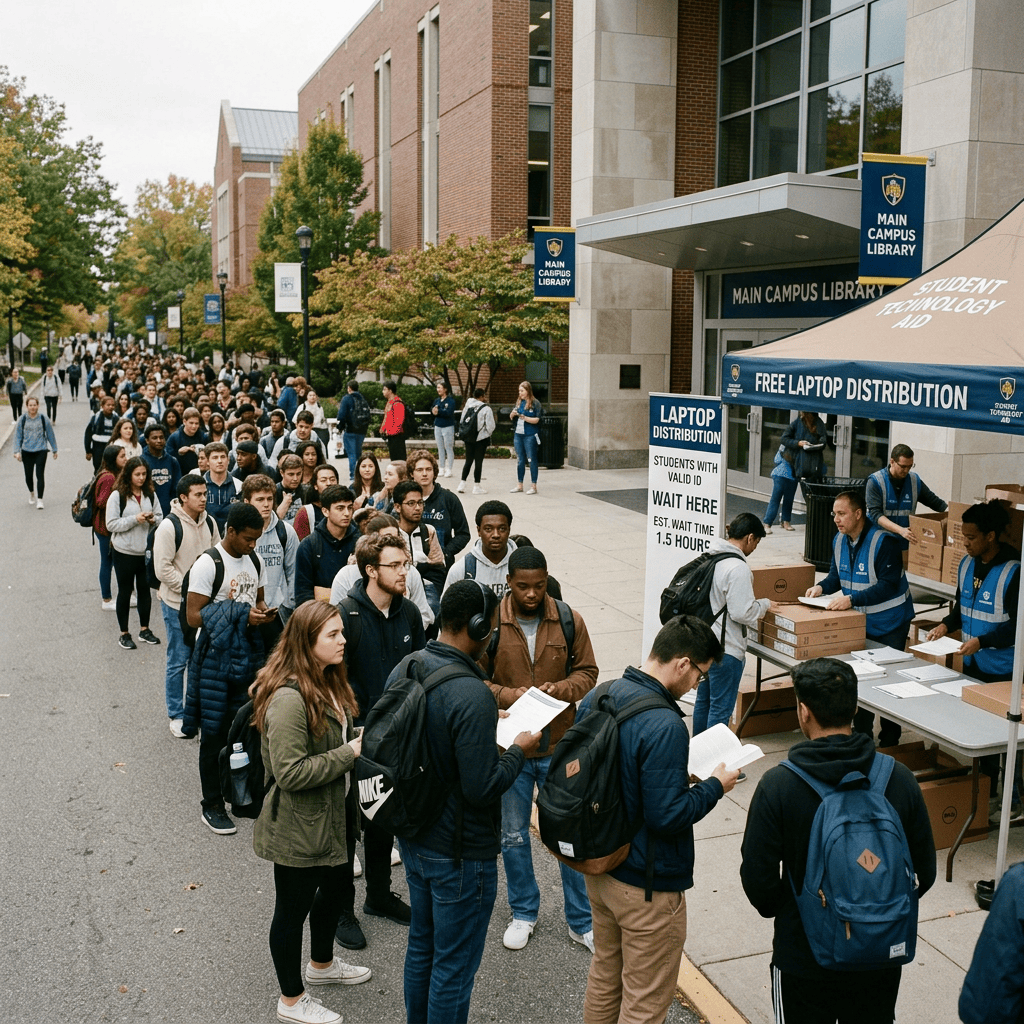
    This wasn’t a minor adjustment; it was a small act of rebellion. Nearly ninety percent of school districts now issue laptops or tablets, sold on the promise of “personalization”—the idea that technology can tailor instruction to each student’s needs, close learning gaps, and adapt to different cognitive styles. It’s an elegant theory, especially attractive to those whose reputations and revenue depend on merging education with technology.

    But in Kane’s classroom, the theory collapsed under the weight of actual human behavior. Screens didn’t personalize learning; they colonized attention. Students stared at them the way gamblers stare at slot machines—fixed, hypnotized, and detached from the room. Class discussion withered. The teacher’s voice, once the organizing force of the classroom, lost every round to the glowing rectangle. When attention becomes a zero-sum game, the screen doesn’t negotiate. It wins.

    Kane’s frustration deepened when he read Jared Cooney Horvath’s The Digital Delusion, which argues that increased technology use correlates with declining student performance. So Kane ran an experiment: he removed the Chromebooks for a month. What he discovered was not subtle. Students began paying attention again. Participation returned. Assignment completion jumped from 45 to 62 percent. Writing equations by hand—slow, deliberate, mildly inconvenient—forced students to see their own thinking unfold. The inconvenience turned out to be the point. Learning, it seems, benefits from friction.

    I’ve been teaching college writing for over thirty-five years, and I’ve seen my own version of this “kryptonite effect.” Smartphones siphon attention. Laptops become portals to games, sports, and anything but the task at hand. I’ve watched students drift out of the room without leaving their seats. The screen doesn’t just distract; it competes, and it usually wins.

    And yet, my experience isn’t a simple indictment of technology. Between 2018 and 2019, I ran a structure that worked. We met twice a week: one day for lecture and discussion, the other as a writing lab. During lab sessions, students wrote on desktops or their own laptops, working through scaffolded assignments. I read their drafts in real time, helping them revise thesis statements and sharpen arguments. The dynamic shifted. I wasn’t a distant lecturer; I was a coach moving from desk to desk. Students completed work on campus instead of procrastinating at home. Completion rates improved, not because of the machines themselves, but because of how they were used.

    The pandemic ended that model. My courses shifted to a hybrid format—one meeting a week—and the lab disappeared. I’ve been reluctant to surrender precious face-to-face time to silent writing sessions. But I’m beginning to wonder if I’ve been too cautious. If Kane is right about the power of attention, perhaps the most effective use of class time is not more talking, but more doing.

    What Kane’s experiment ultimately reveals is not that technology is useless, but that it is context-dependent. A math classroom, built on sequential problem-solving, may suffer when screens fracture attention. A writing classroom, structured around drafting and revision, may benefit from them under the right conditions. The mistake is not using technology. The mistake is treating it as a universal solution.

    If I were back to teaching two days a week, I wouldn’t hesitate. One day for discussion. One day for writing in a lab. Not because technology is inherently good, but because, in that setting, it serves the work instead of sabotaging it.

  • Why the Word “Stress” Has Outlived Its Usefulness

    Why the Word “Stress” Has Outlived Its Usefulness

    The word stress has been talked into exhaustion. It shows up everywhere—therapy sessions, productivity podcasts, corporate memos—until it becomes a kind of verbal white noise. Everything is stressful. Traffic is stressful. Email is stressful. Existence itself is apparently one long panic attack. The result is not clarity but numbness. A word that once pointed to something real now floats, bloated and imprecise, over every inconvenience and calamity alike. It needs to be stripped down, cleaned up, and returned to service.

    Start by dividing what we lazily call “stress” into three distinct experiences.

    First, there is what we might call existential friction—the strain that comes from living a life that actually matters. Sartre described it as getting your hands dirty. It is the tension of responsibility, of choosing action over comfort. Think of Viktor Frankl, who could have escaped a concentration camp but stayed to tend to the suffering around him. To say he was “stressed” is to trivialize the moment. He was engaged in a moral confrontation with evil. The discomfort was not a malfunction; it was the price of meaning. A bodybuilder tears muscle to grow stronger. A moral person strains against life’s conflicts to become more fully human. This is not pathology. It is construction.

    Second, there is narcissistic agitation—the counterfeit version of stress, self-generated and corrosive. This is the anxiety of the addict chasing relief, the restless paranoia of the status-obsessed, the brittle ego that reads every room as a threat. Here the individual is both the engine and the victim of the distress. It is not the friction of purpose but the turbulence of misalignment. To confuse this with existential friction is not just sloppy; it is morally obtuse. One builds character. The other erodes it.

    Finally, there is existential overload—the strain that arrives uninvited and exceeds your capacity to absorb it. This is not heroic and not self-inflicted. It is what happens when life stacks too many weights on the bar at once. Divorce, illness, financial collapse—events that don’t ask for your permission before they rearrange your nervous system. In this state, the body begins to narrate what the mind cannot contain. Appetite disappears. Sleep fractures. Symptoms bloom. There is no lesson neatly packaged inside it, no redemptive arc guaranteed. It is endured, not chosen.

    I think of my brother in 2020. His marriage collapsed. He was suddenly alone during the pandemic, financially strained, disoriented. Then came the diagnosis: Burkitt lymphoma. Two months to live. That is not “stress.” That is existential overload in its purest form. And yet, against those odds, he found a narrow corridor of hope—a CAR T-cell therapy trial at UCSF. He took it. He survived. He is in remission. The word stress does not belong anywhere near that story.

    This is why the word needs to be retired from serious use. It flattens distinctions that matter. It places the inconvenience of a crowded inbox on the same plane as a confrontation with mortality. Better to replace it with terms that carry weight: existential friction, narcissistic agitation, existential overload. Precision is not pedantry; it is navigation. If you’re trying to find your way out of the dark, you don’t need a vague feeling. You need a compass that actually points somewhere.

  • When Time Stops Asking and Starts Telling

    When Time Stops Asking and Starts Telling

    At sixty-four and four months, you thought you were still wading—water warm, footing reliable, the shoreline within easy reach. Then, without warning, the bottom vanished. One step of confidence, followed by that cold, immediate truth: you are no longer in control of the depth. The drop-off doesn’t negotiate. It doesn’t slope politely. It takes you.

    This particular plunge announced itself through something as mundane—and as revealing—as a watch. For decades, you wore mechanical divers with analog dials, small, intricate machines that whispered of heritage, craft, and a certain gentlemanly patience. That language no longer translated. You didn’t want poetry. You wanted coordinates.

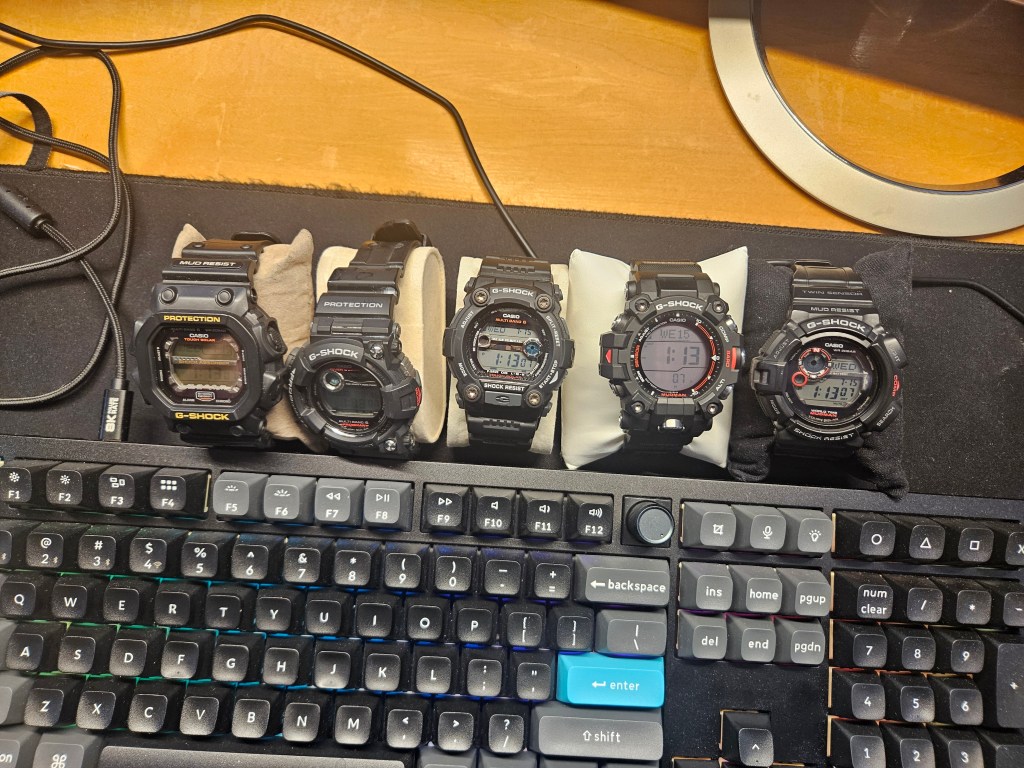
    So you defected. You strapped on Tough Solar, Multiband-6 atomic G-Shocks—watches that don’t ask what time it feels like but what time it is, down to the second, corrected nightly by a signal from a tower you will never see. This was not a style change. It was an Atomic Conversion Event: the moment when nostalgia is exposed as a luxury item and precision becomes a survival tool. Time ceased to be something you admired. It became something you obeyed.

    You found yourself thinking of that Robinson family from Lost in Space—before stepping onto an alien surface, they consulted their robot, which scanned the air and issued a verdict: breathable or lethal. You needed your own robot now, but smaller, quieter, strapped to your wrist. Not to tell you whether the atmosphere would kill you, but whether you were wasting it.

    Because the deeper realization was not horological. It was existential. You no longer had the bandwidth for drift. “Fiddlefaddling,” once an acceptable pastime, now read like malpractice. Clarity was no longer optional; it was oxygen. You had to extract meaning from the noise and live with an alignment that would have bored your younger self. The watch change was merely the visible symptom of an internal regime shift.

    And this was not your first encounter with the abyss. A decade earlier, you performed a similar surgery on your life: you quit sports. Not gradually, not ceremoniously—just stopped. You recognized the structure for what it was: three-hour games followed by hours of commentary, followed by meta-commentary, followed by the analysis of the analysis. An infinite regress disguised as entertainment. You didn’t taper off. You cauterized the habit. Torch, not scalpel.

    That’s when the pattern revealed itself. Life is not a smooth shoreline; it is a series of drop-offs. Each one demands a new posture, a new set of tools, a new tolerance for truth. You don’t get to choose whether they arrive—only whether you adapt before you drown.

    There will be more. Of course there will. The only sensible response is not optimism but readiness.

    Buckle up.

  • The Night the Mechanical Diver Stayed Home

    The Night the Mechanical Diver Stayed Home

    Last night I escorted my family and in-laws to a breezy bistro in Redondo Beach, the kind of place where the ocean air does half the marketing. We sat on the patio while a two-man cover band—guitar and bass, faces cured by sun and time—worked their way through the canon: Gordon Lightfoot, Jim Croce, James Taylor. Their voices had the texture of driftwood. The songs arrived like postcards from a quieter century.

    For twenty years, a restaurant meant ceremony. I would strap on an expensive mechanical diver—the horological equivalent of cufflinks—and let it glint under low lighting as if I were auditioning for a role called “Man of Taste.” Five weeks ago, that instinct died without a funeral. In its place: a $110 Casio G-Shock GW-7900. No romance, no pretense, just a blunt instrument that tells time with the indifference of a wall clock. I wore it and felt, not diminished, but strangely settled. Our server had on a Casio Pro Trek. We exchanged a nod—the quiet recognition of two men who had defected from the same aesthetic regime.

    Two weeks ago, I sold off a pair of mechanical divers. The absence registered as silence, not loss. Five weeks ago, I bought my first Tough Solar, Multiband-6 G-Shock—a Casio G-Shock Frogman GWF-1000. It feels like I’ve owned it for a decade. Time has warped, stretched, lost its usual proportions. My working theory is this: when an obsession mutates—when it takes a hard, unexpected turn—the brain lingers over the wreckage and the new terrain at once. Every moment gets over-processed, as if your mind is trying to reconcile two incompatible identities. The result is temporal inflation. Five weeks feel like ten years. Meanwhile, the watches I once coveted sit in their box like artifacts from a civilization I can’t quite remember belonging to.

    I’ve made a few videos documenting this conversion. To my mild alarm, a handful of people have followed suit—buying the GW-7900, aiming their watches toward the Fort Collins signal tower like amateur astronomers chasing a frequency instead of a star. It’s absurd, and yet there it is: evidence that I may have drifted, however briefly, into the low orbit of influence. Not authority. Not expertise. Influence—the most accidental and least deserved of modern currencies.

    The question now hovers: is this a phase or a verdict? Will some future mood—call it nostalgia, call it vanity—dust me with longing and send me back to my mechanical divers? Or have I crossed a line I can’t uncross, sealed inside a G-Shock logic that values precision over poetry? I don’t know. The future, like the tide, refuses to take requests.

    What I do know is this: today I’ll need to punish myself with extra work in the garage gym. Last night I demolished a crispy chicken sandwich on brioche while listening to “If You Could Read My Mind,” and the song’s quiet sorrow did nothing to slow me down. If anything, it provided a soundtrack for excess—the softest possible music for a thoroughly unrestrained appetite.

  • Santa by Accident, Employee by Design

    Santa by Accident, Employee by Design

    Last night I dreamed that some friends and I staged an ad hoc production so slick it deserved syndication. I was invited to a holiday party—one of those corporate affairs where irony does the heavy lifting—and, on a whim, I put on the Santa suit for a toy company that merchandised its own cartoon characters. It was meant to be a joke–something to be forgotten along with the eggnog.

    Instead, someone filmed it.

    The footage went viral. What began as a throwaway bit turned into an annual television event with ratings that could humble prime time. Every December, there I was—jovial, booming, absurd—beamed into living rooms as if I had been engineered for it. Checks arrived with the regularity of a season: generous, unearned, almost accusatory. 

    To capitalize on the accident, the company staged yearly reunions—cast gatherings dressed up as nostalgia, broadcast to a nation that now insisted we mattered. More ratings. More money. More of me, whether I intended it or not.

    At first, I drifted into these reunions like a tourist in my own life—late, amused, faintly embarrassed. Then the terms clarified. I wasn’t a guest. I was talent. I wasn’t attending; I was reporting for duty. Somewhere in the fine print of success, I had become an employee of an entity I never remembered joining. The arrangement produced a tidy moral shrug: the checks fed my family, so what right did I have to object? Freedom had quietly converted itself into obligation, and the conversion rate was excellent.

    There was, however, a fracture line running through the whole enterprise. By sheer accident, I had chosen Santa—the apex role, the gravitational center. My friends had chosen elves: diligent, decorative, forgettable. Hierarchy, once introduced, does its work without permission. One friend stopped speaking to me altogether. When he finally did, it was not to reconcile but to issue a verdict. I was too thick to see what had happened to him, he said. Years of playing the lesser figure had hollowed him out. The easy talker was gone; in his place stood a sullen, rationed version of a man. We were no longer friends. I was no longer welcome to pretend otherwise.

    Others were kinder, even grateful. They insisted my Santa had ignited the whole spectacle—that without it, there would have been no show, no checks, no ritual of reunion. They thanked me as if I had designed the machine rather than stumbled into its engine.

    But gratitude doesn’t cancel damage; it merely coexists with it. The money was real. The applause was real. So was the loss. Watching a friend calcify into bitterness has a way of stripping glamour down to its wiring. Fame, even the accidental kind, doesn’t just elevate. It arranges people. It assigns altitude. And someone, inevitably, is left breathing thinner air.

  • The Price of Your Work Exit

    The Price of Your Work Exit

    Retirement was supposed to feel like a gentle descent. Instead, it arrives with an invoice. For years, your college played the role of benevolent patron: five hundred dollars a month to insure a family of four at Kaiser Permanente, with a co-pay so small it felt almost ceremonial. Now the curtain lifts. Your wife’s middle school, thrifty to the point of cruelty, hands you the real number—nearly triple. At the same time, your paycheck shrinks to about eighty-five percent of its former self. The vise tightens from both ends: less coming in, far more going out. Retirement, it turns out, is not an exit but a recalibration of anxiety.

    On a Saturday morning, under the fluorescent calm of Trader Joe’s, you confess this arithmetic of dread to the cashier who has watched you age in weekly installments for two decades. He listens, nods, and then offers a solution with the confidence of a man suggesting a new brand of hummus: get a part-time job here. Be a cashier. Let the paycheck subsidize your health insurance. You have the build, the stamina, the conversational ease. In his telling, the transition is almost heroic—a late-life pivot, sleeves rolled, dignity intact.

    But you can already see the other version. You, sixty-five, standing in a Hawaiian shirt that once signaled leisure and now reads as camouflage, being told in a quarterly review that your tone lacks “warmth.” That you cleared the line too efficiently, failed to linger, failed to affirm. That your sarcasm—once a badge of intellect—needs to be diluted into something safer, sweeter, more compliant. You imagine the language of correction: more honey, less acid. You imagine nodding while someone half your age explains emotional calibration. The phrase writes itself in your head: a Late-Life Vocational Humility Crisis—the moment when accumulated status collides with the small, bright humiliations of starting over at the bottom, where friendliness is a metric and personality is a deliverable.

    You float the idea at home. Your wife laughs—not cruelly, but decisively. The verdict is clear: you are not built for this theater. The fantasy collapses on contact with reality. It was never a plan, only a flattering daydream in which you played the rugged provider, stacking pinto beans beside water-packed albacore, funding your family’s security with cheerful competence.

    So you stand in front of the mirror and deliver the final ruling: Trader Joe’s is a no-go. The new discipline will be quieter, less cinematic. No convertibles. No Swiss watch indulgences. No Cabo timeshare fantasies dressed up as investments. Just a narrower life, lived within its means, spared the indignity of proving—too late—that you can still take orders and smile about it.

  • The Man Who Refused to Retire and Learned to Fly at Costco

    The Man Who Refused to Retire and Learned to Fly at Costco

    You will be sixty-five in less than a year—fifteen months from your last day of work—and you would be wise to bury the word “retirement” before it buries you. It is a feeble, anemic term, a linguistic sedative that disguises the collapse of identity as leisure. Nothing about what lies ahead deserves that kind of small thinking.

    What you are approaching requires a name with altitude, velocity, and a touch of myth.

    You are entering the Sovereign Phase.

    In the Sovereign Phase, you do not keep a schedule—you issue one. You do not await approval—you render decisions. This is not an ending ceremonially dressed in khakis and early dinners; it is a coronation. You are not stepping away. You are stepping above.

    Your final act has begun, and it demands a certain boldness. The first order of business is symbolic but essential: you will upgrade your Costco membership to Executive. No committees. No approvals. No memos. You will simply decide—and it will be done.

    And then, one morning, before the doors officially open to the masses, you will enter.

    The aisles are empty. The pallets stand fresh and untouched. The air itself feels newly issued. You move through this cathedral of abundance with first access, first choice, first claim. Something happens to you here—something disproportionate to the act itself. A quiet but unmistakable inflation of the self. A sense that you have not merely arrived early, but ascended.

    You feel it in your chest first, then in your stride. The strange conviction that you are no longer bound by ordinary constraints. That you have, somehow, earned this.

    You have entered Executive Aisle Rapture.

    It is a near-mystical condition in which logistical privilege is mistaken for existential elevation, where empty aisles and shrink-wrapped towers of goods produce a sensation that borders on the divine. You begin to suspect that wings—actual wings—may be forming beneath your shirt, preparing you for a short, ill-advised flight toward the sun.

    This is not a side effect of the Sovereign Phase. It is a requirement.

    So when your last day of work arrives, do not mark it with melancholy or relief. Mark it with a transaction. Upgrade the membership. Secure your access. Step into the early light of the warehouse.

    And when the doors part and the aisles open before you, walk forward without hesitation.

    You are no longer a worker.

    You are sovereign.

  • The Psychological Mess of Wanting Things We Neither Need Nor Intend to Use

    The Psychological Mess of Wanting Things We Neither Need Nor Intend to Use

    One of the strangest features of materialism is the spectacular mismatch between what we imagine an object will do for us and what it actually does. In the mind, the object arrives polished, transcendent—an emblem of taste, discipline, even identity. In reality, it often sits there, unnecessary and faintly ridiculous, like a prop waiting for a performance that never begins. 

    I own an eight-year-old Accord with fewer than 30,000 miles on it—a statistic that quietly announces I neither drive much nor particularly enjoy driving. And yet I can picture, with embarrassing clarity, a brand-new Accord or Camry resting in my garage, gleaming like a sacred artifact I would prefer not to disturb by actually using it.

    Watches operate under the same spell. I can easily imagine owning a Tudor Black Bay or a Tudor Pelagos, each one promising a kind of quiet authority on the wrist. But my habits betray me. I’m not roaming public spaces, not projecting presence, not leveraging this object as a social signal. The watch would sit, admired in theory, unused in practice. I know dozens—no, hundreds—of watch enthusiasts who live in this same contradiction, accumulating pieces they rarely wear because the idea of ownership is more intoxicating than the act of use.

    This gap between having and being is hardly new. I was reminded of it while thinking about Erich Fromm and his book To Have or To Be?, which argues that materialism quietly erodes the possibility of a meaningful life grounded in connection and experience. The argument is persuasive—almost obvious once stated. And yet, knowing this changes very little.

    That’s the part that unsettles me. You can understand the critique, agree with it, even teach it, and still find yourself browsing for the next unnecessary object with the focus of a predator. Clarity does not neutralize desire. It merely observes it, like a detached narrator watching the same old plot unfold. There’s something almost comical about it—this split between the thinking self and the acquisitive impulse. If you wanted to document the absurdity of human behavior, you could dedicate an entire season of Dirty Jobs to it: not the grime of physical labor, but the psychological mess of wanting things we neither need nor intend to use.

  • From Lecture Hall to Checkout Line: A Better Second Act

    From Lecture Hall to Checkout Line: A Better Second Act

    Over the past several years, I’ve watched a pattern unfold. A colleague retires, disappears for a while, and then—two years later—reappears in the writing center as a volunteer. On paper, it looks noble. In person, it looks something else.

    They don’t return with ease or quiet confidence. They return looking unsettled—eyes fixed forward, posture stiff, like deer caught in headlights that never turn off. I’ve seen them alone on the writing lounge couch, staring straight ahead, as if waiting for something that never quite arrives. The impression is hard to shake: retirement didn’t liberate them; it hollowed something out. And so they came back to the place where their sense of worth once had structure and witnesses.

    Students, however, are not sentimental. They don’t greet these returnees as beloved elders. They approach them the way one approaches a last option—politely, cautiously, and only when necessary. The exchange feels inverted. Instead of giving value, the retiree seems to be extracting it: a little affirmation, a little proof of continued relevance, a small ration of being needed.

    The idea of volunteering after retirement sounds admirable in theory. In practice, it reminds me of Lot’s wife—turning back, unable to release the past, even when the mandate is to move forward.

    And I say all this with some unease, because I’m about fifteen months away from retirement myself. My job has kept my mind engaged for decades—lectures, lesson plans, essays, the constant friction of thinking. I can’t pretend I’m immune to the same forces that seem to have pulled my colleagues back: the slow creep of isolation, the loss of structure, the quiet erosion of purpose. Sloth and complacency don’t arrive dramatically; they seep in.

    Still, I’m fairly certain of one thing: I won’t be returning as a volunteer tutor. I see too much of Lot’s wife in that gesture and not enough of a forward-facing project that justifies it.

    There’s also the matter of audience. Students gravitate toward youth. My own teen daughters regard “Boomers” like me with a mix of mild embarrassment and occasional alarm, as if we are well-meaning but out of date. I’m not eager to test that perception in a room where attention is already scarce.

    If pride is a vice, it’s at least an honest one here. My read on younger students, combined with my own instincts, tells me that the writing center would not be my best second act.

    There may be other roles. I’ve entertained, half-seriously, the idea of working part-time at my local Trader Joe’s. I know the staff. I could use the income for health insurance. And I have a skill set that would actually translate: I can talk to people, keep a line moving, and bag groceries without turning it into a philosophical crisis. There’s dignity in that—perhaps more than in hovering around a former life, waiting to be needed.

    One thing I do know: wherever I land, I don’t intend to sit there staring into the middle distance, hoping someone will give me back a version of myself I’ve already lived.