Before reading Jon Ronson’s The Castle: Adventures in a World of Unraveling Men, I decided I should conduct an inventory of my own unraveling. I was sixty-four years and ten months old, retirement was approaching, and I had already developed habits suggesting that the institution employing me had been providing more adult supervision than I cared to admit.
For one thing, I had gone Full Hawaii. Over the previous few years, I had transplanted the dress code of Maui, Kauai, and Oahu into suburban Torrance. Regardless of weather, I wandered around the house and made Costco runs in flip-flops, gray gym shorts, and tank tops advertising Aloha, North Shore, Lahaina, Kona, Kaanapali, Koloa Surf Co., or Maui, usually accompanied by a sunset, surfer, or sea turtle. My wife and daughters mocked my year-round resort wear, but I defended it on physiological grounds. I operated at a higher temperature than ordinary humans, I explained, and my armpits required open air and unrestricted mobility. Confining them inside sleeves could produce claustrophobia, perhaps madness. I was not dressing like a tourist. I was managing a medical condition.
I had succumbed to what I call the Recreational Domestication Principle: the gradual transplantation of vacation behavior into ordinary domestic life. Habits once reserved for a week at a Hawaiian resort migrate home and establish permanent residency. The flip-flops remain. The tank top remains. The relaxed posture remains. Eventually, Tuesday morning in Torrance begins to resemble day four at the Kaanapali Beach Hotel, except there is no ocean and you are taking out the recycling.
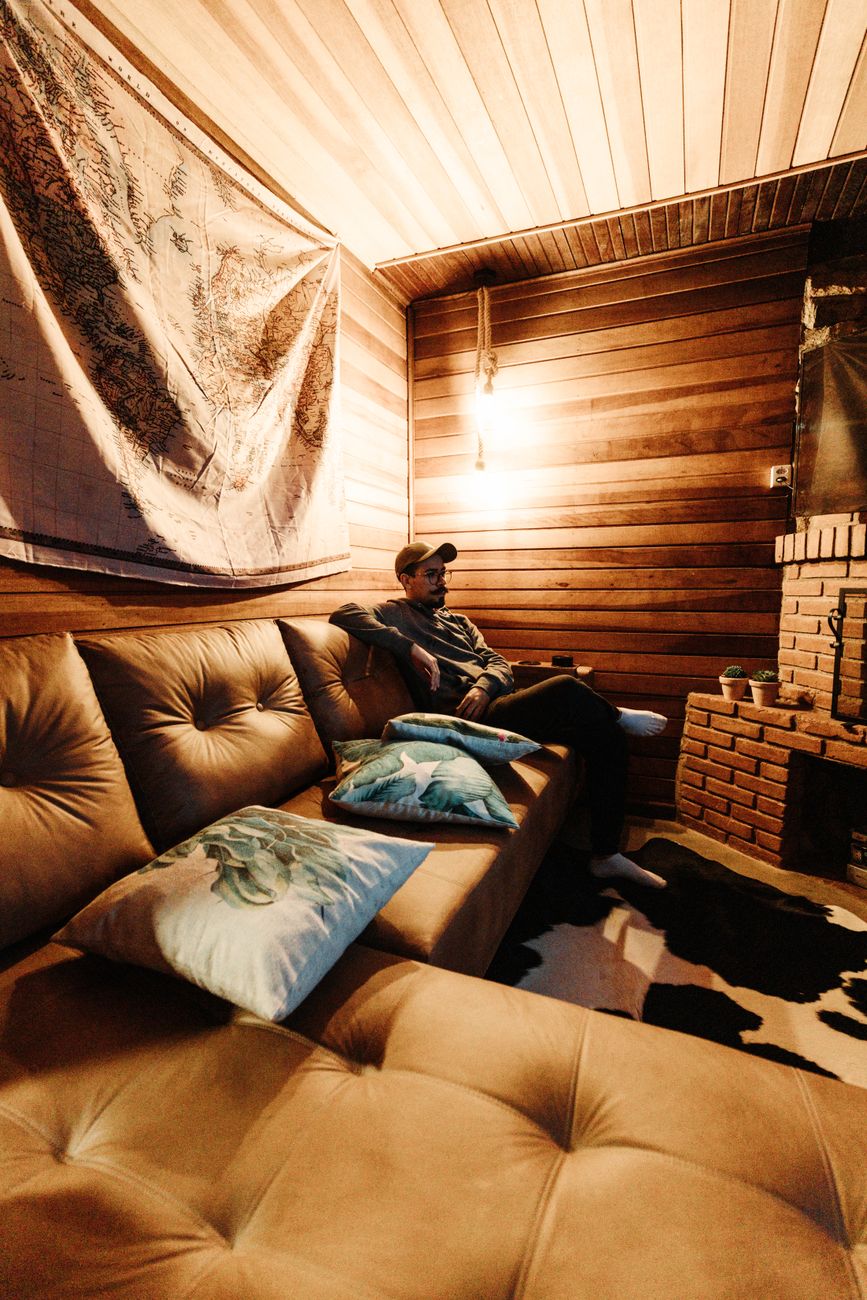
My daughters had identified another stage of my decline. When watching true-crime documentaries, I sprawled across the living-room couch with my hands clasped behind my head and my legs extended while studying police interrogations with the concentration of a homicide detective. Unfortunately, the couch did not provide sufficient cushioning for my 230-pound, retired-linebacker chassis, so I purchased a four-inch self-inflating sleeping pad and placed it on top. Add stacked pillows and a throw blanket, and I had created a small but highly functional residential compound. My daughters christened it “Dad’s homeless encampment.”
There I would lie in my Hawaiian tank top, magnificently supported, watching a detective dismantle a murder suspect’s alibi while becoming increasingly convinced that Nietzsche had predicted me.
I was becoming the Last Man.
Nietzsche’s Last Man abandons difficult aspirations in favor of comfort, security, consumption, and the avoidance of unpleasantness. I had developed my own household expression for this condition: “This is not a premium experience.” If one of my daughters erupted into shrieking laughter while I was eating my wife’s banana-nut French toast, I would look across the table and say, “Child, please stop that.”
“Why?”
“Because your screaming is interfering with my premium experience.”
The joke was funny because it contained evidence.
But as I prepared to enter Ronson’s world of unraveling men, I realized that becoming the Last Man was not a binary condition. You did not go to bed as Marcus Aurelius and awaken the next morning demanding lumbar support and climate control. There were stages. There were gradations. There was a Last-Man Gradient.
You moved along it slowly. First, you preferred comfort. Perfectly reasonable. Then you began arranging your environment to eliminate minor discomforts. Still reasonable. Eventually, however, inconvenience itself started feeling like an affront. The couch required augmentation. The pits required liberation. Breakfast required appropriate noise levels. Life was increasingly evaluated according to the standards of a luxury resort: Was I comfortable? Was I entertained? Was the temperature correct? Was anyone interfering with my experience?
This was what made Ronson’s book feel less like recreational reading than reconnaissance. I was about to retire from an institution that, for all its meetings, protocols, deadlines, passwords, administrators, and Student Learning Outcomes, had forced me to remain engaged with a world that did not exist for my comfort. I had to get dressed. I had to leave the house. I had to teach people. I had to solve problems. I had to accommodate other human beings.
Soon, many of those constraints would disappear.
And there I would be: a free man in a Hawaiian tank top, lying atop four inches of premium inflatable cushioning, remote control in hand, with nobody from Human Resources coming to save me.
Retirement was not the beginning of the Last-Man Gradient.
It was the level I was afraid might unlock the rest of the game.
 Cinemorphosis
Leave a comment