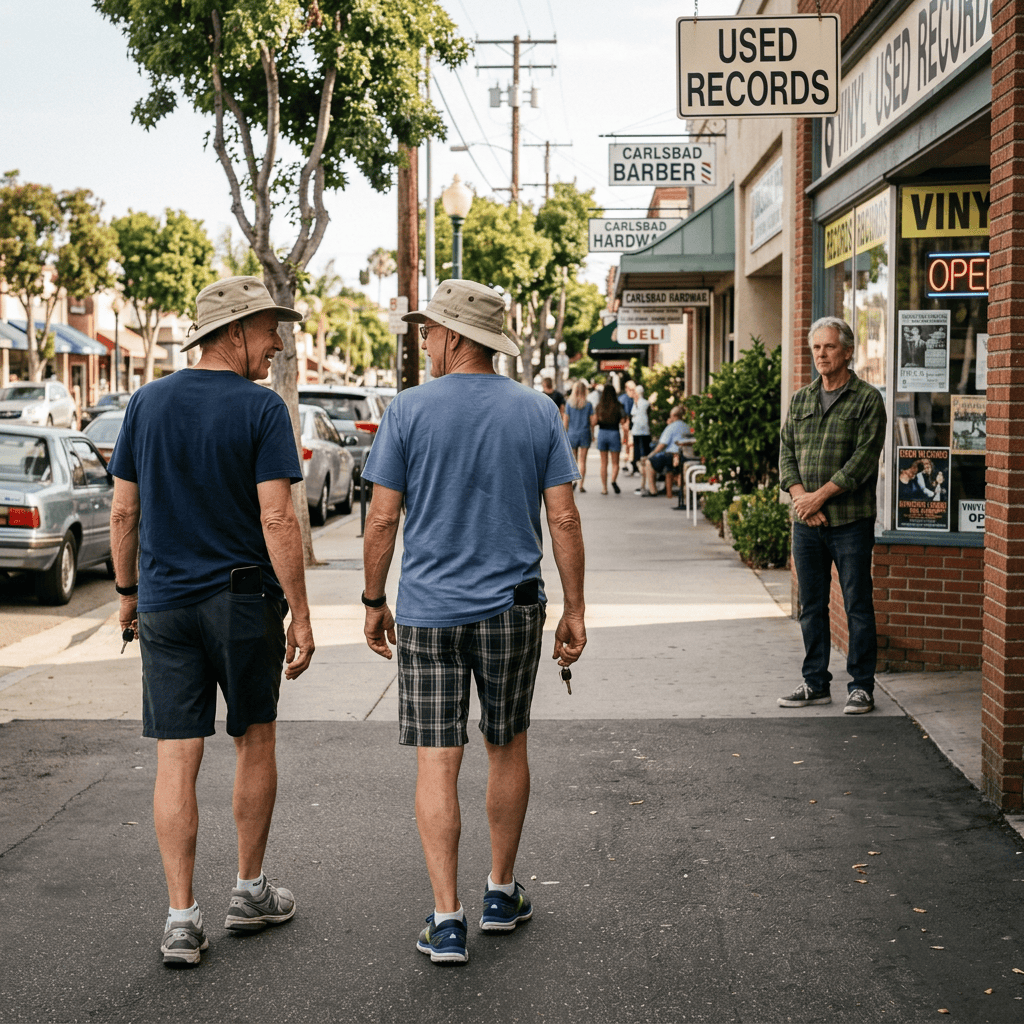
A few weeks before the beginning of what would be my final fall semester teaching college writing, my family spent a week in Carlsbad.
One morning we ate breakfast at the French Corner. I ordered a savory crepe and drank coffee softened with milk, cinnamon, and honey. The meal achieved that increasingly rare equilibrium in which you leave neither hungry nor incapacitated. I was full but not bloated, caffeinated but not vibrating, satisfied without immediately wondering what I might eat next. For several fleeting minutes, I experienced something approaching perfection. The meal did not merely fill my stomach; it seemed to quiet some hidden chamber of the soul that normally conducts emergency meetings around the clock.
Then we wandered into downtown Carlsbad.
My family disappeared into a used record store while I remained outside. I have never understood the romance people attach to the smell of old books, record sleeves, and aging paper. To enthusiasts, the aroma evokes libraries, childhood, discovery, civilization. To me it smells like mildew wearing a tweed jacket.
So I waited on the sidewalk and did what I often do when temporarily deprived of distraction: I conducted an inventory of my deficiencies.
Twenty extra pounds.
Inconsistent discipline.
A tendency to overthink everything.
And, increasingly, the suspicion that I required more regular companionship than I had previously been willing to admit.
Then I saw two men walking toward me.
They appeared to be in their early seventies, and I assumed they were retired. Both wore safari hats, T-shirts, shorts, and tennis shoes. Their phones rested harmlessly in their back pockets rather than occupying the command center of their consciousness. They walked side by side, talking with the effortless rhythm of men who had probably traveled this route together hundreds of times.
They laughed.
They listened.
Neither seemed compelled to dominate the conversation, check a notification, document the walk, measure engagement, cultivate a personal brand, or inform the world that he was currently walking.
They were simply two men walking.
Their calves caught my attention. These were not gym-manufactured calves, inflated through heroic campaigns involving protein powder, compression sleeves, and motivational playlists. They were walking calves: lean, hard, unremarkable, the product of thousands of ordinary miles accumulated without fanfare. Both men looked younger than plenty of men twenty years their junior because their bodies had quietly become advertisements for moderation.
I envied them immediately.
Certainly I envied their leanness. I am not spiritually advanced enough to pretend otherwise. But what I really envied was the life their bodies implied.
These men had apparently solved a problem I had been treating as several different problems. They did not need to schedule exercise and then separately schedule friendship. They had fused the two. Their physical fitness and social fitness occupied the same hour.
They had discovered what I began to think of as The Walking Companion Principle: one of the most valuable pieces of retirement infrastructure is another human being who reliably walks beside you.
Consider the efficiency.
Walking provides cardiovascular exercise, mobility, sunlight, fresh air, routine, and protection against the gradual transformation of the human body into upholstered furniture. A companion provides conversation, laughter, accountability, perspective, and evidence that you still exist outside your own head. Combine the two and you have created a remarkably sophisticated health intervention requiring almost no technology.
Shoes.
Friend.
Walk.
Repeat tomorrow.
No bestselling self-help book is required. No wellness retreat in Sedona. No twelve-week optimization protocol administered by a forty-two-year-old podcaster who owns a cryogenic chamber and hasn’t eaten a carbohydrate since the finale of Breaking Bad.
Just show up.
What unsettled me was that the principle seemed particularly important for retirement while having almost nothing specifically to do with retirement. It was simply a principle for living well.
You take care of your body.
You walk every day.
You eat reasonably.
You cultivate friendships.
You show up.
You repeat the process tomorrow.
These truths possess none of the glamour of revelation. Nobody returns from a monastery in Nepal and announces that he has discovered the importance of taking a walk with a friend. Common sense suffers from terrible marketing.
Yet the older I get, the more suspicious I become that common sense may contain considerably more wisdom than the elaborate intellectual systems I’ve spent decades examining.
Standing outside that record store, I began wondering whether I had spent much of my life practicing Existential Overfishing—casting my line ever deeper into the waters of ultimate meaning while ignoring perfectly good fish swimming near the surface.
I had contemplated religion, mortality, consciousness, transcendence, identity, purpose, and the possibility of God. I had read books by people who had spent their entire lives thinking about these subjects, followed them into increasingly deep philosophical waters, and occasionally surfaced gasping for air with another seven books I apparently needed to read.
Meanwhile, two retired men in safari hats walked past me and accidentally delivered the executive summary.
Move your body.
Find someone you like.
Talk.
Keep doing it.
Could it really be that simple?
Is common sense enough?
Could common sense sometimes be superior to profound religious contemplation?
Had I submerged myself beneath an ocean of fascinating but largely irrelevant abstractions?
Had I mistaken intellectual complexity for spiritual maturity?
Had I spent years searching for the meaning of life while failing to notice some of its operating instructions?
Had I, after all these years, simply lost the plot?
The questions left me strangely melancholy because the Walking Companion Principle contained an obvious problem.
When I retired, who would walk beside me?
Employment had supplied more social infrastructure than I had realized. For forty years, people simply appeared. Students entered classrooms. Colleagues materialized in hallways. Someone stopped outside my office. Conversations occurred because hundreds of people had been deposited into the same institution at approximately the same time.
Retirement would dismantle much of that machinery.
Free time would increase precisely as automatic human contact decreased.
I could walk alone, of course. I could listen to podcasts. I could listen to audiobooks. I could march five miles while absorbing fascinating information about theology, politics, artificial intelligence, crime, nutrition, or the collapse of Western civilization.
But headphones are not companions.
A podcast host does not notice when you fail to show up.
An audiobook does not laugh at your joke.
The men disappearing down the Carlsbad sidewalk possessed something I suddenly wanted very badly: another person who expected them to be there.
I didn’t know whether I would find such a companion in retirement. I didn’t know what could substitute for one if I couldn’t. I didn’t know whether my melancholy was justified or merely another example of my ability to turn an innocent morning into an existential emergency.
But I had learned something.
Perhaps retirement would not require some magnificent new philosophy capable of replacing forty years of professional identity. Perhaps the essential architecture would be embarrassingly ordinary: decent food, regular movement, human companionship, curiosity, and enough discipline to show up again tomorrow.
I stood outside the record store watching the two men disappear into the distance.
I still didn’t know what I was going to do with the rest of my life.
But I knew exactly where I wanted to eat breakfast the next morning.


Leave a Reply