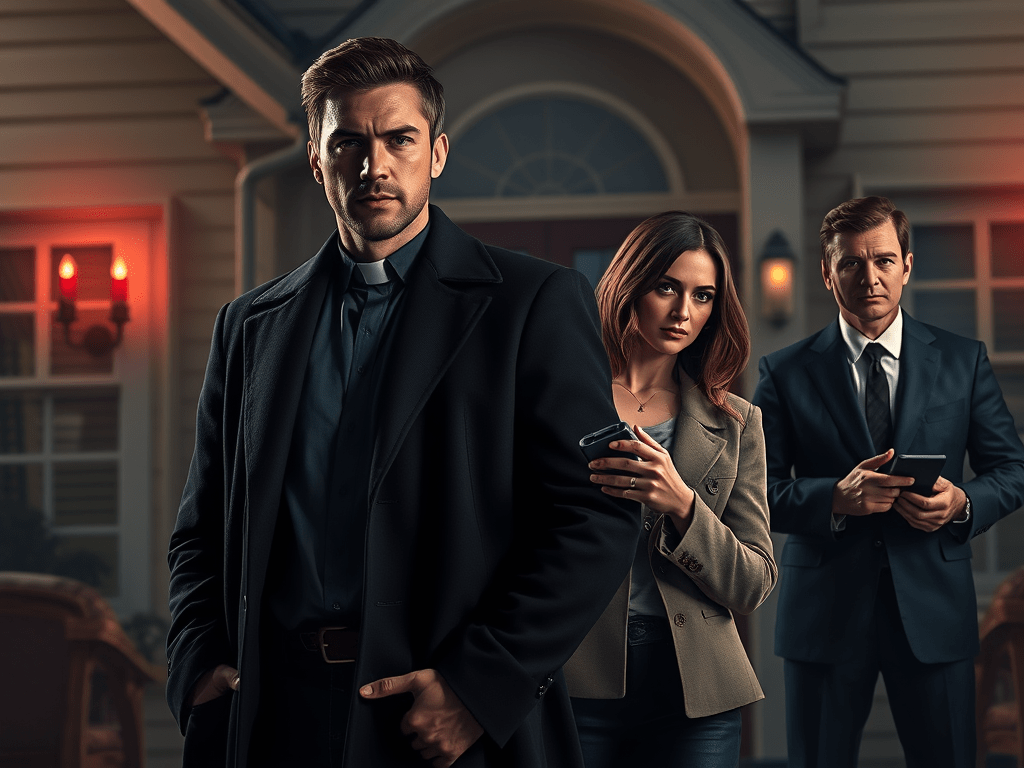
Evil follows the adventures of a tall, chiseled, impossibly handsome priest, David Acosta, who looks like he bench-presses church pews for fun. He’s got two sidekicks: Kristen Bouchard, a psychologist with the looks of a supermodel and the brains to match, and Ben Shakiv, a tech-savvy assistant who’s there to remind us that even in the battle against Satan, someone needs to handle the Wi-Fi. Together, they travel to the darkest corners of the earth—by which I mean upscale suburban homes—where they confront demonic activity with a cocktail of theology, piety, and science. It’s like Scooby-Doo for adults, only instead of unmasking Old Man Jenkins, they’re reporting back to the Diocese after wrestling with the forces of hell itself.
Adding a spicy dash of drama to the mix is the forbidden love between our hunky priest and Kristen, who, let’s be honest, is only human, and no one can resist a priest with a jawline that sharp. Their missions are a delightful blend of exorcisms and scientific investigations, all while offering sly, not-so-subtle satire on social media, technology, and the big, bad world of power. It’s like watching The X-Files meet The Exorcist, with a dash of Project Runway thrown in for good measure.
No battle between good and evil is complete without a proper villain, and Evil delivers one wrapped in a crisp suit and the smarmy charm of a man who’s never met a moral boundary he couldn’t slither past. Enter Leland Townsend, a pencil-necked agent of Satan who oozes the kind of slick, synthetic charm that makes used car salesmen look like monks. If you looked up unctuous in the dictionary, you’d find his face grinning back at you, practically dripping with synthetic sincerity. He’s less a mustache-twirling villain and more a corporate devil—HR-approved, disturbingly polite, and disturbingly effective.
But the true stars of Evil? The fashion. The main characters strut through supernatural horrors in coats so exquisite they could be on loan from the Louvre, each one worth more than my first car. And let’s talk about the priest’s wrist game—a white-dial Patek Philippe that retails for the cost of a small house. Nothing says “vow of poverty” quite like a $50,000 timepiece. This isn’t just aesthetic indulgence; it’s a quiet, winking commentary from the writers: if you’re going to go toe-to-toe with the devil, you might as well do it in couture. After all, nothing repels demonic forces quite like the confidence of someone dressed like they just stepped out of a Milan runway show.
Beyond the sartorial spectacle, what is Evil actually about? The show thrives on one central tension: the ambiguity of evil itself. Is it supernatural? Psychological? A fusion of both? The show refuses to let us settle comfortably on any single answer. Take the episode where Kristen Bouchard’s daughters are up at 3 a.m., faces glowing in the eerie blue light of an iPad running some unholy ghost-hunting software. They swear the house is haunted. Their mother, an atheist clinging to the comfort of logic, insists there’s a rational explanation. Evil dangles both possibilities in front of us and then, just when we think we’ve landed on an answer, it yanks the rug out. It never gives us the luxury of certainty, instead keeping us suspended in a deliciously maddening limbo where science and the supernatural blur together. And that’s its brilliance—an exquisite, unnerving dance on the knife’s edge of belief.
 Cinemorphosis
Leave a comment