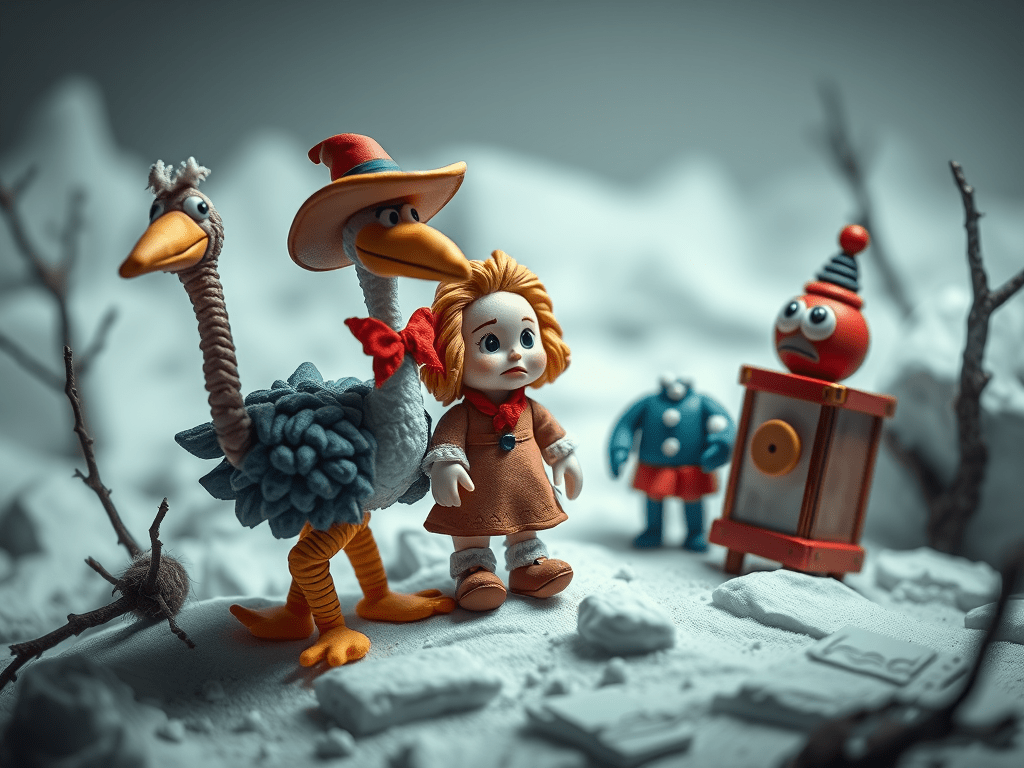
The most exhausting piece I have ever composed—the one that wrings my soul dry after playing its three relentless movements—is called “The Forgotten Song of Misfit Island.” This sonata, a labor of love and obsession spanning forty years, began as something else entirely: my childhood fury at the televised nightmare known as Rudolph the Red-Nosed Reindeer.
Like millions of children before me, I was supposed to cherish this 1964 Christmas special as a heartwarming tale of holiday spirit and triumphant underdogs. Instead, I watched it with horrified disbelief, my small, traumatized brain barely able to process the cruelty inflicted upon the most tragic figures in holiday television: the Misfit Toys.
These weren’t just defective playthings with minor quirks. They were abandoned children, exiled to an arctic hellscape, sentenced to a slow death on a barren glacier. They were ill-equipped for survival, dressed in flimsy rags with no food, no warmth, no shelter from the Abominable Snowman, a giant carnivorous beast stomping the ice sheets with the inevitability of fate itself. Who knows how long they had suffered? Years? Decades? An eternity? And for what crime? Simply being different. The authorities of Christmas had spoken: an ostrich-riding cowboy, a Charlie-in-the-Box, and a melancholy doll were abominations, unfit for the joys of holiday consumerism.
Defenders of Rudolph will no doubt remind me of the “joyous rescue” at the film’s climax, when Santa Claus swoops in to distribute the Misfit Toys to “good homes.” But let’s examine that so-called rescue. These toys, who had only survived through their deep bond and shared trauma, are now forcibly separated and flung into random households. Santa, in his infinite wisdom, has decided that what these emotionally shattered creatures need is total isolation from the only community that has ever accepted them.
Santa Claus, the supposed symbol of holiday cheer, is, in fact, an unapologetic tyrant—a man who exploits child labor, forces elves into unregulated factory work, and belittles an aspiring dentist for daring to dream beyond toy-making. My paleontologist friend, Dr. Zachary J. Rasgon, once pointed out another moment of unhinged brutality: the scene where Yukon Cornelius casually yanks out every tooth from the mouth of an endangered hominid—and we’re all supposed to be a-okay with that.
For over fifty years, this grim portrait of abuse and forced assimilation has been celebrated as a beloved Christmas tradition. And yet, I alone seem to recognize its horrors. I have made my case countless times, but the world continues to revere Rudolph as an “iconic” holiday classic. My protestations fall on deaf ears, branding me as something of a misfit myself.
And so, I have learned to let go of my rage. Or, at least, I have tried.
Turning Rage into Music
As a child, unable to rewrite history, I began rewriting Rudolph. I imagined the Misfit Toys as restless insomniacs, huddled together for warmth, singing a song to ease their suffering. It was a song born of necessity—a celestial hymn of comfort, a melody so powerful that it could momentarily trick them into believing they were loved.
But in my revised ending, their exile ends only to bring a new torment. Ripped away from each other and cast into separate homes, the toys struggle to recall the song that once gave them solace. They catch fragments of it in dreams, in whispers on the wind, but the full melody is lost to them. The song—the very essence of their shared survival—could only exist when they were together.
The only solution? A reunion.
In the version that played in my head for years, an older, wiser, and absurdly wealthy Rudolph, finally understanding the true cruelty of Santa’s decree, takes it upon himself to find and reunite the Misfit Toys. He brings them to a sprawling Tuscan villa, where they can feast under the warm Mediterranean sun and, at long last, remember the song in its full glory. The world hears their melody once more, and it becomes legendary—a song of defiance, resilience, and enduring love.
This imaginary song, the one that saved the Misfit Toys from oblivion, became the foundation for my most demanding piano composition. It took decades—forty years of reworking, revising, and searching for the perfect sequence of notes.
A Lifelong Symphony of Misfits
Even now, I cannot shake my affinity for misfits. My mind is overrun with them: Sidney the Elephant, Kermit the Frog, Tooter Turtle, Beaver Cleaver, Kwai Chang Caine (a.k.a. Grasshopper), Mr. Peabody, George of the Jungle, Milton the Monster. They, too, deserve their own melodies, their own compositions, their own forgotten songs.
Until I write those songs, I will imagine them all gathered together, sipping wine in that Tuscan vineyard, basking in the company of Rudolph and his long-lost misfit family. And in that imagined paradise, I, too, find a place to belong.

 Cinemorphosis
Leave a reply to clubschadenfreude Cancel reply