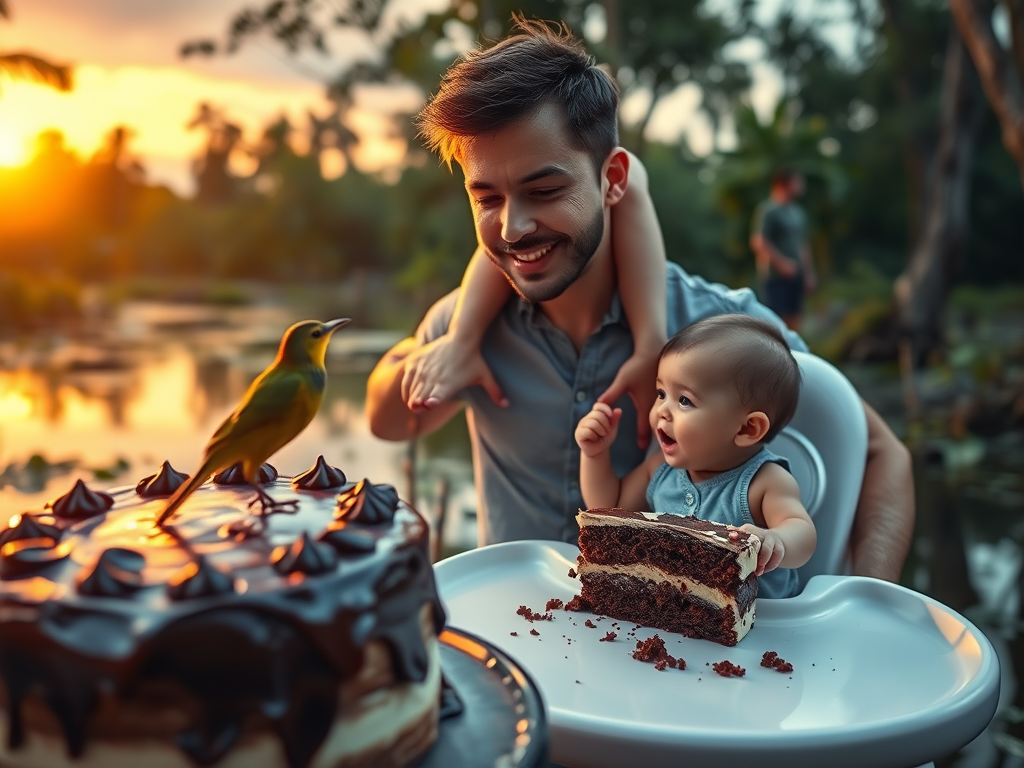
I was a bright-eyed two-year-old growing up in the surreal surroundings of VA housing in Gainesville, Florida. My home, a repurposed army barracks known as Flavet Villages, was nestled near an alligator swamp where the air was thick with the smell of low-tide alligator dung, a stench so potent it could knock out a grown man. Yet, amidst this pungent atmosphere lay an enchanting routine: visiting a Mynah bird perched on the same tree branch in a nearby forest. This mystical bird, almost a local deity, engaged in nightly conversations with my father and me, its wisecracking voice echoing in the twilight. On my second birthday, my father, ever the hero, carried me on his shoulders for our evening visit to the Mynah bird. As we journeyed through the swampy landscape, the scent of celebration wafted from our small apartment, where my mother was busily preparing birthday decorations. In the distance, the melancholic tune of “Bali Ha’i” drifted from a neighbor’s radio, adding a cinematic touch to our adventure. We returned home, greeted by the excitement of neighbors and the promise of birthday cake. The neighbor’s child, a frail wisp of a boy who looked like he might be blown away by the next strong gust of wind, sat in his high chair, a throne of pity contrasting starkly with my robust presence. I, the towering giant of toddlers, was presented with a slice of cake so large it could double as a life raft. The cake, an Everest of chocolate decadence, was all mine to conquer. Then, I glanced at the poor child beside me. His mother, apparently convinced he was a baby bird rather than a human toddler, meticulously pinched off cake crumbs and fed them to him out of the palm of her hand. Each crumb, delivered with the precision of a jeweler setting a diamond, highlighted the stark disparity between my cake feast and his crumb diet. My eyes widened in disbelief. Was this real? Was I witnessing a Dickensian nightmare unfold at my birthday party? My horror magnified as I chewed through my colossal slice of cake, each bite a triumphant celebration of my toddlerhood. Meanwhile, the other child nibbled at his crumbs, a tragic figure resigned to his fate. In my young mind, the situation escalated to epic proportions. I envisioned myself as a benevolent king, feasting on a banquet, while the other boy was a destitute peasant, scrabbling for scraps in my opulent court. That moment, seared into my memory, became a symbol of the great injustices of the world. How could a child, on my birthday no less, be subjected to such cruel cake inequity? The image of his mother, delicately inserting crumbs into his mouth, haunted me like a ghost of birthdays past. It was as if I had witnessed the greatest travesty of my young life, a Shakespearean tragedy played out in frosting and crumbs. Years have passed, and many birthdays have came and went, but the memory remains vivid. I have tasted many cakes since then, each one a reminder of that fateful day when I first encountered true pity. In my exaggerated recollection, the event has grown more fantastical. The crumbs have became smaller, my cake slice grander, and the emotional weight of that moment ever heavier. So here I stand, a veteran of countless birthday celebrations, carrying with me the bittersweet lesson that not all cake experiences are created equal. And perhaps, in my heart of hearts, I’ve learned to savor every slice of cake with the gratitude of one who knows that somewhere, someone might be living on crumbs.
The deeply embedded, early-life memory resulted in the belief that more food is always better—more validating, more righteous, more deserved. Born in toddlerhood and fed by birthday cakes the size of rafts, Maximalust is not just a craving—it’s a worldview. It equates abundance with virtue and scarcity with shame. It’s the toddler id that sees a normal portion and thinks, “Who hurt you?” It’s the pathology that makes buffets feel like moral high ground and crumbs like moral failure. Maximalust is the primal belief that to be loved is to be laden with frosting.
In addition to Maximalust, I discovered the notion of Crumbpassion–the emotional dissonance that arises when your plate is Mount Olympus and theirs is a cautionary tale. It is not kindness—it’s existential discomfort wrapped in frosting empathy. The crumb-fed child becomes a Dickensian ghost, a living allegory of restraint, and you, the overfed protagonist, must reckon with the unfairness of cake distribution and your own frosting-fueled privilege.
Together, Maximalust and Crumbpassion form a tragicomic framework of early appetite mythology—a toddler’s origin story of food, power, and pity that lives rent-free in your adult relationship with dessert.
 Cinemorphosis
Leave a comment