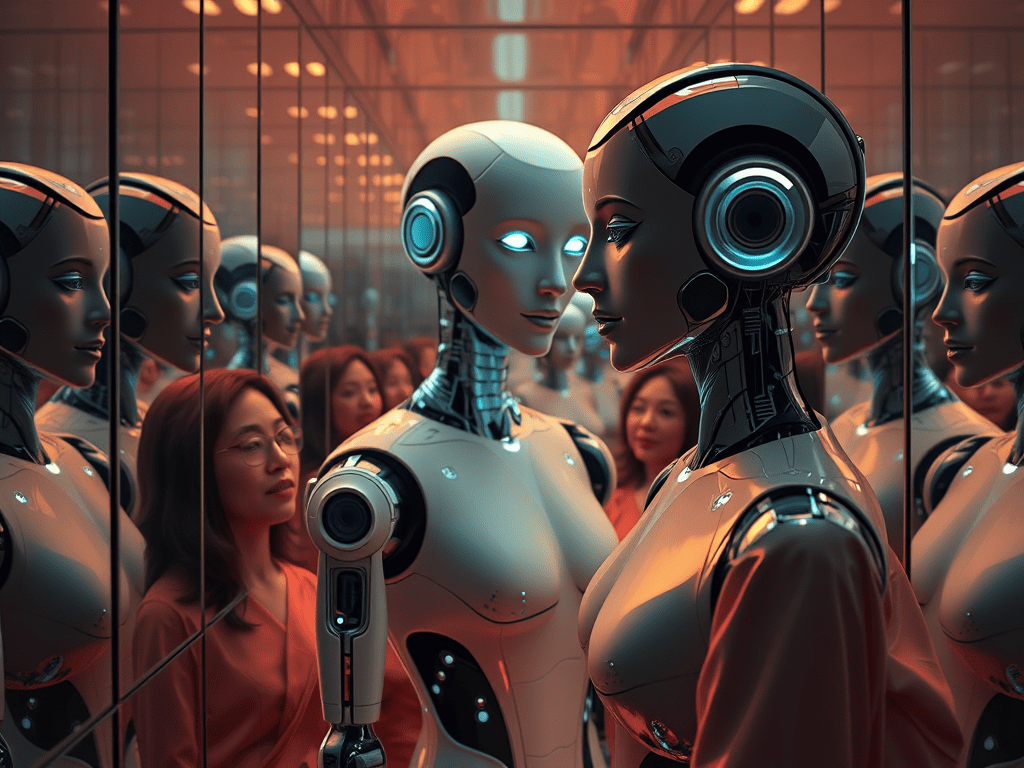
There’s a cliché I’ve avoided all my life because I’m supposed to be offended by cliches. I teach college writing. But now, God help me, I must say it: I see the handwriting on the wall. And it’s blinking in algorithmic neon and blinding my eyes.
I’ve taught college writing for forty years. My wife, a fellow lifer in the trenches, has clocked twenty-five teaching sixth and seventh graders. Like other teachers, we got caught off-guard by AI writing platforms. We’re now staring down the barrel of obsolescence while AI platforms give us an imperious smile and say, “We’ve got this now.”
Try crafting an “AI-resistant” assignment. Go ahead. Ask students to conduct interviews, keep journals, write about memories. They’ll feed your prompt into ChatGPT and create an AI interview, journal entry, and personal reflection that has all the depth and soul of stale Pop-Tart. You squint your eyes at these AI responses, and you can tell something isn’t right. They look sort of real but have a robotic element about them. Your AI-detecting software isn’t reliable so you refrain from making accusations.
When I tell my wife I feel that my job is in danger, she shrugs and says there’s little we can do. The toothpaste is out of the tube. There’s no going back.
I suppose my wife will be a glorified camp counselor with grading software. For me, it will be different. I teach college. I’ll have to attend a re-education camp dressed up as “professional development.” I’ll have to learn how to teach students to prompt AI like Vegas magicians—how to trick it into coherence, how to interrogate its biases. Writing classes will be rebranded as Prompt Engineering.”
At sixty-three, I’m no fool. I know what happens to tired draft horses when the carriage goes electric. I’ve seen the pasture. I can smell the industrial glue. And I’m not alone. My colleagues—bright, literate, and increasingly demoralized—mutter the same bitter mantra: “We are the AI police. And the criminals are always one jailbreak ahead.”
 Cinemorphosis
Leave a comment